Director Vamshi Paidipally’s eagerly awaited film, featuring actors Salman Khan and south star Nayanthara in the lead, on Saturday went on floors with a traditional pooja ceremony here in the city.
This ambitious action entertainer, produced on a grand canvas by Dil Raju under the Sri Venkateswara Creations banner, marks the first-ever coming together of Bollywood Superstar Salman Khan and National Award-winning director Vamshi Paidipally.
When the idea of Project Punjab was brought in by Ricky Ponting in 2025, not a lot of people felt convinced by it. Punjab Kings have been one of the most inconsistent sides in the history of the IPL and they were set for another overhaul.
Almost a year later, suddenly, Ponting seems to have made believers out of his doubters. The followers are on the rise, something Arshdeep Singh will take credit for, but it has been down to the performances on the field. Starting with the openers who oozes of modern T20 cricket exuberance, Priyansh Arya and Prabhsimran Singh make a case for being the best opening pair in IPL 2026.
Then you have Cooper Connolly who has slotted in well and then Shreyas Iyer, who has morphed himself into the new chase master in the tournament. The bowling is being led by Arshdeep and has the presence of Marco Jansen and Xavier Bartlett. Yuzvendra Chahal can be a match-winner on his day. All of this combined, and Punjab find themselves at the top of the table.
Now, when you look at Lucknow Super Giants, a lot of these elements seem to be missing, especially with their batting. The loss to RCB at the Chinnaswamy was once again a reminder that the batting unit doesn’t seem to be clicking at all.
Mitchell Marsh and Aiden Markram, who provided them with big starts, have struggled for consistency. Rishabh Pant’s batting output still struggles to justify the Rs. 27 Crore spent by the owners on him. 104 runs from five matches with a strike-rate of 122.35 isn’t what you expect when such money is being spent on you.
Nicholas Pooran looks like a shadow of himself from the 2025 season, where coming in at No.3 helped him find consistency and rhythm. Last season the output was 524 runs from 14 games. This season, the move to No.5 has yielded just 42 runs from five matches.
The bowling has been a bright spot with Prince Yadav and Mohammed Shami, who have impressed in the powerplay and have got nine and four wickets so far.
With Mohsin Khan and Mayank Yadav nearing match fitness, Lucknow will hope that the bowling can get them some momentum.
PBKS VS LSG: HEAD-TO-HEAD
When it comes to the head to head stats, there is nothing to separate the two teams. They have played six matches so far and have won three games each.
Last season, PBKS were able to complete the double over LSG on their way to the final.
He was hit on the elbow by Josh Hazlewood during the loss to RCB and went off the field before coming on to bat later on. He didn’t come out in the second innings and there were doubts about his participation in the upcoming game. But LSG bowling coach Bharat Arun confirmed that Pant is fit and ready to lead the side once again.
“He is perfectly alright, fit enough to play tomorrow,” said Arun.
Pant doesn’t have the best records against PBKS, scoring just 218 runs from 15 matches. That will need to change immensely.
CAN LUCKNOW STOP PRIYANSH-PRABHSIMRAN ONSLAUGHT?
PBKS bowling coach James Hopes was all praise when it came to the opening pair. He said that he is unsure if Prabhsimran and Priyansh were aware of how good they are.
“I actually don’t think they realise how good they actually are. I’ve never seen an uncapped player do what Priyansh has done since his first game; he looks like an even better player this year. As for boys like Nehal and Shashank in the middle, they haven’t been required to do much yet because of how well our top order is playing. They are doing their jobs with little cameos, but I’m sure they will step up when they are needed in the coming games,” said Hopes.
Priyansh has 118 runs from four games with a strike-rate of 245.83, while Prabhsimran has 211 at 172.95 from five games.
Adding to this, captain Shreyas makes the batting look so much more solid with 203 runs from five matches, with three fifties with an average of 67.67 and a strike-rate of 187.96.
If LSG need to win the game, they will need to ensure that they get early wickets, something they have done well this season. The middle-order of Punjab has been relatively untested this season and that will be looked at by Lucknow ahead of the preparations for the contest.
PBKS vs LSG: PITCH AND CONDITIONS
The surface to used on Sunday is one that hasn’t been used in any of the past 13 matches at New Chandigarh. The exact nature is yet to be determined, but judging by the ones next to it, it could turn out to be a mixed bag.
The weather is expected to be hot and dry, with temperatures likely to touch 37°C, while dew could also play a role later in the game.
PBKS vs LSG: PREDICTED XIS AND IMPACT SUBS
Punjab Kings (starting XI): Prabhsimran Singh (wk), Priyansh Arya, Cooper Connolly, Shreyas Iyer (capt), Marcus Stoinis, Shashank Singh, Marco Jansen, Xavier Bartlett, Vijaykumar Vyshak, Arshdeep Singh, Yuzvendra Chahal.
Impact sub: Nehal Wadhera
Lucknow Super Giants (starting XI): Aiden Markram, Mitchell Marsh, Rishabh Pant (capt), Ayush Badoni, Nicholas Pooran, Abdul Samad, Mukul Choudhary, George Linde, Mohammed Shami, Avesh Khan, Prince Yadav,
Filmmaker David Dhawan is all set to reunite with his son Varun Dhawan for a romantic comedy, Hai Jawani Toh Ishq Hona Hai. Recently, the makers released the first look of the film, which had two AI babies talking about their father being the same person, which left the internet worried if the whole film also has AI. However, Bollywood Hungama reported that the AI babies were just a gimmick.
A still from Hai Jawani Toh Ishq Hona Hai first look.
AI babies in Hai Jawani Toh Ishq Hona Hai first look just a gimmick
A source close to the production told the publication, “It was purely a gimmick to get people talking about the film’s premise.” The source added, “The makers wanted a quick, visually arresting way to set up the love triangle without revealing actual footage. AI babies were the pitch. It got greenlit for the teaser and stopped right there. There is no AI in the film.”
About the first look
The first look began with two AI babies sitting together and talking to each other about their parents, only to realise their fathers have the same name, Jass (Varun Dhawan). The first look then showed Varun romancing both Mrunal and Pooja simultaneously. The video ended with the babies calling it a ‘double trouble love story’. Sharing the first look, Varun wrote, “#HaiJawaniTohIshqHonaHai a David Dhawan entertainer. First look out now! #redflag in cinemas on 22nd May 2026.”
The first look video reminded fans of Govinda’s romantic comedy, Sandwich, which also featured Shilpa Shetty and Mahima Chaudhary. The film followed the story of Sher Singh, a simple man who finds himself leading a double life due to a series of unfortunate misunderstandings and family pressures. After marrying Nisha in Mumbai to satisfy a dying man’s wish, he returns to his village only to be forced into marrying his childhood sweetheart, Sweetie, by his insistent mother. For years, he managed to maintain two separate households and father a son with each wife, both named Shekhar, by pretending to be a frequent traveller. However, things take a turn when both families eventually move to the same city, forcing Sher into a balancing act to prevent his two worlds from colliding.
About Hai Jawani Toh Ishq Hona Hai
The romantic comedy also stars Pooja Hegde and Mrunal Thakur in lead roles, along with Mouni Roy, Rohit Saraf, Jimmy Shergill, Chunky Panday, Maniesh Paul, Rajesh Kumar and Kubbra Sait, among others, in key roles. The film was earlier scheduled to release on June 5, but is now set to release in theatres on May 22.
The ‘Hindi imposition’ debate in Tamil Nadu is more than a century old, one that, to this day, plays a role in the politics in the southern state — particularly ahead of the April 23 assembly election.
Chief minister MK Stalin has affirmed several times that there is no place for Hindi in Tamil Nadu, “then, now and forever”. (PTI/ANI)
The MK Stalin-led Dravida Munnetra Kazhagam (DMK) government in Tamil Nadu has made its stance clear: The state “will never accept” the three-language policy. While the Centre has defended the National Education Policy (NEP 2020), saying that it does not intend to impose Hindi on any state, the Tamil Nadu government believes otherwise.
From 1930s to 2000s: Roots of Tamil pride and anti-Hindi agitation
Tamil is one of the world’s oldest languages, with a literature and documented history of more than 2,000 years. The Dravidian language is still widely spoken, keeping alive the roots of its pride.
The anti-Hindi agitations began prominently in 1937, in the Madras Presidency of the British Raj. In 1937, the Indian National Congress won the elections, and C Rajagopalachari (‘Rajaji’) became the Premier of the Madras Presidency. Within a month of coming to power, Rajaji announced his plans to introduce Hindi as the language of instruction in secondary schools, followed by a policy statement. The move triggered protests led by EV Ramasamy, also known as Periyar, and the then-opposition Justice Party. Despite the agitation, Rajaji issued a government order, making Hindi compulsory in the secondary schools in the Madras Presidency.
Periyar’s Self-Respect Movement and the Justice Party fully supported the anti-Hindi movement, fuelling the passion for retaining Tamil as the state’s main language.
Over time, the resistance against Rajaji’s order only grew. The anti-Hindi protests even turned violent in some places by 1939, resulting in the deaths of some protestors. During their funeral processions, CN Annadurai glorified the deaths of the agitators, saying that their actions should be scripted in history in golden letters, said a 2022 paper in the Review of Research.
Reportedly, there were divisions within the ruling Congress itself, with some leaders suggesting alternatives, to make Hindi a choice rather than a compulsion.
Rajaji’s resolve, further cemented by these actions, prompted him to issue another government order in 1938. He clarified that it was important for students to learn Hindi and that attendance in such classes would be compulsory. The students should take Hindi in addition to the pre-existing language they are learning, it said.
Rajaji’s stubbornness drew the anger of the then British Governor, Lord Erskine, who labelled the Premier as too domineering and oppressive.
Amid the ongoing protests, Dravidian leaders such as Annadurai and Periyar were reportedly jailed for several months. In October 1939, Rajaji’s Congress government resigned in protest against the British administration’s decision to involve India in the Second World War, and thus, the Madras Presidency came under the Governor’s rule.
Once Governor Erskine presided over the state’s administration, Periyar suspended the anti-Hindi agitation and asked him to withdraw the order mandating Hindi in schools. Lord Erskine issued a press communique in February 1940, following which the Madras government withdrew the order of mandatory Hindi learning and made it an optional language.
For the time being, the language debate was settled. However, it soon surfaced again in the post-Independence era. The Congress-led Union government, in the 1960s, was steadfast in making Hindi the official language of India.
The President of India also gave his assent to the bill, and it was decided that Hindi would become the official language of the nation on January 26, 1965.
As the year 1965 approached, Tamil Nadu once again witnessed agitations and riots. Just a day before the official language switch, riots broke out in Madurai and eventually spread across the state, lasting for two months.
The newly formed Dravida Munnetra Kazhagam (DMK) garnered youth support and successfully embedded Tamil nationalism among the state’s people.
Amid mounting pressure, the then Prime Minister Lal Bahadur Shastri finally assured that English would continue as the official language as long as the non-Hindi-speaking states wanted. The PM’s word led to the end of the agitation.
While there weren’t any outright protests thereafter, a silent revolution sat quietly in the background.
In 1964-66, the Education Commission, officially known as the Kothari Commission, first proposed the three-language formula, reported news agency PTI.
The central government, led by the then-Prime Minister Indira Gandhi, formally adopted the National Policy on Education (NPE) 1968.
In 1986, the then-Prime Minister Rajiv Gandhi reintroduced the National Education Policy, which affirmed the implementation of the three-language formula. This was again revised by the Narasimha Rao-led Congress government in 1992.
The formula was defined as such: “The Three Language Formula provides for a study of a modern Indian language, preferably one of the Southern languages, apart from Hindi and English in the Hindi-speaking States and of Hindi along with the regional language and English in the non-Hindi-speaking States.”
Fears of Hindi imposition once again triggered protests in Tamil Nadu, with DMK members even burning part of the Constitution, prompting mass arrests, including former chief minister M Karunanidhi.
To appease the protestors, PM Rajiv Gandhi eventually assured the state that Hindi would not be imposed. After this, Tamil Nadu continued to follow the two-language policy in its schools.
Continued language debate
Fast forward to 2014, the Union home minister issued an order, directing bureaucrats to use Hindi for posting content on social media, once again, drawing ire from political leaders in Tamil Nadu.
DMK chief M Karunanidhi slammed the home ministry’s order and described it as the “first step towards relegating non-Hindi speaking people to second-class citizen status,” The Hindu reported.
He stated that undue urgency on the language issue would divert the nation’s attention from key issues. “This is a beginning to impose Hindi on a person against his wishes,” Karunanidhi said, recalling the anti-Hindi agitations from the past.
However, Kiren Rijiju, who was the minister of state for home at the time, reportedly said Hindi’s promotion should not be viewed as “undermining” other languages. Minister Rajnath Singh also said in a post on the new X (formerly Twitter) handle of the home ministry , “The Home Ministry is of the view that all Indian languages are important. The Ministry is committed to promoting all languages of the country.”
Six years later, came the revised National Education Policy, 2020. The renewed NEP followed the Third Language Bill, 2020, which was tabled and passed in the Parliament.
The bill was to “provide for compulsory third language education from primary to senior secondary level in all the schools throughout the country, to make it imperative for such student to study a third language other than Hindi, English or the student’s mother tongue from one of the languages mentioned in the Eighth Schedule to the Constitution and for making it obligatory for the Central and State Governments to provide requisite infrastructure for the purpose and for matters connected therewith and incidental thereto.”
The Third Language Bill states that it would encourage students to learn a third language, thereby “introducing rich literature, new culture and tradition among the school students,” and “incorporating third language as a compulsory subject in all the schools,” among others.
The NEP 2020 followed the bill. According to the policy, “The three-language formula will continue to be implemented while keeping in mind the Constitutional provisions, aspirations of the people, regions, and the Union, and the need to promote multilingualism as well as promote national unity. However, there will be greater flexibility in the three-language formula, and no language will be imposed on any State.”
The policy clearly states that three languages learned by children at school “will be the choices of States, regions, and of course the students themselves, so long as at least two of the three languages are native to India.”
The clarifications within the NEP weren’t enough. The policy still triggered widespread opposition from Tamil Nadu, especially the MK Stalin-led DMK.
Tamil Nadu refused to implement some key aspects of the 2020 NEP, particularly the three-language formula. This reportedly led the Centre to withhold ₹573 crore in central education assistance under the Samagra Shiksha Abhiyan (SSA).
According to the policy’s rule, all states must comply with the NEP guidelines to receive SSA funding, of which 60 per cent is provided by the Centre to states like Tamil Nadu, news agency PTI reported.
DMK leaders argued that their resistance against the three-language formula comes from what they described as “Hindi imposition in disguise”.
Though AIADMK’s Edappadi K Palaniswami was in the chief minister’s chair at the time, massive protests from the DMK and other firm Dravidian ethicists held centre stage.
DMK chief MK Stalin wrote a letter to Prime Minister Narendra Modi, urging the Centre to “halt the implementation” of the NEP 2020. “While the country is reeling from the impact of COVID-19 pandemic and the economy is stagnating, the unilateral decision to approve the NEP 2020 without discussion or deliberation in Parliament undermines the foundational principles of our democracy,” Stalin wrote, as per news agency PTI.
He further argued that the three-language formula “undermines the glory and dignity of Tamil language and is an affront to the feelings of the people of Tamil Nadu.” Stalin expressed DMK’s strong opposition to the provisions in the NEP 2020.
Hindi imposition debate in focus ahead of 2026 polls
Once again, fast forward to 2026, with the Tamil Nadu assembly election right around the corner, the “Hindi imposition” debate has become a key issue. On January 25 this year, chief minister MK Stalin hailed the “Language Martyrs” of the state who sacrificed their lives during the anti-Hindi agitations in the 1930s and 1960s, asserting that there was “no place” for the language in the state forever.
“A state that loved its language like its life, unitedly struggled against Hindi imposition; protested with the same intensity every time it was imposed,” Stalin was quoted as saying by PTI.
He added that there is no place for Hindi in Tamil Nadu, “then, now and forever”.
AIADMK chief EPS, the state’s Leader of Opposition, said, “Mother Tamil is equal to our life.”
Tamil Nadu deputy CM Udhayanidhi Stalin described the upcoming assembly polls as the contest “between social justice and social injustice, between the Tamil language and the imposition of Hindi”.
At a DMK youth wing meeting in Thanjavur, Udhayanidhi said, “Modi-Amit Shah politics will not work in Tamil Nadu.”
Earlier in March, DMK cadres took things to another level when some of them smeared black paint on Hindi transliterations of Tamil names on signage boards at a Railway office in Tiruchirapalli.
The incident came just hours after CM MK Stalin accused the Centre of “imposing Hindi” in the state, this time under the guise of the “one language, three scripts” approach. “Hindi Imposition by the BJP Government: Unpronounceable names at the very entrance! The BJP is crossing all limits in its obsession with Hindi imposition! The Union BJP government has engaged in the vile act of #HindiImposition by adopting a “one language, three scripts” approach, where Hindi names are simply transliterated into Tamil and English scripts!” he said in a post on X.
Union education minister Dharmendra Pradhan hit out at CM Stalin earlier this month over his criticism of the three-language formula, calling the narrative of “imposition” a “tired attempt” to mask political failures. Pradhan described NEP 2020 as a “manifesto for linguistic liberation”. He said it prioritises the mother tongue, so every Tamil child can excel in their own glorious language.
“By misrepresenting a flexible policy as compulsory Hindi, you are not defending Tamil; you are creating barriers that deny our youth the opportunity to become multilingual global leaders,” he posted on X.
CM Stalin condemned Pradhan’s remarks, calling them “deeply irresponsible”, accusing the Modi government of “weaponising” education funds to coerce states into implementing the three-language formula.
Pradhan once again defended the NEP 2020 and said nowhere does the policy say that “only Hindi will be taught”.
“Whichever state’s resident one is, the mother tongue of that state will be taught there. In addition, they have to take one more Indian language; this is up to the students. They just want to create fear. No language is being imposed on anyone in any scheme,” Pradhan told news agency ANI.
Last week as well, Stalin firmly asserted that as long as the DMK is in power in Tamil Nadu, the three-language policy will not be allowed. He also exuded confidence about his party’s performance in the forthcoming assembly elections and said, “The chances of victory look excellent. We will win all 234 constituencies.”
The 234-member Tamil Nadu assembly is set to go to polls on April 23, 2026, with voting counting scheduled for May 4.
Matheesha Pathirana has finally joined the Kolkata Knight Riders camp, giving the out-of-form side a major boost at a point in the season when they badly need reinforcements. KKR themselves shared visuals of the Sri Lanka fast bowler’s arrival, ending days of uncertainty around his availability and giving the franchise a timely lift ahead of their clash against the Rajasthan Royals at Eden Gardens on Sunday.
Matheesha Pathirana has joined the KKR camp ahead of their match against the Rajasthan Royals. (AP)
Pathirana’s delayed arrival stemmed from injury first, with clearance later. The pacer had suffered a left calf strain during Sri Lanka’s T20 World Cup campaign earlier this year, an injury that kept him out of action and delayed his IPL entry. He remained under the supervision of Sri Lanka Cricket through his rehabilitation period, which meant KKR had to wait well beyond the start of the season for one of their biggest bowling signings to become available.
That wait was extended further because Pathirana also needed to clear Sri Lanka Cricket’s fitness process and obtain the required no-objection certificate before travelling to India. KKR coach Abhishek Nayar had earlier indicated that the franchise was targeting a mid-April window for his return, and that timeline has now finally materialised with the pacer linking up with the squad.
Why Pathirana’s arrival matters
This is not just a routine arrival of an overseas player. KKR have looked short in the pace department through the opening stretch of IPL 2026, and Pathirana’s absence has hurt the balance of their attack. He was bought to be a specialist weapon, particularly in the closing overs, and his skill set remains one of the most distinctive in T20 cricket. The slingy release, sharp yorkers and ability to rush batters in the death overs give KKR an edge they have lacked during a poor start to the campaign.
The timing also sharpens the significance. KKR head into Sunday’s game against Rajasthan Royals under pressure after a string of poor results left them rooted at the bottom of the table. Their campaign has suffered from both structural issues and execution failures, but bowling control at key moments has remained a recurring problem. Pathirana does not instantly solve every issue on the side, but he offers a genuine match-up asset and gives Ajinkya Rahane another wicket-taking pace option to work with.
There is, however, still a difference between joining the camp and being immediately available for selection. KKR will now assess his workload, match fitness and readiness after the rehab phase before deciding when to bring him into the XI. But even that caveat does not reduce the importance of the development. For a side that has been waiting on both quality and momentum, his arrival changes the bowling conversation immediately.
KKR now have back one of the players they invested heavily in. Whether he can help turn their season around will depend on how quickly he gets match-ready and how effectively the team builds around him. But after weeks of delay, the franchise finally has Matheesha Pathirana where it wanted him: inside the camp, in purple, and in contention.
Baby Dua Singh Padukone’s sibling is on the way! Deepika Padukone, her mom took to Instagram on Sunday morning to officially confirm her second pregnancy with husband Ranveer Singh in the most heart-melting way. She shared an adorable picture featuring their daughter holding up a pregnancy test kit, subtly yet clearly announcing that the family is set to grow.
Ranveer Singh with wife Deepika Padukone
It instantly struck a chord with fans, who flooded the comments section with love and congratulations. Their friends from the fraternity too sent love. Actor Bhumi Satish Pednekkar wrote, “Congratulations”, while Samantha shared multiple heart emojis.
Many fans called it one of the cutest celebrity pregnancy announcements, with the focus on little Dua.
For Ranveer, the year is turning out to be one of his professional and personal best, with Dhurandhar The Revenge becoming a blockbuster. Deepika will be seen next in King opposite Shah Rukh Khan.
Ranveer and Deepika had tied the knot in November 2018, and welcomed Dua in September 2024.
Bulgarians vote to elect a new parliament, after mass protests brought down the previous Conservative-led government in December.
Published On 19 Apr 202619 Apr 2026
Bulgarians have started voting in the eighth parliamentary election in five years after mass protests brought down the previous Conservative-led government in December.
Polling stations opened at 7am local time (0400 GMT) and are due to close at 1700 GMT, according to AFP journalists.
Recommended Stories
list of 2 itemsend of list
Sunday’s vote is significant as it could bring to power a left-leaning, pro-Russian former president Rumen Radev – just days after voters in Hungary rejected the authoritarian policies and global far-right movement of Viktor Orban, who cultivated close ties with Russian President Vladimir Putin.
The December protests drew hundreds of thousands of mainly young people to the streets. The protesters called for an independent judiciary to tackle widespread corruption.
Radev, a former air force general, has said he wants to rid the country of its “oligarchic governance model” and backed anti-corruption protests late last year that brought down the conservative-backed government.
He has advocated for renewing ties with Russia and criticised sending military aid to Ukraine. He resigned from the mainly ceremonial presidency in January to launch his bid to lead the government as prime minister.
He leads the newly formed centre-left grouping, Progressive Bulgaria. Opinion polls before Sunday’s vote suggested it could gain 35 percent of votes.
Since 2021, the nation of 6.5 million has struggled with fragmented parliaments that produced weak governments. None managed to survive more than a year before being brought down by street protests or backroom deals in parliament.
Major update of Ayush Mhatre Injury (Screengrab/X)
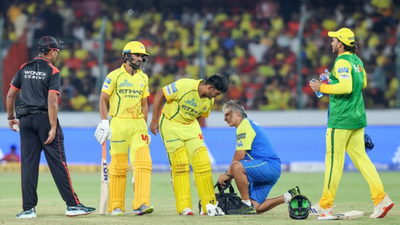
Chennai Super Kings could deal with a major injury scare after young batter Ayush Mhatre suffered a hamstring injury during their chase against Sunrisers Hyderabad. The incident occurred in the fourth over of CSK’s pursuit of 195, when Mhatre pulled up midway while attempting a second run. Clearly in discomfort, he slowed down significantly near the crease and required immediate attention from the physio.Despite the pain, Mhatre chose to continue batting briefly, showing grit and determination. However, his stay was cut short as he was eventually helped off the field by support staff, including Ramakrishna Ghosh and the team physio, with visible difficulty. He was seen limping badly, raising concerns within the CSK camp.
With CSK already dealing with multiple injury concerns this season, the latest setback could not have come at a worse time. Batting coach Michael Hussey confirmed the seriousness of the situation after the match, revealing that the injury could be more severe than initially expected.“Ayush Mhatre has a hamstring tear. I don’t know how bad it is, we will have a scan, but it looks really bad unfortunately. It could be a big loss for us, because he has been in nice touch for us. He is an exciting young talent,” Michael Hussey said in post match press conference.He further added that while the exact extent of the injury will only be known after scans, early signs are not encouraging.Hamstring injuries are notoriously tricky, often requiring significant recovery time, and there are growing fears that Mhatre could miss a substantial part of the tournament, or even be ruled out entirely.Match Summary: CSK vs SRHSunrisers Hyderabad defeated Chennai Super Kings by 10 runs, successfully defending 194 in a close contest.Abhishek Sharma’s explosive start and Heinrich Klaasen’s steady fifty powered SRH to a competitive total. In reply, CSK were in control at one stage but lost wickets at regular intervals, falling short at 184/8.SRH’s disciplined bowling in the middle and death overs proved decisive in sealing the win.
Gold and silver have marked gains of around 10% and 5% year-to-date. Should you buy gold this Akshaya Tritiya? We asked five experts: (AI image)
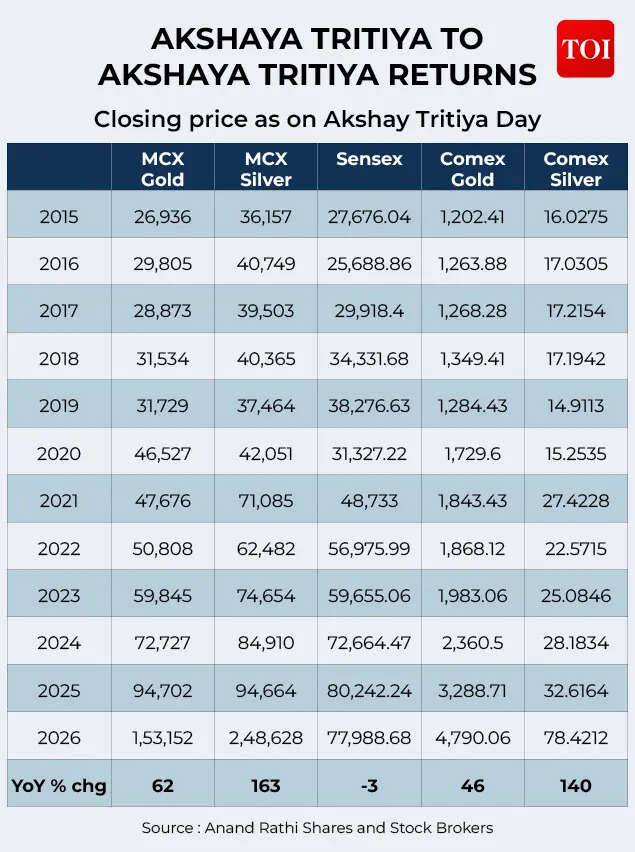
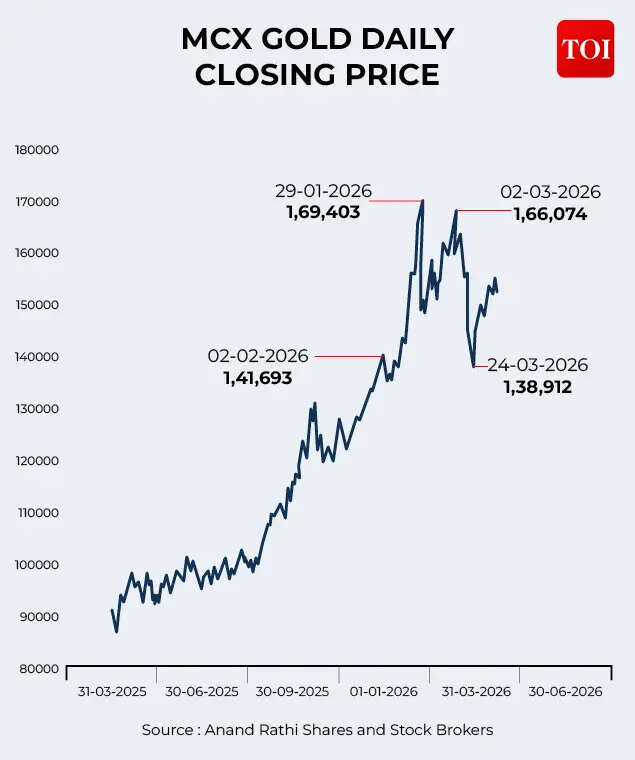
Gold buying in India is not just about its safe haven status – it is traditionally considered auspicious. Festivals across the year become major days on which gold buying peaks. According to Jateen Trivedi, VP Research Analyst – Commodity and Currency, LKP Securities, the returns over the last few years indicate that both physical gold and MCX gold have remained structurally bullish, especially during periods of global uncertainty, inflation spikes, and currency volatility.Gold and silver prices have rallied strongly in the last few years, reaching new peaks in January this year. However, since then prices of both the precious metals have come down. More recently, the safe haven status of gold came under question with prices crashing since the start of the US-Iran war. According to a recent report by Motilal Oswal Wealth Management, from a historical perspective, Akshaya Tritiya has consistently proven to be a favourable entry point for long-term gold investors. Gold and silver have marked gains of around 10% and 5% year-to-date. Respectively. Gold prices have dropped from their recent highs, but are still on the higher side. In this context, should you buy gold this Akshaya Tritiya? We asked five experts – but before that let’s take a look at how gold has fared compared to other asset classes like silver and equities in the last 10 years.
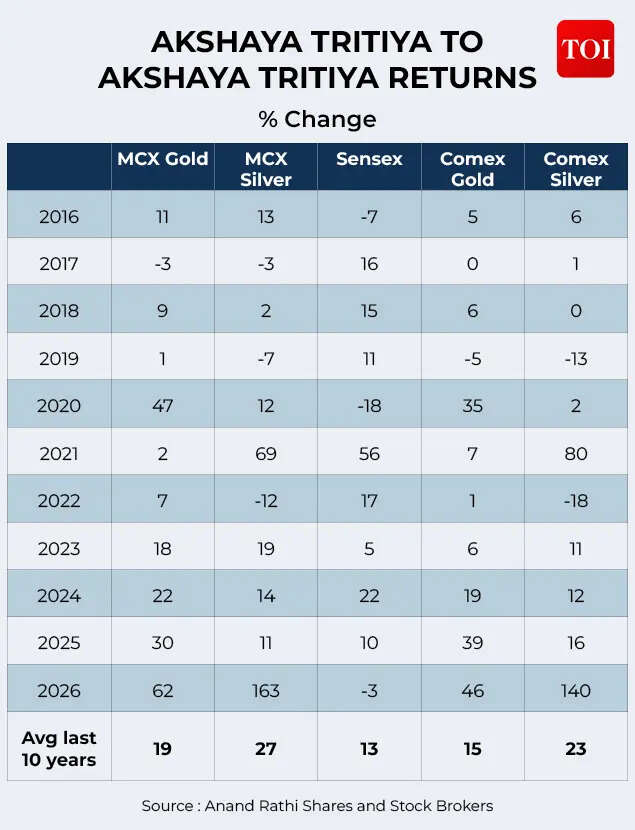
Akshaya Tritiya to Akshaya Tritiya: How Gold, Silver, Sensex Returns Compare
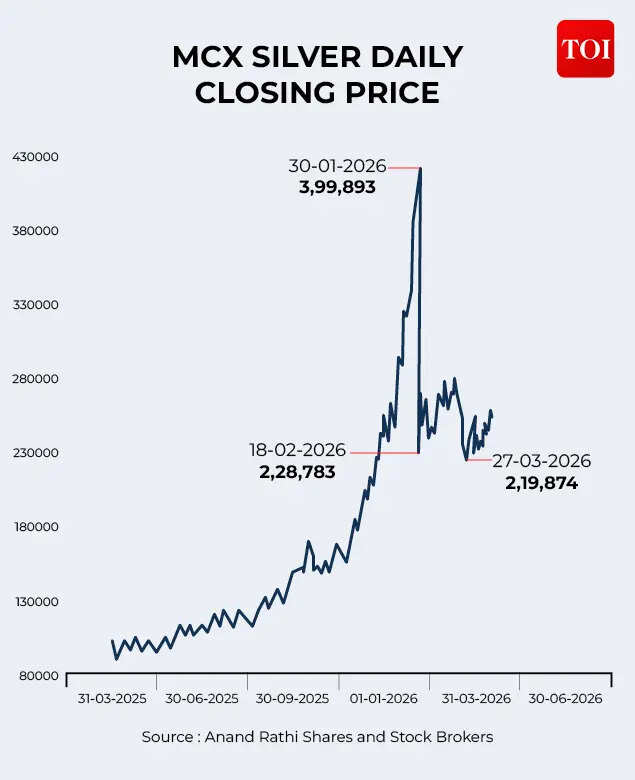
Experts note that silver has outperformed gold & Indian equities since last Akshaya Tritiya. It has delivered stellar, multibagger returns of around 158–160 % since the last Akshaya Tritiya (April 30, 2025), significantly outperforming gold’s roughly 60% gain. Silver prices have surged from just below Rs 1 lakh per kg during last Akshaya Tritiya to around Rs 2.50 lakh per kg by mid-April 2026, driven by high industrial demand and investment inflows. Not only that, the white metal was seen rising to a high of over Rs 4.25 lakh per kg in futures contract during the first month of the current year!
On the other hand, stock markets have bled in the last year due to foreign outflows, rupee depreciation and a host of other factors. BSE Sensex lower since last Akshaya Tritiya close. The long-term data reveals a more telling tale. Over the last 10 years, gold has consistently delivered positive returns from one Akshaya Tritiya to another, with 2017 being an exception with negative returns. On an average, over the last 10 years gold has given around 19% returns, while Sensex has delivered 13%, and silver 27%.
However, it is also noteworthy to see that there are several periods of single digit returns, and others of exceptional performance, like last year, which raise the average. On the other hand, Sensex has delivered more consistent returns.What should your investment decision on Akshaya Tritiya look like? Here’s what 5 experts say:Vedika Narvekar, Research Analyst – Commodities & Currencies, Anand Rathi Shares and Stock BrokersLooking ahead, the outlook for gold this Akshaya Tritiya remains positive, but investors should approach it with a long-term and balanced mindset rather than expecting quick gains. This is because gold is currently facing resistance from a few factors.Disruptions to energy supplies are likely to persist beyond the ongoing conflict, keeping inflation risks elevated. This could push central banks toward tighter monetary policy, leading to higher bond yields, which in turn reduces the appeal of gold, as it does not offer any interest income. At the same time, some key support factors for gold may weaken in the near term. Although central banks—especially the People’s Bank of China have been strong buyers, purchases typically slow in the second quarter. Over the past 20 years, spot gold has risen by an average of 1.2% in Q2, compared to 5.2%, 2.9%, and 2.5% in Q1, Q3, and Q4, respectively. While several global banks remain positive on gold over the long term, near-term gains may remain capped.That said, the broader structural drivers supporting gold, such as central bank buying, global uncertainties, and concerns around inflation and currency stability remain firmly in place. Over the next year, gold prices are expected to stay strong but with significant volatility. Akshaya Tritiya presents a good opportunity to gradually start accumulating gold as part of a long-term strategy but it is advisable to accumulate the same in 3-4 tranches on every dip of 3-4%.MCX gold has the potential to rise by 18–20% till the next Akshay Tritiya (CMP: Rs 153,100 per 10 gm). On the downside, prices may find a floor around ₹1,30,000, while ₹1,65,000 acts as an immediate resistance level. A sustained move above this could open the path toward ₹1,85,000. Internationally, COMEX gold is expected to trade in the range of $4,000 to $5,750 per ounce.
Praveen Singh, Head of Commodities, Mirae Asset ShareKhan
Just eight weeks ago, markets were pricing in more than two rate cuts by the Federal Reserve. However, the escalation of the Iran conflict has upended this narrative. A sharp surge in crude oil and fuel prices has reignited inflationary pressures, pushing inflation expectations higher. Central banks have consequently turned more vigilant, with even the Bank of England and the European Central Bank now being perceived as potential rate hikers – a sharp U-turn from the ratecut expectations prevailing only a few weeks ago.
A stronger US dollar and tighter liquidity conditions amid elevated oil prices have also prompted some sovereign gold selling and swap activity. Meanwhile, US labour market data remains resilient. This data should alleviate the Federal Reserve’s concerns about labour market weakness, at least in the near term.
Gold may experience periods of volatility and further short-term corrections, as central banks remain focused on containing inflation stemming from Middle East tensions that have pushed physical crude oil prices to record highs. However, the medium-to-long term outlook for gold remains constructive over 2026–27, as structural fundamentals continue to provide strong support.
Ongoing de-dollarization driven by geopolitical friction and sanctions, the burden of global sovereign debt estimated at around $340 trillion, and the growing vulnerability of government bonds under fiscal dominance and inflation risk are powerful tailwinds for both gold and silver. Over time, sustained high oil prices are likely to slow global economic growth, which could ultimately revive ratecut expectations. Any growth slowdown or recession would further deteriorate debt-to-GDP ratios, reinforcing the strategic appeal of precious metals.
Overall, the outlook for gold remains strongly constructive, with prices expected to move toward the $6,000–$6,500 range over the next year, supported by macro uncertainty, fiscal stress, and structural shifts in the global monetary system.
Maneesh Sharma, Commodity & Currency ExpertGold short-term outlook: The decline in gold prices since the onset of geopolitics between US–Iran, was seen as a temporary response to a liquidity shock as central bank buying was seen slowing down in Feb–March period. Gold & Silver ETFs in India also witnessed outflows in Feb-Mar period weighing on sentiments for precious metals. Meanwhile, a strong fundamental backdrop still persists for the yellow metal in the coming years driven by macroeconomic uncertainties. For the coming months though, the gold outlook remains highly sensitive to shifts in US Federal interest rate policy outlook amid developments around the US–Iran conflict. Any rallies in global equities could again keep upside limited in the near term.Historically during May–June period, gold has delivered seasonally weak performance on an average in the last 50 years timeframe, often marking a consolidation period following spring peaks. However, the latter half of the year is still expected to remain positive given concerns of a slowdown in economic growth as projected by the IMF in its latest world economic outlook released in the current week. Should you buy it? What’s the outlook? One should consider investing in gold & silver in a portfolio of assets with the investment mix remaining at around 60:40 with 40% being allocated to silver. However investing fresh into gold requires a staggered approach starting this Akshaya Tritiya as dips of 5-10% in prices in the coming months should be seen as an opportunity to accumulate the yellow metal. Overall returns of 18– 25% in gold can still be expected till next Akshaya Tritiya.Silver, having outperformed gold since last Akshaya Tritiya, is still seen as a metal with higher potential for returns but with considerable volatility as the silver market is heading for a sixth year of structural deficit in 2026.
Jateen Trivedi, VP Research Analyst – Commodity and Currency, LKP SecuritiesBuying gold on Akshaya Tritiya carries both cultural significance and financial logic, especially for long-term wealth protection. However, current price levels are elevated after a sharp rally. Hence, a staggered accumulation strategy is more prudent rather than aggressive lump-sum buying.1-Year Outlook & Strategy• Approach: Buy in small quantities (SIP / staggered buying)• Better Accumulation Zone: Near ₹1,30,000 (on corrections)• 1-Year Outlook: Positive bias supported by * Geopolitical uncertainty * Inflation risks * Central bank buying * Currency volatilityTarget Levels (1 Year)• Upside Target: ₹1,75,000 – ₹1,85,000Gold is expected to remain in a long-term uptrend, though interim volatility and corrections should be expected. Gold remains a core portfolio hedge, but at current elevated levels, investors should focus on disciplined accumulation rather than chasing prices, using dips as opportunities.
Kaveri More, Commodity Analyst, Commodity Technical Research at Choice BrokingYes, As the bullion market remains heavily influenced by macroeconomic uncertainty, global growth concerns, and central‑bank actions, with three key drivers standing out ongoing geopolitical tensions in the Middle East (Iran-US), China‑Taiwan, and the Russia‑Ukraine conflict, softening growth in Europe and parts of Asia, and shifting monetary‑policy expectations, especially from the US Federal Reserve.Given these dynamics, buying gold this Akshaya Tritiya still makes sense but not in a lump‑sum, at‑peak manner. A staggered, “buy‑on‑dips” strategy around key support zones better align with a one‑year horizon and reduces the risk of entering near record highs. Reasonable target bands over the next 12 months could be Rs 169000–180000 for, with support zone near Rs 146800—136300.(Disclaimer: Recommendations and views on the stock market, other asset classes or personal finance management tips given by experts are their own. These opinions do not represent the views of The Times of India)
Deepika Padukone and Ranveer Singh are expecting their second child. The Pathaan actress took to social media to make the announcement. The post featured her little daughter, Dua.
Deepika and Ranveer to become parents again
On Sunday morning, Deepika surprised all by sharing a picture of her daughter holding a pregnancy test in which the result was positive. The actress just put two evil eye emojis in the caption. Deepika and Ranveer can be seen holding Dua as she held the positive test result.