Virat Kohli guided Royal Challengers Bengaluru’s (RCB) chase with a steady knock as they beat Lucknow Super Giants (LSG) by five wickets in their IPL match on Wednesday.Chasing 147, Kohli got RCB off to a strong start and scored 49 off 34 balls, hitting six fours and one six. He looked set for his 66th IPL half-century but was dismissed on 49, caught by Nicholas Pooran off Avesh Khan while attempting a shot in the air towards long-on. Actor and wife of Virat Kohli, Anushka Sharma, who was present at the stadium, reacted with disappointment to his dismissal.This was the first time that Virat Kohli was dismissed on 49 in his IPL career. Despite missing out on the half-century, he claimed the Orange Cap with a tally of 228 runs in the tournament so far. Earlier, fast bowler Rasikh Salam Dar returned figures of 4/24 to lead RCB’s bowling effort. Bhuvneshwar Kumar (3/27) and Krunal Pandya (2/38) also took wickets, while Josh Hazlewood picked up one.After being asked to bat, LSG were bowled out for 146, their lowest total of the season. Mitchell Marsh (40 off 32) and Ayush Badoni (38 off 24) were the main contributors.In the chase, Rajat Patidar (27) and Jitesh Sharma (23) added quick runs as RCB reached 149 for 5 in 15.1 overs.For LSG, Prince Yadav (3/32) and Avesh Khan (2/23) shared the wickets.The defending champions have climbed to the top spot with eight points to their name in five matches. LSG, on the other hand, are at the seventh place with four points in as many matches.
Before turning producer, Shweta Tripathi knew the role would come with challenges and learnings. But the actor also knew that the joy of telling a story she wanted to would surpass these hurdles. Armed with this belief, she dived into her first Hindi film production, Mujhe Jaan Na Kaho Meri Jaan, juggling its pre-production with the shoot of Mirzapur: The Movie.
“Juggling multiple roles feels like switching playlists in my head. One moment I’m in actor mode, and the next, I’m a producer,” she laughed.
Mujhe Jaan Na Kaho Meri Jaan, a queer drama directed by Sanjoy Nag, will roll this week. Tripathi has understood that seeing the big picture is the most important lesson in production. “As a first-time producer, the biggest challenge has been understanding the scale of responsibility. It’s not just about the story, it’s about making sure every part aligns — from finances to scheduling to people. It can get intense, but it’s also rewarding to see your vision come together.”
Tillotama Shome
Tillotama Shomewill lead Tripathi’s production ‘Mujhe Jaan Na Kaho Meri Jaan’
Coming into the IPL 2026 season, RCB’s bowling attack was missing a few components. They didn’t have Josh Hazlewood initially, but had a replacement sorted in Jacob Duffy. However, the other missing element was a third pacer to complement Hazlewood and Bhuvneshwar Kumar.
Yash Dayal played this role in their title-winning campaign last year, often coming in as a defensive option and delivering at the death. But for reasons outside of the field, Dayal wasn’t part of the RCB squad this year. They needed to find someone within their ranks to fill the void.
The first opportunity went to Abhinandan Singh, but he failed to live up to expectations. The next option could have been Mangesh Yadav, given he is a left-arm pacer, but RCB opted for Rasikh Salam instead.
Rasikh brought his best in RCB colours with his 4-wicket-haul vs LSG. (PTI Photo)
The Baroda pacer has been around the IPL circuit for quite some time, playing for MI, KKR and DC before his move to RCB. Until last season, it seemed like he never found a permanent spot in any side, often being used as a fringe player. But that now seems to have changed.
In the game against MI, he was used as a defensive option by Patidar to ensure runs didn’t come easily. He conceded 23 runs in his 2.5 overs and picked up a wicket before leaving the field with an injury.
His first wicket was a fortunate one, as Aiden Markram found a leading edge off a full toss on the leg side. But he followed it up with a superb second over against big-hitters Mitchell Marsh and Nicholas Pooran, conceding just two runs to signal the end of the powerplay.
The Ayush Badoni wicket was all about using the conditions to his advantage—something you often see from Hazlewood and Bhuvneshwar.
But it was his duel with Mukul Choudhary that stood out as India Today’s Play Of The Day for the clash at Chinnaswamy.
This wasn’t the Eden pitch, and the bowling attack appeared far more disciplined with their plans. The LSG youngster worked his way to 33 off 26 balls and looked ready to explode.
It was the final over of the innings, and Mukul was always looking to go big. Patidar handed Rasikh the responsibility of closing things out.
The stand-off was underway, and Rasikh’s first delivery was a slower one. Mukul seemed to have enough time to play two shots and generated the power to send it into the crowd.
Rasikh managing to end the Mukul show early, played a key part in RCB’s win. (PTI Photo)
Fans expected a big over, and Mukul looked determined to deliver. But then, Rasikh produced a full delivery that went through Mukul’s legs and crashed into the leg stump.
The beauty of the delivery lay in the planning. Sensing that the slower ball was being anticipated, the RCB pacer went quick—touching 139 kmph.
He could have stuck to his original plan, but instead baited Mukul by pitching it slightly on the leg side. The change in pace made all the difference and brought him the wicket.
Rasikh capped off the over with another superb yorker, this time removing Avesh Khan’s off stump. He finished with figures of 4 for 24 in his four overs and earned praise from the master himself, Hazlewood.
“Rasikh obviously missed the first few games but selected in the last couple and he’s training the house down. He’s got some nice skills. We’ve seen that in the last few games. Bowls the hard overs as well. It’s a big tournament for Rasikh,” said Hazlewood.
With RCB firmly on the march to retaining their crown, a bowler like Rasikh could prove to be the difference in the end. After years of drifting between teams, he finally seems to have found a home and earned the trust of the RCB faithful.
It’s not every day that Mahesh Bhatt hosts a chat show. Then again, it’s not every day that an urgent show comes his way. Within seconds of getting on the call, the filmmaker, succinctly yet philosophically, explained what drew him to Pehchaan. “When the house is on fire, you don’t debate; you bring water. Pehchaan is that water, because you know where the world is right now,” he stated.
Directed by Suhrita Das, the SonyLIV unscripted series features Bhatt in conversation with 13 individuals from the Sikh community, who dedicated their lives to seva. To the host, it’s notable that the chat show’s subjects don’t preach their truth, but practise it. “They have drawn strength from their faith and translated it into action. We’re becoming a sound-byte society. We think we can solve the world’s problems just by talking, tweeting, or putting our ideas on Instagram. These individuals [on the show] are unsung and not seeking accolades. Today, when division is growing by the hour, Pehchaan speaks about connection,” the host asserted.
Mahesh Bhatt. Pic/Ashish Raje
According to him, artistes must focus on building connection in today’s times of hate and division. “Filmmakers and their stories should give you insights into [another human’s] complexities and the turbulence of life. It’s supposed to glue people together. Filmmakers can use a story as a weapon or as a way to stitch,” he said. When asked if stories on screen are “stitching” people together, he rued, “I don’t think so. The entertainment world and media have done the opposite. They are pushing people away from each other, by the hour.”
‘Sadak 2’, which released in 2020, was Mahesh Bhatt’s last directorial feature
Mumbai: The ongoing conflict in West Asia has put world leaders and ordinary citizens alike in a difficult situation, with citizens struggling to meet basic needs. One and a half months into the conflict, long queues remain daily outside liquefied petroleum gas (LPG) agencies as citizens struggle to get cooking gas.
iMumbai, India – March 13, 2026: Residents queue up with empty cylinders for LPG cooking gas refill at Charkop in Kandivali, Mumbai, amid supply concerns due to the ongoing Iran-US conflict, in Mumbai, India, on Friday, March 13, 2025. (Photo by Satish Bate/Hindustan Times) (Hindustan Times)
The rising cost of LPG cylinders and daily commodities has had a devastating impact on the lives of gig workers, small eateries, self-employed and truck drivers. Some have changed their lifestyle, while others have revamped their dietary requirements.
HT visited different sections of daily wage workers to find out how they are coping with limited income and rising expenses – for example, while the price of vada pav and a small cup of tea has not increased, the ingredients used to make them have become costlier, hurting the pockets of vendors.
This is a far cry from restaurants that have recently increased food prices by 15% to 20%.
Sociologist and Director-in-charge Professor B. School of International Relations and Strategic Studies, University of Mumbai.
‘I have to return to my village, start farming’
Name: Ajay Rai, 42
Occupation: Truck Driver
For Ajay Rai, a 42-year-old truck driver from Uttar Pradesh, the road that once promised stability has now turned to uncertainty and despair due to the recession caused by the West Asia crisis.
After driving for more than two decades, he is preparing to return home, feeling defeated by dwindling work and rising expenses.
Rai has been driving trucks since 2000. At the age of 18, he moved from his village to Kushinagar to escape the insecurity caused by intermittent earnings and failure in high school exams. Attracted by the promise of steady employment in the trucking business, he first reached Daman and later Mumbai.
“When I started driving, I had barely grown a moustache,” Rai recalled while speaking to HT on the Nashik Highway.
Rai has been living inside a truck employed by Parth Cargo for the last two years. The company delivers bulk consignments from Nhava Sheva to Wadpe and Bhiwandi. Now, with reduced freight traffic, drivers are left with little work. “Managers tell us business is down,” Rai said.
By paying per trip he earns approx. ₹Rs 2,500 for each journey. “Till recently, I used to complete five to six trips a week, earning around ₹50,000 per month. Now, the assignments have reduced to just one weekly trip, leaving my monthly income at approx. ₹10,000,” he said.
With declining income, Rai who used to eat vegetarian thali now survives on vada pav and bhaji pav.
The financial blow has also affected his family, which also includes monthly fees of around Rs 200. ₹Rs 13,000 for his daughter’s college and son’s school. “I used to send here and there ₹Rs 35,000 every month. But I did not send any money home last month nor will I be able to send it this month,” Rai said.
On the other hand, life on the highways is also not without risks. Last week, eight liters of diesel was taken out of his truck while he was sleeping, causing him to suffer a loss.
After years of tireless work, Rai has decided to stop. He said, “I will deliver my last consignment tomorrow and go home. It has become unbearable to stay here. I will return to my village and work on my agricultural land, which will keep me alive and ensure two meals a day for my family.”
‘Despite the extreme heat, I can’t buy water’
Ganesh Chaugle, 26
Gig worker/food delivery app worker
At 4 a.m., when most of the city is asleep, 26-year-old Ganesh Chaugle walks wearily through the dimly lit streets of Thane to Kalwa. Since last month, the gig worker has been working almost 14 hours a day, with his shifts starting in the afternoon and continuing till the early hours of the morning. “There is hardly any time to relax,” Chowgle told HT while placing an order near Jambli Naka in Thane.
The recession caused by the LPG crisis has reduced the speed of delivery, halving their earnings. “Earlier we used to deliver an order every 10 minutes. Now it takes 20 minutes because many places have shifted to electric induction,” he said.
Their income has been deeply affected. Until recently, Chaugal earned between ₹40,000 more ₹45,000 per month. Today that figure has fallen to close to ₹30,000, of which 15-20% is spent on petrol, maintenance and other work-related expenses. “My income is the backbone of my household,” he said.
Chaugle’s mother works as a domestic help and earns ₹15,000 per month, while the family is struggling with rent, monthly bills and pending EMIs. His sister, a class 10 student, needed a mobile phone for her studies, which increased her financial burden.
“The worst thing is that my mother thinks I’m not responsible towards the house. How do I explain that there’s a hole in my pocket because of the war thousands of miles away?” said the final year commerce student at Patel College, Kalyan.
To save money, he often skips dinner and survives on cheap street food like samosa, sev and bhel.
The harsh realities of gig work have compounded his crisis. “Between 12 noon and 3 pm, we cannot take a break. Yesterday, when I stopped for a while to use the toilet, I felt encouraged ₹Rs 332 were waived off after completing 27 deliveries. This means I have to pay for petrol from my own pocket,” Chougalle said.
He further added, “Besides, water consumption has also increased due to the heat. If I buy two bottles costing ₹20 each, the amount earned from one delivery has been exhausted. I’ve started calculating everything this way.
‘My daily sales have been affected since the price increase’
Name: Umesh Gowda, 38
Occupation: Food Vendor, Andheri East
Umesh Gowda, 38, is one of the many faces in the crowd of street food vendors who serve Mumbai’s working population through breakfast, lunch, snacks and dinner. Gowda earns his living by selling omelettes, bhurji and boiled eggs in Andheri East.
Originally from Bengaluru, he moved to Mumbai a decade ago to make it big in the country’s financial capital. But his aspirations were dashed when his partnership at a restaurant collapsed within three months due to the pandemic.
He started an Anda-Bhurji stall on Andheri-Kurla Road, the hub of corporate houses. Everything was going well until the West Asian conflict had a domino effect on the country’s economic condition.
“The prices of all the ingredients and other materials required for my daily business have increased in the last few months. LPG has become expensive, the price of vegetables and eggs has increased. My margins are decreasing,” Gowda said. “
“For example, the price of a sachet of 900 ml cooking oil is between ₹115 more ₹118 available now ₹146 – ₹150. The cost of packaging materials like spoons, plates, carry bags, butter paper etc. has also increased by 80%. All this has put pressure on my daily income,” he said. He needs about 10 LPG cylinders ₹1000, per month, but was forced to cut down on usage due to unavailability. He has kept a diesel stove as a backup.
To keep itself afloat, Gowda had to increase the price of its food by 25%. Till a month ago one omelette-pav was sold ₹20, now it is ₹25.
This has also affected their daily sales. “My sales have dropped significantly. Earlier, I used to sell around 600 eggs a day, now it is between 400-450 eggs,” he said.
He operates the stall five and a half days a week. In the second half of Saturday, he restocks for his business. While Sundays are for the family, with rising costs and declining profits, he goes out less with his wife and six-year-old daughter.
Despite the adversity, they have now focused their attention on their child’s future. “I want to make plans for her to shape her future,” Gowda said. “Life hasn’t been what I thought it would be. But I’m in a much better place than many other people.”
‘Since I can’t afford to raise tea prices, I’m eating only dal and rice’
Name: Jayesh Pardhi, 25
Occupation: Tea seller
Twenty-five-year-old Jayesh Pardhi’s tea stall in Pratiksha Nagar, which is popular among taxi and auto drivers, is struggling to survive. It is a shop that he inherited from his father, who ran it for 40 years.
Pardhi requires three commercial LPG cylinders a month, each costing ₹2000.
He said, “I sell at least 150 cups of tea every day, but the increase in prices of raw materials like tea powder, sugar and ginger has affected my profits, as I have not yet increased the price of tea. I use both LPG stove and diesel stove.” “Since my earnings have been affected, I have cut down my expenses. Now I cook one meal like dal and rice, or sometimes roti.”
The price of a small cup of tea at their stall is ₹5 and a cutting tea ₹10. “I recently lost my house which has gone into redevelopment, and so I have rented a space opposite my stall ₹Rs 50 per night for sleeping. This helps me save house rent, and I am able to send 60% of my monthly income, which is approximately ₹from 16,000 ₹“My wife and two children who live in Rajasthan will get Rs 18,000,” he said.
When asked why he did not increase the price of tea, he said, “If I do, I will lose all my customers. I will increase the price of tea when other sellers do so.”
‘We cook what we can’t sell’
Sugandha Thakur 65
Occupation: Vegetable seller
At 65, Sugandha Thakur runs her small vegetable shop in Thane’s Jambhali Naka, and depends on daily sales of leafy vegetables to support her family of four.
She says, “I am selling leafy vegetables for my livelihood. Earlier, I used to cook a variety of dishes, but now we are dependent on unsold vegetables as both produce and LPG have become expensive.”
Despite a slight decline in income, Thakur says his family of four makes do by cutting costs and supporting each other. Living in their own home in Kasar Vadawali helps them earn a living.
“We plan our expenses based on our income and try to be happy,” she adds.
As the number one importer of Iranian oil, China has a major problem with any constriction of exports in the Gulf – including the US blockade of Iran’s ports, which began on Monday.
Beijing has condemned the US blockade, calling it “irresponsible and dangerous”.
It has also reportedly sought to play peacemaker in the conflict, steering its ally Iran towards talks with the US in Pakistan last weekend.
But the blockade creates a serious political, economic, and possibly military risk that both the US and China will want to avoid.
The BBC’s security correspondent Frank Gardner explains why China’s role in the conflict is too big to be ignored.
Action thriller Dacoit is currently running in theatres. Shaneil Deo’s directorial debut stars Adivi Sesh and Mrunal Thakur in lead roles. The film was set to release on March 19, but was delayed by three weeks to avoid a clash with Ranveer Singh’s Dhurandhar 2. As expected, Dhurandhar 2 is enjoying a record-breaking run at the box office. Dacoit arrived on April 10, and even as it earned a healthy ₹22 crore net in its opening weekend, it was still beaten by Dhurandhar 2, running in its fourth week.
Adivi Sesh in a still from Dacoit.
Adivi Sesh on Dacoit box office
Many wondered if Dacoit could have been delayed even further. But for Adivi Sesh, all this is a moot point. As he sat down with HT to discuss Dacoit’s box-office performance, we asked him whether Dhurandhar 2 hurt the film? The actor replied, “Honestly, who can say? I mean, had Dhurandhar not been around, had there not been a two-month IPL this time, or had Kantara and Vikram not been released day as Major…” he trails off as he talks about how his previous release, Major, also faced a box office clash with big films and still succeeded.
Sesh added, “But the destiny for this film has been beautifully positive, and I’m just grateful now.”
‘Everything about the film is honest’
As the makers of Dacoit shared posters declaring the film a blockbuster after its ₹40-crore opening weekend (worldwide gross), many wondered if the celebration was premature. Sesh responds, “To them it feels, ‘How can they?’ But at the end of the day, I’ll tell you one thing: everything about our film has come from an honest space.”
The actor-writer is thankful for the support his film has received from not just the audiences but also the industry. Filmmaker Allu Aravind and Nani have been vocal supporters of the film even before it released. “For someone like Allu Aravind, Allu Arjun’s dad, and Bunny Vasu to say, ‘Hey, we want to talk about the movie, can you give us a stage to do so?’ is a big deal. And they said we don’t want to do it in one simple video bite. They came and spoke. And these are just honest things. I don’t have that kind of influence to get those kinds of big guys to talk.”
Dacoit, directed by Shaneil Deo, stars Sesh alongside Mrunal Thakur and Anurag Kashyap. The film opened to lukewarm reviews but grossed ₹40 crore worldwide in its opening weekend. It has since added around ₹10 crore in three days.
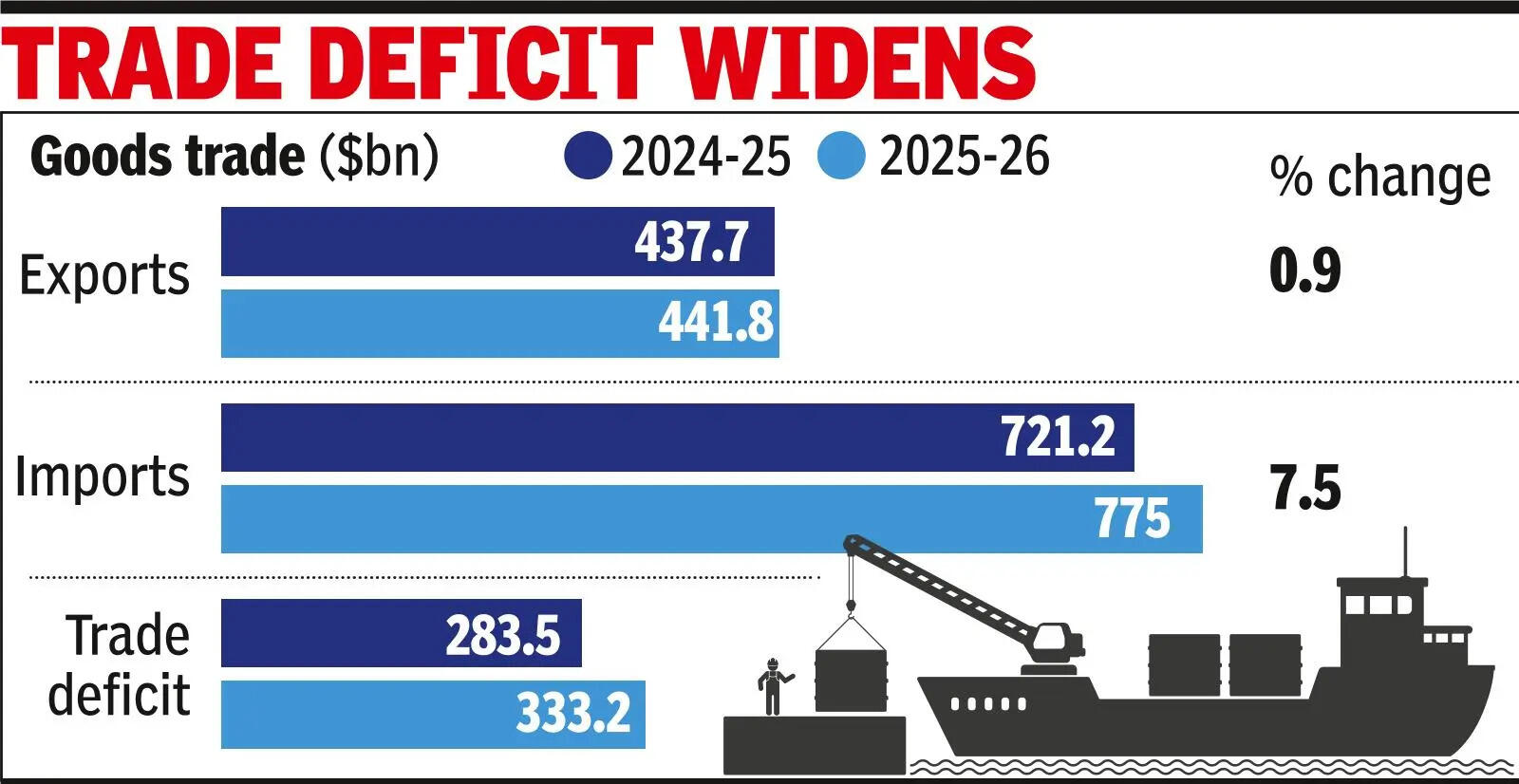
NEW DELHI: India closed the last fiscal with record goods exports of $441.8 billion, 1% higher than the previous year, despite being weighed down by the West Asia conflict, which took a toll on March exports. Driven by a surge in gold and silver shipments, imports rose 7.5% to $775 billion, resulting in a trade deficit widening to $333 billion.The overall number would have been higher, but for a 7.6% decline in exports in March to $38.9 billion, but the trade deficit narrowed to a nine-month low of $20.7 billion as imports fell 6.4% to $59.6 billion. Overall exports, including services, rose 4% to a record $860.1 billion, while imports were 6.4% higher at nearly $920 billion.“Bharat sets a new export record! A matter of great pride as India achieves record exports of $860 billion in FY 2025-26,” commerce and industry minister Piyush Goyal posted on social media, adding that it came despite global headwinds, reflecting the country’s resilience and growing strength in expanding its global trading footprint.
Commerce secretary Rajesh Agrawal said that India’s export grew faster than the global average and came in the backdrop of a tough global environment which included steep US tariffs for a large part of the last financial year to be followed by the Iran war in March.What also hurt exports were the low oil prices in the initial months of last year, which muted the value of diesel and aviation fuel shipments. Non-oil exports were 3.6% higher.“We hope the challenges that we face today will not sustain for long, and we may have smoother trade across the world in months to come,” he said, while banking on trade deals with the UK, Oman and New Zealand to bolster exports this year. Agrawal also said that trade deficit was not a major concern and higher remittances provided comfort on the external front.Record exports in FY26 despite West Asia hitIndia closed the last fiscal with record goods exports of $441.8 billion, 1% higher than the previous year, despite being weighed down by the West Asia conflict, which took a toll on March exports. However, disruption triggered by war cut India’s trade with West Asia over half in March. Commerce secretary Rajesh Agrawal said exports crashed 57.9% last month; imports fell 51.6%. India normally exports goods worth about $6bn every month to the region, but in March it was only about $2.5bn.
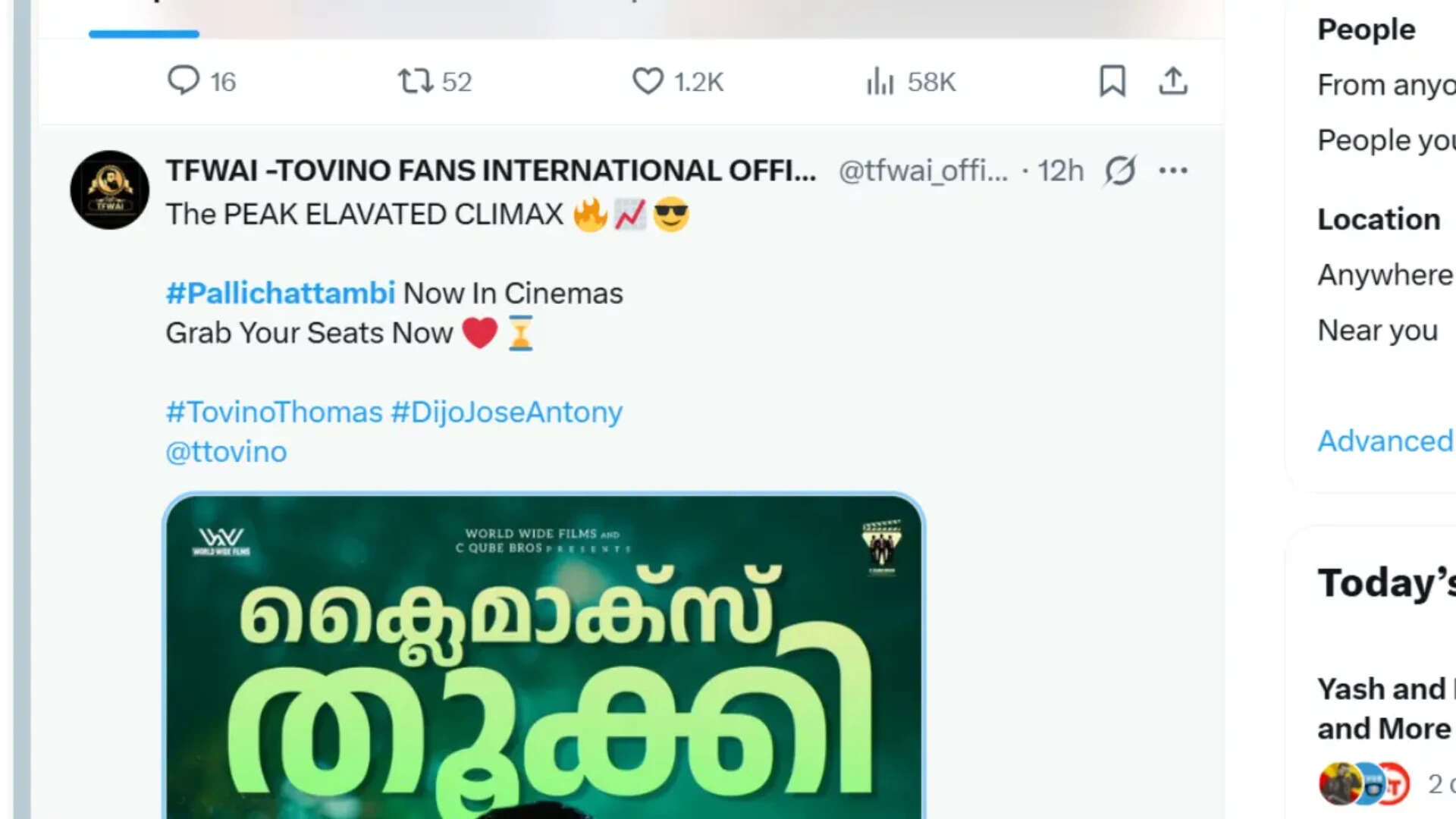
‘Pallichattambi’ brings a big-budget period spectacle to Malayalam screens this Vishu season. Mixed Twitter reviews show divided opinions on scripting and pacing, but Tovino Thomas’s powerful mass avatar and strong technical values keep the film in discussion.
‘Pallichattambi’ hit theatres on April 15, 2026, as part of the Vishu festive lineup. The Tovino Thomas and Kayadu Lohar starrer has received mixed responses from early viewers on social media. While some called it a high-energy mass entertainer, others found the scripting weak. The film also opened to a slow start at the box office.
Day 1 box office performance of Tovino Thomas starrer
The film collected a worldwide gross of Rs 8.20 crores on its first day. India net stood at Rs 2.37 Cr while overseas contributed Rs 1.70 Cr. According to Sacnilk, it initially collected around Rs 1.55 Cr net and reached Rs 2.37 Cr live by the end of the day.It ran across 1,260 shows. Morning occupancy was 32.25 percent and rose slightly to 42.17 percent in the afternoon.
Positive Twitter reviews for ‘Pallichattambi’
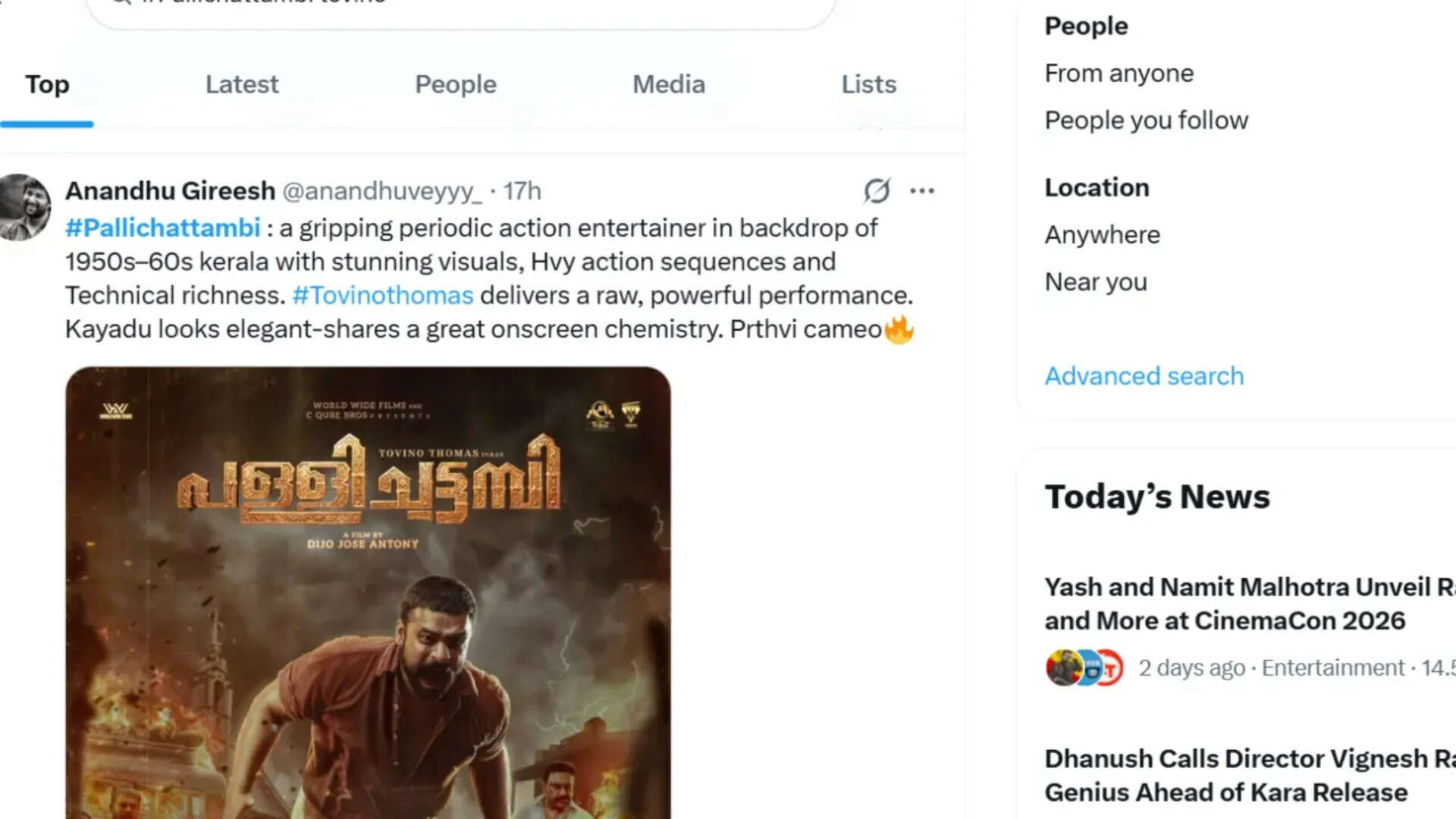
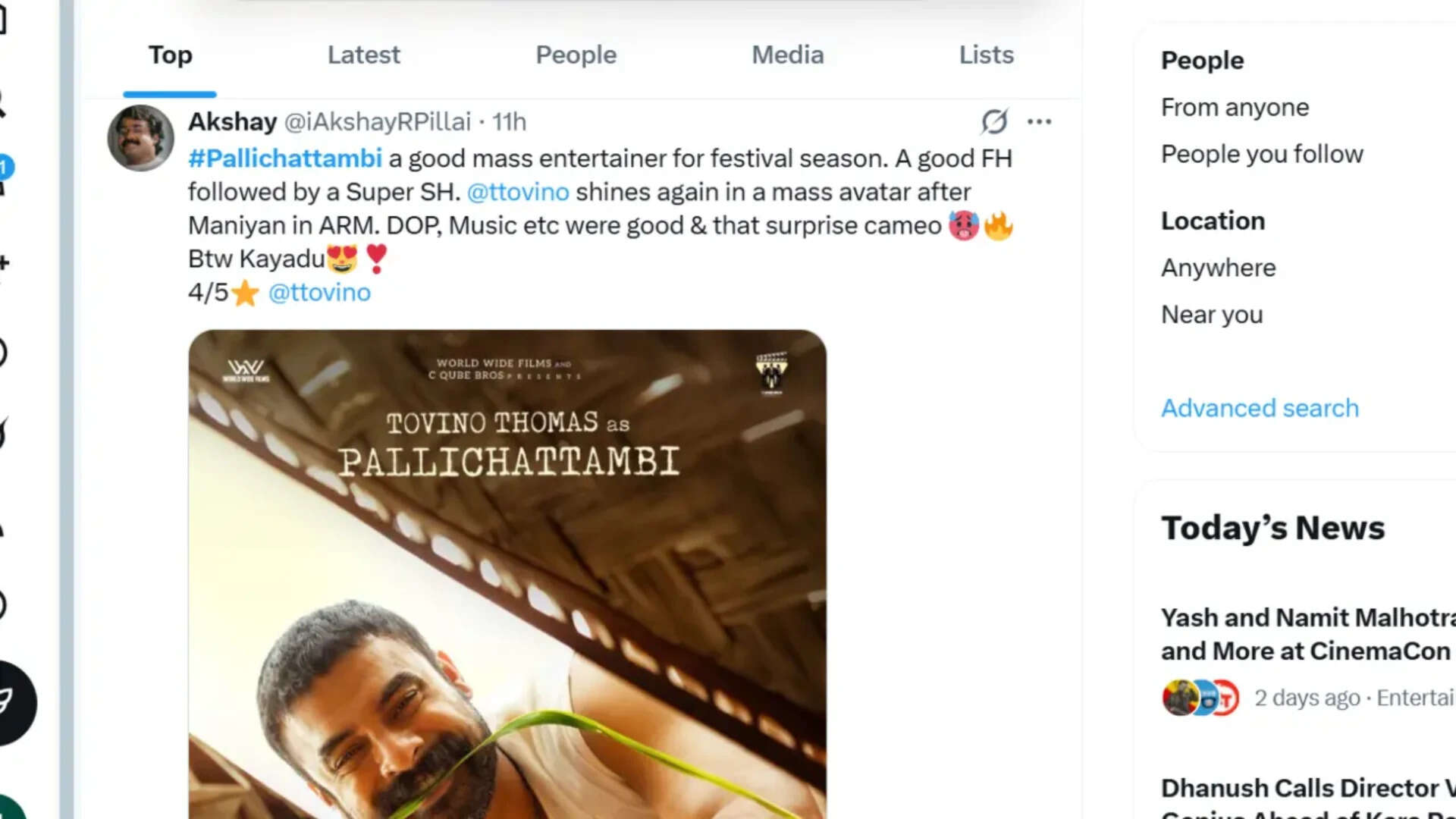
Several moviegoers appreciated the film as a festival entertainer. One user wrote, “#Pallichattambi a good mass entertainer for festival season. A good FH followed by a Super SH. @ttovino shines again in a mass avatar after Maniyan in ARM. DOP, Music etc were good & that surprise cameo Btw Kayadu 4/5 @ttovino.”Another review highlighted the technical aspects. It said, “#Pallichattambi : a gripping periodic action entertainer in backdrop of 1950s–60s kerala with stunning visuals, Hvy action sequences and Technical richness. #Tovinothomas delivers a raw, powerful performance. Kayadu looks elegant-shares a great onscreen chemistry. Prthvi cameo.”One viewer praised the first half strongly. The post read, “#PalliChattambi Interval A Chattambi is recruited to form an army to protect the Church as part of Liberation Struggle Tovino in never before Raw Avatar Superb action Choreography Kayadu is So pretty Very Engaging Making by Dijo Big Budget Spectacle Excellent till now..”
Critical Twitter feedback for Kayadu Lohar’s film
Not all responses were positive. One user shared a below-average rating. The review stated, “#Pallichattambi – BELOW AVERAGE ONE! An Average First Half Followed By Okayish Second Half. Weak Scripting & Story Telling Keeps Down The Graph. Couldn’t Engage Much. Tovino’s Actions The Only High Moment Was Prithvi’s Cameo. That Was Terrific TOTALLY PASSABLE ONE 2/5.”
Cast and story of ‘Pallichattambi’
Tovino Thomas leads the film in the title role with a never-before-seen raw performance. Kayadu Lohar plays the female lead and shares good onscreen chemistry. The supporting cast includes Johny Antony, Sudheer Karamana, Vijayaraghavan, T G Ravi and Prashanth Alexander.The story is set in the late 1950s–60s in Kerala’s high ranges. It revolves around a courageous local figure who protects a migrant farming community during socio-political challenges.Viewers praised the stunning visuals, heavy action sequences and technical richness. Music, background score and stunt choreography received special mentions.As the festive weekend progresses, stronger word-of-mouth could help the film pick up at the box office.
NEW DELHI: Virat Kohli delivered yet another commanding performance with a 34-ball 49 to guide Royal Challengers Bengaluru to a comfortable five-wicket win over Lucknow Super Giants in IPL 2026 at the M. Chinnaswamy Stadium on Wednesday. Chasing 147, RCB cruised home in 15.1 overs, with Kohli once again setting the tone at the top.Despite the match-winning knock, Kohli made a striking admission about his physical condition. “Much better than the last game. I’m still not 100%. My knee was a bit sore last game. Even health-wise, I’ve been under the weather for four or five days now,” he said after the match, adding a stark reflection on his current state: he is “not even 10% yet” of where he wants to be in terms of fitness and rhythm.The former India captain, who was seen training with heavy strapping on his left knee, struck six fours and a six in another fluent innings that took his tournament tally to 228 runs, putting him in the Orange Cap race.‘Intensity was good, but I should have finished it’Kohli said he was pleased with his start but admitted he missed an opportunity to close out the chase himself. “I started off well today, so I was happy with my intensity. Again, would have liked to carry on and finish the game off,” he said.He also noted the slowing nature of the pitch. “Sometimes you have to take the conditions into account as well. The pitch slowed down considerably and I just wanted to keep going in the same manner.”Kohli praised RCB skipper Rajat Patidar for his clarity and aggression, calling him someone who assesses “the bowler’s heart rate rather than the situation,” highlighting the team’s fearless batting approach. RCB’s depth and adaptability driving momentumKohli underlined the flexibility in RCB’s batting unit, crediting the depth provided by players like Romario Shepherd and Tim David. “It looks intimidating if you have Romario and Tim walking in even after five down. These guys can get you 50 runs in four overs,” he said.Looking ahead, Kohli stressed adaptability as the key in the second half of the season. “When pressure kicks in, that’s when the smarts of the game have to be applied. Whoever adapts best will go a long way.”