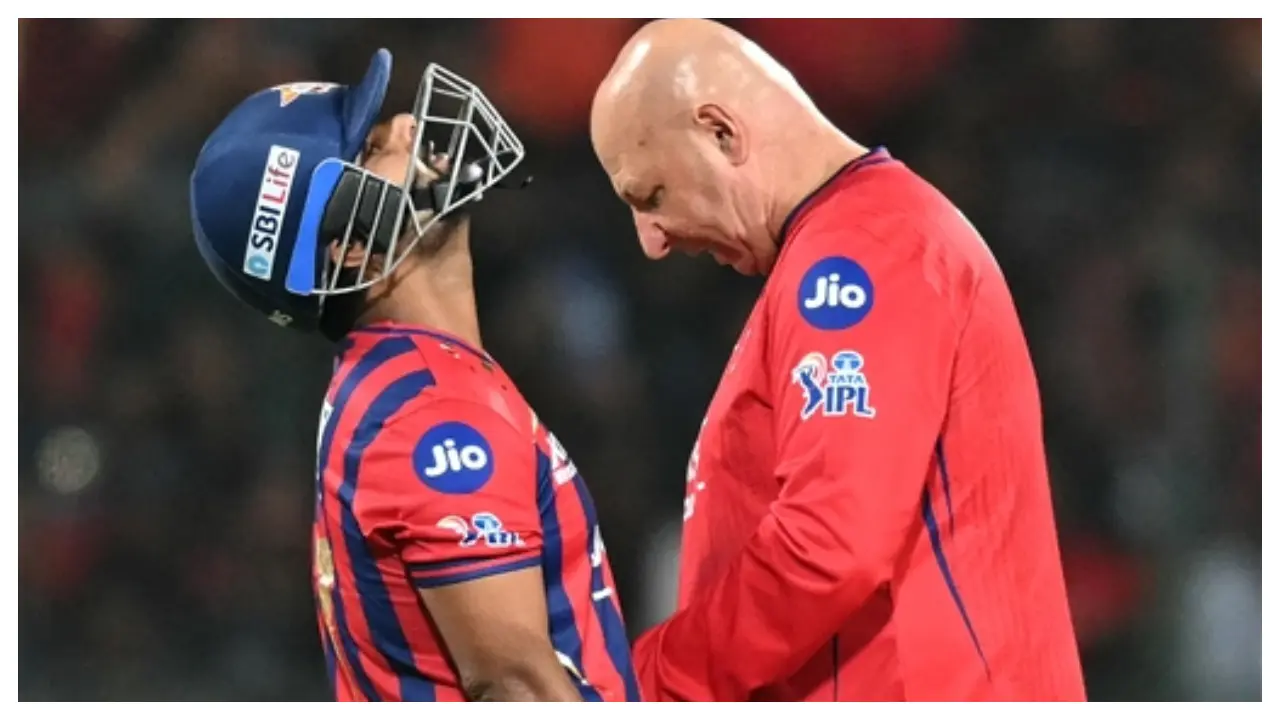
Rishabh Pant’s injury scare added another layer of worry to Lucknow Super Giants’ innings against Royal Challengers Bengaluru, along with the sluggish start they have had, with the LSG captain walking off the field after being struck on the left elbow by a sharp Josh Hazlewood delivery at the Chinnaswamy Stadium.
Rishabh Pant decided to walk-off after being hit by a Josh Hazlewood delivery in the RCB vs LSG match. (X images)
The incident took place in the fifth over of the innings when Josh Hazlewood, back in the RCB XI, hurried Pant with a hard-length ball angled in at pace. Pant was late on the pull, cramped for room, and the ball thudded into his left arm near the elbow before dropping close to the stumps. What initially looked like a painful blow quickly turned into a genuine concern. Play was halted, the LSG physio rushed out, and Pant was seen struggling to move his left hand comfortably. After a brief assessment and treatment with a spray, he decided he could not continue immediately and walked off with the physio.
For LSG, that was an alarming sight. Rishabh Pant remains the side’s captain, wicketkeeper and one of its biggest match-winners, which means any fitness issue affects the team on multiple fronts. It is not only about batting firepower in the middle order, but also leadership on the field and balance behind the stumps. A blow to the elbow can be particularly troublesome for a wicketkeeper-batter because it impacts grip, bat swing, collection and throwing motion all at once.
Why this looked more serious than a routine blow
Cricketers are hit often enough for viewers to avoid overreacting to every body blow, but this did not appear to be a routine sting. Pant needed immediate treatment, looked visibly uncomfortable, and most importantly, chose to walk off after taking time to assess the pain. That sequence usually points to more than a momentary shock. The immediate concerns in such cases are swelling, restricted movement, or a nerve-jarring impact that temporarily weakens the hand and forearm.
There is also context around Pant that makes any elbow issue notable. He has batted through pain in the past and has shown remarkable toughness during injury setbacks in his career. That is why his decision to leave the field carries weight. Players of Pant’s temperament do not usually step away unless the discomfort is affecting function.
At the time of writing, there has been no confirmed official statement from LSG on the extent of the injury, and that remains the key detail. Until the franchise provides clarity, it would be premature to speculate about scans or a layoff. But what can safely be said is this: Pant copped a painful blow on the left elbow from Hazlewood, required on-field treatment, and walked off in a moment that could yet have a major bearing on LSG’s night and possibly beyond, depending on how the injury responds over the next few hours.
Rishabh Pant is known for his fighting ability; he showed that in this match too. As the Lucknow Super Giants lost the fifth wicket in the form of Ayush Badoni, the skipper walked out to bat with an injured hand. Even though, he could not add to his tally of 1 run in the three balls played, Pant once more displayed courage of the highest level by deciding to walk out bat.
Since the deadly Hamas-led attacks on Israel on 7 October 2023, which triggered the Gaza war, UN agencies and Israeli rights groups have reported an increase in claims of abuse of Palestinian prisoners and detainees, including routine beatings, sexual violence, starvation and severe medical negligence. Dozens of Palestinians are reported to have died in detention as a result.
Filmmaker Vignesh Shivan’s latest film Love Insurance Kompany (LIK), starring Pradeep Ranganathan, Krithi Shetty, and SJ Suryah, was released in theatres on Friday. On Wednesday, the film’s team held an event to speak about the film’s success. At the event, Vignesh spoke about the leak of Vijay’s unreleased film Jana Nayagan and compared it to death.
At an event for Love Insurance Kompany, Vignesh Shivan spoke about the Jana Nayagan leak.
Vignesh Shivan pays condolences to H Vinoth
Vignesh seemed disturbed by the state of affairs in the Tamil film industry when he said at the LIK event, “Every day, a film is getting dropped in Kollywood, and directors are being replaced. Today, the situation of directors is very worrisome. I won’t take names…okay, even if I do, let me tell them. A huge film has been leaked online. In this case, I would like to express my condolences to my friend, H Vinoth.”
Explaining why a director would feel the pain of the leak over anyone else, he added, “Because this is as painful as death. Only as a director can you feel that. Every single day, every single shot, I can feel how much the director has struggled. I can feel that pain as a director. When nothing goes as expected, it’s very difficult.” Jana Nayagan was leaked online in HD print on April 9, and six arrests have been made in the case since.
Explains difference between love and piracy
This comes after Vignesh also spoke about this on Behindwoods’ Straight From Hearts show. He claimed that he knocked the phone out of a person’s hand when he spotted them watching the pirated Jana Nayagan on the way to Madurai airport. He mentioned that it hurts to see hard work being treated like that. When the interviewer mentioned that Vignesh had shared a scene of his own film LIK that a fan posted on Instagram stories, he explained the difference.
“One minute to ten minutes, ten minutes to fifteen minutes, like that, some people upload the whole movie on their Instagram Stories. When Suryah sir danced to the famous song Mayiliragae (in LIK), he was initially hesitant to do so. But the theatre enjoyed it a lot, and someone uploaded it. I wanted to reshare it. So, there’s a difference between piracy and love. That was not piracy, it’s love,” he said, laughing.
Jana Nayagan, which also stars Mamitha Baiju, Bobby Deol and Pooja Hegde, was supposed to be released in theatres in January. However, it was postponed due to a delay in the CBFC’s certification. Four months later, a new release date has yet to be announced.
MUMBAI: In a big blow to the Mumbai Indians, already reeling after three straight defeats, their former captain and star opener Rohit Sharma is set to miss the team’s fifth match of IPL 2026 against Punjab Kings at the Wankhede Stadium due to a recurrence of a hamstring injury, TOI has learnt.Rohit sustained the injury during Mumbai Indians’ previous clash against Royal Challengers Bengaluru at the same venue. Providing an update ahead of the pre-match press conference, addressed by Naman Dhir, an MI spokesperson said, “The medical staff is assessing him. An official update will be given when available.” During the team’s training session later in the evening, Rohit was seen jogging at the Wankhede Stadium.
Watch
Bombay Sport Exchange: Munaf Patel on Gautam Gambhir, Virat vs Bumrah & Indian bowling.
The MI spokesperson also confirmed that England allrounder Will Jacks, who has not featured in the IPL so far, “is on his way and will join the team soon.”Rohit picked up the injury during the second innings against RCB and retired hurt in the sixth over of the chase. MI went on to lose the match, their third defeat in four games this season. He walked off after scoring 19 off 13 balls, with two fours and a six, following a lengthy on-field treatment by the team physio before a delivery by Rasikh Salam.Teammate Sherfane Rutherford said after the game, “I’m not entirely sure yet – perhaps it’s a bit of a hamstring issue – but I can’t say for certain. I was in the dugout, so I don’t have much information on it.”Rohit, who recently completed 15 years with MI, has scored 137 runs in four matches, including a half-century. However, the 38-year-old has had a history of hamstring issues, having missed games in IPL 2020 and parts of the 2016-17 season due to similar injuries.
A major political clash has emerged over the government’s proposal to link the Nari Shakti Vandan Act (Women’s Reservation Act) with the nationwide delimitation exercise.
Opposition parties including Congress, DMK and Samajwadi Party have raised many objections on linking these two issues. What are the concerns of the opposition? What have they said? How has the government responded?
Union Minister Kiren Rijiju wrote on Twitter, “Some people are trying to mislead South Indian states on women’s reservation by giving wrong delimitation figures. There should be no politics in giving reservation to women in Lok Sabha and Assemblies. All political parties are united for Nari Shakti.”
Some people are trying to mislead South Indian states on women’s reservation by giving wrong delimitation figures. There should be no politics in giving reservation to women in Lok Sabha and Assemblies. All political parties are united for women power. https://t.co/ZmRQb6AENWpic.twitter.com/6Hkmsw12Ax– Kiren Rijiju (@KirenRijiju) 15 April 2026
What are the concerns of the opposition?
Leaders argue that population based delimitation This practice would penalize southern states that successfully implemented population control measures. They fear that these states will lose their relative political weight in Parliament compared to northern states with higher population growth.
The opposition has criticized the government for “rushing” the bill through a special session of Parliament without sharing the draft or holding all-party meetings. Sonia Gandhi described the move as “crass” and an “attack on the Constitution”.
The opposition argues that instead of waiting for the census and subsequent delimitation, women’s reservation should be implemented immediately on the current strength of 543 Lok Sabha seats.
Parties such as the Samajwadi Party demand a “quota within the quota” for women from Other Backward Classes (OBCs) and minorities, arguing that without it, the Bill will not ensure fair representation for all women.
Some leaders allege that the timing during the election cycle has been designed for “political gain” and as a “smokescreen” to push through a controversial delimitation plan.
#Watch | Delhi: Congress leaders reached the residence of party president Mallikarjun Kharge for the meeting of the Parliamentary Strategy Group on the Women’s Reservation Bill and delimitation issue. Congress MP Syed Naseer Hussain says, “We will decide our stand on this…” pic.twitter.com/xrnquN3PYc
Indian National Congress (INC): Sonia Gandhi has termed the delimitation proposal as an “attack on the Constitution” and a “dangerous” move that penalizes states with successful population control.
The party has demanded immediate implementation of the 33% quota for SC, ST and OBC women without waiting for caste census and sub-quota as well as delimitation.
Dravida Munnetra Kazhagam (DMK): Chief Minister MK Stalin has termed the move a “political coup” against the southern states, warning that it will reduce South India’s relative political weight in Parliament. The party has called for extending the moratorium on seat redistribution based on the 1971 census to 25 years.
#Watch | Tamil Nadu CM MK Stalin tweeted, “Let the black flags fly! Punishment for contributing to India’s progress? Is this how Tamil Nadu and southern states are rewarded? The delimitation amendment, which the BJP government at the Center plans to bring in Parliament tomorrow, is a… pic.twitter.com/PHUDFX6GJN– ANI (@ANI) 15 April 2026
Samajwadi Party (SP): Party chief Akhilesh Yadav described the bills as a “diversionary tactic” to avoid taking into account the caste data of the 2027 census. She reaffirmed her demand for a “quota within a quota” for OBC, Dalit and Muslim women.
Trinamool Congress (TMC): Leader Derek O’Brien said the government was only using women’s reservation to push through delimitation.
Shiv Sena (UBT): MP Sanjay Raut expressed strong objection to this on Wednesday Proposed Delimitation ExerciseHe warned of possible unrest in the southern states, alleging that this was being done “under the guise of women’s reservation” and could change the political map of the country.
#Watch | Tamil Nadu: After an emergency meeting of DMK MPs to discuss the possible adverse impacts to Tamil Nadu due to delimitation, the Chief Minister also called a meeting of district secretaries (Source: DMK) pic.twitter.com/ZwtK1Hz7yt
Bharatiya Janata Party (BJP): It has maintained a uniform 50% increase Will protect proportional representation of all states while enabling women’s quota in seats (up to 816) by 2029. Minister Kiren Rijiju claimed that the design ensures that no region is disadvantaged and the southern states will benefit from the seat increase.
Telugu Desam Party (TDP): Expressed “discomfort” over the lack of statutory clarity on maintaining state-wise seat ratio after redrawing of boundaries.
What have the other parties said?
Bahujan Samajwadi Party (BSP): Mayawati welcomed the 33% quota but sought to increase it to 50% with separate provision for SC, ST and OBC women.
Bharat Rashtra Samithi (BRS): KT Rama Rao warned of “massive public agitation” if southern representation was reduced.
AIMIM: Opposed the Bill on the grounds that it excludes Muslim and OBC women from the reservation framework.
#Watch | Chennai, Tamil Nadu: DMK MP Dayanidhi Maran says, “Our leader MK Stalin held a meeting with all DMK MPs.. They are disguising the bill as a bill for women’s quota, but it is not a bill for women’s quota. It is for delimitation. The real dragon is delimitation. They… pic.twitter.com/YUiHafmBj5– ANI (@ANI) 15 April 2026
What is the government’s stance?
The government believes that it is necessary to link reservation with delimitation for fair and transparent allocation of seats.
To address the concerns of the southern states, government sources indicate a proposal to increase the total number of Lok Sabha seats across all states by 50% (possibly to 850 seats).
The Prime Minister has said that the aim is to fully operationalize the women’s quota by the 2029 Lok Sabha elections.
The government argues that redrawing boundaries based on the latest census data ensures that no region is over- or under-represented as the total number of seats increases.
PM Modi has called for dialogue and support from all parties to pass these “defining reforms” for women empowerment.
#Watch | BJP leader K Annamalai says about MK Stalin on Women’s Reservation Bill, “Tamil Nadu CM wants to do politics on everything as usual. Mothers and sisters of Tamil Nadu want 33% reservation to be implemented as soon as possible. TN CM is watching… https://t.co/60c0FzueWO– ANI (@ANI) 15 April 2026
Top FAQs
What is delimitation in the context of women’s reservation?
Delimitation refers to the redrawing of electoral constituency boundaries based on population changes. The proposed women’s reservation law links implementation to a future delimitation exercise, which will decide which seats are reserved for women.
What objection does the opposition have?
Opposition parties argue that tying women’s reservation to delimitation (and a new census) could delay implementation indefinitely. They are demanding immediate reservation without waiting for these processes, which they fear could take years.
What has the government said?
Government It believes that delimitation is necessary to fairly allocate reserved seats across states and constituencies. It said this process ensures fair representation based on updated population data, even if it takes time.
Agency, with ANI inputs
Handpicked stories, in your inbox
A newsletter featuring the best of our journalism
first published:
April 15, 2026, 13:30 IST
newsexplainer Delimitation for women’s reservation: What is the opposition’s objection? What did the government say?
Disclaimer: Comments represent the views of users, not of News18. Please keep discussions respectful and constructive. Abusive, defamatory, or illegal comments will be removed. News18 may disable any comments at its discretion. By posting you agree with us terms of use And Privacy Policy.
In its latest World Economic Outlook report for April 2026, IMF has actually raised the growth forecast for India. (AI image)
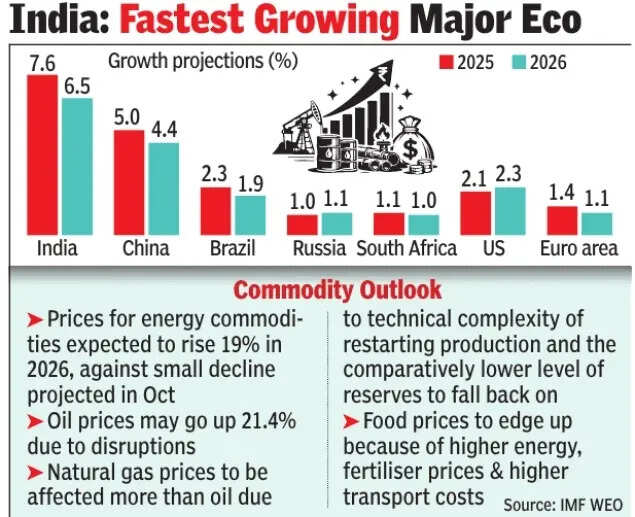
India’s high growth and low inflation period has been dealt an oil shock. Since the start of the Middle East conflict and US-Iran war, crude oil prices have crossed $100 per barrel, in effect threatening the growth story of major economies around the world. India is not immune to the shock, especially as it has high import dependency when it comes to energy needs. However, agencies like IMF and S&P Global have expressed confidence in India’s fundamentals to tide over the current crisis.In its latest World Economic Outlook report for April 2026, IMF has actually raised the growth forecast for India in the ongoing financial year to 6.5%. The raise comes as a result of favourable effects of last year’s high growth numbers and the lowering of US tariffs, which IMF argues will help more than offset the impact from the Middle East crisis.S&P Global in its latest report titled India’s Strong Fundamentals Would Cushion The Blow Of An Oil Shock says India is equipped to handle some strain.
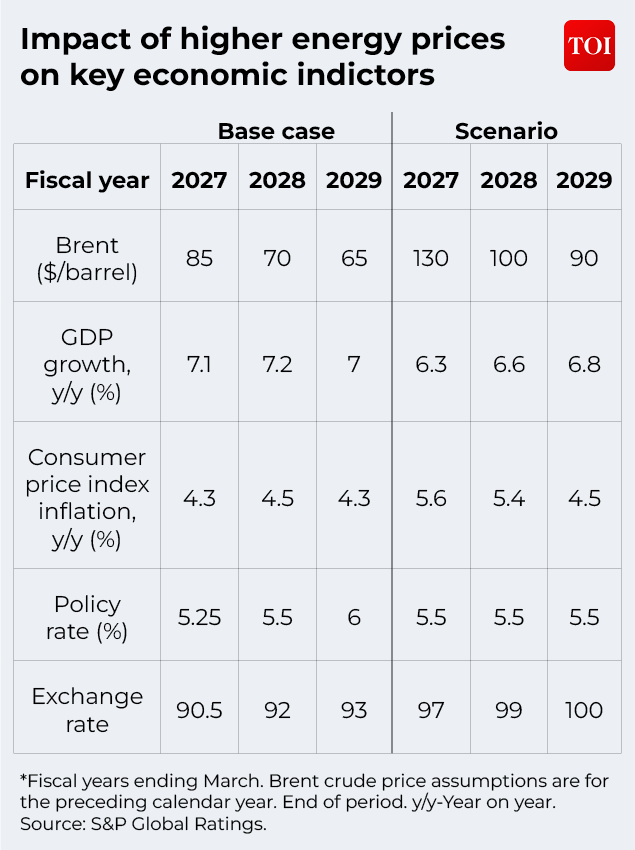
The report assumes a base case scenario of oil prices at an average of $130 per barrel for 2026 and $100 in 2027. This scenario assumes that the war’s intensity will peak and the Strait of Hormuz’s effective closure will ease during April, but some disruptions will likely persist for months.
The Oil Shock Impact
“India isn’t immune to the shocks reverberating from the Middle East war. The pain of higher energy prices and supply disruptions may persist for months, crimping economic activity across households, corporations, and banks,” the report says.S&P Global explains how an oil price shock will transit itself into the Indian economy through mainly four channels. These are:
The current account balance weakening
Higher input costs for producers which will result in margins getting squeezed
In turn, higher prices for consumers will mean reduced purchasing power
When the government will step in to absorb the price shock for consumers, it will strain finances
What is important to understand is that oil is fundamental to several sectors and any domestic energy source substitution will take time, the report says. To put simply, oil’s role in downstream chemicals heightens its economic influence. “Energy supply disruptions that lead to fuel rationing or shortages of downstream petrochemicals and related products such as fertilizers are a risk that could hamper growth,” says S&P Global.
Rising oil prices mean that the current account balance will deteriorate with higher import costs. “Widely used estimates from the Reserve Bank of India and market research suggest that a sustained price increase of $10 per barrel lead to about 0.4 percentage points widening of the current account deficit as a share of GDP,” the report notes.Rupee, which has already depreciated around 3% year-to-date, also comes under pressure. With likelihood of sustained risk-off flows, S&P Global expects the rupee to continue depreciating during the year.Where the shock begins to hit is when it impacts household budgets. “An energy shock would also reverberate through the economy as prices rise. Input costs for producers would increase and squeeze margins and output. Higher prices would eventually be passed on to consumers, weakening their purchasing power,” the report explains the transmission.Finally, from a government point of view, spending would see a shift towards subsidies as it looks to protect the common man from the price rise. This means that fiscal consolidation plans may take a back seat.“A weaker fiscal position resulting from higher subsidy spending will curtail demand in the public sector. Uncertainty could harm confidence for the private sector, and the external balance would be strained. Gains in food prices would likely be gradual, and the large agricultural sector could face fertilizer shortages. Similar constraints are likely across different parts of the economy. For example, gas is rationed in certain sectors. For now, the government has cut excise duties on fuel and kept prices at the pump relatively stable,” S&P Global elaborates.The excise duty cuts and fertiliser subsidies could strain finances, resulting in the government missing its 4.3% fiscal deficit target, the report cautions.However, S&P Global is confident that even though government measures to mitigate high energy prices may lead to a higher fiscal deficit, they will not derail India’s political commitment to fiscal consolidation over the next few years.Will the inflationary pressures mean that RBI will then hike rates to keep it in check? S&P Global expects any tightening to be modest. The economy entered calendar 2026 with strong growth momentum, resilient domestic demand, and contained inflation. But under a sustained energy shock, S&P Global expects economic growth to notably slow down.
What Will Save India?
S&P Global is of the view that India’s strong external position, a key strength in its sovereign credit profile, offsets the risks. “The country holds a net external asset position. While we forecast deficits for the current account will remain small over the next two to three years, they are likely to increase this fiscal year. A higher import bill and decreased remittances from the Middle East diaspora will drive the rise. This may temporarily leave India with a modest level of net external debt. However, we forecast its external balance sheet will continue to support the sovereign rating,” it says in the report.
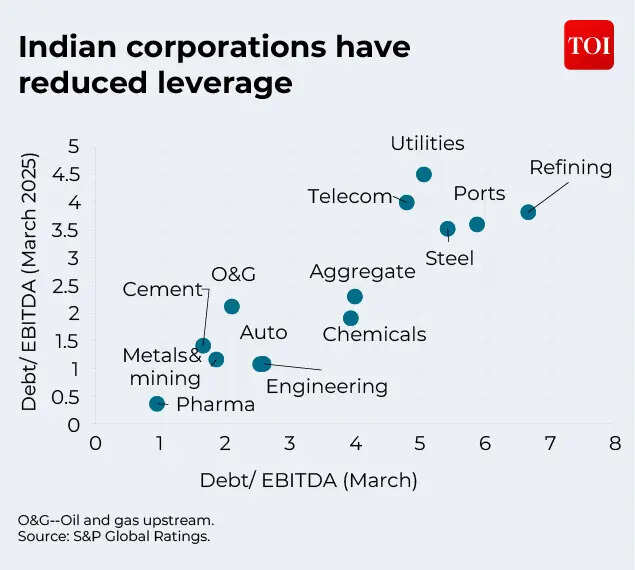
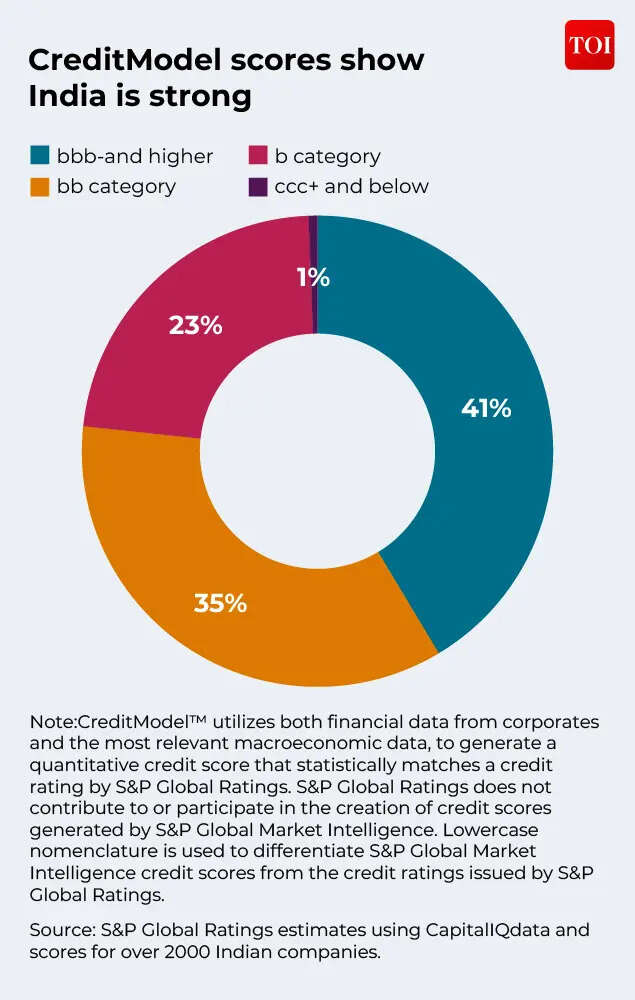
On the corporate front, S&P sees the EBITDA being hit across several sectors but sees resilience. “ At an aggregate level, we estimate that the EBITDA of about 100 of the largest corporates by EBITDA could decline by about 15% over fiscal 2027 and 10% over fiscal 2028 in our stress scenario, compared with previous expectations,” says S&P Global.If the disruptions extend up to six months, the resulting decline in capacity utilization, would mean that the corporate leverage increases by about 1x EBITDA in fiscal 2027. “Our scenario analysis shows a sharp rebound in earnings in fiscal 2028, with EBITDA recovering to fiscal 2026 levels. With most corporates entering the stress with strong balance sheets, it prevents a more severe deterioration in credit quality. Leverage at the end of fiscal 2028 would still be low relative to historical levels,” the report says. According to S&P Global, at a sectoral level:
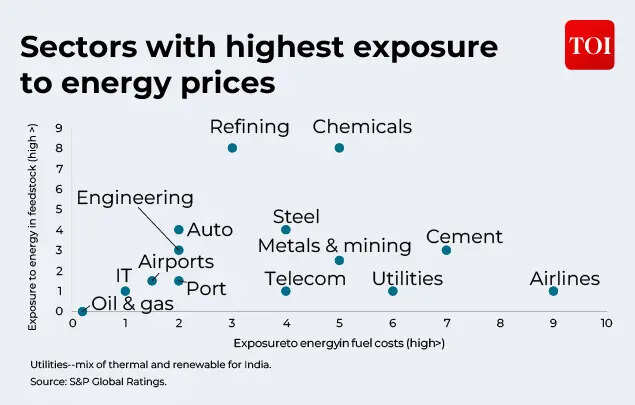
Chemicals, refining, and airlines are among the most exposed sectors.
Cement, metals and mining, steel, and autos could also see material hits, either due to the high energy intensity or raw material pressures.
The pharmaceutical sector may also face margin strains and supply chain risks. This sector, however, benefits from low leverage.
The infrastructure sector, on the other hand, would be relatively unaffected.
Utilities could see higher coal prices, but these would be passed on to customers under pricing mechanisms.
Airports could see lower passenger traffic, particularly if fuel supply issues affect airline capacities.
Some of the other factors that work in favour of corporates are:
The leverage of most sectors remains below the level at which Indian corporations entered the operational disruptions in 2020.
Earnings have grown about 50% over the past five years for the largest corporations. Over the same period, debt grew 10%.
Indian companies also have no major liquidity difficulties over the next year, in S&P’s view.
Proactive refinancing means there are no major maturity walls for companies. Onshore liquidity and access to diverse funding sources underpin the liquidity positions of companies. In contrast, refinancing risk was an issue for many companies and strained credit profiles during the pandemic.
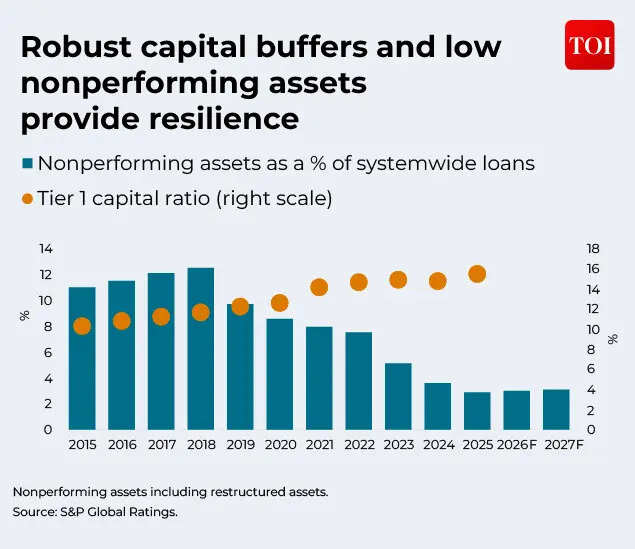
Yet another factor that will work in favour of India’s underlying economic strength is the banking system. As per S&P Global’s report, Indian banks are well-positioned to navigate elevated oil prices and a weakening rupee. “We believe sustained high energy prices and prolonged disruptions to global supply chains could weaken corporate and SME balance sheets. This could lead to a deterioration in asset quality for banks. However, the banks are starting from a position of strength, supported by near decade-high capital adequacy and multi-year low nonperforming loans,” it says.Any supply side shock would transmit to borrowers’ creditworthiness. However, banks do not have high exposure to chemicals, refining, and airlines, says S&P, pointing out that these are the sectors that are likely to be the most affected by the ongoing crisis. Not only that, the exposure of banks to other sectors that are exposed to energy shocks – cement, steel, and metals and mining – is also limited.
Add to that the point that strong fertilizer availability means there is near-term support to agriculture. However, a prolonged conflict may cause disruption to the next sowing cycle, prompting likely subsidy support from the government, the report says.“Higher fuel and transportation costs would squeeze real disposable income, with second-order effects on food and essential goods. Stress is likely to emerge first in unsecured segments and among self-employed borrowers. This could spill over to a degree into vehicle loans and affordable housing. However, the effects of retail issues should remain moderate for banks unless the shock becomes prolonged and begins to materially affect employment conditions,” the report adds.“The profitability of the Indian banking sector will be tested in fiscal 2027 not by domestic fundamentals, but by its ability to absorb external supply-side shocks., The combination of robust starting capital positions, a flight to quality for top-tier banks, and potential regulatory intervention suggests that the sector can avoid any sharp deterioration,” it concludes.
The Prolonged Crisis Scenario:
Even as S&P Global expresses confidence in India’s economic fundamentals it cautions that a longer conflict between the US and Iran could mean greater stress for India, as would be the case for most countries.“India would not be able to fully mitigate the damage of a sustained oil price shock. It is, however, in good shape to weather a few months of higher costs and supply-chain strain. We are watching for signs of how fast India can regain momentum in a scenario in which a ceasefire between Iran and its adversaries lasts. However, if hostilities again erupt, our focus will be on the measures that companies and the government take to prevent the crisis,” says S&P Global.
When the 106th Constitutional Amendment was passed by both Houses of Parliament in September 2023, with 454 votes in favor in the Lok Sabha and unanimous consent in the Rajya Sabha, it was seen as a historic moment. But there is a way of living in the interval between the passage of laws and their implementation. After about two and a half years, Parliament has been called again to close it.Lawmakers will attempt to do what thirty years of political wrangling could not, get India’s women a guaranteed seat at the table of power. The occasion is the Nari Shakti Vandan Act, which is known as the Women’s Reservation Bill.
bills at a glance
The Women’s Reservation Bill, formally known as the Nari Shakti Vandan Act, is a constitutional amendment that reserves 33 percent of the seats in the Lok Sabha and state assemblies for women. This is not a new idea. Bills to amend the Constitution to reserve seats for women in Parliament and state legislatures were introduced in 1996, 1998, 1999 and 2008. The first three bills lapsed with the dissolution of the respective Lok Sabhas, while the 2008 bill was passed by the Rajya Sabha but lapsed with the dissolution of the 15th Lok Sabha.This makes the 2023 passage the culmination of a legislative struggle that has lasted nearly three decades. The alliance was once derailed by arithmetic, ideological disagreements and, at times, outright hostility. When the bill was finally passed in 2023, it was passed in a brand new Parliament building, a symbolism the government wanted to underline. Women constitute less than 15 per cent of the membership of the Lok Sabha and in state assemblies, women constitute less than 10 per cent of members in most legislative bodies across the country. It is this inequity that the bill was created to correct.
House after reform
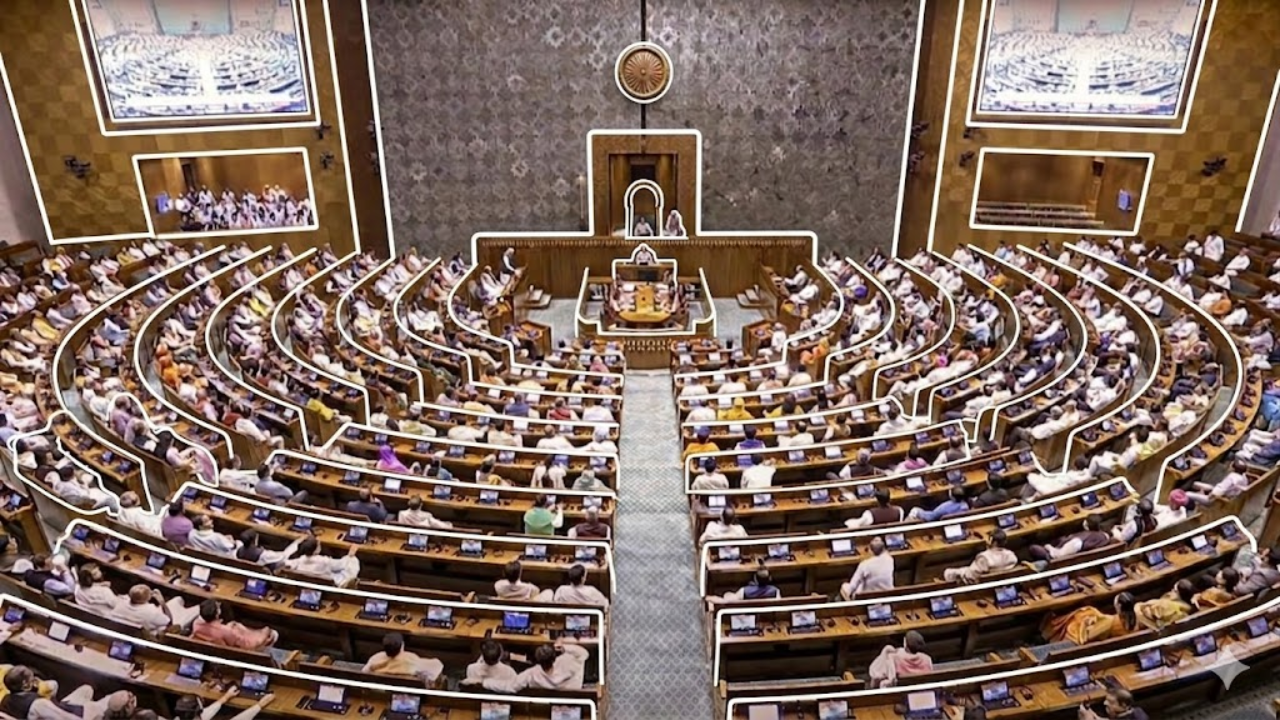
If the proposed changes are made, the structure of the Parliament of India will fundamentally change, both in size and representation.The Lok Sabha is expected to grow from its current 543 seats to 850, reflecting decades of population growth since the last amendment in 1976. Of these, 815 seats will be allotted to states and 35 to union territories.Within this expanded House, one-third of the seats, approximately 283, will be reserved for women, marking the first time that such a quota has been implemented at the national level.
What exists and what is still missing
The bill coincides with the 30th anniversary of the 73rd and 74th constitutional amendments of 1993, which added panchayats and municipalities to the Constitution and reserved one-third seats for women in local bodies.That experiment, which lasted three decades, has yielded real results. But that reservation stopped at the village and municipal corporation levels. The Constitution, as it stood until 2023, had no provision for reserving seats for women in the Lok Sabha or state legislatures, a lacuna that took 75 years to be formally addressed.This reduction is proportionate to the decision taken by Parliament. From criminal laws to maternity benefits, property rights to policies on gender-based violence, decisions taken in Parliament affect women’s lives at every level. A 2003 study on the impact of reservations for women in panchayats showed that women elected under the reservation policy invested more in public goods related to women’s concerns. The case for extending that principle to Parliament is not merely symbolic.
Why wasn’t 2023 the finish line?
The Act passed in 2023 brought with itself the seeds of delay. The 2023 constitutional amendment provided for 33 per cent reservation for women in the Lok Sabha and state assemblies, but this quota would come into effect only after the delimitation exercise is completed based on the 2027 census, meaning the reservation would not come into effect before 2034 under the original law.The reservation will take effect after the census to be conducted after the enactment of the Bill is published and delimitation will be done to reserve seats for women on the basis of that census.The logic is that you cannot decide which constituencies are to be reserved for women unless you know how many constituencies exist and where their boundaries are and this requires both a fresh census and the delimitation exercise that follows.Census 2021 is still incomplete, having been significantly delayed due to the COVID-19 pandemic, and the next census is now proposed for 2027, much before the 2029 general elections. The amendment was, for all practical purposes, a law in name only.
Special Session: Why Now?
The government now proposes to amend the law for implementation based on the 2011 census, to ensure that reservation is implemented before the 2029 general elections. To do this, Parliament will have to amend Section 5 of the Act, which currently links women’s reservation to the delimitation exercise after the first census after the commencement of the law. As a constitutional change, Article 368(2) mandates approval by a majority of the total members in both Houses and at least two-thirds of those present and voting, a high bar that requires at least some opposition support.Along with the amendment to the Women’s Reservation Act, the government is introducing a Delimitation Bill that will dramatically redraw the electoral map which, as mentioned above, could increase from 543 to 850 after the amendment. India’s population has changed significantly since the current 543-seat House was last calibrated. The cap on the number of seats, dating from 1976, was created to prevent states that control their population from being punished in Parliament. Seeing it again now, in 2026, is as much a statement about national demographics as it is about women’s rights.
debate on delimitation
Delimitation is a periodic exercise carried out to redraw the boundaries of constituencies and allocate seats in line with changes in population, ensuring fair representation for the states. India has conducted such exercises several times since independence. For the first time in 1952, 494 Lok Sabha seats were allocated on the basis of the 1951 census. This was followed by exercises in 1963 and 1973. During the 1973 delimitation, the number of seats was fixed at 543, based on the 1971 census, when India’s population was approximately 54.8 crore. That number has remained unchanged since then.The government’s current proposal to expand the Lok Sabha by about 850 seats has triggered a heated debate, mainly focusing on the alleged North-South divide. Since the proposed redistribution is expected to be based primarily on population, northern states, where population growth has been higher, are likely to get a larger share of seats. In contrast, southern states, which have seen slower population growth, may see a decline in their relative representation.like state Tamil NaduKerala, Telangana, Karnataka and Andhra Pradesh have consistently argued that representation should not be determined by population alone. They point out that decades of effective family planning have resulted in low birth rates and warn that a purely population-based approach would unfairly penalize them for this success. Meanwhile, more populous states like Uttar Pradesh, Bihar and Madhya Pradesh will benefit disproportionately.For example, MK Stalin argued that states that complied with central government pressure for population control should no longer suffer losses. Expressing this concern, the Telangana CM wrote to PM Modi and fellow southern leaders, urging them to oppose any expansion of the Lok Sabha on the basis of population metrics alone. In their letter, they warned that such a move would reduce representation and instead proposed a “hybrid model” that would take into account population as well as economic contribution and development indicators.
two sides of the argument
On the surface, the bill enjoys almost universal support. Prime Minister Narendra Modi Wrote letters to leaders of all parties in both Houses, seeking their support for the implementation of the Women’s Reservation Bill, and stressed that “this moment transcends any party or individual.”But there has been no consensus on the route and the objections of the opposition have become clear.senior congress leader Sonia Gandhi has criticized the government’s approach, noting that no draft amendments have been shared with opposition parties. congress president Mallikarjun Kharge Wrote directly to the Prime Minister, arguing that without details of delimitation and other aspects, it would be impossible to have any useful discussion on this landmark legislation and that the special meeting was called without taking the opposition into confidence.Time exacerbates these concerns. The session has been called during the ongoing state elections, scheduled to conclude on April 29, 2026, leaving opposition MPs juggling between campaigning and parliamentary attendance. Mallikarjun Kharge suggested that if the government really wants to move forward collaboratively, it should call an all-party meeting after the elections are over.a democratic arithmetic problemThere is one final lens through which this bill is worth examining: the sheer arithmetic of representation.Women constitute about 48.5 percent of India’s population. The number of males is about 51.5 percent. The 33 percent reservation for women in the bill is far less than proportional representation. Critics argue that the bill goes a step further and does not reflect the true demographic weight of women in India’s democracy. Defenders of the 33 per cent figure say it matches benchmarks already established in panchayats and municipalities and represents a realistic floor rather than an aspirational ceiling. The reservation shall be provided for a period of 15 years, although it shall continue till such date as may be prescribed by law made by Parliament, and the seats reserved for women shall be rotated after each delimitation. The rotation mechanism means that no constituency will be permanently designated as a women’s seat, an attempt to prevent permanent restriction of voter choice to any one area.
what does it stand for
What started as a legislative demand in 1996 has become a constitutional amendment looking for implementation thirty years later. The special session will determine whether Parliament finds political consensus to close that gap before the 2029 elections.There is no credible opposition to the spirit of the Bill. According to political analysts, the question is whether the opposition can afford to vote against the bill in the election season, as it could impact their electoral position in the upcoming assembly elections in West Bengal and Tamil Nadu. In the current political scenario of India, no party is ready to be seen voting against the representation of women.All arguments about seats, states and census data are genuine. But behind all this is that women have for too long been kept out of the rooms where decisions about their lives are taken. That’s what this bill is about.
Lucknow Super Giants (LSG) endured a sluggish start, reaching just 35/1 at the end of the powerplay against Royal Challengers Bengaluru (RCB), while skipper Rishabh Pant was forced to retire hurt after sustaining an elbow injury.
LSG lost an early wicket when Aiden Markram was dismissed by Rasikh Dar. The South African batter managed 12 runs off 8 balls before being caught, leaving the hosts under pressure in the early overs.
In a significant blow, captain Rishabh Pant had to retire hurt after being struck on the elbow by a delivery from Josh Hazlewood. Pant, who was yet to open his account, walked off the field in visible discomfort, casting doubt over his participation for the remainder of the match.
Josh Hazlewood emerged as the standout performer with the ball for RCB, conceding just six runs in his two overs during the powerplay. The Australian pacer returned to the playing XI after missing the previous match against the Mumbai Indians and made an immediate impact.
Earlier, RCB captain Rajat Patidar won the toss and elected to bowl first, citing favourable pitch conditions for chasing.
“We’re going to bowl first. It’s pretty obvious. I see a pretty good surface. So, we want to take advantage early and keep the pressure on. The previous game had a lot of grass, but this wicket looks better with no grass, so it should be a good track. Everyone has been contributing well, stepping up at different stages. That’s what defines our team. Just one change — Josh Hazlewood comes in place of Duffy,” Patidar said.
Confirmed Playing XI for both teams:
Lucknow Super Giants (Playing XI): Aiden Markram, Mitchell Marsh, Rishabh Pant(w/c), Nicholas Pooran, Ayush Badoni, Abdul Samad, Mukul Choudhary, Mohammed Shami, Avesh Khan, Digvesh Singh Rathi, Prince Yadav
Royal Challengers Bengaluru (Playing XI): Philip Salt, Devdutt Padikkal, Rajat Patidar(c), Jitesh Sharma(w), Tim David, Romario Shepherd, Krunal Pandya, Bhuvneshwar Kumar, Josh Hazlewood, Suyash Sharma, Rasikh Salam Dar
Days after actress Ruby Rose made shocking claims against Katy Perry, accusing her of sexual assault, a police investigation is now underway in Australia. Ruby accused Katy of sexually assaulting her more than ten years ago at a Melbourne nightclub. The investigation comes after the pop star has denied the allegations, calling them “reckless lies.”
Australian police investigating Katy Perry
The Victoria Police confirmed investigating the matter via a statement to Variety, which read, “Melbourne sexual offences and child abuse investigation team (SOCIT) detectives are investigating (an alleged) historical sexual assault that occurred in Melbourne in 2010. Police have been told the incident occurred at a licensed premises in Melbourne’s CBD. As the investigation remains ongoing, it would be inappropriate to comment further at this stage.”
Ruby Rose`s accusations
Rose recently came forward Sunday night accusing Perry. She made the shocking claims on Threads, saying Perry had allegedly sexually assaulted her at a club in Melbourne when they were both in their early 20s. Notably, Rose is now 40 years old, while Perry is 41.
“Katy Perry sexual assaulted me at spice market nightclub in Melbourne. Who gives a shit what she thinks,” Rose wrote while responding to a post from Complex sharing Perry’s reaction to Justin Bieber’s Coachella set.
Further elaborating the claims, Rose responded to a fan, writing, “She didn’t kiss me. She saw me ‘resting’ on my best friend`s lap to avoid her and bent down, pulled her underwear to the side and rubbed her disgusting vagina on my face until my eyes snapped open and I projectile vomited on her.”
Rose previously stated she wasn’t interested in filing a police report about the incident, however, on Tuesday she confirmed in a Threads post that she had “finalized all of my reports” and would no longer be able to “comment, repost, or talk publicly about any of those cases, or the individuals involved.” She added, “It’s going to look like I am ignoring everything from supportive messages, to other people’s experiences, but I’m not. This is a standard request from the police and in many ways, quite the relief.”
A representative for Perry earlier denied the claim to Variety. Their statement read, “The allegations being circulated on social media by Ruby Rose about Katy Perry are not only categorically false, they are dangerous reckless lies. Ms Rose has a well-documented history of making serious public allegations on social media against various individuals, claims that have repeatedly been denied by those named.”
A special three-day meeting of Parliament will be held from April 16-18 to make amendments for the implementation of the ‘Nari Shakti Vandan Act’.
Rahul Gandhi and Mallikarjun Kharge (left). (PTI file)
Protesting delimitation, the Indian faction of the opposition has decided to vote against the Women’s Reservation Bill linked to it, Congress chief Mallikarjun Kharge said on Wednesday on the eve of a special three-day session to push for implementation of the law.
Kharge said, “We are all in favor of the Women’s Reservation Bill. But we have objection to the way they have brought it. It is politically motivated.” He said the move was aimed at “suppressing opposition parties”.
A special three-day sitting of Parliament will be held from April 16 to 18, during which amendments to the ‘Nari Shakti Vandan Act’, commonly known as the Women’s Reservation Act, mandating 33 per cent reservation for women in the Lok Sabha and state assemblies, will be brought for implementation in 2029.
The government on Tuesday distributed bills related to women’s quota law and delimitation among MPs. The Congress has alleged that when the intention behind a bill is “mischievous” and its content “devious”, the extent of damage to parliamentary democracy is “enormous”.
Women’s Reservation: Draft Bill and Delimitation
according to draft bill, Lok Sabha seats will be increased from the current 543 to 850 in 2029 to “operationalize” the women’s reservation law, following the delimitation exercise to be conducted based on the 2011 census.
Seats in state and union territory assemblies will also be increased to accommodate the 33 percent reservation for women.
The Government proposes to delink reservation from the need for a fresh census and subsequent delimitation. A central part of the plan is to increase the total number of Lok Sabha seats from 543 to 850. The government plans to introduce a Delimitation Bill, 2026, to redraw constituency boundaries based on 2011 census data instead of waiting for new population data.
We are all in favor of the Women’s Reservation Bill. However, the manner in which it has been brought about is questionable and we have serious objections to it. This is politically motivated. Modi government is working in this way to target and suppress opposition parties.We… pic.twitter.com/mxiVxxWmvr
Congress President Mallikarjun Kharge said Parties have “Reservations” Regarding the manner of presenting the bill. “They are playing some tricks regarding delimitation. All parties should unite and fight in Parliament. We will oppose this bill, but we are not against reservation (for women),” he said.
“Although we have consistently supported the Women’s Reservation Bill, we insist that the earlier amendments be implemented,” Kharge said, adding that the parties have long had concerns over the delimitation process.
Congress’s Jairam Ramesh said, “All opposition parties want that one-third reservation should be given to women and it should be implemented on the basis of the existing Lok Sabha number of 543.”
He said, “Women’s reservation should be implemented from the 2029 Lok Sabha elections itself. All opposition parties are completely against the provisions of delimitation. We will participate in the debate in the Lok Sabha and Rajya Sabha and oppose it.”
Can the bill overcome parliamentary hurdles? Does the NDA government have the numbers?
Under Article 368, needs modification A majority of the total membership of the House and two-thirds majority of the members present and voting.
To pass a constitutional amendment, the government needs a special majority – two-thirds of those present and voting, plus at least 50% Of the total strength of the house.
Lok Sabha
NDA strength: 293
Indian group strength: 230-240
2/3 majority mark: 364 (if all 543 vote)
Margin for NDA: 71
Rajya Sabha
NDA strength: 141
Indian group strength: 58-62
2/3 majority figure: 164 (out of 245 members)
Margin for NDA: 23
In the Lok Sabha, the NDA’s strength includes the BJP with 240 seats, followed by allies like the Telugu Desam Party (TDP) with 16 seats and the JD(U) with 12 seats. The India Bloc is led by Congress with 100 seats and Samajwadi Party (SP) with 37 seats.
NDA’s strength increased from 135 to 141 in March after winning 22 out of 37 seats contested in the Rajya Sabha shift elections. This victory was strengthened by cross voting in states like Bihar and Odisha.
While the government can pass ordinary bills, it is about 70 seats short in the Lok Sabha and 23 seats short in the Rajya Sabha for the two-thirds majority required for the proposed Constitution (131st Amendment) Bill, 2026 (about 364 in the Lok Sabha and 164 in the Rajya Sabha).
The India Bloc, led by the four largest opposition parties – Congress (98), Samajwadi Party (37), TMC (28), and DMK (22) – has about 185 MPs in the Lok Sabha. If they vote together, they can easily stop the government from reaching the figure of 364.
If opposition members abstain or walk out, the government can still pass bills reducing the total number of members “present and voting”, thereby reducing the absolute number of votes required for a two-thirds majority.
Prime Minister Narendra Modi has approached the leaders of all the houses for a special session to find a middle path.
⦿ Saree Electronics wants to give women together, it should be finalized and implemented on the basis of 543⦿ Female Night should be implemented from 2029 elections itself.
⦿ Sari is completely against the entrepreneurs of enterprise delimitation. We will do something else… pic.twitter.com/i0HkF2n8bC
top opposition leader A meeting was held at the residence of Congress President Mallikarjun Kharge on Wednesday to discuss the women’s quota law and develop a joint strategy. Several opposition parties are protesting against linking the women’s reservation law to the delimitation process and increasing seats in several state assemblies as per the 2011 census, and have accused the ruling NDA of playing politics over the law. Leaders of Congress, DMK, Trinamool Congress, Samajwadi Party, RJD, CPI and CPI-M were present in the meeting held at Kharge’s residence.
Apart from Kharge and Rahul Gandhi, other leaders at the meeting included DMK’s TR Baalu, RJD’s Tejashwi Yadav, Trinamool’s Sagarika Ghosh, Shiv Sena (UBT) leaders Sanjay Raut and Arvind Sawant and NCP-SCP’s Spriya Sule, which Samajwadi Party chief Akhilesh Yadav attended virtually.
Apart from Congress general secretaries KC Venugopal and Jairam Ramesh, CPI leader Annie Raja, CPI-M’s Nilotpal Basu, AAP leader Sanjay Singh, Independent MP Kapil Sibal, IUML’s ET Mohammad Bashir and RSP’s NK Premachandran also attended the meeting.
Kharge had earlier called a meeting of the Congress Parliamentary Strategy Group at his residence, where top party leaders discussed women’s reservation and the delimitation process.
What are their concerns?
While the Indian faction largely supports the 33% quota, they are critical of several proposed changes in the Constitution (131st Amendment) Bill, 2026 and the Delimitation Bill, 2026. Opposition leaders, especially Southern states Like Tamil Nadu (Chief Minister MK Stalin), there are arguments that the population-based delimitation exercise would unfairly reduce the political representation of states that have successfully implemented family planning.
The government proposes to increase the size of the Lok Sabha from 543 to 850 seats. The opposition says that this expansion will not be on a proportionate basis and may harm non-Hindi speaking areas.
Parties like BSP (Mayawati) and members of the India Bloc continue to demand separate “quotas within quotas” for women belonging to Scheduled Castes (SC), Scheduled Tribes (ST) and Other Backward Classes (OBCs).
Critics argue that by linking reservation to delimitation, the government is delaying its actual implementation until at least the 2029 general elections.
Handpicked stories, in your inbox
A newsletter featuring the best of our journalism
first published:
April 15, 2026, 17:14 IST
newsIndia Indian faction to oppose Women’s Quota Bill on delimitation: Does the government have the numbers to get it approved?
Disclaimer: Comments represent the views of users, not of News18. Please keep discussions respectful and constructive. Abusive, defamatory, or illegal comments will be removed. News18 may disable any comments at its discretion. By posting you agree with us terms of use And Privacy Policy.