


Israel strikes hit southern Lebanon and Hezbollah fires rockets at Israel, a day after rare direct negotiations.
Israel and Hezbollah continue attacks after Israel-Lebanon talks in US

Naagzilla: Kartik Aryan`s creature comedy postponed to February 2027


Directed by Mrighdeep Singh Lamba, who is known for the Fukrey franchise, and headlined by Kartik Aaryan, Naagzilla has been one of the most anticipated films. The film was all set to release on August 4, 2026, however, as per the latest update, fans will have to wait a little longer to watch the creature comedy.
Naagzilla release date potsponed
The comedy adventure film starring Kartik Aaryan is set to hit the cinemas on February 12, 2027. The makers of the film announced the new release date on Wednesday, along with the film`s poster.
Last year in April, Kartik had announced the film on his Instagram handle, sharing a striking motion poster that shows him shirtless, gazing over a cityscape from within a snake-filled lair. In the caption, Kartik wrote, “I`ve seen many human stories, now watch a story of naags. Naagzilla – Naag lok ka Pehla Kaand… Fun phailaane Aa raha hu main, Preyamvadeshwar Pyare Chand… Naag Panchami par aapke nazdeeki SsSsinemas mein. 4 August 2026 ko”.
About Naagzilla
Naagzilla promises a world of shape-shifting snakes, rooted in Indian folklore. The film is produced by Karan Johar, Mahaveer Jain, Adar Poonawalla, Apoorva Mehta, Mrighdeep Singh Lamba, and Neetu M Jain. Backed by Dharma Productions and Mahaveer Jain Films, the film is co-produced by Marijke deSouza & Divyansh Jain. Written by Gautam Mehra.
Kartik Aaryan will essay the role of Preyamvadeshwar Pyare Chand, an Icchadhaarinaag (shape‑shifting snake) who embarks on an epic adventure. Meanwhile, actor-politician Ravi Kishan will reportedly play the villain against Kartik. According to reports, South Indian actress Preity Mukhundhan will play the female lead in the film. However, nothing has been confirmed so far by the makers.
Meanwhile, on the work front, Kartik Aaryan was last seen in Tu Meri Main Tera Main Tera Tu Meri, alongside Ananya Panday, which bombed at the box-office despite a festive Christmas release. The romantic comedy opened to modest numbers but struggled to sustain momentum later. Going forward, the actor has films like the aviation drama Captain India (2027), and Bhool Bhulaiyaa 4 in the pipeline. Similarly, he also has an untitled musical with director Anurag Basu, co-starring Sreeleela and a project with producer Luv Ranjan in development.
IPL 2026: Virat Kohli not in XI as RCB opt to bowl against LSG | Cricket News


NEW DELHI: Virat Kohli was not included in Royal Challengers Bengaluru’s starting XI against Lucknow Super Giants in Bengaluru, but he was named among the Impact Players, meaning he could still come in to bat if needed. His absence at the start comes after he picked up an ankle injury in RCB’s previous match against the Mumbai Indians, where they secured an 18-run win. Kohli and Philip Salt had been forming a steady opening pair, so his limited role slightly affects the team’s balance.RCB captain Rajat Patidar opted to bowl first, trusting the pitch conditions to help early on. “We’re gonna bowl first. It’s pretty obvious. I see a pretty good surface,” Patidar said at the toss.
“So, we bowl first and take the advantage of the first innings and keep the pressure. Not much (on the pitch). The previous game was having a lot of grass. But I think this wicket, I think there is no grass. So, it will be a good track. But yeah, let’s see.”On the other side, LSG skipper Rishabh Pant sounded confident despite his team’s inconsistent run so far. “We’re pretty confident, [it’s a] good batting pitch. Regardless of whether we bat first or second, we need to do well,” he added. “We don’t want too much introspection; put trust in your team and do well. There are a lot of leaders in the group, so go out and perform well. Same team for us.”RCB made one change, bringing in Josh Hazlewood. Patidar said, “I think everyone is doing pretty much good for the team… Just one change. Josh Hazlewood comes in place of Duffy.”With Kohli still available as an Impact Player despite his recent injury, and both teams eager to climb the table, the contest remains evenly poised.Lucknow Super Giants (Playing XI): Aiden Markram, Mitchell Marsh, Rishabh Pant(w/c), Nicholas Pooran, Ayush Badoni, Abdul Samad, Mukul Choudhary, Mohammed Shami, Avesh Khan, Digvesh Singh Rathi, Prince YadavLucknow Super Giants Impact Subs: Manimaran Siddharth, George Linde, Matthew Breetzke, Himmat Singh, Mayank YadavRoyal Challengers Bengaluru (Playing XI): Philip Salt, Devdutt Padikkal, Rajat Patidar(c), Jitesh Sharma(w), Tim David, Romario Shepherd, Krunal Pandya, Bhuvneshwar Kumar, Josh Hazlewood, Suyash Sharma, Rasikh Salam DarRoyal Challengers Bengaluru Impact subs: Virat Kohli, Venkatesh Iyer, Jordan Cox, Kanishk Chouhan, Mangesh Yadav
Akshay Kumar gets emotional as he calls of Bhooth Bangla a tribute to ‘comedy ke ustad’ Asrani

Bollywood actor Akshay Kumar is currently gearing up for the release of his upcoming film, Bhooth Bangla. The movie will also feature the late actor Asrani posthumously. Akshay recently shared a photo with him from the film’s set, remembering the late star as a master of comedy. He added that Bhooth Bangla is not just a film for him, but also a heartfelt tribute and salute to the legendary actor.

Akshay Kumar remembers Asrani ahead of Bhooth Bangla release
On Wednesday, Akshay took to Instagram and shared a picture with Asrani from the sets of Bhooth Bangla. Along with the picture, he wrote, “Kabhi kabhi ek tasveer sirf yaadon ka tukda nahi hoti… ek poori journey ko samet leti hai. Yeh picture humari Bhooth Bangla ki shoot se hai… Asrani ji ke saath meri second-last film. Total 12 films humne saath ki, aur har ek mein maine unse kuch naya seekha… it was like a masterclass every single time” (Sometimes, a picture is not just a fragment of memories… it captures an entire journey. This picture is from the shoot of our film Bhooth Bangla… my second-last film with Asrani ji. We worked together in a total of 12 films, and with each one, I learnt something new from him… it was like a masterclass every single time).
He further praised the late actor’s comic timing and added, “Comedy itni aasaan lagti thi jab woh karte the, lekin asal mein woh ek mushkil kala hai. Asrani ji uske ustad the aur hamesha rahenge. Bhooth Bangla kal release ho rahi hai… mere liye yeh sirf ek film nahi, ek yaad hai… ek tribute hai… ek salute hai uss legend ko. Asrani ji, aap hamesha yaad aayenge” (Comedy looked so effortless when he performed it, but in reality, it is a difficult art. Asrani ji was its master and always will be. Bhooth Bangla releases tomorrow… for me, this is not just a film, it is a memory… a tribute… a salute to that legend. Asrani ji, you will always be remembered).
About Asrani’s death
In October 2025, the iconic jailer of Sholay and popular comic actor Asrani died at the age of 84 after battling a prolonged illness. The actor’s last rites were performed at Santacruz Crematorium. He is survived by his wife, sister and nephew.
About Bhooth Bangla
Helmed by Priyadarshan, Bhooth Bangla is a horror-comedy which also stars Wamiqa Gabbi, Tabu, Paresh Rawal and Rajpal Yadav in key roles. The film marks Akshay and Priyadarshan’s reunion after over a decade, and fans are excited to see if the duo can recreate their magic on the big screen once again. The film is scheduled to release in theatres on April 17, with paid previews starting from April 16, 9 pm onwards.
Donald Trump targets Fed chief Jerome Powell again, threatens to fire him if he is ‘not leaving on time’

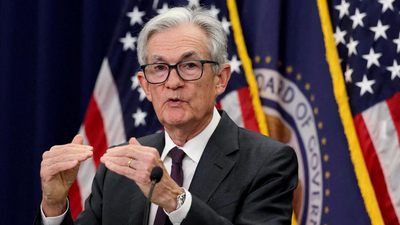
US President Donald Trump on Wednesday renewed his attack on Federal Reserve Chair Jerome Powell, saying he would fire him if he continues in the role beyond the end of his mandate.Powell’s term as Fed chair ends in mid-May, and Trump has repeatedly criticised him for not cutting interest rates more aggressively, AFP reported.“I’ll have to fire him,” Trump told Fox Business, if Powell “is not leaving on time.”The president added: “I’ve wanted to fire him.”The remarks come as the Trump administration steps up pressure on the independent central bank, including initiating a Department of Justice probe into Powell over alleged renovation cost overruns and seeking to remove Fed governor Lisa Cook.Asked if he would drop the DOJ investigation, Trump said: “I’m not playing. I have to find out.”Trump has nominated former central banker Kevin Warsh to succeed Powell, but his appointment requires confirmation by the US Senate.Warsh is scheduled to appear before the Senate Banking Committee next Tuesday, though his confirmation faces resistance.Senator Thom Tillis, a Republican member of the committee, has said he would hold up the nomination while the probe into Powell remains unresolved.As long as the nomination process is delayed, Powell can legally continue as Fed chair.While uncommon, it is possible for a Fed chair to remain on the board even after their term as chief expires.Powell first became Fed chair in 2018 during Trump’s earlier presidency and was reappointed in 2022 under then president Joe Biden.
Iran’s Regime has Changed—for the Worse

On March 13, a massive billboard appeared in Tehran’s Enqelab Square. It showed Iran’s newly selected supreme leader, Mojtaba Khamenei, standing in a trench and instructing commanders of the Islamic Revolutionary Guard Corps to fire missiles at their enemies. The text suggested the mission is divinely inspired, comparing Khamenei to Imam Ali, a revered Muslim figure known for his legendary victory over Jewish tribes.
For opponents of Iran’s regime, the image is the visual representation of their worst nightmare: a militarized Iran ruled by a younger, hard-line leader where the Revolutionary Guard plays an even more dominant role.
IPL 2026: Rajat Patidar wins toss; RCB opt to bowl first against LSG


Rajat Patidar won the toss and Royal Challengers Bengaluru (RCB) elected to bowl first against Lucknow Super Giants (LSG). The two sides are set to clash at the M. Chinnaswamy Stadium in Bengaluru. RCB have won three of their four matches so far, while LSG have won two matches and sit on four points.
After winning the toss, Patidar chose to bowl first, expressing confidence in his team’s current form.
“We’re going to bowl first. It’s pretty obvious. I see a pretty good surface, so we want to take advantage early and keep the pressure on. Not much to say about the pitch — the previous game had a lot of grass, but this wicket looks bare, so it should be a good track. Let’s see how it plays. I think everyone is doing well for the team, stepping up at different stages and performing when needed. That’s what this team stands for. Just one change – Josh Hazlewood comes in place of Duffy,” Patidar said.
LSG skipper Rishabh Pant admitted that he would have preferred to bowl first as well. He stressed the importance of collective responsibility as his team looks to put up a competitive total against a strong RCB batting line-up.
“It looks like a pretty good wicket to bat on. On surfaces like this, you can choose to bat or bowl first, but eventually, you have to play better cricket. As a group, we need to regroup, come together, and take ownership of our roles. We don’t want to overthink every match — we just want to trust the group. Hopefully, individuals will step up and take responsibility to win matches for the team. Leadership is important, and we have many leaders in the group. Ultimately, it’s about going out there, handling pressure, and delivering for the team. We’re playing with the same XI,” Pant said.
Confirmed Playing XI for both teams:
Lucknow Super Giants (Playing XI): Aiden Markram, Mitchell Marsh, Rishabh Pant(w/c), Nicholas Pooran, Ayush Badoni, Abdul Samad, Mukul Choudhary, Mohammed Shami, Avesh Khan, Digvesh Singh Rathi, Prince Yadav
Royal Challengers Bengaluru (Playing XI): Philip Salt, Devdutt Padikkal, Rajat Patidar(c), Jitesh Sharma(w), Tim David, Romario Shepherd, Krunal Pandya, Bhuvneshwar Kumar, Josh Hazlewood, Suyash Sharma, Rasikh Salam Dar
Naagzilla release date postponed from Independence Day; Kartik Aaryan film to now hit the screens in 2027

Director Mrighdeep Singh Lamba’s next film, Naagzilla: Naag Lok Ka Pehla Kaand, will not hit the screens as planned for Independence Day weekend. The film starring Kartik Aaryan will now be released only in 2027. Naagzilla, a creature comedy based on Indian folklore, has a new release date, announced on Wednesday.

Naagzilla new release date announced
A press release states that Naagzilla will now be released on February 12, 2027, for the Valentine’s Day weekend, rather than its initial August 14 release date. In March, when Prime Video announced its slate of films for this year, Naagzilla was included. The announcement had positioned the creature comedy as one of their major upcoming theatrical-backed projects. A poster also offered a glimpse of the film’s tone, showing Kartik against the looming form of a serpent. It was announced that the film would hit the screens on August 14 during the Independence Day weekend, followed by a digital release on Prime Video. However, the film is now postponed.
About Naagzilla
Naagzilla is directed by Mrighdeep Singh Lamba, written by Gautam Mehra and produced by Karan Johar, Mahaveer Jain, Adar Poonawalla, Apoorva Mehta, Mrighdeep Singh Lamba, and Neetu M Jain under Dharma Productions and Mahaveer Jain Films. It is co-produced by Marijke deSouza and Divyansh Jain.
Kartik plays an icchadhari naag (shapeshifting snake) in the film, and his character is named Preyamvadeshwar Pyare Chand. In April 2025, he shared a motion poster on his Instagram, writing, “Insanon wali picharein toh bahut dekh leen, ab dekho naagon wali pichchar…#Naagzilla – Naag lok ka Pehla kaand..Funnn phailaane Aa raha hu main, Preyamvadeshwar Pyare Chand…Naag Panchami par (snake emoji) aapke nazdeeki Sssssinemas mein. 14 August 2026 ko.”
(Translation: You have seen enough films about humans, now watch one about snakes…Naagzilla – the first mischief of Naag lok. I am coming to spread fun, Preyamvadeshwar Pyare Chand…on Naag Panchami…in theatres near you.)
Recent work
Kartik was last seen in the 2025 film Tu Meri Main Tera Main Tera Tu Meri opposite Ananya Panday. The film was a box-office disappointment, earning just around ₹49 crore. The actor now has yet-to-be-titled films with Anurag Basu and Kabir Khan lined up apart from Naagzilla. The Anurag-directed film will mark South star Sreeleela’s debut in Bollywood. The musical had its first look revealed in 2025, but so far, there has been no update on its release date. Many have compared it to the Aashiqui films.
‘Only after hitting 6s against India …’: Pakistan’s Sahibzada Farhan makes big revelation | Cricket News


Pakistan’s Sahibzada Farhan makes big revelation (AP Photo)
NEW DELHI: Pakistan batter Sahibzada Farhan says his most memorable sixes came against India, especially during the Asia Cup. “The ones I hit against India in the Asia Cup. People started to recognise my six-hitting ability after that,” Farhan told ESPNCricinfo. In that final, Farhan stood out by smashing three sixes off Jasprit Bumrah, a rare feat in T20Is. Despite his efforts, India, led by Suryakumar Yadav, won the match, thanks to a successful chase finished by Tilak Varma.
Farhan later explained that his approach wasn’t just about targeting Bumrah alone but facing a strong bowling attack that included Axar Patel and Kuldeep Yadav. “Speaking about Bumrah, I don’t think there was only Bumrah in that (Indian) team. All of them were some of the best bowlers, like Axar Patel and Kuldeep Yadav. So it’s not that there was only Bumrah. But I started with Bumrah. You get confidence as a player when you hit a good player for a six,” he said.He admitted Bumrah challenged him early on. “If you look at him, he gave me a tough time in the beginning. He was bowling slower ones, yorkers and bouncers. He swings the ball, bowls outswing and inswing. It’s natural that it’s very difficult to play him. So you have to find your way. And when you cross that phase, the rest of the bowlers seem easy to you, I think,” he added.Farhan has been in top form since 2025, scoring heavily in T20 cricket and breaking records, including a standout T20 World Cup performance. However, he also drew criticism for a controversial celebration against India, mimicking an AK-47 shot, which upset fans and led to a reprimand.
As world focuses on Iran, Israel ‘engineering starvation policy’ in Gaza | Gaza News

With the global attention fixated on the diplomatic efforts to end the war on Iran, Israel has systematically escalated its attacks on Gaza and choked off vital aid, plunging the besieged enclave into what economic experts are now calling an “engineered, compounded famine”.
The number of aid trucks entering Gaza has dropped drastically in violation of the October 2025 ceasefire with Hamas. Since then, the Government Media Office in Gaza has recorded 2,400 military violations by Israeli forces, resulting in the killing of more than 700 Palestinians.
Recommended Stories
list of 4 itemsend of list
On Tuesday, Israel’s military killed at least 11 Palestinians, including two children, in separate attacks across the war-torn Strip.
The intensity of these attacks spiked during peak regional tensions. Between February 28 and April 8, while Israel and the US were engaged in a bombing campaign against Iran, Israeli forces bombed Gaza on 36 out of those 40 days.
In the last five weeks alone, more than 100 people have been killed, including Al Jazeera journalist Mohammed Wishah. Israel has killed more than 72,336 people since launching the brutal military offensive on October 7, 2023.

The ‘truck deception’
While Israel frequently claims it is allowing hundreds of aid trucks into Gaza, Palestinian officials and economic experts argue these figures are a deliberate mathematical deception.
According to the Government Media Office, only 41,714 aid and commercial trucks have entered Gaza over the past six months. This represents a mere 37 percent of the 110,400 trucks stipulated under the ceasefire agreement. The fuel situation is even more critical, with only 1,366 fuel trucks entering out of a promised 9,200 – an abysmal 14 percent compliance rate.
Recent daily logs highlight the severity of the bottleneck. On April 13, a total of only 102 aid trucks and 7 fuel trucks were allowed into the entire Strip, alongside 216 commercial trucks – a fraction of the more than 600 total trucks required daily under the “ceasefire” deal. By April 14, the numbers remained critically low with 122 aid trucks and 12 fuel trucks entering.
Crucially, Israeli authorities entirely shut down additional entry points like the Zikim and Kissufim crossings, which had processed dozens of commercial and aid trucks just a day prior, bottlenecking all limited traffic exclusively through Karem Abu Salem.
Mohammed Abu Jayyab, a Palestinian economic expert based in Gaza, told Al Jazeera that Israel utilises a “technical and commercial deception” to inflate these numbers.
“An Israeli truck carries up to 32 or 34 pallets… which are then unloaded into two or three smaller, dilapidated Palestinian trucks on the Gaza side,” Abu Jayyab explained. “Consequently, the UN and Israel count double or triple the actual number of Israeli trucks entering.” One pallet holds roughly 1 tonne of goods or food items.
Furthermore, Israel recently banned mixed-load shipments. If a merchant brings in 20 pallets of sugar, the remaining 12 pallet spaces on the truck must remain empty, yet it is still registered as a full commercial truck.
“The political agreement stipulated a ‘truck’ but did not specify quantities, weights, or the number of pallets,” Abu Jayyab noted, allowing Israel to weaponise logistics to restrict aid while appearing compliant.
Engineering starvation
This logistical strangulation is part of a broader strategy. Hassan Abu Riyala, undersecretary of the Ministry of National Economy in Gaza, stated in a meeting published on the ministry’s official Telegram channel that Israel is “engineering a policy of starvation”.
To ensure chaos in the local markets and sky-high prices, Israel has deliberately dismantled civil regulatory bodies. “The occupation targeted the majority of the crews that monitored prices, and assassinated the [former] undersecretary of the Ministry of Economy and five directors general during the war,” Abu Riyala said.
The results have been devastating, basic commodities have become scarce, and bread production has plummeted to 200 tonnes daily, far below the 450 tonnes required to feed the population.
“We manage this structural deficit under exceptional and coercive conditions,” Ismail Al-Thawabteh, director general of the Government Media Office, told Al Jazeera.
He described the ongoing reduction of supplies despite the truce as a “systematic restriction of basic supplies” that pushes the population towards dangerous levels of food insecurity. Fresh produce has skyrocketed, with 1kg (2.2lb) of tomatoes jumping from $1.50 to nearly $4 in a matter of weeks.
Moreover, the humanitarian catastrophe is being accelerated by the withdrawal of major aid groups. Al-Thawabteh noted that the scaling back or suspension of operations by key international institutions, most notably the World Food Programme (WFP), due to Israeli restrictions, represents a “highly dangerous development” that threatens the complete collapse of Gaza’s relief system.
“We issue an urgent appeal to the international community and the guarantors of the agreement to immediately pressure Israel to open the crossings… before reaching a point of no return and an imminent human explosion,” he said.
A ‘compounded famine’
The crisis has evolved beyond a simple lack of food; it is now a complete collapse of the Palestinian economy.
Abu Jayyab described the current situation as a “compounded famine”. With unemployment soaring to 80 percent and the destruction of more than 160,000 jobs across industrial, agricultural, and commercial sectors, the population has entirely lost its purchasing power.
“It has become illogical to link the entry of food supplies from the crossings to their availability to Palestinian citizens,” Abu Jayyab told Al Jazeera. Even when goods reach the market, between 70 to 80 percent of families simply cannot afford to buy them due to the total absence of income.
This extreme deprivation is forcing civilians into life-threatening alternatives. “The return of long queues for bakeries, and citizens resorting to burning plastic and waste in the absence of cooking gas, are dangerous field indicators of an unprecedented deterioration,” Al-Thawabteh warned, noting that government health facilities are currently struggling to treat respiratory and skin diseases resulting from this toxic pollution.
The medical blockade
Meanwhile, the stranglehold extends to Gaza’s most vulnerable patients. While the ceasefire agreement mandated the opening of the Rafah crossing for medical evacuations, Israel has kept the borders tightly restricted.
Over the past six months, only 2,703 people have been allowed to cross through Rafah out of an expected 36,800 – a compliance rate of just 7 percent. Consequently, only 8 percent of the severely wounded and chronically ill patients slated for urgent medical evacuation have been permitted to leave. According to the World Health Organization, roughly 18,000 people are still trapped in Gaza waiting for life-saving treatment abroad.

