Thursday, October 1, 2026
Home Blog Page 6917

U.S. Military Planes Carrying Migrants Land in Guatemala

0
U.S. Military Planes Carrying Migrants Land in Guatemala


Two military jets landed in Guatemala City on Friday carrying deported migrants from Tucson, Ariz., and El Paso, according to local migration authorities and the American Embassy in Guatemala.

Guatemala appears to be one of first countries to have struck an agreement with the United States to receive deported citizens transported on U.S. Air Force jets, after the Trump administration this week authorized the military through executive order to assist in securing the border.

The acting secretary of defense, Robert Salesses, said in a statement this week that, working with the State Department, the Department of Defense would provide military airplanes to support Department of Homeland Security “deportation flights of more than 5,000 illegal aliens from the San Diego, California, and El Paso, Texas, sectors detained by Customs and Border Protection.”

The U.S. Embassy in Guatemala could not confirm how many more military jets were expected to transport deportees to the country or on what timeline.


Myanmar Rebels Are Opening Colleges

0
Myanmar Rebels Are Opening Colleges


The medical student was showering near his dormitory in the jungles of eastern Myanmar when he heard military jets flying overhead. Wearing only undershorts, he raced to a bomb shelter. But there, he faced another danger: a black snake. Grabbing a stick, he killed it before it could bite him.

“It was terrifying,” said Khuu Nay Reh Win, 21, who was inspired to become a surgeon after working as a rebel army medic. “The fear of dying from a snakebite is as real as the fear of bombs.”

Such is student life at Karenni Medical College, a school founded two years ago in territory controlled by rebel forces. The campus, with classrooms and dorms made of thatched bamboo, was built deep in the jungle by the professors and students themselves.

It is one of 18 small universities, colleges and academies established in rebel-held territory in the four years since Myanmar’s military ousted the country’s civilian leaders and seized power in a coup, according to anti-junta officials in five regions of the country. They lack funds for much-needed equipment and supplies, and their facilities are simple. But the hope is that these schools can help create the foundation for a new democratic society in the country.

“We opened without waiting for the revolution to end because we were concerned that if young people were cut off from education for too long, they might change paths, face delays in their learning and miss out on higher education opportunities,” said Dr. Myo Khant Ko Ko, the founder and president of Karenni Medical College.

Myanmar’s civil war has shattered the rhythms of life in the country. Thousands of people have been killed by the military. Tens of thousands more have been imprisoned. Millions have become refugees in their own country. And the economy lies in ruins.

The anti-junta forces are a loose alliance of disparate groups of armed ethnic minorities that have fought the military for years, and of units formed more recently from the ranks of pro-democracy protesters.

In the past 15 months, ethnic rebel forces have scored numerous victories in the countryside, and anti-junta forces now claim control of more than half the country’s territory, giving rise to optimism among supporters.

But the junta retains control of Myanmar’s major cities and the capital, Naypyidaw, as well as most of the country’s wealth and air power. A clear-cut victory remains elusive for the rebels, who lack significant international support, a steady flow of munitions and, most important, a unified command structure, said Anthony Davis, a Bangkok-based security analyst with the Janes group of military publications.

The 18 schools, which are all located in ethnic rebel territory, are recognized by the shadow National Unity Government, said its deputy minister of education, Sai Khaing Myo Tun. Students pay little or nothing to attend.

Educators are also trying to establish a school system for primary- and secondary-school students, many of whom live in camps for displaced people.

The universities and colleges, with student populations ranging from dozens to the low hundreds, offer degrees in the sciences, liberal arts, agriculture, law, technology, nursing and music, among others. Some have ties to foreign universities and have sent students abroad to study.

To avoid airstrikes, the schools remain as concealed as possible. Some have taken over buildings partly damaged by fighting. Others are tucked away in residential areas or are hidden beneath the jungle canopy.

Some students commute to campus from refugee camps where they live with parents and siblings. Others have enlisted with the rebel forces and attend class when they are not fighting.

One school, the Ta’ang Arts Academy in Shan State, is devoted to ethnic culture and music. Its first class has 27 students. The director, Owm Sa Ngarr, said he hoped to preserve local culture while using music “as a medium for healing the psychological trauma faced by people living in conflict zones.”

The biggest challenge, administrators said, was a lack of funding to buy equipment, pay salaries and improve facilities.

But everyone lives in fear of junta jets and drones.

“Every day, we teach under the constant worry of aerial bombings, listening carefully to the sound of planes and watching the skies anxiously,” said Baby Hsan Chit Su, a founder of (and chemistry professor at) Phanshaw University in Karenni State, a liberal arts college that opened in March.

In the days after the 2021 coup, doctors in Mandalay led walkouts that spurred a nationwide civil disobedience movement. Now, some of them are leading efforts to establish medical schools in rebel-held territory.

Khin Maung Lwin, who resigned in protest from his post as rector of the prestigious University of Medicine, Mandalay, founded the School of Medical Science in Kachin State in 2023 and recruited professors who participated in the civil disobedience movement.

The school, with about 100 students, was forced to shut down twice when bombs began falling nearby. The professors and students moved temporarily to a safer area near the Chinese border, where the students helped care for the injured.

“Many of these students have gained significant hands-on experience in treating trauma,” Dr. Khin Maung Lwin said.

Nelly Phoe, 22, who plans to become a surgeon, is typical of many students at the medical school in Karenni State, the second one to open.

Her family’s home was destroyed by junta artillery. Her mother and a younger brother live in a refugee camp. Two older brothers are soldiers in the Karenni Nationalities Defense Force.

But her life is not easy at the jungle medical school.

A giant snake once slithered near her pillow while she was sleeping. Sometimes, because of inadequate facilities, she bathes in a pond where cows drink. When drones and jets fly overhead, she quickly interrupts her studies, turns off her light and flees to a bomb shelter.

And if snakes and air raids were not enough, she and other students must contend with local cattle that wander onto campus and eat their laundry. A veterinarian from the region said the cows may have developed an appetite for soap because their diet lacks salt.

Mr. Khuu Nay Reh Win, the student who encountered the snake in the bomb shelter, said the cows had eaten all but one shirt and his school-issued medical scrubs.

“I’ve lost more than 10 shirts to the cows,” he said.


Trump tours LA fire destruction amid worries about disaster aid

0
Trump tours LA fire destruction amid worries about disaster aid


Anthony Zurcher & Gary O’Donoghue

BBC News

Reporting fromLos Angeles, California

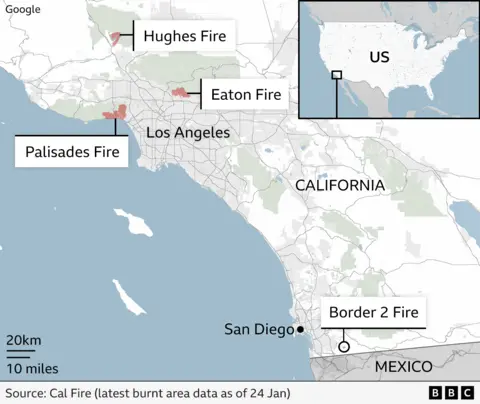
Watch: Border 2 Fire in San Diego burns nearly 5,000 acres

President Donald Trump travelled to California on Friday to survey the destruction from deadly wildfires that devastated several communities in the Los Angeles area earlier this month.

The visit, coming at the end of Trump’s first week back in office, took place as he continued to denounce the state emergency response being led by Democratic Governor Gavin Newsom – one of Trump’s fiercest critics – and worries the president might withhold aid over policies in the liberal state.

Despite the political rivalry, Newsom greeted Trump on the tarmac as he emerged from Air Force One, arriving from North Carolina where he toured damage from Hurricane Helene, which rocked the western part of the state in September.

Trump’s visit came as new fires ignited in southern California, and local officials continue to contend with dry and windy weather conditions that favour fire growth.

Map of Los Angeles area wildfires

Speaking to reporters after shaking hands with Newsom, Trump said: “I appreciate the governor coming out and meeting me”.

“We want to get it fixed,” he continued, telling Newsom that aftermath looks “like you got hit by a bomb”.

Newsom, who Trump has nicknamed “Newscum”, then thanked Trump for coming to visit, telling him: “We’re going to need your support, we’re going to need your help”.

“You were there for us during Covid, I don’t forget that, and I have all the expectations that we’ll be able to work together to get this speedy recovery,” Newsom continued.

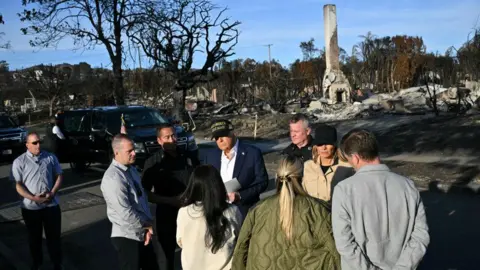
Trump then toured the ruins of Pacific Palisades neighbourhood with his wife Melania, and then attended a roundtable discussion with local leaders, including LA Mayor Karen Bass. He vowed to sign an executive order that would pump water from northern parts of the state to the south.

He quarrelled briefly with Mayor Bass after she said that residents must be patient – because clean-up crews need time to clear “hazardous waste” such as toxic ash from things like lead, polyaromatic hydrocarbons and asbestos – before they can return to their homes.

“What’s hazardous waste? I mean, you’re going to have to define that,” Trump remarked, adding: “I just think you have to allow the people to go on their site and start the process tonight.”

New blazes – named Laguna, Sepulveda, Gibbel, Gilman and Border 2 – flared up on Thursday in the counties of Los Angeles, San Diego, Ventura and Riverside – all in southern California.

Firefighters have made progress in bringing the 10,000-acre Hughes Fire in Los Angeles under control, containing it by 79% since it broke out on Wednesday, forcing tens of thousands of people to evacuate.

Fires have devastated the US state over the last few weeks, with the Palisades and Eaton fires scorching a combined total of more than 37,000 acres and killing at least 28 people. Multiple neighbourhoods have been levelled, leaving more than 10,000 homes and businesses in ashes.

Getty Images Newsom and Trump shaking handsGetty Images

Newsom and Trump shook hands as the president arrived in California

“Unfortunately, it’s a very sad period, but what makes you feel good is I met so many of the homeowners, and every one of them, a lot of them, and every one of them said to me, they want to rebuild,” Mr Trump said after flying over by helicopter and touring the ruins on foot.

“The federal government is standing behind you 100%,” he told local leaders.

Governor Newsom on Thursday announced a $2.5bn (£2bn) state-level aid package to deal with the fire damage.

Trump has been critical of the response to the California fires, threatening to withhold federal assistance unless the state does not change its water laws and implement laws requiring an ID to vote in elections.

“After that, I will be the greatest president that California has ever seen,” Trump said earlier.

California does not usually require ID to vote but does to register to vote.

Newsom’s office said in a statement on social media that: “Conditioning aid for American citizens is wrong”.

Getty Images Trump meets with residents near the ruinsGetty Images

Brian Rice, the president of the California Professional Firefighters, told the BBC that he hopes Trump does not deny the state federal aid.

“The most important focus we have is getting federal aid into California, into these communities where people have lost their lives, their homes,” he said.

The city is set to host both the 2028 Summer Olympics and Fifa World Cup matches in 2026 – two global events that will thrust the Los Angeles region into the spotlight.

Trump has also been critical of the work done by the Federal Emergency Management Agency (Fema) – which is tasked with responding to such disasters – under the Biden administration.

He has suggested getting rid of the agency and letting US states manage disasters in their jurisdictions.

“Fema is a very expensive, in my opinion, mostly failed situation,” Trump told local leaders. “Each state should take care of their problem and get money from the federal government. It would be so much better.”

He made similar remarks during a visit to North Carolina, where at least 104 people were killed in a hurricane, claiming that “Fema was not doing their jobs” in that state.

He noted that some residents still don’t have power or hot water and it was “totally unacceptable”.

Asked by the BBC whether he would withhold federal aid to California, but not North Carolina, Trump said that the situations in the two states are different.

His response came after he touted the “big numbers” North Carolina had given him when he carried the state in the 2024 presidential election. He later noted that he had won the state in every general election and Republican primary contest in which he had been on the ballot.

Meanwhile, California has consistently voted against Trump in the past three presidential elections by substantial margins.

Watch: Air National Guard brought in to tackle the Hughes Fire

Los Angeles is under an elevated fire risk area today with brisk winds, according to BBC Weather.

Rain is expected over the weekend in the county, as well as snow up in the mountains of southern California.

However, while this will aid firefighting efforts, there are concerns that it could also cause flooding and dislodge debris from the fires, creating mudslides.

Specialist crews have been working to try and secure burned areas, while sandbags and other flood prevention supplies have been handed out to locals so that they can protect their properties.

Twenty-three people died in 2018 when mudslides hit the California town of Montecito, one of the areas that had recently been affected by the Thomas Fire.


How Riad Sattouf Uses His Cartoons to Draw a Window Into the Middle East

0
How Riad Sattouf Uses His Cartoons to Draw a Window Into the Middle East


One early evening in December, the Syrian dictator Bashar al-Assad fled his country as rebel forces advanced on Damascus. In France, three days later, one of the country’s most-watched TV news channels turned to a cartoonist for expert opinion on the news.

“Did you think that this could have happened so rapidly?” a news anchor for the channel, BFMTV, asked the cartoonist, Riad Sattouf, whose smiling face appeared on a giant video wall.

Over the past decade, Mr. Sattouf, 46, has become one of France’s biggest literary stars, thanks largely to his masterwork, “The Arab of the Future,” a series of graphic memoirs. Over six volumes, the series tells the story of Mr. Sattouf’s childhood, which was jarringly divided between the Middle East and France, and the disintegration of the marriage between his French mother and his Syrian father.

The books — in a genre known as “bandes dessinées” in France — have sold more than three million copies and have been translated into some 23 languages. Though told from a child’s perspective and drawn in a deceptively simple style, they touch on some of the thorniest questions about the compatibility of the Western and Arab worlds. They are also suffused with a subtle but withering social satire.

For Mr. Sattouf, this posture informs not only his art, but the way he interprets the world. In his TV appearance in December, he told viewers that the fall of Mr. al-Assad was a moment of “immense hope” for Syria. But when asked to predict what might happen next, he warned that he tended to see things “extremely pessimistically.”

“I keep my fingers crossed,” he said, “that a terrible dictatorship won’t be replaced by another dictatorship.”

Mr. Sattouf, who was born in France, grew up enamored with the brutally honest and occasionally offensive work of the American cartoonist Robert Crumb. His work also follows in the tradition of comics that offer readers an intimate view of characters living through pivotal historical moments, including Art Spiegelman’s “Maus” and Marjane Satrapi’s “Persepolis.”

For years, Mr. Sattouf wrote a cartoon strip for Charlie Hebdo, a French satirical magazine. He stopped contributing a few months before January 2015, when the magazine’s offices were targeted in a deadly terrorist attack over its depiction of the Prophet Muhammad. Mr. Sattouf did not draw the cartoons of Muhammad; his strip had been focused on amusing, and sometimes depressing, scenes of daily life he encountered on the streets and metro in Paris.

In “The Arab of the Future,” Mr. Sattouf paints a complex portrait of his father, who made his way from a small rural village in Syria to Sorbonne University in Paris, where he received a doctorate in history and met the woman who would become Mr. Sattouf’s mother. The cartoonist also portrays his father as sliding, over the years, into a state of permanent bitterness toward the West and an embrace of anti-democratic Arab strongmen.

Some of the most arresting pages in the series depict Mr. Sattouf’s experience as a child in Ter Maaleh, his father’s village. He moved there in the 1980s, while he was in grade school, and lived there during the dictatorial reign of Mr. al-Assad’s father, Hafez al-Assad.

Mr. Sattouf’s memories of Ter Maaleh are vivid and coruscating. The French journalist Stéphane Jarno recently described the depictions of the town as “a few buildings surrounded by emptiness, a micro-society steeped in blind piety and power struggles, with apparently little love but a lot of violence.”

This willingness to pull no punches about his experience in Syria puts Mr. Sattouf in a loose but important category of French public figures with roots in the Arab world who are unafraid to criticize it. It can be a fraught position.

The Algerian author Kamel Daoud, who currently lives in France, recently won the Prix Goncourt, France’s most prestigious literary prize, for a novel that addressed the complex history of the Algerian civil war. In the past, Mr. Daoud, who has openly discussed sensitive religious issues, was the subject of a death threat from an Algerian imam. More recently, Mr. Daoud has complained that he has been castigated by elements of the French left for “not being the good Arab, who is in the permanent state of de-colonial victimhood.”

Somehow, Mr. Sattouf has largely avoided that fate. He has been a critical darling of the French news media since at least the mid 2000s, when, as a young man, he was publishing what he called “sexual and provocatively funny” comics. At the same time, he said in a recent interview, he had never faced a backlash from Islamist groups.

“Never,” he said, smiling. “Because my comics are so good.”

The line was delivered with a joking-not-joking sort of flourish.

Mr. Sattouf met for the interview in Rennes, the capital of Brittany, late last month. He comes across as both impish and serious-minded, with a quiet voice that toggled in the interview between French and a workable English that he said he had learned from bingeing “Seinfeld.”

He insisted, as he has in the many interviews he has given since the flight of Mr. al-Assad, that he is not a Middle East expert. “It’s very complicated to me,” he said. “My books are about Syria, but in my books I tell stories of my family. I tell my memory, my point of view as a child.”

The books describe a childhood of wrenching change, with a love of drawing and cartooning as a refuge and a constant.

When he was 12, he left Ter Maaleh, moving back to Brittany with his two younger brothers and his mother as his parents’ marriage had begun to fray. He has not been back to Syria since.

In France, he said, he found a freedom of expression crucial to his craft. He also watched with concern as some French leaders seemed to embrace Mr. al-Assad. He made specific note of the 2008 decision of Nicolas Sarkozy, then the French president, to invite Mr. al-Assad to Paris for Bastille Day festivities.

As revelations of the Syrian regime’s atrocities have come to light, Mr. Sattouf said that he felt a sense of vindication.

“We see that the story I was telling in my books was closer to the reality than what you could see in the media,” he said.

Mohamed-Nour Hayed, 22, a Franco-Syrian activist and writer who was granted asylum in France amid the civil war in Syria, recalls first reading “The Arab of the Future” at age 15. He said he was concerned that Mr. Sattouf’s negative depiction of Syria could reinforce stereotypes among readers who see only a depiction of “a very closed-minded Syria.”

But Mr. Hayed also praised the series and said that it had influenced him as he wrote his own first novel, which is set during the war. Like “The Arab of the Future,” Mr. Hayed said, it is written from the perspective of a child.

In addition to writing “The Arab of the Future,” Mr. Sattouf has directed two feature films. “Les Beaux Gosses,” or “The French Kissers,” a coming-of-age comedy, won a César award for best first film. Late last year, he released the first volume of “I, Fadi, the Stolen Brother” a spinoff series to “The Arab of the Future,” based on interviews with his youngest brother, who, Mr. Sattouf said, was taken from France to Syria by his father when his brother was a child. Mr. Sattouf, in the interview, described it as kidnapping.

When asked to fill in exactly what happened to his brother afterward, Mr. Sattouf declined, saying he did not want to give away the rest of the story, to be published in later volumes.

The first four volumes of the “Arab” series have been translated into English; Fantagraphics, a U.S.-based comics publisher, is planning to publish versions of the final volumes, as well as the new series. Many French bookstores currently feature big cardboard displays showing off Mr. Sattouf’s books, along with a photograph of his face. Outside the Rennes train station recently, a middle-aged man recognized Mr. Sattouf and ran up to shake his hand.

And the French media continue to turn to him for insight into the fall of the Assad regime.

Mr. Sattouf told the regional newspaper Ouest-France that organizing democratic elections “in a country fractured by 13 years of civil war required immense political will, but also international support.”

He told the conservative newspaper Le Figaro that living under Assad rule in Syria had imbued him with “a certain paranoia, let’s say, a distrust which has become part of my personality.”

He also spoke to the newspaper La Croix about going back to Syria one day.

“But this can only happen in a peaceful and democratic Syria,” he said. “For now, it is still a distant and fanciful prospect.”


Israel Says UNRWA Has 6 Days to Halt Operations in East Jerusalem

0
Israel Says UNRWA Has 6 Days to Halt Operations in East Jerusalem


Israel told the United Nations on Friday that its relief agency known as UNRWA, a critical lifeline to two million Palestinians during the 15 months of war in Gaza, had six days to stop all operations in East Jerusalem.

Israel’s ambassador to the U.N., Danny Danon, said in a letter addressed to the U.N. secretary general, António Guterres, “UNRWA is required to cease its operations in Jerusalem and evacuate all premises in which it operates in the city, no later than 30 January 2025.”

The letter was Israel’s first official notice to the U.N. about how it planned to enforce legislation passed by the Israeli Parliament in October banning UNRWA, known formally as the United Nations Relief and Works Agency for Palestine Refugees in the Near East, from operating in Israeli territory. The measure also prohibited Israeli officials from engaging with officials and employees of UNRWA.

The move came after months of tensions between the Israeli government and the U.N. agency, which provides food, shelter, health care, vocational training and education to Palestinians in the Israeli-occupied West Bank and Gaza, especially in the aftermath of the Hamas-led Oct. 7, 2023, attacks on Israel that set off the war. The agency also aids Palestinians who live in neighboring countries like Jordan, Syria and Lebanon, where Palestinians displaced in the founding of Israel have lived for decades.

Israel has accused UNRWA of being infiltrated by members of Hamas. But two U.N. investigations found that fewer than 10 employees out of nearly 13,000 were affiliated with the armed Palestinian group, and they were fired.

Two hundred and sixty-nine of UNRWA’s staff members have been killed in Gaza — the largest loss of life among U.N. employees in any conflict, officials say.

Mr. Danon said in the letter that Israel would continue to cooperate with the U.N. and “any of its agencies that have not been infiltrated by terror organizations.”

Asked for comment, Farhan Haq, a U.N. spokesman, referred to previous statements by Mr. Guterres fiercely defending the work of UNRWA as irreplaceable and essential, particularly in Gaza, where Israeli bombardment to root out Hamas has displaced most of the population and killed about 47,000 people, according to Gazan officials, who do no distinguish between civilians and combatants.

A spokeswoman for UNRWA also referred requests for comments to Mr. Guterres’s office, since the letter was addressed to him.

Mr. Guterres told a meeting of the U.N. Security Council earlier this week on the situation in Gaza, “First, United Nations entities — including the backbone of our humanitarian response, UNRWA — must be able to perform their functions without hindrance.”

UNRWA’s chief, Philippe Lazzarini, also asked the Council last week to intervene to stop Israel from enforcing the legislation outlawing his agency. He said such actions “will massively weaken the international humanitarian response” in Gaza and “immeasurably worsen already catastrophic living conditions.”

Before the letter was sent, Mr. Lazzarini told reporters last Friday that his agency had received no clear directive from Israel on how the measures would be carried out. He also said that he expected UNRWA to continue its work, albeit with enormous logistical challenges in the West Bank and Gaza, and that its work in Jerusalem would be compromised.

In the letter, Israel demanded that UNRWA evacuate two sites in the Maalot Dafna and Kfar Aqueb neighborhoods in East Jerusalem, which is considered by international law to be part of the West Bank and under occupation. Israel considers all of Jerusalem to be part of Israel.

UNRWA was established in 1949 to assist Palestinians who fled or were expelled from their homes during the 1948 Arab-Israeli war.

The agency has widespread support among U.N. member states, and they have urged Israel not to ban the agency’s work. After Israel accused Hamas of infiltrating the agency, the Biden administration suspended millions in annual funding to UNRWA, and Congress in March prohibited U.S. funding to the organization for a year.

During his first presidential term, Donald J. Trump withdrew funding for UNRWA in 2018, and he is expected to continue restricting funding.

Mr. Trump’s pick to be U.S. ambassador to the U.N., Representative Elise Stefanik, criticized the relief agency as “antisemitic” in her Senate hearing this week, and said she supported Israel’s “biblical rights” over the West Bank.

That position is at odds with the U.N.’s stance that the West Bank is occupied Palestinian territory.

Mr. Lazzarini said in a post on X on Friday that preventing UNRWA from operating “might sabotage” the provisional cease-fire recently struck between Israel and Hamas in Gaza, “failing once again hopes of people who have gone through unspeakable suffering.”

He said that, in the first three days of the truce, UNRWA brought in food for one million people in Gaza and had already distributed it to about 3,000 people in northern Gaza, where the U.N. and aid agencies have warned that people were at the brink of famine.

“The work of UNRWA must continue in Gaza + across the occupied Palestinian territory,” Mr. Lazzarini said.


US suspends new funds for aid programmes, excepting Israel and Egypt | Donald Trump News

0
US suspends new funds for aid programmes, excepting Israel and Egypt | Donald Trump News


Trump administration freezes new funding for anti-HIV programme and other health services, excepts key food programmes.

The administration of United States President Donald Trump has announced a freeze on almost all new funding for foreign assistance programmes, with exceptions for allies Israel and Egypt.

The order from the US State Department on Friday also includes exceptions for emergency food programmes, but not health programmes that supporters say provide vital, life-saving services.

In an accompanying memo, newly confirmed Secretary of State Marco Rubio directed senior officials to “ensure that, to the maximum extent permitted by law, no new obligations shall be made for foreign assistance”.

Humanitarian organisations immediately expressed alarm at the directive, voicing fears that it could contribute to global instability and loss of life.

“By suspending foreign development assistance, the Trump administration is threatening the lives and futures of communities in crisis, and abandoning the United States’ long-held bipartisan approach to foreign assistance which supports people based on need, regardless of politics,” Abby Maxman, head of Oxfam America, said in a statement.

The temporary freeze is slated to last for a period of at least three months. In the first 85 days, Rubio is expected to make “decisions whether to continue, modify, or terminate programs”, according to the memo.

Among the health programmes expected to experience a funding freeze is the President’s Emergency Plan for AIDS Relief, also known as PEPFAR.

Established in 2003 under the administration of George W Bush, PEPFAR enjoyed broad bipartisan support for two decades, until Congress missed a deadline to renew its funding in 2023. Its funding got a one-year extension through March 2025, but that is set to expire within the three-month window.

Experts estimate that PEPFAR has helped save as many as 25 million lives since it was first started.

Left untouched by the freeze is aid for Israel and Egypt, two of the largest recipients of US military assistance.

Both countries have faced scrutiny over their human rights records and calls to leverage US aid in exchange for substantial reforms.

Friday’s memo made special mention of waivers for “foreign military financing for Israel and Egypt and administrative expenses, including salaries, necessary to administer foreign military financing”.

There was no indication of a similar exemption for Ukraine, which largely relies on US weapons assistance in its fight to repel a Russian full-scale invasion launched in February 2022.

The US spent more than $60bn in foreign assistance in 2023, more than any other country overall.

But that sum accounts for about 1 percent of US government spending. In the aftermath of Friday’s memo, some aid projects around the world received work-stop orders.

“This is lunacy,” said Jeremy Konyndyk, a former official for the US Agency for International Development (USAID).

He shared with the Reuters news agency his outrage. “This will kill people. I mean, if implemented as written in that cable … a lot of people will die.”


US issues pause on foreign aid, leaked memo says

0
US issues pause on foreign aid, leaked memo says


The US State Department has issued a halt to all existing foreign assistance and paused new aid, according to an internal memo sent to officials and US embassies abroad.

The leaked notice follows President Trump’s executive order issued on Monday for a 90-day pause in foreign development assistance pending a review of efficiencies and consistency with his foreign policy.

The United States is the world’s biggest international aid donor spending $68bn in 2023 according to government figures. The State Department notice appears to affect everything from development assistance to military aid.

It makes exceptions only for emergency food aid and for military funding for Israel and Egypt. The leaked memo’s contents have been confirmed by the BBC.

“No new funds shall be obligated for new awards or extensions of existing awards until each proposed new award or extension has been reviewed and approved,” says the memo to staff.

It adds that US officials “shall immediately issue stop-work orders, consistent with the terms of the relevant award, until such time as the secretary shall determine, following a review.”

It also orders a wide scale review of all foreign assistance to be completed within 85 days to ensure the aid adheres to President Trump’s foreign policy goals.

Secretary of State Marco Rubio – the US’s top diplomat – has previously stated that all US spending abroad should take place only if it makes America “stronger”, “safer” or “more prosperous”.

One former senior State Department official told the BBC the notice meant a “potentially huge” impact on foreign aid programmes funded by the US.

“One can imagine, for example, the humanitarian de-mining programmes around the world suddenly being told stop work. That’s a pretty big deal,” said Josh Paul, who oversaw Congressional relations on weapons transfers at the State Department until late 2023.

Dave Harden, a former US Agency of International Aid (USAID) mission director in the Middle East, told the BBC the move was “very significant”, saying it could see humanitarian and development programmes funded by the US around the world being immediately suspended, while the review is carried out.

He said it could affect a wide range of critical development projects including water, sanitation and shelter.

“The employees of the implementing partner or the [non-governmental organisation] would be able to be paid, but actual assistance, I think, needs to be halted,” said Mr Harden.

“I have gone through [assistance suspensions] many times when I was the West Bank and Gaza mission director, but that was specific to that account. This is global… it’s extremely broad,” he said.

“Not only does it pause assistance, but it puts a ‘stop work’ order in existing contracts that are already funded and underway. It’s extremely broad,” he added.

The AFP news agency reported the funding freeze could also potentially affect Ukraine, which received billions of dollars in weapons under Trump’s predecessor Joe Biden.

Rubio’s memo, justifying the freeze, said it was impossible for the new administration to assess whether existing foreign aid commitments “are not duplicated, are effective and are consistent with President Trump’s foreign policy”.

Rubio has issued a waiver for emergency food assistance, according to the memo.

This comes amid a surge of humanitarian aid into the Gaza Strip after a ceasefire between Israel and Hamas began, and several other hunger crises around the world, including Sudan.

The memo also said waivers have so far been approved by Rubio for “foreign military financing for Israel and Egypt and administrative expenses, including salaries, necessary to administer foreign military financing”.

The State Department has been approached for comment.


What We Know About the Hostage Release

0
What We Know About the Hostage Release


The 33 hostages being released in the first phase include female soldiers and civilians, children, men over age 50 and sick and wounded “humanitarian” cases.

Three hostages — Romi Gonen, Emily Damari and Doron Steinbrecher — were released on the first day of the cease-fire in exchange for about 90 Palestinian prisoners.

Hamas said on Friday that it would release four female soldiers held hostage for over a year in Gaza, as part of a hostage-for-prisoner swap set to take place on Saturday.

Hamas identified the four women as Karina Ariev, 20; Daniella Gilboa, 20; Naama Levy, 20; and Liri Albag, 19. All four were abducted from the military base near Gaza where they served during the Hamas-led attack that began the war.

Israel said mediators had passed along a list of names of hostages set to be released on Saturday, without confirming their identities. It remained unclear whether the four named by Hamas would ultimately be freed.

The releases are staggered, according to the plan. On the first day, Hamas released hostages in exchange for Palestinian prisoners. On Saturday, the seventh day, four female living hostages will be exchanged for Palestinian prisoners.

From the 14th day through the fifth week of the agreement, Palestinian prisoners will be released every seven days in exchange for three male and female hostages.

The remaining hostages agreed to in the first phase will be released in exchange for Palestinian prisoners during the sixth week.

Also during the sixth week, once all 33 hostages have been freed and returned to Israel, Israel will release 47 prisoners who were rearrested after being released in a 2011 deal that saw over 1,000 Palestinians freed in exchange for a captive Israeli soldier, Gilad Shalit.

The Israeli authorities have established three reception points to receive the hostages along the Gaza border, according to an Israeli military official who spoke on condition of anonymity in accordance with protocol. Those reception points will have Israeli soldiers, doctors and psychologists, said the official.

More than 1,000 — meaning the initial deal will most likely become one of the largest prisoner exchanges in Israeli history if completed.

Of the dozens of Palestinians in Israel who will be released for each hostage in the initial six-week phase, some are serving life sentences.

According to the agreement, the release of a living female hostage or civilian under the age of 18 requires the release of 30 Palestinian female or minor prisoners.

The two sides will swap each Israeli civilian man who is 50 or older and is alive for 30 Palestinian prisoners. An Israeli female soldier who is alive requires the release of 50 Palestinian prisoners. A total of 110 Palestinian prisoners will be released in exchange for nine Israeli male civilians who are wounded or sick.

Israel will also release about 1,000 Gazans who were detained over the course of the war, on the condition that they did not participate in the Hamas-led attack of October 2023.

Some 105 hostages — mostly women and children — were freed in November 2023 during a weeklong truce between Israel and Hamas. In exchange, Israel released 240 Palestinian women and teenage prisoners held in Israeli jails.

Early in the war, Hamas unilaterally released four hostages — two Israeli-American women and two Israeli women. Israel has also freed eight hostages in military operations, at least one of which was accompanied by devastating bombing and high Palestinian casualties.

The bodies of more than 35 others were brought back to Israel in various operations over the course of the war, according to the Israeli government.

In a speech this month, Antony J. Blinken, then secretary of state, said seven of the 12 Americans abducted during the Hamas-led attack on Oct. 7, 2023, were still being held captive. They include Sagui Dekel-Chen, who was abducted from his hometown, Nir Oz, near the Gaza border during the Hamas-led attack. Another, Edan Alexander, was spotted in an undated Hamas hostage video in November.

Some, like Itay Chen, a 19-year-old soldier, and Omer Neutra, a 21-year-old tank commander from Long Island, N.Y., are presumed dead by the Israeli authorities. Hamas continues to hold their bodies as bargaining chips for future swaps, Israel says.

Ephrat Livni and Aaron Boxerman contributed reporting.


Arthur Blessitt, Who Carried a Cross Around the World, Dies at 84

0
Arthur Blessitt, Who Carried a Cross Around the World, Dies at 84


Arthur Blessitt, whose fervent efforts to convert the hippies, freaks and addicts along Hollywood’s Sunset Strip were just a prelude to his decision to carry a 110-pound wooden cross from Los Angeles to New York City — and then to keep going, eventually traveling 43,340 miles through every country on the planet — died on Jan. 14. He was 84.

Mr. Blessitt’s death was announced in a first-person statement on his website. The statement did not say where he died or cite a cause of death. He had been living in the Denver area, and his ministry was based in the suburb of Littleton, Colo.

A Southern Baptist preacher who ran a Christian coffeehouse adjacent to a strip club, Mr. Blessitt started his journey on Christmas Day 1969, bearing his homemade 6-by-12-foot cross on his shoulder. He made adjustments along the way, swapping his sandals for boots and adding a 12-inch wheel to the base of his burden; he later swapped the heavy cross for a 42-pound version that he could split in two, making it easier to ship.

It took him six months to walk across the country. When he was done, he returned to Los Angeles, only to receive — in his telling — orders from Jesus to take his journey global.

“Go!” Jesus told him, he recounted on his website. “I want you to go all the way.”

His first trip abroad, in 1971, was to Northern Ireland; other parts of Europe, Africa, the Middle East and East Asia soon followed.

He carried a roll of stickers reading “Smile! Jesus Loves You,” which he handed out to curious passers-by. Not everyone was friendly: Police officers harassed him, malcontents jeered, and his cross was stolen in — of all places — Assisi, Italy, where St. Francis had once lived.

“Some people see me and shout, ‘You’re a nut!’” he said in the 2009 documentary “The Cross: The Arthur Blessitt Story,” directed by Matthew Crouch. “I say, ‘That’s all right, at least I’m screwed on the right bolt.”

Mr. Blessitt kept meticulous notes abroad, detailing how long his boot soles lasted (about 500 miles) and how often he was arrested (24 times). He visited every continent, including Antarctica, as well as war zones, disaster zones and many other places where he was liable to get shot at, beaten or arrested.

He climbed Mount Fuji in Japan, confronted angry baboons in Kenya and was nearly blown up by a terrorist bomb in Northern Ireland — all while carrying his cross. He is listed in Guinness World Records for the “longest ongoing pilgrimage.”

It took him nearly 40 years, but in 2008 he completed his quest to visit every country when he was permitted to enter the last, North Korea. His “trek” there was largely symbolic: Authorities let him carry his cross from the front door of his hotel to the street and back.

There was a Forrest Gump quality to Mr. Blessitt’s journeying. Not only did he travel across country on foot; during his adventures he encountered a long list of historical figures — Yasir Arafat, Billy Graham, Bob Dylan — as well as people who tried to impress their own complicated agenda onto what he insisted was a simple and innocent message.

“In the third world, people’s first thought when they see me is that I’m a holy man,” he told The Independent newspaper in 1999. “In America, though, some people think of the Ku Klux Klan, women often think I’m an anti-abortion protester, other people that I’m a right-winger.”

His decades-long campaign made him a minor celebrity. Profiles invariably zeroed in on his combination of dogged perseverance and an aw-shucks approach to his task.

“You’d be amazed,” he told People magazine in 1978, “how much attention a man carrying a big wooden cross gets.”

Arthur Owen Blessitt was born on Oct. 27, 1940, in Greenville, Miss., to Arthur O.N. Blessitt and Mary (Campbell) Blessitt, and raised in rural northwest Louisiana, where his father managed a cotton farm.

He studied history at Mississippi College, a Christian institution in Clinton, Miss., but left in 1962 without a degree. He later studied at Golden Gate Baptist Theological Seminary (now Gateway Seminary), in Oakland, Calif., but also left before completing his degree.

He started as an itinerant preacher around the Mountain West, spending time in Montana and Nevada before settling in Los Angeles in 1967.

He found himself in the middle of the 1960s counterculture, but he also encountered the early sprouts of what became the Jesus freak movement, blending hippie stylings and freewheeling Christian evangelism.

Mr. Blessitt began preaching in bars, clubs and concert halls, welcome — or just tolerated — by the era’s anything-goes ethos. He dressed the part, with long hair and sandals, and he mingled his sermons with references to drugs and rock ‘n’ roll.

“Like, if you want to get high, you don’t have to drop acid. Just pray and you go all the way to Heaven,” he wrote in “Life’s Greatest Trip” (1970), one of his many religious tracts. “You don’t have to pop pills to get loaded. Just drop a little Matthew, Mark, Luke, or John.”

Mr. Blessitt married Sherry Simmons in 1963. They divorced in 1990. That same year he married Denise Brown.

She survives him, as do his children from his first marriage, Gina, Joy, Arthur Joel, Arthur Joshua, Arthur Joseph and Arthur Jerusalem; a daughter from his second marriage, Sophia; his sister, Victoria; 12 grandchildren; and a great-granddaughter.

With his flowing locks and giant cross, Mr. Blessitt was sometimes mistaken for a Jesus impersonator, and even for the son of God himself, including once in Liberia, when a village leader knelt before him.

“It’s the only time I ever considered stopping,” he told The New York Times in 1997. “I lay the cross against a tree and said, ‘Lord, I will never try to take your glory and portray myself as a religious leader.’ And I heard Jesus whisper to me: ‘Don’t worry about it. Just keep going down the road.’”


Israeli drone attack kills two in expanding occupied West Bank operation | Israel-Palestine conflict News

0
Israeli drone attack kills two in expanding occupied West Bank operation | Israel-Palestine conflict News


Israeli attack on a vehicle close to Qabatiya comes during ongoing assault on nearby Jenin, which has displaced thousands.

An Israeli drone attack on a vehicle near the occupied West Bank town of Qabatiya has killed two people, the Palestinian Ministry of Health says on the fourth day of a large-scale Israeli operation in and around the nearby city of Jenin.

The Israeli military said the air attack on Friday in the Jenin governorate hit a vehicle with what it said was a “terrorist cell” inside, but it gave no further details.

The official Palestinian news agency Wafa reported that it was a drone attack that happened just before Israeli forces stormed Qabatiya and began “sweeping operations”.

The air attack coincided with the ongoing military operation against Palestinian fighters in Jenin and its adjacent refugee camp, which has already resulted in the deaths of 14 Palestinians and injured about 50 others, according to the Palestinian Health Ministry in Ramallah.

The Israeli military also announced the arrests of 20 people it considers “wanted suspects” and said it had seized weapons.


In addition to the loss of life, the operation in the northern West Bank – launched just two days after the truce agreed between Israel and Hamas in Gaza – has caused widespread destruction.

Israeli armoured bulldozers and diggers have demolished houses and dug up roads in the Jenin area and forced the displacement of about 2,000 families.

A United Nations spokesperson on Friday warned against the “deteriorating” situation in the West Bank and called on Israel to protect Palestinians.

During a media briefing, Farhan Haq said the UN Office for the Coordination of Humanitarian Affairs (OCHA) “warns once again that lethal, warlike tactics are being applied, raising concerns over use of force that exceeds law enforcement standards”.

Earlier, Thameen Al-Kheetan, spokesperson for the Office of the UN High Commissioner for Human Rights, expressed grave concerns about the use of disproportionate and unlawful force in Jenin, warning of the potential for widespread human rights violations.

Al-Kheetan emphasised the international community’s responsibility to hold Israel accountable for these actions.