Thursday, October 1, 2026
Home Blog Page 6919

One Family in Gaza Returned Home. But Home Was Gone.

0
One Family in Gaza Returned Home. But Home Was Gone.


Minutes after the fighting stopped in Gaza on Sunday, Islam Dahliz and his father and brother set out for the neighborhood where they had lived until Israeli forces ordered them to leave. They were looking for the family home, but the landscape around them scrambled the senses. Familiar landmarks, streets, neighbors’ houses — everything was rubble.

Then Mr. Dahliz recognized the local wedding hall, he said, or what remained of it. That meant their home stood — had stood — behind them, in a spot they had already passed. They just hadn’t recognized it, this house that Mr. Dahliz’s father had built more than 50 years ago.

“It took us a few minutes to accept that this pile of rubble was our home,” said Mr. Dahliz, 34, who works with local aid groups. They stood there, speechless.

His 74-year-old father, Abed Dahliz, felt the wind knocked out of him, he said. His sons had to help him back to their tent to rest.

“I was shocked when I saw my entire life — everything I worked for — flattened to the ground,” said Abed Dahliz, a farmer all his life, his voice soft and trembling. “The home I spent so many years building, pouring my savings into, is gone.”

This was not the moment they had hoped for and pictured all these months, as they were forced to move from tent to tent to tent, packing up and starting over four times in all. They had imagined a return. A resumption of their lives.

In their latest makeshift tent in a park in western Rafah, the southernmost city in Gaza, they had huddled on Sunday morning, when the cease-fire was supposed to take effect, glued to the radio. Islam Dahliz was on his phone, refreshing social media accounts for the latest news. The whole family tensed when they heard that the truce might collapse over a last-minute hitch: Hamas, Israel said, had not handed over the promised list of Israeli hostages to be freed from Gaza.

Then, at 11:15 a.m., the radio reported that the cease-fire was on. The father and the brothers got in the car, they said, and set out for home.

Home had been a spacious two-story house on al-Imam Ali Street in Rafah, built in 1971 and shared, like many homes in Gaza, by three generations of the same family. The parents lived in one apartment, and Mr. Dahliz, his wife and their children had another. He had put his savings toward a new kitchen, furniture and bedding when he came back to Gaza from Hungary, where he had been studying agricultural science, he recalled.

His brothers Mohammed and Anas had also lived there with their families, with another brother a half-mile away. It was big enough that during the first seven months of the war, the Dahlizes could host around 10 other families that had evacuated from elsewhere in Gaza.

Next door was their farm, started by their father and tended by Mohammed, 40. Olive trees and date palms stood side by side with greenhouses where they grew parsley, lettuce and arugula. They had had rabbits, chickens and 40 sheep, which Mohammed used to lead to the fields to graze every morning.

Mohammed Dahliz could remember his father planting the palm trees when he was a little boy, he said. He could remember his own young children before the war, he said, chasing the chickens around and laughing, gathering their eggs for breakfast.

The Israeli military has said that it struck residential areas because Hamas fighters were embedding themselves in civilian buildings, though a New York Times investigation found that Israel also weakened civilian protections to make it easier to bomb Gaza during the war.

When Israeli forces invaded Rafah in May and ordered everyone in eastern Rafah to leave, Islam Dahliz said, the vegetables were just starting to sprout. The families who had been sheltering at the Dahlizes’ dispersed. The Dahlizes packed up some clothes, tarps and other materials for a makeshift tent, and picked a spot for it as close as they could find to home.

But they didn’t lay eyes on it for months, despite being just a few miles away.

Their cousins managed to sneak into the neighborhood from time to time, bringing back updates. Their home was still standing, they reported. Then they said it was standing, but some of its doors and windows had been blown out.

In the fall, the Dahlizes scoured satellite images circulating on social media: still intact. Then they checked again on Dec. 8, Islam Dahliz recalled. All they saw where the house had been was a gray shadow.

Now their palm and olive trees were knocked down, trunks scattered on the ground. Israeli tanks had left tracks all over their land. Little stood straight on their property other than a few concrete pillars with rebar sticking out of them.

“I feel lost, utterly lost,” said Mohammed Dahliz. Then, becoming angry, he said: “This was an agricultural area, a place of peace. It posed no threat to anyone, no danger to soldiers. We had no ties to politics, no reason to be caught in this violence.”

Islam Dahliz’s daughter Juan, 9, screamed when he showed her pictures of the destruction, he said. “Remember, Daddy, when you threw me a birthday party in the big hall?” she asked, sobbing.

On Monday morning, the brothers and their father drove to their neighborhood a second time, down a road jammed with other families, every vehicle overflowing with passengers and bundled belongings. They were all there to salvage whatever they could. All over Rafah, people filled tattered flour sacks and patched-up bags with scraps of metal they could perhaps sell or reuse and wood they could perhaps burn.

Mohammed Dahliz was just hoping to find some of his 14-year-old daughter Jana’s old toys, the kind he had brought her on her birthday or every time she reached a milestone in school. She had begged him to look for them, he said.

“I just want to find a piece of her childhood,” he said. “I’ve been searching since morning, hoping to find anything that belonged to her.”

Digging through the grayness, Islam Dahliz stumbled on his old school certificates, a discovery that produced a smile. But otherwise, they hadn’t found much. Firewood, a few pillows, an empty tank they hoped to repair.

He was clinging to plans, however fragile.

If — if — the two sides negotiated a permanent end to the war, as they are supposed to attempt during the cease-fire’s initial phase, the Dahlizes would hire a bulldozer to clear the rubble, first from the farm, then from the house. They would install some pipes, build a basic toilet and set up a water tank, he said.

“It won’t end the suffering,” he said, “but at least it’ll be closer to the home where we created so many memories.”

But for now, dusk was falling. They would have to return to their tent. What remained of the Dahlizes’ old lives barely filled the back of one small car.


Did Ukraine Kill Its Own by Downing a Russian Plane? A Year Later, It Hasn’t Said.

0
Did Ukraine Kill Its Own by Downing a Russian Plane? A Year Later, It Hasn’t Said.


One year has passed since Moscow accused Kyiv of shooting down a Russian military plane carrying dozens of Ukrainian prisoners of war. Ukraine opened an investigation, but has yet to release its findings, leaving questions about who was killed, and why.

The crash of the IL-76 transport plane in the Belgorod region of Russia, near the border with Ukraine, set off a series of recriminations at a delicate moment for Kyiv, as it lobbied for Western aid to build up its depleted weapons stocks.

Russian officials called it a “terrorist” act and convened an emergency meeting of the U.N. Security Council. Ukrainian officials did not admit or deny shooting down the aircraft, and said they could not confirm that Ukrainian prisoners were on board. American officials later assessed that Ukrainian forces had used a U.S.-made Patriot missile to shoot it down, thinking the plane carried Russian missiles and munitions.

“We have many questions about the situation,” Sofia Sobolyeva, who believes her father was on the plane, said in a recent interview.

With the families of the prisoners still awaiting answers, here’s what we know about the crash one year on.

Russia’s Defense Ministry said on Jan. 24, 2024 that one of its military transports had been shot down while en route to Belgorod for a prisoner swap. It said the plane was carrying 65 Ukrainian prisoners of war and that no one survived the crash.

Initially, Ukraine asserted its right to target Russian military transport planes in the border area, which had been a staging ground for the 2022 invasion and was used to mount attacks after that. At the time of the crash, deadly Russian missile strikes had been pounding Kharkiv, just across the border in Ukraine, and Kyiv stressed the need to hinder those attacks.

Soon, though, Ukraine’s military intelligence agency hinted at the possibility of a tragic mistake, not directly acknowledging Ukraine had downed the plane but offering explanations for how it might have happened. One Ukrainian official said the IL-76, often used to carry freight, had previously been used to deliver ammunition and missiles, suggesting that it was a legitimate target.

The agency acknowledged a prisoner swap had been planned for Jan. 24 — but said Russia had not warned Ukraine that prisoners were being flown to Belgorod’s airport, as was the case in previous exchanges. Russian officials disputed that account, saying Ukraine’s military had been notified.

The diverging claims illustrated the persistent lack of clarity that has become a defining feature of the war. Both sides have pushed their preferred narratives over nearly three years of fighting, and been reluctant to disclose or acknowledge setbacks.

President Volodymyr Zelensky of Ukraine called for his country’s intelligence agency to determine what had happened and for an international investigation into the crash. He accused Russia of “playing with the lives of Ukrainian prisoners, the feelings of their loved ones and the emotions of our society.”

Ukraine’s domestic intelligence agency opened an investigation into the incident.

Russian officials said the plane had crashed in a snowy field near a settlement in the Korochansky district. No independent groups were able to visit the crash site; Ukraine requested that the Red Cross and United Nations be granted access.

Satellite images and unverified Russian video captured what appeared to be the crash site and debris of a plane in the area Russia described, but it was not possible to identify passengers from the imagery.

Ukrainian officials asked for patience from citizens while they investigated Moscow’s claims.

Prisoner exchanges have occurred regularly throughout the war, even amid bitter fighting. But the Ukrainian authorities typically do not disclose, even to families, the names of those set to be released before exchanges.

The Russian authorities did not identify the victims of the crash when they announced it. But the names of 65 prisoners of war allegedly on board were shared on social media by the editor in chief of RT, the Russian state media broadcaster,

A few days later, the Ukrainian government agency that oversees prisoners of war confirmed that the names on the list matched those who were set to be exchanged on the day of the crash. But the agency said it did not have evidence to confirm that those prisoners were aboard the plane, or even that they were dead.

That was around the time, Sofia Sobolyeva said, that her family received a phone call from the military requesting a meeting. Ms. Sobolyeva’s father had been in Russian captivity since March 2022 — shortly after the start of the war — and his name was on the list.

“They gathered us and explained the situation but did not answer any questions,” she said. The authorities pledged to investigate “quickly,” she said, and asked relatives to submit DNA.

The case dropped from the headlines for months. An exchange of remains in early November was the first sign of a potential break.

The International Committee of the Red Cross confirmed it was present for a Nov. 8 transfer of remains. Russia said the transfer included the remains of 65 killed in the downing of the IL-76, but that claim could not be independently verified.

“I.C.R.C. did not take part in the identification process,” the agency said this week in response to questions, adding that it stood ready to assist the authorities with technical support.

Ms. Sobolyeva said that the families of the 65, who had formed a WhatsApp group, learned about the transfer and were told by the Ukrainian authorities that “time was needed for DNA expertise.”

Ukraine’s general prosecutor and security service did not respond to questions from The New York Times about the status of the investigation or whether any remains had been identified.

But there appears to be little dispute over who downed the plane.

Russia’s defense ministry had accused Ukrainian forces of launching missiles from the nearby Kharkiv region of Ukraine that struck the aircraft. American officials briefed on the incident later said that Ukraine used a Patriot air defense missile to down the plane.

While Ukraine has not formally accepted responsibility, Ms. Sobolyeva said that’s beside the point now.

“Logically, we understand that Ukraine shot it down,” she said, even though “officially we have nothing.

What she’s less sure about is whether the families will ever have answers to their other questions — like how it happened, and why.

She described her father as a kind man with “golden hands” — able to fix anything that broke — who loved gardening.

“There was a lot of stress and tears, but I still can’t understand what happened,” Ms. Sobolyeva said one recent evening.

“Now,” she added, “I just wear his black hat, so I feel warmer — both mentally and physically.”


Drug marketplace founder Ross Ulbricht speaks out after Trump pardon | Technology News

0
Drug marketplace founder Ross Ulbricht speaks out after Trump pardon | Technology News


Silk Road founder thanks US president for ‘amazing blessing’ in video message after his release from prison.

Ross Ulbricht, the dark-web marketplace founder pardoned by United States President Donald Trump, has spoken about his release from prison for the first time.

Ulbricht, 40, was sentenced to two life sentences, plus 40 years, in 2015 for running Silk Road, an illicit online market that US prosecutors said facilitated $183m in drug sales using Bitcoin.

Trump on Tuesday issued Ulbricht a full and unconditional pardon, fulfilling a campaign promise to libertarians and cryptocurrency enthusiasts who had lobbied for his release.

In a video message posted on X on Friday, Ulbricht expressed his gratitude to Trump for granting him clemency.

“I was doing life without parole, and I was locked up for more than 11 years but he let me out. I’m a free man now. So let it be known that Donald Trump is a man of his word,” he said.

“Thank you so much, President Trump, for giving me this amazing blessing. I am so, so grateful to have my life back, to have my future back, to have a second chance.”

Ulbricht said he planned to spend time with his family but would have more to say in the future.

“This is a victory and it’s your victory, too. And this is an important moment for everybody, everywhere who loves freedom and who cares about second chances,” he said.

“It feels amazing to be free, to say the least. It’s overwhelming.”

Ulbricht’s case had been held up as an example of government overreach by libertarians and crypto supporters, who argued that he had been unfairly prosecuted for transactions made by other people and that his punishment did not fit the crime.

Ulbricht’s lawyers also argued that although he had created the site, he handed off control to others after just a few months and had been lured back as a fall guy just as authorities were closing in.

Announcing his pardon, Trump branded Ulbricht’s punishment “ridiculous” and said those responsible for his prosecution were some of the “same lunatics who were involved in the modern-day weaponisation of government against me”.

US prosecutors cast Ulbricht as a criminal mastermind driven by a desire for money and power, and alleged that drugs sold on his site had caused the deaths of six people.

Prosecutors also alleged that Ulbricht had solicited the murders of people he viewed as threats to his operation, though he was not convicted of any such crime and no evidence was presented that anyone had actually been killed.

While some Republicans known for espousing libertarian views hailed Trump’s pardon, the move drew condemnation from a number of Democratic legislators.

“Pardoning drug trafficking kingpins is a slap in the face to the families who’ve lost loved ones to his crimes,” Democratic Senator Catherine Cortez Masto said in a post on X.

“Donald Trump should have to explain to them how any of this makes America safer. It’s an outrage.”


Mostly civilians died in IDF attack on Lebanon village, BBC finds

0
Mostly civilians died in IDF attack on Lebanon village, BBC finds


Nawal al-Maghafi

Senior international investigations correspondent, BBC World Service

BBC Ashraf and Julia both smiling for the camera, with a background of greenery. Ashraf has dark hair and a beard and is wearing a dark shirt, and Julia has lighter brown hair - long and wavy - and has brightly painted lips.
BBC

Ashraf (l) persuaded his sister Julia to join him in the family apartment, which he believed was safe from IDF strikes

Julia Ramadan was terrified – the war between Israel and Hezbollah was escalating and she’d had a nightmare that her family home was being bombed. When she sent her brother a panicked voice note from her apartment in Beirut, he encouraged her to join him in Ain El Delb, a sleepy village in southern Lebanon.

“It’s safe here,” he reassured her. “Come stay with us until things calm down.”

Earlier that month, Israel intensified air campaigns against Hezbollah in Lebanon, in response to escalating rocket attacks by the Iran-backed armed group which had killed civilians, and displaced tens of thousands more from homes in northern Israel.

Ashraf was confident their family’s apartment block would be a haven, so Julia joined him. But the next day, on 29 September, it was subject to this conflict’s deadliest single Israeli attack. Struck by Israeli missiles, the entire six-storey building collapsed, killing 73 people.

The Israel Defense Forces (IDF) says the building was targeted because it was a Hezbollah “terrorist command centre” and it “eliminated” a Hezbollah commander. It added that “the overwhelming majority” of those killed in the strike were “confirmed to be terror operatives”.

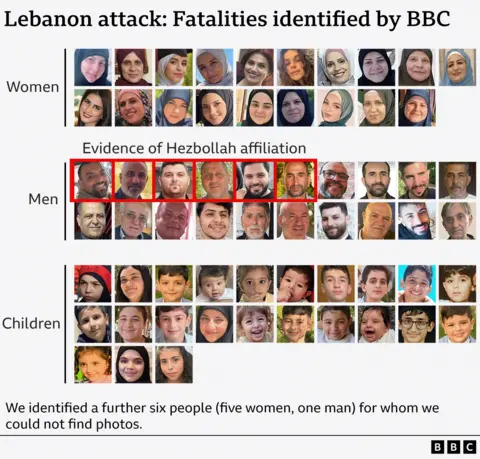
But a BBC Eye investigation verified the identity of 68 of the 73 people killed in the attack and uncovered evidence suggesting just six were linked to Hezbollah’s military wing. None of those we identified appeared to hold a senior rank. The BBC’s World Service also found that the other 62 were civilians – 23 of them children.

Among the dead were babies only a few months old, like Nouh Kobeissi in apartment -2B. In apartment -1C, school teacher Abeer Hallak was killed alongside her husband and three sons. Three floors above, Amal Hakawati died along with three generations of her family – her husband, children and two granddaughters.

A photographic graphic titled: 'Lebanon attack: Fatalities identified by BBC'
It shows three banks of photos: Women, men (including the six we found to be have Hezbollah affiliation) and children. There is a footnote which adds: We identified a further six children (five women, one man) for whom we could not find photos.

Ashraf and Julia had always been close, sharing everything with each other. “She was like a black box, holding all my secrets,” he says.

On the afternoon of 29 September, the siblings had just returned home from handing out food to families who had fled the fighting. Hundreds of thousands of people in Lebanon had been displaced by the war.

Ashraf was in the shower, and Julia was sitting in the living room with their father, helping him upload a video to social media. Their mother, Janan, was in the kitchen, clearing up.

Then, without warning, they heard a deafening bang. The entire building shook, and a massive cloud of dust and smoke poured into their apartment.

“I shouted, ‘Julia! Julia!,'” says Ashraf.

“She replied, ‘I’m here.’

“I looked at my dad, who was struggling to get up from the sofa because of an existing injury to his leg, and saw my mother running toward the front door.”

Julia’s nightmare was playing out in real life.

“Julia was hyperventilating, crying so hard on the sofa. I was trying to calm her down and told her we needed to get out. Then, there was another attack.”

Video footage of the strike, shared online and verified by the BBC, reveals four Israeli missiles flying through the air towards the building. Seconds later, the block collapses.

Watch the moment missiles struck the building, causing it to collapse

Ashraf, along with many others, was trapped under the rubble. He began calling out, but the only voice he could hear was that of his father, who told him he could still hear Julia and that she was alive. Neither of them could hear Ashraf’s mother.

Ashraf sent a voice note to friends in the neighbourhood to alert them. The next few hours were agonising. He could hear rescuers sifting through the debris – and residents wailing as they discovered loved ones dead. “I just kept thinking, please, God, not Julia. I can’t live this life without Julia.”

Ashraf was finally pulled from the rubble hours later, with only minor injuries.

He discovered his mother had been rescued but died in hospital. Julia had suffocated under the rubble. His father later told him Julia’s last words were calls for her brother.

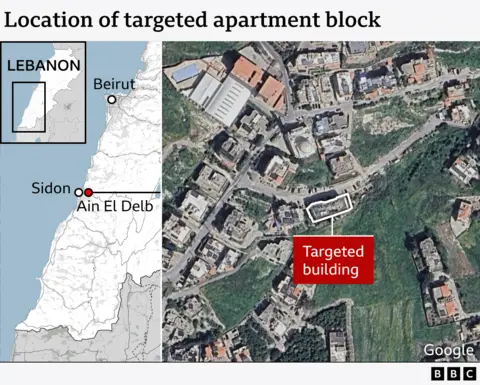
Map showing the location of the targeted apartment building - it shows a zoomed in location of where it was within Ain El Delb, and a zoomed out location of Ain El Delb - close to Sidon, and well south of Beirut.

In November, a ceasefire deal was agreed between Israel and Hezbollah with the aim of ending the conflict. The deal gives a 60-day deadline for Israeli forces to withdraw from southern Lebanon and for Hezbollah to withdraw its forces and weapons north of the Litani River. As this 26 January deadline approaches, we sought to find out more about the deadliest single Israeli attack on Lebanon in years.

In the apartment below Julia and Ashraf’s, Hawraa and Ali Fares had been hosting family members displaced by the war. Among them was Hawraa’s sister Batoul, who, like Julia, had arrived the previous day – with her husband and two young children. They had fled intense bombardment near the Lebanon-Israel border, in areas where Hezbollah has a strong presence.

“We hesitated about where to go,” says Batoul. “And then I told my husband, ‘Let’s go to Ain El Delb. My sister said their building was safe and that they couldn’t hear any bombing nearby.'”

Batoul’s husband Mohammed Fares was killed in the Ain El Delb attack. A pillar fell on Batoul and her children. She says no-one responded to her calls for help. She finally managed to lift it alone, but her four-year-old daughter Hawraa had been fatally crushed. Miraculously, her baby Malak survived.

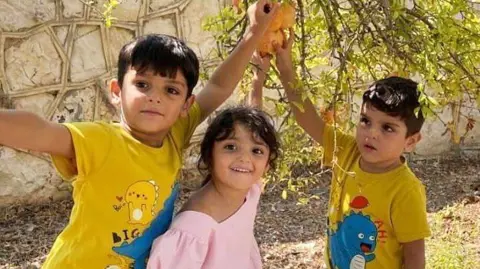
Fares family Hawraa, and her cousins Hassan and Hussein, photographed playing together. Hawraa is wearing a pink dress with puff sleeves and a square neck line. Her cousins are both in yellow cartoon dinosaur t-shirts.Fares family

Four-year-old Hawraa with her cousins – all three were killed in the attack

Three floors below Batoul lived Denise and Moheyaldeen Al-Baba. That Sunday, Denise had invited her brother Hisham over for lunch.

The impact of the strike was brutal, says Hisham.

“The second missile slammed me to the floor… the entire wall fell on top of me.”

He spent seven hours under the rubble.

“I heard a voice far away. People talking. Screams and… ‘Cover her. Remove her. Lift the stone. He’s still alive. It’s a child. Lift this child.’ I mean… Oh my God. I thought to myself, I’m the last one deep underground. No-one will know about me. I will die here.”

When Hisham was finally rescued, he found his niece’s fiance waiting to hear if she was alive. He lied to him and told him she was fine. They found her body three days later.

Hisham lost four members of his family – his sister, brother-in-law and their two children. He told us he had lost his faith and no longer believes in God.

To find out more about who died, we have analysed Lebanese Health Ministry data, videos, social media posts, as well as speaking to survivors of the attack.

We particularly wanted to interrogate the IDF’s response to media – immediately following the attack – that the apartment block had been a Hezbollah command centre. We asked the IDF multiple times what constituted a command centre, but it did not give clarification.

So we began sifting through social media tributes, gravesites, public health records and videos of funerals to determine whether those killed in the attack had any military affiliation with Hezbollah.

We could only find evidence that six of the 68 dead we identified were connected to Hezbollah’s military wing.

Hezbollah memorial photos for the six men use the label “Mujahid”, meaning “fighter”. Senior figures, by contrast, are referred to as “Qaid”, meaning “commander” – and we found no such labels used by the group to describe those killed.

We asked the IDF whether the six Hezbollah fighters we identified were the intended targets of the strike. It did not respond to this question.

Graphic showing the Ain El Delb apartment building, highlighting three apartments where our contributors were living or staying: The Ramadan family in Apartment 4A, the Fares family in Apartment 3A and the Al-Baba family in Apartment -1A

One of the Hezbollah fighters we identified was Batoul’s husband, Mohammed Fares. Batoul told us that her husband, like many other men in southern Lebanon, was a reservist for the group, though she added that he had never been paid by Hezbollah, held a formal rank, or participated in combat.

Israel sees Hezbollah as one of its main threats and the group is designated a terrorist organisation by Israel, many Western governments and Gulf Arab states.

But alongside its large, well-armed military wing, Hezbollah is also an influential political party, holding seats in Lebanese parliament. In many parts of the country it is woven into the social fabric, providing a network of social services.

In response to our investigation, the IDF stated: “The IDF’s strikes on military targets are subject to relevant provisions of international law, including taking feasible precautions, and are carried out after an assessment that the expected collateral damage and civilian casualties are not excessive in relation to the military advantage expected from the strike.”

It had earlier also told the BBC it had executed “evacuation procedures” for the strike on Ain El Delb, but everyone we spoke to said they had received no warning.

UN experts have raised concerns about the proportionality and necessity of Israeli air strikes on residential buildings in densely populated areas in Lebanon.

This pattern of targeting entire buildings – resulting in significant civilian casualties – has been a recurring feature of Israel’s latest conflict with Hezbollah, which began when the group escalated rocket attacks in response to Israel’s war in Gaza.

Between October 2023 and November 2024, Lebanese authorities say more than 3,960 people were killed in Lebanon by Israeli forces, many of them civilians. Over the same time period, Israeli authorities say at least 47 civilians were killed by Hezbollah rockets fired from southern Lebanon. At least 80 Israeli soldiers were also killed fighting in southern Lebanon or as a result of rocket attacks on northern Israel.

The missile strike in Ain El Delb is the deadliest Israeli attack on a building in Lebanon for at least 18 years.

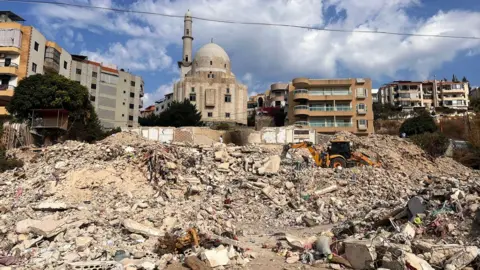
Scarlett Barter / BBC Rubble of the apartment block in the foreground, and in the background a few apartment blocks of various styles, flanking a mosque. A yellow digger picks through the detritus.Scarlett Barter / BBC

Families continued to visit the site of devastation weeks later to rake through the rubble

The village remains haunted by its impact. When we visited, more than a month after the strike, a father continued to visit the site every day, hoping for news of his 11-year-old son, whose body had yet to be found.

Ashraf Ramadan, too, returns to sift through the rubble, searching for what remains of the memories his family built over the two decades they lived there.

He shows me the door of his wardrobe, still adorned with pictures of footballers and pop stars he once admired. Then, he pulls a teddy bear from the debris and tells me it was always on his bed.

“Nothing I find here will make up for the people we lost,” he says.

Additional reporting by Scarlett Barter and Jake Tacchi


Review: In ‘English,’ Looking for a Language to Live In

0
Review: In ‘English,’ Looking for a Language to Live In


Some plays are bouillabaisses, crammed with everything a playwright can put in the pot. Even if it means splattering the stovetop, these stories are going to boil.

Other plays are perfectly calibrated consommés. Refined and subtle, they shine at a simmer.

The Broadway transfer of Sanaz Toossi’s “English,” which opened on Thursday at the Todd Haimes Theater, is the consummate consommé. Even more so than when it debuted Off Broadway in 2022, and won the Pulitzer Prize in Drama in 2023, it strikes me as a work of uncommon discipline despite its big and occasionally easy laughs. Without ever releasing a tight grip on its theme — or perhaps because of that tight grip — it suggests a world of small tragedies and smaller compensations.

The theme is the conflict between mother tongues and other tongues. Over six weeks in 2008, as four Farsi-speaking adults at a small school in Iran prepare for the Test of English as a Foreign Language, or Toefl, they and their teacher struggle with the often humorous mechanics of initial w’s and definite articles. (One does not say “the Canada,” for instance.) But in reaching for opportunities to remake themselves in a new language, they also bump up against the limits created by the one they already know.

That isn’t a problem for Goli (Ava Lalezarzadeh). Just 18, she has no goal in acquiring English except to enjoy the easy practicality and cultural currency of the international lingua franca. “English does not want to be poetry like Farsi,” she says approvingly. “English does not try to sink.” For Show and Tell, she plays a CD of Ricky Martin’s “She Bangs” on her boombox.

The other students find the burden of imperfect English heavy. Elham (Tala Ashe) has the hardest time achieving proficiency, despite needing it most. (Her acceptance to a medical school in Australia is conditioned on achieving a good Toefl score.) Roya (Pooya Mohseni) wants to master the language so she can live with her neglectful son in Canada. (He will not allow his Canadian-born daughter to be influenced by Roya’s thick accent.) And though Omid (Hadi Tabbal) is already glib in English and sounds fully American to everyone else, he knows the truth in his own inner ear.

In 21 scenes plus a prologue, we watch them progress and stall, surge and relapse under the warm but firm tutelage of Marjan (Marjan Neshat). Having returned to Iran after nine years in England, she has her own push-pull relationship to the language; she watches Julia Roberts rom-coms to sustain her fluency and perhaps something more. In English, she tells us, she eventually became a different person, a person she liked; what has happened to that person now that she’s back home?

The politics of an insular, religious dictatorship are never more than glancingly suggested. (Various characters mention the difficulty of obtaining visas.) Yet you are aware at all times of the way Toossi has built her finger-trap of a plot on the conflict between the unsustainable repression and fearful liberation that so many subjects of bad government experience. The question for the students, and for Marjan as well, is: Which language represents which quality? If English is freedom, why does it feel so elusive? If Farsi is repression, why does it feel like a beloved mother tongue?

In hewing narrowly to these questions, the production, directed with exceptional sensitivity by Knud Adams, creates more drama than its ingredients and its lifeboat of neatly differentiated characters would seem to permit. There is no big crisis, just a series of smallish, slightly muffled ones. Does someone fall in love? Maybe. Does someone learn a painful truth about someone else? Probably. Is anyone very different at the end than they were at the beginning? Hard to be sure.

But most six-week slices of life are like that. To overload the story with trauma would be to endanger its naturalism in a wave of forced feeling — something Toossi seems constitutionally averse to. As it is, the play is so hermetic, so fixated on seeing the world through its one lens, that it has trouble ginning up an ending, instead circling its territory several times before settling down like a dog for the night.

No matter. Adams’s staging and his work with the faultless actors pull off the trick of making what “English” doesn’t say out loud so moving. Also moving: the rotating box of a set by Marsha Ginsberg, which offers changing perspectives on action that might otherwise dig a rut. Also beautifully considered are the interstitial rearrangements of the classroom furniture; the shifting of angles of the sun and thus its shadows (lighting by Reza Behjat); the subtle changes of clothing (costumes by Enver Chakartash); and the unexpectedly nonliteral music, mostly solo piano works with a distinctive French accent. (Sound by Sinan Refik Zafar.)

These effects are bigger for Broadway yet paradoxically also more delicate than when “English,” a co-production of the Atlantic and Roundabout theater companies, appeared on the Atlantic’s stage, with the same cast, in Chelsea. Though a few laughs have been goosed — “She Bangs” is obviously a funnier Show and Tell than was Shakira’s “Whenever, Wherever” — the play somehow feels graver now. Elham in particular is a tougher character, in Ashe’s uncompromising performance: easier to understand and harder to like. The fury she feels at her own limitations, spilling everywhere, now fully earns Roya’s withering take on her: “In English you won’t have redeeming qualities.”

Whether we are to make more of that comment than Roya intends is another of the play’s open questions. Is English a bully? Goli loves it because it can do so much. Elham dislikes it for the same reason. Perhaps generalizing from her son’s insistence, Roya feels it as a betrayal. (Her analysis of his voice mail messages is devastating.) For Omid, and perhaps for Marjan, it is a lost lover, or a love they could never fully embrace.

Blame it on overamplified American culture: English is the boombox of languages. But also note that when handled with great care, it tells as quiet a story as can be heard.

English
Through March 2 at the Todd Haimes Theater, Manhattan; roundabouttheatre.org. Running time: 1 hour 40 minutes.


I.C.C. Prosecutor Seeks Arrest of Taliban Leader for Persecuting Afghan Women and Girls

0
I.C.C. Prosecutor Seeks Arrest of Taliban Leader for Persecuting Afghan Women and Girls


The chief prosecutor of the International Criminal Court said on Thursday he had requested arrest warrants for the supreme leader of Afghanistan’s Taliban government and the country’s chief justice for their “unprecedented” persecution of Afghan women and girls.

The prosecutor, Karim Khan, said in a statement that the Taliban’s leader, Sheikh Haibatullah Akhundzada, and the head of Afghanistan’s supreme court, Abdul Hakim Haqqani, had committed a crime against humanity: “persecution on gender grounds.”

“Afghan women and girls, as well as the LGBTQI+ community, are facing an unprecedented, unconscionable and ongoing persecution by the Taliban,” the statement said.

Since U.S. troops pulled out of Afghanistan in 2021 and the Taliban regained power, the fundamentalist rulers have issued ever-tightening codes of vice and virtue laws that have driven women entirely from public life and from many private activities.

The edicts, presented as Muslim religious rules, have excluded women from jobs and almost all public areas. In 2023, the Taliban shut all beauty salons — one of the few public places left in the country where women could congregate outside the home. Afghanistan also barred girls from high school and women from university education — the only country to do so.

A United Nations rapporteur has described the extreme regime as “gender apartheid.”

Many women have fled the country, and others are seeking ways to escape from their confined way of life.

The prosecutor’s move is the first legal filing by the court, which is based in The Hague, to include the plight of L.G.B.T.Q.I.+ groups in a discrimination complaint. But it is not the first international legal attempt to pressure the Taliban to loosen their grip on Afghan women’s lives.

Last year, Australia, Canada, Germany and the Netherlands took the Taliban to the International Court of Justice, the United Nations’ highest court, and denounced them for “gross and systematic” violations of the U.N. convention, ratified by Afghanistan, that forbids all forms of discrimination against women.

Other countries have since joined this case, which is winding its way through the World Court and is expected to lead to public hearings and, possibly, court orders.

Although the Taliban have ignored international pressure to change their extremist treatment of women, activists hope that the group would make concessions as the country’s leaders seek to normalize diplomatic relations or obtain international aid. They say that international court cases are important to keep the plight of Afghan women on the agenda.

“Afghan women and girls finally have a chance to secure justice for the cruelty they have endured since the Taliban’s takeover,” said Binaifer Nowrojee, president of the Open Society Foundations, independent groups working for justice, democratic governance and human rights. “Without the I.C.C. and other international tribunals, Afghan women and girls would have nowhere else to turn to hold the Taliban accountable.”

Mr. Khan’s request for warrants is part of his broader investigation into alleged Taliban crimes. In his brief, the prosecutor said that his office would seek further warrants for other senior Taliban officials for broad attacks against the Afghan civilian population.

A panel of three judges issues I.C.C. arrest warrants, a process that can take months. Lawyers familiar with the court said these warrants might emerge faster because the edicts discriminating against Afghan women in violation of international law have been openly issued by the Taliban rulers.

The leader of the Taliban has not been known to leave the country, so if the warrants are issued, chances are slim they could be executed.

Mr. Khan said in his statement that opposition to the Taliban is “brutally repressed” through “crimes including murder, imprisonment, torture, rape and other forms of sexual violence, enforced disappearance and other inhumane acts.” He compared the oppression and violence to the Taliban’s earlier crimes, when they were previously in power.

The ultraconservative militants rose to prominence in the aftermath of the withdrawal of invading Soviet troops, capturing the capital, Kabul, in 1996. An alliance of international forces led by the United States invaded in 2001, tracking Osama bin Laden, the leader of Al Qaeda. The bombing campaign led to the Taliban’s retreat.

The I.C.C.’s investigations into crimes committed in Afghanistan first began in 2007 and had long lingered on the back burner. They have included accusations of misconduct by U.S. troops, including extrajudicial killings and torture.

But Mr. Khan surprised many when, soon after taking office in 2021, he announced that he would “de-prioritize” the investigation into U.S. personnel. He said his decision was based on his need to use limited resources efficiently. That essentially shelved the U.S. component of the inquiry.


Trump orders release of last files on assassinations of JFK, RFK and MLK | Donald Trump News

0
Trump orders release of last files on assassinations of JFK, RFK and MLK | Donald Trump News


US president says ‘everything will be revealed’ about the JFK assassination that has fuelled conspiracy theories for decades.

United States President Donald Trump has ordered the declassification and release of all remaining files related to the assassination of former US President John F Kennedy, the subject of popular conspiracy theories for six decades.

Trump’s executive order signed on Thursday also calls for the release of the last remaining records on the assassinations of Robert F Kennedy, JFK’s younger brother, and the civil rights icon Martin Luther King Jr.

“This is a big one. A lot of people have been waiting for this for years, for decades,” Trump said as he signed the order at the White House.

“And everything will be revealed.”

Under Trump’s order, the Director of National Intelligence must present a plan within 15 days for the “full and complete release” of files related to JFK’s assassination and a plan within 45 days for the release of documents on the other two assassinations.

The circumstances of JFK’s assassination in Dallas, Texas, on November 22, 1963, have transfixed Americans for decades, with surveys showing widespread doubt about official explanations of the killing.

In a 2023 Gallup poll, 65 percent of Americans said they did not believe the Warren Commission’s finding that Lee Harvey Oswald, a US Marine veteran arrested over JFK’s death, acted alone in killing the president.

Twenty percent of respondents said they believed Oswald conspired with the US government, while 16 percent said they believed that he worked with the CIA.

Robert F Kennedy Jr, Trump’s nominee for health secretary and the son of Robert F Kennedy, claimed in a 2023 interview that there was “overwhelming” evidence of CIA involvement in his uncle’s killing and “very convincing” but “circumstantial” evidence that the intelligence agency was involved in his father’s death.

After signing his order at the Oval Office, Trump handed the pen he used to an aide, saying, “Give that to RFK Jr”.

Criticising Trump’s order, Jack Schlossberg, the grandson of JFK, said his grandfather’s death had not been part of an “inevitable grand scheme.”

“Declassification is using JFK as a political prop, when he’s not here to punch back. There’s nothing heroic about it,” Schlossberg, who works as a political correspondent for Vogue magazine, said in a post on X.

In 1992, the US Congress passed a law mandating that outstanding files related to the JFK assassination be released within 25 years unless the president determined that the harm to national security outweighed the public interest in disclosure.

Trump ordered the release of more than 2,800 documents upon the arrival of the 2017 deadline but bowed to pressure from the CIA and FBI to withhold thousands of more files pending review.

The administration of former US President Joe Biden ordered the release of approximately 17,000 more documents, leaving fewer than 4,700 withheld in part or in full.

In total, more than 99 percent of some 320,000 documents reviewed since the passage of the 1992 law have been released, according to The National Archives.

King, whose “I Have a Dream” speech became a defining moment of Black Americans’ struggle for equality, was fatally shot outside a motel in Memphis, Tennessee, on April 4, 1968.

Robert F Kennedy was shot dead at a Los Angeles hotel on June 5, 1968, shortly after wrapping up a speech to mark his victory in California’s Democratic presidential primary.


Before Los Angeles disaster, wildfires pushed others out of California

0
Before Los Angeles disaster, wildfires pushed others out of California


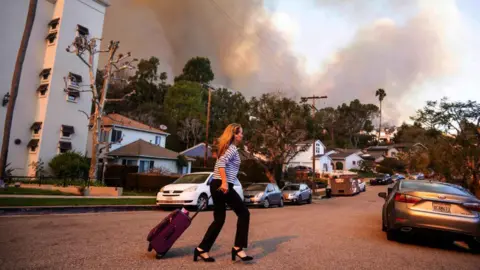
Getty Images A woman rolls a suitcase to her car parked on an LA street while smoke billows in the distanceGetty Images

More than 150,000 people were forced to evacuate due to the recent fires in LA

Christina Welch still remembers what the sky looked like the day a wildfire came within 2 miles (3.2 km) of her Santa Rosa, California, home.

It was the Tubbs fire of 2017, the most destructive in California history at the time. Ms Welch’s neighbour woke her in the morning, and told her to grab her belongings and get out. When Ms Welch opened the door, ashes were falling from the sky and smoke filled the air.

Then, in 2019, the Kincade wildfire forced her parents to evacuate for five days.

It was the final push for Ms Welch. After advice from a friend, she packed her belongings and drove across the country to her new hometown: Duluth, Minnesota.

“It was just the culmination of all of it,” the 42-year-old said. “There’s only so many times that I was going to go through every fall of worrying about what is going to set on fire, if I was going to lose a house.”

Ms Welch is one of several people who has left California in recent years because of climate disasters, even before the most destructive wildfires in Los Angeles history killed 25 people this month.

Just this week, a new, fast-moving wildfire broke out in Los Angeles County, north-west of the city, forcing tens of thousands of people to evacuate a region already reeling from destruction. Trump plans to visit Southern California on Friday to witness the devastation from the blazes.

Climate experts say so far, they have not seen mass migration from the state because of climate change – and it’s difficult to estimate the number of people who have left for that reason. The state’s population growth rate, however, has continued to decline since 2000, according to the US census.

But scientists and demographic experts say that as climate change disasters become more extreme and unpredictable, the number of people leaving the state could rise, leaving some unprepared cities with the task of welcoming new residents.

“There could be this wave of new folks saying, ‘You know what? California is just not going to work out for me because this is the third time in five years that I’ve had to close my doors because of the extreme soot and smoke,'” said University of Michigan data science professor Derek Van Berkel.

“We have to start preparing for those eventualities, because they’re going to become more frequent and more extreme.”

Leaving California for ‘climate havens’

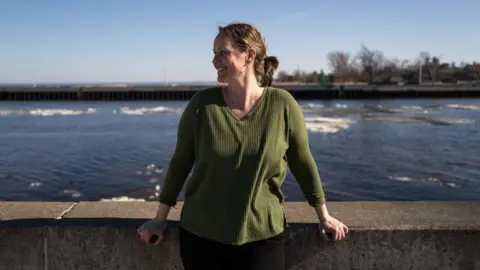
Getty Images Christina Welch wears a green sweater while standing near the water in DeluthGetty Images

Christina Welch moved to Duluth for several years after she and her family were evacuated from multiple wildfires in California

A number of climate-related factors may push Californians to leave home over the next decade. From 2020 to 2023, wildfires destroyed more than 15,000 structures in California, according to CalFire. At least 12,000 structures have been lost in the Los Angeles wildfires that broke out at the start of this year.

The state faces other climate change impacts as well, including flooding. Sea level rise could put half a million California residents in areas prone to flooding by 2100, according to the state attorney general’s office.

The state also deals with at least two earthquakes on average each year of magnitude 5.5 or greater, according to the California Department of Conservation.

As climate disasters have become more extreme and more frequent, home insurance rates in the state also have continued to rise. More than 100,000 California residents have lost their home insurance since 2019, according to a San Francisco Chronicle analysis.

LA fires: How four days of devastation unfolded

Data suggests that climate migration is, so far, more of a local phenomenon, with some moving inland within their home state or even seeking higher ground in their own city to avoid flooding, said Jeremy Porter, head of climate implications with First Street, which conducts climate risk modeling.

But, he said, in recent years, a smaller number of people have begun to flock to cities outside of California that advertise themselves as potential “climate havens”.

Several cities – and media reports – began using the term after climate adaptation researcher Jesse Keenan created a list of places in 2019 that are expected to have a lower risk for extreme climate events, places he calls “receiving zones”.

Near the top of the list is Duluth, Minnesota, a former industrial city, home to about 90,000 people, a population that has grown slowly since 2020 after years of stagnation.

One of the draws of the town is its proximity to the Great Lakes, the series of lakes that comprises the largest freshwater body in the world. Around 10% of the US and 30% of Canada relies on the lakes for drinking water.

“In a scenario where resources have become scarce, this is a tremendous asset,” Mr Van Berkel said.

The Great Lakes water supply lured Jamie Beck Alexander and her family to Duluth. Alarmed by three consecutive, destructive wildfire seasons in California, Ms Alexander, her husband and two young children piled into a camper van and drove across the country to Minnesota in 2020.

Ms Alexander has found similarities between the small, progressive city and their old city of San Francisco.

“There’s a real depth of connection between people, and deep rootedness, things that I think are important for climate resilience,” she said.

Ms Welch ignored her friends who thought she was crazy to move to a city known for its record-breaking snowfall and icy conditions, with an average 106 days a year of sub-freezing temperatures. The crisp, pretty city on a hill has become her own, she said.

“There’s a lot of people here who love where they live and want to protect it,” Ms Welch said of Duluth.

Day two of LA fires: Inferno skies and charred homes

Preparing for climate migration

Though some cities have embraced their designation as climate havens, it remains a challenge for smaller local governments to find the resources to plan for new residents and climate resilience, said Mr Van Berkel.

Mr Van Berkel works with Duluth and other cities in the Great Lakes area on climate change planning, including welcoming new residents moving because of climate change.

The city of Duluth declined to respond to the BBC’s request for comment on how it was preparing to potentially welcome climate migrants.

For now, Mr Porter said, the Great Lakes region and other “climate haven” cities aren’t seeing high levels of migration. But if that changed, many would not be ready, he said.

“It would take a huge investment in the local communities… for those communities to be able to take on the kind of population that some of the climate migration literature indicates,” Mr Porter said.

In the city of Duluth, for instance, housing availability can be an issue, Ms Alexander said. She said that although the city has space to create new housing, it does not currently have enough new developments for a growing population. As a result, in the years since she moved there, she said, housing prices have risen.

And any new housing and other developments also need to be made with climate change in mind, Mr Van Berkel said.

“We don’t want to make missteps that could be very costly with our infrastructure when we have climate change rearing its ugly head,” he said.

Are ‘climate havens’ a myth?

In 2024, a Category 4 Hurricane destroyed over 2,000 homes and businesses in Kelsey Lahr’s climate haven of Asheville, North Carolina.

She moved there in 2020, drawn to the city’s warm climate, restaurant and music scene, after a series of devastating wildfire seasons and mudslides near her town of Santa Barbara, California.

Before moving, Ms Lahr researched extensively the most climate-resilient places to live, with Asheville ranking near the top because of its milder temperatures and inland location, shielding it from flooding.

But last year, Hurricane Helene ploughed through western North Carolina, killing over 100 people in the state and decimating Ms Lahr’s new hometown of Asheville. Many were left without power for nearly 20 days and without potable drinking water for over a month.

“Clearly southern Appalachia is not the ‘climate haven’ that it was built up to be,” Ms Lahr said.

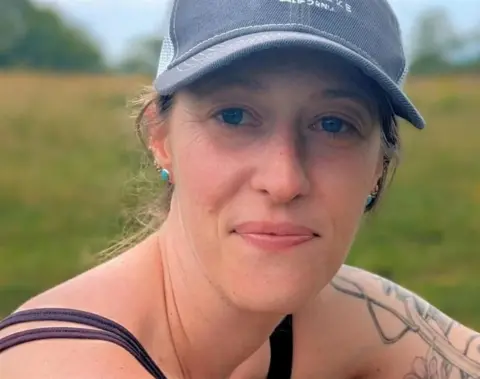
Kelsey Lahr Kelsey Lahr wears a baseball cap in a field near her home in Asheville, North CarolinaKelsey Lahr

Ms Lahr feels safer from wildfires and other climate disasters in her new home of Asheville, North Carolina

In Deluth, Ms Alexander said her family also learned quickly that they could not run away from climate change.

During their first summer, the town was hit with the same smoke and poor air quality that drove them away from California – this time from Canadian wildfires.

“It was like, this really profound joke that the universe played on me,” she said. “Unless we address the root cause [of climate change], we’re always going to feel like we need to pick up and move.”

She has since moved to Wisconsin for personal reasons, but says she doesn’t regret that first trek to Minnesota. Neither does Ms Lahr regret moving to Asheville.

Though Ms Lahr often misses the ancient forests of Yosemite National Park in California, where she would spend her summers working as a park ranger, a future that may bring more climate disasters requires sacrifices, she said.

“I sort of increasingly think that climate havens are a myth,” she said. “Everybody has to assess the risk where they live and go from there.”


Hamas Takes Charge in Gaza After 15 Months of War

0
Hamas Takes Charge in Gaza After 15 Months of War


The morning the cease-fire in Gaza went into effect, masked members of Hamas’s military wing drove through the streets of Gaza in clean, white pickups, carrying Hamas flags and automatic rifles.

The militants were also carrying an unambiguous message: However weakened, Hamas survived Israel’s 15-month bombing campaign in Gaza and remains the most powerful Palestinian party in the territory.

Since the cease-fire started on Sunday, Hamas has been working overtime in an attempt to show it still controls Gaza, even after Israel killed thousands of its members and demolished its tunnels and weapons factories in retaliation for the Oct. 7, 2023, cross-border attack that killed an estimated 1,200 people.

Throughout the war, Prime Minister Benjamin Netanyahu of Israel has vowed to eliminate Hamas, but he never offered a plan for a realistic alternative that could take control of Gaza, leaving behind a vacuum that the armed group filled.

Even for many residents of Gaza, however, the swift re-emergence of the fighters, some in official uniforms, was a surprise.

“They came out of hiding in a snap of a finger,” said Mohammed, 24, who requested his last name be withheld to avoid possible retribution from Hamas. “We had no idea where these people were during the war.”

Later on the first day of the cease-fire, dozens of Hamas militants turned up at Saraya Square in Gaza City to hand over three hostages to the Red Cross for release to Israel, the first of 33 to be freed as part of the deal. The appearance of the militants didn’t suggest they were on their last legs: They appeared to be wearing clean uniforms, in good shape and driving decent cars.

It is not clear just how many fighters, police officers, bureaucrats and political leaders survived the war or just where the militants had been hiding. But by showcasing the handover in such a public way, Hamas made clear that it was still standing in a part of Gaza that had seen some of the most devastating bombing attacks of the war.

“We’re talking about an area that was essentially plowed by the Israelis,” said Mkhaimar Abusada, a professor of political science from Gaza City who is now a visiting scholar at Northwestern University.

Israeli officials have said that they stand behind their goal of dismantling Hamas’s military wing and government, suggesting that they could resume the war after the remaining 30 hostages, of roughly 100 still held in Gaza, are freed over the coming weeks.

Despite its show of force, Hamas likely hopes to relieve itself of the daily burdens of administration and reconstruction of Gaza, but it wants any future arrangement for the territory to leave it as the top security power, and therefore, the main decision maker, Ghaith al-Omari, an expert on Palestinian affairs said. Hamas probably has to make some concessions to enable enough aid to enter Gaza for reconstruction.

Since the cease-fire, Hamas’s government has attempted to impose some sense of security, sending police forces to the streets, directing traffic, protecting aid trucks and offering a degree of law and order, residents say.

On Monday in Gaza City, a senior official in the Hamas-run Interior Ministry identified as Gen. Mahmoud Abu Watfa toured the city center in plain clothes as Gazan journalists took pictures of armed internal security forces participating in a procession.

“The picture is clear,” General Abu Watfa told a reporter. “The ones controlling security, protecting citizens and safeguarding the internal front are the forces of the Interior Ministry.”

Challenges are still evident. An official in Hamas’s internal security service, who spoke on condition of anonymity to discuss operational matters, noted that many security workers in Gaza City were using paper records instead of computers, and some were reporting to work at a bombed-out headquarters by foot because Israel had destroyed almost every police car in the city.

The bomb disposal unit in Gaza City, the official said, was struggling to defuse unexploded bombs.

“Hamas is much weaker than it was before Oct. 7,” said Michael Milshtein, a former military intelligence analyst specializing in Palestinian affairs. “But it’s totally clear that it can impose its sovereignty everywhere in Gaza.”

Municipalities in Gaza that coordinate closely with Hamas’s government have sent workers to clear rubble, remove piles of trash and survey damage to infrastructure. In Rafah, the municipal council convened a meeting in a tent outfitted with an official city flag, a desk and chairs, according to a post it shared on social media.

In an interview, Mousa Abu Marzouk, a senior Hamas official, crowed that Israel had failed to destroy Hamas. “They tried to uproot these people and they didn’t succeed,” he said. “They were steadfast on the ground for 470 days.”

Hamas, analysts said, was trying to make clear in its recent moves that it must have an influential role in discussions about the “day after,” referring to the future administration of Gaza.

“Their message to everyone is, ‘You can’t exclude us from the day after,’” said Mr. al-Omari, the Palestinian affairs expert.

Hamas leaders have indeed expressed readiness to give up civilian governance in Gaza, but without dismantling its military wing — a dynamic that would be similar to Hezbollah’s role in Lebanon before its last conflict with Israel.

The United States has said that a “revitalized” Palestinian Authority, which now has limited autonomy in governing the Israeli-occupied West Bank, should take over Gaza, but Mr. Netanyahu has rejected the idea. The authority governed Gaza until 2007, when Hamas forcibly took over in a coup after winning a majority in parliamentary elections.

On Sunday, Gideon Saar, the Israeli foreign minister, told reporters that Hamas’s rule was dangerous for Israel’s security and emphasized that Israel had not agreed to a permanent cease-fire deal that leaves Hamas in control of Gaza.

While some analysts say Israel could eventually remove Hamas from power, others say it would struggle to resume the war in the face of international pressure. And even if it does, those analysts say, Israeli forces would face immense challenges in uprooting Hamas from Gaza without carrying out a direct occupation.

In Gaza, supporters of Hamas said they felt reassured by its show of force this week. But many people without allegiances to the group worried that if it remained in power, they would be subject to its heavy-handed rule and that there would be another war, sooner or later.

“It may take Hamas time to reach a point where it will provoke Israel into another major war,” said Alaa, 28, who has been sheltering in Deir al-Balah, in central Gaza, and whose last name is being withheld to avoid reprisals.

“As long as it’s in power, it’s only a matter of time,” he added. “It’s hard to reach any other conclusion other than there’s no future here.”


French Crypto Entrepreneur and Wife Are Freed After Kidnapping

0
French Crypto Entrepreneur and Wife Are Freed After Kidnapping


A founder of a French cryptocurrency company and his wife were freed in France this week after being brutally kidnapped and held for ransom, the authorities announced on Thursday.

David Balland, a founder of Ledger, a company that sells physical devices to store crypto assets, was abducted alongside his wife early on Tuesday from their home in Vierzon, a city in central France, according to the Paris prosecutor. The couple were whisked away by car, then separated and detained at different locations, the prosecutor said.

The kidnapping set off a broad investigation involving more than 230 officers who sought to locate the couple. In the end, they freed them without firing a shot, the authorities said at a news conference in Paris on Thursday evening.

“This was an extremely complex case,” said Gen. Ghislain Réty, the head of an elite unit specializing in hostage rescue that freed the couple.

The Paris prosecutor, Laure Beccuau, said that the kidnappers had contacted another founder at Ledger and demanded that a large ransom be paid using cryptocurrency. She said investigators were still establishing how much in total they had requested.

The company alerted the gendarmerie, the police force in smaller towns and rural and suburban areas of France. French news outlets that caught wind of the investigation were urged to refrain from publishing any details to avoid jeopardizing the couple’s safety.

The gendarmes rapidly located Mr. Balland in Châteauroux, about 30 miles southwest of his home, and freed him on Wednesday. He was hospitalized because of a “mutilation” inflicted by the kidnappers to his hand, Ms. Beccuau said.

An official with knowledge of the investigation, who was not authorized to speak publicly about an ongoing case, said that the kidnappers had sent an image of Mr. Balland’s mutilated finger to pressure the company.

Part of the ransom was paid during negotiations with the kidnappers, Ms. Beccuau said. “Almost all of that cryptocurrency was tracked, frozen and seized,” she said.

On Thursday, by using surveillance of some suspects, analyzing phone records and questioning several people who had already been arrested, investigators located Mr. Balland’s wife in Étampes, about 80 miles north of Vierzon.

Officers found her tied up in a car but otherwise unharmed, Ms. Beccuau said.

In all, nine men and one woman, ages 20 to 40, have been taken into custody for questioning about the kidnapping, Ms. Beccuau said. She did not identify them or provide details about their involvement, saying only that they were from different cities and had criminal records. They were not known to the police as being part of organized crime, she said.

Pascal Gauthier, the chief executiveof Ledger, wrote on social media Thursday that he was “deeply relieved.”

“Our top priority was always to allow law enforcement to do their jobs and protect the integrity of the investigation,” Mr. Gautier said. “We respected law enforcement requests around safeguarding critical details of the ongoing investigation and appreciated members of the press who did the same.”

Ledger, a prominent start-up valued at more than $1 billion, was founded in 2014 and has sold over six million units since then, according to the company’s website. It has over 700 employees in Europe, Asia and the United States, the company says.

Éric Larchevêque, another founder at the company and a known TV personality who has appeared on the jury of France’s equivalent of “Shark Tank,” expressed “immense relief and profound joy” on social media after the release of Mr. Balland and his wife.

Prosecutors are opening an investigation into charges of kidnapping and holding someone against his or her will as part of an organized gang in order to obtain something in exchange; acts of torture; and armed extortion. Those crimes can carry life prison sentences, Ms. Beccuau said.

The case echoed a similar one reported by French news media this month in which a man and his family were held hostage by a group that wanted to blackmail his son, a cryptocurrency influencer living in Dubai. They were released, but no arrests have been made in that case, according to news reports.

At this stage, investigators have not established any ties between the two cases, Ms. Beccuau said.