Thursday, October 1, 2026
Home Blog Page 6921

Saudi Arabia Says It Will Increase U.S. Trade and Investment by $600 Billion

0
Saudi Arabia Says It Will Increase U.S. Trade and Investment by 0 Billion


Crown Prince Mohammed bin Salman of Saudi Arabia told President Trump on Wednesday that the kingdom intends to increase its investment and trade with the United States by at least $600 billion over the next four years, according to the official Saudi Press Agency.

The crown prince, the de facto leader of Saudi Arabia, told Mr. Trump that his new administration had the ability to create “unprecedented economic prosperity” in the United States, and that the kingdom wanted to participate, a statement from the Saudi Press Agency said.

There was no immediate confirmation of the call from the White House.

Mr. Trump has promised to accelerate investment in the United States, particularly to help revive manufacturing. While campaigning last year, he said he would use a mix of tax cuts and tariffs to force companies to invest in the United States.

On Tuesday, Mr. Trump announced Stargate, a joint venture between OpenAI, SoftBank and Oracle that is intended to create at least $100 billion in artificial intelligence infrastructure. The initiative could invest as much as $500 billion over four years.

Saudi Arabia was Mr. Trump’s first stop on his first overseas trip as president in 2017, a reflection of the importance he put on his relationship with the crown prince. During that term, the United States pursued major deals with the kingdom, including arms sales.

Since then, Mr. Trump and his family have signed several personal business deals in the Gulf region, especially in Saudi Arabia and the United Arab Emirates.

The Trump organization announced several projects in Saudi Arabia in December and also unveiled a $533 million Trump Tower in Jeddah with Dar Global, the global arm of Saudi Arabia’s Dar Al Arkan real estate company. Both Dar Al Arkan and its Dar Global subsidiary are private companies, but they have close ties to the Saudi government.

Jared Kushner, Mr. Trump’s son-in-law, also secured a $2 billion investment from a Saudi government fund for his private equity firm six months after Mr. Trump left the White House in 2021.

“One thing is certain, Trump and M.B.S. are both fluent in the language of business,” said Salman al-Ansari, a geopolitical analyst from Saudi Arabia, using a widespread abbreviation of the crown prince’s name.

Mr. Trump told reporters in the Oval Office on Monday that Saudi Arabia was his first foreign stop during his previous term because “they agreed to buy $450 billion worth of our product.”

If Saudi Arabia wanted to “buy another 450 or 500,” he said, “I think I’d probably go there,” for his first overseas trip in his second term.

In the spring, before his election, Mr. Trump spoke with the crown prince. It was unclear what they discussed and whether this was the only conversation they had since Mr. Trump left office.

During the campaign, Mr. Trump told Al Arabiya, a Saudi-owned broadcaster, that he had “so much respect for Mohammed, who is doing so great.”

Mr. Trump stood by the crown prince in the aftermath of the killing of the Washington Post columnist Jamal Khashoggi in 2018, despite the C.I.A.’s assessment that the crown prince had likely approved the killing and dismemberment of Mr. Khashoggi.

Secretary of State Marco Rubio has also spoken with the Saudi crown prince, in a phone call during which they discussed the “strength of the U.S.-Saudi partnership in this time of momentous change,” according to a State Department readout. In 2018, while he was a senator, Mr. Rubio said there was “no doubt” the Saudi crown prince was involved in the Khashoggi murder.

Another focus of the Trump administration is persuading Saudi Arabia to join the Abraham Accords, an agreement brokered during Mr. Trump’s first term that resulted in several Arab nations establishing formal diplomatic relations with Israel.

In a readout released early Thursday morning by the Saudi press agency, the Saudis said Mr. Trump and Crown Prince Mohammed had also discussed “ways to promote peace, security, and stability in the Middle East,” though the statement did not mention any discussions on a potential expansion of those accords.

In the Oval Office on Monday, Mr. Trump also discussed those agreements. He told reporters: “I don’t think you have to push them. I think it’s going to happen, but maybe not quite yet. But they’ll end up in the accords, the Abraham Accords.” When asked when he expected both sides to sign a new deal, Mr. Trump replied, “Soon.”

Last year, Crown Prince Mohammed stated that the kingdom would not normalize relations with Israel without first securing recognition of Palestinian statehood, a position that marked a shift from earlier statements.


Mexico’s Ambitious Plan to Prepare to Receive Its Citizens Deported From the US

0
Mexico’s Ambitious Plan to Prepare to Receive Its Citizens Deported From the US


Mexico’s plan to receive thousands of its deported citizens from the United States is nothing short of ambitious. Plans are underway to build nine reception centers along the border — massive tents set up in parking lots, stadiums and warehouses — with mobile kitchens operated by the armed forces.

Details of the initiative — called “Mexico Embraces You” — were revealed only this week, although Mexican officials said they had been devising it for the past few months, ever since Donald J. Trump pledged to conduct the largest expulsion of undocumented immigrants in U.S. history.

Nearly every branch of government — 34 federal agencies and 16 state governments — is expected to participate in one way or another: busing people to their hometowns, organizing logistics, providing medical attention, enrolling the recently returned in social welfare programs like pensions and paid apprenticeships, along with handing out cash cards worth about $100 each.

Officials say they are also negotiating agreements with Mexican companies to link people to jobs.

“We are ready to receive you on this side of the border,” Mexico’s interior minister, Rosa Icela Rodríguez, said at a news conference this week. “Repatriation is an opportunity to return home and be reunited with family.”

President Claudia Sheinbaum of Mexico has called the expected large-scale deportations a “unilateral move” and has said she does not agree with them. But as the country with the single largest number of unauthorized citizens living in the United States — an estimated four million people as of 2022 — Mexico has found itself obligated to prepare.

The government’s plan is focused on Mexicans deported from the United States, though the president has indicated the country could temporarily receive foreign deportees, too.

Mexico is not alone in preparing: Guatemala, its neighbor to the south that also has a large undocumented population in the United States, recently rolled out a plan to absorb its own deportees.

While Mexico’s foreign minister spoke by phone to the new U.S. secretary of state, Marco Rubio, this week about immigration and security issues, Mexico and other countries in the region have said that they have not been briefed by the Trump administration on its deportation plans, leaving them to scramble in the absence of any specifics.

“The return of Donald Trump again finds Mexico unprepared to face these scenarios,” said Sergio Luna, who works with the Migrant Defense Organizations’ Monitoring Network, a Mexican coalition of 23 shelters, migrant houses and organizations spread across the country.

“We can’t keep responding to emergencies with programs that may have the best intentions but fall absolutely short,” Mr. Luna said. “What this shows is that for decades Mexico has benefited from Mexican migrants through remittances, but it has resigned this population to oblivion.”

Moreover, while the government has a fleet of 100 buses to take deportees back to their home states, many of them had fled those places to escape violence and a lack of opportunities in the first place.

Other experts wondered if the Mexican government was really prepared to deal with the long-term trauma that deportations and family separations might cause.

“These people are going to come back and their return is going to have an impact on their mental health,” said Camelia Tigau, a migration researcher at the National Autonomous University of Mexico.

Even with the new facilities, existing shelters — often small and underfunded — may be hard-pressed to serve large numbers of recently arrived people along with the usual population of migrants from the south hoping to cross the U.S. border, shelter operators said, even though the number of migrants has dropped drastically in recent months.

“We can’t prepare because we don’t have financial resources,” said Gabriela Hernández, the director of the Casa Tochán shelter in Mexico City, adding that her team mostly relies on donations from everyday citizens. “So we consider this to be an emergency. It’s like an earthquake.”

Other shelter operators in Mexico City said they had not been offered extra support from the government.

Mexico City, the capital, is likely to end up receiving many of the returnees. Studies show that, when deported, people often don’t settle in their hometowns, but relocate to larger cities.

“It is a good thing that the Mexican government is planning for the initial reception,” said Claudia Masferrer, a migration researcher who has studied return dynamics from the United States to Mexico and their implications. Still, she added, “it is important to think about what will happen afterward, in the following months.”

Temístocles Villanueva, Mexico City’s chief of human mobility, said in an interview that officials planned to create new shelters and nearly triple the capital’s capacity to house migrants and deportees — to more than 3,000 from about 1,300.

Those who work with migrants and the deported are also concerned that Mexico and other countries in the region could be hobbled in their efforts to receive large numbers of people if the Trump administration halts the disbursement of foreign aid, as Mr. Rubio said on Tuesday that it was starting to do, after an executive order signed on Monday by Mr. Trump.

“That could translate into a crisis, or at least a temporary weakening of these humanitarian assistance support networks,” said Mr. Luna.

The United States is the largest funder of the United Nations’ International Organization for Migration, or I.O.M., for example, which presently offers many of the services provided to migrants and deportees, starting with the kits of sanitary supplies people receive when they step off deportation flights.

The organization, which is collaborating with Mexico’s government on the “Mexico Embraces You” plan, declined to comment.

In a cable sent to State Department employees on Tuesday, Mr. Rubio specifically mentioned migration in connection with foreign aid. In the past, such aid has also gone to programs aimed at alleviating hunger, disease and wartime suffering.

In his cable, Mr. Rubio said that “mass migration is the most consequential issue of our time” and the department would no longer take actions that would “facilitate or encourage it.”

Diplomacy, especially in the Western Hemisphere, would “prioritize securing America’s borders,” he added.

Ms. Sheinbaum has signaled that Mexico could receive deportees other than Mexicans. She said, however, that her government planned to “voluntarily” return any non-Mexican nationals — including those waiting for asylum hearings in the United States — to their countries of origin.

The question of who would pay to return them, she said, was on the list of topics she planned to discuss with U.S. government officials.


Zelensky Could Face Tough Re-election Prospects, Polls Show

0
Zelensky Could Face Tough Re-election Prospects, Polls Show


Since Russia invaded his country three years ago, President Volodymyr Zelensky of Ukraine has survived a military assault on his capital, assassination plots, corruption scandals in his government, political infighting and ominous setbacks in his army’s fight against Russia.

He had enough support from Ukrainians to carry him through each time.

Now, with Donald J. Trump installed in the White House, Mr. Zelensky is facing a new challenge: maintaining good relations with the country’s most critical ally and a president who has been disdainful toward him and skeptical of military aid.

Mr. Trump’s arrival comes at a precarious time for Mr. Zelensky domestically. The soaring popularity he experienced early in the war — with an approval rating of about 90 percent — has been slumping badly. The latest polling shows support sinking to nearly 50 percent, and it falls even lower in surveys that gauge his popularity against potential competitors if elections were held in the wake of a cease-fire agreement with Russia.

And a new trouble spot for Mr. Zelensky has emerged: the revival of political opposition in Ukraine, animated by the prospects of a cease-fire and the elections that could soon follow. His opponents are also encouraged by the barrage of criticism Mr. Trump and his aides have aimed at Mr. Zelensky.

Two opponents who ran against Mr. Zelensky in Ukrainian elections in 2019 — former President Petro O. Poroshenko and former Prime Minister Yulia Tymoshenko — have reached out to members of Mr. Trump’s team. Ms. Tymoshenko traveled to Washington to attend some inaugural events on Monday.

Mr. Zelensky did not attend the ceremony. He had said he would travel to Washington only if invited by Mr. Trump.

“He believes in the one-man show, but it doesn’t work,” Oleksiy Goncharenko, a member of Parliament in the opposition European Solidarity party, said of Mr. Zelensky’s role as the face of Ukrainian resistance after the Russian invasion in 2022. More pluralism will help the war effort, he said in an interview: “We are not Russia.”

Mr. Zelensky rallied his people and allied nations through the war with nightly videos and frequent trips abroad. But beyond that, he has cloistered himself in an ever-tightening circle of loyal aides, restricting access to opposition figures and typically ignoring their advice, Mr. Goncharenko said. The more active opposition emerging now will aid the war effort, he added.

To be sure, no vote in Ukraine is scheduled — or even possible, election experts say — while the war rages and the country is under martial law. Russia could disrupt any voting with missile volleys. Millions of Ukrainians, including soldiers in combat, refugees in Europe and people living under occupation, would risk disenfranchisement. So while Ukrainians are fighting for their democracy, they cannot practice it.

Still, opposition figures have not failed to notice how setbacks in the war have whittled away at Mr. Zelensky’s popularity. Under the Constitution, elections must be called after martial law is lifted. Parliament first imposed martial in February 2022, after the full-scale Russian invasion, and extends it with periodic votes.

By one measure, Mr. Zelensky still has the support of a majority of Ukrainians, albeit a slim one: 52 percent still have trust in the president, according to a poll in December by the Kyiv International Institute of Sociology.

But polling focused more narrowly on a hypothetical presidential election shows Mr. Zelensky trailing a former commander in the military, Valery Zaluzhny, who was removed by the president as part of a sweeping overhaul of the military command and is now Ukraine’s ambassador to Britain.

One survey, by the polling agency Leading Legal Initiatives, showed Mr. Zaluzhny winning a hypothetical first round of a two-stage election with 24 percent of the vote. Mr. Zelensky trailed, with 16 percent; and Ms. Tymoshenko, the opposition figure, came in third place with 12 percent. Neither Mr. Zaluzhny nor Ms. Tymoshenko has declared an intention to run.

Dwindling support has implications beyond politics for Mr. Zelensky: It could undermine his role as commander in chief in wartime.

“It is hardly worth explaining further what disasters can happen in the event of delegitimization and collapse in control,” Anton Hrushetskyi, the executive director of the Kyiv International Institute of Sociology, wrote in an analysis of falling approval ratings.

That has not stopped Mr. Trump and members of his entourage from taking swipes at Mr. Zelensky. At a rally in September, for example, Mr. Trump called Mr. Zelensky “the greatest salesman in history” for the billions in military aid he has secured to defend his country.

Speaking to reporters on Monday after the inauguration, however, Mr. Trump offered a positive assessment of Mr. Zelensky’s openness to settlement talks and one of his harshest assessments to date of Russia’s president, Vladimir V. Putin, who he said was “destroying Russia” with the war.

Mr. Zelensky and aides have scrambled to make inroads with Mr. Trump’s team. The Ukrainian president met with Mr. Trump in New York in September. Andriy Yermak, the Ukrainian presidential chief of staff, met in December on Capitol Hill with Vice President-elect JD Vance and the incoming national security adviser, Michael Waltz, who was then a congressman from Florida, according to two people familiar with the meeting.

Mr. Zelensky’s aides have also looked to curry favor behind the scenes. Officials in Kyiv have discussed the possibility of brokering a deal to purchase the Ukrainian language rights to Melania Trump’s book, “Melania,” according to a Ukrainian official familiar with the discussion.

It was unclear if any in the group had reached out to Ms. Trump’s aides or publisher, the official said. He described the discussion as not more than “brainstorming” by Zelensky aides on establishing good relations with Mr. Trump.

On a trip to Washington in December, Mr. Poroshenko spoke with Mr. Waltz, the pick for national security adviser. Mr. Poroshenko touted the exchange in a Facebook post in which he promoted his ties to the Trump team and included photographs of himself with Mr. Waltz.

“I received assurances of the readiness of the new American Administration to demonstrate leadership in the matter of repelling Russian aggression and establishing a just peace in Ukraine,” he wrote, adding that Mr. Trump’s team “remembers well our cooperation with him during my presidency.”

A person who was present said Mr. Poroshenko had overstated the significance of the interaction with Mr. Waltz, which occurred in a hallway at a function the two were attending and was not a formal meeting. Mr. Poroshenko has denied pursing any political goals during the war.

Oleksandr Merezhko, the chairman of the foreign policy committee in Ukraine’s Parliament and a member of Mr. Zelensky’s political party, said it was standard diplomacy for Mr. Trump’s team to engage with an opposition party.

“Ukraine is a democratic society,” he said. “It’s great to meet with the opposition.”

But he claimed that the opposition’s outreach was “mostly about self-promotion and political PR.” Mr. Merezhko has tried a different approach to focus Mr. Trump on the war: Last fall, he nominated Mr. Trump for a Nobel Peace Prize.

Mr. Merezhko said he did not believe that Mr. Trump held any deep-seated animosity toward Mr. Zelensky. The “greatest salesman” comment, he said, could be read as laudatory.

“In the world of Trump, this is a compliment,” he said.


Video: Thai same-sex couples marry as equality law takes effect

0
Video: Thai same-sex couples marry as equality law takes effect


Hundreds of gay couples have married in Thailand as a new law took effect that allows same-sex unions.


Couples wed in a riot of colour as same-sex marriage becomes legal

0
Couples wed in a riot of colour as same-sex marriage becomes legal


Jonathan Head, Thanyarat Doksone and Panisa Aemocha

Watch: Couples say ‘I do’ as Thailand legalises same-sex marriage

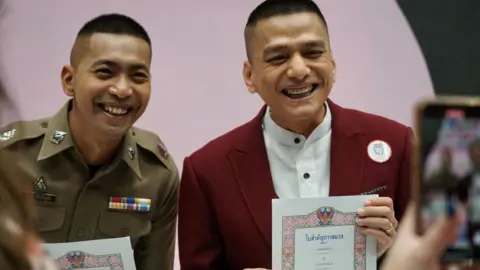
When Thailand’s long-awaited equal marriage law came into effect on Thursday, police officer Pisit “Kew” Sirihirunchai hoped to be among the first in line to marry his long-term partner Chanatip “Jane” Sirihirunchai.

And he was – they were the sixth couple to register their union at one of Bangkok’s grandest shopping malls, in an event city officials helped organise to celebrate this legal milestone.

Hundreds of couples across Thailand received marriage certificates on Thursday, breaking into smiles or tearing up over the moment they had dreamed of for so long.

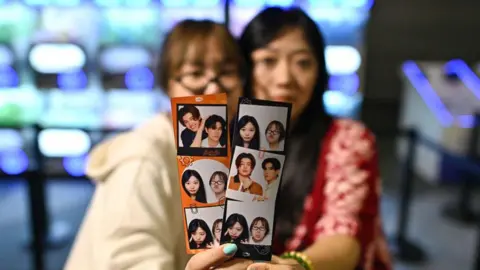
It was a pageant of colours and costumes as district officials hosted parties with photo booths and free cup cakes – one Bangkok district was giving air tickets to the first couple who registered their marriage there.

“The rainbow flag is flying high over Thailand,” Prime Minister Paetongtarn Shinawatra wrote on Facebook from Davos where she is attending the World Economic Forum.

Activsts said they were hoping to cross the 1,448-mark for registrations by the end of Thursday – 1448 is the clause in the Thai Civil Code covering the definition of marriage.

“We have been ready for such a long time,” Pisit said. “We have just been waiting for the law to catch up and support us.”

Lulu Luo/BBC Pisit "Kew" Sirihirunchai (L) in police uniform and his partner Chanatip "Jane" Sirihirunchai in a red suit smile while holding their marriage certificatesLulu Luo/BBC

Pisit “Kew” Sirihirunchai (L) and his partner Chanatip “Jane” Sirihirunchai smile while holding their marriage certificates

The two men have been together for seven years. Eager to formalise their relationship, they had previously been to a Buddhist monk to give them an auspicious new last name they can share – Sirihirunchai. They had also asked local officials to issue a letter of intent, which they both signed, pledging to get married.

But they said having their partnership recognised under Thai law is what they had been waiting for: “This is perfect for us. The law that protects our rights.”

Until now, official documents listed Pisit and Chanatip as brothers. That way they could be a family in the eyes of the law. A marriage certificate means LGBTQ+ couples now have the same rights as any other couple to get engaged and married, to manage their assets, to inherit and to adopt children.

They can also make decisions about medical treatment if their partner becomes ill and incapacitated, or extend financial benefits – such as Pisit’s government pension – to their spouse.

“We want to build a future together – build a house, start a small business together, maybe a café,” he adds, making a list of all that the law has enabled. “We want to build our future together and to take care of each other.”

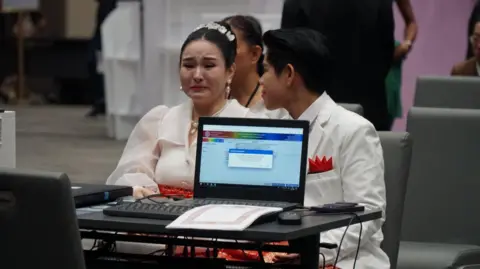
Lulu Luo/ BBC A couple tears up while registering their marriageLulu Luo/ BBC

Ploynaplus Chirasukon and Kwanporn Kongpetch – the first couple to be married at the Bangkok mall – said they were waiting 17 years for this day

Lulu Luo/ BBC Photos couples hanging at the venueLulu Luo/ BBC

Hundreds of couples are registering their marriages across Thailand today

The law, which passed in both houses of parliament in June last year before being endorsed by the Thai king in September, is a big step for LGBTQ+ rights.

Thailand remains an outlier in Asia in recognising marriage equality – only Nepal and Taiwan have legalised same-sex unions.

It’s one reason why Aki Uryu, who is Japanese, moved to Bangkok to be with her partner. She said life is difficult for the LGBTQ+ community back home: “In Thailand, I can hold hands with my partner, walk together. No one says anything. It’s just different. It feels right.”

After the two women married on Thursday, Aki said: “It is like I have started my new life.”

Watching them celebrate, along with so many other couples in a Bangkok mall, was Mr Zhang, a gay Chinese man who did not want to reveal his first name.

“We’re excited, we’re also very jealous,” he said. “Thailand is so close to China, but in another sense it’s so far away.”

And yet, even in Thailand, with its famed tolerance towards LGBTQ+ people, activists say it took a sustained campaign to win legal recognition.

A long wait

“We’ve been waiting for this day for 18 years – the day everyone can recognise us openly, when we no longer need to be evasive or hide,” 59-year-old Rungtiwa Thangkanopast, who will marry her partner of 18 years in May, told the BBC earlier this week.

She had been in a marriage, arranged by her family, to a gay man, who later died. She had a daughter, through IVF, but after her husband’s death began spending time, and later helping run, one of the first lesbian pubs in Bangkok. Then she met Phanlavee, who’s now 45 and goes by her first name only.

On Valentine’s Day 2013 the two women went to the Bang Rak district office in central Bangkok to ask to be officially married – a popular place for marriage registration because the name in Thai means “Love Town”.

This was the time when LGBTQ+ couples began challenging the official view of marriage as an exclusively heterosexual partnership by attempting to get marriage certificates at district offices.

There were around 400 heterosexual couples waiting with them on that day. Rungtiwa and Phanlavee were refused, and the Thai media mocked their effort, using derogatory slang for lesbians.

Rungtiwa Thangkanopast Rungtiwa in a white wedding gown and Phanlavee in a white suit with a pink corsage. Both are smiling in a lawn in front of a stately white building.Rungtiwa Thangkanopast

Rungtiwa (R) and Phanlavee are marrying in May but they took part in a government-sponsored event to raise awarness about marriage equality

Still, activists managed to persuade the government to consider changing the marriage laws. A proposed civil partnership bill was put before parliament, offering some official recognition to same-sex couples, but not the same legal rights as heterosexual couples.

A military coup in 2014 which deposed the elected government interrupted the movement. It would be another decade before full marriage equality was approved by parliament, in part because of the rise of young, progressive political parties that championed the cause.

Their message resonated with Thais – and attitudes too had changed. By this time, same-sex marriage was legalised in many Western countries and same-sex love had become normalised in Thai culture too.

Such was the shift in favour of the law that it was passed last year by a thumping majority of 400 votes to just 10 against. Even in the notoriously conservative senate only four opposed the law.

And couples like Rungtiwa and Phanleeva now have their chance to have their love for each other recognised, without the risk of public derision.

“With this law comes the legitimacy of our family,” Rungtiwa says, “We’re no longer viewed as weirdos just because our daughter isn’t being raised by heterosexual parents.”

Rungtiwa Thangkanopast Rungtiwa and Phanlavee pose in the background as their daughter takes a selfie with them Rungtiwa Thangkanopast

Rungtiwa says the equal marriage law finally recognises their family

The new law takes out gender-specific terms like man, woman, husband and wife from 70 sections of the Thai Civil Code covering marriage, and replaces them with neutral terms like individual and spouse.

However, there are still dozens of laws in the Thai legal code which have not yet been made gender-neutral, and there are still obstacles in the way of same-sex couples using surrogacy to have a family.

Parents are still defined under Thai law as a mother and a father. The law also does not yet allow people to use their preferred gender on official documents; they are still stuck with their birth gender. These are areas where activists say they will still need to keep pushing for change.

And it is especially significant for older couples, who have had to ride out the shifts in attitude.

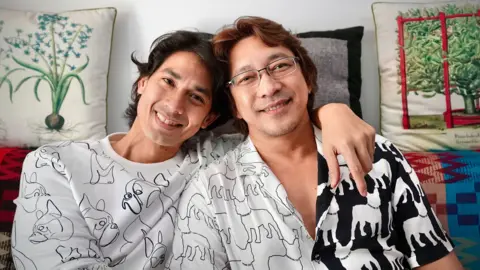
“I really hope people will put away the old, stereotypical ideas that gay men cannot have true love,” said Chakkrit “Ink” Vadhanavira.

He and his partner Prinn, both in their 40s, have been together for 24 years.

Benjamin Begley/ BBC Chakkrit (R) and Prinn smiling with Prinn's arm around Chakkrit's shoulderBenjamin Begley/ BBC

Chakkrit (R) and Prinn have been together for more than two decades

“The two of us have proved that we genuinely love each other through thick and thin for more than 20 years,” Chakkrit said. “We have been ready to take care of each other since our first day together. We are no different from heterosexual couples.”

While Chakkrit’s parents quickly accepted their partnership, it took Prinn’s parents seven years before they could do so.

The couple also wanted to share the production business they ran together, and other assets, as a couple, so they asked Prinn’s parents to adopt Chakkrit officially, giving him the same family name. Prinn says the new law has brought welcome legal clarity to them.

“For example, right now when a same sex couple buy something together – a large item – they cannot share ownership of it,” said Prinn. “And one of us passes away, what both have us have earned together cannot be passed on to the other. That’s why marriage equality is very significant.”

Today, said Prinn, both sets of parents treat them as they would just like any other married children.

And when they had relationship problems like any other couple, their parents helped them.

“My dad even started reading gay magazines to understand me better. It was quite cute to see that.”

Additional reporting by Lulu Luo, Paweena Ninbut and Ryn Jirenuwat in Bangkok


Houthis Free the Crew of a Cargo Ship They Hijacked 14 Months Ago

0
Houthis Free the Crew of a Cargo Ship They Hijacked 14 Months Ago


Yemen’s Houthi rebels on Wednesday freed the crew of a commercial vessel, the Galaxy Leader, that they hijacked 14 months ago as part of their campaign of attacks in the Red Sea to support Hamas in its war against Israel.

The decision is consistent with an announcement made on Sunday by the rebel group, which is backed by Iran, to scale back its attacks, given a cease-fire in the conflict in Gaza that went into effect over the weekend.

The Houthis took the Galaxy Leader to the Yemeni port of Al-Hudaydah in November 2023 and since then had held its crew hostage. The World Cargo News website reported in November that its 25-member crew included nationals of the Philippines, Ukraine, Bulgaria, Mexico and Romania.

“This is a moment of profound relief for all of us, not only for the crew and their families, but also to the wider maritime community,” Arsenio Dominguez, the secretary general of the International Maritime Organization, said in a statement that announced the release. The organization had campaigned for the crew to be freed.

A senior Houthi official, Nasser Al-Din Amer, had earlier said on social media that the crew would be freed on Wednesday. The Yemeni television channel Al-Masirah, which is affiliated with the rebels, said that the decision had been ordered by the Houthi leader, Abdul-Malik Badr al-Din al-Houthi, and was coordinated with Hamas and mediated by Oman.

The Galaxy Leader, which is designed to carry vehicles, sails under the flag of the Bahamas and was shown on Wednesday as “stopped” in the Red Sea and out of range of satellite navigation, according to MarineTraffic, a ship tracking app and website that provides real-time information about vessels around the world. It was unclear what would happen to the ship.

The capture of the vessel, which had been en route to India from Turkey, was one of the most audacious maritime operations by the Houthis and came at the start of their campaign in support of Hamas, which attacked Israel on Oct. 7, 2023, triggering the war in Gaza.

At the time, the Houthis had threatened to target ships traversing the Red Sea that were flagged, owned and operated by Israel. After the Galaxy Leader was seized, a Houthi spokesman announced that the hijacking was a demonstration of support for “the oppressed Palestinian people.”

While Israel’s military said the Galaxy Leader’s crew had no Israelis, it appears that an Israeli billionaire, Rami Ungar, was at one point the beneficial owner of the company that owns the ship, according to the Paradise Papers, a major leak of confidential documents that in 2017 exposed a hidden world of wealth and ownership. A beneficial owner of a company is a person who exercises control over it, owns more than a quarter of it or receives substantial economic benefit from it.

The Houthi campaign against Israel disrupted maritime traffic in one of the world’s most important shipping routes, forcing many vessels to take a much longer journey around the Cape of Good Hope at Africa’s southern tip.

In recent months, the group has also launched a series of missile and drone attacks at Israel. Most have been intercepted before reaching Israeli territory, but Israel’s military has responded with a series of airstrikes against targets in Yemen linked to the rebels.

The Houthis’ spokesman, Mohammed Abdulsalam, said on social media on Sunday that supporting the Palestinian cause would remain a top priority even after the cease-fire. The Houthis have said they would stop targeting all ships “upon the full implementation of all phases” of the cease-fire agreement.” But they said they would continue to target vessels owned by Israeli individuals or entities or sailing under the Israeli flag.

But in an email dated Sunday and sent by a Houthi-linked group that communicates with the shipping industry, the Houthis warned that if the United States or Britain directly attacked Yemen, they would resume their assaults on vessels associated with those countries.

Rawan Sheikh Ahmad contributed reporting.


Migrants Left Stranded After Trump Cancels Asylum Claims at Border

0
Migrants Left Stranded After Trump Cancels Asylum Claims at Border


Thousands of migrants are now in limbo at the U.S.-Mexico border after President Trump shut down the main legal channel for asylum seekers to enter the country. Many had waited months for immigration appointments, until the CBP One app was abruptly shut down on Monday.


Victor Wembanyama Prepares to Become ‘Genuine’ Face of the N.B.A.

0
Victor Wembanyama Prepares to Become ‘Genuine’ Face of the N.B.A.


One day last summer, Harrison Barnes, a longtime N.B.A. veteran, was finishing up an off-season workout with Victor Wembanyama, his 7-foot-4, then-20-year-old San Antonio Spurs teammate and one of the league’s most dazzling young stars.

Barnes was new to the team — he had recently been traded from the Sacramento Kings — and new to Wembanyama. But he was already beginning to understand that Wembanyama was precocious in more than one way.

In the N.B.A., many teams track shooting percentages and shots made in games and at practice as a way of gauging their players’ progress. The Spurs had a chart that tracked both, but ranked players based on makes. Barnes told Wembanyama that metric felt insufficient. Wembanyama pondered Barnes’s concern. Then he got to work.

He picked up a marker and started to sketch out some thoughts on a white board. He wondered if a graph might be better than a chart and if it should include week-to-week changes. Wembanyama plotted ideas for three theoretical players, whom he labeled A, B and C. At one point, Barnes heard the word “coefficients.”

“He was really trying to wrap his mind around like, ‘How do you get better at that?’” Barnes said. “How do you chart what progress is?”

That day, Barnes saw into Wembanyama’s psyche — the sincere search for knowledge and human connection that he’s carried with him through the early part of his N.B.A. career. It leads to the kind of authenticity that marketers crave, and fans are drawn to.

Wembanyama came into the N.B.A. from France as the most hyped prospect since LeBron James. He was taken first overall in the 2023 draft, and his play on the court has matched the early expectations. He can handle the ball like someone a foot shorter. He can dunk and shoot 3-pointers, generating debates about which he should do more. He is perhaps the most fearsome defender in the league, with an eight-foot wingspan that is nearly impassable.

As the N.B.A. confronts its future without an aging James and his contemporaries Stephen Curry and Kevin Durant, Wembanyama has embraced the idea that he will lead it, with his play and his endeavors off the court. And he has learned that the best way to present himself is to just be who he is, a person intensely focused on being a great basketball player, who also loves reading fantasy novels, playing chess and gathering all the knowledge he can about the world.

“Most of us want to craft a nice legacy and nice image because those are the things that people will remember,” Wembanyama, who turned 21 this month, said in a recent interview. “But on the other side, I think the best way for me to have the best image, and to give the right messages I want to send, is to be genuine. Just like not force myself to do things that don’t resemble me or to say things that I don’t believe in.”

As he spoke, he sat at a table in a plain conference room at a hotel in Milwaukee. It was a day off between games, and the Spurs had arrived a few hours earlier after taking a bus from Chicago. Wembanyama dressed comfortably, in a dusty rose-colored sweatsuit.

“I’m not in a hurry, but I make strategic choices,” Wembanyama said. “And I don’t hesitate turning down offers in the millions and millions of dollars just for something that I don’t believe in.”

It is an analog way of looking at life in a society that often is in a hurry. The youngest to accomplish something are often lionized, and impatience sets in if success is seen to take too long.

This is particularly true of the N.B.A., which many of the best players join when they are 18 or 19, and the inability to achieve immediately has dimmed many bright stars. The third pick in Wembanyama’s draft, 20-year-old Scoot Henderson of the Portland Trail Blazers, is already facing questions about whether he has what it takes to succeed in the league. Zion Williamson is 24, yet some are wondering if his marriage with the New Orleans Pelicans, who selected him first overall to much fanfare in 2019, has failed.

No one is asking those questions about Wembanyama.

He was the league’s rookie of the year last season and its leader in blocked shots per game. This season he became the first player in N.B.A. history to have more than 2,000 points, 1,000 rebounds and 200 3-pointers in his first 100 games. He is the betting favorite to be the league’s defensive player of the year, an award rarely won this early in one’s career.

“He cares about everything,” said Chris Paul, 39, the Spurs’ point guard who is learning French on the app Duolingo so he can try to speak to Wembanyama in his native language. “He cares about how he treats people. He cares about wins and losses. He cares about if he’s doing enough work.”

Wembanyama scored 50 points against the Washington Wizards in November, his first 50-point game and only the eighth 50-point game in Spurs history. After the game, he downplayed what he’d done, saying he hoped it was just one of many accomplishments he would have in his career.

Wembanyama knows he will eventually be judged by how many championships he wins, which seems just fine with him.

“He has larger ambitions,” Barnes said. “He is motivated by winning. He wants to be one of those guys who goes and wins an Olympic gold medal, he goes and wins an N.B.A. championship, that those are the things that really motivate him.”

Wembanyama’s arrival fits nicely with the N.B.A.’s ambition to be a global league.

Part of that involves playing games around the world, including in Paris. Since 2020, the N.B.A. has played four regular-season games there.

This week, in a first, Paris will host two regular-season games, when the Spurs and the Indiana Pacers play on Thursday and Saturday. On Tuesday, Wembanyama and the Spurs unveiled an outdoor court, which he designed and the team paid a significant portion of the cost for, in Le Chesnay, the Parisian suburb where he grew up.

Wembanyama has increased the Spurs’ popularity in France dramatically, and his jersey is the second-best selling N.B.A. uniform in Europe behind James. He is the league’s third-most viewed player on social media globally, trailing only James and Curry.

“I would say we haven’t seen anybody like this, especially from a European player, ever,” said George Aivazoglou, the N.B.A.’s managing director of Europe and the Middle East.

The N.B.A. has a long history of outstanding European players. The first to win the league’s Most Valuable Player Award was Germany’s Dirk Nowitzki, after the 2006-07 season. In five of the last six years, one of two European players, Greece’s Giannis Antetokounmpo and Serbia’s Nikola Jokic, have won the award. The other player to win during that stretch was Joel Embiid, who is from Cameroon. After his Milwaukee Bucks played the Spurs this month, Antetokounmpo said Wembanyama will “be a face of the league for a lot of years.”

Until recently the best players in the league — and certainly the biggest stars — have tended to be American. Even as Jokic, Antetokounmpo and Luka Doncic have become dominant on the court, nothing excites N.B.A. viewers like James facing Curry in the playoffs, regardless of whether their teams have a legitimate chance at a championship.

But the league bet early on Wembanyama and his ability to captivate fans.

His French team, Metropolitans 92, played a pair of exhibition games in Las Vegas against the G League Ignite in October 2022, which the N.B.A. helped organize. Wembanyama played brilliantly there. In the two games, he scored a combined 73 points, on 50 percent shooting, with nine 3-pointers, 15 rebounds and 9 blocked shots. After that, the rest of his Metropolitans 92 games were broadcast on the N.B.A. App so American fans could familiarize themselves with him.

Around then an upstart sports drink company called Barcode started hatching a plan to land Wembanyama as a partner.

Barcode was founded in 2020 by Bar Malik, who had worked with N.B.A. teams and players, and Kyle Kuzma, a forward for the Washington Wizards who then played for the Lakers. One of Barcode’s top investors was a businessman named Karim Maachi, who had a close relationship with Wembanyama’s agents.

Wembanyama said he relied on his agents, Bouna Ndiaye and Jeremy Medjana, the founders of the agency Comsport, and his marketing agent, Issa Mboh, Comsport’s head of global marketing, to filter offers.

“My goals in business with who I partner with is, it’s not money,” Wembanyama said. “The motivation is more to create an ecosystem of things that I can relate to and to create a legacy of things I want to leave behind me.”

He trusts that they know him well enough to choose the right opportunities. Before he entered the N.B.A., they spent months interviewing dozens of Wembanyama’s friends and family members to make sure they had a clear picture of who he was as a person.

“We want him to stay French,” Ndiaye said. “Because some of the international players, they go into the U.S. and they get Americanized. And we also want him to embrace the American culture because he lives in the U.S. He’ll live there for maybe all his life.”

Ndiaye said a marketer offered to pay $1 million for an hour of Wembanyama’s time to promote a brand at the All-Star game last year. But Ndiaye turned down the offer because it wasn’t a company with which they had a deeper relationship.

“We’ve turned down deals because he didn’t consume the product, like fast food or soda,” Mboh said. “The thing he would always say is, ‘I’m not going to promote something I don’t consume myself.’”

He added, “We’re not looking to have 100 partners, but a strong pool of partners that are with him in the long run.”

Wembanyama currently has deals with Nike and the French luxury fashion brand Louis Vuitton, both of which help him solve the problem of how someone so tall and thin can find clothes. He also works with the San Antonio-based grocery chain H-E-B, the sports merchandise company Fanatics and the video game NBA2K, all established brands with long histories of relationships with stars.

Barcode was not that type of company. It is now the official sports drink of the Spurs, the Brooklyn Nets and the Miami Heat, but back then it was an unproven startup. Maachi knew that could be a disadvantage when he first broached the idea of pursuing Wembanyama with Malik.

“We have about a 1 percent chance of getting him,” Maachi told Malik.

But why not try?

They made it past the agents’ screening. Then Malik made a presentation to Wembanyama over a video call in November 2022.

“It really spoke to me,” Wembanyama said. Watching from his apartment on the outskirts of Paris, he liked the product and the business plan.

A few months later, Malik and Wembanyama met at a coffee shop in Paris. Wembanyama arrived in the passenger seat of Medjana’s tiny Smart car (which Wembanyama insists is “surprisingly spacious”), amusing Malik as he emerged, unfolding his long spindly legs.

Then only 18, Wembanyama’s “serious demeanor” and focus impressed Malik.

“He just listens and he’s taking it in,” Malik said. “And he knows what he wants.”

He asked for equity in the company and now has the second largest stake next to Malik. He is also the face of the brand. The successful effort to sign Wembanyama made Maachi think of “Air,” the movie about how Nike signed Michael Jordan.

In the conference room in Milwaukee, Wembanyama was told about Maachi’s comparison. He raised his eyebrows, smiled a little and exhaled sharply.

“That’s funny,” Wembanyama said. “I sure hope I can have the same kind of impact. Of course.”

The partnership between Nike and Michael Jordan was transformative for both, as Jordan became the best to ever play the game.

Is that Wembanyama’s goal? He hesitated.

“So,” he said, then hesitated for several seconds more.

“I’m a superstitious person,” he said. “I don’t talk about my — I don’t say my goals out loud.”

Wembanyama smiled sheepishly and noted it was a good way to answer this question, one he is sure to get again.

He has not had much media training, but he does think about how he interacts with the press. He sometimes reviews his answers in interviews to identify areas of improvement.

He taught himself English as a child because he knew that one day he wanted to play in the N.B.A. He believes that his proficiency in the language, though it may help him connect with American audiences, is less important than showing his personality, being driven and performing well on the court.

“In the first year, being a foreign player, it can limit the reach a little bit maybe,” Wembanyama said. “But it’s not a worry to have in the long run.”

And he does let people in to see his quirkier side.

When he came to New York in late December for a pair of games against the Knicks and the Nets, he asked the Spurs and Mboh to help him find a park in the city where he could play chess. On a cold, drizzly day, he told his followers on social media to meet him at the southwest corner of Washington Square Park, where he played a few games.

“I’m sure people want to keep me safe, would like me to stay in the cozy hotel room,” Wembanyama said. “I just, I’m human, you know. Just wanted to have fun.”

His public profile has grown though, so he didn’t take the subway there, as he did to a Yankees game before the draft.

“I wish!” he said.

In his postgame news conferences, Wembanyama rarely reaches for clichés. He recalled a time when he tried to give an answer to a question about French politics which he thought would please everyone.

“It didn’t work out, so I’ll never do it again,” he said.

But he understands why some of his N.B.A. peers speak in platitudes.

“I don’t blame them because it’s a lot,” Wembanyama said. “The truth is, after every game I do media, after every game, it’s an opportunity for me to fail.”

He added, laughing, “But I don’t think of failure that often. I’m not a pro at failing.”

He liked that line, too. Then he tried another.

“I fail at failing,” he said. He smiled again, having written his own perfect tagline.


Jubilation as Thailand’s marriage equality law comes into effect | LGBTQ News

0
Jubilation as Thailand’s marriage equality law comes into effect | LGBTQ News


Thailand has become the first country in Southeast Asia, and only the third in Asia, to legalise same-sex marriage.

Hundreds of couples are tying the knot in Thailand, as the kingdom becomes the first Southeast Asian nation to legalise same-sex marriage.

The Marriage Equality Act, which was overwhelmingly passed in a historic parliamentary vote last June, was ratified by King Maha Vajiralongkorn in October and comes into effect on Thursday.

Thailand’s marriage law now uses gender-neutral terms in place of “men”, “women”, “husbands” and “wives”. It also grants the same adoption and inheritance rights to same-sex couples as heterosexual couples for the first time.

Same-sex couples can now also make medical decisions for ill or incapacitated partners, as well as extend personal financial benefits, including state pensions, to their spouse.

Campaign group Bangkok Pride and Bangkok city authorities have organised a mass LGBTQ wedding in the Thai capital, with about 180 couples gathering at the Siam Paragon shopping mall from 8am to register their unions.

Pisit Sirihirunchai, left, and Chanatip Sirihirunchai from the LGBTQ+ community show their marriage certificates after the Marriage Equality Act took effect in Bangkok, Thailand, Thursday, Jan. 23, 2025. (AP Photo/Sakchai Lalit)
Pisit Sirihirunchai, left, and Chanatip Sirihirunchai from the LGBTQ community show their marriage certificates after the Marriage Equality Act took effect in Bangkok on Thursday [Sakchai Lalit/AP Photo]

“This day is important not just for us, but for our kids as well. Our family will finally become one,” transgender woman Ariya “Jin” Milintanapa told the AFP news agency.

Thailand, which ranks highly on LGBTQ legal and living conditions indexes, now becomes the third country in Asia to legalise same-sex marriage, after Taiwan and Nepal.

The law’s passing marks the culmination of around a decade of campaigning by LGBTQ groups to pass equal marriage laws in Thailand. The Netherlands was the first country to allow same-sex unions in 2001, with more than 30 countries around the world following suit in the years since.

During a celebratory photoshoot last week in advance of the law coming into effect, Thailand’s Prime Minister Paetongtarn Shinawatra emphasised the need for gender identity recognition beyond biological sex.

“Whether male, female or non-binary, people should have the right to identify as they wish,” she said.

“No matter your gender or who you love, love knows no limits or expectations. Everyone will be protected under the same laws.”

Despite opinion polls suggesting overwhelming public support for the move, much of Buddhist-majority Thailand remains traditional and conservative.

A couple from the LGBTQ+ community wait to sign their marriage certificates as the Marriage Equality Act takes effect in Bangkok, Thailand, Thursday, Jan. 23, 2025. (AP Photo/Sakchai Lalit)
Couples from the LGBTQ community wait to sign their marriage certificates as the Marriage Equality Act takes effect in Bangkok, Thailand, on January 23, 2025 [Sakchai Lalit/AP Photo]


Why Thailand became a haven for LGBT couples

0
Why Thailand became a haven for LGBT couples


Jonathan Head

Southeast Asia correspondent

Getty Images This photo taken on January 10, 2025 shows Thai actors Apiwat "Porsch" Apiwatsayree (L) and Sappanyoo "Arm" Panatkool in beige tuxedos sharing a kiss at their unofficial wedding ceremony in Bangkok. They are surrounded by family and friends taking photos of them under a tree decorated with twinkling lights.   Getty Images

Over the years same-sex relationships have become less contentious in Thailand and are now widely accepted

“It has been a long fight full of tears for us.”

That is how Ann “Waaddao” Chumaporn describes the years that led to this moment – on Thursday, when same-sex marriage becomes legal in Thailand, and more than a hundred couples will tie the knot in one of Bangkok’s biggest shopping malls, in a riot of colour and celebration.

And the same question which has been heard throughout the long campaign to get the equal marriage law passed will be asked again: why Thailand? Why nowhere else, aside from Taiwan and Nepal, in Asia?

People think they know the answer. Thailand is famously open to and accepting of lesbian, gay, bisexual and trans people. They have long been visible in all walks of life. Thai people are easy-going about pretty much everything. “Mai pen rai” – no big deal – is a national catch-phrase. Buddhist beliefs, followed by more than 90% of Thais, don’t forbid LGBT lifestyles. Surely, then, equal marriage was inevitable.

Except it wasn’t. “It was not easy,” says Ms Waaddao, who organises Bangkok Pride March.

The first Pride march in Thailand took place only 25 years ago. Back then it was hard to get approval from the police, and the march was a chaotic, unfocused event. After 2006 only two marches took place until 2022. In 2009 one planned Pride march in Chiang Mai had to be abandoned because of the threat of violence.

“We were not accepted, by our own families and by society,” Ms Waaddao adds. “There were times when we did not think marriage equality would ever happen, but we never gave up.”

‘We did not fight, we negotiated’

For all of Thailand’s general tolerance of LGBT people, getting equal rights, including marriage, required a determined campaign to change attitudes in Thai officialdom and society. And attitudes have changed.

When Chakkrit “Ink” Vadhanavira started dating his partner in 2001, they were both actors playing leading roles in TV series. At that time homosexuality was still officially described by the Thai Ministry of Health as a mental illness.

“Back then society could not accept leading male roles being played by a gay man. There was lots of gossip about us in the media, much of it untrue, which really stressed us,” Mr Chakkrit recalls.

“We decided then that if we were going to date each other, we had to leave showbiz.”

They are still together but they have stayed out of the limelight for more than 20 years, running a successful production company.

A lot has changed in that time – and their industry gets some credit for that.

The way LGBT characters are portrayed in Thai TV dramas, from comical oddities to mainstream roles, made a big difference, according to Tinnaphop Sinsomboonthong, an assistant professor at Thammasat University who self-identifies as queer.

“Nowadays they represent us as normal characters, like you see in real life,” he says. “The kind of LGBTQ+ colleague you might have in the office, or your LGBTQ+ neighbour. This really helped change perceptions and values in all generations.”

The so-called Boy Love dramas have helped bring the rest of society round to the idea of not just tolerance, but full acceptance and equal rights for the community.

Getty Images This photo taken on April 23, 2024 shows Thai fans hold photographs of popular "Boys' Love" drama actors Naravit "Pond" Lertratkosum and Phuwin Tangsakyuen during a GMMTV promotional event in Bangkok. Getty Images

Thai fans hold photographs of actors popular for their roles in Boy Love dramas

These romantic television dramas featuring love affairs between beautiful young men have grown enormously in popularity over the past decade, especially during the Covid pandemic.

They are now one of Thailand’s most successful cultural exports, with huge audiences in places like China. Series like My School President and Love Sick have got hundreds of millions of views on streaming networks.

At the same time, activists became more focused and united in their bid to get the law changed. The many different LGBT groups came together in the Change 1448 campaign – 1448 is the clause in the Thai Civil Code covering the definition of marriage – and later under the Rainbow Coalition for Marriage Equality.

They linked up with other groups fighting for greater rights and freedoms in Thailand, and they learned to work with political parties in parliament to persuade them to change their stance on the law.

The resumption of Pride marches in 2022, and getting the government to recognise and promote the appeal of Thailand as an attractive destination for LGBT travellers also helped change public perceptions.

“We did not fight, we negotiated,” Mr Tinnaphop says. “We knew we had to talk to Thai society, and little by little, we shifted attitudes.”

The right political moment

Getting the equal marriage law through parliament was also helped by political developments in Thailand.

For five years following a coup in 2014, the country was ruled by a conservative military government, which was willing only to consider recognising civil partnerships for LGBT couples, without full rights like inheritance.

But in the 2019 election which returned Thailand to civilian rule, a new, youthful reformist party called Future Forward, which fully supported equal marriage, did unexpectedly well. They won the third-largest share of seats, revealing a growing hunger for change in Thailand.

Getty Images Thailand's Prime Minister Paetongtarn Shinawatra (L) and former PM Srettha Thavisin (centre) are smiling alongisde an activist at the Bangkok Pride Festival last year. Getty Images

Marriage equality now has the support of political leaders including Paetongtarn Shinawatra (L) and her predecessor Srettha Thavisin (centre)

When a year later Future Forward was dissolved by a controversial court verdict, it set off months of student-led protests calling for sweeping reforms, including curbs to the monarchy’s power.

LGBT campaigners were prominent in those protests, giving them greater national prominence. The protests eventually died down, with many of the leaders arrested for questioning the monarchy’s role.

But in the 2023 election the successor to Future Forward, calling itself Move Forward, performed even better than in 2019, winning more seats than any other party. Again, it was clear that the desire for change was felt across Thai people of all ages.

Move Forward was blocked from forming a government by conservatives who objected to its call for wholesale political reforms.

But by this time, equal marriage was less contentious. Few opposed it. And passing it gave the unwieldy and unpopular coalition government which had been formed without Move Forward a quick accomplishment with which to please most of the country.

Pioneering move may boost tourism

Thailand, though, is an outlier in Asia. Few other countries in the region are likely to follow suit.

The influence of Islam in Malaysia, Indonesia and Brunei makes the notion of equal marriage a non-starter. LGBT communities there face discrimination and prosecution; in Brunei sex between men carries the death penalty.

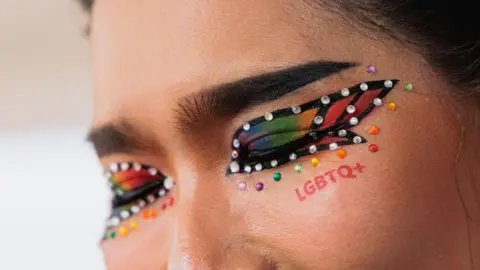
Getty Images A woman with her face painted and rainbow-coloured eye shadow sports the letters LGBTQ+ in red below her closed eyes. The photo was taken in 2024 during the Pattaya Community Pride Parade in Thailand.Getty Images

Thailand is one of the few places in Asia, along with Taiwan and Nepal, that has an equal marriage law

In the Philippines, there is growing acceptance of LGBT couples living together openly. But the Roman Catholic Church vehemently opposes same-sex marriage.

In Vietnam, like Thailand, there are no religious or ideological obstacles, but campaigning to change the law, as happened in Thailand, is difficult under a repressive regime. Much the same is true in China. Until the ruling communist party endorses equal marriage, which it shows no signs of doing, it cannot happen.

Even in democracies like Japan and South Korea – where political parties are largely conservative and dominated by older men – the prospects look bleak.

“It is largely conservative Christians who are blocking it,” says Chae-yoon Han, executive director of the Beyond the Rainbow Foundation in South Korea.

“Most, if not all, politicians in the conservative party of President Yoon are devout Christians, and they have framed marriage equality as a ‘leftist agenda’, which could potentially open society to a ‘leftist, communist takeover’.”

India appeared close to legalising same-sex marriage in 2023, when the decision fell to its Supreme Court – but the judges declined, saying it was up to parliament.

So Thailand hopes to benefit from being a pioneer. Tourism is one of the few areas of the Thai economy doing well in the post-pandemic recovery, and the country is seen as a safe and welcoming destination for LGBT holiday-makers.

Growing numbers of same-sex couples from other Asian countries are choosing to live here now.

The legal recognition they can get for their marriages will allow them to raise children and grow old together with nearly all the rights and protections given to heterosexual couples.