


Residents of LA’s Altadena neighbourhood are picking through the rubble after fires destroyed their homes.
Pearls, a power saw and a lawnmower toy: What LA fire survivors went back for

Hostage Is Found Dead in Gaza Tunnel, Israel Says

The Israeli military said on Wednesday that it had discovered the body of a hostage taken from Israel on Oct. 7, 2023 in an underground tunnel in the area of Rafah in the Gaza Strip, along with evidence that raises questions about the state of another, related captive.
The deceased hostage was identified as Youssef Ziyadne of Rahat, an Arab Bedouin city in southern Israel. Mr. Ziyadne, who was in his 50s, and three of his grown children, were abducted from a kibbutz where he and two of the children had been working during the Hamas-led attack on Israel that ignited the war in Gaza.
Two of Mr. Ziyadne’s children, Bilal and Aisha, both in their late teens, were released during a temporary truce and exchange of hostages for Palestinian prisoners in November 2023.
But the father and his adult son, Hamza Ziyadne, about 22 at the time of his abduction, remained in captivity. The Israeli military noted that the same operation that led to the discovery of Youssef Ziyadne’s body also revealed “findings” related to Hamza, “which raise serious concerns for his life.”
The announcement that a hostage had been found dead, and that the fate of another is uncertain, came as the families of captives and President-elect Donald J. Trump have been pressuring Israel and Hamas to close a deal that would lead to a cease-fire and the return of the remaining captives before Mr. Trump takes office later this month.
Of the 250 hostages taken on Oct. 7, 2023, about 100 remain held in Gaza, with a third or more of those still there presumed dead.
In a briefing with reporters on Wednesday, Lt. Col. Nadav Shoshani, an Israeli military spokesman, said “dozens of hostages” are still alive but declined to give a specific number.
Addressing the discovery of Mr. Ziyadne, Colonel Shoshani said that bodies presumed to belong to his Hamas guards had also been found nearby, but he did not indicate how the hostage or the others had been killed. He also did not detail the findings that the military said had raised concerns about the fate of Hamza Ziyadne, the son.
“Our hearts ache over the immense tragedy of the Ziyadne family,” Isaac Herzog, Israel’s president, said in a statement. He added, “Time is running out. Youssef was abducted alive! Our hostages are in immediate life-threatening danger. We must continue to do everything possible to urgently return 99 of our brothers and sisters — the living to their families and the fallen and murdered to be laid to rest in dignity.”
Prime Minister Benjamin Netanyahu, who has been accused by some Israelis of failing to prioritize the return of the hostages, on Wednesday expressed “deep sorrow over the bitter news” for the Ziyadne family. He also pledged to “continue making every effort to secure the release of all hostages back home — both the living and the dead.”
There are about 300,000 Bedouin in the Negev desert area of southern Israel, and other members of the community, in addition to the Ziyadne family, were killed or taken hostage in the Oct. 7, 2023 attacks. Samer Talalka, a Bedouin, was one of three hostages mistakenly killed by Israeli forces in December 2023. In August of last year, the Israeli military brought home alive Farhan al-Qadi, a Bedouin from a village near Rahat, where Mr. Ziyadne’s family lives.
The Bedouin are a marginalized minority in Israel, with unemployment high and poverty rampant in their villages, which have long suffered from a lack of basic services, including running water and electricity. Some Bedouin, who are Arab and Muslim, choose to serve in the Israeli military or work on kibbutzim or for other Israeli Jews, and are sometimes seen as traitors by fellow Arabs.
Mr. al-Qadi had worked as an unarmed guard on a kibbutz in southern Israel when he was taken hostage. Mr. Ziyadne and the two sons were working on a dairy farm at a nearby kibbutz, and Aisha was visiting her father and brothers at work, when they were all taken captive.
President Biden and top aides have been working for many months to negotiate the release of the remaining hostages and to secure a cease-fire, and a deal has seemed imminent several times, only to fall apart after what Biden administration officials have said were rejections by Hamas negotiators. Israeli officials have also repeatedly objected to some parts of proposed deals.
Relatives of the captives argue that there is no time to wait, and many have pushed for an immediate cease-fire deal. In a statement expressing sorrow over the death of Youssef Ziyadne, the Hostages Families Forum, which represents relatives of the captives, repeated a call for urgency it has made many times before.
“Every day in captivity poses an immediate mortal danger to the hostages who have managed to survive for 15 months, and threatens the possibility of returning the deceased for burial,” the forum said.
Johnatan Reiss contributed reporting.
The Fight Over Lee Kuan Yew’s House

The bungalow was built for a Dutch trader in colonial times, but it has become part of modern Singaporean lore. It was where Lee Kuan Yew lived for decades, where he started his political party and where he began building Singapore into one of the richest countries in the world.
Mr. Lee had said that he wanted the house to be demolished after he died rather than preserved as a museum, with the public “trampling” through his private quarters.
But the wording of his will left the property’s fate in limbo and caused a rift between his three children — one that reflects an intensifying debate over Singapore’s semi-authoritarian political system.
Now, an extraordinary voice has joined those who complain that the city-state’s prosperity has come at the cost of a government that lacks accountability: one of Mr. Lee’s own children.
“The idea that one good man at the center can control this, and you just rely on his benevolence to ensure that everything is right, doesn’t work,” Lee Hsien Yang, the youngest child, who wants to honor his father’s wishes for the house, said in a recent interview with The New York Times from London.
After Lee Kuan Yew’s death in 2015, the eldest child, by then Singapore’s prime minister, argued that his father’s instructions for the bungalow were ambiguous. His siblings wanted it demolished, though one continued to live in the house, and as long as she did, its fate remained unresolved.
Then, after her death in October, the dispute resurfaced — and escalated sharply. Lee Hsien Yang, called Yang by his parents and siblings, announced that he had obtained political asylum in Britain because he feared being unfairly imprisoned in Singapore over the disagreement.
Yang said his brother — Lee Hsien Loong, who stepped down in May as prime minister — had abused his power in the conflict over the house.
Yang, 67, described what he called a pattern of persecution by the Singapore government in recent years. In 2020, his son was charged with contempt of court for criticizing Singapore’s courts in a private Facebook post. That year, his wife, a lawyer who had arranged for the witnesses at the signing of the patriarch’s will, was barred from practicing law for 15 months. Then the couple faced a police inquiry about lying under oath. In 2022, they left Singapore.
In October, Yang announced that Britain had granted his asylum request, ruling that he and his wife “have a well-founded fear of persecution and therefore cannot return to your country.”
Singapore’s government rejected the claims, saying that the couple was free to return home. It said it was accountable to voters and an independent judiciary. Yang, it added, was engaged in “an extravagant personal vendetta” against his brother, Loong.
Loong, 72, who now holds the title of senior minister, declined to comment because he has recused himself from the matter of the house.
For Yang, the yearslong dispute is proof that there are “fundamental problems in the way Singapore is governed and run.”
Yang acknowledged that his father had detained opposition politicians and union leaders, but said that he “had the best interests of the country at heart.”
The People’s Action Party has governed Singapore with a tight grip for nearly 70 years. And years after the founding father’s death, it continues to praise his legacy.
This, some analysts say, has left Singapore at a crossroads.
“Are we able to move on?” said Ja Ian Chong, who teaches political science at the National University of Singapore. “Or are we still stuck with this relatively brittle, big-man kind of approach to politics?”
Lee Kuan Yew transformed a colonial outpost into an economic powerhouse in a generation. He made no bones about intervening in the lives of Singaporeans and prioritized the community over the individual — a notion that some observers say points to the irony of the family feud.
He “understood that the government would have to preserve the house if it decided that was in the public interest,” Loong wrote in a 2016 letter to Lawrence Wong, who was part of a government committee created to consider options for the property, and is now prime minister.
That panel concluded that the bungalow had historical significance, and that Lee Kuan Yew had been amenable to its preservation. But polls indicate that most Singaporeans want it torn down. In October, the government said it was again studying whether to preserve the circa 1898 house.
‘The Best Combination’
For decades, Lee Kuan Yew’s family appeared to be as orderly as the state he ran. His wife, Kwa Geok Choo, was in charge of the household at 38 Oxley Road, in one of Singapore’s most expensive areas.
In the 1950s, Mr. Lee and a group of friends set up his political party, the P.A.P., in the basement dining room. Most of the house was spartan. The furniture was old and mismatched; the family bathed by scooping water from earthenware vessels. Even after the sons had married and moved out, they gathered every Sunday for family lunch.
Visitors were quick to notice that only one child’s photographs were displayed: Loong’s.
“He got the best combination of our two DNAs,” Mr. Lee would tell local journalists. “The others have also combinations of both, but not in as advantageous a way as he has. It’s the luck of the draw.”
“He was the apple of my mother’s eye, and she had ambitions for him,” Yang said of Loong. “I was never antagonistic with him, neither did I have any jealousy or envy of him.”
In 2004, Loong became prime minister. Yang at the time was the chief executive of Singapore’s state-owned phone company and said that he harbored no political ambitions. That would change.
Demolition Debate
After Mr. Lee’s wife died, he continued to live in the house with his daughter, Dr. Lee Wei Ling, a neurologist. Mr. Lee died in March 2015, and his children gathered at the bungalow the following month for the reading of his will.
The house was left to Loong, but Ling could continue to live there. Once she moved out, the house was to be torn down. And if for some reason, the house was not demolished, he did not want it to be open to the public.
Loong was blindsided and would later say publicly that he did not know about this final will. When the will was being discussed, he became “aggressive” and “threatening,” his sister wrote in a previously undisclosed email to a friend in May 2015. She added that Loong told his younger siblings that if they pursued the demolition clause, the government would intervene and declare the house a national monument.
It was the last time Loong spoke with Ling and Yang, according to Yang.
The next day, Loong raised the matter in Parliament. He said that he wanted to see his father’s wishes carried out, but that “it will be up to the government of the day to consider the matter.”
A few months later, it appeared that the siblings had reached a resolution. Yang bought the house from Loong for an undisclosed price.
But soon, the government formed a committee to explore options for the house. That marked the start of Yang’s troubles with the state.
New Opposition Party
Loong told the panel that he was “very concerned” that the demolition clause in the will was “reinserted under dubious circumstances.” He asked whether there was a conflict of interest for Lee Suet Fern, Yang’s wife, who had organized the signing of the will.
To the younger siblings, it appeared that the committee was “conducting an inquisition into the will,” Yang said, pointing out that a court had declared it as binding.
In a joint statement in 2017, Yang and Ling said that they did not trust their brother as a leader. They said that Loong and his wife were milking “Lee Kuan Yew’s legacy for their own political purposes,” and harbored dynastic ambitions for their son.
Loong responded in Parliament, saying that he did not give instructions to the committee and that his only dealings with the panel were his responses to their requests in writing.
He has denied grooming his son for office.
Then the government accused Yang’s wife of professional misconduct over the will. A disciplinary tribunal ruled against her, saying she and her husband had built an “elaborate edifice of lies” during the proceedings.
A three-judge panel then ruled that Yang’s wife, Ms. Lee, gave “a contrived and ultimately untrue account of her role” in the will, and suspended her for 15 months for misconduct. But it also ruled that she had not been acting as Mr. Lee’s lawyer, and that he had been content with his will.
For Yang, the People’s Action Party had lost its way. He joined the Progress Singapore Party, a new opposition group, and considered running for president, a ceremonial post.
In 2022, the police asked to interview him and his wife, saying they had lied in the misconduct proceedings. The couple agreed to be questioned at a later date, but soon left Singapore. It was not until 2023 that a minister revealed in Parliament that they were being investigated by the authorities.
In October, Yang organized Ling’s funeral from afar. Loong was not invited.
The walls of 38 Oxley Road are now cracked, and rust has eroded part of the gate. When a reporter rang the doorbell on a recent Sunday, a housekeeper answered and said nobody was home.
Second synagogue in Sydney, Australia defaced with anti-Semitic graffiti | Religion News

Australia has seen a series of anti-Semitic incidents in the last year, including graffiti on buildings and cars.
A synagogue in Sydney has been daubed in anti-Semitic graffiti, police said, a day after the anti-Semitic vandalism of a separate synagogue in the New South Wales state capital.
According to police officials, vandals spray painted red swastikas outside the entrance to an inner-city synagogue early on Saturday, while a house in Sydney’s affluent east was daubed with anti-Jewish slurs.
The incident comes a day after an attack on the Southern Sydney Synagogue in the suburb of Allawah in the early hours of Friday morning. A special police task force was set up to investigate the incident later on Friday.
“[There is] no place in Australia, our tolerant multicultural community, for this sort of criminal activity,” Australian Prime Minister Anthony Albanese said on Friday, referring to the Southern Sydney Synagogue incident.
“These people are determined to divide our community in two,” added state Premier Chris Minns.
“We will always call out these acts for what they are – monstrous and appalling.”
Australia has seen a series of anti-Semitic incidents in the last year, including graffiti on buildings and cars in Sydney, as well as an arson attack on a synagogue in Melbourne that police have ruled as “terrorism”.
The December attack on the Melbourne synagogue prompted the government to create a federal task force targeting anti-Semitism.
Anti-Semitic and Islamophobic incidents in the country have increased since Hamas attacked Israel in October 2023 and Israel launched its war on Gaza.
Some Jewish organisations have said that the government has not taken sufficient action in response.
The incidents have also strained Australia’s relations with Israel.
Israeli Prime Minister Benjamin Netanyahu has accused Albanese’s Labor Party government of encouraging such attacks with “anti-Israel” policies.
“Unfortunately, this criminal act cannot be separated from the anti-Israel spirit blowing from the Labor government in Australia,” Netanyahu wrote on X in December, referring to the arson attack at a synagogue.
Australian Attorney-General Mark Dreyfus, who is Jewish, said Netanyahu was “absolutely wrong” to link the attack to government policy.
“Australia remains a close friend of Israel as we have been since the Labor government recognised the state of Israel when it was created by the United Nations,” Dreyfus told the Australian Broadcasting Corporation, the national broadcaster last month.
“Now, that remains the position.”
When Jimmy Carter met Kim Il-sung and stopped a nuclear war


 AP
APThree decades ago, the world was on the brink of a nuclear showdown – until Jimmy Carter showed up in North Korea.
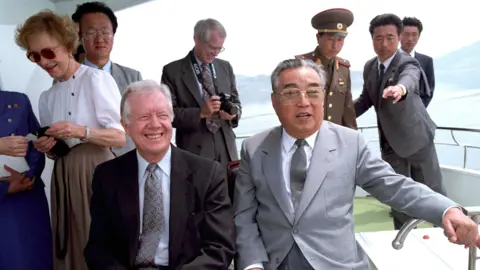
In June 1994, the former US president arrived for talks in Pyongyang with then leader Kim Il-sung. It was unprecedented, marking the first time a former or sitting US president had visited.
But it was also an extraordinary act of personal intervention, one which many believe narrowly averted a war between the US and North Korea that could have cost millions of lives. And it led to a period of greater engagement between Pyongyang and the West.
All this may not have happened if not for a set of diplomatic chess moves by Carter, who died aged 100 on 29 December.
“Kim Il-sung and Bill Clinton were stumbling into a conflict, and Carter leapt into the breach, successfully finding a path for negotiated resolution of the standoff,” North Korean expert John Delury, of Yonsei University, told the BBC.
 Kyodo
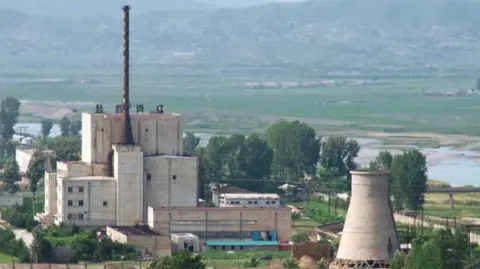
KyodoIn early 1994, tensions were running high between Washington and Pyongyang, as officials tried to negotiate an end to North Korea’s nuclear programme.
US intelligence agencies suspected that despite ongoing talks, North Korea may have secretly developed nuclear weapons.
Then, in a startling announcement, North Korea said it had begun withdrawing thousands of fuel rods from its Yongbyon nuclear reactor for reprocessing. This violated an earlier agreement with the US under which such a move required the presence of inspectors from the International Atomic Energy Agency (IAEA) nuclear watchdog.
North Korea also announced it would withdraw from the IAEA.
American suspicion spiked as Washington believed Pyongyang was preparing a weapon, and US officials broke off negotiations. Washington began preparing several retaliatory measures, including initiating UN sanctions and reinforcing troops in South Korea.
In subsequent interviews, US officials revealed they also contemplated dropping a bomb or shooting a missile at Yongbyon – a move which they knew would have likely resulted in war on the Korean peninsula and the destruction of the South’s capital, Seoul.
It was in this febrile atmosphere that Carter made his move.
For years, he had been quietly wooed by Kim Il-sung, who had sent him personal entreaties to visit Pyongyang. In June 1994, upon hearing Washington’s military plans, and following discussions with his contacts in the US government and China – North Korea’s main ally – Carter decided to finally accept Kim’s invitation.
“I think we were on the verge of war,” he told the US public broadcaster PBS years later. “It might very well have been a second Korean War, within which a million people or so could have been killed, and a continuation of the production of nuclear fissile material… if we hadn’t had a war.”
Carter’s visit was marked by skillful diplomatic footwork – and brinkmanship.
First, Carter had to test Kim’s sincerity. He made a series of requests, all of which were agreed to, except the last: Carter wanted to travel to Pyongyang from Seoul across the demilitarised zone (DMZ), a strip of land that acts as a buffer between the two Koreas.
“Their immediate response was that no-one had ever done this for the last 43 years, that even the United Nations secretary-general had to go to Pyongyang through Beijing. And I said, ‘Well, I’m not going, then’,” he said.
A week later, Kim caved.
The next step for Carter was harder – convincing his own government to let him go. Robert Gallucci, the chief US negotiator with North Korea at the time, later said there was “discomfort in almost all quarters” about the US essentially “subcontracting its foreign policy” to a former president.
Carter first sought permission from the State Department, who blanked him. Unfazed, he decided to simply inform then-US president Bill Clinton that he was going, no matter what.
He had an ally in vice-president Al Gore, who intercepted Carter’s communication to Clinton. “[Al Gore] called me on the phone and told me if I would change the wording from “I’ve decided to go” to “I’m strongly inclined to go” that he would try to get permission directly from Clinton… he called me back the next morning and said that I had permission to go.”
The trip was on.
 AFP
AFP‘Very serious doubts’
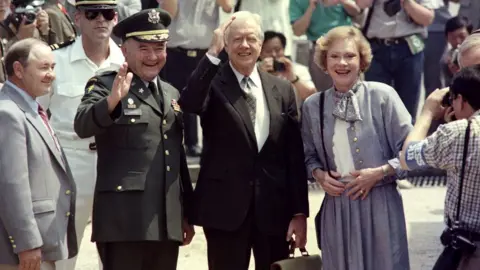
On 15 June 1994, Carter crossed over to North Korea, accompanied by his wife Rosalyn, a small group of aides and a TV crew.
Meeting Kim was a moral dilemma for Carter.
“I had despised Kim Il-sung for 50 years. I was in a submarine in the Pacific during the Korean War, and many of my fellow servicemen were killed in that war, which I thought was precipitated unnecessarily by him,” he told PBS.
“And so I had very serious doubts about him. When I arrived, though, he treated me with great deference. He was obviously very grateful that I had come.”
Over several days, the Carters had meetings with Kim, were taken on a sightseeing tour of Pyongyang and went on a cruise on a luxury yacht owned by Kim’s son, Kim Jong-il.
Carter discovered his hunch was right: North Korea not only feared a US military strike on Yongbyon, but was also ready to mobilise.
“I asked [Kim’s advisers] specifically if they had been making plans to go to war. And they responded very specifically, ‘Yes, we were’,” he said.
“North Korea couldn’t accept the condemnation of their country and the embarrassment of their leader and that they would respond.
“And I think this small and self-sacrificial country and the deep religious commitments that you had, in effect, to their revered leader, their Great Leader as they called him, meant that they were willing to make any sacrifice of massive deaths in North Korea in order to preserve their integrity and their honour, which would have been a horrible debacle in my opinion.”
Carter presented a list of demands from Washington as well as his own suggestions. They included resuming negotiations with the US, starting direct peace talks with South Korea, a mutual withdrawal of military forces, and helping the US find remains of US soldiers buried in North Korean territory.
“He agreed to all of them. And so, I found him to be very accommodating,” Carter said. “So far as I know then and now, he was completely truthful with me.”
Crucially, Carter came up with a deal where North Korea would stop its nuclear activity, allow IAEA inspectors back into its reactors, and eventually dismantle Yongbyon’s facilities. In return, the US and its allies would build light-water reactors in North Korea, which could generate nuclear energy but not produce material for weapons.
 Getty Images
While enthusiastically embraced by Pyongyang, the deal was met with reluctance from US officials when Carter suggested it in a phone call. He then told them he was going on CNN to announce details of the deal – leaving the Clinton administration little choice but to agree.
Carter would later justify forcing his own government’s hand by saying he had to “consummate a resolution of what I considered to be a very serious crisis”. But it did not go down well back home – officials were unhappy at Carter’s “freelancing” and attempt to “box in” Clinton, according to Mr Gallucci.
Near the end of the trip, they told him to convey a statement to the North Koreans, reiterating Clinton’s public position that the US was continuing to press for UN sanctions. Carter disagreed, according to reports at that time.
Hours later, he got on the boat with Kim, and promptly went off-script. As TV cameras rolled, he told Kim the US had stopped work on drafting UN sanctions – directly contradicting Clinton.
An annoyed White House swiftly disowned Carter. Some openly expressed frustration, painting a picture of a former president going rogue. “Carter is hearing what he wants to hear… he is creating his own reality,” a senior official complained at the time to The Washington Post.
Many in Washington also criticised him for the deal itself, saying the North Koreans had used him.
But Carter’s savvy use of the news media to pressure the Clinton administration worked. By broadcasting his negotiations almost instantaneously, he gave the US government little time to react, and immediately after his trip “it was possible to see an almost hour-by-hour evolution in US policy towards North Korea” where they ratcheted down their tone, wrote CNN reporter Mike Chinoy who covered Carter’s trip.
Though Carter later claimed he had misspoken on the sanctions issue, he also responded with typical stubbornness to the blowback.
“When I got back to Seoul, I was amazed and distressed at the negative reaction that I had from the White House. They urged me not to come to Washington to give a briefing, urged me to go directly to… my home,” he said.
But he went against their wishes.
“I decided that what I had to offer was too important to ignore.”
A final dramatic coda to the episode happened a month later.
On 9 July 1994, on the same day as US and North Korean officials sat down in Geneva to talk, state media flashed a stunning announcement: Kim Il-sung had died of a heart attack.
Carter’s deal was immediately plunged into uncertainty. But negotiators ploughed through, and weeks later hammered out a formal plan known as the Agreed Framework.
Though the agreement broke down in 2003, it was notable for freezing Pyongyang’s nuclear programme for nearly a decade.
‘Carter had guts’
Robert Carlin, a former CIA and US state department official who led delegations in negotiations with North Korea, noted that Carter’s real achievement was in getting the US government to co-operate.
“Carter was, more or less, pushing on an open door in North Korea. It was Washington that was the bigger challenge… if anything, Carter’s intervention helped stop the freight train of US decision-making that was hurtling toward a cliff,” he told the BBC.
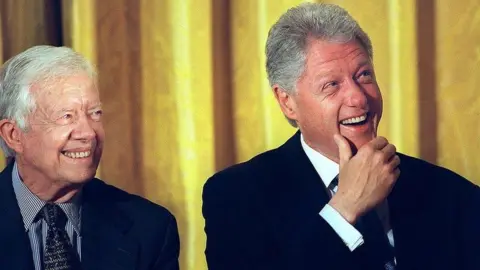
Carter’s visit was also significant for opening a path for rapprochement, which led to several trips later, including one in 2009 when he travelled with Clinton to bring home captured US journalists.
He is also credited with paving the way for Donald Trump’s summit with Kim Jong Un – Kim Il-sung’s grandson – in 2018, as “Carter made it imaginable” that a sitting US president could meet with a North Korean leader, Dr Delury said.
That summit failed, and of course, in the long run Carter’s trip did not succeed in removing the spectre of nuclear war, which has only grown – these days North Korea has missiles regarded as capable of hitting the US mainland.
But Carter was lauded for his political gamble. It was in sharp contrast to his time in office, when he was criticised for being too passive on foreign policy, particularly with his handling of the Iran hostage crisis.
His North Korea trip “was a remarkable example of constructive diplomatic intervention by a former leader,” Dr Delury said.
His legacy is not without controversy, given the criticism that he took matters in his own hands. His detractors believe he played a risky and complicated game by, as CNN’s Mike Chinoy put it, “seeking to circumvent what he viewed as a mistaken and dangerous US policy by pulling the elements of a nuclear deal together himself”.
But others believe Carter was the right man for the job at the time.
He had “a very strong will power”, but was also “a man of peace inside and out,” said Han S Park, one of several people who helped Carter broker the 1994 trip.
Though his stubbornness also meant that he “did not get along with a lot of people”, ultimately this combination of attributes meant he was the best person “to prevent another occurrence of a Korean War”, Prof Park said.
More than anything, Carter was convinced he was doing the right thing.
“He didn’t let US government clucking and handwringing stop him,” says Robert Carlin. “Carter had guts.”
Effectively Banned by the Regime, a Syrian Film Resurfaces

“Stars” developed something of an underground reputation in Syria, the filmmaker said, and could be found in pirated copies. A friend sent him an image of a poster for the movie hanging in a Damascus bar. “This generation, seeking art, theater, music — they know,” he said, adding, “the film where Assad was insulted and he banned the film — it’s enough to be famous.”
But no high-quality version has been available anywhere. When the film showed in New York in 2006 at Lincoln Center, the theater played it off a videotape; in 2017, MoMA screened it from a file. Cecilia Cenciarelli, head of research and special projects for the Cineteca di Bologna, said it was one of the most challenging titles that the organization had restored in collaboration with the World Cinema Project, an initiative of Martin Scorsese’s Film Foundation that preserves work from countries neglected in Western film histories.
For a start, it was unclear if a restoration-grade copy existed. Mohammed had deposited a print with the Cinémathèque Française, but it was in poor shape; Cenciarelli tracked down copies with Spanish subtitles, but subtitles would be obstacles to a preservation effort. Then Mohammed remembered that the film had screened on German television in the 1990s, at a time when TV stations routinely used 35-millimeter prints for broadcast.
Cenciarelli, who speaks Italian, English, French and a little Spanish, but not German, took old TV guides from the Cineteca’s library, ran them through Google Translate — and found a match. But the station told her the print had been dubbed in Turkish. “There’s a very, very large Turkish community in Germany,” she said. Her hope was that the cataloger had simply mistaken the film’s dialogue, which is in Arabic, for Turkish. Sure enough, the station had a pristine print in the original language.
The other obstacle, Cenciarelli said, was the rights holder, the National Film Organization of Syria, with whom communication was fruitless. Luckily, she said, Mohammed retained the rights to screen it noncommercially, so the restored “Stars” could always show at festivals like To Save and Project, even though a release wasn’t in the cards.
But now, with the ouster of the younger al-Assad, maybe the film can be screened more widely. Mohammed is looking into showing it in Syria. He said that every day people ask him about a screening.
Biden Issues Sweeping Deportation Protections Before Trump Takes Office

The Biden administration on Friday issued sweeping extensions of deportation protections for hundreds of thousands of people from Sudan, Ukraine, El Salvador and Venezuela in a move that makes it almost impossible for President-elect Donald J. Trump to swiftly strip the benefit when he takes office.
The extension of Temporary Protected Status, as the program is called, allows the immigrants to remain in the country with work permits and a shield from deportation for another 18 months from the expiration of their current protection in the spring. Late last year, Secretary of State Antony J. Blinken recommended the protections be extended in a series of letters.
For decades, Democratic and Republican administrations have designated the protection for citizens of countries that are in upheaval and deemed unsafe to return to. President Biden has expanded who could receive the status, as war erupted in Ukraine and instability gripped countries like Venezuela and Haiti.
“These designations are rooted in careful review and interagency collaboration to ensure those affected by environmental disasters and instability are given the protections they need while continuing to contribute meaningfully to our communities,” said Representative Adriano Espaillat of New York, the chairman of the Congressional Hispanic Caucus.
Mr. Trump has vowed to end the program, at least for certain countries. Immigrant advocates had been urging the Biden administration to extend it for many of those countries before he takes office.
In his first term, Mr. Trump terminated the status for about 400,000 people from El Salvador and other countries, arguing that conditions there had changed and that the protection was no longer warranted. The move was challenged in court and did not take effect, but he is expected to try again during his second term, as part of his pledge to conduct mass deportations.
According to the Congressional Research Service, more than a million migrants from countries in Latin America, the Caribbean, Africa and the Middle East had Temporary Protected Status as of 2024.
The move makes it legally difficult for Mr. Trump to roll back the protections for citizens of the four countries, at least until they expire some time in 2026.
“Because President Biden has extended protection for the nationals of all these countries, President Trump will be unable to deport these individuals any time soon, “ said Steve Yale-Loehr, an immigration scholar at Cornell Law School.
”Trump can’t ignore what Congress wrote into law in 1990,” he said.
About 600,000 Venezuelans who currently have the protection will be allowed to renew and remain in the United States until October 2026, and approximately 232,000 immigrants from El Salvador will be able to do so. More than 100,000 Ukrainians will also be able to remain in the United States until October 2026. Some 1,900 people from Sudan will also be allowed to renew their status.
The program was signed into law by President George H.W. Bush to ensure that foreign citizens already in the United States can remain in the country if it is not safe for them to return to their home country because of a natural disaster, armed conflict or other upheaval.
On the campaign trail, JD Vance, the vice president-elect, called the program illegal when he criticized Haitians who had settled in his home state of Ohio and benefited from it. Haiti has been experiencing political turmoil and gang violence, and some 200,000 of its citizens are protected from removal under T.P.S. until early 2026.
“We’re going to stop doing mass grants of Temporary Protected Status,” Mr. Vance said in October.
Critics have argued that the temporary protections are extended repeatedly and serve as a de facto means to enable people to stay in the country indefinitely, contrary to its intention of being a short-term solution.
While the program has become all but permanent for many immigrants, it also highlights how troubled many corners of the world are and the failure of Congress to pass legislation to update the U.S. immigration system to the realities of contemporary global migration.
Immigrants from several countries, including El Salvador, Honduras and Nicaragua, have been eligible for the protection for more than two decades. Other countries, such as Ethiopia, Lebanon and Syria were added more recently.
If the status were eliminated, hundreds of thousands of immigrants would immediately become unlawful residents of the United States, unless they immediately departed. Many of them have U.S.-born children, businesses and jobs in sectors that rely on immigrant labor such as construction, hospitality and health care.
In cities like Denver, temporary status has allowed thousands of Venezuelans, who arrived in the last two years from the southern border on buses provided by the Republican governor of Texas, Greg Abbott, to legally work there and integrate into the economy.
Mike Johnston, the city’s mayor, said that he applauded the Biden administration’s announcement to extend the designation.
“In Denver, folks with Temporary Protected Status are working critical jobs, contributing to our economy and becoming integral members of our communities,” he said.
Gonzalo Roa, 43, a Venezuelan who is a beneficiary in Columbus, Ohio, said that he had been anxious about the fate of the program.
“It is great news that it’s being renewed,” said Mr. Roa, who works at a car dealership and runs a small restaurant with his wife.
Without the status, Mr. Roa said, he would lose his job at the dealership and his two Venezuelan-born children would not be eligible for college scholarships and other benefits that require legal status.
Could a mango flavoured pill end intestinal worms?

A new tablet being developed to cure intestinal worms has shown promising results in trials and could help eradicate the parasitic infection, which affects about 1.5 billion people globally, researchers say.
The mango-flavoured pill is a combination of two existing anti-parasitic drugs that, used together, appear more effective in getting rid of worms.
These worms are caught through contact with food or water that has been infected by soil contaminated with worm eggs and infections cause severe gastrointestinal symptoms, malnutrition and anaemia.
Researchers say the pill could help overcome any future drug resistance problems and better manage the disease on a large scale.
The parasites, also known as soil-transmitted helminths (STHs), include whipworm and hookworm and are endemic in many developing countries where hygiene levels are poor.
Many of those affected are children and there is no preventative treatment other than better sanitation.
According a study, called “ALIVE”, published in the Lancet, this new pill could help countries most affected reach goals set by the World Health Organization to eliminate the diseases.
It would be taken as a fixed-dose of of either one single pill or three tablets over consecutive days.
Researchers from eight European and African institutions say it would be a simple way to cure large numbers of people in mass treatment programmes.
“It is easy to administer, as it is one single pill,” says project leader Prof Jose Muñoz.
“Also, we hope that combining two drugs with different mechanisms of action will reduce the risk of the parasites becoming drug-resistant,” Prof Muñoz says.
Once a person is infected, the parasites root themselves in people’s digestive tracts.
While the drug albendazole is good at treating some species of STH, it appears to be becoming less effective in tackling some others.
During a clinical trial involving 1,001 children aged between 5-18 in Ethiopia, Kenya and Mozambique, it was found to be more effective on more types of infection when combined with the drug ivermectin.
However, researchers said the results were not conclusive on how well it treated threadworm.
Prof. Hany Elsheikha, an expert in parasitology at the University of Nottingham said the pill could be a “significant improvement over other treatments” and could be used against multiple parasites.
“There are some challenges with existing medications…so this could be a major, major addition.”
However, he said that while the study was “promising”, it had “some gaps”.
“We don’t know if the results would be the same for adults, mature people, younger kids, people in other parts of the world.”
The results of the trial have been submitted to regulators in Europe and Africa, with decisions expected in early 2025.
Participants are now being recruited to take part in a further trial on 20,000 people in Kenya and Ghana.
Dr Stella Kepha, a researcher at Kenya Medical Research Institute who worked on the study said the pill had ” great potential for improving the health of affected communities” but that there was still “work to do” to widely roll out the treatment.
ISIS Says It Inspired New Orleans Attack, but Doesn’t Claim Responsibility

The Islamic State lauded the man who killed 14 people when he rammed a truck into a busy New Orleans street early on New Year’s Day, with the group claiming in a digital newsletter dated Thursday that its online propaganda had inspired the attack.
The group said the attacker who ran over pedestrians walking on Bourbon Street was “influenced by the discourse and messaging of the Islamic State.” but its message stopped short of claiming responsibility.
The newsletter bulletin, obtained by the Counter Extremism Project, a terrorism watchdog, appeared to mock the American news media for “holding its breath” while waiting for ISIS to claim the attack.
While the ISIS message did not directly mention New Orleans, it did describe an attack by an American man and referenced Meta glasses. The F.B.I. has said the attacker, Shamsud-Din Bahar Jabbar, was wearing Meta glasses. and the Counter Extremism Project said the ISIS message was referring to the New Orleans attack.
The truck driven by Mr. Jabbar, a 42-year-old U.S. Army veteran from Texas, carried an ISIS flag. Mr. Jabbar, who was killed in a shootout with New Orleans police, also left a chilling recorded message for his family, telling them he had joined the terrorist group.
The authorities have denied that Mr. Jabbar had active connections to the terrorist group, but the F.B.I. said he was “100 percent inspired by ISIS.”
It is unclear what online content Mr. Jabbar may have consumed before the attack, but ISIS produces weekly newsletters as part of a sophisticated media operation that keeps its far-flung factions connected.
Experts say this latest claim is unusual for the group.
“Unlike other attacks in the past, where ISIS has released a claim of responsibility for the attack, in this case, the group has stated that the attacker was inspired by ISIS propaganda messaging but does not claim they had a direct relationship,” said Joshua Fisher-Birch, a researcher at the Counter Extremism Project.
The ISIS statement’s emphasis on the importance of people who translate and share ISIS content, Mr. Fisher-Birch said, “speaks to the efforts to continue the spread of the group’s official messaging and unofficial propaganda efforts made by supporters.”
He added that the article included a clear call for future attacks during events and holidays.
Aaron Boxerman, Neil MacFarquhar and Alissa J. Rubin contributed reporting.
Mauro Morandi, Italy’s Robinson Crusoe, Dies at 85

Mauro Morandi, whose 32-year sojourn on an uninhabited Mediterranean island led to his being known as Italy’s Robinson Crusoe, died on Jan. 3 in Modena, Italy. He was 85.
The cause was a brain hemorrhage, said Antonio Rinaldis, who wrote a 2023 book with Mr. Morandi about his life on the island.
Unlike Daniel Defoe’s hero, who was shipwrecked and fervently hoped to be rescued, Mr. Morandi chose his life of solitude.
He said he had fallen in love at first sight with Budelli, a pristine, undeveloped island off the northern tip of Sardinia. He arrived in 1989, somewhat by chance, he said in interviews. He left — against his will — in 2021, writing on social media that he was tired of “fighting against those who want to send me away.”
Mr. Morandi’s singular choice to live in solitude spawned at least two books, at least one song, short documentaries and countless interviews. As the world turned inward during the coronavirus pandemic, reporters sought Mr. Morandi’s insights on isolation.
“I read a lot, and think,” he told CNN in 2020. “I think many people are scared of reading because if they do, they’ll start meditating and thinking about stuff, and that can be dangerous. If you start seeing things under a different light and be critical, you could end up seeing what a miserable life you lead.”
Budelli, one of the main islands that make up the Maddalena Archipelago, is a dab of paradise occupying less than two-thirds of a square mile. It is known for its pink sand beach surrounded by turquoise water. The island has no running water, is not connected to an electrical grid and is accessible only by boat.
Mr. Morandi lived in an abandoned World War II hut, tacking up canvas tarps in an open area in front. He created sculptures from branches, cooked on a propane stove and read voraciously, buying books and supplies on trips to La Maddalena, the largest town on the archipelago. Visitors also brought him food and water. He used car batteries and solar power to charge his cellphone and his tablet.
It was, he said, “a simple life made up of big and small pleasures.”
“The most important thing,” he added, “is that I have a serene relationship with time.”
For years he was the island’s designated guardian, hired by the Swiss-Italian real estate company that owned it.
His main task was to protect the island’s habitat from unruly tourists, who are allowed only on certain paths, part of an effort by Italy’s environment ministry to protect the rare pink sand. He told people about the marvels of the island, and how fragments of coral and shells had turned the sand pink. He picked up trash from the beach, cleared the island’s paths and carried out light maintenance.
Mr. Morandi initially chose to live as a hermit, he said in an interview at Genoa’s maritime museum, but he ultimately welcomed select people as part of his mission to make them “understand why we need to love nature.”
He said he did not miss human contact. “He didn’t like what humanity had become in the 21st century — consumeristic and individualistic — especially with regard to nature,” Mr. Rinaldis said. That was why Mr. Morandi cared about protecting Budelli.
When he finally got an internet connection, he used social media to showcase the island’s untamed beauty.
In 2016, after a protracted legal battle over the island’s ownership, it was turned over to the state and became part of Maddalena Archipelago National Park. Mr. Morandi was asked to leave.
The park’s president, Giuseppe Bonanno, acknowledged Mr. Morandi’s unique position. “Morandi symbolizes a man, enchanted by the elements, who decides to devote his life to contemplation and custody,” he told reporters. But there were other issues, including whether Mr. Morandi would be able to survive a medical emergency alone, not to mention his shack’s failure to meet code.
He fought back. He campaigned against his eviction on social media. He gave interviews to the news media. An online petition drew nearly 75,000 signatures.
“We do not want Mauro to leave the island because we think first of all that if Budelli has remained a wonder of nature it is also thanks to him,” the petition said. “And second, because we are convinced that the park has everything to gain from his presence: Mauro has lived on Budelli for a quarter of a century, he knows every plant and every rock, every tree and every animal species, he recognizes the colors and scents with the changing of the wind and the seasons.”
But after battling the authorities for five years, Mr. Morandi relented. He was 82 and no longer in good health. “Part of his resignation was tied to his fragility,” Mr. Rinaldis said, “but he was also disappointed because he had been forced to leave by the authorities.”
Mr. Morandi left the island for good in March 2021 and moved to a small apartment in La Maddalena. “I’ll leave hoping that in the future, Budelli will be safeguarded, like I’ve been doing it for 32 years,” he said.
Mauro Morandi was born on Feb. 12, 1939, in Modena. His father, Mario Morandi, was a gymnast who won the national championship for artistic gymnastics in 1936 and was later the caretaker of a school. Mauro’s mother, Enia Camellini, worked for a tobacco company.
Mr. Morandi studied to become a physical education teacher and taught at a middle school in Modena through the 1970s, when he was able to retire early. He had three daughters during a marriage that ended in divorce.
They survive him, as do a brother, Renzo, and six grandchildren.
In a 2016 interview with the Turin daily La Stampa, Mr. Morandi said that after reading Richard Bach’s 1970 best seller, “Jonathan Livingston Seagull,” he “took flight,” discovering the sea. In 1989, he said, he decided that he was “tired of society and seeking a different life.” He bought a catamaran with some friends, with the idea of sailing to Polynesia.
To raise money, they scouted locations for charter cruises and came across Budelli. There they met Budelli’s caretaker, who had recently decided to leave. He offered them his job, and Mr. Morandi took it. He was paid at first, but he stayed on even after he was no longer receiving a salary; he then lived off his teacher’s pension. On rare occasions he returned to Modena for short holidays to visit his family.
At one point he read a study by the University of Sassari showing that Budelli’s flora and fauna were similar to those of the Polynesian islands he had once hoped to reach. “It was almost as though Budelli wanted me, made sure I got here, to the only beach in the whole Mediterranean Sea, which is almost similar in composition to the islands where I wanted to go,” he said in a 2016 interview with the photographer Claudio Muzzetto.
After Mr. Morandi’s death, Margherita Guerra, one of his many thousands of followers on social media, wrote: “Safe travels. Finally no one will ever be able to send you away from your beloved island.”
