Thursday, October 1, 2026
Home Blog Page 6949

Venezuela’s Autocrat Detains U.S. Citizens As He Tightens Grip on Power

0
Venezuela’s Autocrat Detains U.S. Citizens As He Tightens Grip on Power


He is an autocrat condemned inside and outside his country as having stolen the nation’s last election. Yet on Friday, Nicolás Maduro, the Venezuelan president who has overseen his country’s dramatic decline — including runaway inflation, blackouts, hunger, mass migration and the unraveling of the nation’s democracy — is set to be sworn in for a third term in office.

If he serves the full six years, it will extend his party’s reign into its third decade.

Mr. Maduro will return to Miraflores, the presidential palace in Caracas, even after millions of Venezuelans used the ballot box to express a desire for change. And he will do so amid his harshest crackdown yet, with the police and military in riot gear blanketing the streets of the capital; journalists, activists and community leaders in prison; and a broad expansion of his surveillance apparatus.

The man the United States and others say won the election, Edmundo González, remains in exile, forced to flee to Spain or face arrest, while the country’s most important opposition leader, María Corina Machado, has been in hiding inside Venezuela.

On Thursday she emerged for the first time since August, joining street protests against Mr. Maduro in Caracas, the capital. She stood atop a truck while thousands of supporters, all risking detention, shouted “freedom! freedom! freedom!”

There have been few other recent protests against the government, and the ever-present threat that security forces will imprison civilians is likely to make it difficult for Ms. Machado to continue to rally supporters to the streets.

Mr. González has said he will return to Venezuela on Friday for his own swearing in — but the government has placed a $100,000 bounty on his head, and it’s unclear how he plans to avoid arrest if he does so.

For his part, Mr. Maduro faces the possibility that President-elect Donald J. Trump, who has filled his foreign policy team with Maduro foes, will take a hard line against him, possibly imposing more economic sanctions.

In response, the Venezuelan leader has spent the last six months amassing a cache of foreign prisoners, which analysts and former U.S. diplomats say he hopes to use as a bargaining tool in negotiations with the United States and other nations.

Since July, Venezuelan security forces have picked up about 50 visitors and dual-passport holders from more than a dozen countries, according to the watchdog group Foro Penal.

“They are pawns to be exchanged,” said Gonzalo Himiob, a founder of Foro Penal.

Mr. Maduro wants the removal of U.S. sanctions, which have battered the Venezuelan economy, and international recognition, among other policy changes.

Venezuelan officials say they have detained at least nine people with American citizenship or resident status, with officials accusing some of them of plotting to kill Mr. Maduro.

The United States has no diplomatic presence in Venezuela, and a State Department representative said the U.S. government was not even sure where its citizens were being held.

Relatives of three detained U.S. citizens said that they had not heard from their loved ones since they disappeared months ago and have received only limited communication from their own government.

David Estrella, 64, a father of five, had crossed into Venezuela by land from Colombia on Sept. 9, according to his former wife, Elvia Macias, 44.

Ms. Macias, who is close to her ex-husband, described him as an “adventurer” who — full of optimism that the situation in Venezuela was “not that bad” — had gone to visit friends.

David Estrella, a U.S. citizen detained in Venezuela.Credit…Elvia Macias

He worked in quality control for pharmaceutical companies in New Jersey, was preparing to retire and had already visited Venezuela once before, she said.

Ms. Macias cried as she recounted celebrating Christmas without him.

“This situation has had a tremendous impact on our lives,” she said.

Mr. Maduro’s socialist-inspired movement has run the country since 1999, when his predecessor, Hugo Chávez, took office. In July, Mr. Maduro faced his most difficult electoral challenge yet, facing off against Mr. González, a former diplomat who became the surrogate for Ms. Machado when the government barred her from running.

Even amid a stepped-up repression campaign, many Venezuelans came out in force to support Mr. González. And in the days after the election, the opposition collected thousands of vote tally sheets, publishing them online and saying they showed that Mr. González had won by a landslide.

Mr. Maduro nevertheless declared victory, an assertion questioned by independent observers, including the Carter Center, the United Nations and a member of the country’s electoral council.

The United States has recognized Mr. González as the winner — and even Maduro allies like presidents Gustavo Petro of Colombia and Luiz Inácio Lula da Silva of Brazil, both leftist neighbors of Venezuela, have distanced themselves.

Neither will attend the inauguration.

Mr. Maduro has held foreigners for political purposes before. But never has his government held so many at once, according to Foro Penal, the watchdog group.

Some analysts said Mr. Maduro had decided to arrest foreigners because he has seen that it gets him what he wants.

In 2022 and then again in 2023, the United States struck deals with the Venezuelan government, in which Washington released high-profile Venezuelan allies in exchange for U.S. citizens held by Mr. Maduro.

This was a part of a shift in American dealings with governments and others who capture Americans abroad.

In the past, U.S. policy was not to negotiate with captors, out of fear that cutting deals would encourage the taking of hostages.

But this left detained Americans with little hope of rescue, and critics said it even contributed to the deaths of people like James Foley, a journalist killed by ISIS in Syria in 2014.

The United States has since shown more willingness to negotiate. But some critics maintain that provokes the very practice Mr. Maduro is engaged in.

Tom Shannon, who served in a high-ranking State Department role in the Obama and Trump administrations, said he believed Mr. Maduro had been encouraged by recent hostage deals with Russia and Iran.

Still, he did not think cutting deals was a mistake.

“I think one of our jobs is to take care of American citizens abroad,’’ Mr. Shannon said. “And it’s very difficult just to write people off and say, ‘oh bad luck, so sorry.’”

Instead, he said the U.S. government should “inflict levels of pain on the kidnappers that make it clear that this is not going to happen again.”

Other U.S. citizens detained in Venezuela include Wilbert Castañeda, 37, a Navy SEAL who traveled to Venezuela to visit his girlfriend, according to his mother, Petra Castañeda, 60.

Mr. Castañeda, a father of four, was apprehended by the authorities in late August. By September his face had been plastered across state television, with Diosdado Cabello, Venezuela’s interior minister, accusing him and others of participating in a plot to assassinate the president.

Ms. Castañeda, who lives in California, said her son was innocent.

“The whole family is very worried, we are desperate,” she said. “We are clinging to the hope that the United States will be able to reach an agreement with Mr. Maduro.”

Stephen William Logan, 83, a retired teacher in West Virginia, said he did not even realize his son Aaron Barrett Logan, 34, had gone to Venezuela. Then, in September, his family got a call from State Department officials, notifying them that he had been detained.

Mr. Logan said his son worked in the United States for a major bank as a “penetration tester” — testing the bank’s security by trying to hack into its systems.

Mr. Cabello accused the younger Mr. Logan of being involved in the same assassination plot.

“I don’t even know how to visualize it,” the older Mr. Logan said of the conditions his son was living in, wondering if it was like “a concentration camp.”

Representatives of Mr. Trump’s transition team declined to comment. None of the U.S. detainees have been declared wrongfully detained by the State Department, a designation that could get them more help from within the U.S. government.

In Caracas, many attended Thursday’s anti-Maduro protest even though similar gatherings have been met with violence from security forces and ended in the deaths of participants.

Among those in the streets was Laura Matos, 21, who said “everyone” had told her “don’t go out.”

But “last night I couldn’t sleep,” she said. “I said, ‘I want something to happen, I want President-elect Edmundo González to be sworn in, I want Venezuela to experience a change.’”

“We don’t deserve to be like this,” she went on, as fellow protesters blew plastic horns around her. “We deserve more, to have a better future. Young people like me deserve to be able to study and work and stay in our country.’’

Alain Delaquérière contributed research.


Friday Briefing

0
Friday Briefing


Three days of wildfires.


Meta, Facebook to drop fact-checkers: What does this mean for social media? | Social Media News

0
Meta, Facebook to drop fact-checkers: What does this mean for social media? | Social Media News


Meta, the owner of Facebook and other social media platforms, will implement major changes to its content moderation policies, founder Mark Zuckerberg announced this week in a video titled, “More speech and fewer mistakes”.

Among the changes, Meta’s use of fact-checking organisations will end abolished and the group will switch to a system of community notes – similar to those used by the X platform – instead.

The move, revealed on Tuesday, comes as tech executives brace for the arrival of incoming US President Donald Trump, whose right-wing supporters have long decried online content moderation as a tool of censorship.

So why is this happening now and will it lead to more misinformation?

In a video posted to social media platforms, Zuckerberg explained that Meta plans to scrap fact-checking in favour of a new system of community notes which users can use to identify posts of others that may have misleading or falsified information. Meta plans to roll this community note system out in the next coming months.

Zuckerberg said fact-checking organisations had proved to be “biased” when it came to selecting content to moderate and added that he wanted to ensure free speech on all platforms. “It’s time to get back to our roots around free expression,” he wrote in the post with the five-minute video.

“Our system attached real consequences in the form of intrusive labels and reduced distribution. A programme intended to inform too often became a tool to censor.”

While this policy will extend to all subject matters, Zuckerberg singled out the issues of “gender and immigration” in particular.

Meta’s upcoming modifications will take effect across its trio of major social media platforms: Facebook, Instagram and Threads, which are used by more than 3 billion people worldwide.

Is Meta also moving operations to Texas? Why?

Meta plans to relocate its content moderation teams from California to Texas, hoping the move will “help us build trust” while having “less concern about the bias of our teams”. Some experts see the move as politically motivated and could have negative implications on how political content is handled on Meta’s platforms.

“This decision to move to Texas is born out of both some practicality and also some political motivation,” stated Samuel Woolley, the founder and former director of propaganda research at the University of Texas at Austin’s Center for Media Engagement who spoke to digital newsgroup The Texas Tribune.

“The perception of California in the United States and among those in the incoming [presidential] administration is very different than the perception of Texas,” he added.

Zuckerberg appears to be following in the footsteps of Musk, who shifted Tesla’s headquarters to Austin, Texas in 2021. In an X post in July, Musk also expressed interest in moving his other ventures, X and SpaceX, from California to Texas, citing Governor Gavin Newsom’s recently enacted SAFETY Act which prevents schools from mandating teachers to notify parents when a student requests to be recognised by a “gender identity” that differs from their sex.

How has content moderation on Meta platforms worked until now?

Presently, social media platforms like Facebook and Threads use third-party fact-checking organisations to verify the authenticity and accuracy of content posted to each platform.

These organisations evaluate content and flag misinformation for further scrutiny. When a fact-checker determines a piece of content to be false, Meta will take action to substantially limit that piece of content’s reach, ensuring that it reaches a significantly smaller audience. However, third-party fact-checkers do not have the authority to delete content, suspend accounts or remove pages from the platform. Only Meta can remove content from its platforms that violates its Community Standards and Ads policies. This includes, but is not limited to, hate speech, fraudulent accounts and terrorist-related material.

Since 2016, Meta has worked with more than 90 fact-checking organisations in more than 60 languages around the world. Some of the major fact-checking organisations it works with include PolitiFact, Check Your Fact, FactCheck.org and AFP Fact Check. Some partnerships with fact-checking organisations go back nearly 10 years, with PolitiFact being one of the earliest to join forces with Meta in 2016.

How will the new moderation work?

Similar to X, formerly known as Twitter before it was bought for $44bn by billionaire Elon Musk in 2022, Meta will use Community Notes to moderate content instead of fact-checkers.

X’s Community Notes, previously known as BirdWatch, was piloted in 2021 and gained significant traction in 2023 as a feature designed to identify and highlight potentially misleading information on the platform.

X Community notes feature [Source. X}
X Community Notes feature [Source: X}

Community Notes appear in boxes labelled “Readers added context” below posts on X which have been identified as potentially misleading or inaccurate. A Community Note typically provides a correction or clarification, frequently supported by a hyperlink to a reputable online source which can verify the information provided.

These annotations are crafted by eligible platform users who have opted into the programme. As long as a user has no X violations on their account since January 2023, has a verified phone number provided by a legitimate mobile carrier and their platform account is at least six months old, they are eligible to participate.

Once approved by X as a Notes contributor, participants may rate other Community Notes as “Helpful or “Not Helpful”. Contributors receive a “Rating Impact” score that reflects the frequency with which their ratings influence notes that achieve “Helpful” or “Not Helpful” status. A Rating Impact score of 5 allows a contributor to progress to the next level, and write Contributor Notes for X posts as well as rate them.

Community Notes which receive five or more ratings undergo algorithmic evaluation. The algorithm categorises each note as either “Helpful”, “Not Helpful” or “Needs more ratings”. At this point, the Notes are not yet visible to X users, only contributors.

Only those Notes which receive a final “Helpful” status from the algorithm are shown to all X users beneath the corresponding post.

Although Meta has not outlined exactly how its community notes would work, Zuckerberg stated in his video that they would be similar to X’s community note system.

There is debate about how well Community Notes work on X, which has 600 million users.

Yoel Roth, the former head of Twitter’s trust and safety department stated in a BlueSky post: “Genuinely baffled by the unempirical assertion that Community Notes ‘works.’ Does it? How do Meta know? The best available research is pretty mixed on this point. And as they go all-in on an unproven concept, will Meta commit to publicly releasing data so people can actually study this?”

However, some research into the effectiveness of Community Notes has been carried out.

In October 2024, the University of Illinois published a working paper about X’s Community Notes feature, led by assistant professor of business administration Yang Gao. In general, his study results were positive.

“We find that receiving a displayed community note increases the likelihood of tweet retraction, thus underscoring the promise of crowdchecking. Our mechanism tests reveal that this positive effect mainly stems from consideration of users who had actively interacted with the misinformation (ie, observed influence), rather than of users who might have passively encountered or would encounter the misinformation (ie, presumed influence),” Gao explained in the paper.

Another research paper led by University of Luxembourg researchers published in April 2024 in Open Science Framework (OSF) – which allows researchers to share their academic papers – found the use of Community Notes reduced the spread of misleading posts by an average of 61.4 percent.

However, the research paper added, “Our findings also suggest that Community Notes might be too slow to intervene in the early (and most viral) stage of the diffusion.”

A recent analysis of Notes mentioning election claims between January 1 and August 25, 2024, by The Center for Countering Digital Hate (CCDH) also revealed limits to the effectiveness of the X Community Notes feature.

The researchers examined 283 posts containing election-related claims that independent fact-checking organisations had determined to be false or misleading. In its analysis, it focused exclusively on posts which had received at least one proposed note from Community Notes contributors. It found that 209 out of 283 “misleading” posts in its sample were not being shown to all X users – “equivalent to 74 percent,” the report stated – because they had not reached the ranking of “helpful” despite being accurate.

It added that the delay in moving a post to “helpful” status contributed to this.

According to the Washington Post, which did a separate analysis of the data, only 7.4 percent of Community Notes proposed in 2024 related to the election were ever shown and the number dropped to 5.7 percent in October.

How have fact-checking organisations reacted to Meta’s decision to switch to Community Notes?

Some fact-checking organisations have criticised the move, saying it is unnecessary and politically driven.

“Facts are not censorship. Fact-checkers never censored anything. And Meta always held the cards,” said Neil Brown, president of the Poynter Institute, the journalism nonprofit that owns PolitiFact in a public statement. “It’s time to quit invoking inflammatory and false language in describing the role of journalists and fact-checking.”

“We’ve learned the news as everyone has today. It’s a hard hit for the fact-checking community and journalism. We’re assessing the situation,” the news agency AFP, which operates AFP Fact Check, said in a statement.

Who else has criticised the move and why?

Some experts in social media have cautioned that the change may open the door to an increase in misinformation appearing on Meta platforms.

“I suspect we will see a rise in false and misleading information around a number of topics, as there will be an incentive for those who want to spread that kind of content,” Claire Wardle, an associate professor in communication at Cornell University told Vox, a digital media company and news website.

Others believe Meta is deliberately aiming to placate the right wing as a second Trump presidency looms and is opening the door for more MAGA-centred content.

Lina Khan, who chairs the Federal Trade Commission, expressed concern during a CNBC interview on Tuesday that Meta executives may be pursuing favourable treatment from the Trump administration. She suggested that the company might be attempting to secure a “sweetheart deal” with the White House.

“I think that Mark Zuckerberg is trying to follow in Elon’s footsteps, which means that actually, they’re going to use this guise of free speech to actually suppress critics of Trump and critics of themselves,” Representative for New York Alexandria Ocasio-Cortez told Business Insider.

“There’s been a shift rightward in terms of attitudes toward free speech in Silicon Valley and perhaps this decision is part of that,” Sol Messing, a research associate professor at New York University’s Center for Social Media and Politics and a former research scientist at Facebook, told ABC News.

Nate Silver, founder of FiveThirtyEight and a political pollster who now runs the Silver Bulletin blog on Substack, gave his take on the change in a recent blog post: “As someone who tries to be non-hypocritically pro-free speech, my inclination is to welcome the changes. But Zuck’s motivations are questionable: there’s no doubt that Meta and other media companies are under explicit and intense political pressure from the incoming Trump administration. So perhaps it’s the right move for the wrong reasons.”

Who has welcomed the move?

Some big names in social media have actively welcomed Meta’s announcement.

Elon Musk, CEO of Tesla and who will lead Trump’s Department of Government Efficiency (DOGE) with former Republican presidential hopeful Vivek Ramaswamy stated, “This is cool” on a recent X post.

Cenk Yuger, founder of the Young Turks, a major left-leaning digital news channel welcomed the change in an X post. “He actually mentioned something that is not getting a lot of attention. He said, basically we are done with relying on legacy media,” he wrote. “That’s who the ‘fact checkers’ were in the past. Legacy media has an enormous agenda. They are not at all objective.”

The move is “a great step toward the decentralisation of information and the end to the control legacy media has had on the prevailing narrative”, said Christopher Townsend, an Air Force vet and conservative rapper with more 300,000 Instagram who spoke to Business Insider.

“It seems like Meta is finally taking a page from Elon Musk’s playbook & letting Americans make decisions for themselves. It’s about time Meta owned up to censoring Americans,” Republican Representative Randy Weber of Texas who spoke to Business Insider

President-elect Donald Trump appeared to believe he had played a role in Meta’s revised content moderation policy when he spoke at a news conference at Mar-a-Lago on Tuesday. Asked if his previous criticism of the company had prompted the change, Trump’s response was succinct: “Probably.”

How will Meta’s change impact regions outside the US?

Although the initial rollout of the new feature will take place in the next couple of months in the United States only, Zuckerberg also referred to other regions and countries in his video, including Europe, China and Latin America.

“Europe has an ever-increasing number of laws, institutionalising censorship and making it difficult to build anything innovative there,” he said. “Latin American countries have secret courts that can order companies to quietly take things down. China has censored our apps from even working in the country. The only way that we can push back on this global trend is with the support of the US government, and that’s why it’s been so difficult over the past four years when even the US government has pushed for censorship.”

In a recent statement, the EU rejected Meta’s claims that it has engaged in any form of censorship under its digital regulation.

“We absolutely refute any claims of censorship on our side,” European Commission spokesperson Paula Pinho told reporters in Brussels.


Israeli settlers in West Bank see Trump win as chance to push on

0
Israeli settlers in West Bank see Trump win as chance to push on


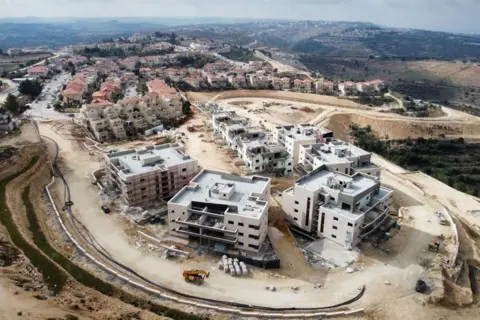
EPA A picture taken with a drone shows a construction site of a new neighborhood in the Neve Daniel settlement, in the Gush Etzion settlement block at the West Bank, 15 February 2023.EPA

Israel continues to build settlements in the occupied West Bank

On a clear day, the skyscrapers of Tel Aviv are visible from the hill above Karnei Shomron, an Israeli settlement in the occupied West Bank.

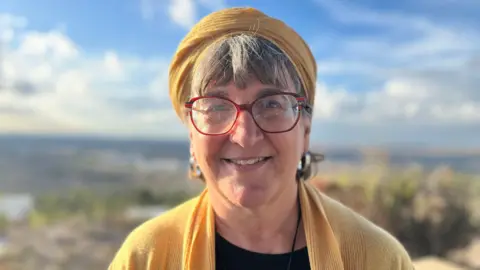
“I do feel different from Tel Aviv,” said Sondra Baras, who has lived in Karnei Shomron for almost 40 years. “I’m living in a place where my ancestors lived thousands of years ago. I do not live in occupied territory; I live in Biblical Judea and Samaria.”

For many settlers here, the line between the State of Israel, and the territory it captured from Jordan in the 1967 Middle East war, has been erased from their narrative.

The visitors’ audio-guide at the hill-top viewpoint describes the West Bank as “a region of Israel” and the Palestinian city of Nablus as the place where God promised the land to the Jews.

But formal annexation of this territory has so far remained a dream for settlers like Sondra, even while settlements – viewed as illegal by the UN’s top court and most other countries – have mushroomed year after year.

Now many see an opportunity to go further, with the election of Donald Trump as the next US president.

“I was thrilled that Trump won,” Sondra told me. “I very much want to extend sovereignty in Judea and Samaria. And I feel that’s something Trump could support.”

Standing outside, Sondra stares into the camera, wearing red rimmed glasses, a yellow scarf and yellow cardigan. In the background is out of focus greenery

Settler leader Sondra Baras has lived in the West Bank for nearly four decades

There are signs that some in his incoming administration might agree with her.

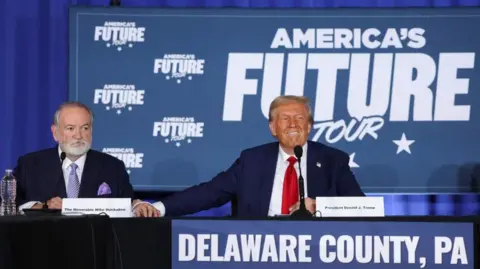
Mike Huckabee, nominated as Trump’s new ambassador to Israel, signalled his support for Israeli claims on the West Bank in an interview last year.

“When people use the term ‘occupied’, I say: ‘Yes, Israel is occupying the land, but it’s the occupation of a land that God gave them 3,500 years ago. It is their land,'” he said.

Reuters Mike Huckabee and Donald Trump are seen at a campaign event in Drexel Hill, Pennsylvania, U.S., October 29, 2024Reuters

Mike Huckabee, seen with Donald Trump on the campaign trail last year, is the president-elect’s nominee for US Ambassador to Israel

Yisrael Gantz, head of the regional settlement council that oversees Karnei Shomron, says he has already noticed a change in tone from the incoming Trump administration as a result of the 7 October 2023 Hamas attacks on Israel, which triggered the war on Gaza.

“Both here in Israel and in the US, they understand that we must apply sovereignty here,” he told me. “It’s a process. I can’t tell you it will be tomorrow. But in my eyes, the dream of a two-state solution is dead.”

US President Joe Biden has always maintained the US position in support of a future Palestinian state alongside Israel. Asked whether he was hearing something different from the incoming Trump administration, Mr Gantz replied, “Of course, yes.”

But there are also signs that Israelis lobbying for annexation of the West Bank – some of them in cabinet positions – might be disappointed in Trump’s decisions.

Their hopes have been fuelled by memories of his first term as president, during which he broke with decades of US policy – and international consensus – by recognising Jerusalem as Israel’s capital, and Israeli sovereignty over the occupied Golan Heights, which were captured from Syria in 1967.

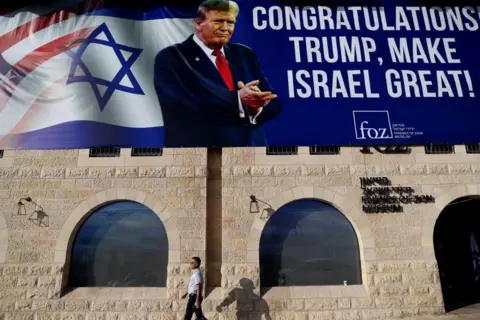
EPA A man walks past a large billboard congratulating US President-elect Donald Trump, on the facade of Friends of Zion Museum in Jerusalem, 07 November 2024.EPA

Many Israelis welcomed Donald Trump’s election win in November

But supporting annexation of the West Bank would be a much bigger and thornier issue for Trump.

It would likely alienate Washington’s other key ally, Saudi Arabia, complicating Trump’s chances for a wider regional deal.

It could also alienate some moderate Republicans in the US Congress, concerned about the impact on West Bank Palestinians, and their future status under Israeli rule.

Settler leader Sondra Baras told me that West Bank Palestinians who did not want to live in Israel could “go wherever they want”.

Challenged on why they should leave their homeland, she said: “I’m not kicking them out, but things change. How many wars did they start? And they lost.”

“If sovereignty were to go forward, there would be a lot of yelling and screaming, absolutely,” she continued. “But at some point, you create a fact that’s irreversible.”

Shortly after Trump’s election victory last November, Israel’s far-right Finance Minister, Bezalel Smotrich, publicly called for annexing the Israeli settlements in the West Bank.

“2025 must be the year of sovereignty in Judea and Samaria,” he said.

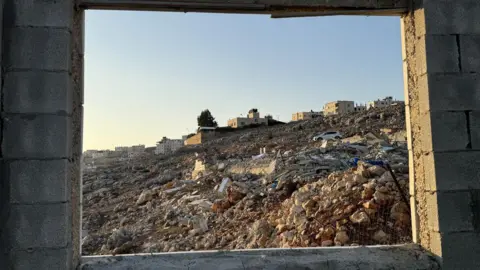
View through the empty window frame of a large pile of rubble in Nablus, with some buildings still standing in the distance

Mohaib Salameh’s home on the outskirts of Nablus has been demolished

Whether or not the new US president agrees, many Palestinians say discussion of formal annexation misses the point – that Israel is, in practice, already annexing territory here.

One of them is Mohaib Salameh. He leads me across the rubble of his family home, built on private Palestinian land, on the outskirts of Nablus. The building was ruled illegal by an Israeli court last year and demolished.

Israel has full control over security and planning in 60% of the West Bank on an interim basis, as outlined in the Oslo peace accords three decades ago.

While settlements are expanding, permits for Palestinian homes are almost never granted. And lawyers say demolitions like this are increasing.

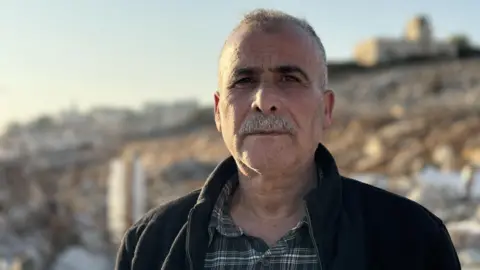
Close up shot of Mohaib in focus, with the rubble and destruction in the background out of focus

Mohaib Salameh says his now-demolished home posed no threat to the Israelis

“This is all part of policies to force us to leave,” Mohaib said. “It’s a policy of forced migration. What difference does it make to them [Israelis] if I build here or not? We pose no threat to them.”

Palestinians are also increasingly being forced off their land by violent Israeli settlers – who have been sanctioned by the US and UK, but largely left unchallenged by Israeli courts at home.

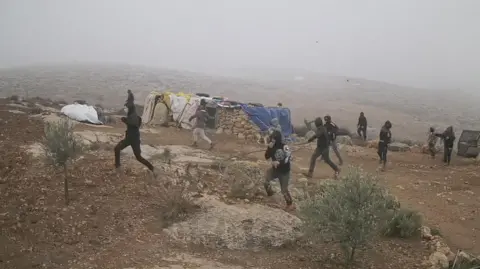
B’Tselem About a dozen people dressed in black with faces covered by hoods and scarves run in the same direction across dry ground, with a small stone building in the background, Khirbet Susiya in the South Hebron Hills, 21 December 2024B’Tselem

This image, provided by an Israeli human rights organisation, shows what they describe as teenage settlers attacking Palestinian homes in the southern West Bank

Activists say more than 20 Palestinian communities in the West Bank have been expelled over the past few years by increasingly violent attacks, and that settlers are now encroaching into new areas outside Israel’s interim civil control.

Mohaib told me that no US president had ever protected Palestinians, and that he doesn’t believe Donald Trump will either.

America’s next president is widely seen as a friend of Israel.

But he’s also a man who also likes closing deals – and avoiding conflicts.


Saudi Arabia May Partner With UFC Owner TKO to Create Boxing League

0
Saudi Arabia May Partner With UFC Owner TKO to Create Boxing League


In the days after Donald J. Trump was re-elected president, one of his most high-profile stops was at an Ultimate Fighting Championship event at Madison Square Garden.

Mr. Trump’s appearance in the front row was notable, as was the presence of some of his closest confidants, like Elon Musk, who sat alongside him. But few in attendance for the fights would have recognized the other man sitting beside the president-elect.

Yasir al-Rumayyan, the governor of Saudi Arabia’s vast sovereign wealth vehicle, the Public Investment Fund, watched the action from ringside, and is getting even closer to being part of the action. A company owned by the fund is close to creating a boxing league with TKO, the owner of Ultimate Fighting Championship. A deal for what would be a new competition, featuring up-and-coming boxers tied exclusively to the league, could be announced within weeks, according to three people familiar with the matter.

TKO said in a statement on Wednesday that it had “nothing to announce,” but that it “would evaluate any unique and compelling opportunity that could fit well in our portfolio of businesses and create incremental value for our shareholders.”

The wealth fund did not comment.

The potential investment in TKO follows a Saudi Arabian effort in June to create a multibillion-dollar boxing league that would aim to unite the world’s best boxers, who for decades have been divided by rival promoters and fighting for titles controlled by an alphabet soup of sanctioning bodies. That effort, while not completely abandoned, had proved complicated and expensive, even for a country like Saudi Arabia, which for the past half decade has disbursed billions to become a player across some of the world’s biggest sports.

The investment in the new league will be made by Sela, a subsidiary of the Public Investment Fund. TKO — which is majority controlled by the entertainment and sports conglomerate Endeavor and embodied by Dana White, the U.F.C. empresario, a longtime friend of Mr. Trump’s — would be a managing partner. In return, TKO has been offered an equity stake and a share of the revenue, according to the people familiar with the matter, who spoke on the condition of anonymity ahead of the official announcement.

Saudi Arabia has backed some of the biggest and richest boxing bouts in history in recent years. It has played host to major title fights, most recently a face-off between Oleksandr Usyk and Tyson Fury, which ended with Mr. Usyk as the first undisputed heavyweight champion in more than a generation. Fights like that, which for years proved almost impossible to negotiate, have taken place thanks to the millions of dollars put on the table by Turki al-Sheikh, a government official with close ties to the kingdom’s crown prince, Mohammed bin Salman.

Mr. al-Sheikh, a former security guard, has become perhaps the most powerful man in boxing, seen at ringside and even inside the ring for the biggest bouts. He is also a frequent recipient of messages of thanks from some of the best-known fighters and boxing promoters, who refer to him as “His Excellency.” He pushed for a partnership with Mr. White, who over the last two decades has turned the U.F.C. from a $2 million company into one worth more than $10 billion. Talks have been taking place for more than a year in the United States, Europe and Saudi Arabia.

Mr. al-Sheikh had suggested in interviews that he was planning a new boxing venture. And he has made no secret of his frustration at the way the sport has been run, with the best fighters rarely meeting in their prime. In November, he purchased Ring Magazine — the century-old bible of the sport — and vowed to re-establish its prominence.

Mr. al-Sheikh has also teamed up with the World Boxing Council, a sanctioning organization, to create the Boxing Grand Prix, a tournament for young boxers.

For TKO, which owns both the U.F.C. and World Wrestling Entertainment, the venture has little risk, given that the Saudis are footing the bill. “If we were to get involved in boxing, we would expect to do so in an organic way, not an M&A way,” said Mark Shapiro, TKO’s president, on an earnings call in November, referring to mergers and acquisitions.

He added, “So, i.e., we’re not writing a check.”

Should the deal be completed, TKO will earn management fees of close to $30 million a year. Saudi Arabia is expected to pay significantly more in hosting fees to the league than any other country, according to details of the plan reviewed by The New York Times. Two fights there will bring in more than $40 million in fees. Other bouts are planned for the United States and Europe, where the hosting fees will be far lower.

TKO has also been talking with other parties, including other Arab nations, about the boxing league, according to one of the people familiar with the matter.

Endeavor, TKO’s parent company, has at times had a strained relationship with Saudi Arabia, and this potential partnership suggests that it has largely been repaired. In 2019, after the killing of the Saudi journalist Jamal Khashoggi, Endeavor returned $400 million that the Saudi sovereign wealth fund had invested in the company.

For the Saudis, getting a partner like Mr. White would come at an opportune time. He joined the board of Meta this week, and has spoken at the last three Republican National Conventions. Mr. Trump regularly hosted U.F.C. events at his properties in the organization’s early years, and he has attended many fights. Mr. Trump and Mr. al-Rumayyan are also close, with the Saudi-owned LIV golf championship holding several of its events at Mr. Trump’s courses, including one scheduled for April in Florida.

Saudi officials have described sports and entertainment as major pillars of a strategy, known as Vision 2030, to pivot their economy away from its reliance on oil exports, and as a part of efforts to liberalize society. Critics have described those efforts differently, positioning them as a way of using sports to distract the focus from Saudi Arabia’s human rights record, a tool known as sportswashing.

What TKO would get is a partnership with the biggest sports investor in the world. Saudi Arabia has invested in teams, talent and events across a wide range of sports, most recently securing rights to the 2034 men’s soccer World Cup, the most-watched event on the planet.

The U.F.C.’s U.S. media rights agreement with ESPN expires this year, as does the network’s deal with Top Rank, a top boxing promoter. TKO could try to bundle the rights to its new boxing league with the U.F.C. rights to help shore up the fledgling boxing league.

But applying the U.F.C. playbook to boxing will be extremely difficult. Boxing is a much more heavily regulated sport than mixed martial arts, with the federal Muhammad Ali Act mandating a separation in boxing between the role of manager and promoter, and the public listing of purse figures.

Unlike U.F.C., the league would not include the most prominent boxers. And they may not think there is an upside to joining it. While the fractured nature of boxing means its earning potential isn’t maximized for promoters and managers, top boxers earn far more than top M.M.A. fighters.

In October, the U.F.C. settled an antitrust lawsuit filed by former fighters — who claimed that the company illegally suppressed fighters’ pay — for $375 million. Documents submitted as evidence in that suit showed that the U.F.C. paid less than 20 percent of its revenue to its fighters.

In boxing, those figures are reversed, with fighters combining to earn well over 50 percent of the revenue from any fight.


A Timeline of Justin Trudeau’s Rise and Fall

0
A Timeline of Justin Trudeau’s Rise and Fall


2020: During the coronavirus pandemic, Mr. Trudeau became the first Group of 7 leader to isolate himself, after his wife, Sophie Grégoire Trudeau, tested positive for Covid-19. (They are now separated.) Mr. Trudeau pushed for restrictive measures and was targeted over them by his Conservative critics, even though most of the restrictions were put in place by provincial governments.

2021: When his approval ratings were still relatively high, Mr. Trudeau called a snap election, saying he wanted a strong mandate for his party to lead Canada out of the pandemic and into economic recovery. He eked out a narrow victory, but the Liberal Party again failed to secure a majority of votes.

2022: Canadian protesters fighting vaccine requirements paralyzed Ottawa, the capital, and several border crossings. Mr. Trudeau took the rare step of declaring a national public order emergency, allowing the authorities to move aggressively to restore public order, banning public assembly and restricting travel. It was a move that fueled some conservative anger against him, while rising housing costs and inflation were a frustration for Canadians of all political persuasions.

2023: In a discussion with The New York Times in 2023, Mr. Trudeau noted that people were angry. “It really sucks right now. Like, everything sucks for people, even in Canada. We’re supposed to be polite and nice, but, man, people are mad.” While he was contending with popular outrage over the cost of housing and high unemployment, Mr. Trudeau also had friction with India, accusing “agents of the government of India” of carrying out the assassination of a Sikh community leader in British Columbia.

2024: In September, Mr. Trudeau’s hold on power slipped somewhat when the left-leaning New Democratic Party deprived Liberals of guaranteed support needed to pass legislation. In October, Mr. Trudeau said he was tightening Canada’s immigration policies after the country welcomed nearly three million people over three years, straining health care and other services, a move viewed as an admission his policy had not worked. In December, Chrystia Freeland, the deputy prime minister and finance minister, resigned abruptly, a stinging rebuke to Mr. Trudeau.

2025: Mr. Trudeau caved to pressure from many in his party to step down.


‘Much more persecution’: Venezuela braces for Nicolas Maduro’s inauguration | Nicolas Maduro News

0
‘Much more persecution’: Venezuela braces for Nicolas Maduro’s inauguration | Nicolas Maduro News


Bogota, Colombia – Jesus Medina Ezaine had already spent 16 months in a Venezuelan military prison, accused of crimes he said were related to his work as a photojournalist.

But another prison stint seemed imminent, particularly after the contested re-election of Venezuelan President Nicolas Maduro.

With Maduro set to be sworn in for a third term, Medina, 43, made a difficult decision: to flee his home in Venezuela for the relative safety of Bogota, the capital of neighbouring Colombia.

“Before they could put me back in prison, I decided to escape,” said Medina.

Maduro’s government has long faced criticism for the alleged repression of political rivals. But Friday’s inauguration ceremony is set to bring the recent electoral crisis to a head, with observers warning that the violence may escalate as Maduro strives to hold onto power.

“The regime  is going to do everything they can to ensure that Maduro can be re-inaugurated and that he can continue with his administration,” said Juan Pappier, deputy director of Human Rights Watch’s Americas division.

“If they see that possibility challenged in any way, for example through [opposition-led] demonstrations, they are going to repress them brutally.”

Jesus Medina holds up a phone featuring an emaciated photo of himself in prison
Jesus Medina Ezaine spent 16 months in a Venezuelan military prison from 2018 to 2020 [Christina Noriega/Al Jazeera]

A climate of fear

Medina remembers his final months in Venezuela as being drenched in fear.

In the lead-up to the controversial election, he had joined the campaign of opposition leader Maria Corina Machado as a photographer, documenting her efforts to galvanise support for presidential candidate Edmundo Gonzalez.

But that work once again made him a target.

Medina was not unknown to the Maduro government: In 2018, he was arrested on charges of money laundering, criminal association and inciting hate, all of which he denies.

Instead, he maintains his arrest was in retaliation for his reporting on human rights abuses. He was held without trial in the Ramo Verde military prison until January 2020.

“The Venezuelan regime does not tolerate any comments or information against them,” he said.

“The media is scared,” Medina added. “Freedom of expression in Venezuela has been completely lost because journalists inside Venezuela are doing what they can to avoid imprisonment.”

But the presidential election on July 28, 2024, brought political repression worse than any Medina had witnessed before.

Hours after polls closed, the National Electoral Council named Maduro the winner, without offering its usual breakdown of voting tallies.

Meanwhile, the opposition published receipts of the votes that instead suggested Gonzalez had won the election with nearly 70 percent of the vote. As protests erupted over the alleged electoral fraud, a government crackdown ensued.

As state forces swept the streets for protesters, seizing dissidents from their homes, Medina said he was tipped off that he would be jailed — again.

He quickly went into hiding. Medina spent two months holed up in different locations in the capital Caracas, trying to avoid arrest. He said the country’s intelligence forces had already knocked at the door of his home in the city.

Feeling cornered, Medina decided to flee on September 15 to Bogota, where he has stayed ever since.

Jesus Medina crosses his arms, two tattoos stretching on the outside of his forearms: "Rebelde" and "Legion"
Jesus Medina Ezaine has said he hid from Venezuelan authorities for months before seeking refuge abroad [Christina Noriega/Al Jazeera]

A wave of repression

As many as 2,500 people were ultimately detained in the post-election protests, according to government statistics.

Another 25 people were killed, in what independent investigators for the United Nations called “unprecedented levels of violence”.

A UN fact-finding mission announced earlier this month that at least 56 political opposition activists, 10 journalists and one human rights defender were among the arrested between August and December.

On Tuesday, the Inter-American Commission on Human Rights also published a report alleging systematic state repression intended “to prevent the political participation of the opposition” and “sow terror among citizens”.

But in the lead-up to Friday’s inauguration, more than 1,500 prisoners detained in the post-election sweep have been released, in what critics say could be an attempt to reduce scrutiny on the government’s human rights record.

Alfredo Romero, the director of Foro Penal, a Venezuelan human rights watchdog, explained that “having a number of innocent youths with their relatives, especially their mothers, at the door of the prisons” holding vigils was reflecting poorly on the Maduro administration.

Rights groups have also questioned the accuracy of the government’s numbers.

Romero said that at least 1,749 prisoners remained in custody as of the first week of January, and more alleged dissidents had since been detained.

“People may be released from prison, but it doesn’t mean that new ones won’t be jailed,” he said.

Maria Corina Machado greets a crowd of supporters on January 9
Venezuelan opposition leader Maria Corina Machado greets supporters at a protest against President Nicolas Maduro in Caracas, Venezuela, on January 9 [Ariana Cubillos/AP Photo]

Inauguration backlash

Despite widespread fear over repression, demonstrations are expected on the day of Maduro’s third inauguration.

Gonzalez, the opposition’s presidential candidate, has also pledged to return to Venezuela from his exile abroad and be sworn in on Friday. It is unclear how or if he will follow through on that pledge.

In a video message posted to social media on Sunday, Machado, who has remained in hiding in Venezuela for months, called on Venezuelans to march in support of a transition of power this week.

“Maduro is not going to leave on his own, we must make him leave with the strength of a population that never gives up,” Machado said. “It is time to stand firm and make them understand that this is as far as they go. That this is over.”

In turn, the Maduro government has ramped up security and deployed more than 1,200 military personnel to cities across the country to “guarantee peace” on inauguration day.

The government has also detained more than 12 human rights defenders, political activists, and relatives of opposition figures in recent days, according to Amnesty International, a human rights organisation.

The detainments allegedly include Gonzalez’s son-in-law, Rafael Tudares: The presidential candidate said Tudares was abducted by masked men in Caracas on Tuesday.

And on Thursday, Machado herself was detained as she left an anti-Maduro protest, according to opposition officials who said her transportation was fired upon. She was swiftly released.

Jesus Medina looks out an open window near a brick wall
Jesus Medina told Al Jazeera he plans to continue fighting for a better Venezuela [Christina Noriega/Al Jazeera]

An uncertain future

The recent arrests have prompted a new swell of international condemnation.

The United States Embassy in Venezuela has called the detention of Gonzalez’s son-in-law an act of “intimidation” against the opposition. Colombian President Gustavo Petro said that the arrests prevented him from attending Maduro’s inauguration on Friday.

Still, Maduro’s control of state institutions has allowed security forces to act with impunity, according to the recent report from the Inter-American Commission on Human Rights.

Medina himself believes repression in Venezuela may escalate if Maduro remains in power for a third term.

“If we do not achieve freedom, there will be much more persecution,” said Medina. “They will try to put an end to everything that they consider the opposition, including political leaders and the media.”

For now, he added that he hopes to continue his work exposing human rights abuses from abroad.

“What I have decided is that, no matter what, I’ll fight for my country.”


Why the US is trying to stop a 9/11 guilty plea

0
Why the US is trying to stop a 9/11 guilty plea


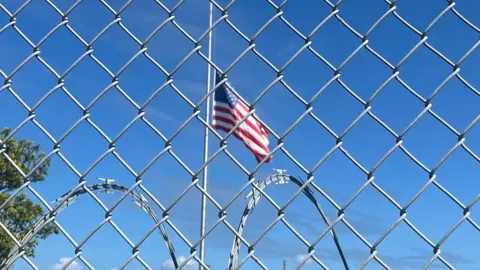
BBC An American flag flies against a blue sky behind a chainlink fence and barbed wire at Guantanamo BayBBC

The accused mastermind of the 9/11 terror attacks on the US will no longer plead guilty on Friday, after the US government moved to block plea deals reached last year from going ahead.

Khalid Sheikh Mohammed, often referred to as KSM, was due to deliver his pleas at a war court on the Guantanamo Bay naval base in south-eastern Cuba, where he has been held in a military prison for almost two decades.

Mohammed is Guantanamo’s most notorious detainee and one of the last held at the base.

But a federal appeals court on Thursday evening halted the scheduled proceedings to consider requests from the government to abandon the plea deals for Mohammed and two co-defendants, which it said would cause “irreparable” harm to both it and the public.

A three-judge panel said the delay “should not be construed in any way as a ruling on the merits”, but was aimed at giving the court time to receive a full briefing and hear arguments “on an expedited basis”.

The delay means that the matter will now fall into the incoming Trump administration.

What was scheduled to happen this week?

At a hearing beginning on Friday morning, Mohammed was scheduled to plead guilty to his role in the 11 September 2001 attacks, when hijackers seized passenger planes and crashed them into the World Trade Center in New York and the Pentagon outside of Washington. Another plane crashed into a field in Pennsylvania after passengers fought back.

Mohammed has been charged with offences including conspiracy and murder, with 2,976 victims listed on the charge sheet.

He has previously said that he planned the “9/11 operation from A-to-Z” – conceiving the idea of training pilots to fly commercial planes into buildings and taking those plans to Osama bin Laden, leader of the militant Islamist group al-Qaeda, in the mid 1990s.

Friday’s hearing was set to happen in a courtroom on the base, where family members of those killed and the press would have been seated in a viewing gallery behind thick glass.

Why is this all happening 23 years after 9/11?

Pre-trial hearings, held at a military court on the naval base, have been going on for more than a decade, complicated by questions over whether torture Mohammed and other defendants faced while in US custody taints the evidence.

Following his arrest in Pakistan in 2003, Mohammed spent three years at secret CIA prisons known as “black sites” where he was subjected to simulated drowning, or “waterboarding”, 183 times, among other so-called “advanced interrogation techniques” that included sleep deprivation and forced nudity.

Karen Greenberg, author of The Least Worst Place: How Guantanamo Became the World’s Most Notorious Prison, says the use of torture has made it “virtually impossible to bring these cases to trial in a way that honors the rule of law and American jurisprudence”.

“It’s apparently impossible to present evidence in these cases without the use of evidence derived from torture. Moreover, the fact that these individuals were tortured adds another level of complexity to the prosecutions,” she says.

The case also falls under the military commissions, which operate under different rules than the traditional US criminal justice system and slow the process down.

The plea deal was struck last summer, following some two years of negotiations.

What does the plea deal include?

The full details of the deals reached with Mohammed and two of his co-defendants have not been released.

We do know that a deal means he would not face a death penalty trial.

In a court hearing on Wednesday, his legal team confirmed that he had agreed to plead guilty to all charges. Mohammed did not address the court personally, but engaged with his team as they went over the agreement, making small corrections and changes to wording with the prosecution and the judge.

If the deals are upheld and the pleas are accepted by the court, the next steps would be appointing a military jury, known as a panel, to hear evidence at a sentencing hearing.

In court on Wednesday, this was described by lawyers as a form of public trial, where survivors and family members of those killed would be given the opportunity to give statements.

Under the agreement, the families would also be able to pose questions to Mohammed, who would be required to “answer their questions fully and truthfully”, lawyers say.

Central to the prosecution agreeing to the deals was a guarantee “that we could present all of the evidence that we thought was necessary to establish a historical record of the accused’s involvement in what happened on September 11th,” prosecutor, Clayton G. Trivett Jr., said in court on Wednesday.

Even if the pleas go ahead, it would be many months before these proceedings would begin and a sentence ultimately delivered.

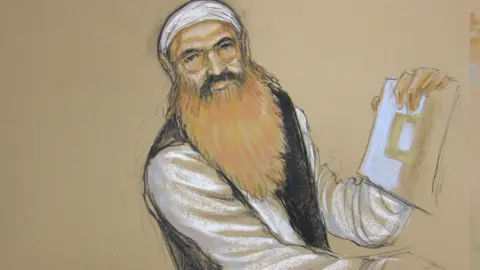
Reuters Khalid Sheikh Mohammed is seen in an artist"s sketch during a court recess at a pre-trial hearing at the U.S. Naval Base Guantanamo Bay, Cuba, in this October 15, 2012Reuters

The case against Khalid Sheikh Mohammed, shown here during a 2012 pre-trial hearing, has been ongoing for two decades at the U.S. Naval Base Guantanamo Bay.

Why is the US government trying to block the pleas?

US Defense Secretary Lloyd Austin appointed the senior official who signed the deal. But he was travelling at the time it was signed and was reportedly caught by surprise, according to the New York Times.

Days later, he attempted to revoke it, saying in a memo: “Responsibility for such a decision should rest with me as the superior authority.”

However, both a military judge and a military appeals panel ruled that the deal was valid, and that Mr Austin had acted too late.

In another bid to block the deal, the government this week asked a federal appeals court to intervene.

In a legal filing, it said Mohammed and the two other men were charged with “perpetrating the most egregious criminal act on American soil in modern history” and that enforcing the agreements would “deprive the government and the American people of a public trial as to the respondents’ guilt and the possibility of capital punishment, despite the fact that the Secretary of Defense has lawfully withdrawn those agreements”.

Following the announcement of the deal last summer, Republican Senator Mitch McConnell, then the party’s leader in the chamber, released a statement describing it as “a revolting abdication of the government’s responsibility to defend America and provide justice”.

What have the victims’ families said?

Some families of those killed in the attacks have also criticised the deal, saying it is too lenient or lacks transparency.

Speaking to the BBC’s Today Programme last summer, Terry Strada, whose husband Tom was killed in the attacks, described the deal as “giving the detainees in Guantanamo Bay what they want”.

Ms Strada, the national chair of the campaign group 9/11 Families United, said: “This is a victory for Khalid Sheikh Mohammed and the other two, it’s a victory for them.”

Other families see the agreements as a path towards convictions in the complex and long-running proceedings and were disappointed by the government’s latest intervention.

Stephan Gerhardt, whose younger brother Ralph was killed in the attacks, had flown to Guantanamo Bay to watch Mohammed plead guilty.

“What is the end goal for the Biden administration? So they get the stay and this drags into the next administration. To what end? Think about the families. Why are you prolonging this saga?” he said.

Mr Gerhardt told the BBC the deals were “not a victory” for the families, but that it was “time to find a way to close this, to convict these men”.

Families on the base were meeting with the press when news of the delay was made public.

“It was supposed to be a time of healing. We’ll board that plane still with that deep sense of pain – there’s just no end to it,” one said.

Why are the proceedings happening in Guantanamo?

Mohammed has been held in a military prison in Guantanamo Bay since 2006.

The prison was opened 23 years ago – on 11 January 2002 – during the “war on terror” that followed the 9/11 attacks, as a place to hold terror suspects and “illegal enemy combatants”.

Most of those held here were never charged and the military prison has faced criticism from rights groups and the United Nations over its treatment of detainees. The majority have now been repatriated or resettled in other countries.

The prison currently holds 15 – the smallest number at any point in its history. All but six of them have been charged with or convicted of war crimes.


Egypt Sees Its Refugees as a Scapegoat and an Opportunity

0
Egypt Sees Its Refugees as a Scapegoat and an Opportunity


In easier times for Egypt’s refugees, Azza Mostafa, a pro-government TV anchor, had nothing but generous words for the many thousands of Syrians who had built new lives in Egypt after their own country imploded into civil war in 2011.

“I’d like to say to our Syrian families and our brothers in Egypt,” she said in a 2019 broadcast, “you’ve truly brought light to Egypt.”

But there she was on her show in June, fulminating against Egypt’s growing number of outsiders — an echo of the country’s leaders, whose policy toward refugees and migrants has hardened as they wrestle with an economic crisis made worse by wars in neighboring Gaza, Sudan and Libya.

“This has become unbearable,” Ms. Mostafa said, accusing migrants of driving up rents and promoting female genital mutilation. “There are many acts of overstepping bounds. Is that acceptable? After we opened our country for them?”

Egypt long made it easy for foreigners of all kinds to live and work in the country, largely without interference, whether they were refugees, migrant workers or Westerners escaping coronavirus lockdowns.

The past 13 years have brought a near unbroken stream of newcomers fleeing conflict to the country that is known among Arabs as the “mother of the world.” That includes not just Syrians but also Sudanese, Yemenis, Eritreans and, most recently, Palestinians from Gaza.

Egypt’s lax immigration rules meant many never formally registered as refugees or received official permission to stay long-term, yet managed to stitch themselves almost seamlessly into the country, supporting themselves and sometimes starting businesses.

Since Sudan’s civil war drove a surge of refugees to Egypt starting in 2023, however, the impoverished government in Cairo has complained louder and louder about the burden of foreigners. It rapidly tightened its policies — hoping, analysts and diplomats say, to win more support from international backers eager to prevent migration to their own countries.

Egypt says it spends $10 billion each year on its nine million refugees, according to officials and government-controlled media (though experts say both numbers are greatly exaggerated), all while Egyptians endure soaring prices and subsidy cuts.

Years of government overspending, reliance on imports and policies that neglected private-sector growth left the country’s finances in precarious shape before the wars in Ukraine and Gaza sent them crashing. Egypt lost $7 billion in crucial revenue from the Suez Canal in 2024 as the conflict in Gaza has squeezed shipping in the Red Sea, according to government officials.

With Egypt deep in debt and hard-pressed to pay for imports such as wheat and energy, the currency has crashed, while some goods have become difficult to find.

Ahmed Abu Al-Yazid, the head of a government-owned sugar firm, the Delta Sugar Company, blamed refugees for a sugar shortage that experts link to the economic crisis. The president accused them of draining Egypt’s precious water. On social media, pro-government accounts — some of which appeared to be fake — accused Sudanese refugees of driving up rents and promoting female genital mutilation.

A crackdown soon followed the accusations, according to migrants, refugees and their advocates.

Sudanese refugees have been rounded up in police sweeps, detained and summarily deported. Syrians who have lived in Egypt for years have been told to pay thousands of dollars to stay. Many remain hesitant to return, despite the fall of the Assad regime in December, until the situation stabilizes.

Foreign workers from Asia and from other parts of Africa now face extra hurdles to keep their legal status, and in some cases, have been arrested to compel them to pay high fees, advocates say.

Last month, Egypt passed a law that would hand responsibility for screening refugees and others to the government, instead of to the United Nations refugee agency.

Government officials said the measure would ensure a wide array of refugee rights. Critics of the move, however, said that it would become far harder for refugees to gain protection or access to health care and schools. The law also empowers the government to revoke refugee status on vague grounds such as breaches of national security, political activity or violations of Egyptian social customs.

Abu Saleh, 32, a Syrian who works in a small Cairo grocery, said he had lived in the city for 13 years “without a single issue” until he discovered in July that he could no longer enroll his son in school without a residence permit.

Just to renew his family’s tourist visas, he said, he was told that he would have to return to Syria and pay $2,000 per person in fees — a process he would have to repeat every six months.

“Egypt has been there for us all along,” said Abu Saleh, who asked to be identified by the name he uses around town to avoid possible repercussions. “I’d like to appeal to the government of Egypt: Give us residence, even if it’s a little more expensive. We’re facing tough conditions.”

Egypt has not explained its hardening attitude toward foreigners. But analysts and migrant advocates tie it to the economic crisis, which has generated widespread bitterness and undermined President Abdel Fattah el-Sisi’s rule.

The newcomers make convenient scapegoats for Egyptians’ hardships, rights groups say. Immigration fees, charged in dollars, can supply some of the foreign currency that Egypt badly needs. And foreigners are also valuable pawns in Egypt’s quest for more financial support from its international partners, rights groups say.

“They think, ‘How can these people be useful for the government?’” said Nour Khalil, executive director of the Refugees Platform in Egypt, which advocates migrants’ rights.

The U.N. refugee agency counts about 818,000 registered refugees in Egypt, who are entitled to free public health care and education. There are likely many more unregistered refugees, though analysts and aid workers dispute the figure reaches nine million.

The benefits that registered refugees receive mean that Egypt “is treating them like Egyptians, despite the fact that we are not a rich country,” the foreign minister, Badr Abdelatty, said at a news conference last month. “There is no country in the world assuming these responsibilities and challenges like here in Egypt. We don’t have one single refugee camp — they are fully integrated in society.”

Refugee advocates agree that Egypt needs more resources. Unlike other countries in the region, including Jordan, Lebanon and Turkey, where the United States, the United Nations and the European Union have poured billions into supporting refugees, Egypt has not received significant funds to help house Syrian or other refugees.

That is changing.

As the war in Gaza has pounded Egypt’s finances, Western backers have rushed to Egypt’s aid, anxious to prevent an economic collapse in the Arab world’s most populous country, analysts and diplomats say. A crash in Egypt could further destabilize the Middle East and send a deluge of migrants across the Mediterranean Sea to Europe, where there is heavy public pressure to restrict migration.

The European Union pledged a fast-tracked $8 billion aid package to Egypt in March, echoing deals the bloc has struck with Mauritania, Tunisia and Turkey that funded migration enforcement in those countries.

Other backers, including the International Monetary Fund, have sent billions more to stabilize Egypt’s economy.

Critics say the European pact with Egypt, like the bloc’s other migration deals, is enabling rights abuses by rewarding Mr. el-Sisi’s authoritarianism and potentially funding the current crackdown on migrants.

Groups including Amnesty International and the Refugees Platform in Egypt have documented what they say is a pattern of mass arbitrary arrests and unlawful deportations of Sudanese refugees — some detained as they were smuggled across the border, others rounded up during random sweeps of predominantly Sudanese neighborhoods.

Some Syrians, too, have been expelled, Mr. Khalil of the refugees platform said. His group has also documented more than 50 arrests of foreign workers, some of whom already had residency, who were held until they paid $1,000 in fees and fines, he said.

An atmosphere of fear has brought throngs of Sudanese to the doorstep of the U.N. refugee agency in Cairo, seeking formal protection. But refugee status can take months, if not years, to obtain: Appointments to begin the process are not available until late 2025. And some of the Sudanese who have been detained and deported, Mr. Khalil said, held some form of U.N. identification, casting doubt on whether the organization could guarantee security.

Among those waiting outside one morning was Mohammed Abdelwahab, 36. By the time he and his family tried to cross the border from Sudan this spring, Egypt had tightly restricted what had been free-flowing movement between the two countries, so they resorted to smugglers instead.

Without legal papers, Mr. Abdelwahab and his 14-year-old son, Mohanad, collected plastic bottles on Cairo’s streets for a living. Mr. Abdelwahab was looking for better work one day in June when Mohanad disappeared.

Twenty days later, Mohanad resurfaced with a WhatsApp message: He had been rounded up with a group of other Sudanese and deported.

Mr. Abdelwahab had been looking for Mohanad in another city. When he returned to Cairo, his wife and three other children had been evicted for nonpayment.

“It’s indescribable,” he said. “Now they’re all camping out here,” he added, referring to his family and indicating the sidewalk in front of the refugee agency, where groups of other Sudanese waited listlessly in the sun.

Emad Mekay and Rania Khaled contributed reporting.


Venezuela’s Opposition Leader, Maria Corina Machado, Is Freed After Being Detained

0
Venezuela’s Opposition Leader, Maria Corina Machado, Is Freed After Being Detained


Venezuela’s popular opposition leader, María Corina Machado, was briefly detained by adversaries during an antigovernment protest in Caracas on Thursday, according to a statement on X by a political aide. But she was soon released.

Ms. Machado was “violently intercepted as she left the gathering,” her party said on X. “Regime troops shot at the motorcycles that were transporting her.”

The country’s autocrat, Nicolás Maduro, is set to be sworn in for a third term as president on Friday.

Ms. Machado had been living in hiding in Venezuela amid threats of arrest from government officials, and this was her first public appearance since August. She had called for gatherings around the country, and in cities around the world, to protest Mr. Maduro’s inauguration.

Thousands turned out to support Ms. Machado at an event in Caracas on Thursday, all risking government detention. There, the opposition leader stood atop a truck while supporters shouted, “Freedom! Freedom! Freedom!”

On X, the political aide, Magalli Meda, said that as Ms. Machado was leaving the gathering, she was knocked off her motorbike.

“Firearms went off at the event,” Ms. Meda said. “They took her away by force.”

During her brief detention, “she was forced to record several videos and was later released,” she added. “In the next few hours she herself will be the one to address the country to explain what happened.”

Representatives for Ms. Machado declined to say who detained her. The event was full of government security forces, who are often backed by members of armed gangs know as colectivos.

Venezuela’s interior minister, Diosdado Cabello, speaking in a television interview, called the capture “a lie” and accused the opposition of inventing it to attract attention.

The country’s opposition, as well as the United States and other countries, say that Mr. Maduro had stolen a recent election and that the real winner was Edmundo González, a former diplomat who has Ms. Machado’s backing.

Mr. González has been living in exile since September.

Before her detention, Ms. Machado told her followers, “This force that we have built and that grows every day has prepared us for this final phase.”

“Whatever they do tomorrow,” she said of the Maduro inauguration, “they’ve just buried themselves!”

About 2,000 people have been detained in Venezuela since the July 28 election, including, in recent days, Mr. González’s son-in-law, Rafael Tudares, as well as Carlos Correa, the director of a high-profile nonprofit organization, Espacio Público.