A former city counsellor in Brazil has returned a toilet and two sinks she had removed from her office after losing a bid for re-election.
Footage of one of Janaína Lima’s employees hauling away the facilities was posted online as her tenure as Sao Paulo councilwoman ended.
“I decided to donate the equipment I acquired with my own resources to the chamber,” she said in statement on X, following a social media backlash.
“Obviously, neither I nor my advisers need a toilet.”
CCTV cameras caught employees in her office removing the facilities that were installed when she took office eight years ago.
In a statement posted on social media, Lima said the bathroom renovation was paid for with her own money and therefore not an asset belonging to the council.
Lima said she had followed the guidance of the legal department, which had indicated that all personally installed resources should be removed.
She told Brazilian media outlet G1 the hydraulics in the building are “sensitive”.
She added that other fixtures she had bought for the office – such as a glass partition and industrial-style light fittings – would remain in place for her predecessor.
Lima served as served as a counsellor for the New Party until 1 January.
The 41-year-old lost her position to Adrilles Jorge, of the Brazilian Labour Party, in the 2024 elections.
At his inauguration on Monday, Jorge quipped to G1 that his team would “use a communal potty” until the situation is resolved.
“I visited the office and thought the architecture was brilliant. But she took everything out,” he said.
“They even took out the toilet and the sink. She didn’t say [that she was going to take them out]. And it’s something that neither she would say, nor I would ask.”
The new president of the House, Ricardo Teixeira said “appropriate measures” would be taken.
Even under ambitious climate policies, lower-income countries would see consumer food prices rise 2.45 times by 2050 while producer prices would rise 3.3 times, a study has found.
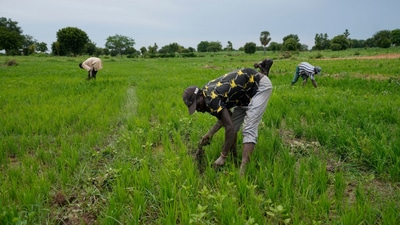
Workers remove weeds from a rice farm outside Kano, Nigeria. Many poor countries in Africa face the harshest effects of climate change: severe droughts, vicious heat and dry land, but also unpredictable rain and devastating flooding. The shocks worsen conflict and upend livelihoods because many people are farmers — work that is increasingly vulnerable to a warming world. (File image)(AP)
While the rise in consumer prices is less pronounced for farmers in lower-income countries, it would still make it harder for people in these countries to afford sufficient and healthy food, said researchers from the Potsdam Institute for Climate Impact Research (PIK), Germany.
“In high-income countries like the US or Germany, farmers receive less than a quarter of food spending, compared to over 70 per cent in Sub-Saharan Africa, where farming costs make up a larger portion of food prices,” said David Meng-Chuen Chen, a PIK scientist and lead author of the study published in Nature Food.
“This gap underscores how differently food systems function across regions,” he said.
The researchers projected that as economies develop and food systems industrialise, farmers will increasingly receive a smaller share of consumer spending, a measure known as the ‘farm share’ of the food dollar.
For the analysis, the researchers assessed food price components across 136 countries and 11 food groups, using statistical and process-based models. They studied prices of food both consumed at home and away from home.
“Most models stop at farm costs but we went all the way to the grocery store and even the restaurant or canteen,” Chen said.
Analysing entire food value chains also helped the researchers provide insights into how policies aimed at mitigating greenhouse gases impact consumers.
“Climate policies aimed at reducing emissions in agriculture often raise concerns about rising food prices, particularly for consumers. Our analysis shows that long supply chains of modern food systems buffer consumer prices from drastic increases, especially in wealthier countries,” Chen said.
However, these climate policies impact poor consumers differently, the researchers said.
Consumer food prices in richer countries would be 1.25 times higher with climate policies, even if producer prices are 2.73 times higher by 2050, the researchers found.
In contrast, lower-income countries would see consumer food prices rise by a factor of 2.45 under ambitious climate policies by 2050 while producer prices would rise by a factor of 3.3, they found.
“Even under very ambitious climate policies with strong greenhouse gas pricing on farming activities the impact on consumer prices by 2050 would be far smaller in wealthier countries,” said author and PIK scientist Benjamin Bodirsky.
Revenues from carbon pricing — when governments charge one for emissions produced — could be used to support low-income households, the researchers said, citing a 2021 PIK study that showed that the households would be better off this way despite food price inflation.
“Climate policies might be challenging for consumers, farmers and food producers in the short term but they are essential for safeguarding agriculture and food systems in the long run,” said author Hermann Lotze-Campen, who is also the head of the research department — ‘Climate Resilience’ — at PIK.
“Climate policies should be designed to include mechanisms that help producers and consumers to transition smoothly, such as fair carbon pricing, financial support for vulnerable regions and population groups, and investments in sustainable farming practices,” Lotze-Campen said.
Every day for the past week, Kim Kwon-seop, 72, has joined thousands of others gathered near the home of South Korea’s impeached president, Yoon Suk Yeol. They were determined to shield Mr. Yoon from prosecutors who wanted to detain him on insurrection charges stemming from his short-lived declaration of martial law last month.
To them, it was the opposition who had committed insurrection, abusing its majority power at the Assembly to repeatedly block Mr. Yoon’s political initiatives. To them, the opposition’s parliamentary majority was invalid because the election last April was rigged. And to them, protecting Mr. Yoon was synonymous with protecting South Korea from “North Korea followers” who have taken root in every corner of their society, from the judiciary to schools to the news media.
South Koreans commonly dismiss such conspiracy theories as little more than online demagoguery spread by right-wing YouTubers with the help of social media algorithms. But amid the country’s entrenched political polarization, they have fueled the turmoil over Mr. Yoon’s situation, driving zealous believers like Mr. Kim to take to the streets in large numbers, calling for the president’s return to office.
“When I leave home for this rally every day, I tell my wife that this may be the last time she sees me alive, because I am ready to die for my cause,” Mr. Kim said. “This is not just about protecting President Yoon. It’s about saving my country for my descendants.”
If President-elect Donald J. Trump has a “Make America Great Again” movement behind him, Mr. Yoon has the “taegeukgi budae” (literally, “national-flag brigade”). It consists of mostly older, churchgoing South Koreans who enliven their rallies with patriotic songs, a wave of South Korean and American flags in support of their country’s alliance with Washington, and vitriolic attacks on the nation’s left-wing politicians, whom they fear would hand their country over to China and North Korea.
“We won!” flag-waving supporters of Mr. Yoon shouted on Friday when investigators retreated from the presidential residence after failing to serve a court warrant to detain him for questioning.
“Yoon Suk Yeol is depending on the South Korean version of MAGA to hold onto power,” said Ahn Byong-jin, a professor of political science at Kyung Hee University in Seoul.
Mr. Yoon invoked the right-wing fear and indignation when he declared martial law on Dec. 3 to “eliminate the despicable pro-North Korean and anti-state forces at one stroke.” But his attempt to place his country under military rule for the first time in 45 years lasted only hours. The opposition-dominant National Assembly voted to rescind it and later impeached him.
Suspended from office, Mr. Yoon now faces a trial at the Constitutional Court, which will decide whether to formally remove him. He is also subject to separate investigations from prosecutors, who have accused him of committing insurrection when he ordered troops to seize the Assembly and to detain his political enemies during his martial law.
With public surveys showing a majority of South Koreans wanting him ousted, Mr. Yoon’s strongest defenders are his flag-waving supporters and the right-wing YouTubers, who glorify him as a champion of promoting the alliance with Washington. These YouTubers, some with around a million subscribers, demand Mr. Yoon’s reinstatement and livestream pro-Yoon rallies, where speakers call the efforts to remove him a “coup d’état” at North Korea’s behest. They also reinforce political polarization by channeling conspiracy theories against Mr. Yoon’s progressive enemies.
Right-wing YouTubers have long boasted of their friendship with Mr. Yoon, after dozens of them were invited to his inauguration in 2022. In the wake of his botched martial law, Mr. Yoon left little doubt that he was a big fan.
“I am watching your struggle in real time through YouTube livestreaming,” Mr. Yoon said in a message to his supporters gathered outside his home on New Year’s Day. “Our country is in danger because of anti-state forces running amok, as well as forces in and outside who violate our sovereignty.”
During a rally on Wednesday, Seok Dong-hyeon, a lawyer who serves as Mr. Yoon’s spokesman, thanked right-wing YouTubers there and called the investigators trying to detain Mr. Yoon “a front” for the opposition.
“This is war,” he said. “And you are warriors.”
Like other democracies, South Korea has grappled with the role of social media in shaping politics. About 53 percent of South Koreans say they consume news on YouTube, higher than an average of 30 percent in 46 countries surveyed, according to a 2023 report by Korea Press Foundation.
Analysts worry that algorithm-fueled information bubbles, with people continually served more of the type of content they have expressed interest in by watching, are helping divide the nation. The language and conspiracy theories Mr. Yoon and his supporters adopted mirror those purveyed by right-wing YouTubers, said Hong Sung-guk, a former lawmaker and columnist.
“Yoon’s is likely the world’s first insurrection instigated by algorithm addictions,” Mr. Hong said.
A dozen participants in a recent pro-Yoon rally interviewed for this article were all firm believers in the conspiracy theories, saying that right-wing YouTubers were their primary or only source of news.
“They speak the truth,” said Kim Jae-seung, 72. “I no longer read newspapers or turn on TV. They are full of bias.”
Kim Yong-son, 70, pulled out his battered smartphone to show a video clip that depicted the progressive leaders as hellbent on undermining South Korea’s alliance with the United States and colluding with North Korea and China — viral content created by the popular right-wing pastor, the Rev. Jun Kwang-hoon.
In 1980, Chun Doo-hwan, the leader of the military junta that ruled the country at the time, justified imposing martial law by citing the threats from “North Korean puppets” and “dangerous elements” at home.
As his own political troubles deepened in the wake of scandals and disaster, Mr. Yoon aligned himself more openly with the radicalized political right. He accused unfriendly journalists of spreading “fake news” and called his political enemies subscribers to “Communist totalitarianism.” He even appointed a right-wing YouTuber as head of the center for training government officials.
Long before Mr. Yoon’s declaration of martial law, some of the right-wing YouTubers had urged him to take such an action to deal with his domestic enemies. They also spread sinophobia, hinting that China was a secret manipulator of domestic politics in South Korea, including its elections. Rallies of his supporters often ring with calls for “expelling Chinese.” Mr. Yoon raised fears of Chineses spies while defending his martial law.
Mr. Yoon and right-wing YouTubers also argue that election results in South Korea are no longer trustworthy. Pro-Yoon supporters often carry signs saying “Stop the Steal,” borrowing a term made popular by people in the United States who falsely claimed that the ballot count for the 2020 presidential election was manipulated against Mr. Trump. One of them, Shin Eun-ju, 52, said she believed the vote fraud theory, citing “YouTube” as her source.
The police and prosecutors, as well as the election authorities, have long dismissed the allegation as groundless. But when Mr. Yoon declared martial law, he also sent troops to the National Election Commission to investigate allegations of vote fraud. Military officers involved in his martial law decree had instructions, prosecutors said, to confiscate the commission’s computer servers and detain senior election monitors, tying, blindfolding and taking them to an underground military bunker for questioning about election fraud. (Martial law ended before any computers were seized or people taken away.)
Mr. Yoon and his lawyers have not commented on specific allegations, and they have broadly denied allegations of insurrection, calling his acts the legitimate exercise of presidential power.
“It’s clear that the president lost his mind to outlandish vote-fraud conspiracy theories while watching low-quality YouTube channels,” said Cho Gab-je, a prominent conservative journalist.
Mr. Yoon’s lawyer, Yoon Kab-keun, said the allegations of rigged elections were strong and divisive enough to merit an investigation.
Google Korea said it manages YouTube contents according to its community guidelines.
Ironically, it was also YouTube that helped news of Mr. Yoon’s declaration of martial law go viral on the night of Dec. 3, prompting citizens to rush to the National Assembly to delay the advance of troops and buy time for opposition lawmakers to vote down the martial law.
“It was a clash between the different roles of algorithms,” Mr. Hong said. “Algorithms help information go viral, but also help make you a slave to it.”
MUMBAI: A post-festival moderation in growth, as indicated by various economic reports, could lead to lower-than-projected growth in the third quarter. While October saw a spike in economic activity, it tapered down in November as was first seen in indicators like payments. Current high-frequency indicators reflect a slowing of momentum, according to Kaushik Das, an economist with Deutsche Bank. “GST growth in December 2024 was only 7.3% year-on-year, the fourth consecutive month of single-digit growth. Manufacturing PMI for the same period came at 56.4 – a 12-month low.” “Core infrastructure production growth improved in Nov to 4.3% year-on-year, from 3.7% in October, but remained below the 5% mark. Industrial production growth in Nov is likely to be even lower at 3.8%, though improving slightly from the 3.5% out-turn in Oct,” he added. According to Das, the growth momentum needs a positive shock given the slowdown, and monetary policy needs to be forward-looking. “We estimate India’s real GDP growth to average about 6.5% YoY in FY25 and FY26, aided by policy support. This will be below the potential growth rate of the economy at 7-7.5%,” he said in a report. A Motilal Oswal report said that economic indicators revealed divergent trends in Nov and Dec 2024, suggesting an uneven growth trajectory. The report states that real GDP growth for Q3 is expected to rise slightly to 5.5%-5.7% year-on-year, significantly lower than the RBI’s forecast of 6.8%. According to the report, the Economic Activity Index-to-GDP – which estimates overall economic output – declined for the first time in 28 months, shrinking 0.8% year-on-year in Nov. The contraction follows a 9.3% increase in Oct and 3% growth in Nov 2023, with the decline attributed to a sharp contraction in external trade. Faster growth in imports relative to exports shaved 6.3 percentage points off GDP growth. “In several high-frequency indicators, Nov was the best month the Indian economy saw through FY24-25, but some moderation is already visible in Dec,” Rahul Bajoria, an economist with Bank of America Global Research, said.
It is August 2022, and four Americans – all men in their 70s – disembark at a small airport outside Quy Nhon, a city of about half a million located on the south-central coast of Vietnam and the capital of the Binh Dinh province. With its lush landscapes and stunning tropical beaches, it is hard to accept that the region was the setting of fierce fighting during the Vietnam War, which ended 50 years ago this coming April.
The Americans exit the airport and are met by Major Dang Ha Thuy – a uniformed Vietnamese man, also elderly – who greets them warmly. Half a century ago, they would have exchanged gunfire; today, they exchange handshakes and smiles.
They have been drawn together by a shared mission. Thuy has spent 20 years searching for the missing remains of his North Vietnamese comrades lost in battle, and the Americans have come to help. Not only might these veterans know where some of the bodies can be found, but they are the ones who buried them.
The five board a shuttle along with a film crew from VTV4 – a Vietnamese television network facilitating and documenting the trip – which carries them all to Xuan Son Hill, a remote point in the Kim Son Valley. Fifty years ago, it was the site of a brutal battle at the United States Army’s Firebase Bird – and until recently, it was the location of a mass grave containing the remains of 60 people.
Major Thuy consoles a tearful Steve Hassett [Screen capture from the documentary Fragment of Memory]
The battle at Firebase Bird
By 1966, Vietnam’s civil war had been raging for more than a decade, and US involvement had grown from a smattering of military advisers and special forces to a sprawling army of 400,000. While the violence would not peak for another two years, the casualty rate was already rising fast. Hundreds of US personnel were killed every month, and the Vietnamese losses were much worse. Before ending in 1975, about 58,000 Americans, 350,000 Laotians and Cambodians, and between 1-3 million Vietnamese were killed in the war.
On Christmas of 1966, a declared truce would suspend the carnage for 30 hours. For American soldiers holed up at Firebase Bird – a small helicopter landing zone and staging base – it was a much-needed opportunity for rest amid the “search and destroy” mission that had them slogging through the jungles of Binh Dinh in search of the North Vietnamese Army (NVA) and guerrilla forces. But when the truce expired in the early morning hours of December 27, the NVA attacked.
“We were totally surprised,” reported Spencer Matteson half a century later in Fragments of Memory, a 2023 VTV4-produced documentary about the battle and search for its resulting mass graves. Matteson only survived the initial onslaught due to a last-minute bunker switch – the soldier who took his place was killed instantly by a direct mortar strike. As the rounds rained down, he said, “It was the loudest thing I’ve ever heard in my life. I’ve never been able to hear right since.”
It did not take long for the attacking forces to overwhelm the hill and base, and soon, the American defenders only had their last remaining heavy gun. From this, they fired a last-ditch weapon called a “beehive”, which scattered a barrage of small projectiles in every direction and finally broke the attack.
After the firing died down, the smoke cleared and the sun rose, 27 Americans had been killed and 67 had been wounded. Exact figures for Vietnamese casualties are less certain, but official records number the dead at 267.
“The battlefield was covered with dead bodies,” said a tearful Matteson in the documentary. “It’s just horrible beyond belief.”
When I later spoke with Matteson, he went into greater detail about the hours following the battle.
“They dug a big pit with a small bulldozer”, he explained, “and then we were put on details to drag the enemy dead over there. I was on one of those details too. The aftermath of the thing was almost even worse than the battle itself. When the sun came up it was like a nightmare. It was like waking up inside a Hieronymus Bosch painting. It was really grim. I remember very clearly. The whole thing was etched in my mind”.
“Soldiers had dragged a lot of the dead NVA to a central point in the LZ [landing zone],” recalls survivor Steve Hassett. “And at that point, I began taking photographs.” These photos would come into play some 50 years later.
“It was like your worst nightmare,” said Matteson. “It didn’t look real, but it was. And for an 18-year-old kid to see stuff like that, it’s not good psychologically. It’s never left me.”
Though Matteson and Hassett soon returned home, the war raged for another six years. After it ended, life moved on. The jungle reclaimed the site cleared for Firebase Bird. And the Vietnamese families of those killed attacking it were left to wonder about the remains of their lost loved ones.
Decades passed.
Photo taken after the massacre at US Army Firebase Bird on December 27, 1966. An 18-year-old Steve Hassett shot the scene with a Kodak Instamatic he says he barely knew how to use [Courtesy of Steve Hassett]
A stolen statue comes full-circle
For Matteson, like so many veterans and civilians touched by the war, life in its wake was not easy. Post-Traumatic Stress Disorder (PTSD) resulted in alcohol and drug abuse, which in turn ruined his marriage. Then, in 1991, Matteson got sober and began attending reunions with other veterans. Around that time, he found among his things a long-forgotten memento picked up during the war: a small Buddhist statue stolen from a pagoda.
“That statue was the start of everything,” Le Hoang Linh, the filmmaker behind Fragments of Memory, told Al Jazeera. It set in motion a chain of events that would eventually reveal a mass grave and bring together American and Vietnamese collaboration in the search for more.
According to Matteson, he had pilfered the statue not long before the battle at Bird.
“We were on what they call a ‘search-and-destroy’ mission in what they called a ‘pacified’ area,’” he told Al Jazeera, “which meant anything in there was the enemy, so it was a free-fire zone and you could shoot at anything that moved”.
Over the course of the mission, his unit came across a vacant Buddhist pagoda, which they proceeded to ransack. Matteson took the statue and carried it in his backpack through the remainder of his tour, even though it was made of heavy metal and only added to his burden. At the time, he thought it was a little Buddha, but he later learned it was in fact a Bodhisattva – an enlightened being who rejects paradise in favour of helping those suffering here on Earth.
When Matteson rediscovered the statue more than 20 years later, it brought forth contradictory feelings of guilt and calm. To sit before it gave him a sense of peace, though he harangued himself for its theft.
“I was always interested in Buddhism, even when I was young and in the army. It was all kind of mysterious to me back then,” he told Al Jazeera. “But then I got back and I got out of the army and I had a bad case of PTSD, and the longer I kept that thing, the more I thought what I did was really not right. I basically stole it, and if I ever got a chance, I swore that I would go back and try to return it.”
So in 2014, that is what he did — or at least tried. When Matteson arrived at the pagoda and explained his situation to one of its monks, he received an unexpected response.
“The monk kind of sat there looking at it and mulling it over in his mind for a minute or two,” said Matteson. “Then he said that because the pagoda had been destroyed twice since I was there, he thought it was my karma to keep the thing, because if I hadn’t taken it, it would have been destroyed along with the building when it was bombed out. So I carried this thing halfway around the world, and I ended up carrying it all the way back too. I still have it.”
The statue that Matteson took from a vacant Buddhist pagoda before the battle at Bird and tried to return on a trip back to Vietnam [Courtesy of Spencer Matteson]
Connecting the dots
Matteson had blogged online about his experiences in Vietnam for several years leading up to the visit, but what had been an occasional post now grew to a steady stream. Then, in 2016, he finally opened up about “the battle that changed me forever” in a blog post titled “Bad Night at LZ Bird”, which goes into gory detail.
“It was kind of part of the healing process,” he told Al Jazeera.
Unbeknown to Matteson, he was not the only one preoccupied with the ghosts of Xuan Son Hill. On the other side of the world, excavation teams in Vietnam had been searching for the remains of Vietnamese soldiers for years, to no avail.
“Right now, there are about 200,000 Vietnamese soldiers missing in action whose remains have not been found,” Linh explained. “The pain in Vietnamese families lingers on. Since the war ended less than 50 years ago, the pain is always there.”
In 2018, engineer and excavator Nguyen Xuan Thang chanced upon Matteson’s post describing the battle, which contained photos of the massacre taken by Steve Hassett.
“It was a Kodak Instamatic and I barely knew how to use it,” Hassett told Al Jazeera. Even so, the photos he captured with it proved instrumental to locating long-hidden graves.
Thang forwarded the post to Major Thuy, who had not participated in the battle but served nearby during the war and was now looking for the remains of comrades lost at Xuan Son. Thuy leveraged clues from the story and photos to narrow the focus of the search. By comparing the photos against the now-overgrown landscape of Xuan Son Hill, he was able to get a more general sense of where to look, but successive excavations proved fruitless as the search area was still impossibly vast. Thuy needed more information.
That is when they connected with Bob March, 77, an American veteran who produced YouTube videos about the Vietnam War. While he had not participated in the battle at Firebase Bird, he agreed to gather testimonies from soldiers who had.
“He was the one who weaved everything together,” said Linh.
Through these combined efforts, it was concluded that there must have been two mass graves associated with the battle, and the search was further focused. Then in March 2022, after three days of digging, local excavation teams unearthed a rubber sandal of the type used by NVA troops. The more they dug the more they found. A purse. A comb. A belt. A pen. And bones. Here was the first of the graves.
Some of the items found in the first mass grave dig, including a rubber sandal and a purse [Courtesy of Le Hoang Linh]
From the families came a great outpouring of grief and relief. One man remembered saying goodbye to his older brother who went off to battle, never to return. Another’s mother had searched for his brother until the day she died. There was a daughter who never met her father, connected only now, after his death – her mother’s final wish before passing was that her husband’s remains be found. These stories, captured by Linh’s film crew, expose the wounds that have yet to heal, even 50 years on.
All told, the remains of roughly 60 Vietnamese soldiers and volunteers were uncovered and then properly laid to rest in April 2022 at the Tang Bạt Ho Town Martyrs’ Cemetery, where a solemn ceremony was attended by state leaders and thousands of veterans, locals and the families of the fallen.
The remains of roughly 60 Vietnamese soldiers and volunteers were laid to rest in April 2022 at the Tang Bạt Ho Town Martyrs’ Cemetery in a solemn ceremony [Courtesy of Le Hoang Linh]
The second dig
In August 2022, when Matteson and Hassett, along with fellow Firebase Bird survivors Ivory Whitaker and Kin Lo, returned to Vietnam to help search for the second grave, the meeting with Major Thuy was a happy one, with handshakes and smiles all around.
“I want to help the families bring closure to their lives,” Whitaker explained in Fragments of Memory. “And that, in turn, will help me in some way – knowing that we did something good after all of this bad.”
Major Thuy brought them directly from the airport to Xuan Son Hill, which, according to Matteson, was unrecognisable.
“When I was there during the war, it was just a denuded hilltop. There were a few bushes and such, but there were almost no trees at all on the actual firebase,” Matteson told Al Jazeera. “And then when I went back, the whole thing was a forest of acacia trees. They grow them for building materials and fuel.”
Aerial view of Xuan Son Hill, a remote point in the Kim Son Valley, Vietnam [Courtesy of Le Hoang Linh]
Hassett had never considered returning to Vietnam until the opportunity arose. He had previously been sceptical of the idea of visiting as some kind of war tourist, but then the US Institute for Peace (USIP) offered to cosponsor the mission along with VTV4, covering the travel costs and facilitating the trip logistics. The USIP later screened the documentary that emerged from the effort at its annual War Legacies and Peace Dialogue.
“The opportunity to actually do something concrete – that’s what appealed to me,” Hassett explained.
He, too, noticed how 50 years had changed Xuan Son Hill.
“When we left,” he said, “that battle had been turned into a free-fire zone. All the people had been forced out and it was basically depopulated. Nobody was able to go back in until after 1975. It had been sprayed with Agent Orange.”
But the people returned and rebuilt.
“It really struck me how much it had recovered,” said Hassett, adding that he had expected that the countryside would be “poisoned” and “permanently devastated”.
Now it was time to get down to the task of finding the remaining grave, but here the four veterans ran into the stumbling block that is the human memory. Half a century is plenty of time for memories to fade.
“Some of the details they don’t remember very well,” said March. “It was pouring down rain, but most of them don’t even realise that it was raining at all, because they were much more concerned about things other than the weather.”
But while “most people involved in a major battle like LZ Bird have pretty vivid memories”, March explained the difficulty of piecing together events from multiple perspectives amidst the chaos of battle.
“It becomes almost like putting together a complex puzzle,” he said. In preparation for the search, March – who was unable to join for health reasons but helped with coordinating the mission from the US – spoke with as many as 30 veterans about the battle, sifting through recollections that were then applied to maps and satellite imagery on the ground by excavators at Xuan Son Hill. This proved vital to locating the first grave.
But now that the Americans were onsite, memories clashed. Information did not align, and though the septuagenarian veterans spent day after day scouring the forest in the tropical heat, the second grave remained – and still remains – elusive.
Bob March [Screen capture from the documentary Fragment of Memory]
The search continues
The excavations at Xuan Son Hill were not the first efforts to locate the country’s long-hidden mass graves, but they were the first to bring together Vietnamese and American veterans. Since then, Linh, March, Thang and a growing number of American, Vietnamese and even Australian colleagues, have expanded their search across more old battlefields throughout Vietnam. So far, they have located the remains of some 600 people spanning eight mass graves.
While these results are to be celebrated, said Linh, there is still much work to be done.
“Because in Vietnamese belief, one cannot rest in peace without being properly buried,” he explained. “Mothers, wives, sisters and relatives are longing to find their loved ones’ remains until their last breath,” lest the souls of the dead wander endlessly. “There are millions of people living in pain for years to look for 200,000 missing in action. And we have to do it now before it’s too late.”
Kin Lo, Ivory Whitaker and Steve Hassett visit a Vietnamese family [Screen capture from the documentary Fragment of Memory]
Why too late? Because finding mass graves depends largely on the memories of those who dug them. And not only are memories fading fast after 50 years and counting, but there are fewer and fewer living veterans able to provide them.
According to March, who is responsible for connecting with American veterans and gathering their testimonies, while their team has identified the sites of some 100 potential mass graves, the biggest challenge to pinpointing them involves the diminishing number of soldiers available to provide data.
“I hope to see the word get out and more veterans get involved and come forward to be witnesses,” said March. “I’m hoping that continues for as long as it can. There is an upper limit. Ten years from now, it’s going to be very difficult to find many Vietnam veterans.”
While the USIP has provided some support for the search, March said there are a number of ways the US government could bolster the mission.
He explained that it is expensive and time-consuming to visit the National Archives for the aerial photographs and other material they rely on, and that some form of research assistance would help. At the same time, he wondered if a branch could be created within the USIP or the US Defense POW/MIA Accounting Agency – which is already responsible for finding the remains of American soldiers still missing in Vietnam – that could be tasked with locating mass graves buried by US soldiers in Vietnam and other war zones.
Finally, he laments that the government does not make it easier for veterans to communicate with one another.
When March does connect with a veteran for information, he said, while some are neutral or reluctant to dredge up old memories, “They’re almost universally positive. They all understand that the war is over and it’s been over for nearly 50 years. They’re of the mind that if they can do any good to help out the existing civilians that are over there now, that’s what they are perfectly willing to do.”
While it can be difficult to draw forth such distant, painful memories, March has found that most veterans are willing to speak with him frankly – because he understands what they went through.
“I was an infantry guy on the ground, a grunt as they say,” March explained. “And they knew that I had shared experiences – bad ones, too.”
Matteson said: “I understand the ones that don’t want to get involved, and I would never try to push them into something they don’t want to do. But for the ones that are still suffering from PTSD, I would definitely recommend it as a way to cope.”
For the Vietnamese, reminders of the war remain an everyday part of life, even half a century on.
“This deep pain has passed down through generations. Almost everyone around me carries it,” explained Linh. “I have seen people digging through layers of earth in tears, searching for remains, and it pains me deeply.”
He hopes to establish an information hub for mass graves where American veterans can document their memories before it is too late. While he and his colleagues are aided in the search by a growing number of technological tools, firsthand soldier accounts are still essential to their success.
“I wish people were more aware of it,” Hassett said. “Just the chance to go back and do something. I wouldn’t call it closure … my daughter called it ‘closing the circle’. That’s a good description.”
IndiGo Advisory Today: Amid severe fog conditions in Delhi, Indigo airlines on Saturday issued an advisory and stated that the flight schedules from the city and other Northern regions could be impacted.
Taking to social media X, the airline in a post wrote about the current fog conditions in North India.”6ETravelAdvisory: With winter in full swing, many regions in Northern India are experiencing varying fog conditions.
#6ETravelAdvisory: With winter in full swing, many regions in Northern India are experiencing varying fog conditions. On some days, fog may be dense, while on others, lighter fog could still impact flight schedules. (1/2)
— IndiGo (@IndiGo6E) January 3, 2025
On some days, fog may be dense, while on others, lighter fog could still impact flight schedules,” the post read. Further, the post mentioned the prevailing low visibility situations impacting the flight schedules.
“6ETravelAdvisory: Delhi continues to experience significantly reduced visibility due to fog, impacting flight schedules,” the post further read. The airline ensured a smooth travel for the passengers.”Thank you for your patience and understanding as we work to ensure smooth travel for everyone,” the post further read.Delhi recorded a minimum temperature of 10.2 degree Celsius at 5:30 a.m. on Saturday, as per Indian Meteorological Department.
#6ETravelAdvisory: #Delhi continues to experience significantly reduced visibility due to fog, impacting flight schedules. (1/2)
— IndiGo (@IndiGo6E) January 3, 2025
The air quality in the national capital continued to be ‘very poor’. According to the Central Pollution Control Board, the AQI was recorded at 385 in Delhi today at 6 am. Yesterday at the same time it was 348. An AQI between zero and 50 is considered ‘good,’ 51 and 100 ‘satisfactory,’ 101 and 200 ‘moderate,’ 201 and 300 ‘poor,’ 301 and 400 ‘very poor,’ and 401 and 500 ‘severe.’
#6ETravelAdvisory: Due to foggy conditions in #Bengaluru, low visibility may lead to changes in flight schedules. We request you to stay updated on your flight status https://t.co/IEBbuCsa3e before heading to the airport. (1/2)
— IndiGo (@IndiGo6E) January 4, 2025
Furthermore, Indigo also issued an advisory regarding changes in flight schedules in Bengaluru due to prevailing low visibility and fog conditions. “6ETravelAdvisory: Due to foggy conditions in Bengaluru, low visibility may lead to changes in flight schedules. We request you to stay updated on your flight status before heading to the airport,” the post read. Bengaluru recorded a minimum temperature of 15.6 degree Celsius as per the IMD.
Danielle Deadwyler plays Queen Yodit – a character she describes as regal, cunning and sensual
Playwright Banna Desta has brought to life an often-overlooked ancient African civilisation in her latest work – a compelling audio drama about an increasingly tyrannical queen and her scheming twin sons.
“As well as wanting the audience to be entertained – because the play is good fun – I wanted to add another dimension to people’s understanding of Africa,” Desta tells the BBC.
“I wanted to write about a time when the continent wasn’t afflicted by colonialism and there were thriving societies,” she says.
The Abyssinians is set in the 5th Century in the Aksumite Empire, also known as the Kingdom of Aksum.
Aksum was a wealthy and influential monarchy that at its height spanned what is now northern Ethiopia, Eritrea, Sudan, southern Saudi Arabia and western Yemen. It lasted almost 1,000 years, from approximately 100BC to AD960.
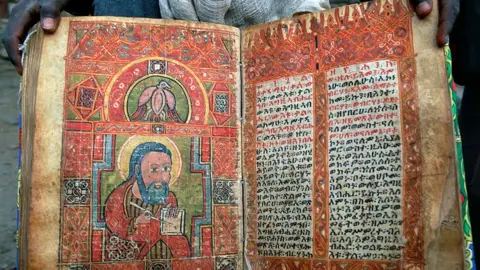
It was where Christianity first came to Africa and the continent’s first coins were minted.
It lay at the heart of a trade network between India and the Mediterranean and its ships controlled the Red Sea trade through the port of Adulis and the inland routes of north-eastern Africa.
In the third century, it was considered one of the world’s four great powers, alongside Persia, Rome and China.
“I feel like Aksum is completely excluded out of that picture. Ethiopia is a cradle of civilisation – and yet I feel that it is never really included in our understanding of global history,” says Desta.
She chose that part of the world and that period of history because of her personal connections. She was born in the US to a mother from Tigray in northern Ethiopia and a father from Eritrea – the very areas that were at the heart of the old Aksumite empire.
“The impulse was really just wanting to learn more about a pre-colonial era – and I thought a wonderful place to start is my own heritage and ancestral lineage.”
The Abyssinians, released by Audible and directed by Shariffa Al, is Desta’s first audio play. It is a tragicomedy that mixes historical fact with the author’s imagination.
The play is “really also about the ways in which people hold on to their humanity in periods of immense change”, Desta says.
It tells the story of a monarchy at a crossroads in history.
Getty Images
Ethiopians are proud of their ancient Christian heritage
Queen Yodit must decide which of her twin sons – Kaleb or Negus – must succeed her to the throne, just as she is contending with social and economic upheaval and clashing beliefs about religion and rights. There is also romance.
“Queen Yodit is… complex, regal, cunning, raw, sensual and compelling,” says Danielle Deadwyler – the Bafta-nominated movie star who played the role.
The character of Yodit was loosely inspired by the real Queen Yodit – or Judith – who reigned at a different time to the period in which the play is set.
She is a figure shrouded in mystery because of the lack of historical records and conflicting folklore about who she was.
She is seen by some as dictatorial and instrumental in Aksum’s downfall, says Desta – who travelled to Ethiopia as part of her research for the play.
“I thought that she was a good jumping-off point for that type of character,” Desta says.
“I think a lot of times the characters of female leaders have to be so ‘on point’ – and I love the idea of a woman being a tyrant in this period of history.”
Writer James Baldwin once said that artists are “emotional or spiritual historians” – and those words resonated profoundly with Desta as she wrote the play.
“I wanted to explore the full spectrum of human emotions – the characters’ private feelings, the things that they struggle with as human beings that have nothing to do with their public roles,” she tells the BBC.
Queen Yodit was a character who Desta felt did not have much love in her life.
“A lot of her reactions to the world are coming from that place of not being cherished as a partner and not really necessarily feeling like she has a place or that she has chosen to be a leader,” Desta says.
AFP
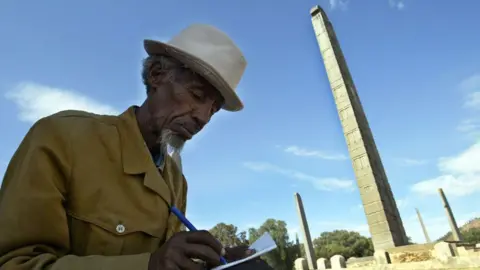
Aksum’s famous obelisks are one of the most striking remnants of the Aksumite Empire
Another female character written to break stereotypes is Makeda, played by Arsema Thomas of Bridgerton spin-off Queen Charlotte fame.
She is sent to work as a servant in the royal household to pay off her father’s debts. But she is also someone “who can think for herself, can think bigger than her station in life and is a global thinker”.
Despite being set in a world of antiquity, the dialogue and dry humour in The Abyssinians makes it feel modern and relevant.
Queen Yodit, especially, is fond of dropping a snide comment right in the middle of a serious moment.
The production features an original Ethio-jazz score by DA Mekonnen, an Ethiopian-American musician, and Andrew Orkin – and features the Ethiopian-born multi-instrumentalist Kibrom Birhane.
“The score parallels and complements the tone of the play,” says Desta “because I feel like a lot of Ethiopian music has that ancient quality and then jazz is that sort of contemporary spin.”
Lia Chang
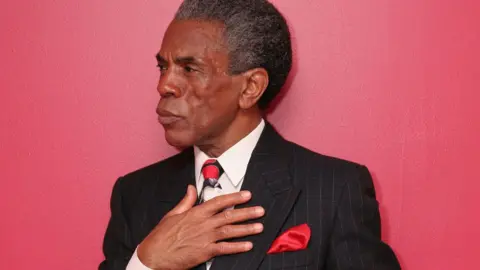
Award-winning actor André De Shields plays Frumentius, the bishop who brings Christianity to the ancient kingdom
Tony-winner André De Shields described being in The Abyssinians as an “opportunity of returning to one’s ancient culture” and an illustration of “the power of art to transform lives”.
It was crucial to Desta that actors of the black diaspora play the characters.
The cast also includes Zainab Jah, who in 2021 won the best actress award for Farewell Amor at Fespaco, Africa’s leading film festival.
Chukwudi Iwuji, who began his acting career with the Royal Shakespeare Company in the UK, and Phillip James Brannon, best known for his Broadway roles and the movie Contagion, also star.
“The talent was amazing,” Desta says, “I know that that doesn’t really happen for a lot of early playwrights, so I’m especially grateful.”
Desta’s next goal is to get The Abyssinians on to the stage with, she hopes, the same cast.
The Islamic State has lost thousands of fighters to death or prison and suffered the demise of its self-declared caliphate in Iraq and Syria. But the global reach of the group, also known as ISIS, is still vast, in part because of its sophisticated media output and the people around the world who consume it.
On New Year’s Day, a man with an Islamic State flag killed at least 14 people when he drove into a crowd in New Orleans. Authorities say there was no evidence that the man, Shamsud-Din Bahar Jabbar, had active connections to the terrorist group. But the F.B.I. said “he was 100 percent inspired by ISIS.”
It is not yet clear which specific online content Mr. Jabbar may have seen or how else he may have been radicalized. Experts noted that the placement of the flag on the truck resembled one depicted by ISIS in a media campaign urging followers to “run them over without mercy.” And, authorities said, he posted several videos to his Facebook account before his attack in which he pledged allegiance to ISIS.
From online videos to social media platforms — and even a weekly Islamic State newsletter — the group that wants to force all Muslims to adhere strictly to the faith’s earliest teachings has a very modern media strategy.
“Terrorism is essentially communications,” said Hans-Jakob Schindler, a former United Nations diplomat who is the senior director of the Counter Extremism Project, a think tank with offices in New York and Berlin. “It is not warfare, because obviously, ISIS cannot militarily defeat the West, right? They tried and it didn’t exactly end well.”
A terrorist newsletter
How did the Islamic State keep its influence alive? In part, by transforming its movement into a global franchise beyond the Middle East, with active chapters in Afghanistan, Somalia, Mali, the Democratic Republic of Congo, the Caucuses and Turkey, among other places.
But the glue that holds the disparate branches together — and also helps to inspire “lone wolf” terrorists like Mr. Jabbar who carry out their own attacks — is the Islamic State’s sophisticated media operation. Experts say that while it is doubtful that the media operation has a physical headquarters, it is highly centralized and controlled by its media directorate. Much of its output appears to come from affiliates in Africa, which have recently been the most active in terms of attacks..
The group also puts out an online weekly newsletter called Al Naba, or The News, which contains details of the group’s latest exploits, implicitly encouraging followers to commit acts of violence.
“The Al Naba newsletter comes out like clockwork every Thursday, which is one of the more impressive things that the group is able to do,” said Cole Bunzel, a scholar of militant Islam in the Middle East at the Hoover Institution at Stanford University.
“They have an editorial; they cover the different provinces, as they’re called; they cover attacks from that week. They tally up the number of attacks and casualties that they claim. And that’s the main way that they stay connected with their global support base,” he said.
The most recent edition of the newsletter, published on Jan. 2, did not mention the New Orleans attack, and the Islamic State has not claimed responsibility for it.
Al Naba was initially published through the messaging app Telegram and other platforms, constantly adapting as different channels were shut down, said Aaron Zelin, a Washington Institute fellow who has tracked the activities and propaganda of Islamist groups for more than 15 years.
Supporters of the group have also disseminated messages on Twitter, Facebook pages and other social media platforms, according to researchers. When their user profiles are blocked, they often just create new ones. T he Islamic State has used decentralized internet tools that are harder to shut down and moved some of its messaging to the dark web, Mr. Zelin said.
Terrorism analysts say that it has been easy for extremists to connect with potential supporters on social media because of the lack of effort both by some of the companies that operate the platforms and by governments to force a crackdown.
Mr. Schindler said that in light of the New Orleans attack both political parties should ask: “Why is this massive industry with these profits not helping our security services to prevent such attacks? Why do we not get a tip, as we do from the banks and every financial institution in North America and worldwide, that there is a terrorist here, or a tip that there’s a radicalization process going on?”
Terrorism experts say the Islamic State’s mastery of media and message is a key to its success. Al Qaeda, which the Islamic State split from in 2013, laid the groundwork, publishing both online and print magazines and producing videos as well as social media.
‘Kill them wherever you find them’
In January, 2024, the extremist group revived a campaign directed at its global adherents: “kill them wherever you find them,” a reference to a verse in the Quran.
The idea, which first surfaced in 2015, was to encourage would-be followers to commit acts of jihad at home rather than traveling to Iraq and Syria. That notion became even more important once the caliphate was defeated.
During the period when the Islamic State held ground in Syria and then Iraq (2013-2017) and was eager to gain adherents in the West, it was notorious for posting grisly depictions of violence, such as the beheading of the photojournalist James Wright Foley.
Now, experts say an increasingly daunting challenge is that social media platforms are doing much of the work of spreading the Islamic State’s message, as algorithms that seek to boost engagement take some users deeper and deeper into the extremist worldview.
“Terror groups don’t have to make a ton of effort to radicalize people anymore; the algorithm does it for them,” Mr. Schindler said. “The point of the algorithm is to keep the user on the platform, to give them what they like, and if this happens to be Islamic extremism or if you are in the radicalization process, your worldview shifts.”
In Syria, where the Islamic State took advantage of a long civil war to seize a large swath of territory, only to lose it eventually to U.S.-backed fighters, the group has begun to rebound, accelerating its attacks. That trend might continue, because the regime of President Bashar al-Assad was suddenly toppled in December by another extremist group, Hayat Tahrir al Sham, which was once associated with the Islamic State and Al Qaeda.
The situation is still fluid, but some analysts fear that the Islamic State could regain ground amid the chaos. The group’s newsletter has spoken dismissively of Hayat Tahrir al Sham as “jihadists turned politicians,” but has not called for attacks on them.
Meanwhile, Hayat Tahrir al Sham and other rebel groups say they should take over the role of guarding Islamic State prisoners in eastern Syria and manage the camps holding some 40,000 Islamic State fighters and family members — a job that has been done for nearly five years by the Kurdish-led Syrian Defense Force, which is backed by the United States. Many terrorism experts question how Hayat Tahrir al Sham, which once had links to the Islamic State but then bitterly separated, might carry out the mission of suppressing it.
The Islamic State recently renewed its “Breaking the Walls” media campaign, which encourages the imprisoned fighters to break out of the jails in eastern Syria and free their families.
If that succeeds, Mr. Zelin said, it would be a “disaster.”
Today Gold Rate: Gold rate increased on Saturday. The rate of 24 carat gold is ₹7938.3 per gm, up by ₹870.0. The rate of 22 carat gold is ₹7278.3 per gm, up by ₹800.0.
Gold silver image
24 carat gold’s rate has changed in the last one week by -0.22%, whereas in the last month it has changed by -0.14%. The silver rate is ₹95700.0 per kg, up by ₹2200.0.
Gold rate in Delhi Gold rate in Delhi today is ₹79383.0/10 grams. Yesterday on 03-01-2025, the price of gold was ₹78183.0/10 grams, and last week, the price on 29-12-2024 was ₹78013.0/10 grams.
Silver rate in Delhi Silver rate in Delhi today is ₹95700.0/Kg. Yesterday on 03-01-2025, the price of silver was ₹93500.0/Kg, and last week, the price on 29-12-2024 was ₹95500.0/Kg.
Gold rate in Chennai Gold rate in Chennai today is ₹79231.0/10 grams. Yesterday on 03-01-2025, the price of gold was ₹78031.0/10 grams, and last week, the price on 29-12-2024 was ₹77861.0/10 grams.
Silver rate in Chennai Silver rate in Chennai today is ₹102800.0/Kg. Yesterday on 03-01-2025, the price of silver was ₹100600.0/Kg, and last week, the price on 29-12-2024 was ₹102600.0/Kg.
Gold rate in Mumbai Gold rate in Mumbai today is ₹79237.0/10 grams. Yesterday on 03-01-2025, the price of gold was ₹78037.0/10 grams, and last week, the price on 29-12-2024 was ₹77867.0/10 grams.
Silver rate in Mumbai Silver rate in Mumbai today is ₹95000.0/Kg. Yesterday on 03-01-2025, the price of silver was ₹92800.0/Kg, and last week, the price on 29-12-2024 was ₹95000.0/Kg.
Gold rate in Kolkata Gold rate in Kolkata today is ₹79235.0/10 grams. Yesterday on 03-01-2025, the price of gold was ₹78035.0/10 grams, and last week, the price on 29-12-2024 was ₹77865.0/10 grams.
Silver rate in Kolkata Silver rate in Kolkata today is ₹96500.0/Kg. Yesterday on 03-01-2025, the price of silver was ₹94300.0/Kg, and last week, the price on 29-12-2024 was ₹96300.0/Kg.
The gold April 2025 MCX futures were trading at ₹78127.0 per 10 gm, down by ₹0.483 at the time of publishing. The silver May 2025 MCX futures were trading at ₹91001.0 per kg, up by ₹0.091 at the time of publishing.
Gold and silver prices are affected by a range of factors, among them the input from major jewelers. Elements such as the global demand for gold, currency variations, interest rates, and government policies all play a role in the prices. Apart from this, international factors such as the state of the global economy and the strength of the US dollar against other currencies also exert an influence on gold rates in the Indian market.
Here are the key developments on the 1,045th day of Russia’s invasion of Ukraine.
Here is the situation on Saturday, January 5:
Fighting
One person was killed and five injured in a Russian drone attack on the Ukrainian capital of Kyiv.
The Ukrainian Air Force said it shot down 60 of 93 Russian drones launched in the early hours of Friday morning.
Three missiles struck a residential area near the northern Ukrainian city of Chernihiv, killing one, injuring five others and destroying two homes.
Four people were hurt when the town of Sloviansk was shelled near the front line in Ukraine’s Donetsk region.
Ukrainian President Volodymyr Zelenskyy said Russia had launched 300 attack drones and 20 missiles at Ukrainian targets in the first three days of 2025.
An explosion as a drone is seen in the sky over Ukraine’s capital, Kyiv, during a Russian attack on January 3, 2025 [Gleb Garanich/Reuters]
Russia’s creeping advance in Donetsk has captured 4,168 square kilometres (1,609sq miles) of territory at the cost of 430,000 soldiers, according to a new analysis.
Ukraine will reportedly receive its first French Mirage 2000-5F multirole fighters this month, according to French magazine Avions Legendaires.
A Russian court has ordered the largest search engine in Russia, Yandex, to hide maps and photos of one of the country’s biggest oil refineries after repeated attacks by Ukrainian drones, state news agency TASS reports.
Military aid
United States President Joe Biden is expected to announce additional security assistance for Ukraine in the coming days, according to White House spokesperson John Kirby.
Regional security
US Secretary of State Antony Blinken told the Financial Times that he believes China intervened to stop Russia from using nuclear weapons in Ukraine.
A Finnish court has refused to release an oil tanker suspected by police of damaging an undersea power line and four telecommunications cables in the Baltic Sea. The Eagle S Tanker was carrying Russian oil at the time the cable between Finland and Estonia was damaged on December 25 along with four telecoms lines.
Politics
Russian envoy to the United Nations, Vasily Nebenzya, told state television channel Rossiya-1 TV that there was “nothing of interest” in proposals by US President-elect Donald Trump to end the war in Ukraine.
Blinken will begin his final trip in his role this weekend, which the State Department said will conclude with meetings in Paris to discuss European security and Ukraine with French officials.
Environment
Oil from two ageing and damaged Russian oil tankers was detected off the coast of Sevastopol, the largest city in Moscow-annexed Crimea on Friday, according to local officials. The vessels were hit by a storm last month, causing one to sink and the other to run aground, pouring some 2,400 tonnes of heavy fuel oil into the surrounding waters.