New Delhi: Driven by rising private consumption and disposable incomes, India saw vehicle retail sales increase by at least 9 per cent in 2024 (year-on-year) to cross 26 million units. This surpasses the pre-Covid peak of 25.4 million units in a single year in 2018.
Industry experts said that the key aspects to watch out in 2025 will be government’s focus on infrastructure spend and growth in end use segments, which will augur well for the commercial vehicles industry. “Looking ahead, we expect demand to improve in Q4 FY25 across most segments of the commercial vehicle industry,” said Girish Wagh, Executive Director, Tata Motors Ltd.
According to the Federation of Automobile Dealers Associations (Fada), they are optimistic about 2025, especially with multiple launches lined up, and expect the electric vehicle (EV) sector to perform well. In 2024, EV sales reached 1.95 million units, up from 1.5 million in 2023. EV penetration also went up to 7.5 per cent, compared with 6.39 per cent in the previous year.
In the electric two-wheeler (2W) space, Bajaj Auto’s market share increased by 3 per cent to 25 per cent in December 2024, which was 22 per cent in November. At the same time, Ola Electric’s market share declined by 5 per cent on a MoM (month-on-month) basis to 19 per cent in December. It was 24 per cent in November.
In the passenger vehicle (PV) space, Maruti Suzuki India recorded a 30 per cent jump in sales to 1,78,248 units in December 2024 from 1,37,551 units in the same month last year. Automaker Kia India reported a 6 per cent rise in total sales at 2,55,038 units in 2024 compared to the previous year, recording its highest-ever annual sales. The company had sold 2,40,919 units in 2023. Hyundai Motor India Limited (HMIL) registered the highest-ever yearly domestic sales of 6,05,433 units in 2024.
Saltwater crocodiles were almost hunted to extinction in Australia’s Northern Territory (NT). Now they’re thriving
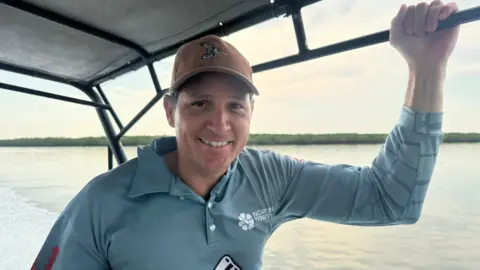
It’s dawn on Darwin Harbour and government ranger Kelly Ewin – whose job is to catch and remove crocodiles – is balancing precariously on a floating trap.
Heavy rain clouds from the storm that has recently passed are overhead. The engine of the boat has been cut so now it’s mostly silent – that is, apart from the intermittent splashing coming from inside the trap.
“You get pretty much zero chances with these guys,” says Ewin as he attempts to loop a noose around the jaw of the agitated reptile.
We’re in Australia’s Northern Territory (NT), home to an estimated 100,000 wild saltwater crocodiles, more than anywhere in the world.
The capital, Darwin, is a small coastal city surrounded by beaches and wetlands.
And, as you quickly learn here in the NT, where there is water, there usually are crocs.
Watch: The BBC’s Katy Watson is onboard with crocodile rangers in Darwin Harbour, Australia
Saltwater crocs – or salties, as they are known to locals – were nearly hunted to extinction 50 years ago.
After World War Two, the uncontrolled trade in their skins soared and numbers fell to around 3,000.
But when hunting was banned in 1971, the population started rising again – and fast.
They still are a protected species, but are no longer threatened.
The recovery of the saltwater crocodile has been so dramatic that Australia now faces a different dilemma: managing their numbers to keep people safe and the public onside.
“The worst thing that can happen is when people turn [against crocodiles],” explains croc expert Prof Grahame Webb.
“And then a politician will invariably come along with some knee-jerk reaction [that] they’re going to ‘solve’ the crocodile problem.”
Living with predators
The NT’s hot temperatures and abundant coastal surroundings create the perfect habitat for cold-blooded crocs, who need warmth to keep their body temperature constant.
There also are big saltie populations in Northern Queensland and Western Australia as well as in parts of South East Asia.
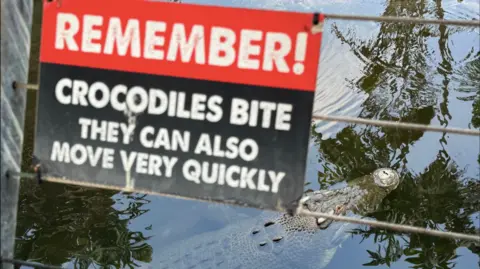
While most species of crocodile are harmless, the saltie is territorial and aggressive.
Fatal incidents are rare in Australia, but they do happen.
Last year, a 12-year-old was taken – the first death from a crocodile in the NT since 2018.
This is busiest time of year for Ewin and his colleagues.
Breeding season has just started, which means salties are on the move.
His team are on the water several times a week, checking the 24 crocodile traps surrounding the city of Darwin.
The area is popular for fishing, as well as for some brave swimmers.
The crocodiles that are removed from the harbour are most often killed, because if they are released elsewhere, they’re likely to return to the harbour.
“It’s our job to try and keep people as safe as we can,” says Ewin, who’s been doing his “dream job” for two years. Before that, he was a policeman.
“Obviously, we’re not going to capture every crocodile, but the more we take out of the harbour, the less risk there’s going to be an encounter with crocodiles and people.”
Kelly Ewin’s job is to capture and remove crocodiles from Darwin Harbour
Another tool helping to keep the public safe is education.
The NT government goes into schools with its programme “Be Crocwise” – which teaches people how to behave responsibly around croc habitats.
It’s been such a success that Florida and the Philippines are now looking to borrow it, in order to better understand how the world’s most dangerous predators can live alongside humans with minimal interactions.
“We’re living in crocodile country, so it’s about how we [keep ourselves] safe around the waterways – how should we be responding?” says Natasha Hoffman, a ranger who runs the programme in the NT.
“If you’re on the boats when you’re fishing, you need to be aware that they’re there. They’re ambush hunters, they sit, watch and wait. If the opportunity is there for them to grab some food, that’s what they’re going to do.”
In the NT, mass culling is currently not on the table given the protected status of the species.
Saltwater crocodiles are the largest living reptile in the world
Last year though, the government approved a new 10-year crocodile management plan to help control the numbers, which increased the quota of crocs that can be killed annually from 300 to 1,200.
This is on top of the work Ewin’s team is doing to remove any crocodiles that pose a direct threat to humans.
Every time there’s a death, it reignites the debate about crocodiles living in close proximity to people.
In the days after the 12-year-old girl was taken last year, the Territory’s then leader Eva Lawler made it clear she wouldn’t allow the reptiles to outnumber the human population of the NT.
Currently that stands at 250,000, well above the number of wild crocs.
It’s a conversation that goes beyond the NT.
Queensland is home to about a quarter of the number of crocs that the Top End of NT has, but there are far more tourists, and more deaths, which means talk of culls sometimes feature in election debates.
Big business
The apex predators may court controversy, but they’re also a big draw card for the NT – for tourists but also for fashion brands keen to buy their leather.
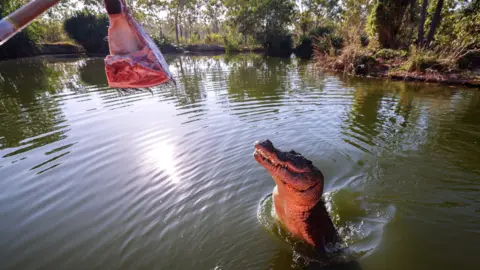
Visitors can head to the Adelaide River to watch “croc jumping” – which involves salties being fed bits of meat on the end of a stick if they can leap out of the water for their audience.
“I’m supposed to tell you to put your [life-jackets] on,” jokes the head skipper at Spectacular Jumping Croc Cruises, Alex ‘Wookie’ Williams, as he explains the house rules of the boat.
“The bit I don’t have to tell you… [is that] life jackets are pretty useless out here.”
For Williams, who’s been obsessed with crocs since childhood, there’s plenty of opportunity to work alongside them.
“It’s boomed over the last 10 years or so,” he says of the number of tourists coming to the region.
Getty Images
Shows with wild crocodiles are organised in the NT to attract tourists
Farming, which was brought in when hunting was banned, has also become an economic driver.
It’s estimated there are now about 150,000 crocodiles in captivity in the NT.
Fashion labels such as Louis Vuitton and Hermès – which sells a Birkin 35 croc handbag for as much as A$800,000 ($500,000; £398,000) – have all invested in the industry.
“The commercial incentives were effectively put in place to help people tolerate crocodiles, because we need a social licence to be able to use wildlife,” says Mick Burns, one of the NT’s most prominent farmers who works with luxury brands.
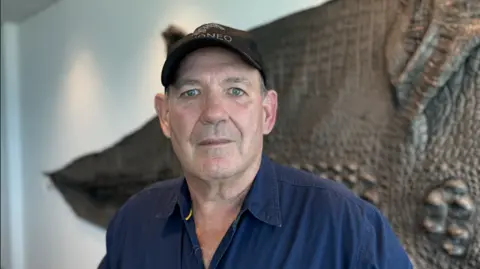
His office is in downtown Darwin. Spread across the floor is a massive croc skin. Pinned to the wall of the conference room, there is another skin that spans at least four metres.
Mick Burns has been working in the NT’s crocodile farming industry for years
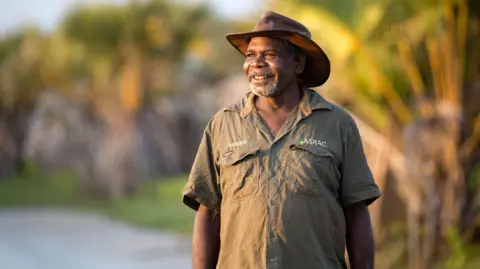
Burns is also involved with a ranch in remote Arnhem Land, about 500km (310 miles) east of Darwin. There, he works with Aboriginal rangers to harvest and hatch croc eggs to sell their skins to the luxury goods industry.
One of the area’s Traditional Owners, Otto Bulmaniya Campion, who works alongside Burns, says more partnerships like theirs are crucial for ensuring Aboriginal and Torres Strait Islander communities share in the financial benefits of the industry.
For tens of thousands of years, crocs have played a significant role in Indigenous cultures, shaping their sacred stories, lives and livelihoods.
“My father, all the elders, used to go and harpoon crocodiles, get a skin, and go and trade it for tea, flour, and sugar. [However] there was no money at that time,” the Balngarra man says.
“Now, we want to see our own people handling reptiles.”
But not everyone is on board with farming as a practice – even if those involved say it helps with conservation.
The concern among animal activists lies in the way the crocs are held in captivity.
Despite being social animals, they are usually confined to individual pens to ensure their skins are flawless – as a scrap between two territorial crocs would almost certainly damage a valuable commodity.
Aboriginal Swamp Rangers Aboriginal Corporation
Otto Bulmaniya Campion is a Traditional Owner of the Central Arnhem Land region in the Top End
Everyone in Darwin has a story about these formidable creatures, regardless of whether they want to see them hunted in greater numbers or more rigorously preserved.
But the threat they continue to pose is not imagined.
“If you go [swimming in] the Adelaide river next to Darwin, there’s a 100% chance you’ll be killed,” says Prof Webb matter-of-factly.
“The only question is whether it’s going to take five minutes or 10 minutes. I don’t think you’ll ever get to 15 – you’ll be torn apart,” he adds, pushing up his trouser leg to reveal a huge scar on his calf – evidence of a close encounter with one angry female nearly forty years ago as he was collecting eggs.
He is unapologetic about what he calls the pragmatism of authorities to manage numbers and make money out of crocs along the way – a way of life that, in the near future at least, is here to stay.
“We’ve done what very few people can do, which is take a very serious predator…and then manage them in such a way that the public is prepared to [tolerate] them.
“You try and get people in Sydney or London or New York to put up with a serious predator – they aren’t going to do it.”
Residents of Gurgaon can now order ambulances via Blinkit in just 10 minutes.
Blinkit CEO Albinder Dhindsa has announced a new 10-minute delivery service for the residents of Gurgaon. Blinkit users will now be able to order ambulance services in case of emergencies to their doorstep in just 10 minutes.
Blinkit users will now be able to order ambulance services in case of emergencies to their homes in just 10 minutes.(X/albinder)
“We are taking our first step towards solving the problem of providing quick and reliable ambulance service in our cities. The first five ambulances will be on the road in Gurugram starting today. As we expand the service to more areas, you will start seeing an option to book a Basic Life Support (BLS) ambulance through the Blinkit app,” the CEO said in a long post on X.
Take a look at the full post here:
What services will be offered?
While announcing the one-of-its-kind emergency transport service, the Blinkit CEO said that all the ambulances will be equipped with essential life-saving equipment which includes oxygen cylinders, defibrillators, stretcher, monitor, and essential emergency medicines and injections.
Every ambulance will also have a trained paramedic and an assistant apart from the driver.
While Dhindsa did not reveal how much the service will cost, he stated that “profit is not a goal” for the newly launched service.
“We will operate this service at an affordable cost for customers and invest in really solving this critical problem for the long term. We are carefully scaling this service up, as it is both important and new to us. Our aim is to expand to all major cities over the next two years,” he said.
This is the second new service that Blinkit has launched this week. Earlier, CEO Albinder Dhindsa had announced a large order fleet. “These are all electric vehicles designed to handle all large (electronics/party orders) orders. Currently live in Delhi and Gurugram. Will be launching this in other cities very soon,” he wrote, while sharing pictures of the vehicles.
Spain received 63,970 migrants and refugess who arrived through irregular routes last year, including 46,843 people in the Canary Islands.
At least 46,843 people reached Spain’s Canary Islands in 2024 through the increasingly deadly Atlantic migration route, the country’s interior ministry has said.
The European country received 63,970 migrants who arrived through irregular routes last year, the vast majority in the Atlantic archipelago, up from 56,852 in 2023, the ministry said on Thursday.
EU border agency Frontex noted that irregular crossings into the bloc from January to November 2024 fell 40 percent overall but grew 19 percent on the Atlantic route, with people from Mali, Senegal and Morocco attempting to cross.
Years of conflict in the Sahel region, unemployment, and the effect of climate change on farming communities are among the reasons why people attempt the crossing.
The Atlantic route, which includes departure points in Senegal, The Gambia, Mauritania and Morocco, is also the world’s deadliest.
Last week, at least 69 people, including 25 Malians, died after a boat heading from West Africa to the Canary Islands capsized off Morocco.
A report by NGO Caminando Fronteras last month, said at least 10,457 migrants died or disappeared while trying to reach Spain by sea from January 1 to December 5, 2024.
Caminando Fronteras added that it was a 50 percent increase from 2023 and the highest toll since its tallies began in 2007, and attributed it to the use of ramshackle boats, dangerous waters and a lack of resources for rescues.
Migrant aid group Walking Borders also blamed a lack of action or arbitrary rescues and the criminalisation of migrants for the surge in deaths at sea. The aid group has accused European governments of “the prioritisation of immigration control over the right to life”.
MUMBAI: Retail borrowers will find it difficult to over-leverage by obtaining multiple personal loans in the new year. A new norm, that requires lenders to update credit bureau records within 15 days instead of one month earlier, is kicking in. With records being updated every two weeks, fewer borrowers will qualify for multiple loans. The directive to lenders and credit bureaus to reduce the reporting interval to 15 days was issued in August, with RBI giving them until Jan 1 to get their systems in place. RBI had said that this would enable lenders to make better risk assessments of borrowers. “Equated monthly instalments (EMIs) are scheduled on various dates across the month. A once-a-month reporting cycle could delay reflecting defaults or payments for up to 40 days, resulting in outdated data for credit evaluations. Switching to a 15-day reporting cycle would significantly reduce these delays. More frequent updates allow lenders to capture defaults or payments more accurately and closer to real-time,” Sachin Seth, chairman at credit information company CRIF High Mark, said. In a recent interview with TOI, SBI chairman C S Setty had said that when new-to-credit borrowers obtain a loan and become part of the credit system, the new access sometimes ends up with them taking money from multiple lenders – more than what they can service. SBI had recommended more frequent updating of records to enable creditors to have a better view of borrower behaviour. “This is likely to tone down multiple borrowings by the same individual,” he said. “A borrower with multiple loans on different due dates would have their financial activity reflected in the system within two weeks, reducing the blind period where critical data might be missing. This ensures lenders have a clearer, more current view of a borrower’s credit behaviour,” Seth said. Lenders say that frequent data updates also prevent practices like “evergreening,” where borrowers use new loans to cover old defaults without the system reflecting the risk. By cutting the reporting cycle in half, credit bureaus and lenders gain sharper and more reliable data that improves decision-making and fosters a healthier lending ecosystem.
Watch: Las Vegas police say driver in Tesla Cybertruck explosion likely US soldier
The man who rented a Tesla Cybertruck that exploded outside the Trump Hotel in Las Vegas was an active-duty US special forces soldier and shot himself dead before the blast, officials have said.
Las Vegas police have identified Matthew Alan Livelsberger, 37, as the man who rented the vehicle and drove it from Colorado to Las Vegas.
Officials said they are fairly certain he was found dead in the vehicle after the explosion but are waiting to confirm that through DNA evidence and said they could not yet be “100%”.
The body in the vehicle was burnt beyond recognition and was found with a self-inflicted gunshot wound to the head, Las Vegas Sheriff Kevin McMahill said on Thursday.
Seven people were injured when the vehicle – filled with fuel canisters and firework mortars – exploded on New Year’s Day. Officials said all injuries were minor.
The Cybertruck arrived in the city on Wednesday morning, less than two hours before the detonation, police have said. Parked in front of the hotel near a glass entrance, the vehicle started to smoke, then exploded.
Las Vegas authorities said the Cybertruck helped contain the explosion, sending it vertical rather than outward. The nearby glass doors and windows of the hotel did not shatter in the blast.
Authorities said they have yet to determine any motive behind the incident.
“I’m comfortable calling it a suicide with a bombing that occurred immediately after,” Sheriff McMahill said during Thursday’s press conference.
The sheriff said investigators recovered a military ID, a passport, two semi-automatic pistols, fireworks, an iPhone, a smart watch and several credit cards in Mr Livelsberger’s name from the charred vehicle.
Mr McMahill said they found two tattoos on the driver’s remains matching ones Livelsberger had.
The Colorado Springs native rented the Cybertruck on 28 December in Denver.
Police were able to track his movements using a number of photographs on the drive from Denver, Colorado to Las Vegas, Nevada. He was the only one seen driving the vehicle.
Mr McMahill said there are several parallels – but no definitive link – between the suspects in the incident in Las Vegas and a truck attack in New Orleans that left 14 dead, which both took place on New Year’s Day.
Both suspects served at Fort Bragg in North Carolina, though there is no record they served in same unit or were there at the same time. They also both served in Afghanistan in 2009, but there is no evidence they were in the same region or unit.
Both also used rental company Turo for the vehicles involved in the incidents, Mr McMahill said.
“We don’t believe there’s any further threat from this subject or anybody associated to him here in Las Vegas,” he said.
Mr Livelsberger had decades of experience with the US military, having served in both the Army and National Guard. He was a decorated Special Forces Intelligence Sergeant.
He was serving in Germany but on approved leave at the time of the incident.
Mr Livelsberger’s father told the BBC’s news partner CBS that his son was in Colorado to see his wife and eight-month-old daughter.
He said he last spoke to his son at Christmas and that everything seemed normal.
Vande Bharat Sleeper Express: Indian Railways Minister Ashwini Vaishnaw unveiled the newly designed Vande Bharat Sleeper Express a few months ago saying that the train would be put to trials and hinting at an early 2025 launch. The train has lived up to the common man’s expectation with superior amenities as per its contemporary express trains. Now, the train has been spotted during its trial run.
Under the instructions of Railway Minister Ashwini Vaishnaw, the newly developed Vande Bharat sleeper coach train has arrived in Kota for testing. It is undergoing trials at various speeds, both loaded and unloaded. Tests are being conducted on its braking system, air suspension, and coupler force. The train has been clocked 180 km/h speed during the trials and has also been tested on curved tracks.
These trials began on December 31 on the Delhi-Mumbai railway track within the Kota Railway Division. Initially, the train was tested between Nagda and Kota, and currently, trials are being conducted between Sawai Madhopur and Kota. After the trials, a detailed report will be sent to the Ministry of Railways and the Railway Board.
Vande Bharat Sleeper clocking a speed of 180kmph+ disappearing in just 8 seconds pic.twitter.com/3mEqgHIRyP
According to reports, Senior Divisional Commercial Manager of Kota Railway Division, Saurabh Jain, stated that the operational department of Kota is working with the Lucknow-based Research Design and Standards Organization (RDSO) on these trials. The train is being tested against various standards, and the trials are expected to continue for another month, reported ETV Bharat.
Movement Inspector Sushil Jethwani and Loco Inspector RN Meena are coordinating with the RDSO Lucknow team for these trials. On Thursday, the Vande Bharat sleeper rake underwent its third day of trials. It was run at 180 km/h over a 30-kilometer stretch between Kota and Laban, simulating passenger weight.
Senior DCM Saurabh Jain reported that initial trials were conducted on the Kota-Nagda rail section between Rohal Khurd and Chaumahla with passenger-equivalent weight. The train was initially tested at speeds of 130 km/h, then 140 km/h, and later 150 km/h. Subsequently, on January 1, the train was tested at 160 km/h on the same track and at 177 km/h between Rohal Khurd and Vikramgarh. Additionally, a 40-kilometer stretch between Rohal Khurd and Kota saw the train running at a speed of 180 km/h.
The Federal Bureau of Investigation (FBI) in the United States has released further information about the deadly New Year’s Day car-ramming incident in New Orleans, offering a brief timeline of how the suspect executed his attack.
In a news conference on Thursday, Christopher Raia, a deputy assistant director from the FBI’s counterterrorism division, also clarified that only one suspect is currently implicated in the attack: 42-year-old Texas resident Shamsud-Dim Jabbar.
“We do not assess at this point that anyone else is involved in this attack except for Shamsud-Dim Jabbar,” Raia said.
Though he emphasised the investigation was still in its early stages, he added, “We’re confident at this point that there are no accomplices.”
The news briefing took place just over a day after Jabbar allegedly drove a rented Ford F-150 pickup truck into the holiday crowds celebrating on Bourbon Street, a centre for tourism and nightlife in New Orleans.
Fourteen people were killed as the truck circumvented a traffic barricade at Canal Street and travelled nearly two and a half blocks up the busy pedestrian thoroughfare.
The truck crashed near the intersection with Conti Street, and Jabbar allegedly exchanged gunfire with law enforcement officers as he attempted to flee.
He was ultimately killed in the exchange. At least 35 people were injured, including two police officers.
Media reports indicated those killed include a father of two from the city of Baton Rouge, a single mother from the Louisiana town of Metairie, and a football player who attended Princeton University.
A Louisiana state trooper blocks the entrance to Bourbon Street on January 2 [George Walker IV/AP Photo]
A revised timeline
Raia explained that authorities now have a better idea of how Jabbar came to be on Bourbon Street in the early hours of New Year’s Day, when the attack occurred.
“ Investigators believe Jabbar picked up the rented F-150 in Houston, Texas, on December 30,” Raia said. “He then drove from Houston to New Orleans on the evening of the 31st.”
In the final hours before the attack, Jabbar posted a series of five videos to his Facebook account, “proclaiming his support” for the armed group ISIL (ISIS), according to Raia.
The first video was published at 1:29am local time (07:29 GMT). The last came at 3:02am (09:02 GMT). By around 3:15 (09:15 GMT), the deadly attack was under way.
That footgage indicated to Raia and his colleagues that Jabbar “was 100-percent inspired by ISIS”.
“ In the first video, Jabbar explains he originally planned to harm his family and friends, but was concerned the news headlines would not focus on the, quote, war between the believers and nonbelievers,” Raia said.
“Additionally, he stated he had joined ISIS before this summer. He also provided a will and testament.”
A man cleans Toulouse Street, near Bourbon Street, with a power washer on January 2 [George Walker IV/AP Photo]
Ongoing investigation
Authorities emphasised, however, that their investigation into the attack was ongoing.
Evidence technicians continue to comb through the rented pickup truck for evidence. Three phones linked to Jabbar, as well as two laptops, are also being searched.
Raia added that FBI agents received more than 400 tips from the public since the time of the attack. He appealed for further information, particularly about the suspect.
“ Whether you know Jabbar personally, worked with him, served in the military or saw him in New Orleans or Texas, we need to talk to you,” Raia said.
Authorities have revealed that Jabbar was a US-born citizen and military veteran who served in Afghanistan from 2009 to 2010.
After leaving the military in 2020, he worked at the consulting firm Deloitte and appears to have done a stint in real estate.
An ISIL flag was ultimately recovered from the back of Jabbar’s rented pickup truck on Wednesday.
Bomb technicians also found two improvised explosive devices, or IEDs, placed in coolers near the site of the car-ramming: one at the intersection of Bourbon and Orleans streets, and another two blocks away.
“Let me be very clear about this point: This was an act of terrorism. It was premeditated and an evil act,” Raia said.
Raia added that reports of other explosives found at the scene either turned out to be misinformation or “not actual functioning devices”.
Bomb-sniffing dogs inspect cars at the Superdome parking garage ahead of the Sugar Bowl NCAA College Football Playoff game on January 2 [Butch Dill/AP Photo]
No accomplices
In Thursday’s briefing, Raia also backtracked from an earlier FBI statement that suggested Jabbar did not act alone.
A day prior, Alethea Duncan, the assistant special agent in charge of the New Orleans FBI bureau, told reporters, “We do not believe that Jabbar was solely responsible.”
But Raia sought to dispel concerns that Jabbar may have had accomplices who have yet to be detained.
“We’ve had 24 hours now to go through media, to go through phones, to interview people, to analyse those videos, analyse other databases,” Raia said.
“ There’s been hundreds and hundreds of leads done just in 24 hours. We’re confident at this point that there is no accomplices.”
He explained that much of the concern stemmed from witnesses who spotted passersby approaching the coolers where the IEDs were later discovered.
“A lot of the early reports came out that there were extra people that were setting the coolers down,” he said.
“It turns out those are just patrons on the street that were looking inside the coolers. We didn’t know that at first.”
Louisiana Governor Jeff Landry chimed in to urge public patience with the investigative process.
“ No one does a thousand-piece jigsaw puzzle and puts it together in five seconds,” he told reporters.
A member of the military guards the entrance of Dauphine Street in New Orleans’s French Quarter [George Walker IV/AP Photo]
Bourbon Street ‘restored’
State and local officials at Thursday’s news conference also sought to restore public confidence after the deadly attack, which raised questions about safety precautions in New Orleans, a popular tourist destination.
New Orleans had been in the process of replacing its bollards — poles used to impede traffic in pedestrian hotspots — but city authorities have emphasised other barriers were in place where bollards had been removed.
Mayor LaToya Cantrell also revealed that law enforcement officers have cleared the crime scene on Bourbon Street and returned the area to the city’s authority.
That allowed street cleaners to work for nearly six hours overnight to prepare the pedestrian thoroughfare for visitors, including those attending Thursday’s Sugar Bowl, a college football championship game.
The game had been postponed for a day following the car-ramming attack, while its stadium, the Caesars Superdome, underwent an extensive security sweep.
“ Safety continues to be our top priority,” Cantrell said, noting that law enforcement has been deployed throughout the city.
“Because of that, the confidence is there to be re-open Bourbon Street to the public prior to game time today.”
Governor Landry added there was an “unprecedented amount of law enforcement resources” in the city. He has previously stated he plans to attend the Sugar Bowl game.
Tourism is a pillar of the New Orleans economy, and an estimated 43 million visitors pass through Louisiana every year.
In 2023 alone, tourists spent a total of $18.1bn and generated $1.9bn in state and local taxes.
This year, the city is slated to not only host its traditional Mardi Gras parades — a high point on the tourism calendar — but also the Super Bowl, the most watched sporting event in the country.
Cantrell gave a nod to those upcoming events in her remarks on Thursday.
“ I want to reassure the public that the city of New Orleans is not only ready for game day today,” she said. “We’re ready to continue to host large-scale events in our city because we are built to host.”
The average daily transaction count during December was 539.68 million, up from 516.07 million in November.
Transactions through the popular Unified Payments Interface (UPI) touched a record 16.73 billion in December, recording a growth of 8 per cent over the preceding month, according to data released by the National Payments Corporation of India (NPCI).
In November 2024, the UPI transaction count was 15.48 billion, NPCI data showed.(Shutterstock)
In November, the UPI transaction count was 15.48 billion.
NPCI said the value of the transactions worked at ₹23.25 lakh crore in December 2024 as against ₹21.55 lakh crore in November.
The average daily transaction count during December was 539.68 million, up from 516.07 million in November.
In value terms, the average daily transaction amounted to ₹74,990 crore in December. This compares with ₹71,840 crore in November.
NPCI, an initiative of the Reserve Bank of India (RBI) and the Indian Banks’ Association, is an umbrella organisation for operating retail payments and settlement systems in India (IBA).
NPCI runs the Unified Payments Interface (UPI) used for real-time payments between peers or at merchants’ end while making purchases.
Stay updated with the…
See more
News/Business/ UPI transactions touched record 16.73 billion in December 2024: NPCI data
The names of around 425,000 people suspected of collaborating with the Nazis during the German occupation of the Netherlands have been published online for the first time.
The names represent individuals who were investigated through a special legal system established towards the end of World War 2. Of them, more than 150,000 faced some form of punishment.
The full records of these investigations were previously only accessible by visiting the Dutch National Archives in The Hague.
The Huygens Institute, which helped digitise the archive, says this is a major barrier for people wishing to research the Netherlands’ occupation, which lasted from its invasion in 1940 to 1945.
“This archive contains important stories for both present and future generations,” the Huygens Institute says.
“From children who want to know what their father did in the war, to historians researching the grey areas of collaboration.”
The archive contains files on war criminals, the approximately 20,000 Dutch people who enlisted in the German armed forces, and alleged members of the National Socialist Movement (NSB) – the Dutch Nazi party.
But it also contains the names of people who were found to be innocent.
This is because the archive is comprised of files from the Special Jurisdiction, which from 1944 investigated suspected collaborators.
The online database only contains the names of suspects – as well as the date and place of their birth – which are only searchable using specific personal details.
It does not specify whether a particular person was found guilty, or what form of collaboration they were suspected of.
But it will tell users what file to request to see this information if they visit the National Archives. People accessing the physical files must declare a legitimate interest in viewing them.
There has been some concern in the Netherlands about personal information pertaining to a sensitive period of history being made freely available – prompting the information published online to be initially limited.
“I am afraid that there will be very nasty reactions,” Rinke Smedinga, whose father was an NSB member and worked at Camp Westerbork, from which people were deported to concentration camps, told Dutch online publication DIT.
“You have to anticipate that. You should not just let it happen, as a kind of social experiment.”
Tom De Smet, the director of the National Archives, told DIT that relatives of both collaborators and victims of the occupation had to be taken into account.
But he added: “Collaboration is still a major trauma. It is not talked about. We hope that when the archives are opened, the taboo will be broken.”
In a letter to parliament on 19 December, Culture Minister Eppo Bruins wrote: “Openness of archives is crucial for facing the effects of [the Netherlands’] difficult shared past and to process it as a society.”
How much information made available online would be limited given privacy concerns, and those visiting the archive in person will not be allowed to make copies. Bruins has expressed a wish to change the law to allow more information to be disclosed publicly.
The online database’s website says that people who might still be alive are not listed online.