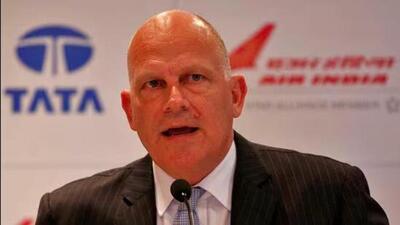
New Delhi: Air India, which added 100 new aircraft to its order book towards the end of 2024, is set to see major expansions and increase its global coverage in 2025, the airline’s chief executive officer Campbell Wilson said on Wednesday.
Air India CEO Campbell Wilson. (Reuters)
In his New Year greetings, Wilson said that the airline’s mergers and new aircraft deliveries have taken the Air India Group fleet to 300 aircraft and its global coverage will further increase in the years ahead.
“The merger of the four Tata airlines into one full-service carrier, Air India, and one low-cost carrier, Air India Express, was completed in late 2024. The old Vistara aircraft are now deployed on metro-to-metro domestic routes and key international destinations such as Frankfurt and Singapore,” Wilson said.
“These mergers and new aircraft deliveries have taken the Air India Group fleet to 300 aircraft. Air India’s global coverage will further increase in the years ahead, not least because of the recent addition of 100 aircraft to our order book, augmenting the earlier commitment for 470 made in 2023,” he said.
He said that more than 100 new aircraft were deployed, including India’s first Airbus A350, that are now flying from Delhi to London and New York.
“These are part of one-third of our twin-aisle fleet, with the remainder progressively undergoing similar upgrades over the next two years. The interior refit of our single-aisle fleet, serving domestic and short-haul international destinations, is already well underway and will be completed by mid-2025,” he said.
He said that the new aircraft will be supported by a brand-new 12-bay maintenance facility and training school in Bengaluru, a new 34-aircraft flight school in Amravati, besides the newly opened training facility in Gurugram, which, at 800,000 square feet, is South Asia’s largest.
Wilson further said that the new lounge for travellers in premium classes opened at Bengaluru will soon be followed by another in Delhi during 2025, and in other key cities in the time to come.
“Air India’s transformation covers every aspect of our business, and involves significant upgradation of systems, processes, infrastructure, equipment, and people,” he said.
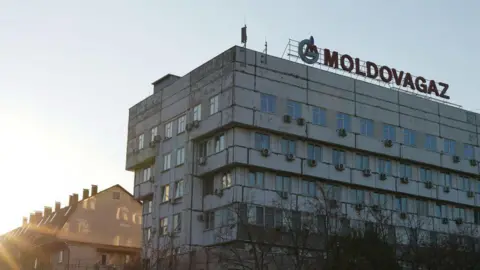
On New Year’s Day, Russian gas stopped flowing through Ukraine.
Kyiv is calling it a “historic” day as its refusal to extend a transit agreement with Russia’s Gazprom has halted the return flow of cash to fund the full-scale invasion of Ukraine
But in neighbouring Moldova, the move threatens to cause a crisis.
Heat off in Transnistria
In Transnistria, a separatist region of eastern Moldova loyal to Moscow, the year began with only hospitals and critical infrastructure being heated, not houses.
“The hot water was on until about 2am, I checked. Now it’s off and the radiators are barely warm,” Dmitry told the BBC by phone from his flat in the enclave.
“We still have gas, but the pressure is very low – just what’s left in the pipes.”
“It’s the same everywhere.”
Transnistria split from the rest of Moldova in a short war as the Soviet Union fell apart. It still has Russian troops on its soil and an economy that’s fully dependent on Russian gas, for which the authorities in Tiraspol pay nothing.
“They just have a file, where it says how much the debt is each month,” explains Jakub Pieńkowski, of the Polish Institute of International Affairs, PSIM. “But Russia is not interested in asking for this money.”
Suddenly, that lifeline via Ukraine has been cut.
In some Transnistrian towns, the authorities are setting up “heating points” and there are hotlines for help finding firewood. Families have been advised to gather in one room for warmth and seal cracks in the windows and doors with blankets.
New Year’s Day in the enclave brought sunshine but the temperature overnight is forecast to fall below 0C.
“It’s chilly now inside the flat,” local resident Dmitry says. “And we don’t know what frost January will bring.”
Blackout threats
The electricity is still flowing, for now.
But Transnistria’s main power plant in Kurchugan is already being fuelled by coal instead of Russian gas and the authorities say there’s only enough of that for 50 days.
That means problems for the rest of Moldova, which gets 80% of its electricity from Kurchugan.
The government in Chisinau says it has enough gas to heat the country until spring and it will switch to buying electricity from Europe, but that means a giant hike in costs.
A state of emergency was introduced last month and businesses and citizens have been told to reduce consumption with the country braced for power cuts.
The abrupt halt in gas via Ukraine affects Slovakia and Hungary, too.
Both have governments sympathetic to Moscow that have been far slower than others in the EU to wean themselves off Russian fuel and stop funding Russia’s war. Paying more for alternative supplies will squeeze their budgets.
But Moldova is poorer and less stable – a prolonged crisis could have serious economic and political consequences.
That may well be what Moscow wants.
Russia could supply its allies in Transnistria via Turkey, albeit at a higher cost, which would mean electricity for all Moldova.
Instead, Gazprom claims it has halted supplies because Chisinau is almost $700m in debt. The Moldovan government says an international audit put the true amount at around $9m which has mostly been repaid.
Playing politics?
“We’re treating this not as an energy crisis but a security crisis, induced by Russia to destabilise Moldova both economically and socially,” Olga Rosca, foreign policy adviser to Moldova’s president, told the BBC.
“This clearly is a shaping operation ahead of parliamentary elections in 2025, to create demand for a return of pro-Russian forces to power.”
Relations between Moldova and Moscow are tense.
Once part of the USSR, the country has begun talks to join the EU and turned even more firmly away from Russia since its full-scale invasion of Ukraine.
President Maia Sandu was re-elected last year despite evidence of a massive campaign against her led from Moscow.
It hasn’t stopped.
Before her inauguration, Russia’s external SVR intelligence agency issued a bizarre statement falsely claiming she planned to take back Transnistria by force to restore energy supplies. It painted the president as “frenzied” and “emotionally unstable”.
Analyst Jakub Pieńkowski agrees that the Kremlin is exploiting Kyiv’s decision to ban the transit of Russian gas.
“It’s a reason to make some political and social issues in Moldova,” he argues. “Electricity prices have already risen about six times in three years and people are angry.”
As the humanitarian situation in Transnistria worsens, pressure on Chisinau will grow. But Tiraspol is refusing all help, even generators.
“They will create a narrative of Chisinau freezing Transnistria into submission,” Olga Rosca believes.
And even if Tiraspol opts to buy gas from elsewhere, the hit to its economy could be disastrous.
“The prices here would shoot up, including for heating and food. But pensions here are tiny, and there’s no work,” Dmitry told me, from Bendery in the buffer zone on the edge of Transnistria.
He says people there are barely “clinging on” as it is. Now life elsewhere in Moldova will also get harder.
“Russia can wait for the elections and then parties who are not pro-EU will probably win,” Jakub Pieńkowski predicts.
“Because Maia Sandu can talk about EU accession. But what use is that if people don’t have money for electricity or gas?”
NEW DELHI: Standard Glass Lining Technology Ltd on Wednesday said it has fixed a price band at Rs 133-140 per equity share for its Rs 410.05 crore initial public offering (IPO) that opens for public subscription on January 6. The public issue of Standard Glass Lining Technology is set to become the first mainboard IPO of 2025. The company has reduced the size of its offer for sale component to nearly 1.43 crore equity shares from 1.84 crore shares as planned earlier. The three-day initial public offering (IPO) will conclude on January 8 and the bidding for anchor investors will open on January 3, the company said in a statement. At the end of the upper price band, the company is going to fetch up to Rs 410.05 crore from the IPO. Investors can bid for a minimum of 107 shares and in multiples thereof, it added. The Telangana-based company’s IPO is a combination of fresh issuance of equity shares worth Rs 210 crore and an offer for sale (OFS) of up to 1.43 crore shares by promoters and other selling shareholders, according to the red herring prospectus (RHP). S2 Engineering Services, Kandula Ramakrishna, Kandula Krishna Veni, Nageswara Rao Kandula, Standard Holdings, Katragadda Venkata Ramani, and Venkata Siva Prasad Katragadda are among shareholders selling shares through the OFS route. Proceeds from the fresh issue to the extent of Rs 130 crore will be used by the company for payment of a debt and Rs 30 crore for investment in a wholly-owned subsidiary, S2 Engineering Industry. Funds worth Rs 20 crore will also be utilised by the company towards inorganic growth through strategic investments or acquisitions, Rs 10 crore for purchase of machinery and equipment and a portion will also be used for general corporate purpose. Standard Glass Lining Technology offers comprehensive solutions that encompass design, engineering, manufacturing, assembly, installation, and commissioning, as well as establishing standard operating procedures for pharmaceutical and chemical manufacturers on a turnkey basis. The company has the capability to manage the entire production process in-house. Some of its pharma clients include the likes of Aurobindo Pharma, Cadila Pharmaceutical, Granules India Ltd, Macleods Pharmaceuticals, Piramal Pharma, and Suven Pharmaceuticals. IIFL Capital Services Ltd (Formerly known as IIFL Securities Ltd) and Motilal Oswal Investment Advisors Ltd are the book running lead managers while KFin Technologies is the registrar for the issue. The shares will be listed on the BSE and the National Stock Exchange (NSE).
New Delhi: Several roads in Delhi were jam-packed and long queues formed at key metro stations as huge crowds thronged to India Gate, Connaught Place and religious places across the national capital on New Year’s Day. The C-Hexagon at India Gate saw a massive crowd gathering on Kartavya Path, leading to traffic congestion in the area.
Other key spots attracting large crowds included Bangla Sahib Gurdwara, Prachin Hanuman Mandir at Connaught Place, Akshardham Mandir, Jhandewalan Mandir, Khatu Shyam Mandir on GT Road and the Jagannath Temple in South Delhi. According to a police officer, their main focus was on India Gate, Ashoka Road, Hanuman Mandir and Connaught Place.
“We have deployed personnel across 11 roads at India Gate’s C-Hexagon. Auto-rickshaws are not being allowed to park on C-Hexagon, and visitors have been asked to stay within the India Gate premises to minimize traffic disruptions,” the officer explained.
The Delhi Traffic Police also reported congestion in several areas on Wednesday, including Jhandewalan, GT Road at Alipur and Paharganj Chowk. The Delhi Metro also experienced overcrowding, with long queues forming at key stations. Apart from this, the famous markets of the national capital also witnessed a large number of shoppers.
According to the Chamber of Trade and Industry (CTI), Chairman Brijesh Goyal and President Subhash Khandelwal, markets like Kamla Nagar, Sarojini Nagar, Chandni Chowk, Sadar Bazar, Rajouri Garden, Lajpat Nagar, Connaught Place, South Extension and Karol Bagh were packed with crowds and shoppers.
“We have seen a very good response this New Year season,” they said. Ashok Randhawa, president of the Sarojini Nagar Mini Market Traders’ Association, said the number of people visiting the market had increased on Wednesday.
“The number of shoppers surged today, almost like a weekend crowd. The recent cold snap, following rain in Delhi, has driven demand for winter clothing, boosting sales,” Randhawa added.
When I started studying nursing at Al Azhar University, I knew I wanted to work at al-Shifa Hospital. It was my dream.
It was the biggest, most prestigious hospital in the Gaza Strip. Some of the best doctors and nurses in Palestine worked there. Various foreign medical missions would come and provide training and care there as well.
Many people from the north to the south of the Gaza Strip sought medical help at al-Shifa. The name of the hospital means “healing” in Arabic and indeed, it was a place of healing for the Palestinians of Gaza.
In 2020, I graduated from nursing school and tried to find a job in the private sector. After several short-term jobs, I got into al-Shifa as a volunteer nurse.
I loved my job at the emergency department very much. I went to work with passion and positive energy every day. I would meet patients with a wide smile, hoping to relieve some of their pain. I always loved to hear patients’ prayers for me in gratitude.
In the emergency department, we were 80 nurses in total – both women and men – and we were all friends. In fact, some of my closest friends were colleagues at the hospital. Alaa was one of them. We did shifts together and went out for coffee outside of work. She was a beautiful girl who was very kind and loved by everyone.
A photo of Alaa, the author’s late friend, who was killed by Israeli bombardment of Beit Lahiya; it was taken on June 29, 2022 [Courtesy of Hadeel Awad]
It was such friendships and the comradery among the staff that helped me pull through when the war started.
From the very first day, the hospital became overwhelmed with casualties. After my first shift ended that day, I stayed in the nurses’ room crying for an hour over everything we had been through and all the injured people I had seen suffering.
Within days there were more than a thousand wounded and martyrs in the hospital. The more people were brought in, the harder we worked, trying to save lives.
I never expected that this horror would last for more than a month. But it did.
Soon, the Israeli army called my family and told us that we needed to leave our home in Gaza City. I faced a difficult choice: to be with my family in this horrific time or to be with the patients who needed me the most. I decided to stay.
A photo of the author taken on October 9, 2023 at al-Shifa Hospital [Courtesy of Hadeel Awad]
I bid farewell to my family who fled south to Rafah and I stayed behind in al-Shifa Hospital, which became my second home. Alaa stayed behind as well. We supported and comforted each other.
In early November, the Israeli army told us to evacuate the hospital and laid a siege to it. Our medical supplies started to dwindle. We were quickly running out of fuel for our electricity generators that were keeping life-saving equipment going.
Perhaps the most heartbreaking moment was when we ran out of fuel and oxygen and we could no longer keep the premature babies we had in our care in the incubators. We had to relocate them to an operating room where we tried to keep them warm. They were struggling to breathe and we had no oxygen to help them. We lost eight innocent babies. I remember sitting and crying for a long time that day for those innocent souls.
Then on November 15, Israeli soldiers stormed the complex. The attack came as a shock. As a medical facility, it was supposed to be protected under international law, but that clearly did not stop the Israeli army.
Just before the raid, our administration told us that they had received a call that the Israelis were about to storm the medical complex. We quickly closed the gate of the emergency department and gathered inside around the nursing desk in the middle of it, not knowing what to do. The next day, we saw Israeli soldiers surrounding the building. We could not leave and we were running out of medical supplies. We struggled to provide treatment to the patients we had with us.
A photo of a single meal that several nurses shared during the siege on al-Shifa Hospital [Courtesy of Hadeel Awad]
We had no food or water left. I remember feeling dizzy and almost fainting. I had not eaten anything for three days. We lost some patients because of the siege and the Israeli raid.
On November 18, Dr Mohammad Abu Salmiya, al-Shifa’s director, came to tell us that the Israelis had ordered the whole medical complex to be evacuated. If I had a choice, I would have stayed, but the Israeli army did not leave me one.
Hundreds of us, doctors and nurses, were forced to leave, along with many patients. Only about two dozen staff stayed behind with bed-ridden patients who could not be moved. Dr Abu Salmiya also stayed behind and was arrested several days later. He disappeared for the next seven months.
I, along with dozens of colleagues head south per Israeli orders. Alaa and a few others defied these orders and headed north to their families. We walked for many kilometres and passed Israeli checkpoints, where we were made to wait for hours, until we were able to find a donkey cart that could transport us some of the way.
When we finally arrived in Rafah, I was beyond happy to see my family. There was a lot of crying and relief. But the happiness of being with my family was soon overshadowed by shocking news.
Alaa was able to return to her family in Beit Lahiya, who had been displaced in a school shelter. But when she and her brother went to their abandoned house to retrieve some belongings, an Israeli missile hit the building and they were martyred.
The news of her death came as an enormous shock. A year later, I still live with the pain of losing my close friend – one of the sweetest people I had ever known who loved to help others and who was always there to comfort me in difficult moments.
A photo of the emergency department of al-Shifa Hospital taken on October 31, 2023 [Courtesy of Hadeel Awad]
In March, Israeli soldiers returned to al-Shifa. For two weeks, they rampaged through the hospital, leaving behind death and devastation. Not a building was left in the medical complex that was not damaged or burned down. From a place of healing, al-Shifa was transformed into a graveyard.
I do not know how I will feel when I see the hospital again. How will I feel knowing that the place of my best professional achievements and dearest moments shared with colleagues also became a place of death, forced disappearances and displacement?
Today, more than a year after I lost my workplace, I live in a tent and care for the ill in a makeshift clinic. My future, our future is uncertain. But in the new year, I have a dream: to see al-Shifa as it used to be – grand and beautiful.
The views expressed in this article are the author’s own and do not necessarily reflect Al Jazeera’s editorial stance.
Blake Lively and Justin Baldoni have filed competing lawsuits that ramp up a battle over allegations of what happened on the set of their film, It Ends With Us.
Lively filed a lawsuit in New York against the actor and his publicity team on Tuesday, alleging sexual harassment on the set of the film and a scheme to “destroy” her reputation.
Baldoni, meanwhile, has filed a lawsuit against The New York Times, which first reported Lively’s legal complaint, accusing journalists of working with the actress to damage his reputation and ignoring evidence which contradicted her claims.
The newspaper has denied his allegations and said their original story was “meticulously and responsibly reported”.
Lively’s legal case includes many of the same accusations which appeared in her civil rights complaint, often a precursor to a lawsuit, which was filed in California in December.
She asks for compensatory damages, including “lost wages” and money for “mental pain and anguish”. She does not specify a monetary amount.
In his own lawsuit against The New York Times, first reported by Variety, Baldoni claims libel and fraud, He accuses journalists of working with the actress to “damage” his reputation, and not giving his team appropriate time to respond to a “bombshell story”.
Baloni’s lawsuit alleges that the Times relied on “‘cherry picked’ and altered communications “stripped of necessary context and deliberately spliced to mislead”.
In a statement, the New York Times told BBC News its report was “based on a review of thousands of pages of original documents, including the text messages and emails that we quote accurately and at length in the article”.
“We published their [Baldoni and his team’s] full statement in response to the allegations in the article as well.”
Baldoni was dropped by his talent agency after the claims were published in the newspaper. His lawsuit asks for a jury trial and damages of $250m (£199m).
The actor’s lawyer Bryan Freedman told CBS News that the newspaper “aided and abetted” a “smear campaign designed to revitalise Lively’s… floundering public image”.
Baldoni’s lawsuit includes many of the same text messages and communications listed by Lively, which she used to accuse his team of orchestrating a social media campaign to alter public opinion against her.
In her own lawsuit, Lively accuses Baldoni and his team of attacking her public image following a meeting to address “repeated sexual harassment and other disturbing behaviour”.
In the meeting, she is said to have laid out 30 demands relating to alleged misconduct to ensure they could continue to produce the film, which included not describing genitalia on set and not adding any intimate scenes beyond the ones Lively had previously approved.
Lively’s legal team further accused Baldoni and his film studio Wayfarer of leading a “multi-tiered plan” to wreck her reputation, which included social media manipulation and using friendly journalists to further certain narratives.
Baldoni’s lawyers have previously told the BBC that the allegations made by Lively are “categorically false” and said they hired a crisis manager because Lively had threatened to derail the film unless her demands were met.
BBC News has contacted representatives for Lively, Baldoni and The New York Times for further comment.
It Ends With Us was released last summer, and sees Lively play a woman in a relationship with a charming but abusive boyfriend, played by Baldoni.
The film is based on a best-selling novel by Colleen Hoover. The 45-year-old author has said her inspiration was the domestic abuse endured by her mother.
Over the December month, it fell 3.2% after US investors started cashing their profits after Republican candidate Donald Trump’s victory in the US elections pushed it to its all-time high of $108,315 by mid-December.
This is because Trump is a huge supporter of cryptocurrencies.
However, the rally has now cooled after expectations of an interest-rate cut from the Federal Reserve waned, which reduced investor appetite for riskier assets like cryptocurrency.
“While optimism surrounds crypto-friendly regulations post-Trump inauguration, we think the key catalyst may come in January as institutions readjust asset allocations,” the report quoted QCP Capital as saying in a note to clients. “With Bitcoin now broadly adopted by a broad spectrum of institutions — adding university endowment funds to the list this year — allocations are likely to increase, strengthening Bitcoin dominance, stabilizing spot movements, and shifting volatility dynamics closer to equities.”
India’s gross Goods and Services Tax (GST) collections for December 2024 rose to Rs 1.77 lakh crore against Rs 1.65 lakh crore collected in December 2023. This collection reflects a year-on-year increase of 7.3 per cent, as per the data released by the government on Wednesday. The December collections included Rs 32,836 crore from central GST (CGST), Rs 40,499 crore from state GST (SGST), Rs 47,783 crore from integrated GST (IGST), and Rs 11,471 crore from cess.GST revenues from domestic transactions grew by 8.4 per cent to Rs 1.32 lakh crore, while collections from imports increased by 4 per cent to Rs 44,268 crore. In November 2024, GST revenues stood at Rs 1.82 lakh crore, recording 8.5 per cent annual growth. The highest-ever monthly collection was achieved in April 2024, with a record Rs 2.10 lakh crore. So far, in the financial year 2024-25, total GST collections have increased by 9.1 per cent, amounting to Rs 16.33 lakh crore, compared to Rs 14.97 lakh crore during the same period last year. For the entire financial year 2023-24, gross GST revenues reached Rs 20.18 lakh crore, registering an 11.7 per cent growth from the previous fiscal year.
During December 2024, refunds worth Rs 22,490 crore were issued, marking a 31 per cent increase over the corresponding period last year. After accounting for refunds, the net GST collection rose by 3.3 per cent to Rs 1.54 lakh crore. The steady growth in GST revenues reflects a positive trajectory for India’s economy, driven by strong domestic consumption and buoyant trade activity. These figures signal resilience amidst global uncertainties and underscore the country’s fiscal stability and economic recovery efforts. Introduced on 1st July 2017, GST has transformed India’s indirect tax system. States were assured compensation for any revenue losses under the GST (Compensation to States) Act, 2017, for five years following its implementation. To ease the financial burden on citizens, the GST Council has reduced tax rates on essential items like hair oil, toothpaste, soap, wheat, rice, and curd. Consumer goods such as mobile phones, refrigerators, and TVs up to 32 inches have also seen substantial rate cuts. The GST Council, chaired by the Union Finance Minister and comprising state finance ministers, continues to guide the tax framework. The most recent meeting, held on 21st December 2024 in Jaisalmer, Rajasthan.
The next round of talks with European powers will take place one week before Trump’s return to the White House.
The next round of nuclear talks between Iran and France, the United Kingdom and Germany will take place in Geneva in January, Iran’s semi-official ISNA news agency reports, citing the country’s Deputy Foreign Minister Kazem Gharibabadi.
“The new round of talks between Iran and three European countries will be held in Geneva on January 13,” Gharibabadi said on Wednesday.
Iran held talks with the three European powers about its disputed nuclear programme in November. Those discussions, the first since the presidential election in the United States, came after Tehran was angered by a Europe-backed resolution that accused Iran of poor cooperation with the United Nations nuclear watchdog.
Tehran reacted to the resolution by informing the IAEA watchdog that it plans to install more uranium-enriching centrifuges at its enrichment plants.
On December 17, the three European countries accused Iran of growing its stockpile of high-enriched uranium to “unprecedented levels” without “any credible civilian justification”. They have also raised the possibility of restoring sanctions against Iran to keep it from developing its nuclear programme.
IAEA chief Rafael Grossi told Reuters news agency in December that Iran is “dramatically” accelerating its enrichment of uranium to up to 60 percent purity, closer to the roughly 90 percent level that is weapons grade.
Tehran insists on its right to nuclear energy for peaceful purposes and has consistently denied any ambition of developing nuclear weapons capability.
In 2015, Iran reached an agreement with world powers, including the US, to curb its nuclear programme due to concerns about the country potentially developing nuclear weapons.
But in 2018, the then administration of Donald Trump exited Iran’s 2015 nuclear pact with six major powers and reimposed harsh sanctions on Iran, prompting Tehran to violate the pact’s nuclear limits, with moves such as rebuilding stockpiles of enriched uranium, refining it to higher fissile purity and installing advanced centrifuges to speed up output.
Indirect talks between US President Joe Biden’s administration and Tehran to try to revive the pact have failed, but Trump said during his election campaign in September: “We have to make a deal, because the consequences are impossible. We have to make a deal.”
The January 13 talks will take place one week before Trump’s return to the White House.
New Delhi: India’s goods and services tax (GST) collections rose 7.3 per cent to Rs 1.77 lakh crore in December compared to Rs 1.65 lakh crore in the same month a year ago, according to the government data released on Wednesday. The Central GST collection stood at Rs 32,836 crore, State GST at Rs 40,499 crore, Integrated GST at Rs 47,783 crore and cess at Rs 11,471 crore.
The GST from domestic transactions during the month grew 8.4 per cent to Rs 1.32 lakh crore, while revenues from tax on imports rose about 4 per cent to Rs 44,268 crore. In November, GST mop-up was Rs 1.82 lakh crore with 8.5 per cent annual growth. The highest-ever collection was in April 2024 at over Rs 2.10 lakh crore.
During the month, refunds worth Rs 22,490 crore were issued, registering 31 per cent increase over the year-ago period. After adjusting refunds, net GST collection increased by 3.3 per cent to Rs 1.54 lakh crore. The country’s GST collections have remained buoyant during the current financial year, helping the government to mobilise more resources and keep the fiscal deficit in check.
India’s fiscal deficit for the first eight months from April to November of the current financial year is estimated at Rs 8.47 lakh crore, which works out to 52.5 per cent of the estimate for the financial year, according to official data released on Tuesday.
This reflects a strong macroeconomic financial position as the fiscal deficit is well under control with the government sticking to the consolidation path. The government aims to bring down the fiscal deficit to 4.9 per cent of gross domestic product (GDP) in the current financial year from 5.6 per cent in 2023-24.
The buoyancy in tax collections places more funds in the government’s coffers to undertake investments in large infrastructure projects to spur economic growth and take up welfare schemes for the poor. It also helps to keep the fiscal deficit in check and strengthens the macroeconomic fundamentals of the economy.
A lower fiscal deficit means the government has to borrow less, which leaves more money in the banking system for big companies to borrow and invest. This in turn leads to a higher economic growth rate and the creation of more jobs. Besides, a low fiscal deficit keeps the inflation rate in check, which strengthens the fundamentals of the economy and ensures growth and stability.