Wednesday, September 30, 2026
Home Blog Page 6993

Tamil Nadu 2024 – the highs and lows 

0
Tamil Nadu 2024 – the highs and lows 


As usual, numerous events that occurred over 2024 did make an impact on the fortunes of Tamil Nadu. While it is undeniable that several significant events took place during this year, all chronicled in these columns as and when they happened, N. Sai Charan picks out 12 critical events that made headlines and influenced the course of history in the State. They have left their mark, but are also likely to have a long-standing impact on the near, and distant futures

If there was one incident in Tamil Nadu that shook the entire nation in 2024, it was the Kallakurichi hooch tragedy. Several residents, mostly daily-wage labourers of Karunapuram near Kallakurichi town, who consumed methanol-infused hooch bought from a local bootlegger on the night of June 18, complained of breathlessness, abdominal pain, blurred vision, and repeated bouts of diarrhoea. They were admitted to hospitals in Kallakurichi, Villupuram and Salem, and JIPMER in Puducherry. Within a couple of days, nearly 50 persons died. The State government made arrests and took action against officials. It also transferred the Collector, placed a few police officers under suspension, and transferred the probe to the Crime Branch-CID. By July, the death toll touched 68. Based on a batch of writ petitions filed by the Opposition parties, the Madras High Court on November 20 ordered a Central Bureau of Investigation (CBI) probe into the tragedy.

Kallakurichi hooch tragedy
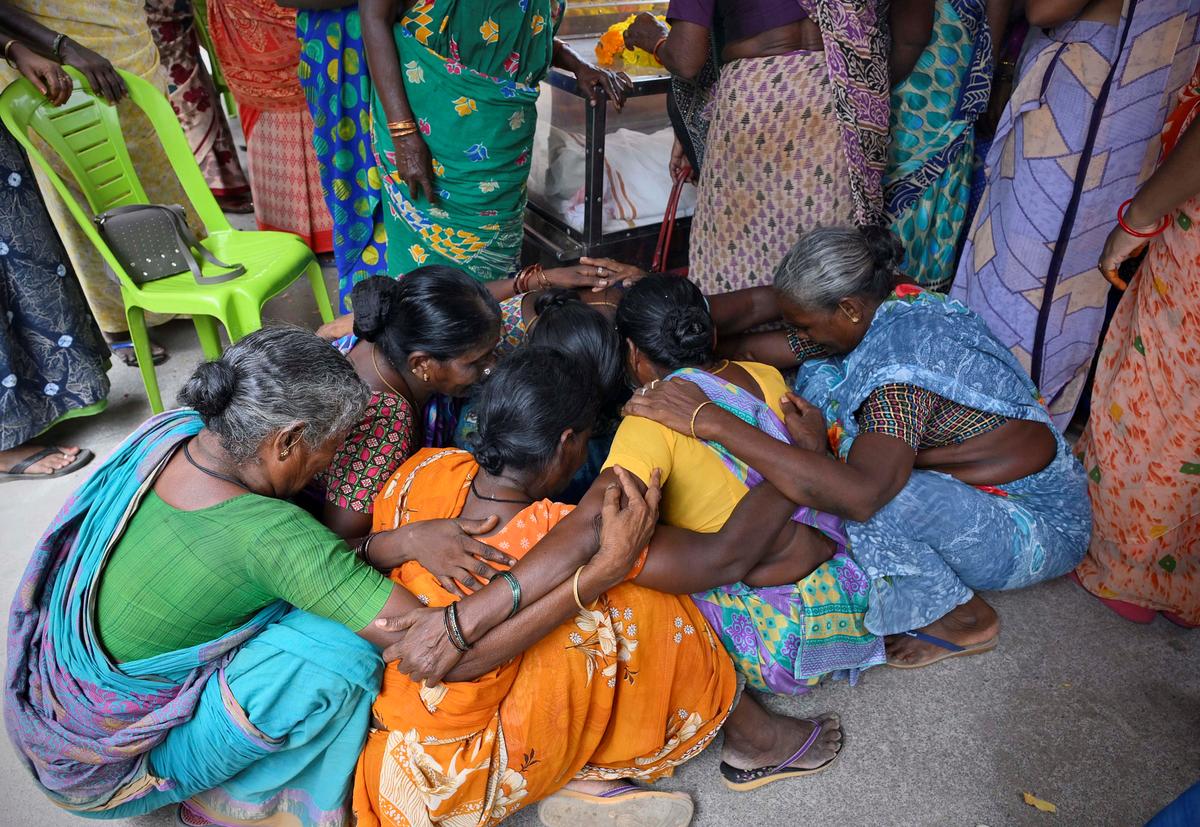
Relatives grieving over the deaths of Suresh and his wife Vadivukarasi in the hooch tragedy at Karunapuram in Kallakurichi town.

Relatives grieving over the deaths of Suresh and his wife Vadivukarasi in the hooch tragedy at Karunapuram in Kallakurichi town.
| Photo Credit:
S.S. Kumar

In the 2024 Lok Sabha election, Tamil Nadu witnessed a four-cornered contest: the INDIA bloc, the AIADMK-led alliance, the NDA, and the Naam Tamilar Katchi were in the game. The INDIA bloc, led by the ruling DMK won all the 39 seats. The lone seat in Puducherry also went to the INDIA bloc. The nominees of the ruling party-led alliance were far ahead of their opponents. By winning in Sriperumbudur, DMK treasurer T.R. Baalu became the second MP to enter the Lower House of Parliament for the seventh time from Tamil Nadu, next to Congress veteran P. Chidambaram. Earlier, the DMK-led alliance, in its previous avatar as the United Progressive Alliance, had swept the Lok Sabha election in 2004. The AIADMK, which hoped to reverse its fortunes after back-to-back setbacks, had lost in Theni too. It had won the seat last time. The BJP drew a blank, but increased its vote share to double-digit without an alliance.

Lok Sabha elections
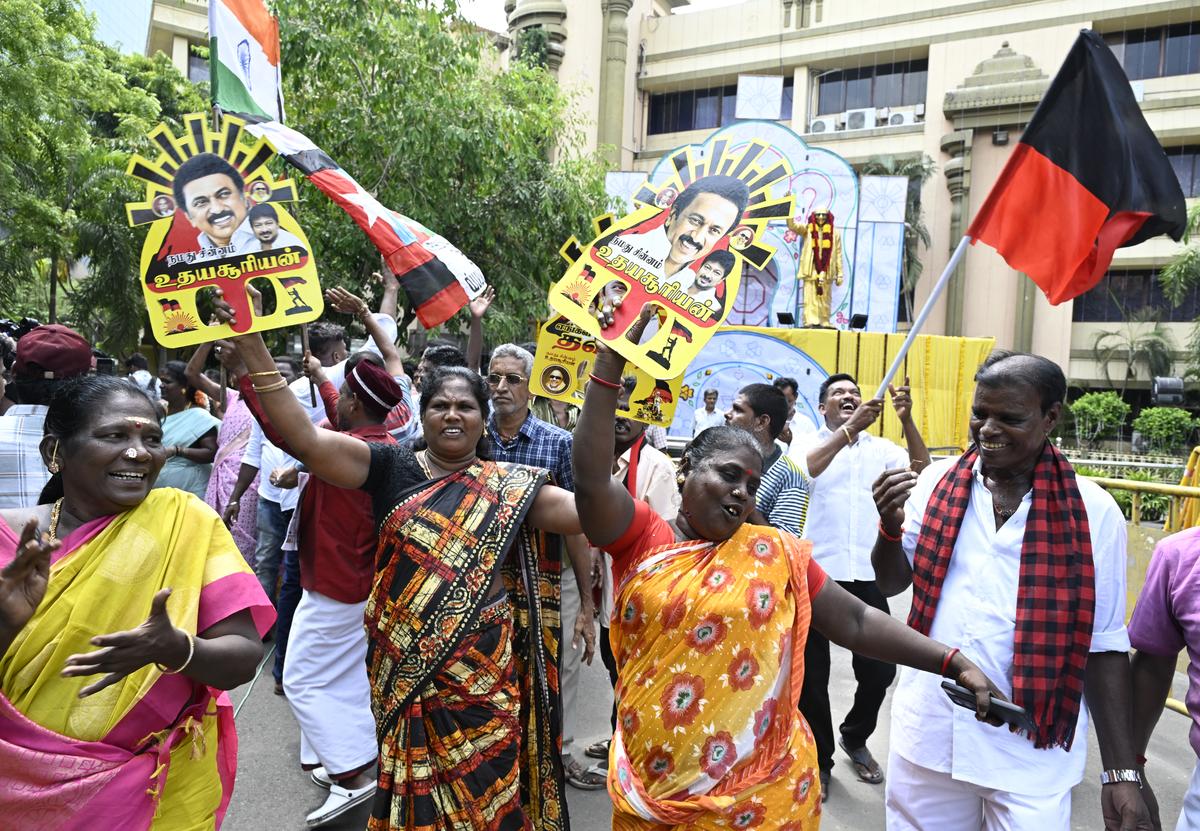
DMK  party Cadres celebrating  party leading over their  Lok Sabha Elections at Anna Arivalayam in Chennai.

DMK party Cadres celebrating party leading over their Lok Sabha Elections at Anna Arivalayam in Chennai.
| Photo Credit:
R. Ragu

In July 2024, the State government set up a 23-member ‘One Health and Climate Change Strategic Committee’ to enhance the State’s climate resilience through the One Health approach. It aims to tackle public health challenges linked to climate change, land use, and lifestyle changes, which may trigger diseases affecting both humans and animals. The Health Department’s ‘One Health and Climate Hub’ will establish response mechanisms to mitigate risks associated with zoonotic diseases, and heat and air pollution. Tamil Nadu also declared heatwave a State-specific disaster, enabling those affected by extreme temperatures to get compensation.

One Health
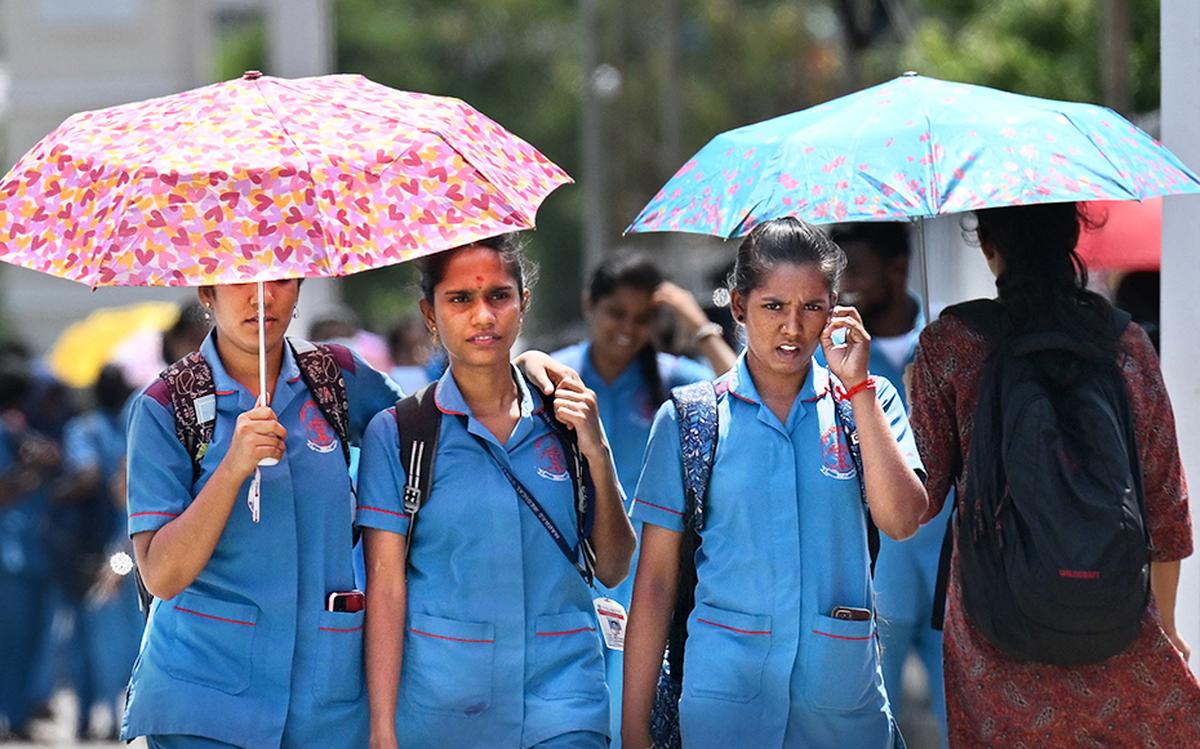
With the temperatures soaring up, college students seen using umbrellas to shield themselves from the scorching sun at Stanley viaduct near Chennai Central station.

With the temperatures soaring up, college students seen using umbrellas to shield themselves from the scorching sun at Stanley viaduct near Chennai Central station.
| Photo Credit:
B. Jothi Ramalingam

Tamil cinema’s leading hero Vijay on February 2 took the political plunge and announced the formation of his political party Tamilaga Vettri Kazhagam (TVK). Positioning himself against the politics of “corruption” and “divisiveness”, Mr. Vijay declared that his party would enter the fray in the 2026 Assembly election. At its inaugural political conference held at Vikravandi on October 27, Mr. Vijay declared that his party would fight against “sectarian forces ideologically” and “Dravidian model-invoking corrupt forces politically”. He also declared that the TVK was open to sharing power with parties, hinting at such an arrangement in 2026. He claimed that Dravidam and Tamil Nationalism were two eyes of this land.

Tamilaga Vettri Kazhagam
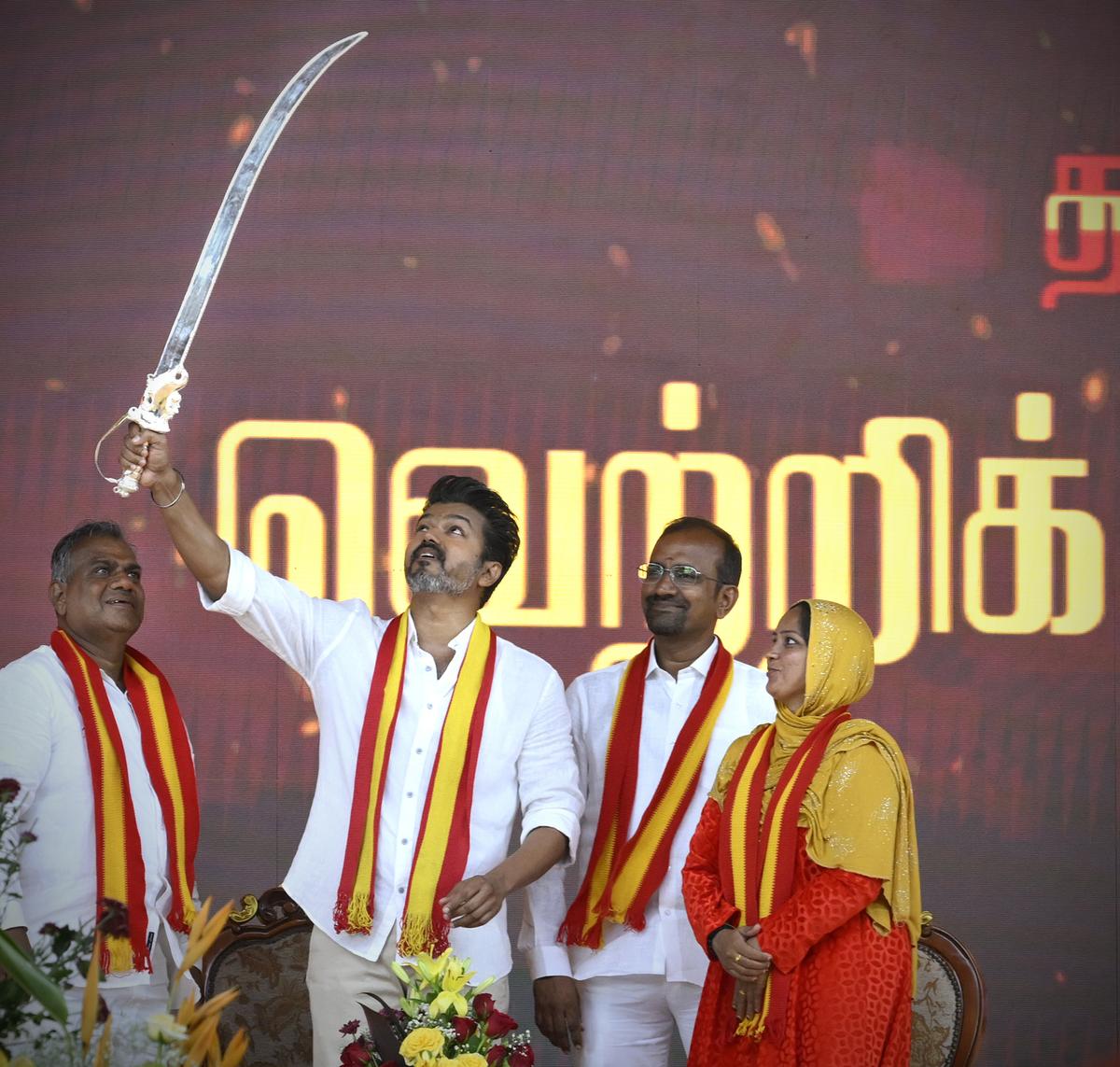
Actor Vijay, at the debut public rally of Tamilaga Vettri Kazhagam held at Vikravandi in Villupuram District.

Actor Vijay, at the debut public rally of Tamilaga Vettri Kazhagam held at Vikravandi in Villupuram District.
| Photo Credit:
S.S. Kumar

The Global Investors Meet (GIM 2024) attracted investment commitments exceeding ₹6.64 lakh crore through 631 Memoranda of Understanding (MoUs). Chief Minister M.K. Stalin announced that these investments were expected to generate 26,90,657 jobs. A majority of investments were planned in the southern region of the State. VinFast, an electric vehicle manufacturer from Vietnam, announced its plans to establish an electric vehicle plant in Thoothukudi, and within a short span of time, the foundation was laid for this project. Later, during the Chief Minister’s trip to the United States, Ford Motor Company, which had wound up its operations in Chennai a few years ago, expressed interest in restarting manufacturing in Tamil Nadu.

Global Investors Meet
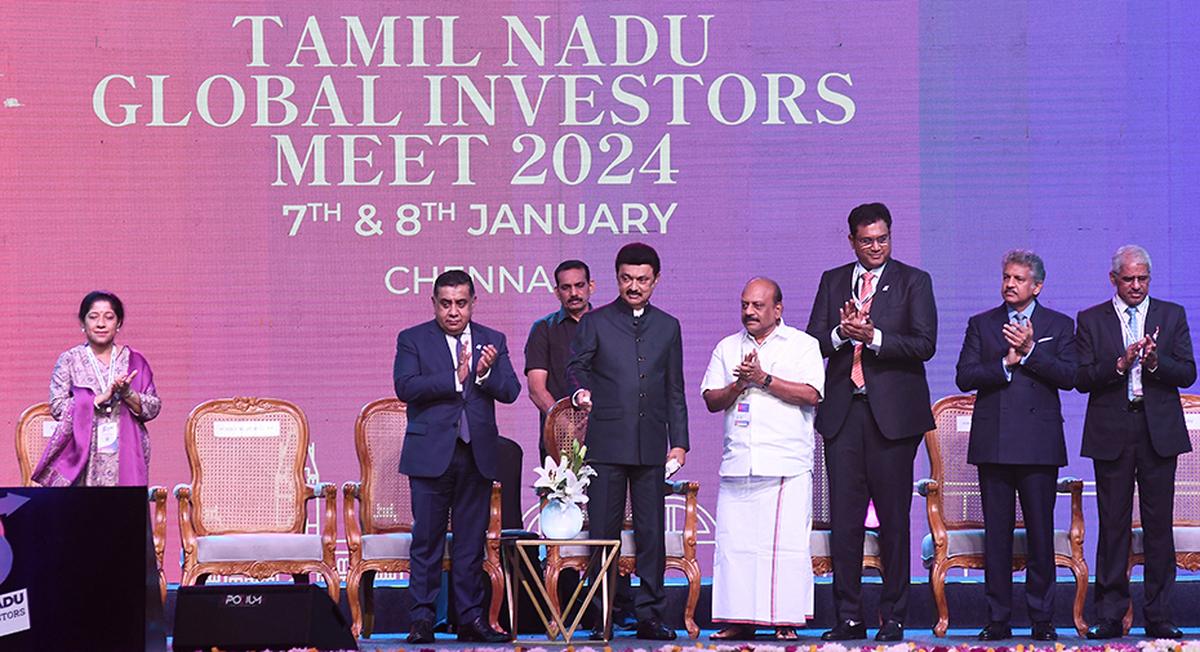
Tamil Nadu Chief Minister M. K. Stalin, Inaugurating new industry project at various district, with Mahindra Group Chairman Anand Mahindra, Minister of State, United Kingdom, Tariq Ahmad, Minister for Industries T.R.B. Rajaa and others at the valedictory ceremony of the Global Investors Meet-2024, at Nandambakkam in Chennai.

Tamil Nadu Chief Minister M. K. Stalin, Inaugurating new industry project at various district, with Mahindra Group Chairman Anand Mahindra, Minister of State, United Kingdom, Tariq Ahmad, Minister for Industries T.R.B. Rajaa and others at the valedictory ceremony of the Global Investors Meet-2024, at Nandambakkam in Chennai.
| Photo Credit:
B. Velankanni Raj

Cyclone Fengal, the complex and slow-moving cyclone, left a trail of destruction in the State. While cyclones causing heavy rainfall were not uncommon during the Northeast monsoon, Cyclone Fengal’s long life-cycle set it apart. The December cyclone that brought 50 cm rainfall on a single day in many districts, including Krishnagiri, Mayiladuthurai, Kallakurichi, and Villupuram, had wreaked havoc in Puducherry and Tamil Nadu, claiming 12 lives and affecting 14 districts. When it moved inland, the cyclone pummelled several districts along its path, caused flash floods, submerged acres of crops, and displaced thousands of people. Tragedy struck Tiruvannamalai district when seven persons, including children, were killed in a landslide on December 1 following torrential rainfall. The overflow from the South Pennai river that was in spate, and discharge of nearly 1.68 lakh cusecs of floodwater from the Sathanur dam on December 2 led to widespread devastation.

Cyclone Fengal
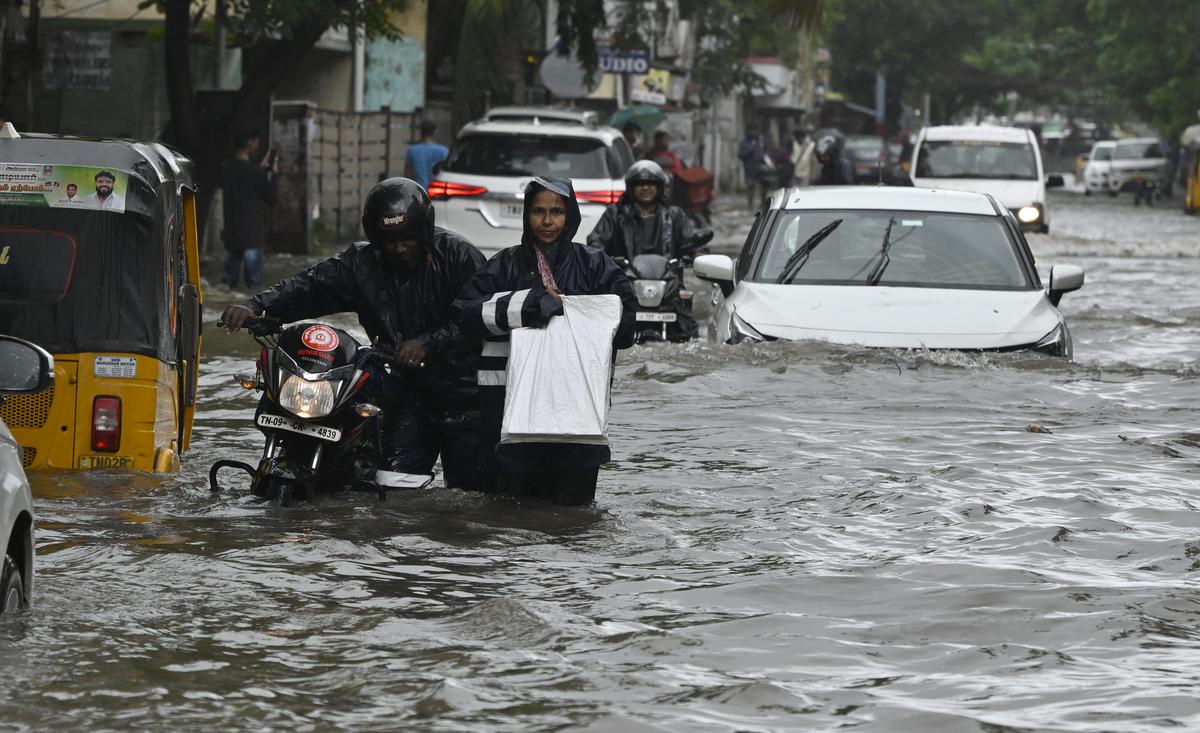
Vehicles wade through stagnanted rain water at Brindavan Street Extension, West Mambalam due to Fengal cyclone in Chennai.

Vehicles wade through stagnanted rain water at Brindavan Street Extension, West Mambalam due to Fengal cyclone in Chennai.
| Photo Credit:
M. Vedhan

In a much-awaited Cabinet reshuffle, DMK Youth Wing secretary and Minister for Youth Welfare and Sports Development Udhayanidhi Stalin was elevated as Tamil Nadu’s Deputy Chief Minister on September 28. He had entered the Assembly in 2021 for the first time by winning from the Chepauk-Triplicane constituency. He was inducted into the Cabinet in December 2022. Within two days of his release from the Puzhal Central Prison in Chennai on September 26, V. Senthilbalaji, who was arrested by the Enforcement Directorate in a money laundering case in June 2023, was reinstated in the Cabinet. Mr. Senthilbalaji, who was the Minister for Electricity, Prohibition and Excise before his resignation following the arrest, was given the same portfolios.

Udhayanidhi Stalin becomes Deputy Chief Minister
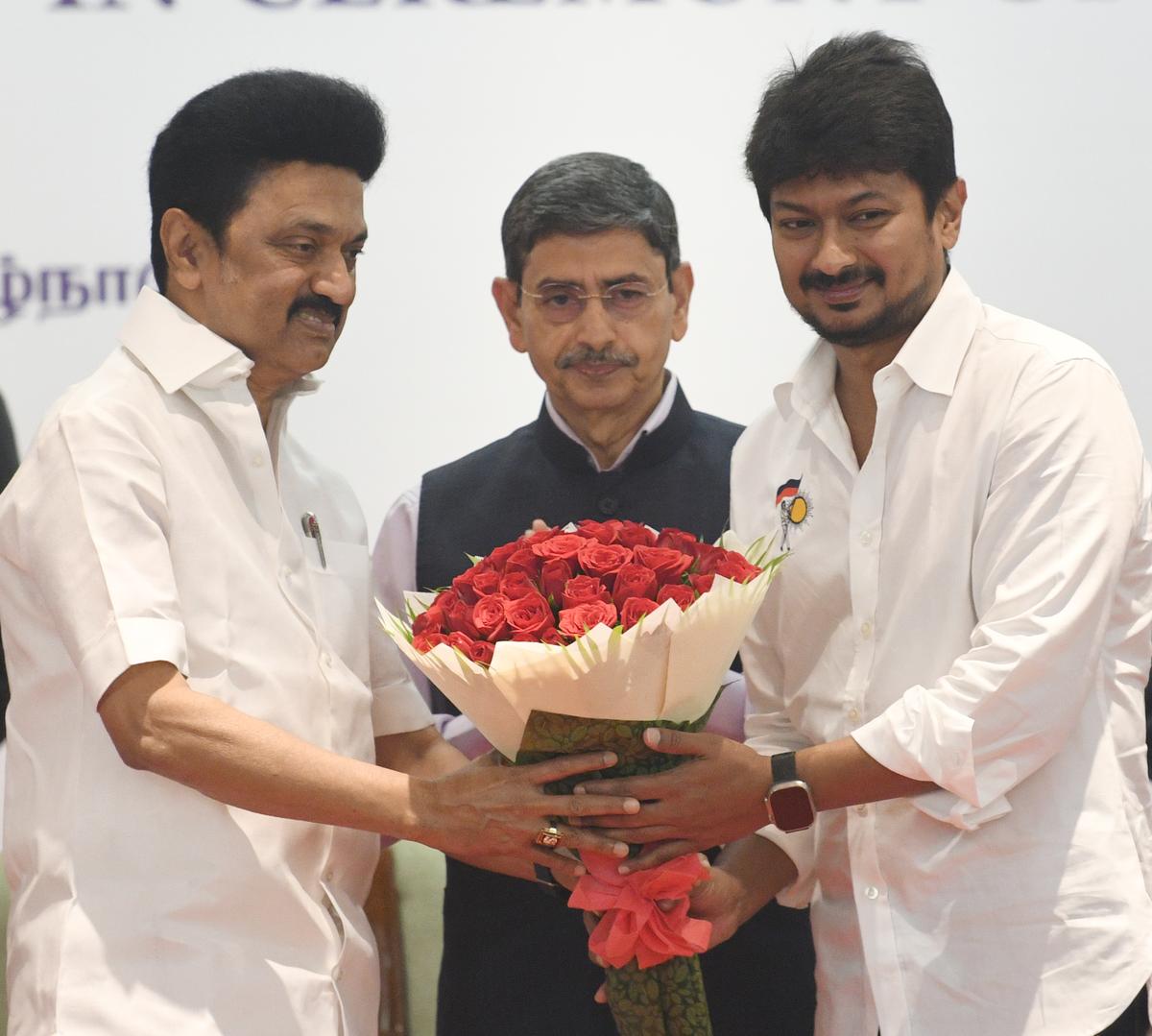
M. K. Stalin, Tamil Nadu Chief Minister, giving away a flower bouquet to the newly sworn in Minister Udayanidhi Stalin, Minister for Youth Welfare & Sports Development in Chennai on December 14, 2022. The Tamil Nadu Governor R.N. Ravi looks on.

M. K. Stalin, Tamil Nadu Chief Minister, giving away a flower bouquet to the newly sworn in Minister Udayanidhi Stalin, Minister for Youth Welfare & Sports Development in Chennai on December 14, 2022. The Tamil Nadu Governor R.N. Ravi looks on.
| Photo Credit:
S.R. Raghunathan

The election to the managing committee of the Chennai Press Club was conducted after a gap of 25 years on December 15. The election witnessed a record voter turnout of 91.27%. The election was last held in 1999. Justice V. Bharathidasan, a retired judge of the Madras High Court, who was appointed as the Election Officer by the 12-member Chennai Press Club Special Guidance Committee that was headed by veteran journalist N. Ram, conducted the election. Earlier, the Madras High Court dismissed two petitions filed against the conduct of the election to the Chennai Press Club.

Chennai Press Club elections
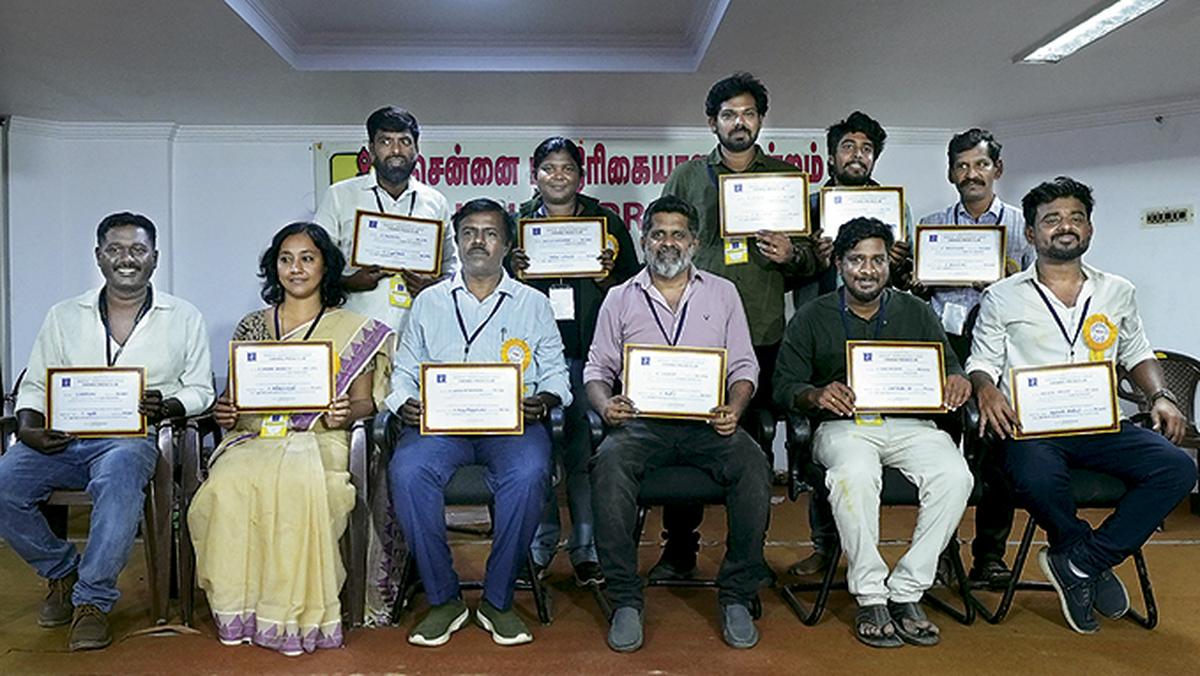
The newly elected office bearers of the managing committee of the Chennai Press Club after receiving their certificates.

The newly elected office bearers of the managing committee of the Chennai Press Club after receiving their certificates.
| Photo Credit:
B. Jothi Ramalingam

Wearing the uniform of food delivery executives, a gang of unidentified men hacked Bahujan Samaj Party Tamil Nadu president K. Armstrong, 52, to death near his house at Sembium in Chennai on July 5. The murder took place when he was standing near a construction site, close to his house, around 7 p.m. on Venugopalaswamy Street. A gang that came on bikes surrounded and attacked him with knives. Initially, it was presumed to be an act of revenge for the killing of ‘Arcot’ Suresh, said to be a gangster in north Chennai. The police eventually arrested nearly 30 persons linked to what had quickly become a highly politicised murder.

Armstrong murder
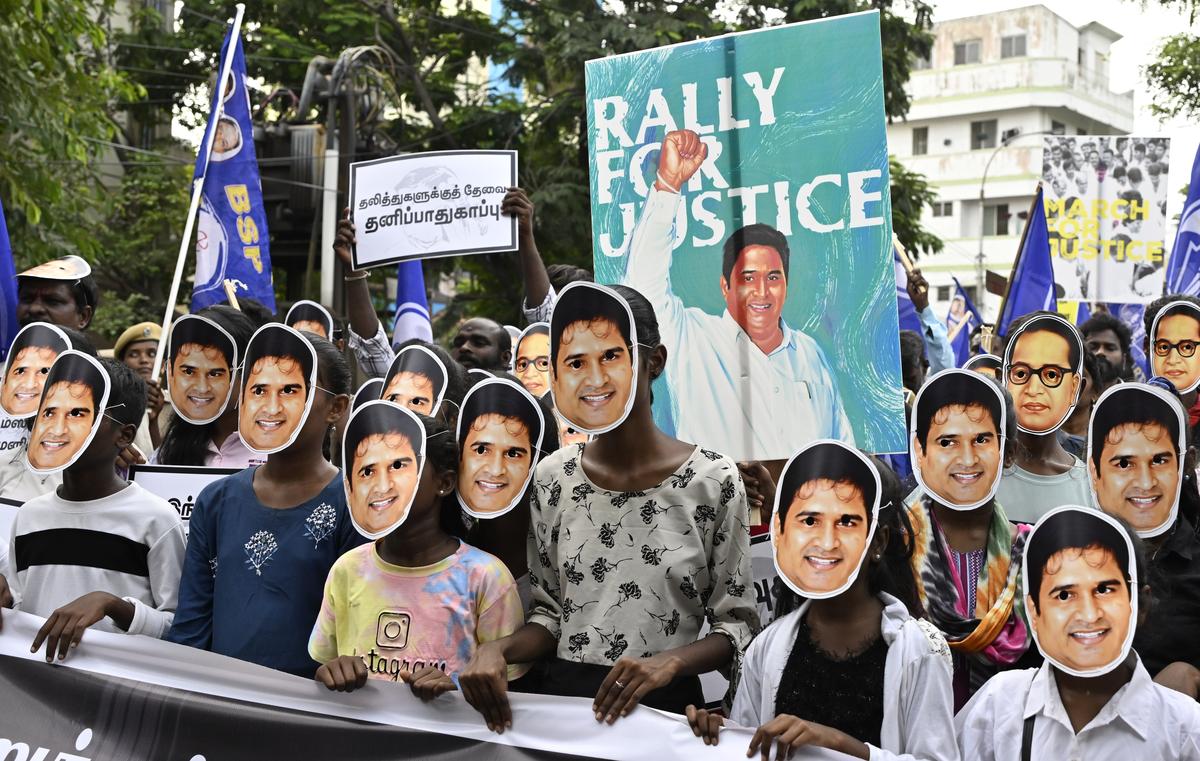
Members of Bahujan Samaj Party (BSP) organisations taking out a  March Rally in Chennai on Saturday, seeking justice for  Party State president Armstrong Murder Case.

Members of Bahujan Samaj Party (BSP) organisations taking out a March Rally in Chennai on Saturday, seeking justice for Party State president Armstrong Murder Case.
| Photo Credit:
M. Vedhan

In September, workers of Samsung’s manufacturing facility at Sriperumbudur went on strike, pressing a slew of demands, including recognition of Samsung India Workers’ Union (SIWU), affiliated to the Centre of Indian Trade Unions. While workers raised various economic demands such as an incremental increase in their salaries over the next two years, at the heart of their protest was the demand for the recognition of SIWU. The government organised several rounds of conciliation meetings led by Ministers. Finally, On October 15, the Labour Department announced that the strike ended after successful negotiations between the workers and the management. Samsung workers returned to work on October 17, ending a 38-day strike.

Samsung workers’ strike
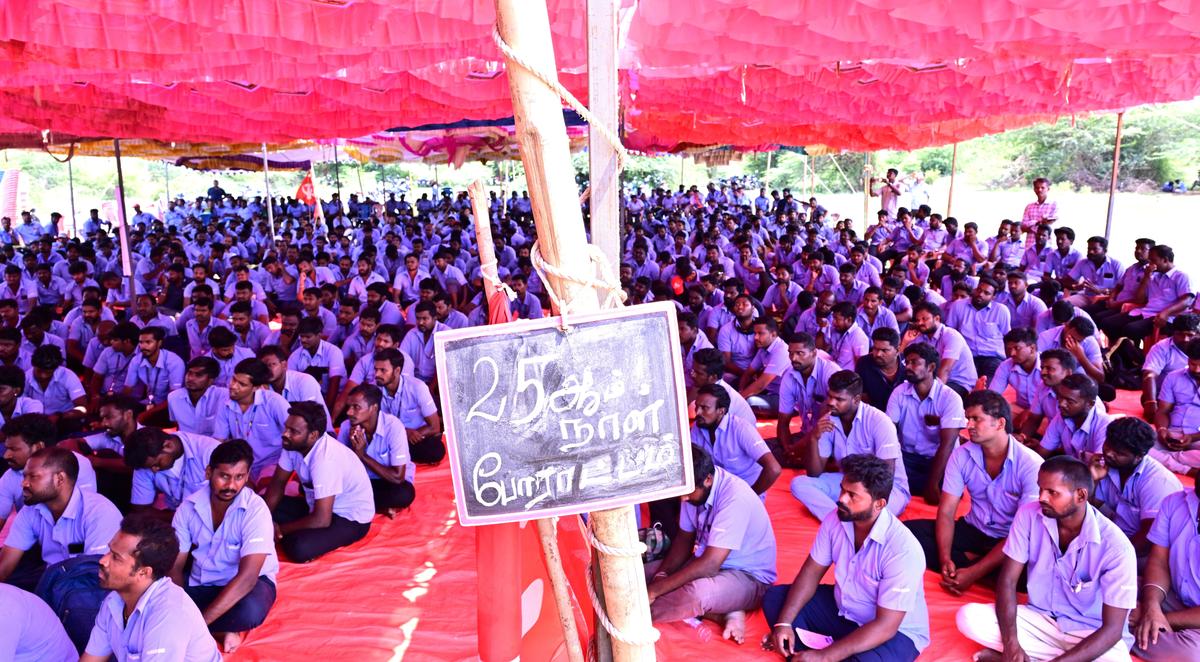
Samsung India factory workers staging continuous strike 25th day at Sunguvarchatram in near Kancheepuram.

Samsung India factory workers staging continuous strike 25th day at Sunguvarchatram in near Kancheepuram.
| Photo Credit:
B. Velankanni Raj

More than 15 lakh people from various parts of Chennai and surrounding districts thronged the shores of the Marina and its neighbourhood on October 6 to witness the air show of the Indian Air Force (IAF), which was conducted as part of the 92nd Indian Air Force Day celebrations. The city, which hosted the IAF air show after a gap of 21 years, witnessed a scintillating display of fighter jets, helicopters, and vintage aircraft, which enthralled the audience. However, lack of careful preparations led to the loss of five lives. The deaths were attributed to heatstroke. Several persons reportedly fainted because of dehydration and struggled to reach hospitals owing to a surge in spectators who rushed to come out of the Marina as soon as the air show ended.

IAF airshow deaths
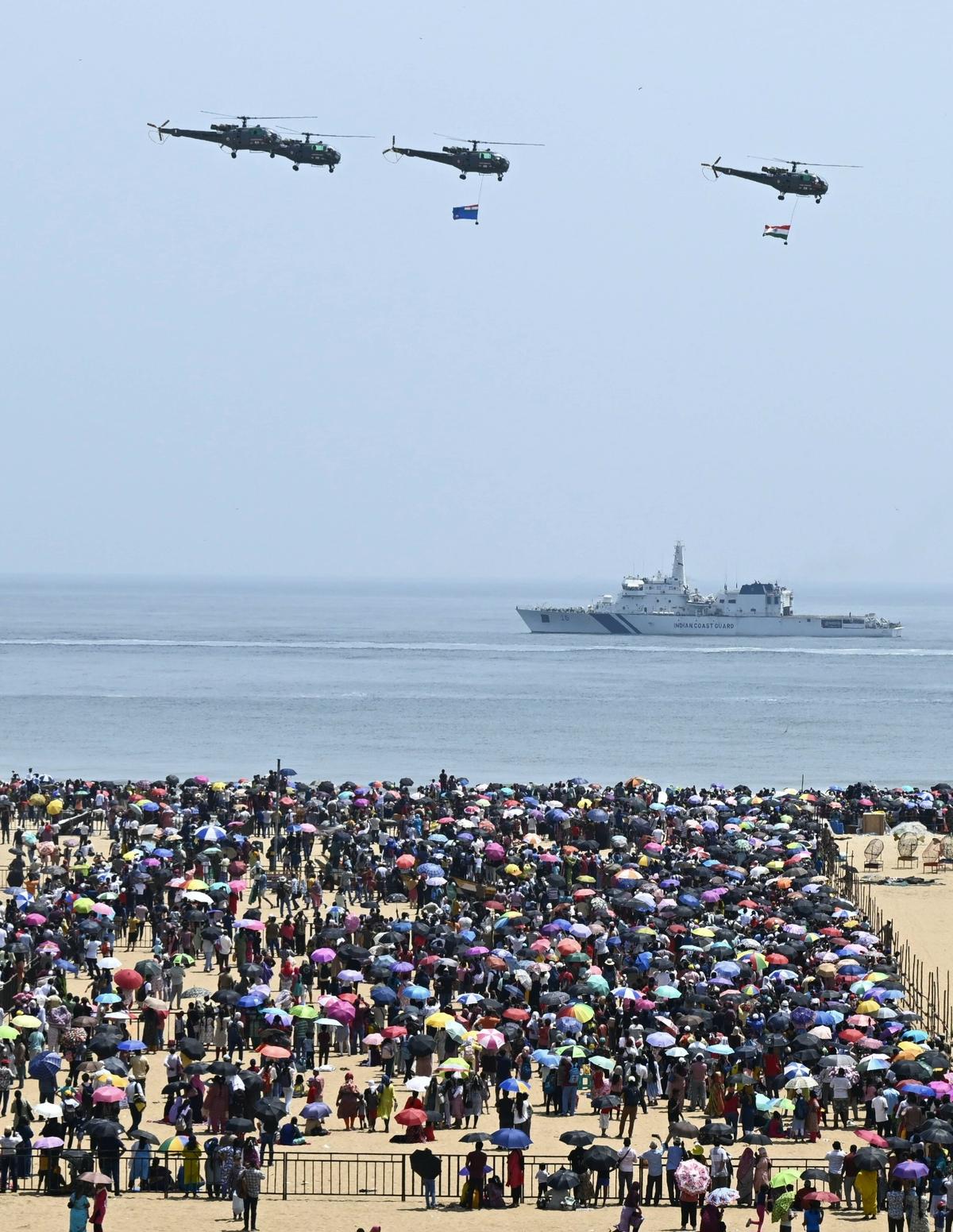
Crowds gather at the Marina Beach in Chennai to watch the airshow rehearsal , ahead of the 92nd Indian Air Force Day celebrations to be held on October 6, 2024.

Crowds gather at the Marina Beach in Chennai to watch the airshow rehearsal , ahead of the 92nd Indian Air Force Day celebrations to be held on October 6, 2024.
| Photo Credit:
R. Ragu

Row over tungsten mining

A cross section of villagers in Madurai district objected to the proposed tungsten mining project at Nayakkarpatti in the Melur block. The issue escalated after the Union Ministry of Mines granted tungsten mining rights to Hindustan Zinc Limited through an auction on November 7. Several villages fall under the Nayakkarpatti tungsten block which also include Arittapatti, a notified biodiversity heritage site famous for archaeological monuments. The State Assembly, on December 9, adopted a resolution urging the Centre to immediately cancel the tungsten mining rights. On December 24, the Ministry of Mines requested the Geological Survey of India to re-examine the block and explore the possibility of redefining the boundaries by excluding the biodiversity heritage site.


Leicester City vs Man City: EPL preview, team news, how to follow, stream | Football News

0
Leicester City vs Man City: EPL preview, team news, how to follow, stream | Football News


Who: Leicester City vs Manchester City
What: English Premier League
Where: King Power Stadium, Leicester, United Kingdom
When: 12:30pm (12:30 GMT) on Sunday
Follow Al Jazeera’s live text and photo build-up and commentary stream.

Pep Guardiola insists he will not walk out on troubled Manchester City as he strives to stop the champions’ stunning decline.

The Spaniard, whose side visit Leicester City on Sunday, only recently signed a two-year contract extension but City’s dismal form has raised questions about his future. A nightmare run of nine defeats in 13 games, with just one win in that woeful spell, triggered suggestions the City boss could decide to quit if he cannot find an answer to his team’s problems.

Having led City to six Premier League titles in the past seven seasons, however, Guardiola is adamant he still has the hunger to turn the situation around.

“I will try, I will keep going. Sometimes you think the bad run will be ended earlier or it would be easier to fix it, but it takes more time,” he told reporters in the run-up to Sunday’s match. “I will not give up. I want to be here. I want to do it and, with the situation that we have, we have to do it.

“Of course, I want it, everyone wants it. I don’t want to disappoint my people in terms of the club, the fans, the people who love this club. I think all of us in our job want to do it well and please the people. That is undeniable, not a question mark.

“The biggest test is to come back again, but we have done that before.”

MANCHESTER, ENGLAND - DECEMBER 26: Pep Guardiola, Manager of Manchester City, reacts during the Premier League match between Manchester City FC and Everton FC at Etihad Stadium on December 26, 2024 in Manchester, England. (Photo by Carl Recine/Getty Images)
Pep Guardiola has not previously endured such a barren run in his career [Carl Recine/Getty Images]

Guardiola won’t criticise in City crisis

Injuries have been a major factor in City’s decline, leaving them languishing in seventh place in the Premier League.

Most especially, the gaping hole left by Ballon d’Or winner Rodri, as he recovers from a long-term knee injury. Nor have matters been helped by the erratic form in an inconsistent season by the usually prolific Erling Haaland, who missed a penalty that could have sealed a City win against Everton in their last match.

Haaland has scored just once in his last seven games, but Guardiola refused to blame the Norway striker or any of his teammates.

“I don’t have it in my education to start complaining, to point at people. It’s happened, it’s life, it’s football, so let’s try it again,” he said.

“That’s why we have had success, because always it is never enough, we will try it again and again and again. That’s why we won a lot of titles.

“Every three days it was a game and win, win, win for many, many months and years. Now, we have to do the same when results are not good.”

City still have doubts about the fitness of several players as they bid to get back to winning ways at struggling Leicester, who have won only one of their last 11

“Sometimes you have injuries,” Guardiola said. “For how many years we were incredibly consistent but now, yes, we’re a little bit down and the main reason is having so many important players injured.

“But I saw the team spirit, how we trained this week, how focused they are, how they try to practise.”

MANCHESTER, ENGLAND - DECEMBER 26: Pep Guardiola, Manager of Manchester City, reacts during the Premier League match between Manchester City FC and Everton FC at Etihad Stadium on December 26, 2024 in Manchester, England. (Photo by Molly Darlington/Getty Images)
Manchester City’s draw with Everton ended their three-game losing streak [Molly Darlington/Getty Images]

Leicester City team news

Jordan Ayew, who is suspended after the forward was booked for the fifth time this season during the defeat by Liverpool in Leicester’s last outing.

Captain Jamie Vardy should be fit to return from a minor knock, but Wout Faes misses out again in defence.

Man City team news

Long-term absentee Rodri was joined on the sidelines by Ruben Dias, John Stones, Ederson, Kyle Walker, Jack Grealish and Matheus Nunes for the 1-1 draw with Everton.

Head-to-head

This is the 128th meeting between the clubs, of which City have won on 64 occasions, while Leicester have come away the spoils following 32 of the encounters.

City have won the last five league meetings, scoring 10 goals in the last three of those, while Leicester could only break up that run with a Community Shield victory following the 2020-21 title-winning season.

Leicester’s last league win came in that campaign with a 5-2 victory at City, and included a hat-trick from Vardy. The reverse game at King Power Stadium resulted in a 2-0 scoreline that gave City the three points and began their current dominant streak over the Foxes in the league.


India’s electronics sector eyes major growth, with 12 million jobs projected by 2027

0
India’s electronics sector eyes major growth, with 12 million jobs projected by 2027


India's electronics sector eyes major growth, with 12 million jobs projected by 2027

NEW DELHI: India’s electronics industry is on the brink of a transformative phase as it targets USD 500 billion in manufacturing output by 2030, according to TeamLease report.
Achieving this goal will require the sector to expand fivefold in the next five years, addressing a USD 400 billion production gap. Presently, the industry’s domestic production stands at USD 101 billion, with mobile phones accounting for 43 per cent of this output.
Other key contributors include consumer and industrial electronics (12 per cent each), electronic components (11 per cent), and emerging segments such as auto electronics (8 per cent), LED lighting (3 per cent), wearables and hearables (1 per cent), and PCBAs (1 per cent).
This extraordinary growth trajectory is projected to generate 12 million jobs by 2027, encompassing 3 million direct and 9 million indirect roles. Direct employment opportunities will span nearly 1 million engineers, 2 million ITI-certified professionals, and 200,000 specialists in high-demand fields such as artificial intelligence (AI), machine learning (ML), and data science.
Meanwhile, non-technical roles will account for the bulk of indirect employment opportunities, reflecting the sector’s potential to drive economic growth and create diverse career paths.
Despite its promising outlook, the electronics sector faces a significant talent gap that could impede its progress. This challenge is not just about numbers; it involves a critical shortage of skilled professionals essential for achieving the sector’s ambitious manufacturing goals. Bridging this gap is crucial to strengthening India’s position in the global electronics supply chain.
To address this issue, workforce skills must be aligned with industry needs, particularly in high-demand areas such as semiconductors, electromechanical parts, and both passive and active components.
The talent pool is expected to come from specialized fields such as Electronics and Electrical streams, ITI-certified professionals, and other technical domains, while general education streams can effectively support indirect roles.
AR Ramesh, CEO of TeamLease Degree Apprenticeship, highlighted the need for targeted skilling programs, stating, “Scaling apprenticeship enrollments, currently growing at a 55 per cent CAGR and projected to reach 1 million apprentices by 2027 to 2 million apprentices, will help create a robust talent pipeline to meet industry needs.”
He added, “To realize its vision of becoming a global leader in electronics manufacturing, India must blend skilling with strategic investments in infrastructure, policy interventions, and innovation to propel the sector forward.”
Sumit Kumar, Chief Strategy Officer at TeamLease Degree Apprenticeship, emphasized the importance of capacity building, “Employers and industries can strengthen this effort by setting up in-house training centres and collaborating with academia through Work-Integrated Learning Programs (WILP) and degree apprenticeships.”
He added, “Scaling apprenticeship programs, reskilling, and upskilling initiatives for over 50 per cent of the workforce, alongside robust capacity-building measures, will empower India to bridge the skills gap and drive sustainable growth, solidifying its position as a global leader in electronics.”
To realize its vision of becoming a global leader in electronics manufacturing, India must adopt a multi-pronged approach. This includes investing in skilling programs, fostering industry-academia partnerships, and enhancing infrastructure and policy support.
Efforts to increase ITI enrollment, establish in-house training centres, and expand apprenticeship opportunities will be pivotal.
Scaling reskilling and upskilling initiatives for over 50 per cent of the workforce, coupled with robust capacity-building measures, can empower the sector to overcome talent shortages and sustain its rapid growth trajectory.


Building consensus for a net-zero economy

0
Building consensus for a net-zero economy


Is India’s political economy ready for a low-carbon transition? Due to the climate crisis, India is now being hit by frequent extreme weather, causing loss of lives, livelihoods and economic output ranging from crops to infrastructure. At the same time, the energy transition is increasingly visible – from rising sales of electric vehicles to new plans for solar energy deployment to announcements of green hydrogen and, more recently, green steel. However, the transition to net-zero industries, cities, states, and economies calls for an economic transformation. To sustain this multi-decade marathon, India needs domestic consensus across economy, society and politics.

India (rightly) supports climate justice by demanding differentiated climate action based on historical responsibility. , (Photo by Punit Paranjape/AFP) (AFP)

Extreme weather events are classified for disaster management purposes rather than as a requirement for economic resilience. Repeated shocks – droughts, floods, cyclones – escalate in two ways. One, their frequency and intensity are increasing. Two, they are affecting the same areas, creating multi-threat vulnerabilities. Indian states will face fiscal limitations in responding to recurring shocks. Disaster risk reduction (not just disaster management) is now an imperative. Climate risk is a macroeconomic risk. It will cause social disruption, force migration of internally displaced people, and test the resilience of vulnerable communities and the adaptive and fiscal capacity of the state, especially local administrations.

All risks have costs and the question is who will bear them. Politicians respond to what their constituents want, and Indians are accustomed to protections ranging from low-cost electricity or water to low-cost carbon or natural capital. It is possible that what is good for the planet may also be good for people. But India’s political economy must be able to manage the disruptions that are inevitable in any transition. Can the macroeconomics of political patronage (increasing fiscal constraints) also be environmentally sustainable (by directing public finances towards green alternatives)? Conversely, can environmentally sustainable infrastructure and investment be both economically rational (renewables and energy storage are now cheaper than coal-fired power) as well as politically “sellable”?

Part of the answer will lie in economic feasibility. But the delivered price of electricity, clean public transportation or treated water also depends on other factors, such as who gets the cross-subsidy and who bears the burden. Four paths can be explored to align economics, environment and politics.

First, green livelihood. A “green economy” paradigm extends far beyond energy and may include the bioeconomy, nature-based solutions, and the circular economy. India should identify opportunities across multiple value chains. Not all regions will attract investment in large-scale manufacturing of cleantech products. Instead, new value chains can support more evenly distributed jobs, livelihoods and investment. In a state like Odisha, bio-economy sectors such as seaweed farming, mangrove management or bio-based packaging are more labour-intensive and can attract substantial investment. In 2021, 8,600 million cubic meters of treated wastewater was available, which could have irrigated an area nine times the size of Delhi and generated revenue of $12 billion. The list extends to recycling plastic e-waste, waste from construction and demolition, or batteries.

Second, taxes and subsidies. The low-carbon transition will not succeed unless externalities are taxed and subsidies are repurposed. Both are full of political minefields. As economist As reported a few months ago, there is a conundrum for politicians: Indian voters expect support from the government in terms of cash and food welfare schemes, yet this is insufficient to garner votes as they seek more investment in infrastructure. And also expect better delivery of education and health. Services. For sustainable growth, India’s central and state governments will have to work within limited fiscal space (the state fiscal deficit for FY2015 is likely to be 3.2% of state GDP).

One way is to price and tax externalities such as carbon emissions or water pollution, but in a way that those with larger environmental footprints pay progressively higher rates. With a limited direct tax base, other indirect taxes may have to be reduced to reduce inflationary pressures.

Furthermore, subsidy targeting should be the mantra to optimize budget room and efficient use of natural resources. To reverse the politics of subsidies, costs must be distributed, and benefits must be local and visible. Many plans with positive potential environmental benefits fail because the adverse effect becomes dominant. Take air pollution for example. When pollution abatement measures are implemented, polluting industries or farmers who burn stubble feel the pinch directly, but the broader public health benefits for a healthy and productive workforce are dissipated. More immediate and targeted benefits – such as better public transport for poor workers living in remote suburban areas, cleaner and cheaper fuel for cooking and small industrial clusters or revised agricultural procurement policies – may yield more immediate political benefits.

Third, resource security. India imported coal worth $49 billion, oil worth $132.4 billion and natural gas worth $7.7 billion in FY 2024. Overall, this accounted for ~28% of India’s total merchandise imports. Resource security is an integral part of national security. A transition to clean energy could reduce import bills, and that would be good for the economy and security. If benefits increase with greater indigenization of cleantech components in which India has a comparative advantage.

Building a circular economy reduces the import of virgin minerals and materials. A recent study by CEEW, RMI and WRI India found that systematic recycling of solar panels could meet 20% of the global solar photovoltaic industry’s demand for aluminium, copper, glass and silicon between 2040 and 2050, and battery recycling Less raw material can be produced. Procurement costs will be reduced by 25% to 30% and dependence on critical minerals will be reduced by 15% to 20%. Rajasthan, Gujarat, Karnataka, Andhra Pradesh and Tamil Nadu will account for two-thirds of the 340 kilotonnes of solar waste generated by 2030. They have the opportunity to build substantial mineral-recycling and reprocessing industries.

Fourth, differentiated leadership. India (rightly) supports climate justice by demanding differentiated climate action based on historical responsibility. Also, its domestic policies have helped create large markets for clean energy and (now) electric mobility and (in the future) green hydrogen, green steel, etc. India has taken this home story to the world by co-creating the International Solar Alliance, the Coalition for Disaster Resilient Infrastructure or launching the recently announced Global Biofuels Alliance.

India can articulate its unique approach to the energy transition. It has provided energy access to millions of people (through electrification and clean cooking schemes) while creating a vast clean energy infrastructure. These multiple changes are not sequential (as is the case in advanced economies) nor can they be easily controlled. Instead, they relied on competitive markets, targeted subsidies, and new institutions. These lessons are relevant to other energy-deprived economies, especially in sub-Saharan Africa.

There is also more scope to tell an evolving sub-national story. Several state governments are exploring their own net-zero pathways (Bihar, Gujarat, Odisha, Tamil Nadu) or have updated their state action plans for climate change (Maharashtra). With their different levels of development, there is scope for different leadership even within countries. Some states may aggressively emphasize clean heavy industry, other states may emphasize EV manufacturing and still others may emphasize sustainable agriculture. Differentiated leadership is more authentic, bottom-up, and can offer greater political returns from low-carbon development when strategies are localised, and communities see benefits closer to home.

Change is never straightforward and never unopposed. Managing change requires leadership. We often make the mistake of assuming that the political will for low-carbon and sustainable economic growth will emerge externally. That may be a desirable fantasy. To make this more possible, we must highlight the economic and political returns from new sources of livelihoods, more targeted public expenditure, resource security and opportunities to attract investment and demonstrate leadership at multiple levels. In short, the kind of change that can be supported.

Arunabha Ghosh is the CEO of the Energy, Environment and Water Council. Views expressed are personal


WHO chief says he ‘escaped death narrowly’ in Yemen airport attack

0
WHO chief says he ‘escaped death narrowly’ in Yemen airport attack


The director general of the World Health Organization (WHO) has said he and his colleagues “escaped death narrowly” while being caught up in an Israeli air strike on an airport in Yemen.

Tedros Adhanom Ghebreyesus recounted feeling “completely exposed” during the attack, which killed at least six, in an interview with BBC Radio 4’s Today programme.

He and other UN staff had been leaving Sanaa, in western Yemen, on Thursday following a trip to negotiate the release of UN detainees and assess the humanitarian situation in the country when the airport was hit.

Israel’s military said it carried out “intelligence-based strikes on military targets” belonging to Iran-backed Houthi rebels.

“It was very chaotic, you know, people were in disarray and running everywhere,” Dr Tedros said on Saturday.

He added there was “no shelter, so we were completely exposed. It’s a matter of luck, otherwise if the missile deviated just slightly it could have been on our heads”.

“So my colleague actually said, after all that, we escaped death narrowly,” he said.

The WHO chief – who has led the organisation since 2017 and made regular public appearances during the Covid pandemic – said his presence at the airport was public knowledge prior to the strike.

But he added: “It doesn’t matter whether I’m there or not. Any civilian life is life – my life is not better than another human being.”

Dr Tedros said the airport is a civilian facility and therefore should not have been attacked by Israel.

The Israel Defense Forces (IDF) said the airport had been used by Houthi rebels “to smuggle Iranian weapons into the region” which it used to attack Israel, as well as to welcome “senior Iranian officials”.

“This is a further example of the Houthis’ exploitation of civilian infrastructure for military purposes,” it added.

The Houthi-run Saba news agency said three people were killed at the airport and a further 30 injured.

It said another three people were killed and 10 wounded in other strikes, which targeted power stations and a port in the region.

It is unclear whether the fatalities were civilians or Houthi rebels.

The Iran-backed group described the attacks as “barbaric” and “aggressive”. It vowed to continue launching strikes on Israel until the conflict in the Gaza Strip ceased.

Houthi rebels have been attacking Israel since the first months of the war, which began in October 2023 when Palestinian militants launched a surprise attack on Israel, killing around 1,200.

Israel has retaliated against Houthi attacks with intermittent strikes.

On Saturday, the Houthis said they had launched a strike on the Nevatim airbase in central Israel. The IDF said a missile from Yemen was intercepted by the air force before crossing into Israeli airspace.

The Houthis are an armed political and religious group backed by Iran. The group has ruled large parts of western Yemen, including the capital Sanaa, since ousting the internationally recognised government in 2015.


India Achieves Record Coal Production Of 997.83 MT In FY24, Targets 1.5 BT By 2030 | Economy News

0
India Achieves Record Coal Production Of 997.83 MT In FY24, Targets 1.5 BT By 2030 | Economy News


New Delhi: India achieved its highest-ever coal production of 997.826 million tonnes (MT) in the financial year 2023-24, reflecting a remarkable 11.71 per cent growth compared to 893.191 MT in 2022-23.

According to the Ministry of Coal, under the Integrated Coal Logistics Plan the government has targeted Coal production of 1.5BT by FY 2030. During the calendar year 2024 (up to December 15), coal production reached a provisional 988.32 MT, marking a year-on-year increase of 7.66 per cent.

Coal supplies also saw significant growth, with 963.11 MT provisionally supplied by December 15, 2024, an increase of 6.47 per cent over the previous year.The power sector received 792.958 MT of coal, a 5.02 per cent rise, while the Non-Regulated Sector (NRS) saw a 14.48 per cent growth with 171.236 MT supplied.Under the “Mission Coking Coal” initiative, the Ministry of Coal is targeting domestic raw coking coal production of 140 MT by 2030. For FY 2023-24, production stood at 66.821 MT, with a target of 77 MT set for FY 2024-25.

Key measures include- modernizing ageing washeries under Bharat Coking Coal Limited (BCCL) and Central Coalfields Limited (CCL), monetizing old washeries to enhance operational efficiency and auctioning 14 coking coal blocks to private players, expected to commence production by 2028-29.The Ministry has implemented several reforms to streamline operations and promote transparency. 

In 2024, the VIIth tranche of the NRS e-auction saw 17.84 MT of coal booked. Four tranches under the SHAKTI B(VIII-A) policy facilitated the auction of 23.98 MT of coal. A revised pricing mechanism for coal gasification projects was introduced, with the ROM price for regulated sectors now applicable to gasification projects commissioning within seven years. The Ministry has launched the Mine Closure Portal, developed by CMPDI and CIL, to oversee mine closure activities. 

Additionally, the National Coal Mines Safety Report Portal was inaugurated to enhance safety management practices and reduce accidents. These initiatives are part of a broader push to foster a “Culture of Mine Safety.”Between January 1 and December 18, 2024, 16,838.34 acres of land were acquired for subsidiaries of Coal India Limited under the Coal Bearing Areas (Acquisition and Development) Act, 1957.

Land data for over 257,000 hectares has been uploaded on the PM GatiShakti Portal.In 2024, 13,341 appointment letters were issued for various posts under Coal India Limited (CIL) and NLC India Limited (NLCIL), reinforcing the sector’s commitment to job creation. 


How concerned are Israelis by what their government is doing in their name? | Israel-Palestine conflict News

0
How concerned are Israelis by what their government is doing in their name? | Israel-Palestine conflict News


Israeli soldiers have stormed, raided and burned down Kamal Adwan Hospital in northern Gaza, forcing everyone inside to evacuate and detaining dozens of the medical staff, including the director, Dr Hussam Abu Safia.

The sick and injured people there have no other medical facility to go to, because Israel has destroyed all the other hospitals in the north, and they cannot leave the north.

Northern Gaza is under a “siege within a siege” imposed by Israel since October this year, trapping tens of thousands of people there with no food, services, or adequate shelter and, now, no hospitals.

Israel besieged Gaza in October 2023 and launched a war on its trapped population, killing 45,399 people and injuring more than 107,000 to date.

Most of these people are civilians. Tens of thousands of children have lost at least one limb in Israeli bombing and tens of thousands are orphaned.

Throughout, Israel has attacked hospitals and schools where people whose homes were bombed were sheltering.

Most of the internal opposition to the continuation of Israel’s war on Gaza centres around demanding the release of approximately 100 captives taken from Israel in a Hamas-led operation in October 2023.

However, awareness among many Israelis of the extent of their country’s actions in Gaza appears minimal.

The consequence, analysts say, of a pliant media that – with a few notable exceptions – appears ready to parrot the country’s Prime Minister Benjamin Netanyahu and his increasingly far-right government.

At war with reality

In February, reports surfaced that Netanyahu was attempting to shut down public broadcaster Kan because it was resisting political pressure to alter its editorial line.

Three months later, the Israeli government passed a bill banning Al Jazeera from operating within its territory.

In November, it passed a bill severing ties with liberal Israeli newspaper Haaretz, which has proven a consistent critic of the Netanyahu government and its war on Gaza.

In December, the Committee to Protect Journalists (CPJ) said 75 reporters have been arrested by Israel in its territory, the occupied West Bank and Gaza since its war on Gaza began, with others assaulted, threatened and censored.

INTERACTIVE-GAZA-NORTH-KAMAL-ADWAN-HOSPITAL-DEC24-2024-1735035193
(Al Jazeera)

Israel has also killed nearly 200 journalists and media workers.

“Israelis have the right to know what is being done in their name, not least in the war in Gaza,” Rebecca Vincent, director of campaigns with Reporters Without Borders (RSF) told Al Jazeera.

“Netanyahu’s government is deliberately working not only to portray a distorted narrative of the war in Gaza, but to tighten state controls on media … This will have devastating longer-term consequences for press freedom in Israel, but also for Israeli democracy,” she said.

Many humanitarian and rights organisations operating in Israel to defend Palestinian rights feel their voices are being silenced amid increased hostility to their mission.

“There is zero room for our work,” says Dr Guy Shalev, executive director of Physicians for Human Rights-Israel (PHRI) which campaigns for Palestinians’ right to healthcare.

“There’s only one platform available to PHRI and that’s Haaretz … the only platform featuring news on Palestinians, the occupation and Gaza that isn’t guided by the security apparatus,” he said.

“There are others (outside the country), but they’re small and, if you want to speak to Israelis in Hebrew, they may as well not exist,” he said of the information vacuum many in Israel operate within.

Framing genocide

For Shalev, the issue is primarily one of framing, with news stories that reinforce the government’s war aims, rather than presenting facts.

On Thursday, Israel bombed Yemen, hitting the international airport in Sanaa where World Health Organization chief, Tedros Adhanom Ghebreyesus, was about to board a departing flight.

International media reported the danger to Ghebreyesus, who posted on social media that one of the flight’s crew had been injured and two people at the airport killed.

In contrast, Israel’s most widely read newspaper, the free Israel Hayom, boasted of a strike during a “rebel news conference”, making no mention of the international diplomat’s near-killing.

Likewise, Israel’s second-most widely read newspaper, Yedioth Ahronoth, trumpeted details of the strike, with no mention of the condemnation, including by the UN.

When matters such as the near-total lack of humanitarian aid entering Gaza are mentioned at all, “the emphasis will be on Hamas, or armed gangs, robbing it,” Shalev said.

This, he said, allows the growth of an Israeli narrative that there is no famine in Gaza, and that even if there was one, “it’s Hamas who is to blame for the famine and not Israel”.

Isolation in an echo chamber

“The public is mostly UNAWARE of what happened in Gaza in the last year plus,” Haaretz columnist and former Israeli Ambassador Alon Pinkas told Al Jazeera by WhatsApp.

“⁠Much of it is deliberate denial. It was understandable in the immediate aftermath of October 7, 2023, when people were devastated and wanted revenge.”

However, Pinkas continued: “⁠It is inexcusable now. The information is there, whether (in) Haaretz, foreign media covering it extensively, the US administration and various humanitarian agencies. People consciously choose to ignore.”

According to Shalev, the outcome of the information vacuum is the increase of paranoia in a society that has been told to see itself as under siege by the international community, its courts, institutions and rights organisations for a war that – according to much of its media – is “legitimate”.

Kamal Adwan
Kamal Adwan director, Hussam Abu Safia, shows the damage caused by Israel’s attacks, in Beit Lahiya, northern Gaza, on December 18, 2024 [Reuters]

Referencing the two far-right ministers often credited as exemplars of growing Israeli hardliners, Shalev continued: “It’s more widespread than just [National Security Minister Itamar] Ben-Gvir or [Finance Minister Bezalel] Smotrich.

“It’s a far wider sense of Jewish supremacy. People just take that as a given. It goes beyond right wing, left wing or settlers. It’s everyone,” he said.

The Israeli media’s presentation of the war on Gaza, Shalev continued, is “just for the 30 to 50 percent of the population who need it. The others have already made their mind up. They don’t want to see any aid getting into Gaza, they want to see hospitals attacked.

“Growing up as a Jewish Israeli, all my schooling was about the Holocaust and how people at the time all said they didn’t know,” he continued, “I could never understand that.

“Now we’re seeing it happen again in a horrific way and we’re all watching.”


Italy approves 2025 budget focusing on tax cuts and debt control measures

0
Italy approves 2025 budget focusing on tax cuts and debt control measures


Italy’s parliament on Saturday approved the 2025 budget, aiming to both appease EU demands to lower the eurozone nation’s deficit and honour Prime Minister Giorgia Meloni’s pledge to cut taxes.

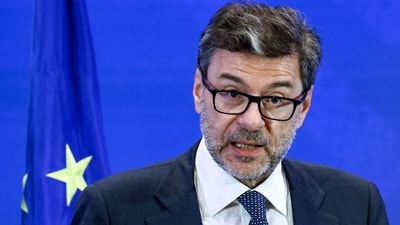
Giancarlo Giorgetti, Italy's finance minister, speaks during a World Savings Day event in Rome, Italy, on Tuesday, Oct. 31, 2023(Alessia Pierdomenico/Bloomberg)
Giancarlo Giorgetti, Italy’s finance minister, speaks during a World Savings Day event in Rome, Italy, on Tuesday, Oct. 31, 2023(Alessia Pierdomenico/Bloomberg)

Over half of the package, worth some 30 billion euros ($31 billion), is devoted to cuts to tax and social security contributions for low- and middle-income earners.

Rome is having to perform a fine fiscal balancing act, after Brussels took Italy to task earlier this year over its debt worth nearly 3 trillion euros, the second highest as a proportion of gross domestic product (GDP) in the European Union.

Also Read: Pro-Russian hacker group claims cyberattack on Italy’s foreign ministry, airports

Meloni’s hard-right coalition has committed to reducing the public deficit to 3.3 percent of GDP in 2025, down from an expected 3.8 percent this year.

But the budget comes amid slowing growth, with the ISTAT national statistics office estimating GDP this year to increase just 0.5 percent — half what it forecast in June.

The measures approved include making permanent a merging of the lower two income tax brackets, so people earning 28,000 euros a year can pay 23 percent instead of 25 percent.

And the budget expands the number of people eligible for a reduction of social or tax charges.

Also Read: Italy vows to work ‘tirelessly’ for release of journalist arrested in Iran

Meloni’s far-right Brothers of Italy party is also trying to boost Italy’s flagging birth rate, and the budget allocates a 1,000-euro bonus per newborn for families earning up to 40,000 euros a year.

Environmental associations have complained there is little for tackling man-made climate change, though Rome is scrapping a bonus for gas-fired boilers, under pressure from Brussels.

Instead, buyers of energy-efficient household appliances will be eligible for a bonus of up to 100 euros — rising to 200 euros for households earning under 25,000 euros.

Companies that boost hiring and reinvest part of their profits will be able to benefit from a reduction in the corporate tax rate, which drops from 24 percent to 20 percent.

Also Read: Italian journalist under arrest for more than a week in Iran, says Italy

This new measure is partly financed by Italy’s banking sector, which has been asked to contribute a total of 3.4 billion euros for the 2025 and 2026 budgets.

They have agreed to postpone tax credits for these two years to provide liquidity to the Italian state, which should repay them later.


Putin apologises for Azerbaijan Airlines plane crash, without saying Russia at fault

0
Putin apologises for Azerbaijan Airlines plane crash, without saying Russia at fault


Russia’s President Vladimir Putin has apologised to the president of neighbouring Azerbaijan for the downing of a commercial airliner in Russian airspace, in which 38 people were killed – but stopped short of saying Russia was responsible.

In his first comments on the Christmas Day crash, Putin said the “tragic incident” had occurred when Russian air defence systems were actively repelling Ukrainian drones.

It had been reported the plane came under fire from Russian air defence systems as it tried to land in Chechnya – forcing it to divert across the Caspian Sea.

It crash-landed in Kazakhstan, killing 38 of the 67 on board.

The Kremlin released a statement on Saturday noting Putin had spoken to Azerbaijan’s president Ilham Aliyev by phone.

“(President) Vladimir Putin apologised for the tragic incident that occurred in Russian airspace and once again expressed his deep and sincere condolences to the families of the victims and wished a speedy recovery to the injured,” the statement said.

Prior to Saturday, the Kremlin had not yet commented on the crash. But Russian aviation authorities had said the situation in the region was “very complicated” due to Ukrainian drone strikes on Chechnya.

Aviation experts and others in Azerbaijan believe the plane’s GPS systems were affected by electronic jamming and it was then damaged by shrapnel from Russian air-defence missile blasts.

Survivors had previously reported hearing loud bangs before the plane crashed, suggesting it had been targeted.

Azerbaijan had not officially accused Russia this week, but the country’s transport minister said the plane was subject to “external interference” and damaged inside and out as it tried to land.


Reliance acquires Karkinos Healthcare for Rs 375 crore

0
Reliance acquires Karkinos Healthcare for Rs 375 crore


Reliance acquires Karkinos Healthcare for Rs 375 crore

NEW DELHI: Billionaire Mukesh Ambani‘s Reliance Industries has acquired technology-driven and oncology-focused healthcare platform Karkinos for Rs 375 crore, the firm said on Saturday. Reliance Strategic Business Ventures (RSBVL), a wholly-owned subsidiary of Mumbai-listed India’s most valuable company, completed the acquisition of Karkinos Healthcare Pvt Ltd with allotment of requisite shares, the firm said in a stock exchange filing.
Karkinos was incorporated in India on July 24, 2020, and is in the business of providing technology-driven innovative solutions for the early detection, diagnosis, and management of cancer. It had a turnover of about Rs 22 crore in the 2022-23 fiscal.
“Reliance Strategic Business Ventures Ltd has on December 27, 2024, subscribed to and has been allotted 1 crore equity shares of Rs 10 each, for cash, aggregating Rs 10 crore and 36.5 crore optionally fully convertible debentures of Rs 10 each, for cash, aggregating Rs 365 crore of Karkinos,” according to the filing.
Karkinos, it said, has cancelled the existing outstanding 30,075 equity shares held by the erstwhile shareholders of the company in accordance with the approved resolution plan.
It, however, did not give details.
Its previous prominent investors included Ewart Investments Limited (100 per cent subsidiary of Tata Sons), Reliance Digital Health Ltd (a subsidiary of Reliance Industries), Mayo Clinic (US), Sundar Raman (Director at Reliance Foundation Youth Sports and former COO of Indian Premier League since 2008), and Ravi Kant (ex-MD of Tata Motors).
The company is focused on providing end-to-end services relating to early detection and effective treatment of cancer at substantially lower than prevailing rates, while still generating healthy profitability. In order to meet this vision, Karkinos started partnering with hospitals to provide oncology services (testing, radiation therapy, etc.).
The company has partnered with around 60 hospitals till December 2023. It is through a subsidiary setting up a 150-bed multispecialty cancer hospital at Imphal, Manipur. Going forward, its source of income was said to be via Advanced Cancer Care Diagnostics and Research (ACCDR), Distributed Cancer Care Network (DCCN), tie-ups with corporates for early diagnosis of cancer, and cancer care hospitals.
“The acquisition of Karkinos will help expand the health services business portfolio of the Reliance group,” the filing said.
The resolution plan for Karkinos was approved by the National Company Law Tribunal (NCLT), Mumbai Bench, and no additional governmental or regulatory approvals were needed for the transaction, it added.
Earlier, on December 10, Reliance announced that the NCLT had approved the resolution plan submitted by RSBVL for Karkinos under the Corporate Insolvency Resolution Process of the Insolvency and Bankruptcy Code, 2016.