Wednesday, September 30, 2026
Home Blog Page 7004

Sajad Shakoor brings hope and halal meals to California prisoners | Fork the System

0
Sajad Shakoor brings hope and halal meals to California prisoners | Fork the System


A visit to the mosque was not the only thing on Shakoor’s mind after he got his freedom back.

Like many formerly incarcerated people re-entering society, there was a long list of needs to attend to, many complicated by his status as a person with a felony conviction: securing housing, catching up with loved ones, finding work.

He fared better than most, getting a job at a Bay Area Middle Eastern restaurant called Falafel Corner several weeks after his release. The skills he had fine-tuned with makeshift hot plates in his cell and prison kitchens were now put to work building a new career, and he quickly moved up to managing the restaurant.

In 2016, the restaurant opened a second location in Sacramento, and in 2018, Shakoor bought out the former owner. He says the business now has more than 30 franchises around northern California.

If cooking was one skill that Shakoor continued to build after leaving prison, his interest in criminal justice reform work was another.

Sajad Shakoor serving food to a customer at his restaurant
Sajad Shakoor serving food to a customer at his restaurant [Brian Osgood/Al Jazeera]

In 2014, Shakoor, who had remotely obtained a degree from Ohio University while incarcerated, testified at the State Senate in support of SB 1391, which expanded access to college education for people incarcerated in California’s prisons. The bill was passed and signed into law in September 2014.

In 2023, he also became a vocal supporter of SB 309, which created universal standards applying to religious grooming and headwear across California’s detention facilities.

He drew on his own experiences of harassment for expression of religious devotion behind bars, recalling an incident in 2002 when he was sent to solitary confinement for seven days for refusing to remove his chitrali cap, important to his identity as a Muslim of Pakistani heritage.

But perhaps his favourite type of activism has come in the form of sharing food and worship with fellow Muslims in prisons across the state, a practice he began in 2017.

He says he typically does about five such visits per year, sometimes as many as 10. They are no small task, requiring hours of cooking and the even more strenuous ordeal of navigating the exhausting bureaucracy of the prison system.

But Shakoor sees the events as a source of fellowship and optimism for the prisoners in a situation that can otherwise feel oppressively hopeless.

During his time in San Quentin, when he still believed he would spend the rest of his life behind bars, he recalls becoming enamoured with a pair of flowers that had managed to sprout up from a crag of inhospitable rock.

“We can’t always change our surroundings, just as that flower couldn’t,” he says. “But we can learn to rise above the things holding us down and use our surroundings to cultivate us.”

Back in the room in Solano decorated with colourful murals, Kali, the 69-year-old man savouring his burrito, whom Shakoor has known since they were both incarcerated in Pleasant Valley State Prison, talks about the purpose and sense of peace that he has found through Islam.

He first converted in 1992, during a stint in solitary confinement, where he took what he called a “moral inventory” of himself by diving into the Bible and the Quran.

For many condemned to life in prison, religion offers a means of resisting, if never entirely escaping, the downward pressure of despair that comes with a life that is forever confined.

The physical proximity of the free world, often visible just beyond a window or a concertina fence, only adds to the tantalising sense of foreclosed possibility. In such circumstances, it seems miraculous that sources of warmth, creativity, and fellowship emerge at all.

It is a feeling that Shakoor deeply understands, and that Kali says he now helps others try to live with by leading anger management classes in Solano.

He quotes his favourite verse from the Quran: “Verily, with the hardship, there comes ease.”


Ola Electric Mobility: Ola Electric opens 3,200 stores amid year of consumer complaint woes

0
Ola Electric Mobility: Ola Electric opens 3,200 stores amid year of consumer complaint woes


Ola Electric opens 3,200 stores amid year of consumer complaint woes
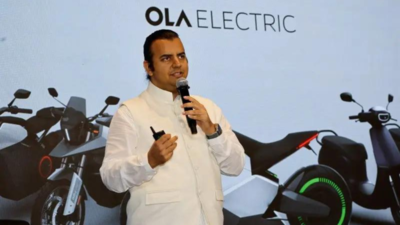
File photo: Ola co-founder Bhavish Aggarwal (Picture credit: Reuters)

Ola Electric Mobility Ltd. announced opening of 3,200 new stores in a single day, as India’s biggest e-scooter maker seeks to expand its local footprint and address customer frustration related to shortcomings in service.
The Bengaluru-based Ola Electric has increased the number of showrooms and service centers to 4,000, Ankush Aggarwal, group head of financial services and retail auto business, said at an even on Wednesday.
The company, led by co-founder Bhavish Aggarwal, is looking to penetrate India’s small towns as well as bolster its after-sales service. “By leveraging its direct-to-consumer (D2C) model, Ola is ensuring that EV ownership becomes a reality for every household,” the company said in an exchange filing last week.
Ola Electric’s single-day store launch blitz marks its attempts to revive its market share and reputation after a tumultuous year marked by a blockbuster listing in August followed by an onslaught of consumer complaints regulatory scrutiny and a heated spat between its chairman and a stand-up comedian.

Almost every Indian town, city and district would have an Ola Electric store and a service center, its Chairman Bhavish Aggarwal said in a Dec. 19 video posted on X. The milestone was initially expected on Dec 20 but later pushed to Dec 25.
The massive rollout comes a couple of months after it got slammed by service and performance-linked customer complaints. A monthly runrate of 80,000 such complaints were overwhelming its service centers, according to local media reports.
Videos and photos of malfunctioning Ola Scooters circulating on social media while Aggarwal had a social media altercation with an Indian comedian, who criticized the company’s flagship model.
Reputational Turnaround
“Their service network is an area the company is trying to address” as it scripts a reputational turnaround, Jinesh Gandhi, analyst at Ambit Capital Pvt., told Bloomberg News.
India’s heavy industry ministry ordered an audit of the firm’s servicing hubs in October, Reuters reported, and the Central Consumer Protection Authority served a notice in October over alleged violation of customer rights, misleading ads and unfair trade practices.
This has led to market share loss for the sector leader — it dropped to 24.5% in November versus 32.6% in the same month last year. Ola Electric shares are now trading about 40% lower from their peak in August after the strong listing.
The store expansion plans might help lift its market share that is under pressure from rival automakers such as Bajaj Auto Ltd. and TVS Motor Co.
Though Ola Electric in November launched e-scooters for gig workers who are powering India’s quick commerce economy, competition is fierce in one of the world’s biggest two-wheeler markets.
India’s No. 2 two-wheeler maker Honda Motorcycle and Scooter India Pvt. has also launched the electric version of India’s topselling scooter Activa.
The store openings are also in preparation of the upcoming vehicle launches, Ambit’s Gandhi said. “The bigger challenge they need to address is getting the product quality right from day one of the launch.”


Former Chief Justice of Manipur High Court

0
Former Chief Justice of Manipur High Court


New Delhi:

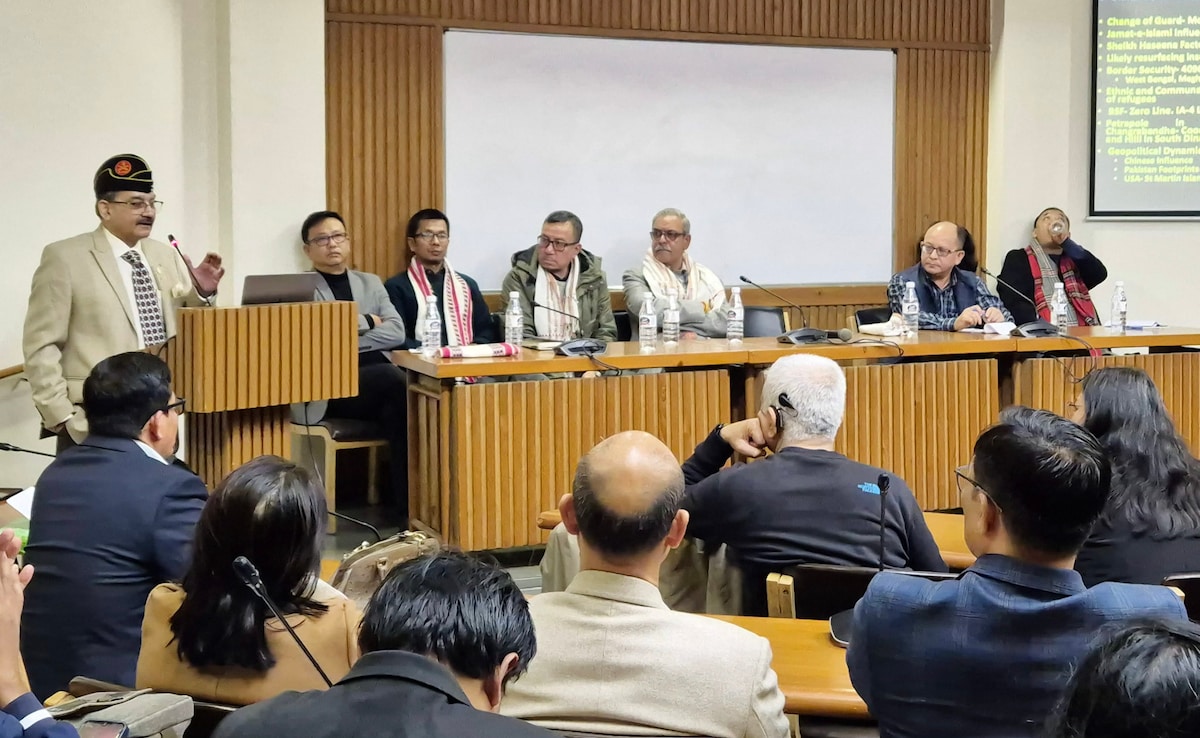
Former Chief Justice of Manipur High Court Siddharth Mridul said at an event in Delhi on Tuesday that nothing is more important than ensuring rule of law and disarming all armed groups to bring peace in violence-hit Manipur.

To NDTV’s question on whether some civil society organizations are threatening internally displaced people or IDPs to return to their remaining homes to rebuild them with government support and protection, Justice Mridul said, “IDPs are not their (Some organizations’) are hostages. Let’s be clear.”

“They can return home, provided we create a conducive environment for their return home, which will bring us back to the rule of law. Once law and order is restored and there will be rule of law, and the groups will be deprived of all illegal weapons. Whatever they have has been given, it has either been looted or smuggled, and this is being negotiated under the auspices of the government, this is the only way forward, apart from external factors because I believe Manipur curious about, i’m sure the outer There are factors, but I am no expert on that,” said Justice Mridul, who served as Chief Justice of the Manipur High Court from October 2023 till his retirement last month.

The valley-dominant Meitei community and more than a dozen separate tribes, collectively known as the Kukis, who are dominant in some hilly areas of Manipur, have been fighting since ethnic conflict broke out between the two in May 2023. At least 50,000 people have been displaced.

Kuki tribes also include ‘any Kuki tribe’, which was added to the Scheduled Tribe (ST) list in 2003 when the Congress was in power in the state under Chief Minister Okram Ibobi Singh.

Justice Mridul reiterated what the Supreme Court had said in November 2023 about “keeping the pot boiling” while hearing the report of the court-appointed committee, which flagged disturbing actions by civil society organizations that Contributed to maintaining ethnic tension in Manipur.

“…The reason I believe anyone is interested in boiling the pot is because every time the situation seems to be returning to normal, there is a new injection of violence, which leads me to believe that There are forces – and if I were to believe the General, the forces are external, not internal. Even if the forces are external, they have allies at the local level to ensure that the agenda of keeping Manipur burning is vigorously pursued. Go, “Justice Mridul said, referring to a presentation. Major General Rajan Kochhar (Retd) at the Delhi event.

He said, “I am beginning to believe in the idea that there appears to be an invisible hand. Whose hand it is is not yet clear to me. There could be many factors involved.”

Latest and breaking news on NDTV

Justice Mridul had worked closely with state officials during his stay in Manipur. He said that although there was no violence for some time, normalcy has not been restored in Manipur at any level since May last year.

“…You must understand the separation of powers. My conversation with the executive was purely to ensure that the judiciary was able to discharge its function. These are not political discussions, these should never be political discussions. “But the impression I got was that – I could be wrong, I could be very wrong – it looks like no one is in command of the ship,” he said.

“The point is that unless there is disarmament, unless the weapons that were looted, snatched, whatever, are recovered, and unless the people with weapons smuggled across the border are stopped and the weapons are recovered from them, “There is no possibility of peace returning to Manipur,” Justice Mridul said. “The armed people will not allow you to return to your homes or live in peace.”

“Trust is important”: Major General Rajan Kochhar (Retd)

Major General Kochhar said that trust is the most important factor for normalizing Manipur.

“Without trust, there will be all kinds of forces – you can call them internal, you can call them external – that will increase division. I’ve listened to everyone here. Everyone agrees there has to be peace. What kind of peace is this to bring, is the big question,” said Major General Kochhar of the VSM, who retired after 37 years of service.

“A large number of people have come to Manipur from Myanmar… It is very important for the local community to identify militants among the civilians. It is the responsibility of the community. Unless we do that, we are creating a buffer zone within ourselves. ” Your state. This cannot be. Lebanon, the Blue Line, was a buffer zone created between the two warring countries to prevent the war from escalating. How can you create a buffer zone within yourself? Major General Kochhar said, “Restricting the state and the movement of people from one place to another is a big question which I think both the communities need to answer.”

Latest and breaking news on NDTV

Dr Arambam Noni, associate professor at Imphal-based DM University and one of the speakers at the Delhi event, took the “unsustainable and obsolete demand” for an ethnocentric homeland further with his remarks, which he made at a side event of the 57th session. United Nations Human Rights Council (UNHRC) in Geneva in early October.

ethnocentric homeland

“Ethnic political leaders are playing a dangerous game. They want to end overlapping spaces. When they end overlapping spaces in a state like Manipur where 35 officially recognized communities live, some of which have a population of only 600, or 1,000 people, they will cease to exist. The danger is that if we allow these overlapping spaces to be abolished, they will only increase the demand for ethnic-centric political spaces and it will set a very dangerous precedent. “By supporting an ethnocentric motherland because the Constitution does not actually acknowledge the possibility of an ethnocentric motherland,” Dr. Noni said.

He said the question that needs to be answered is whether the modern state can allow continued movement of population across borders in the name of culture, or whether the modern state can accommodate them.

“Do you have any mechanisms in the modern state system to accommodate these free-flow movements of population, not only for cultural cohesion but also for territorial cohesion? This is problematic. I think modern states have a common There is no such mechanism to deal with these continued, territorial encroachments of identity because modern states fundamentally stand on fixed territoriality and sovereignty. What is happening in North-East India is the porousness of the fixed idea of ​​state.

“I do not see any problem in the cultural transformation of people across borders. But I do see a problem in the continued assimilation of identities to an ethnically centric motherland. This will certainly create conflicts with overlapping places like Manipur, which is a multicultural Having said that, I think our problem is very complex. The weaponization of identity is not good because the media or academic society should not get trapped in the binaries they believe in. There are… because there are other aspects of our social world, and we must also acknowledge those resources that can unite people, not divide people.

No comfortable life in relief camps

“The institutions need to be democratised. There should be fair development and redistribution of resources… The second suggestion I would like to make is – as Justice Mridul has already said – that you should allow the IDPs to return home Because it is their fundamental right, you cannot give them a comfortable life in relief camps,” Dr Noni said in a panel discussion ‘Northeast India and Manipur’ organized by TMP Manipur, Meitei Alliance and Manipur International. Understanding the Barriers to Violence: The Way Forward’ said in the Youth Centre.

Latest and breaking news on NDTV

This is the second winter that internally displaced people in Manipur are spending in relief camps.

10 MLAs from the Kuki tribe and Zo people and their civil society groups have said that talks are not possible unless Manipur Chief Minister N Biren Singh resigns. Kuki tribes also blame him for allegedly starting the Manipur crisis; He has further strengthened this allegation Leaked tape controversy,

Kuki leaders have sought a political solution in the form of a separate administration before discussing any other issues, including the return of thousands of people living in relief camps.

Meitei leaders have cited this condition alleging that Kuki leaders are demanding an ethnocentric homeland; Meitei leaders argue that negotiations can continue and also that people living in difficult conditions in the camps can return home because no area is ethnically specific.

There are many villages of Kuki tribes in the hills surrounding the Meitei dominated valley districts.

The general category Meiteis want to be included under the Scheduled Tribe category, while the Kukis, who share ethnic ties with the people of Chin State and Mizoram of neighboring Myanmar, have cited discrimination against the Meiteis and lack of access to resources and power as some of the reasons behind their Unequal sharing has been cited. Call for separation.



Zelensky condemns “inhumane” Russia Christmas Day attack

0
Zelensky condemns “inhumane” Russia Christmas Day attack


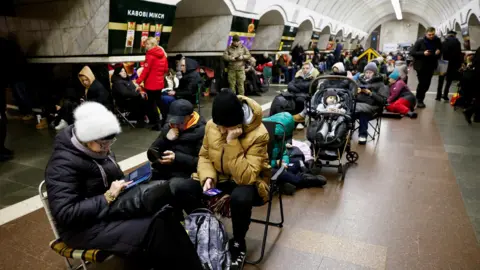
Reuters People sheltering inside a metro station, all dressed warmly. Most are sitting on fold-out chairs, while others are on the floor or standing. There is also a baby in a pram.Reuters

Many Kyiv residents sheltered in metro stations

Ukrainian President Volodymyr Zelensky says Russia made a “conscious choice” by launching a major attack on his country’s energy infrastructure on Christmas Day.

Ukraine’s air force said it had detected 184 missiles and drones, but many were shot down or missed their targets.

It said there were casualties from the strikes but gave no figures.

Moscow confirmed the attack and said its goal had been achieved.

The attack led to power cuts across the country, including in the capital Kyiv, where some residents sheltered in metro stations.

Russia’s defence confirmed its forces had carried out a “massive strike” on “critical” energy facilities in Ukraine.

It added that the strike had been a success and all targets were hit.

This was the 13th major attack on Ukraine’s energy sector this year, the country’s largest private energy company, DTEK, said.

In September, President Zelensky said 80% of Ukraine’s energy infrastructure had been destroyed by Russian bombs.

Responding to Wednesday’s attacks, Zelensky said the timing had been a “conscious choice”.

He called them “inhumane” and said work was being done to restore power as soon as possible.

“Russian evil will not break Ukraine and will not distort Christmas”, he added.

This is the second time Ukraine has celebrated Christmas Day on 25 December. It traditionally followed the Julian calendar, like Russia, where Christmas falls on 7 January.

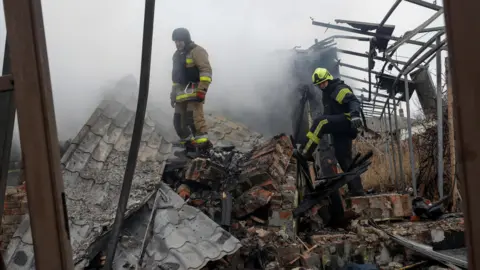
Reuters Firefighters work at the site of residential buildings hit by a Russian drone strikeReuters

Damage was recorded to 74 buildings in Kharkiv, the city’s mayor said

In the north-eastern city of Kharkiv – Ukraine’s second largest – the attack left half a million people without water, electricity or heating in bitterly cold temperatures, the regional governor said.

Ukrainians across the country woke to sound of air raid alarms, and were told to shelter as the attacks unfolded in the morning.

Kyiv residents sheltered in metro stations, with one local telling Reuters news agency that she felt angry and frightened.

“Of course, I want to be at home and celebrate, but we had to shelter because it’s scary to stay at home,” Sofiia Lytvynenko said.

Another Kyiv resident, Oleksandra, said that despite the attack, “Christmas is not cancelled”.

She told Reuters that she planned to enjoy traditional Ukrainian food and drink with family and friends after it is safe to leave the shelter.

Ukraine’s state-owned power company, Ukrenergo, warned Ukrainians that power cuts could last until at least the end of the day.

It has imposed usage restrictions while it tries to restore service.

Meanwhile, Ukrainian Foreign Minister Andrii Sybiha described the strikes as “Christmas terror”.

He said a Russian missile went through Moldovan and Romanian airspace “reminding that Russia threatens not only Ukraine”.

Moldovan President Maia Sandu condemned the strike and confirmed that a missile was detected in the country’s airspace.

Romania said it did not detect a missile in its airspace.

Elsewhere, four people were killed and five others injured by Ukrainian shelling in Russia’s Kursk region, according to the region’s acting governor.


Govt Aims To Cut Fiscal Deficit To 4.5% Of GDP In 2025-26 | Economy News

0
Govt Aims To Cut Fiscal Deficit To 4.5% Of GDP In 2025-26 | Economy News


The government will continue its focus on improving quality spending, strengthening the social security net and reducing the fiscal deficit to 4.5 per cent of the GDP in the financial year 2025-2026, according to a Finance Ministry statement.  

Finance Minister Nirmala Sitharaman is expected to continue with the government’s position of increasing expenditure on big-ticket infrastructure projects and social welfare schemes for the poor while keeping the fiscal deficit in check when she presents the Union Budget for 2025-26 in Parliament on February 1.

The government is committed to pursuing the glide path of fiscal consolidation which aims to lower the fiscal deficit to 4.5 per cent of GDP by financial year 2025-26, according to Finance Ministry statements on the half-yearly review of the trends in receipts and expenditure.

“The thrust will be on improving the quality of public spending, while at the same time, strengthening the social security net for the poor and needy. This approach would help further strengthen the nation’s macro-economic fundamentals and ensure overall financial stability,” the review said.

According to the statements, the Budget 2024-25 was presented against the backdrop of global uncertainties caused by the wars in Europe and the Middle East. India’s sound macroeconomic fundamentals have cushioned the country from the vagaries afflicting the global economy.

“It has also helped the nation pursue growth with fiscal consolidation. As a result, India retains its pride of place as one of the fastest-growing economies in the world. However, risks to growth still remain,” it said.

Total expenditure was estimated at Rs 48.21 lakh crore, of which, expenditure on the revenue account and capital account were estimated at Rs 37.09 lakh crore and Rs 11.11 lakh crore, respectively, as per the Budget Estimate for 2024-25. As against the total expenditure of Rs 48.21 lakh crore, the expenditure in the first half of fiscal 2025 was Rs 21.11 lakh crore or about 43.8 per cent of BE.

Taking into account the grant for the creation of capital assets, the effective capital expenditure was projected at Rs 15.02 lakh crore. Gross Tax Revenue was estimated at Rs 38.40 lakh crore with an implied tax-GDP ratio of 11.8 per cent.

Total non-debt receipt of the Centre was estimated at Rs 32.07 lakh crore. It comprised tax revenue (net to Centre) of Rs 25.83 lakh crore, non-tax revenue of Rs 5.46 lakh crore, and miscellaneous capital receipts of Rs 0.78 lakh crore.

With these estimates of receipts and expenditure, the fiscal deficit was pegged at Rs 16.13 lakh crore in BE 2024-25 or 4.9 per cent of the GDP. In the first half of 20234-25, the fiscal deficit is estimated at Rs 4.75 lakh crore, or about 29.4 per cent of BE.

India’s net direct tax collections, comprising corporate tax and personal income tax, shot up by a robust 15.4 per cent to Rs 12.1 lakh crore, from April 1 to November 10 during the current financial year, according to the latest figures released by the Central Board of Direct Taxes (CBDT). Similarly, there has been a robust growth in GST collections on the back of rising economic activity.

The buoyancy in tax collections places more funds in the government’s coffers and will help to control the fiscal deficit which bolsters the macroeconomic fundamentals of the economy. A lower fiscal deficit means the government has to borrow less which leaves more money in the banking system for big companies to borrow and invest.

This in turn leads to a higher economic growth rate and the creation of more jobs. Besides, a low fiscal deficit also keeps the inflation rate in check which imparts stability to the economy.


Syrian Christians attend first Christmas Eve service since al-Assad’s fall | Religion News

0
Syrian Christians attend first Christmas Eve service since al-Assad’s fall | Religion News


Syrian Christians have attended Christmas Eve services for the first time since the overthrow of President Bashar al-Assad in early December.

In Sednaya, Syria, a large crowd gathered near a historic monastery on Christmas Eve to witness the lighting of a towering tree adorned with glowing green lights.

The celebration offered a rare moment of joy in a city scarred by more than a decade of war and its infamous prison, where tens of thousands were held.

Families and friends stood by the illuminated tree, some wearing Santa hats, others watching from rooftops, while a band played festive music and fireworks lit up the sky.

“This year is different, there’s happiness, victory and a new birth for Syria and a new birth for Christ,” said attendee Houssam Saadeh.

Another, Joseph Khabbaz, expressed hope for unity across all sects and religions in Syria.

The pews of Lady of Damascus Church in Syria’s capital filled with a mixed congregation of young and old, holding candles as hymns filled the air and echoed through the church.

Hours before the service, hundreds of protesters in Damascus had gathered to denounce an incident in which a Christmas tree was burned in the northern countryside of Hama governorate in western-central Syria.

Carrying wooden crosses, they chanted, “We are your soldiers, Jesus”, “With our blood and soul, we sacrifice for Jesus,” and “The Syrian people are one.”


Ex-comedian, ex-Goldman analyst to advise Japan stock fund

0
Ex-comedian, ex-Goldman analyst to advise Japan stock fund


A former comedian and an ex-Goldman Sachs Group Inc. analyst will be offering investment advice for a Japanese equity fund that will be launching in January, according to a report by Bloomberg.

Comedian-turned-investor Toshiya Imura speaks during an interview with Reuters in Tokyo, Japan December 3, 2024(Kim Kyung-Hoon/Reuters)

This fund will be run by a Tokyo-based asset management firm called Fundnote.

Also Read: Will popcorn sold in movie theatres become more expensive? Here’s how much GST will be levied

It will invest in stocks with limited downside risk by looking at their price-earnings ratio and price-to-cash flow ratio, along with other measures, according to its website.

It also looks to achieve alpha. Alpha refers to the excess returns higher than a benchmark investment return. It is calculated by subtracting the total return of an investment from the benchmark returns over the same period of time.

The comedian-turned investor is Toshiya Imura, boasting more than 334,000 followers on X (Formerly Twitter) and whose disclosed holdings have moved shares in the past, according to the report.

Also Read: Flexible workspaces provider IndiQube Spaces files for ₹850 crore IPO

Meanwhile, the former Goldman analyst is Keizo Takeiri. Both of them will together advise on the fund, initially limited to ¥10 billion ($63.5 million).

However, the fund doesn’t qualify for a tax-free investment scheme for individuals in Japan, called NISA, according to the report which cited its registration statement. Thus, it may not be able to fully capture demand from retail investors.

This comes at a time when Japanese stocks have seen increased volatility, but are also expected to end higher in the year, according to the report.

Also Read: Honda, Nissan deal could be important for a comeback against China’s BYD

It’s because the Bank of Japan is expected to hike rates next year, which also comes at a time when the incoming Trump administration is already causing market uncertainties.


Dozens die in Azerbaijan Airlines accident

0
Dozens die in Azerbaijan Airlines accident


Dozens of people have died after a passenger plane crashed with 67 people on board in Kazakhstan, local officials say.

Authorities in Azerbaijan, where the flight originated, say there were at least 30 survivors.

Azerbaijan Airlines flight J2-8243 caught fire as it attempted to make an emergency landing near the Kazakh city of Aktau.

The plane was en route to Grozny in Russia but it was diverted due to fog, the airline told the BBC.

Video verified by Reuters news agency shows the plane heading towards the ground at high speed, with its landing gear down.

Seconds after it seems to attempt to land, a huge fireball erupts.

The airline said the plane “made an emergency landing” about 3km (1.9 miles) from Aktau.

It took off from the Azerbaijani capital Baku at 03:55 GMT on Wednesday, and crashed around 06:28, data from flight-tracking website Flightradar24 showed.

There were 62 passengers and 5 crew members on board the Embraer 190 aircraft, the transport ministry said.

Those on board were mostly Azerbaijani nationals, but there were also some passengers from Russia, Kazakhstan, and Kyrgyzstan.

Out of the 25 known survivors, 22 were taken to hospital, the emergency ministry said.

Unverified video footage showed emergency services pulling people out of the wreckage and survivors crawling out.

Both Azerbaijan and Kazakhstan have launched investigations into the cause of the accident. Embraer told the BBC it was “ready to assist all relevant authorities”.

The BBC has contacted Azerbaijan Airlines for comment.

The aircraft involved was an Embraer E190, the Brazilian company is a smaller rival to Boeing and Airbus, it traditionally has a strong safety record.


Auto industry rides on partnerships, joint ventures

0
Auto industry rides on partnerships, joint ventures


Auto industry rides on partnerships, joint ventures

NEW DELHI: As Nissan and Honda look to work out a strategy to combine businesses for survival and higher competitiveness, they are not alone in striking collaborations. Indian car companies and two-wheeler players are increasingly going for tie-ups and joint ventures as they try to strike synergies for efficient product and platform development as well as to achieve cost savings and gain access to better technology.
So, you have Japanese Suzuki (parent of Maruti) and compatriot Toyota at one end, which are co-operating on hybrids, electrics and product sharing, while on the other hand you see Korean siblings Kia and Hyundai are collaborating to understand Indian market better and for component and raw material sourcing.
When it comes to European makers, the Stellantis group, which has brands, such as Jeep and Citroen, is making cars in collaboration with Tata Motors at Pune. This relationship stems from an old manufacturing alliance that Tatas had with Italian Fiat, which is now part of the Stellantis group.
Despite having global issues with alliance partner Nissan, French company Renault churns out cars from a joint factory around Chennai. If Honda joins hands with Nissan, it will be interesting to watch how the Renault-Nissan India factory figures into the deal, considering Honda has a factory in Greater Noida (UP) and Alwar (Rajasthan).
Mahindra & Mahindra is working with German Volkswagen group for components on electrics and the two companies are now in talks for a broader and more product-oriented JV.
The situation is no less different in case of two-wheelers where Bajaj has partnered KTM for churning out powerful bikes. TVS Motor has a partnership with German BMW Motorrad for making 310cc motorcycles. The alliance has already spanned a decade and is expanding to other products and platforms. As the partnership completed a decade last year, K N Radhakrishnan, director & CEO of TVS Motor, described its success on “shared values of innovation, quality, customer delight and engineering prowess.”
“Aligning with our EV-led global vision for growth, we are proud to extend this partnership with cutting-edge technologies and sustainable mobility solutions. In this next stage of our partnership, we are creating opportunities to jointly design and develop common platforms,” Radhakrishnan said.
After a disappointing run in India, Harley-Davidson has decided to come back in partnership with Hero MotoCorp. Hero is making Harley’s mid-powered motorcycles in India, which are also being exported to global markets.
The move has also benefited Hero, like TVS gained with BMW Motorrad. “Hero expects a big push to its desire for having a bigger share in the premium and high-margin market through partnership with Harley. Hero believes in long relationships. I’m sure we will go for a long, long haul with Harley,” Hero Moto chairman Munjal said.


From Fighters to Policemen in a Post-Assad Damascus

0
From Fighters to Policemen in a Post-Assad Damascus


new video loaded: From Fighters to Policemen in a Post-Assad Damascus

transcript

transcript

From Fighters to Policemen in a Post-Assad Damascus

As the rebels who ousted Syria’s longtime dictator, Bashar al-Assad, transition from insurgents to administrators, maintaining order in the streets of the capital has become a top priority.

Until recently, these men were at war with the Syrian government. Now, they’re manning checkpoints across the capital. They’re former fighters for Hayat Tahrir al-Sham, or H.T.S. The Islamist group, once an Al Qaeda affiliate, overthrew the government of Bashar al-Assad in early December. After 13 years of civil war, restoring security is one of the top priorities for H.T.S. The group has installed people like Basel al-Helal, a former rebel, to head the police in Damascus. The fighters turned police now control traffic and are trying to return property that was looted during the recent government overthrow. They also say their mission is to conduct raids to apprehend drug dealers, thieves and former government officials. Before ousting al-Assad, H.T.S. ran a local government in a part of northern Syria that it controlled. There, it was accused of rights abuses, including the jailing of critics. This has some people worried. They are concerned about how H.T.S. will govern now that it controls a much larger and more diverse part of the country. These H.T.S. fighters say concerns about them are misplaced.

Recent episodes in Conflict in Syria