Tuesday, September 29, 2026
Home Blog Page 7029

Best heaters for office under ₹3000: Top 7 options that offer comfort and energy efficiency

0
Best heaters for office under ₹3000: Top 7 options that offer comfort and energy efficiency


Staying warm in the office is essential to maintain comfort and productivity, especially during the colder months. A reliable heater can transform your workspace, whether you’re in a compact cubicle or a large open office. Choosing the right heater ensures consistent heat without putting a strain on your budget.

The 3000 ensures warmth, energy savings and portability for comfortable workplaces.’ title=’Office Heater Under 3000 ensuring warmth, energy savings and portability for comfortable workplaces.” />₹3000 ensuring warmth, energy savings and portability for comfortable workplaces.’ title=’Office Heater Under 3000 ensuring warmth, energy savings and portability for comfortable workplaces.” />
office heater down The 3000 ensures warmth, energy savings and portability for comfortable workplaces.

To help you find the right solution, we’ve compiled a list of the best office heaters 3000. These affordable options include portable models for easy movement and energy-efficient designs to save electricity costs. Whether you need targeted heating or consistent heat in your workspace, these heaters are practical and budget-friendly.

Stay comfortable and focused with these reliable options that balance performance, efficiency, and cost-effectiveness. No matter what the size or layout of your office, you’re sure to find a heater that will meet your needs while keeping you comfortable all day long.

₹3000: Top 7 options that offer comfort and energy efficiency” data-vars-section=’product hub’ data-vars-formatType=”>

₹3000: Top 7 options that offer comfort and energy efficiency” data-title = “B0DNJ99L2Z’ = “” data-vars-index = 1 data-vars-position = “1” >

The Byrzone Electric Portable Heater is a versatile option for keeping your office warm. With advanced safety features and adjustable temperature settings, this heater is ideal for small to medium-sized workspaces.

Specifications of Cretazone Electric Portable Heater

  • adjustable temperature settings
  • advanced security protection
  • Portable and lightweight design
  • energy-efficient operation
  • Suitable for bedroom use
reason to buy reasons to avoid
Adjustable temperature settings for personal comfort May not be suitable for large office spaces
Advanced safety features for worry-free operation

₹3000: Top 7 options that offer comfort and energy efficiency” data-title = “B0BDRZW32B’ = “” data-vars-index=2 data-vars-position = “2” >

Orient Electric Convector Heater HC2004D delivers powerful heating performance with noise-free operation. Its compact design and durable construction make it a great choice for office use.

Specifications of Orient Electric Convector Heater HC2004D

  • powerful convection heating
  • noise free operation
  • sustainable construction
  • Compact and space saving design
  • Multiple heat settings
reason to buy reasons to avoid
Powerful convection heating for quick heat Can be very powerful for small workspaces
Noise-free operation for quiet working environment

₹3000: Top 7 options that offer comfort and energy efficiency” data-title = “B0DNF7PH1Q’ = “” data-vars-index = 3 data-vars-position = “3” >

The Room Techcool portable heater provides advanced security protection and efficient heating for your office. Its portable design and easy-to-use controls make it a convenient choice for any workspace.

Specifications of Room Techcool Portable Heater

  • advanced security protection
  • efficient heating technology
  • Portable and easy to use design
  • quiet operation
  • energy-saving mode
reason to buy reasons to avoid
Advanced security features for worry-free use May not be suitable for large office spaces
Efficient heating technology for consistent warmth

Also read:Interested in a Crompton room heater? Check out our list of the top 6 picks

₹3000: Top 7 options that offer comfort and energy efficiency” data-title=’B0DBLQPPCB’ = “” data-versus-index=4 data-versus-position=’4″ >

The Goodscity ceramic oscillation heater offers wide-angle oscillation and powerful heating performance. With multiple safety features and a 1-year warranty, it is a reliable choice for your office.

Specifications of Goodscity Ceramic Oscillation Heater

  • wide-angle oscillation
  • powerful ceramic heating
  • Multiple security features
  • Portable and lightweight design
  • 1 year warranty
reason to buy reasons to avoid
Wide-angle oscillation for even heating Can be very powerful for small workspaces
Multiple security features for peace of mind

₹3000: Top 7 options that offer comfort and energy efficiency = “” data-versus-index=5 data-versus-position=”5″ >

REDUCKTM Electric Portable Heater provides quick and efficient heating with adjustable temperature settings. Its compact and portable design makes it a great choice for office use.

Specifications of REDUCKTM Electric Portable Heater

  • quick and efficient heating
  • adjustable temperature settings
  • Compact and portable design
  • energy-saving mode
  • quiet operation
reason to buy reasons to avoid
Quick and efficient heating for instant heat May not be suitable for larger office spaces
Compact and portable design for easy placement

₹3000: Top 7 options that offer comfort and energy efficiency” data-title = “B0DNSKZ9G1′ “` data-vers-index = 6 data-vers-position “6’>

FLUZOV Electric Portable Heater offers advanced temperature control and multicolored LED display for easy operation. Its portable design and energy-saving mode make it a versatile choice for any office.

Specifications of FLUZOV Electric Portable Heater

  • advanced temperature control
  • multicolor led display
  • Portable and lightweight design
  • energy-saving mode
  • quiet operation
reason to buy reasons to avoid
Advanced temperature control for personal comfort Can be very powerful for small workspaces
Multicolor LED display for easy operation

Also read:Orpat Room Heater for Every Budget: Top 10 Picks for You

₹3000: Top 7 options that offer comfort and energy efficiency” data-title = “B0DN1SP2BF’ = “” data-vars-index = 7 data-vars-position = “7” >

Embassy Noiseless Room Heater offers powerful heating performance with advanced safety protection. Its noise-free operation and compact design make it a great choice for office use.

Specifications of Embassy Noiseless Room Heater

  • powerful heating performance
  • advanced security protection
  • noise free operation
  • Compact and space saving design
  • energy-efficient operation
reason to buy reasons to avoid
Powerful heating performance for quick heat up Can be very powerful for small workspaces
Advanced security protection for worry-free use

Also read:Best Room Heaters with Oil: Top 8 Oil Heaters to Stay Warm in Extreme Winters on a Budget

Top 3 Features of Best Heater for Office 3000:

Best heater for office 3000 advanced security protection Portable and lightweight design powerful heating performance
Cretazone Electric Portable Heater Yes Yes No
Orient Electric Convector Heater HC2004D No Yes Yes
Room Techcool Portable Heater Yes Yes No
Goodscity Ceramic Oscillation Heater Yes Yes Yes
REDUCK™ Electric Portable Heater No Yes No
FLUZOV Electric Portable Heater No Yes No
Embassy Noiseless Room Heater Yes Yes Yes

Best value for money heater for office 3000:

Room Techcool portable heater stands out as the best value for money with its advanced safety protection, efficient heating technology and portable design. It offers reliable performance at an affordable price, making it a smart choice for budget-conscious buyers.

Also read:Havells heaters: Here are the top 10 models to beat the winter chill

Best overall heater for office 3000:

The Goodscity Ceramic Oscillation Heater takes the top spot for best overall product with its wide-angle oscillation, powerful heating performance, and multiple safety features. This heater provides superior warmth and peace of mind for a comfortable working environment.

Things to keep in mind while choosing the best heater for office 3000:

energy efficiency: Choose heaters with energy-saving features to reduce electricity costs. Look for models with adjustable settings or timers to control power usage.

Size and portability:Compact and lightweight heaters are ideal for offices. Portable models ensure easy placement and flexibility in small or shared workplaces.

safety features:Prefer heaters with essential safety features like overheat protection, tip-over switches, and cool-to-touch exteriors to prevent accidents.

heating capacity: Match heater power to office size for effective heat. Smaller spaces may require lower wattage, while larger areas may require higher capacity.

noise level: Choose a heater with quiet operation to maintain a distraction-free workspace.

similar stories for you

Best Room Heaters in India: Top 10 heaters to keep your indoor living space warm and cozy all winter long

Top room heaters: 10 premium options to match your tastes

Bajaj Room Heater: Choose from our top 10 options that guarantee warmth this winter

Oil Filled Room Heater vs Halogen Heater: Comparison between the two, Best Options and more

FAQs on Heaters for Office Under Rs 3000

  • What are the energy-saving features of these office heaters?

    Many of the office heaters listed above offer energy-saving modes and advanced temperature controls to optimize heating efficiency and reduce power consumption.

  • Are these heaters suitable for large office spaces?

    While some heaters may be more suitable for small to medium-sized offices, others offer powerful heating performance that can effectively heat larger workplaces.

  • Do these heaters come with safety certifications?

    Yes, most of the office heaters mentioned in the list come with advanced safety protections and are designed to meet the safety standards for worry-free operation.

  • What are the warranty terms for these office heaters?

    Warranty terms may vary for each product, but many heaters come with a 1-year warranty to ensure customer satisfaction and peace of mind.

Disclaimer: At Hindustan Times, we help you stay updated with the latest trends and products. Hindustan Times has an affiliate partnership, so we may get a share of the revenue when you make a purchase. We will not be liable for any claims under applicable laws, including but not limited to the Consumer Protection Act, 2019, relating to the Products. The products listed in this article are in no particular order of priority.


Briefly Millionaire! Bihar Student Withdraws Rs 500 From ATM, Finds Rs 87 Crore In Balance–Know What Happens Later | Personal Finance News

0
Briefly Millionaire! Bihar Student Withdraws Rs 500 From ATM, Finds Rs 87 Crore In Balance–Know What Happens Later | Personal Finance News


New Delhi: A Bihar student found himself to be a millionaire when he withdrew money from his ATM, albeit the shock and pleasure of this sudden fortune lasted only for a few hours.

As per a news18 report, the Class 9 student hailing from Bihar’s Muzaffarpur had visited a local cyber cafe during which he withdrew Rs 500 from a nearby ATM. However, once the transaction was over, and much to his shock, he found a staggering Rs 87.65 crore in his account balance.

The student, named Saif Ali, and the cyber cafe owner, still in shock checked the account balance again, only to find that the humongous amount balance remained unchanged in his bank account. 

Saif immediately rushed home to share the news with his mother who subsequently informed another boy in their village locality about the money that was suddenly showing in the former’s bank account.

Later the family went to the Customer Service Point (CSP) for a bank statement, but this time, Rs 87.65 crore balance was no longer visible. The bank statement reflected Rs 532 as balance, which was the correct amount Saif had in his account.

The entire episode lasted only five hours. The North Bihar Gramin Bank launched an internal investigation to probe crediting of this  mind-boggling amount in Saif’s account, reported news18. Although the bank’s officials could not give a clear explanation on the amount credit.

Cyber DSP Seema Devi told Local 18 that the episode could be one of those involvinng cybercrime or cyber fraud during which unscrupulous people could have used Saif’s account for some time, during which the amount appeared in his bank balance. Saif’s family has not formally lodged a complaint with the cyber police station, wrote news18.


Rare accounts of life for women inside notorious Iranian prison

0
Rare accounts of life for women inside notorious Iranian prison


BBC A composite image showing Nasim wearing a baseball cap, with Evin prison in the background. Nasim is wearing make-up and her hair can be seen. The sign on the prison reads Evin House of Detention. The image has been treated so that it has a greyish hue. BBC

Crouched alone on the floor, in a tiny, windowless cell, Nasim could hear what sounded like other prisoners being tortured. The guard would bang on the door and say: “Can you hear that beating? Get ready, you’re next.”

She was “interrogated for 10 to 12 hours every day” and repeatedly threatened with execution.

The bare cell, no more than two metres across, had no bed or toilet. Four months in solitary confinement was the 36-year-old hairdresser’s introduction to Iran’s notorious Evin prison. The only people she saw were her interrogators. She thought that she would “die and no-one would know”.

We have pieced together accounts from multiple reliable sources to build a picture of everyday life for Nasim and other women, who are currently being held in Evin prison.

Many were among the tens of thousands of people arrested in connection with the “Woman, Life, Freedom” protests that followed the death of 22-year-old Mahsa Amini in September 2022. Mahsa had been arrested for allegedly breaking Iranian laws that require women to wear the hijab and she died in police custody.

While people have spoken about conditions in Evin after they have been released, it is rare to get details of inmates’ lives while they are still inside.

UGC A photograph of Nasim shows her smiling on a sunny day, with grass in the background. She is wearing sunglasses, has a pierced lower lip and her dark brown hair is long with a fringe. UGC

Nasim worked as a hairdresser before she was arrested in April 2023

What we have heard reveals not only brutality, but a place of complex contrasts where the prisoners continue to campaign for women’s rights and defiantly challenge restrictions imposed on them. There are surprising moments too – one inmate, occasionally allowed time alone with her husband, has even got pregnant.

Nasim – who loves rap music and make-up – was taken into custody in April 2023 after joining protests with her friends, one of whom was killed in the government crackdown. She survived interrogations “by thinking about those who died on the street”. People who saw Nasim when she came out of solitary confinement have described cuts and bruises on her body and how she was tortured to make false confessions.

Rezvaneh was also arrested following the protests, along with her husband, in 2023. They both ended up in Evin, which has separate sections for men and women. Her interrogators said they would kill her husband and “hit him so much that he would turn black like coal, and purple like an aubergine”.

After solitary confinement, interrogations and humiliation, Nasim was moved to the women’s wing, that houses about 70 people, including Rezvaneh, most of whom were arrested on political charges.

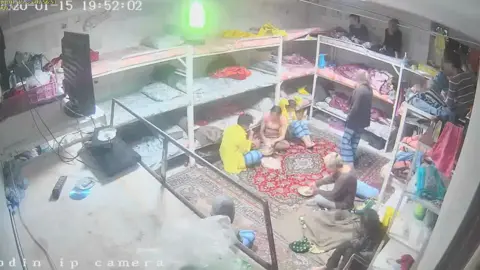
Evin prison CCTV A frame from CCTV shows a room with bunk beds stacked three-high and end-to-end along the three walls that are visible. Approximately 18 beds are visible. Each bed has some bedding on it. People are sitting on some of the beds. Six people are sitting on the floor which is covered with a traditional patterned carpet. They are wearing casual clothing.Evin prison CCTV

CCTV footage of a cell for trans inmates in Evin prison was leaked in 2020 – it is similar to the cells in the main women’s wing

It is where the British-Iranian citizen Nazanin Zaghari-Ratcilffe, who was allowed to return to the UK in 2022, spent nearly four years of her sentence.

Most of the women there have been sentenced because of their activism, for offences including spreading propaganda, drawing arms against the regime, and endangering national security.

They live in four crowded cells with up to 20 people in each one and bunk beds stacked three- high.

Living together in cramped quarters often causes friction, and sometimes fights – both physical and verbal – break out. But the women also forge tight bonds.

In winter, “everyone is freezing” and the women “walk around with hot water bottles” to stay warm. In summer, they swelter in the heat.

There is a small kitchen area with a couple of hobs where – if they have enough money to buy food from the prison shop – they can cook for themselves to supplement the basic prison meals that are brought to their cells.

A dark, dirty area at the end of a corridor serves as a place to smoke. A small cemented yard with a little area for plants and a volleyball net provides a bit of outside space.

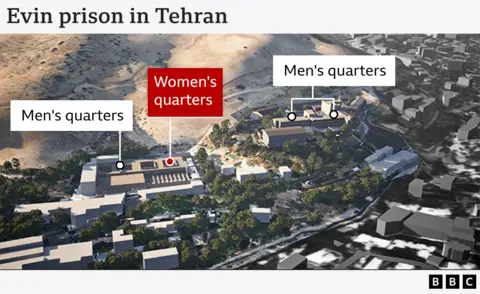
BBC graphic of Evin prison, showing its location next to hills on the northern edge of Tehran. It shows the location of the women's quarters at one end of a building and the men's quarters spread between the end of the same building and another building to the right.

They can wear their own clothes and are free to move around their living quarters which have two bathrooms. Every evening, they queue to use the toilet and brush their teeth.

It was here, after she had been in prison for about four months, that Rezvaneh found out she was pregnant.

She had struggled with infertility for years and had given up on ever having a baby. But according to Evin’s rules, she and her husband – who is still a prisoner in the men’s wing – were occasionally allowed to meet in private and, on one of these occasions, she conceived.

When she realised she was pregnant she “cried for several days”.

She found “the worst thing was the mental pressure and tensions inside the prison”. Finding a quiet place in the crowded cells, where people spend most of their days sitting on their beds, was a constant challenge.

The prison food left her craving apple juice, bread, and meat, which were hard to get hold of. When she could get some meat from the prison shop it was at least twice the price of meat on the outside.

The prison eventually allowed her to have an ultrasound scan at four months, and doctors told her she was having a girl.

As she listened to “each heartbeat the sense of hope became stronger”. But she was afraid that the conditions in prison would endanger the baby’s health. Rezvaneh was not just concerned about her diet – she has epilepsy and needed to avoid stress. Prison doctors told her she had a high risk of miscarriage.

An account of Rezvaneh’s pregnancy and the birth of her child, voiced by an actor and narrated by Nazanin Zaghari-Ratcliffe

Vida, a journalist, loves to paint. She uses bedsheets for canvases and paints portraits of the other women.

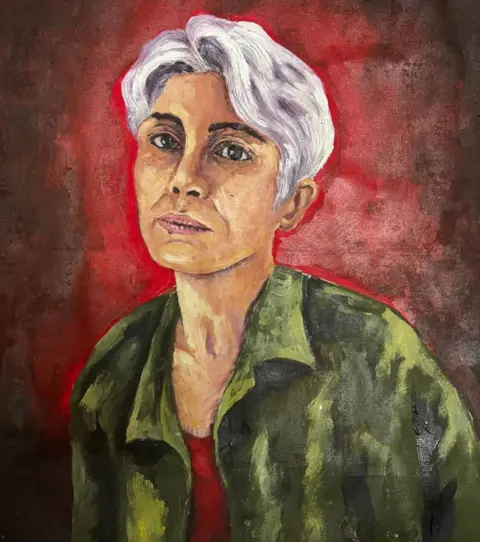
One, which was smuggled out of Evin, is of Kurdish prisoner Pakhshan Azizi who travelled to Kurdish areas of Iraq and Syria to help victims of the Islamic State group. Pakhshan has been sentenced to death, following charges of using arms to fight the Iranian regime, and there is great concern this sentence could be carried out soon.

Vida has been warned not to draw anything with a hidden meaning. On one of the walls in the yard she painted crumbling bricks with a green forest behind them. The authorities sprayed over it.

In a corridor she painted a picture of an Iranian cheetah running. Some of the women “kept saying how much good energy they got from it”. But one night the authorities “went and painted over it” and restricted Vida’s access to painting supplies.

One of her murals has been left intact though – huge, blue ocean waves on the walls of the corridor where the women go to smoke.

UGC A painting of Pakhshan Azizi shows her with short grey hair, wearing a green shirt with a red top underneath it. She looks thoughtful. The background is deep red.  UGC

Vida’s portrait of Pakhshan Azizi, who has been sentenced to death

Getting medical care has been a constant battle for the women. One of the inmates, human rights activist and Nobel Peace Prize winner Narges Mohammadi, has life-threatening heart and lung conditions.

But in prison she has had to fight long and hard for access to a doctor. Relatives said that officials repeatedly blocked treatment because she refused to wear a headscarf to a medical appointment. The authorities only relented after fellow prisoners went on hunger strike for two weeks. Narges was released for 21 days at the start of December on medical grounds.

Behind bars, she and the others have carried out protests, pushing the boundaries and continuing to fight for their rights. Although the law requires them to wear headscarves, many refuse. And after a long fight with the authorities, the women were allowed curtains around the beds so they could have some privacy, out of view of CCTV cameras.

One of the toughest things for the women is waiting to hear their sentences. Nasim’s interrogators had threatened her with the death penalty and she had to wait nearly 500 days to find out her fate.

She found solace in her fellow prisoners – who she has described as sisters who give her life and act as “a balm on the wounds” of her wings.

Every morning, one of her friends pulls aside the bed curtain and makes her get up for breakfast.

“Each day we think of something to do, so by the end of the day we can tell ourselves, ‘We lived today,'” one of our sources explains.

UGC A photograph of Vida against a light grey background. Vida is smiling and has short brown hair. She is wearing make-up, a thin gold chain around her neck and a short-sleeved V-necked top which is white with small dark spots. UGC

Thirty-five-year-old Vida was charged with distributing anti-government propaganda and working against national security

Others spend their time reading poetry, singing, playing homemade card games and watching TV – there are two televisions where they can watch Iranian channels showing drama, documentaries and football.

It is these small things that kept Nasim going while she waited for her sentence, under the constant threat of execution. When the sentence finally came, she was given six years in prison, 74 lashes and 20 years in exile in a small town far from Tehran. She had been charged with distributing propaganda and drawing arms against the Islamic Republic.

Despite the severity of the sentence, Nasim felt she could breathe again, and embrace the life she thought she had lost.

Three other women in the wing have been sentenced to death for drawing arms against the regime or affiliation to armed groups. However one of them has had her sentence overturned.

More than 800 people were executed in Iran last year – the highest number in eight years, according to Amnesty International. Most were for crimes involving violence and drugs. A handful were women.

So every Tuesday, the women protest against executions, chanting in the prison yard, refusing to move all night and staging hunger strikes. The campaign has spread through jails across Iran, gaining international support. On the anniversary of Mahsa Amini’s death the women in Evin burned headscarves.

There have been repercussions – sometimes the guards raid their cells and women have been beaten and injured. They can also be taken for further interrogations, put back in solitary confinement or have phone calls and visits blocked. Most of the guards are women and “sometimes they are kind, sometimes they are cruel and hard-hearted, depending on what orders they receive from a higher authority”, says one of our sources.

The Iranian government routinely denies allegations of human rights violations, saying conditions inside Evin prison meet all necessary standards and prisoners are not mistreated.

UGC Photograph of Rezvaneh holding her baby daughter. Rezvaneh has short to medium-length dark hair, is smiling and is wearing a light pink top. Her daughter has dark hair and is wearing white and grey striped top and grey trousers. There are yellow flowers in the background.UGC

Rezvaneh gave birth to a daughter in October

As Rezvaneh’s due date approached, the prison authorities allowed her to temporarily leave prison for the birth. In October, she had a baby girl.

But her joy and relief at the safe arrival of her daughter is mingled with fear, sadness and anger. Her husband was not allowed out of prison with her, although she has been able to take their daughter to visit him in Evin.

And because of the stress, Rezvaneh has struggled to produce breastmilk. She is expecting to be recalled to Evin prison soon with her baby daughter to serve the rest of her five-year sentence – if she’s not granted an early release, that could be nearly four years.

Babies are usually allowed to stay with their mothers in jail until the age of two. After that they are often sent to a close relative, or if that is not possible, they might be placed in a children’s home.

But rather than stop the inmates, one prisoner has said the challenges they face have made her “braver and stronger,” supporting their belief that “the future is clear: to fight, even in prison”.

UGC A painting by Vida depicts a snow-covered hill. There is a watchtower in the top right corner and a bit of the prison wall can be seen at bottom of the image. There is a snow-covered fir tree on the right-hand side of the hill, some bare branches at the bottom of the painting and a fox is walking across the hillside.UGC

One of Vida’s paintings shows the hills north of Tehran which can be seen from Evin

BBC 100 Women logo. The wording 100 WOMEN is in black capital letters and there are some small coloured circles in the design.


US stocks tumble as Federal Reserve eyes fewer 2025 rate cuts, Dow falls 2.6%

0
US stocks tumble as Federal Reserve eyes fewer 2025 rate cuts, Dow falls 2.6%


Wall Street stocks tumbled Wednesday after the Federal Reserve lowered interest rates but also slashed the number of 2025 rate cuts in its forecast.

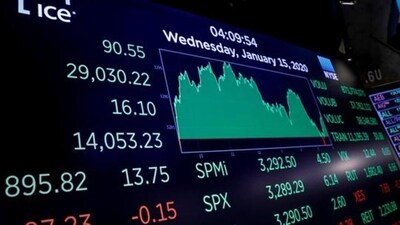
 The Dow slid 2.6, or more than 1,100 points on Wednesday.(REUTERS file photo)
The Dow slid 2.6, or more than 1,100 points on Wednesday.(REUTERS file photo)

All three major indices finished firmly lower after the Fed projected just two interest rate cuts next year, down from four.

The Dow slid 2.6 percent, or more than 1,100 points, to 42,326.87.

The broad-based S&P 500 dropped 3.0 percent to 5,872.16, while the tech-rich Nasdaq Composite Index slumped 3.6 percent to 19,392.69.

“Seeing the kind of decline we are experiencing right now indicates that the Fed took the market quite by surprise,” said CFRA Research’s Sam Stovall.

Although stocks often enjoy a late-year bounce referred to as the “Santa Claus rally,” Stovall said the depth of Wednesday’s drop could spur more selling if traders take profits.

“Maybe Santa is already on vacation,” he said.

The US central bank, as expected, moved ahead with a decision to reduce interest rates by a quarter point as Fed Chair Jerome Powell offered an upbeat appraisal of the US economy.

But the announcement was coupled with the altered outlook on 2025 monetary policy.

After the latest interest rate cut, the Fed is now “significantly closer” to the point where no further cuts will be needed, said Powell, who emphasized the central bank still views two percent inflation as a critical long term priority.

In the last couple of months the Fed’s favored inflation measure has ticked higher, moving away from the bank’s long-term target of two percent.

Wall Street’s reaction suggests the investors are “grappling” with the likelihood that interest rates “for all intents and purposes, are going to remain higher for longer,” said Briefing.com.

Wednesday’s losses were broad-based with 29 of 30 companies in the Dow ending lower and all 11 sectors in the S&P 500 finishing in the red.


As Trump 2.0 looms, Taiwan’s chip industry braces for upheaval | Technology

0
As Trump 2.0 looms, Taiwan’s chip industry braces for upheaval | Technology


Taipei, Taiwan – With just weeks left in office, outgoing United States President Joe Biden and his team are scrambling to lock in billions of dollars in funding to re-shore chip manufacturing to the US.

Signed into law by Biden in 2022, the CHIPS and Science Act set aside $280bn in funding to boost domestic semiconductor research and manufacturing in the US, including $39bn in subsidies, loans and tax credits for both US and foreign companies.

The law received bipartisan support in Congress and was broadly welcomed in both Democratic and Republican-leaning states eager to lure cutting-edge manufacturing facilities and create jobs.

But with President-elect Donald Trump set to take office on January 20, the future of the CHIPS Act now looks uncertain, leaving Biden’s administration racing to wrap up complex negotiations with chipmakers and distribute funds.

During an appearance on the Joe Rogan Experience podcast shortly before the election, Trump blasted the legislation as being “so bad”.

“We put up billions of dollars for rich companies,” Trump said.

Trump has also accused places such as Taiwan, home to the world’s top producer of advanced semiconductors, Taiwan Semiconductor Manufacturing Company (TSMC), of “stealing” the chip industry from the US.

Most of the 24 recipients of funds under the CHIPS Act are US companies, chief among them Intel, which last month secured nearly $7.9bn in direct funding from the US Department of Commerce.

Four East Asian companies have also signed on to the CHIPS Act: TSMC and GlobalWafers of Taiwan, and Samsung and SK Hynix of South Korea.

In recent weeks, the Commerce Department has finalised its deals with TSMC and GlobalWafers, after earlier signing nonbinding memorandums of agreement.

TSMC locked in $6.6bn in grants and $5bn in loans to build four facilities in Arizona, while GlobalWafers finalised a deal to receive $406m to build facilities in Missouri and Texas.

Trump cannot unilaterally repeal the CHIPS Act because it was passed by the US Congress, but analysts say he could make it difficult for the law to function as intended.

As president, he could block or delay the Commerce Department in distributing funds, possibly as part of cost-cutting efforts spearheaded by the new so-called Department of Government Efficiency, to be led by tech mogul Elon Musk and entrepreneur Vivek Ramaswamy.

Biden
US President Joe Biden speaks about his economic agenda after touring the site of a planned TSMC facility in Phoenix, Arizona on December 6, 2022 [Patrick Semansky/AP]

Dan Hutcheson, vice chair of California-based Tech Insights, said Trump could also simply try to renegotiate some of the terms of the CHIPS Act or repackage elements of it under new legislation.

Trump pulled a similar manoeuvre in 2018, with the signing of the US-Mexico-Canada Agreement to replace the substantially similar North American Free Trade Agreement, Hutcheson said.

The Trump administration borrowed heavily from the wording of NAFTA and the Trans-Pacific Partnership, a free trade deal with Asia proposed by former President Barack Obama, for the revised agreement.

“What [Trump] really wants is to get his brand on everything … and you see that with all of his hotels and resorts and everything else,” Hutcheson told Al Jazeera.

“It’s his typical modus operandi, which I think you can expect will happen with the CHIPS Act.”

Among the CHIPS Act’s Asian partners, Taiwan’s TSMC has made the most visible efforts to ramp up US investment.

After earlier signing a non-binding memorandum of agreement, the Taiwanese company last month locked in $6.6bn in grants and $5bn in loans to build four semiconductor fabrication plants in Arizona.

Other Asian companies have moved less quickly, put off by the delays of the past two years and their own business challenges, according to Chim Lee, a senior analyst for China and Asia at the Economist Intelligence Unit.

In April, Samsung signed a nonbinding deal to spend $45bn expanding its production facilities in Texas in exchange for $6.4bn in grants.

Eight months later, there has been no announcement of any progress on the agreement.

In October, the South Korean tech giant issued a rare public apology after posting disappointing third-quarter results blamed on competition from its Chinese rivals.

There have also been no further updates on the status of nonbinding agreements, announced in April and July, respectively, for SK Hynix to build a $3.87bn facility in Indiana and GlobalWafers to invest $4bn in the production of silicon wafers in Texas and Missouri.

Yachi Chiang, a professor in tech law at National Taiwan Ocean University, said many people in Taiwan think that the Trump administration will ask TSMC to invest more than the $65bn it has pledged to build three Arizona plants in exchange for US subsidies.

With the change of administration, companies may be less eager to extend negotiations further, said the EIU’s Lee.

“Renegotiations can prolong the distribution of funds, if not undermine some of it. The allocation [of funds] has already taken more than two years since the bill’s passage. Businesses don’t like to wait, and they don’t like uncertainty,” he told Al Jazeera.

“Of course, this goes both ways. For some companies, production in the US is so costly that they will not commit to investment unless there are strong incentives.”

Lai Ching-te
Taiwanese President William Lai Ching-te waves to the crowd on National Day on October 10, 2024 [Ann Wang/Reuters]

Asia’s tech companies have other incentives to keep production closer to home.

South Korea and Taiwan last year enacted their own equivalents of the CHIPS Act to boost subsidies and tax breaks for firms that invest locally.

Japan earlier this year approved $3.9bn in subsidies to domestic chipmaker Rapidus, and Tokyo aims to spend as much as $65bn through public and private sector funding to catch up with its chip-making neighbours.

Meanwhile, China recently pledged $45bn to shore up its chip industry in the face of US export controls and other attempts to curb its acquisition of advanced technology.

Taiwan’s Ministry of Economic Affairs told Al Jazeera it would not be appropriate to comment on the CHIPS Act before Trump takes office.

Taipei, however, has signalled to Trump that it is listening to his concerns.

Shortly after Trump’s election win, The Financial Times reported that Taiwan was considering a $15bn weapons purchase deal to show the president-elect that it was “serious” about its defence following his criticism that it should spend more on its military.

At the same time, there is political gridlock across East Asia, creating further uncertainty about how governments will respond to the Trump administration and its economic demands.

While Taiwanese President William Lai Ching-te can engage with Trump as the head of state, he is constrained at home policy-wise by an opposition that holds a majority in the legislature.

In South Korea, Han Duck-soo is serving as a caretaker leader as the country’s Constitutional Court considers whether to remove Yoon Suk-yeol from office following his impeachment over a short-lived declaration of martial law.

In Japan, Prime Minister Shigeru Ishiba is leading a minority government after his Liberal Democratic Party lost its majority in parliament following a snap election in October.

A second election is scheduled for next year for Japan’s upper house of parliament, portending further uncertainty ahead.

William Reinsch, a senior adviser with the economics programme at the Center for Strategic and International Studies, said the CHIPS Act was just one of many issues on the minds of East Asia’s leaders.

“I would expect Korea, Taiwan and Japan to look at the big picture of how best to maintain good relations with the US rather than focusing only on the CHIPS Act,” Reinsch told Al Jazeera.

“You should expect them to think seriously about more investment in the US, spending more money on their own defence budgets, and thinking about how best to align themselves with US policy with respect to China.”


Wall Street: US stocks fall sharply, Dow tumbles 1,100 points

0
Wall Street: US stocks fall sharply, Dow tumbles 1,100 points


Wall Street: US stocks fall sharply, Dow tumbles 1,100 points
Lingering inflationary pressures and the transition to the Trump administration have introduced additional variables into the Fed’s calculus.

US stock markets endured one of their most severe declines of the year on Wednesday after the Federal Reserve signaled a shift in its monetary policy trajectory. The S&P 500 fell 2.9%, narrowly missing its largest loss of 2024, while the Dow Jones Industrial Average plummeted by 1,123 points, or 2.6%. The tech-heavy Nasdaq composite suffered the worst drop, declining 3.6%.
The central bank announced its third rate cut of the year, lowering its main interest rate to a range of 4.25% to 4.50%. However, it was the Fed’s updated projections for 2025 that rattled investors: Policymakers now anticipate only two additional cuts next year, down from four projected just three months ago.
“We are in a new phase of the process,” Fed Chair Jerome Powell said, explaining the tempered outlook as a response to robust job market performance, rising inflation readings, and economic uncertainties, including the upcoming Trump administration’s policies.
Bond yields climb, stock market feels the squeeze
Treasury yields surged following the Fed’s announcement, exerting additional pressure on stocks. The yield on the 10-year Treasury rose to 4.51% from 4.40%, while the two-year yield, more sensitive to Fed actions, increased to 4.35% from 4.25%.
Higher yields typically hurt stock valuations, particularly for companies reliant on borrowing to drive growth. The Russell 2000 index of smaller companies tumbled 4.4%, reflecting the acute impact of rising interest rates on smaller-cap stocks.
“We’re seeing the market recalibrate for a ‘higher for longer’ rate environment,” said Sam Stovall of CFRA Research. “The Fed’s announcement caught investors off guard, eroding confidence in the expected pace of rate reductions.”
Winners and losers on Wall Street
Among individual stocks, General Mills fell 3.1% despite better-than-expected quarterly profits, as its lowered profit forecast for the year spooked investors. Nvidia, a significant driver of this year’s market rally, dropped 1.1%, extending its losses to over 13% since its record high last month.
Conversely, Jabil surged 7.3% after reporting stronger-than-expected quarterly earnings and raising its full-year revenue forecast.
Global markets and economic uncertainty
Global markets displayed mixed reactions. In London, the FTSE 100 rose marginally by less than 0.1%, buoyed by data showing UK inflation at an eight-month high. The Bank of England is expected to keep rates unchanged when it announces its decision on Thursday.
Japan’s Nikkei 225 fell 0.7%, even as Nissan shares jumped 23.7% on reports of potential collaboration with Honda. Meanwhile, Mitsubishi Motors, partly owned by Nissan, saw its shares soar nearly 20%.
Economic outlook clouds amid inflation and political shifts
Powell noted that while rate cuts could stimulate economic growth, they also risk exacerbating inflation. “When the path is uncertain, you go a little slower,” he said, likening the Fed’s approach to navigating a foggy night.
Lingering inflationary pressures and the transition to the Trump administration have introduced additional variables into the Fed’s calculus. Powell acknowledged that some officials are already weighing the implications of potential fiscal policy changes, including tariffs and spending initiatives.
Cleveland Fed President Beth Hammack was the lone dissenter in Wednesday’s decision, arguing against the rate cut.
As Wall Street digests the Fed’s outlook, concerns grow that the anticipated “Santa Claus rally” may be replaced by further volatility, with analysts suggesting that traders may lock in profits amid uncertainty.
(With inputs from agencies)


Verdicts due for 51 men in mass rape trial that shocked France

0
Verdicts due for 51 men in mass rape trial that shocked France


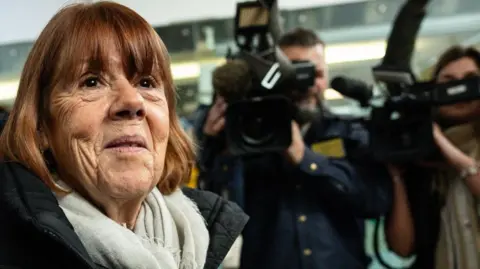
CLEMENT MAHOUDEAU/AFP Gisèle Pelicot, 72, stands outside the court in Avignon ahead of the verdicts of 51 men accused in a mass rape trialCLEMENT MAHOUDEAU/AFP

It was Gisèle Pelicot’s decision to open the case to the public that has given the trial international significance

Judges in the French city of Avignon will hand down verdicts on 51 men on Thursday in a mass rape trial that has turned a 72-year-old woman into a feminist icon.

For almost a decade, Gisèle Pelicot was drugged by her ex-husband Dominique, who then invited dozens of men he had recruited online to have sex with her in her bed at home while she was unconscious and unaware.

It was her decision to waive her anonymity and throw this trial into the open – in her words, making “shame swap sides” from the victim to the rapist.

Although he admits the charges against him, most of the other men on trial deny what they did was rape.

Prosecutors have asked for jail sentences ranging from four years to 20 years, the maximum sentence for a charge of aggravated rape.

One of the defendants, who has admitted the charges, has said the trial was rushed and “botched”.

Campaigners say this case proves the need for consent to be built into France’s rape laws, as in other European countries.

What is the case is all about?

From 2011 to 2020, Dominique Pelicot plied his wife with tranquilising drugs and sleeping pills without her knowledge, crushed them into powder and added them to her food and drink.

Gisèle Pelicot suffered memory loss and blackouts because of the drugs and she has spoken of 10 years of her life that have been lost.

He was eventually caught because a security guard reported him to police for taking photographs under women’s skirts in a supermarket.

“I thought we were a close couple,” she once told the court. Instead, her husband was going on a notorious but now banned website called Coco.fr to invite local men to their home to have sex with her while she was comatose.

“I was sacrificed on the altar of vice,” Gisèle Pelicot said early in the trial.

Since the start of September, Judge Roger Arata and his four colleagues have heard how 50 men, now aged between 27 and 74, visited the Pelicots’ home in the village of Mazan.

Who are the accused?

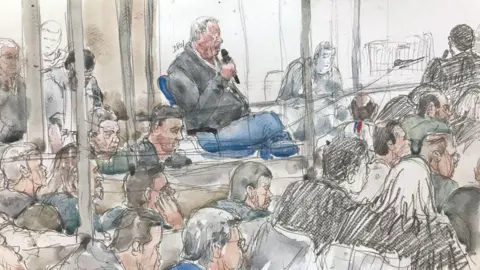
Benoit PEYRUCQ/AFP A court sketch shows Dominique Pelicot giving evidence in court during the trial in AvignonBenoit PEYRUCQ/AFP

A court sketch shows Dominique Pelicot giving evidence in court

Dominique Pelicot has admitted all the charges against him – drugging and raping his wife and recruiting dozens of men to rape her. Prosecutors want the judges to hand him the maximum 20-year jail term for aggravated rape.

“I am a rapist,” he has told the judges. “I acknowledge all the facts [of the case] in their entirety.” He has begged his ex-wife and three children for forgiveness, but his actions have torn the Pelicot family apart.

The other defendants come from all walks of life and most of them are from a 50km (30-mile) radius of the Pelicots’ village of Mazan. The fact they are firefighters, security guards and lorry drivers has earned them the name Monsieur-Tout-Le-Monde (Mr Everyman). Most of them have children too.

Fifty of the 51 are accused of aggravated rape and attempted rape.

Romain V, 63, is facing 18 years in prison if found guilty. He is accused of raping Gisèle Pelicot on six separate occasions while knowing he was HIV-positive. His lawyer says he could not have passed on the infection as he had years of treatment.

Another 10 men could face sentences of 15-17 years, and prosecutors are seeking jail terms of 10-14 years for 38 of the others.

Ahead of the verdicts, one of the few men who has admitted rape told the BBC through his daughter that many people had made up their minds right away: “There was not enough time. For me it was botched work.”

The average jail term for rape in France is 11.1 years, according to the French justice ministry.

One man is accused of aggravated sexual assault rather than rape. Prosecutors say Joseph C, a retired sports coach and grandfather of 69, should face the lightest sentence of four years in prison.

Some of them have apologised for their behaviour, but many have not.

Cyril B said he was sorry to Gisèle Pelicot.

“I’m ashamed of myself, I’m disgusted,” said Jean-Pierre M this week. His lawyer hoped that the judges would take account of his contrition.

What makes this case unusual?

Not only has this case been held in full view of the public, but the evidence against all the accused was recorded on video by Dominique Pelicot at the time and then played out in court.

Gisèle Pelicot, who has divorced her husband, said the men “treated me like a rag doll”. “Don’t talk to me about sex scenes. These are rape scenes,” she said.

Therefore none of those accused has been able to challenge the allegation that they were in Gisèle Pelicot’s room while she was comatose.

Their defence has relied on the definition of rape, because it currently involves any kind of sexual penetration “by violence, coercion, threat, or surprise”. That means prosecutors must prove intent to rape.

Public prosecutor Laure Chabaud told the court that no-one could say any more that “since she didn’t say anything, she gave her consent – that belongs to a bygone age”.

Thousands of people have joined protests in support of Gisèle Pelicot in France. And women have stood outside the court every day chanting one of the phrases her lawyers said in court: “Shame is changing sides.”

Why has Gisèle Pelicot become so important?

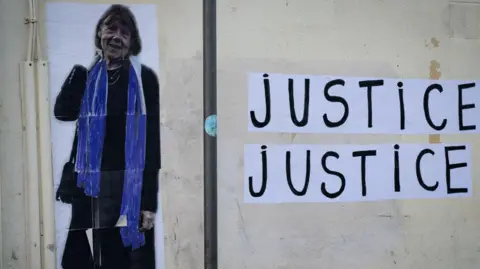
MIGUEL MEDINA/AFP A mural in Avignon shows a picture of Gisèle Pelicot and reads "justice, justice"MIGUEL MEDINA/AFP

Murals have appeared in Avignon in support of Gisèle Pelicot

Gisèle Pelicot has attended almost every day of the trial, appearing at the court in her sunglasses just before nine o’clock.

Her decision to waive her anonymity is highly unusual, but she has stood firm at every moment. “I want all women who have been raped to say: Madame Pelicot did it, I can too.”

But she has been clear that behind her facade of strength “lies a field of ruins” and despite the widespread acclaim for what she has done, she is a reluctant hero.

“She keeps repeating, ‘I am normal,’ she does not want to be considered as an icon,” her lawyer Stéphane Babonneau has told the BBC’s Emma Barnett.

“Women generally have a strength in them that they can’t even imagine and that they have to trust themselves. That’s her message.”

How this case has shaken France

Lawyers for the 51 defendants have highlighted the ordinary lives they led, although a court-appointed psychiatrist Laurent Layet testified that they were neither ordinary nor “monsters”.

In the early weeks of the trial, the then mayor of the village of Mazan told the BBC that the case could have been far more serious as nobody died.

But those remarks provoked an outcry across France and the mayor quickly apologised. He has since said he is withdrawing from public life.

The fact the trial has been held in public has meant every session has been reported at length and in detail.

Elsa Labouret of activist group Dare to be Feminist told the BBC: “[Gisèle Pelicot] decided to make this bigger than herself. To make this about the way we, as a society, treat sexual violence.”


Bharat Mobility Expo Set To Become World’s Largest Automotive Show Soon: EEPC India | Auto News

0
Bharat Mobility Expo Set To Become World’s Largest Automotive Show Soon: EEPC India | Auto News


Bharat Mobility Global Expo: Bharat Mobility Global Expo is set to become the world’s largest show in the automotive sector soon with participation of over 1,500 exhibitors and expected unveiling of vehicle models, EEPC India, a coordinating agency for the event, said on Wednesday. The second edition of the expo, scheduled for 17- 22 January 2025, will see the exhibition area double to 200,000 square meters, said an official of the Engineering Export Promotion Council (EEPC).

“We are at par with 2 lakh sq metres of exhibition space and just short of 200 exhibitors of the world’s top IAA Hannover show. We expect that the exhibition will become the world’s largest mobility show soon in line with the Commerce Ministry’s vision,” EEPC Vice Chairman Aakash Shah said. Over five lakh visitors are expected to come to the global expo, he said.

The second edition will consolidate nine trade shows within the mobility ecosystem under one umbrella. “Cycles were missing from the mobility ecosystem, so EEPC took the responsibility of hosting a dedicated cycle show,” Shah added. The expo will feature over 34 prominent vehicle manufacturers unveiling new models and electric vehicles.

There will be a wide display of electric, hybrid, CNG, and biofuel-powered vehicles from both domestic and international companies, another official said. Leading EV manufacturers such as Ather Energy, Ola Electric, Vayve Mobility, Eka Mobility, and Vietnam’s Vinfast will further drive the electric revolution.

More than 800 auto component manufacturers and 1,000 brands from over 13 global markets will exhibit their products, technologies, and services for OEMs and the aftermarket.

“Dedicated country pavilions from Germany, the UK, South Korea, and Japan, along with participation from the US, Spain, UAE, China, Russia, Italy, Turkey, Singapore, and Belgium, will make the event a truly global platform,” former EEPC Chairman Arun Garodia said.

Shah also noted that despite visa issues, Chinese companies operating in India will participate in the expo, though their numbers remain far lower compared to the pre-COVID period.

The Ministry of Commerce and Industry will host the Bharat Mobility Global Expo 2025 in January in three venues – Bharat Mandapam in New Delhi, Yashobhoomi in Dwarka, and India Expo Centre and Mart in Greater Noida.


US Fed cuts interest rates but cautions for year ahead | Business and Economy News

0
US Fed cuts interest rates but cautions for year ahead | Business and Economy News


Slower progress on inflation translates into a slower pace of rate cuts, especially as economic growth is brisk.

The United States Federal Reserve has cut interest rates but signalled it will slow the pace at which borrowing costs fall any further, given a relatively stable unemployment rate and little recent improvement in inflation.

“Economic activity has continued to expand at a solid pace” with an unemployment rate that “remains low” and inflation that “remains somewhat elevated”, the central bank’s rate-setting Federal Open Market Committee said in its latest policy statement on Wednesday.

“In considering the extent and timing of additional adjustments to the target range … the Committee will carefully assess incoming data, the evolving outlook, and the balance of risks,” it said in new language that sets up a likely pause to rate cuts beginning at the January 28-29 meeting.

US central bankers now project they will make just two quarter-percentage-point rate reductions by the end of 2025.

That is half a percentage point less in policy easing next year than officials anticipated as of September, with Fed projections of inflation for the first year of the new Trump administration jumping from 2.1 percent in their earlier projections to 2.5 percent now – well above the central bank’s 2 percent target.

“From this point forward, it’s appropriate to move forward cautiously and look for progress on inflation … from now, we are in place where the risks are in balance,” Fed Chair Jerome Powell said in a news conference after the end of the central bank’s two-day policy meeting

Powell described the latest rate cut as a “closer call” and noted that the slower pace of projected rate cuts next year reflected higher inflation readings in 2024.

Slower progress on inflation, which is not seen returning to the 2 percent target until 2027, translates into a slower pace of rate cuts.

Fed officials also boosted their estimate of the long-run neutral rate of interest – the level that is thought to neither spur nor hinder the economy – to 3 percent.

The reduction in the benchmark policy rate to the 4.25 percent to 4.5 percent range was opposed by the president of the Federal Reserve Bank of Cleveland, Beth Hammack, who preferred to leave the policy rate unchanged.

“While the Fed opted to round out the year with a third consecutive cut, its New Year’s resolution appears to be for a more gradual pace of easing,” said Whitney Watson, global co-head and co-chief investment officer of fixed income and liquidity solutions for Goldman Sachs Asset Management. Watson added that “we expect the Fed to opt to skip a January rate cut, before resuming its easing cycle in March.”

Trump uncertainty

The new policy rate is now a percentage point lower than the peak reached in September when officials concluded inflation was dependably on the way back to the 2 percent target and that there were risks to the job market of keeping monetary policy too tight for too long.

Key measures of inflation since then, however, have largely moved sideways, while continued low unemployment and stronger-than-expected economic growth have sparked debate among policymakers about whether monetary policy is as tight as thought.

The latest quarterly projections are the first since President-elect Donald Trump’s victory in the November 5 election, which introduced a new level of uncertainty into the economic outlook given his campaign promises for tax cuts, tariff hikes and a crackdown on unauthorised immigration – aspects of which analysts see as inflationary.

Trump doesn’t take office until January 20, and Fed officials have said they can’t base monetary policy on campaign proposals that may or may not be enacted.

Still, Fed staff have likely been gaming out different scenarios, and policymakers’ projections show growth remaining above potential at 2.1 percent next year, inflation staying above target for two more years, and the jobless rate never rising above 4.3 percent.


Canada stocks tumble over 2% after Fed moderates rate cut expectations

0
Canada stocks tumble over 2% after Fed moderates rate cut expectations


Dec 19, 2024 03:12 AM IST

The Toronto Stock Exchange’s S&P/TSX composite index ended down 562.71 points, or 2.2%, at 24,557.00, its lowest closing level since November 5.

Canada’s main stock index posted its biggest decline in 10 months on Wednesday, with the technology sector pacing broad-based declines, as the Federal Reserve signaled a slower pace of interest rate cuts.

Why Companies Split Stocks, Exploring Motivations and Market Effects.

The Toronto Stock Exchange’s S&P/TSX composite index ended down 562.71 points, or 2.2%, at 24,557.00, its lowest closing level since Nov. 5.

U.S. stocks also posted large declines and bond yields jumped after the Fed cut interest rates by a quarter of a percentage point as expected and forecast two cuts next year, down from four in a previous projection.

“It is pretty shocking to see how quickly those 2- and 10-year rates went up right after the decision,” said Michael Sprung, president at Sprung Investment Management.

“I think what that’s telling us is the market is much more in fear of possible inflation coming than the Fed might like to contemplate at this point in time.”

Canada‘s 10-year yield jumped 8.2 basis points to 3.224%, tracking the move in U.S. Treasuries.

All ten major sectors ended lower. Technology declined 4.5%, with e-commerce company Shopify Inc down 7.3%.

The materials group, which includes fertilizer companies and metal mining shares, fell 3.5% as gold and copper prices fell.

The price of oil gave back some of its earlier gains, settling 0.7% higher at $70.58 a barrel. Energy ended 1.9% lower and heavily weighted financials dropped 2%. (Reporting by Fergal Smith in Toronto and Ragini Mathur in Bengaluru; Editing by Shounak Dasgupta, Mohammed Safi Shamsi and Alistair Bell)

Stay updated with the…

See more