Twenty-nine prisoners remain at the US detention facility in Cuba after the transfer of Mohammed Abdul Malik Bajabu.
The United States has released Guantanamo Bay detainee Mohammed Abdul Malik Bajabu to Kenya, bringing the number of prisoners at the facility to 29.
The Pentagon announced Bajabu’s release on Tuesday, saying Secretary of Defense Lloyd Austin had notified Congress of the decision to repatriate him to Kenya last month.
Bajabu was arrested by Kenyan authorities in Mombasa in 2007 and transferred to Guantanamo weeks later for alleged involvement with al-Qaeda’s branch in East Africa.
The Periodic Review Board, which assesses the status of detainees, determined in 2021 that Bajabu “was no longer necessary to protect against a continuing significant threat to the national security of the United States”.
Reprieve US, which represented Bajabu, welcomed his release, saying that he was tortured by Kenyan authorities as well as US military personnel.
“The US robbed an innocent man of the best years of his life, separating him from his wife and young children when they most needed him,” a lawyer who helped represent Bajabu said in a statement.
“His children, infants when he was tortured, interrogated and shipped to Guantanamo, are now grown. That debt can never be repaid, but the least the US can do is ensure that Abdulmalik receives the support and the space he needs to begin his life anew.”
The Guantanamo detention facility opened in 2002 to house detainees captured during the so-called “war on terror” after the 9/11 attacks.
Located at a US military base in Cuba, the prison operates under a legal system led by military commissions that do not guarantee the same rights as traditional US courts.
Detainees cleared for release sometimes spend years at Guantanamo as Washington looks for countries to take them after they are freed.
The prison once housed nearly 800 detainees, many of whom initially spent time at covert CIA locations known as “black sites”, where they were tortured under the “enhanced interrogation” programme authorised by former President George W Bush’s administration.
Guantanamo has become a lasting symbol of US abuses during that era.
Of the 29 detainees who remain at Guantanamo, 15 are eligible for transfer, according to the Pentagon.
In July, Khalid Sheikh Mohammed, the alleged mastermind of the 9/11 attacks, and two other detainees reached a plea deal that would see them spend the rest of their lives in jail without the prospect of a trial where the government would seek the death penalty for them.
But Austin blocked the deal after an outcry from some conservative lawmakers and families of victims of the attack.
A military judge reinstated the plea agreement, but the Pentagon is appealing that decision.
On Tuesday, the Pentagon said that it aims to eventually close the detention centre in Guantanamo.
“The United States appreciates the support to ongoing US efforts toward a deliberate and thorough process focused on responsibly reducing the detainee population and ultimately closing the Guantanamo Bay facility,” it said.
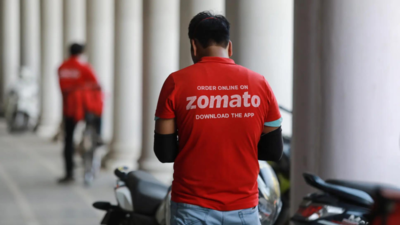
NEW DELHI: Amid its focus on health and term insurance, the GST Council, which will meet on Saturday, is expected to clarify that a 5% levy on delivery charges by apps such as Zomato and Swiggy will apply retrospectively from 2022, and also state that tax has to be paid by builders on charges paid for ‘floor space index’, including additional FSI, to local authorities. The fitment committee, comprising top officers, has backed the two moves with the proposal on food delivery apps likely to create a liability as it will not be possible for the players to collect taxes on past transactions. GST Council may back tax cut on gene-modified cell therapy Although the proposal is to impose 5% GST without input tax credit on food delivery apps, going forward, it will not result in a significant burden on consumers as the delivery charges are a fraction of the cost of orders. The move has been necessitated by a tax demand of around Rs 750 crore on delivery apps, where GST authorities have taken a view that 18% levy should be imposed. The council led by Union finance minister Nirmala Sitharaman, which will meet in Jaisalmer, is expected to provide major relief by backing a reduction in tax on gene-modified cell therapy, being developed for treatment of advanced blood cancer cases, from 12% to nil. It will also provide some clarity on ready-to-eat popcorn with those mixed with salt and spices should attract 5% tax, while those with sugar should face 18% GST. Further, the panel of officers has rejected the plea to reduce the tax on components of electric vehicles (EVs) from 18% and 28% to 5% and may clarify that no GST is payable on penal charges levied by banks and finance companies, which are regulated by the RBI. The committee has concluded that local authorities provide services such as the grant of FSI or additional FSI to businesses in return for consideration, which attracts 18% GST, and there is no justification for an exemption as input tax credit is available. Besides, these services are seen to be commercial in nature and help builders further their business.
Luigi Mangione has been charged with first-degree murder in the killing of healthcare CEO Brian Thompson, the New York district attorney said on Tuesday.
Mr Mangione faces various charges, including first-degree murder, and two counts of second-degree murder, one of which describes the killing as an act of “terrorism”, Bragg said.
“The intent was to sow terror,” New York District Attorney Alvin Bragg said, calling the shooting a “frightening, well-planned and targeted murder”.
Mr Mangione is scheduled to appear for a court hearing on 19 December over whether he will be extradited to New York on the charges, though Bragg suggested the suspect may not fight extradition.
“We have indications the defendant may waive that hearing,” Bragg said.
The extradition proceeding is scheduled for the same day as Mr Mangione’s preliminary hearing on gun-related charges in Pennsylvania.
“In the nearly two weeks since Mr Thompson’s killing, we have seen a shocking and appalling celebration of cold-blooded murder,” Tisch said. “We don’t celebrate murders and we don’t lionise the killing of anyone.”
In addition to murder, the suspect also faces weapons and forgery charges. If he is convicted on the most serious charges placed against him – first degree murder and second degree murder as an act of terrorism – Mr Mangione could face life in prison without the possibility of parole.
Asked about the specific terrorism charges, Bragg replied that “in its most basic terms, this was a killing that was intended to evoke terror”.
Five days after Mr Thompson, the UnitedHealthcare CEO, was shot and killed, Mr Mangione was arrested at a McDonald’s in Altoona, Pennsylvania, with a fake ID and so-called “ghost gun”, police said.
His lawyer, Thomas Dickey, has said he has not seen evidence that links Mr Mangione’s gun with the crime.
New York prosecutors began to share evidence in their case against Mr Mangione with a grand jury last week.
If extradited, the 26-year-old is likely to be held at Riker’s Island or another New York prison.
Shutterstock
The evidence against Mr Mangione includes a positive match of his fingerprints with those discovered at the crime scene, Commissioner Tisch said.
According to District Attorney Bragg, the suspect arrived in New York City on 24 November, staying in a Manhattan hostel using a fake ID before carrying out the attack against Mr Thompson 10 days later.
In addition to the ghost gun – a gun assembled from untraceable parts – and fake ID, a passport and a handwritten document indicating “motivation and mindset” also were found on Mr Mangione when he was arrested, police said.
During Tuesday’s news conference announcing the New York charges, NYPD Chief of Detectives Joseph Kenny also described an interaction with the suspect’s mother, who in November filed a missing person report for her son in San Francisco.
After the manhunt for the shooting suspect had begun, that report was flagged to authorities, who contacted Mr Mangione’s mother. According to Detective Kenny, his mother said she did not identify her son as the suspect, but said “it might be something that she could see him doing”.
Mr Mangione was formally charged in Pennsylvania with forgery, carrying firearms without a licence, tampering with records or identification, possessing instruments of crime and providing a false identification to police.
While Mr Mangione awaits his fate in the New York court system, he remains under maximum security at Huntingdon State Correctional Institution in Huntingdon County, Pennsylvania.
He has been denied bail.
Watch: Healthcare CEO murder was ‘frightening, well-planned and targeted’
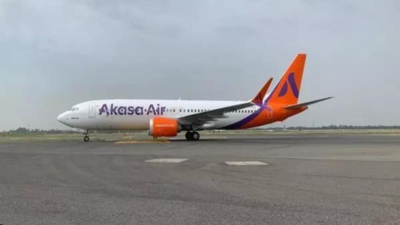
DGCA Issues Show Cause Notice To Akasa Air: Aviation regulator DGCA has issued a show cause notice to Akasa Air for violation of norms related to the airline’s operations manual, according to sources. An Akasa Air spokesperson said the Directorate General of Civil Aviation (DGCA) has raised certain findings for which they have issued a notice for clarification from the airline’s flight operations team.
So far this month, at least two show-cause notices issued by the regulator to the airline, which started flying in August 2022. Sources said that the watchdog has found a violation with respect to the operations manual, which is required to be revised every six months.
Citing the submissions made by SNV Aviation Pvt Ltd, which operates Akasa Air, the regulator said the revision cycle of the operations manual has exceeded the six-month cycle, which is in violation of certain provisions of Civil Aviation R (CAR), as per the sources.
The show cause notice, dated December 16, has also mentioned that the Director Flight Operations of the airline failed to ensure compliance with CAR, the sources said and added that the carrier has been asked to show cause as to why suitable action should not be initiated for the violation.
“The DGCA has raised certain findings for which they have issued a notice for clarification from Akasa Air’s Flight Operations team. As always, we are working closely with the DGCA to clarify this issue and enhance our protocols as required by the regulator,” the Akasa Air spokesperson said in a statement.
On December 9, the watchdog issued a show cause notice to an Akasa Air aircraft maintenance engineer for poor (maintenance) standards and certification. Akasa Air, which currently has a fleet of 26 planes, faced another headwind last week when some pilots flagged concerns about safety and training practices.
In a letter dated December 11 to Civil Aviation Minister K Rammohan Naidu, they had also sought an independent investigation into Akasa Air’s management practices, training method and safety standards. Among other issues, the letter alleged that the airline’s claims of maintaining the highest safety standards are misleading.
Akasa Air on December 12 termed the allegations as baseless and untrue and that they do not represent the views of the airline pilots. In its statement, the airline also said 324 pilots have joined the airline since October 2023, and during this period, it has recorded an annualised attrition of less than 1 per cent for this employee group.
Uniform Civil Code (UCC) implemented Uttarakhand Union Home Minister Amit Shah on Tuesday said this is a model law which will be widely debated and then Bharatiya Janata Party (BJP) governments will bring a Uniform Civil Code in all states, accusing the Congress of weakening the Constitution and appeasement. Accused of promoting politics. ,
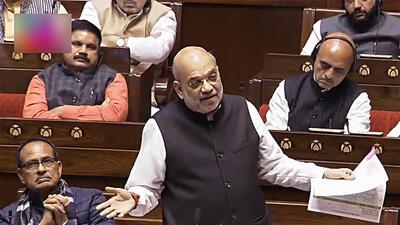
Union Home Minister Amit Shah speaking during the debate on the Constitution in the Rajya Sabha in New Delhi on Tuesday. (ANI/Sansad TV)
Responding to the debate on the 75th year of the Constitution Rajya SabhaThe combative Shah drew differences between the constitutional amendments brought by the Congress and the BJP, arguing that the BJP pushed for the changes for personal gain and power. In the 85-minute speech, he also alleged that the Congress never respected reservations, wanted to break the 50% limit to bring in religion-based quota, and attacked the opposition party over the imposition of Emergency.
“We work democratically… A law that brought about huge changes in social life was passed as a model law UttarakhandIt will be legally examined and discussed by religious heads…suggestions will be accepted. After that, BJP governments will bring a uniform civil code in all states,” he said.
“It could not be brought till now due to the appeasement politics of Congress.”
UCC refers to a common set of laws that will amalgamate the customary laws of different religions and govern issues such as marriage, divorce, inheritance and maintenance. Part of the trinity of core ideological goals of the BJP, the UCC was one of the party’s poll promises in the 2022 assembly elections.
Last February, Uttarakhand passed a UCC law, granting women equal rights in marriage, divorce, alimony and inheritance of property, banning certain types of relationships, banning polygamy, registration of marriages It was made mandatory and mandatory registration or self-declaration was done to survive. -In relationships. The law has not yet been implemented.
decades old demand ucc – which is a part of the non-equitable Directive Principles of State Policy in the Constitution – is linked to India’s complex system of personal laws, rules and customs, especially for religious minorities. The UCC would, in theory, impose uniform rules for marriage, divorce, inheritance, financial compensation and adoption for all communities, but many activists and experts fear that it would eliminate the customs and traditions of particular communities. Can, and can become a proxy. Target their beliefs.
Prime Minister Narendra Modi has repeatedly made a strong case for the UCC and the BJP has promised to bring a common law if it wins elections in Jharkhand earlier this year.
Shah said that BJP amended the Constitution 22 times in 16 years and Congress 77 times in 55 years. He said the intention behind the amendments reflected whether the party had confidence in the document or not.
“The constitutional amendments made by our government were aimed at strengthening democracy and ensuring equal rights for the underprivileged, the opposition’s amendments were only to retain political power,” he said.
“The first amendment was made on June 18, 1951… After the framing of the Constitution, the Congress did not have enough patience to wait for the Lok Sabha elections before going to power… Article 19A was added to curtail the freedom Of the speech… Jawaharlal Nehru was the Prime Minister at that time,” he said.
He said, the second amendment was the 24th amendment made by the then PM Indira Gandhi on November 5, 1971, which sought to curtail the fundamental rights of the citizens. He said, “The 39th Amendment on August 10, 1975, which exempted the election of the PM and the President from judicial scrutiny, was invoked to protect the political leadership during the Emergency when Indira Gandhi’s election was declared invalid. “
After this, he termed the 42nd amendment brought to extend the tenure of Lok Sabha and Rajya Sabha by six years as a step taken out of fear of defeat in the elections.
He tried to draw a comparison with the changes initiated by the BJP. Shah said the 101st amendment in 2018 brought the Goods and Services Tax (GST) which revolutionized India’s tax structure by establishing an integrated taxation system. “In 2018, the 102nd Amendment gave constitutional status to the National Commission for Backward Classes (NCBC). Modi did this because Congress did not believe in the welfare of backward classes… In 2019, the 103rd amendment was introduced, giving 10% reservation for Economically Weaker Sections (EWS)… For years, Congress Talked about poor welfare. welfare of the poor) but the will was not there for it,” he said.
The minister mentioned two more amendments – the 105th amendment in 2021 that gave state governments the power to identify socially and educationally backward classes (SEBCs) and the 106th amendment in December 2023, which created 33% reservation for women in assemblies and the Lok Sabha. Reservation approved. According to the Women’s Reservation Bill.
He mocked the Congress for blaming electronic voting machines for the election defeat. “These days they blame EVMs. When they lost in Maharashtra, the EVMs were malfunctioning, but when they won in Jharkhand, they wore new clothes and rushed to take oath,” he said.
Shah accused Congress of insulting BR Ambedkar and said that Congress wanted to increase the quota limit by more than 50% to accommodate Muslims. He said, “Even if BJP has only one MP, we will not allow reservation on the basis of religion.” Congress MPs protested, saying that the party never recommended reservation on the basis of religion.
Shah accused successive Congress prime ministers from Nehru to Rajiv Gandhi of not being in favor of caste-based reservation and said it was the BJP that gave constitutional status to the OBC Commission and allowed reservation for them in NEET and JEE.
Amid protests from the opposition, he said, “These days some leaders see reservation as a formula to win elections…but the Kaka Kalelkar report was put on the back burner.” He was referring to the first OBC Commission report which was never implemented.
When Congress leader Jairam Ramesh objected and said that a copy of the report could be seen in the Parliament library, Shah replied, “He did not send it to the Cabinet nor put it before Parliament, he kept it in the Library.” kept.”
Challenging the Congress to clarify its position on Muslim Personal Law, Shah said that its introduction marked the beginning of appeasement politics in the country. “If they want Muslim personal law, why don’t they allow punishment for crimes under Sharia…that’s where they started appeasement,” he said.
Responding to Congress MP Digvijay Singh’s taunt on why UCC has not been implemented yet, Shah said it is because of the policies of the opposition party.
Accusing the Congress of treating the Constitution as a “private family property” (private property of a family), Shah said that when Article 35(A) – which gives the erstwhile state of Jammu and Kashmir the power to decide domicile – was introduced If done, constitutional provisions were violated. Through Presidential Order and not brought before Parliament, and when Article 1 was amended to “cede” Katchatheevu Island to Sri Lanka.
He also underlined the excesses committed during the Emergency. “I used to listen to Binaka Geet Mala on the radio…when it was stopped, a neighbor told me that Kishore Kumar’s songs could not be played on the radio and all his songs would be sung by Lata Mangeshkar…” Shah Said.
Shah praised Indian democracy and said that it did not allow dictatorship in the country. “In the last 75 years, there have been many nations that became independent and made new beginnings, but democracy could not succeed there. But the roots of our democracy run very deep. We made many changes without shedding even a drop of blood. The people of this country have shattered the ego of many dictators and that too in a democratic manner.”
Urging people not to link patriotism or bravery with ideology, religion or politics, the minister attacked the Congress for not respecting VD Savarkar and said the freedom fighter did not deserve the title of Veer (brave) from any political party. , but rather earned from the people of the country. Country.
“From 1857 to 1947, if there was anyone who was sentenced to life imprisonment twice in the same lifetime, it was Veer Savarkar. If anyone had the courage to jump into the sea for the freedom of the country, it was Veer Savarkar. In the same jail, two brothers served the sentence of Kala Pani for 10 years, but did not even see each other. There is no other such brave family in the entire country.
He also cited Indira Gandhi’s letter praising Savarkar. The comments come days after Congress leader Rahul Gandhi said in the Lok Sabha that Savarkar did not believe in the Constitution and that his grandmother Indira Gandhi had told him how Savarkar had compromised with the British.
Taking a dig at Rahul Gandhi’s election slogan ‘love shop’, Shah said, ‘I want to tell them that love cannot be sold in any shop… it is an emotion; This is something worth feeling.”
Congress retaliated. Ramesh said, “Amit Shah lied for 90 minutes…It was just an attack on Congress, it was not a speech…Amit Shah insulted the leader of the opposition in the Rajya Sabha.”
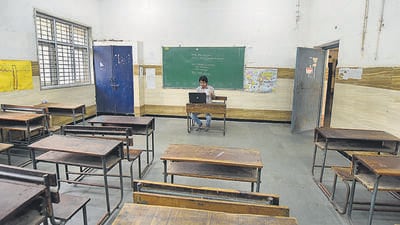
As soon as her Hindi teacher announced a group quiz in class one day, fear gripped the 15-year-old girl hiding in the back benches at a private school in the South. DelhiAs other students gathered in groups of friends, she stood alone in a corner – knowing that the teacher would have to include her in a group.
This winter, the parents of a six-year-old EWS student at a school in East Delhi could not get him a winter jacket with his uniform. (PTI)
“No one chose me. “I sat in a circle with a group, and gave a book to a classmate, who said, ‘Who the hell got my book,'” recalled the 15-year-old. Months later she cried in class over this comment.
Born in an unauthorized colony in South Delhi, the girl grew up seeing her family struggling with money. With dreams of a better future in his eyes, his father enrolled him in a private school 300 meters away from the slum under the Economically Weaker Section (EWS) quota. “My parents put me here thinking it was a famous private school that is now accessible to the poor… but I hate it here. No one talks to me because I am from a slum,” Kishore said on a cold December evening.
Her friend, a 14-year-old student from another prestigious school in south Delhi, is shocked by the revelation. When she consoled her friend sitting next to her at the tuition centre, she shared her completely different experience. “I also got admission in school under this ews quotaOur father is a driver and there is not much money at home. But I never faced any discrimination in school. The teachers are supportive and encouraging. I’m like any other student there… I can’t connect with my friend, but I feel sorry for him,” she said.
She said her friends did not know where she lived or what her father did for a living. “I go to school in a van, they don’t know I live here. Maybe if they came to know, they would treat me the same way. But I can always complain about this to my teachers. They’ll set them straight,” he said confidently.
Between the experiences of these two teenagers hangs a mixed bag of consequences from one of India’s most significant educational reforms – the Right to Education (RTE) Act, which provides for “free and compulsory education for all children aged six to 14 years.” ” has been called for. ” and ordered that 25% seats in private, unaided schools will be reserved for children from the Economically Weaker Section (EWS).
Since its inception, Delhi-based lawyer and activist Ashok Aggarwal has seen the system falter and then slowly evolve. He said, cases of discrimination have reduced but have not ended.
“Till a few years ago, cases of rampant discrimination were more common in private schools. Now, the nature of complaints is different. In the past, there were complaints by parents about EWS quota students being made to sit in separate classes or being forced to wear different uniforms. The schools will motivate the parents of general category students to raise their voice against the inclusion of EWS quota students in classes. The situation has become better now,” he said.
“There are still cases of bheda bhaav (discrimination), but now the most common complaints are about schools not providing books and uniforms to EWS category students, as is mandatory,” Agarwal said. He said the reason behind the apparent change is the important role played by the courts in uprooting schools.
However, for a 15-year-old, that’s little consolation. She has two friends in school – both from the EWS category – and on days when both of them are absent, school becomes unbearable. “Teachers do not let us easily participate in annual functions or any school assembly programme. If I ask for an extra pencil my classmates will not give it to me. They are children from big families, why would they share anything with me? (They are rich kids, why would they share anything with me?” she said. “Bahut dukh hota hota hai (I feel very sad)).”
slowly getting better
Living in the same tuition center with two teenagers, a 12-year-old boy in Class 7 said that his biggest lesson from staying in a private school in an affluent neighborhood for eight years was to always complete his homework before going to school. And avoid it. Getting into a fight with a student.
“If a rich kid beats a kid from a poor family, the teachers don’t say anything. But if a poor child beats a child from a rich family, we get punished,” he said. “Is this discrimination?”
A former teacher at Vasant Valley School, who worked there for over two decades, said that while sensitization workshops for teachers can be helpful, the need of the hour is to initiate a dialogue among private schools across the city. Schools that are better at running inclusive classes can tell other schools about the tools and methods they have implemented. “Conferences on this can help us all learn and learn from each other. When the EWS quota was implemented, there were only three-four children in this category, and they stood out. But once the numbers increased it got better. The numbers help,” she said.
Advocate and activist Khagesh Jha agreed.
“It started as an experiment in 2004. At that time, the number of EWS quota students was very less. They faced harassment and ostracism. Once it was made mandatory that 25% seats had to be kept aside after 2009, the numbers increased and we saw that the cases of discrimination were reducing.
But problems remain. This winter, the parents of a six-year-old EWS student at a school in East Delhi could not get him a winter jacket with his uniform. “The school refused to give him a uniform, so we had to buy it. we spent Spent $2,000 on clothes including sweaters, but were unable to buy jackets; it was for another 2,000,” said the child’s 52-year-old grandmother, who fought hard to get him admitted to a private school.
His son is the sole breadwinner and earns 9,000 per month as an assistant at a shop. The grandmother said, “This expenditure on books and uniforms is a big blow… The school keeps telling us that they don’t have money right now and that someday we will be compensated.”
Jyoti Kukreja Sehgal, field coordinator of Joint Operation for Social Help (JOSH), an organization that works with urban poor communities in Trilokpuri and Kalyanpuri, said the wait for compensation is often as long as five-six years.
“We have come across cases where schools have made similar promises, but the child has now been in school for five years or more, and the parents have not been given any money or the amount is less than the promise. Many parents are willing to give up this EWS quota in private schools only because they know that apart from tuition fees, books and uniforms will also be paid for,” Sehgal said.
institutional hand-out
Textbooks supplied by schools are another problem. Most are dog-eared, torn and bearing old pencil and pen marks, students said. “This may make children feel embarrassed. It is an identifier in many ways. Parents have no option, so they convince their children to use them, but it is these things that sting them,” Sehgal said.
The 15-year-old girl said she faced a lot of embarrassing moments in school. “The school organizes picnics and outings… I also want to go but I can’t because sometimes the expense of outings is more than my father earns. My classmates come back with stories and friendships,” she said.
Shweta Verma, a counselor at The Heritage School in Gurugram, said the government needs to ensure that schools are equipped with strong mental health programs. “Just building infrastructure and talking about inclusivity is not enough. Schools, teachers and staff members should follow an ethos of inclusivity. Buddy systems in classrooms can be very helpful, and of course, regular sensitization workshops for teachers, parents and children.
The situation is gradually improving. Agarwal said students who graduated from private schools four or five years ago faced more difficulties in the classroom as they could be easily identified as those seeking admission through the EWS quota.
“Earlier, we had seen some cases of schools adding the letter ‘N’ in brackets in the name badges of EWS category students. But once the courts took a tough stance on schools, they had no choice but to end the practice. The nature of the complaints we receive from parents and students tells us that things are getting better,” he said.
But for some EWS students, they are not improving fast enough.
A few months ago, at the beginning of the new session, when a 13-year-old boy – an EWS quota student at a private school in East Delhi – came home, he angrily told his mother to quickly buy the books he needed. School. “I will never forget this moment. My son, who is in class 7, told me that his teacher said, ‘you guys want everything for free (You guys want everything for free)’ in front of other students. I calmed him down, and bought books,” said his 40-year-old mother, who lives in an east Delhi slum.
The six-year-old student’s grandmother agreed. She recalled how during a recent parent-teacher meeting, teachers at her private school had gathered all the parents of EWS students in one room, while parents of other students were given individual time and feedback from the teacher. Was found. “They have decided that our children will grow up to be nothing, so they don’t want to waste their time on them or on us,” he said.
Cyclone Chido devastated Mayotte, levelling neighbourhoods in the Indian Ocean archipelago. French aid teams are rushing food, water and medical supplies to survivors. Authorities expect the death toll to rise into the thousands. The storm also caused damage in Mozambique.
President Joe Biden’s administration is set to initiate a trade investigation into Chinese semiconductors in the coming days, as part of a push to reduce reliance on a technology that US officials believe pose national security risks.
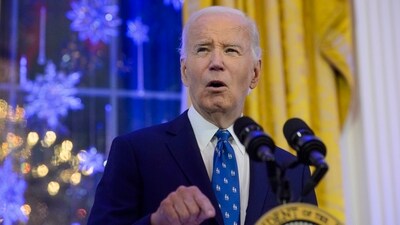
President Joe Biden speaks during a Hanukkah reception in the East Room of the White House in Washington, Monday, Dec. 16, 2024. AP/PTI(AP12_17_2024_000020B)(AP)
The probe could result in tariffs or other measures to restrict imports on older-model semiconductors and the products containing them, including medical devices, cars, smartphones and weaponry, according to people familiar with the matter.
The investigation examining so-called foundational chips could take months to conclude, meaning that any reaction to the findings will be left to the discretion of President-elect Donald Trump’s incoming team.
Biden officials have for months debated whether to initiate the investigation under Section 301, which allows the US to impose restrictions on countries with unfair trade practices, the people said. This week, White House officials agreed to move forward with the inquiry that could help protect the US chip industry.
Approving the probe now means that the new Trump administration will likely have the option to impose trade restrictions to protect domestic semiconductor production in the early months of the president-elect’s term.
Bolstering the US semiconductor industry has been a key focus for Biden, who has taken aggressive steps to limit advanced US technology from being exported to China. Biden signed into law legislation that provided billions of dollars of incentives for chipmakers to build semiconductor factories in the US to stave off a need for cheaper Chinese-made chips.
Spokespeople for the National Security Council and the US Trade Representative declined to comment.
Global Competition
The White House has used the past two years to implement export restrictions on advanced semiconductors made with American and allied technology. But in the meantime, China has been able to manufacture the older, widely available types of semiconductors at a lower cost than their competitors.
Biden officials worry that without restrictions, Beijing will flood the US and global markets with inexpensive chips that will undercut other companies and run them out of business.
In May, the White House announced it will increase tariffs on Chinese legacy semiconductors from the current 25% rate to 50% by 2025. But the Biden team largely agreed that was not enough to prevent a market disruption in the future, especially as the US is looking to increase domestic production of semiconductors.
To impose those tariffs, Biden used the same authority Trump employed to levy more than $300 billion in tariffs on Chinese goods during his first term.
Ukrainian sources have told the BBC that the country’s security service was behind the killing of a high-ranking general in the Russian armed forces and his assistant.
The BBC’s Analysis Editor Ros Atkins, along with BBC Verify, takes a look at material from the scene to assess what we know – and what we don’t.
Produced by Catherine Karelli, Richard Irvine Brown, Olga Robinson and Mark Lyons
NEW DELHI: The Directorate General of Civil Aviation (DGCA) on Monday issued a show cause notice to Akasa for alleged lapses in its operations manual and for the airline’s director (flight operations) “failing to ensure compliance of civil aviation requirements (CAR or DGCA rules.” This notice comes within a week of the regulator issuing a show cause to Akasa after finding certain maintenance lapse during a spot check of one of its aircraft and a section of the airline’s pilots requesting Union aviation minister Rammohan Naidu to conduct an independent investigation into Akasa’s management practices, training method and safety standards. Sources say the latest notice is for: “…revision cycle of operations manual exceeding six months cycle as accepted in approved (manual)” and non-compliance of CARs. On its part, the airline said in a statement: “Over the last few months, the DGCA has conducted a number of routine audits on Akasa Air flight operations department. On one of these audits, DGCA raised certain findings for which they have issued a notice for clarification. As always, we are working closely with the DGCA to clarify this issue and enhance our protocols as required by the regulator. Safety is of utmost importance, and we continuously strive to pursue the highest standards of safety.” However, a section of Akasa pilots points to “issues” in the airline’s management practices and training. “Failure to revise operations manual within the required six-month cycle is a breach of safety standards. The latest notice raises questions, which we have been raising, whether mandatory protocols are being followed. Only recently some pilots had expressed concerns about the airline’s flight operations, allegedly biased trainer behaviour, and training and safety standards, in a letter to the minister,” said sources, adding, “The DGCA’s warnings, show-cause notices and penalties have not led to meaningful and required changes. This is damaging the airline’s reputation.” On December 9, the DGCA had issued a show cause notice to an Akasa aircraft maintenance engineer for poor (maintenance) standards and certification. In their letter to minister Naidu, the section of pilots had alleged the airline’s claims of maintaining highest safety standards are misleading. Akasa had countered this by saying: “…commitment to employee centricity is at the heart of everything we do. Our monthly employee survey reveals that pilots, amongst all employee groups have consistently reported the highest levels of job satisfaction…. This dedication is further evidenced by the minimal number of pilots seeking opportunities outside of Akasa Air throughout 2024. For context, 324 pilots have joined Akasa since October 2023. During this same period, we have recorded an annualised attrition of less than 1% for this employee group. We are focused on building a brand that resonates with both our customers and our employees, ensuring that our team feels proud to be part of our journey.”