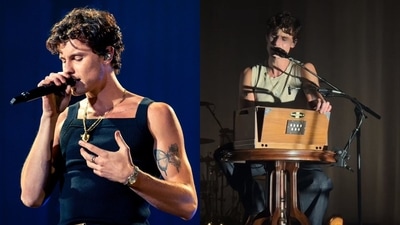
Shawn Mendes’ swing at the harmonium was a very genuine attempt. But trust the internet to create a (hilarious) rabbit hole of puns from the soulful moment
The internet is forever and the (in)famy singer Shawn Mendes is experiencing, courtesy of a resurfaced clip of his, is among the latest specimens of this. The equation’s pretty simple. It’s Shawn, mid-concert, at the harmonium. The video shows him sitting in stance, belting out a few notes. Now how the notes came off, are a bit debatable at best. Some believed he aced the classical high pitch — something that doesn’t really show up much in his own body of work. Others were pretty sure he needs to get some solid hours of practice in if he wants to give the Indian classical singers a run for their money. Now regardless of if Shawn’s tryst with the harmonium impressed you or left you confused, what will have you in splits is the internet using this as an opportunity to go on an endless pun run.
Shawn Mendes at the harmonium has the internet swirling in an endless pun run(Photos: X)
“What universe is this happening in😂😂😂” was the general vibe of the comments section, no matter where you may have chanced across this one-of-a-kind clip. What really has us in a chokehold however, are the punny name spins inspired from actual classical singing legends. Some of our favourites include: “Shawnu Nigam”, “Kumar Shawnu”, “Shawn Fateh Ali Khan”, “Shawnker Mahadevan”, “Pt. Ravi Shawnkar” and “Mendes Hasan Saab”. Other chuckle-inducing intrusive thoughts read: “I thought he was gonna start singing kabhi khushi kabhi ghum” and “me waiting for him to start singing ‘Maula mere Maula mere Maula mere Maula’ “.
Speaking of Shawn’s India connect, the singer is set to perform at the famed Lollapalooza music festival next year. Slated to take place on March 8 and March 9, 2025, this will mark his return to live stage shows after a gap of 2 years. The festival is set to take place in Mumbai.
What did you think of Shawn’s harmonium moment?
See more
News/HTCity/Cinema/ ‘Shawnu Nigam’: Shawn Mendes playing the harmonium has the internet on an endless pun run
Vivo X Fold 3 Pro is reportedly receiving the Android 15-based FuntouchOS 15 update. The over-the-air (OTA) update is claimed to add Live Transcribe and Circle to Search functionalities to the foldable. Vivo and its sub-brand iQOO had officially announced the rollout schedule for the Android 15-based FunTouchOS 15 user interface in September. The update brings new icon styles, animations, effects and several AI-based features.
According to a report by GSMArena, the Vivo X Fold 3 Pro is currently receiving the Android 15-based Funtouch OS 15 update with the firmware version PD2337F_EX_A_15.1.8.21.W30. The update is said to be 2.47GB in size.
As per the the screenshots of the changelog shared by the publication, the Android 15-based Funtouch OS 15 brings new live immersive wallpapers, themes, home screen with fresh icon styles and rounded corner styles. The update has support for hiding app names and new styles for clock widgets. The Albums app gets a new feature called Memory Movie that lets users browse memories as a movie.
Multiple quick setting options are added in Ultra Game Mode while the Notes app gets more text editing tools. The update brings the Live Transcribe feature that describes speech content in the text format on the screen and the Circle to Search feature.
Vivo revealed the rollout schedule for the new user interface in September this year. Besides the Vivo X Fold 3 Pro, the new version of the operating system is confirmed to reach the Vivo X100 series and iQOO 12 series initially.
Vivo X Fold 3 Pro Price, Specifications
The Vivo X Fold 3 Pro debuted in India in June with a price tag of Rs. 1,59,999 for the 16GB RAM + 512GB storage variant. The foldable arrived with Android 14-based Funtouch OS 14 on top.
Vivo X Fold 3 Pro has an 8.03-inch primary 2K (2,200×2,480 pixels) resolution E7 AMOLED inner display and a 6.53-inch (1,172×2,748 pixels) AMOLED cover display. It runs on Snapdragon 8 Gen 3 SoC alongside 16GB of RAM and 512GB of storage. It has a Zeiss-backed triple rear camera setup comprising a 50-megapixel main camera alongside a 64-megapixel telephoto sensor with 3x zooming, and a 50-megapixel ultra-wide sensor. The cover screen and main screen boast 32-megapixel selfie shooters. It carries a 5,700mAh lithium battery with support for 100W wired and 50W wireless charging.
Affiliate links may be automatically generated – see our ethics statement for details.
Honor MagicBook Art 14 2024 was launched on Friday at the company’s launch event, where it also unveiled the Honor Magic V3, Magic Vs 3, MagicPad 2, and Honor Pad 9 Pro. The latest laptop from Honor runs on Windows 11 Home Chinese Edition and sports a 14.6-inch OLED screen. It runs on Intel Core Ultra 5 or Core Ultra 7 CPUs, along with up to 32GB of RAM. Honor has equipped the MagicBook Art 14 2024 with a 60Wh battery that can be charged to 46 percent in 30 minutes, according to the company.
Honor MagicBook Art 14 2024 Price, Availability
Honor MagicBook Art 14 2024 price is set at CNY 7,799 (roughly Rs. 89,800) for the base model with a Core Ultra 5 CPU with 16GB of RAM. The Core Ultra 5 model with 32GB of RAM is priced at CNY 8,499 (roughly Rs. 97,900). Customers can also purchase the top-end model with a Core Ultra 7 CPU and 32GB of RAM that costs CNY 9,499 (roughly Rs. 1,09,400).
The laptop is listed on the company’s website in Summer Olives and Sunrise Impressions colour options (translated from Chinese) and is already available to order in China. There’s no word from the company on plans to launch the device in other markets.
Honor MagicBook Art 14 2024 Specifications
The newly launched Honor MagicBook Art 14 2024 features a 14.6-inch Ultra-HD (3,120×2,080 pixels) OLED touch screen display with 258ppi pixel density and 700 nits peak brightness. It also offers 100 percent coverage of the DCI:P3 colour gamut. The laptop is powered by up to Intel Core Ultra 7 155H chipset with Intel Arc graphics, paired with up to 32GB of LPDDR5X RAM.
Honor has equipped the MagicBook Art 14 2024 laptop with 1TB of SSD storage. Connectivity options include Wi-Fi 6 and Bluetooth 5.3, and the laptop is equipped with a USB Type-C port, a USB 3.2 Type-A port, a Thunderbolt 4 port, an HDMI 2.1 port, and a 3.5mm combo audio port.
The laptop also offers NFC connectivity and has a fingerprint sensor for biometric authentication. The MagicBook Art 14 2024 us equipped with a 60Wh lithium polymer battery that can be charged to 46 percent in 30 minutes and takes 95 minutes for a full charge, according to the company. Besides, it measures 316.77×223.63×12.95mm and weighs 1.03kg.
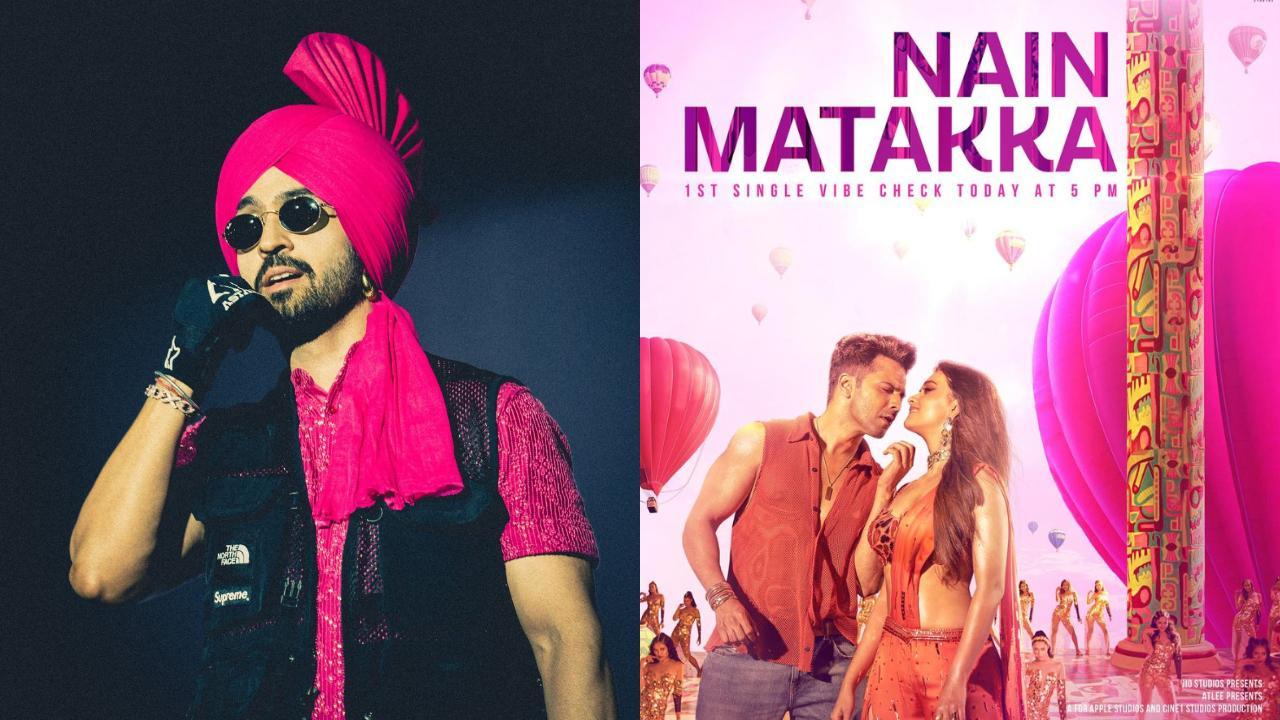
Punjabi singer Diljit Dosanjh`s song `Nain Matakka` from Varun Dhawan-starrer `Baby John` is all set to be out soon.
Dheekshitha Venkadeshan, aka Dhee, also lent her vocals to the track.
As per the makers, `Nain Matakka` is a “foot-tapping, peppy number that showcases the sizzling on-screen chemistry between Varun Dhawan and Keerthy Suresh.”
Recently, the teaser of Baby John was unveiled. It paints `Baby John` as a mass action drama enriched with emotional undertones.
Dhawan plays a police officer and single father, portraying a character who is not afraid to confront adversaries head-on. In a powerful scene, he declares, “Mere jaise bohat aaye hoge, main pehali baar aaya hu” (“Many like me might have come before, but I have come here for the first time”), setting the tone for his heroic journey.
The teaser also introduces Keerthy Suresh as the female lead and features veteran actor Jackie Shroff in a brief yet impactful role as the antagonist.
Wamiqa Gabbi and Rajpal Yadav round out the cast, contributing to the film`s dynamic ensemble.
The film is directed by A Kaleeswaran and backed by acclaimed filmmaker Atlee. It will be out in theatres this December.
This story has been sourced from a third party syndicated feed, agencies. Mid-day accepts no responsibility or liability for its dependability, trustworthiness, reliability and data of the text. Mid-day management/mid-day.com reserves the sole right to alter, delete or remove (without notice) the content in its absolute discretion for any reason whatsoever
Brave rolled out a new artificial intelligence (AI) feature for Brave Search on Thursday. Earlier this year, the San Francisco-based software company introduced ‘Answer with AI’ to its search engine, a feature that shows AI-generated summaries for searched queries. Now, it has added an extension to this feature dubbed AI chat mode, which allows users to ask follow-up questions in a chat-like interface. This feature is currently available to all users on Brave’s search engine.
Brave Search Gets an AI Chat Mode
In a blog post, the software company detailed its new AI feature. The feature is available on Brave Search, a privacy-focused search engine which was released in 2022. Earlier this year, the company introduced an AI summary feature which is similar to Google’s AI Overviews and shows intelligent summaries of the searched query.
However, unlike AI Overviews, Brave will now allow users to enter the rabbit hole by asking AI as many follow-up queries as they like. The AI chat mode appears at the bottom of the ‘Answer with AI’ section as a thin text field. Once an additional query has been entered, a separate chat interface opens on top of the search page where the AI answers the query.
Brave Search AI chat mode
Gadgets 360 staff members were able to test the feature and found that users can ask multiple follow-up queries. The interface is minimal with fast inference time and processing speed. The chatbot also shows all the reference websites from where the information was sourced on top of the response. Additionally, it also issues a warning asking users to verify critical facts.
The AI chat mode also allows users to copy the response and leave feedback by either leaving a thumbs-up or thumbs-down remark. Further, users can open the searched query in a new tab and share the generated response by quickly copying the URL.
Brave claims that the AI feature offers all the privacy protections of the search engine and does not profile the user or store the queries. The conversations with the AI are also not stored and kept private.
The company stated that the AI chat mode feature is powered by both the company’s internal LLM and third-party AI models. The data is sourced from Brave Search results to keep the responses grounded and reduce the risks of AI hallucination.
Recanting a foot-in-mouth moment makes complete sense. On the face of it then, director Imtiaz Ali going out of his way to take back a statement made by him a mere few hours ago, seems odd. Odd because the general context of what he was saying, was that he ensured set safety for a young Alia Bhatt as they shot for Highway (2014), by sending a crew member back who appeared to be hovering around her a little too much — appears positive. But Imtiaz appears to want to have nothing to do with the anecdote.
Imtiaz Ali recants Alia Bhatt anecdote from the sets of Highway (2014), shared at IFFI 2024
Earlier today, taking to his Instagram stories, the director shared a screenshot of an article referencing his anecdote he shared while speaking at a panel discussion at IFFI Goa 2024, and atop it wrote: ‘making a slight clarification – there was no misdemeanour on the sets of the movie Highway and nobody was sent back fromt that unit. The unit of highway was exemplary :)’.
Imtiaz Ali takes back statement made at IFFI Goa 2024 panel discussion(Photo: Instagram/imtiazaliofficial)
For context, Imtiaz had made a very elaborate comment on the topic of women’s safety in Hindi cinema, especially on the sets of films. In supplementing his argument, he cited two examples — one involving Kareena Kapoor from the sets of Jab We Met (2007) which was a thoroughly positive anecdote, and another involving Alia Bhatt from the sets of Highway, which reportedly ended with him sending a crew member back after they kept attempting to hover around Alia, as she say, changed, or tended to nature’s call. Imtiaz had shared, “There have been three times in my entire life that I’ve sent people back, from different places, from different sets. I am happy that it’s only three. I remember once it happened on the sets of Highway. We were shooting on the rural highway with Randeep and Alia and there were no proper vanity vans back in 2013. Alia had to change, go for nature’s call in different, unusual places. Once I had to send this guy back from the set when he was trying to be around her during that time…”.
What’s wrong with the statement?
It’s getting some pushback. The Bebo and Alia anecdotes shared by Imtiaz were actually part of a larger discussion on women’s safety in the film industry in general, and specifically on set. Though Imtiaz had anecdotes to supplement what he was saying, they were preceded by a sort of blanket statement which essentially dismissed the very real threat to safety that women in the film industry are potentially subjected to, on a daily basis, followed by a similarly toned statement about casting couch. For instance, Imtiaz said, “I have been a director in the Hindi film industry for 15-20 years. I have heard a lot about the casting couch. A girl comes in, she’s scared, and she feels the need to compromise. Let me tell you, if a woman or girl cannot say ‘no,’ her chances of succeeding don’t necessarily increase. It’s not like if a girl compromises, she’ll definitely get a role”.
Filmmaker-writer Vinita Nanda for one, has publicly called out Imtiaz over his blanket statements. An excerpt from her note read, “Why has IFFI Goa selected him to speak on behalf of women? Is it to whitewash the truth? If men like him had the courtesy to abstain from speaking o a subject they have no experience about, one will believe that change is indeed taking place”.
Do you think Imtiaz is in the wrong with his statement?
The WhatsApp message was from the chief negotiator of one of the most powerful countries at the COP climate gathering. Could I stop by for a chat, he asked.
As his team hunched over computers eating takeaway pizza, he raged about the obstructionist behaviour of many of the other teams at the conference.
So far, so normal. Others had been saying versions of this all week – that this was the worst COP ever; that negotiating texts, which are meant to get smaller as deadlines approached, were in fact ballooning; that COP in its current form might be dead in the water…
Looming over it all was the prospect of US president-elect Donald Trump withdrawing the US from the COP process when he takes office for a second time. He has called climate action a “scam” and, at his victory celebration in West Palm Beach earlier this month, vowed to boost US oil production beyond its current record levels, saying, “We have more liquid gold than any country in the world”.
But there was one positive: China.
“It’s the only bright spot in all of this is,” the chief negotiator told me. Not only was its negotiating style markedly different to previous years, but he also observed that, as he puts it, “China could be stepping forward.”
So what would it mean for the global effort to tackle climate change if it does step to the fore, just as the US steps back?
Negotiating styles – a change of tack
In the past, China has played a dual role in these talks. Sometimes it has aligned with the US and Europe, for example on ambitious targets to boost renewable power or on the reduction of methane, a potent greenhouse gas. On other issues, meanwhile, it has slowed progress.
One such example was COP15, which was held in Copenhagen in 2009. There had been high hopes that an agreement would be reached to commit countries to deep cuts in carbon emissions. But the conference nearly collapsed when China fought against US pressure to submit to a regime of international monitoring. The final non-binding deal was generally considered a failure.
This year was different. The chief negotiator I spoke to said that China was being “unusually cooperative” across all the discussions.
Getty Images
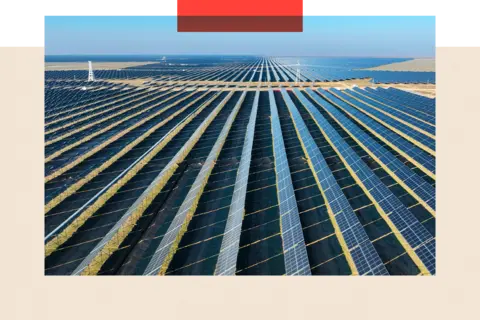
In the first half of 2024, 13 gigawatts (GW) of Chinese manufactured solar panels were imported by Pakistan
The most obvious sign of this came at the start of the conference, when China made public details of its climate funding.
Traditionally, China has released minimal information about its climate policies and plans, so it came as a surprise when this year, for the first time, officials said they have paid developing countries more than $24 billion for climate action since 2016.
“That’s serious money, almost nobody else is at that level,” one COP insider told me.
This got the conference buzzing. It is a “notable signal”, says Li Shuo, a director of China Climate Hub, “as it’s the first time that the Chinese government has laid out a clear figure in terms of how much they have been providing.”
Developing country vs superpower
China is classed as a developing country in the context of UN climate talks, despite being the world’s second biggest economy, the result of a peculiarity in the COP rules. (This is linked to its economic status in 1992 when the talks process began.)
It has long resisted pressure from developed countries to change its status, meaning it doesn’t have to contribute to the pot that rich countries have agreed to pay to poorer ones.
That pot has been one of the focuses in the talks at Baku. It totals $100 billion a year currently, but developing countries – those with low and middle incomes – need at least a trillion dollars a year to help them switch to clean energy and deal with the effects of climate change, according to the World Economic Forum.
Getty Images
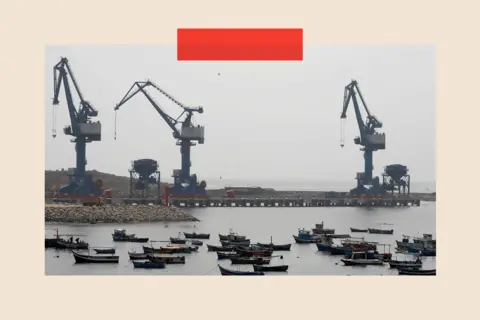
The new $3.5bn (£2.75bn) Chancay port in Peru has been masterminded by China’s state-owned Cosco Shipping
What form that funding takes is another question, as little data is available. What is known is that Chinese money is helping to fund projects like solar farms and energy efficient lighting in certain developing countries such as Rwanda, where Chinese manufactured electric buses have been used in the capital Kigali.
“What’s so interesting is the language the Chinese used,” says Professor Michael Jacobs, an expert on climate politics at Sheffield University. “They described it as ‘provided and mobilised’ – that’s the term developed countries use for their payments.”
Language matters at climate conferences. Negotiators can spend days discussing whether something “should” or “will” happen. So, the Chinese echoing the language of the rich world is significant, Prof Jacobs argues.
“They used to calibrate everything against what the US did,” he says. When Trump took office in 2016, China stood back from the talks in response. This time is different, according to Prof Jacobs.
According to Li Shuo, the shifting economics of renewables explains why China is likely to be a bigger player.
“The green transformation is very much being led by China – not necessarily the government, but its private sector and companies”. These companies lead the rest of the world by what Shuo says is a “very significant margin”.
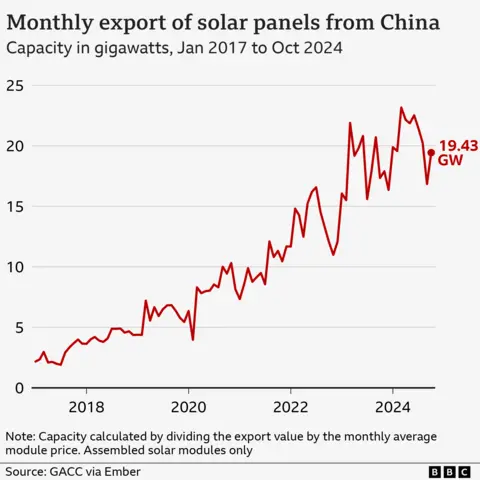
Eight out of every ten solar panels are made in China, and it controls some two-thirds of wind turbine production. It is reckoned to produce at least three-quarters of the world’s lithium batteries and more than 60% of the global market for electric vehicles.
Earlier this year, Chinese President Xi Jinping said that solar panels, EVs and batteries are the “new trio” at the heart of the Chinese economy.
It is the huge investments China has made in renewable technologies and the massive economies of scale that it has created that have also driven down renewable costs year after year – the challenge it faces now is finding new markets to sell it into.
The developing world is where the demand is set to boom. These countries will account for two-thirds of the renewable market within 10 years, according to a recent report by a group of economists tasked by the UN with calculating the costs of the energy transition.
Pakistan imported 13 gigawatts (GW) of solar panels in the first six months of this year alone, according to research by Bloomberg NEF. To put that in context, the UK has 17GW of installed solar.
Getty Images
China’s “Belt and Road Initiative” aims to develop new trade routes and dovetails with the country exporting clean tech to emerging economies
Shipping clean tech to emerging economies dovetails with another of China’s policies: its “Belt and Road Initiative,” an effort to develop new trade routes, including roads, railways, ports and airports, to connect with the rest of the world.
China has spent more than a trillion dollars on the project, according to the World Economic Forum. Last week, President Xi opened a new port on the coast of Peru.
Which begins to explain why, as Prof Jacobs sees it, while the US may withdraw, China looks like it might be stepping up. “It now sees its best interest as encouraging other countries to also cut their emissions by using Chinese technologies and equipment.”
A tectonic shift in climate talks
If China does take a more central role, it would mark a tectonic shift in the COP process. Historically, Western countries – particularly the US and EU – have provided the momentum, cheered on by smaller climate-vulnerable nations. The difference in the way the talks play out will be marked.
Jonathan Pershing, program director of environment at the William and Flora Hewlett Foundation, has been to every COP and understands better than most the behind-the-scenes bartering, bullying and brinkmanship that makes or breaks deals at summits. He says that China won’t lead from the front, like the US and Europe.
“They’re more cautious players than that. It may be that they’re leading with Chinese characteristics, which is what they might say themselves.”
(This echoes how Deng Xiaoping, president in the early 1980s, described his economic reforms, which catapulted the country’s economic growth into double figures: “socialism with Chinese characteristics”.)
Pershing suggests that China is likely to help drive the COP process forward by discreetly intervening to unblock disputes. Most of this effort will take place behind closed doors, he believes, but is likely to include urging developing and developed countries to increase their ambition – and the flow of cash.
However China may not be entirely helpful on some of the challenges that slow the process, such as instances when countries use COP as a stage to champion their own interests.
One of the biggest blockers in Baku was said to be Saudi Arabia, which heads up a group of fossil fuel producing countries that want to slow the transition to renewables. As a big consumer of fossil fuels, China has often thrown its weight behind them in the past, such as by resisting the UK’s effort to get agreement to phase out coal at COP26 in Glasgow.
Ultimately, though, there is cause for hope, according to some well-placed observers. Camilla Born, who has been part of the UK’s negotiating team and helped run COP26 in Glasgow, believes that the future talks will be determined by the new economics of energy, not the politics of meetings.
“This isn’t just about an idea of how to deal with climate change anymore,” she argues. “This is about investments, about money – it’s people’s jobs, it’s new technologies. The conversations are different.”
It is, after all, the biggest revolution in energy since the start of the industrial revolution. And regardless of which superpower takes the lead, or if the US is out of the game for four years, it’s unlikely that anyone will want to miss out on such a vast market.
BBC InDepth is the new home on the website and app for the best analysis and expertise from our top journalists. Under a distinctive new brand, we’ll bring you fresh perspectives that challenge assumptions, and deep reporting on the biggest issues to help you make sense of a complex world. And we’ll be showcasing thought-provoking content from across BBC Sounds and iPlayer too. We’re starting small but thinking big, and we want to know what you think – you can send us your feedback by clicking on the button below.
Microsoft said a Russian-linked hacking group attacked its corporate systems, getting into a “small number” of email accounts, including those of senior leadership and employees who work in cybersecurity and legal. The company said it’s acting immediately to fix older systems, which will probably cause some disruption.
The hacking group doesn’t appear to have accessed customers’ systems or Microsoft servers that run outward-facing products, the software giant said Friday in a blog post. Microsoft also has no evidence the group, named Midnight Blizzard, got into source code or artificial intelligence systems.
“We will act immediately to apply our current security standards to Microsoft-owned legacy systems and internal business processes, even when these changes might cause disruption to existing business processes,” the company said. “This will likely cause some level of disruption.”
The group that Microsoft deemed responsible, also known as “Nobelium,” is a sophisticated nation-state hacking group that the US government has tied to Russia. The same group previously breached SolarWinds, a US federal contractor, as part of a massive cyber-espionage effort against US federal agencies.
The company said hackers beginning in November used a “password spray” attack to infiltrate its systems. That technique, sometimes known as a “brute force attack,” typically involves outsiders quickly trying multiple passwords on specific user names in order to try breaching targeted corporate accounts.
In this case, in addition to the accessed accounts, the attackers also took emails and attached documents. Microsoft said it detected the hack on January 12, adding that the company is still notifying employees whose emails were accessed.
Eric Goldstein, executive assistant director for cybersecurity at the US Cybersecurity and Infrastructure Security Agency, said government officials are “closely coordinating with Microsoft to gain additional insights into this incident and understand impacts so we can help protect other potential victims.”
Microsoft technology has frequently been the target of major hacking campaigns.
The US Cyber Safety Review Board, which reports to the Department of Homeland Security, is already assessing a 2023 intrusion against Microsoft Exchange Online that the company attributed to China-linked hackers. That breach enabled the hack of senior US officials’ email accounts and has prompted growing concerns about cloud computing security. Microsoft said in September it identified five different errors in how its systems that have “been corrected.”
In an interview with Bloomberg in 2023 following that breach, Jen Easterly, director of the agency that manages the board, suggested that Microsoft should “recapture the ethos” of what Microsoft co-founder Bill Gates called “trustworthy computing” in 2002, when he instructed employees to focus on security over adding new features.
“I absolutely positively think they have to focus on ensuring their products are both secure by default and secure by design, and we are going to continue to work with them to urge them to do that,” Easterly said of Microsoft.
In November, Microsoft said it was overhauling how it protects its software and systems after a series of high-profile hacks. Now the company said it must pick up the pace on changes, particularly to older systems and products.
“For Microsoft, this incident has highlighted the urgent need to move even faster,” the company said Friday.
After the huge success of Jawan with Shah Rukh Khan, director Atlee is ready to team up with Salman Khan for his sixth film. The news of this collaboration has been buzzing among fans, with many eager to learn more about the project. The film is expected to be an epic two-hero saga, with Atlee planning to cast either Kamal Haasan or Rajinikanth alongside Salman Khan in a parallel lead role. This could become one of the biggest casting coups in recent times, though the final casting is still to be confirmed.
According to a report in Pinkvilla, Atlee’s next film is a high-budget reincarnation action drama featuring Salman Khan in a never-before-seen role. The film will span two eras—past and present—with stunning visuals set in a fictional world. Salman will portray a warrior in the period era, while details of the present-day storyline are being kept secret. The focus will be on the period segments, as the script calls for intense drama and conflict in the fantasy world, with all characters connected across both timelines.
The report also added that the mega-budget two-hero epic is set to begin production in Summer 2025, as Atlee needs time to finalize the script and start pre-production. It’s an ambitious project aimed at creating a new cinematic world filled with action, drama, thrills, and emotion. Atlee plans to finalize the entire cast for A6 by the end of this year and is confident that either Kamal Haasan or Rajinikanth will play the parallel lead.
The film, produced by Sun Pictures, will be shot over the course of one year, starting in Summer 2025. It is expected to be Salman Khan’s major release in 2026, with an official announcement and teaser planned for next year. All other details are being kept secret for now. The film will mark Salman Khan’s return to the reincarnation genre, last seen in the 1995 film Karan Arjun. Additionally, Salman Khan will appear in an extended cameo in the Christmas 2025 release Baby John, starring Varun Dhawan. Stay tuned to Pinkvilla for more updates.
Google Pixel 9 series was announced in August and it debuted with three new apps, with Pixel Screenshots being the standout. It is not only an image manager but also leverages artificial intelligence (AI) to retrieve information from stored screenshots on the device, functioning as a searchable library. A new report suggests Google might be developing visual tweaks and more functionalities for the app, including a new layout and the ability to select multiple images.
New Features Coming to Pixel Screenshots App
According to an Android Authority report, the changes were discovered following an APK teardown of the Pixel Screenshots app version 0.24.373.08. The app is reportedly being tested with a new home page layout, which includes a new layout button alongside the Screenshots header. Following this change, users might be able to see all their screenshots on the home page of the app, along with a quick option to change the layout.
The report hints at the inclusion of a new way to select multiple images. Instead of long-pressing and tapping each screenshot individually, it could allow users to carry out a drag gesture while selecting multiple screenshots simultaneously. They may also be able to rename collections within the Pixel Screenshots app.
Google is reported to be developing new shortcuts for adding images to the app, along with the host of UI changes that are said to be in development. This change may enable users to add screenshots to the app from the Gallery and Camera quickly by long-pressing the app icon. New ways to add, copy and send emails, or copy and call phone numbers from information provided in screenshots might also be in development, the report adds.
However, all of the aforementioned features are not available to the public yet and are in development. Instead, only code strings containing references to them have been discovered. Thus, it is possible that it might take Google some time to roll them out to the public. Alternatively, there is a possibility that the Mountain View-based tech giant might tweak some of them in one way or another, or not bring them to the Pixel Screenshots app at all.