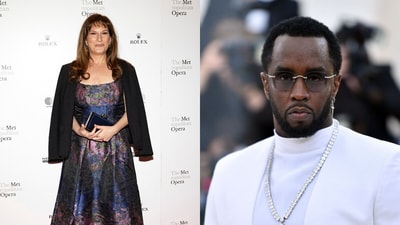
SNL alum Ana Gasteyer recently shared an unforgettable memory from her time on Saturday Night Live involving disgraced rapper Sean ‘Diddy’ Combs. During her guest appearance on the Las Culturistas podcast on November 20, the comedian recalled a high-profile musical guest’s appearance in May 1998 and the unexpected humour that unfolded behind the scenes.
Ana Gasteyer recalls a SNL moment with Sean ‘Diddy’ Combs, detailing the chaos his presence brought
Gasteyer, a cast member on SNL from 1996 to 2002, described, “Of course, like, [Diddy] shut down the whole building.”
“You can tell like the five a**h***s in the six years that I was there when they would be like, ‘So and so is in the building, everybody stay in your dressing rooms,’ ”Gasteyer explained, noting that such restrictions seemed excessive.
“Which is applicable if you’re a presidential candidate. But apart from that, really, it’s my house. For P. Diddy, he demanded a totally closed set.”
Gasteyer recounts Will Ferrell’s epic prank on Diddy
The Wine Country actress recounted the events leading up to Will Ferrell’s now-infamous prank during Combs’ rehearsal of his song “Come With Me,” a 1998 hit that sampled Led Zeppelin’s “Kashmir.” The prank was conceived during a writers’ meeting, where someone jokingly suggested that Ferrell, in character as “Ron,” should crash the performance.
“He went on down the stairs, and he marched right in,” Gasteyer said. “And I have the video from the control room where Sean Combs is rapping with like, ‘Da-na-na, da-na-na, da-na-na, da-na-na’ behind him. And Ron’s walking around, looking really disoriented [still in character].”
While the prank delighted the SNL cast, Gasteyer admitted that Puff did not share the humour. “[Combs] really did not roll with it. He was very uncomfortable, but it was also just like, the artifice of all that faux importance,” she said, poking fun at the dramatic energy surrounding the performance.
Ferrell himself has corroborated the story back in a 2020 interview with Vulture, “Someone said, ‘Ron should go up onstage,’ and before everyone turned to see, I had sprinted out the door.”
Black Myth: Wukong released earlier this week and has since climbed to the top of Steam charts, becoming one of the most played games of all time on the platform. The action-RPG from Chinese developer Game Science is available on PC and PlayStation, but hasn’t yet launched on Xbox. While Microsoft has not clarified the reason for the delay, Black Myth: Wukong’s launch on Xbox Series S/X has reportedly been pushed back over a “tech issue.”
Black Myth: Wukong on Xbox Series S/X
According to a report by Forbes, The Xbox launch of Black Myth: Wukong hasn’t been delayed because of an exclusivity deal between Sony and Game Science. The game has reportedly not arrived on Microsoft’s console simultaneously with other platforms because of a “tech issue.”
The report doesn’t clarify the technical issue with an Xbox version of the game, but one can gauge it might have something to do with optimising the game for both the higher-end Xbox Series X and the less powerful Xbox Series S.
Earlier this year, Game Science had clarified the reason for the game’s delay on Xbox Series S/X in the FAQ section of the game’s website. “PC and PS5 users can enjoy the full game starting August 20, 2024. We are currently optimizing the Xbox Series X|S version to meet our quality standards, so it won’t release simultaneously with the other platforms,” the developer had said. “We apologize for the delay and aim to minimize the wait for Xbox users. We will announce the release date as soon as it meets our quality standards.”
Black Myth: Wukong is built in Epic Games’ Unreal Engine 5 and is a graphically demanding title that could likely face issues with running smoothly on Xbox Series S. The underpowered console has previously acted as a hurdle for games launching on Xbox. Baldur’s Gate 3 was released on Xbox Series S/X months after launching on PC and PS5 because developer Larian Studios struggled to make the game’s split-screen co-op feature work optimally on Series S. The game eventually released on the platform without the split-screen mode.
Microsoft, as policy, enforces gameplay feature parity between both of its current-generation consoles and the company intends for games to launch on both Xbox Series X and Series S simultaneously.
Black Myth: Wukong arrived on PC (via Steam and Epic Games Store) and PS5 on August 20. Since launch, it has gone on to become the second most-played game on Steam, behind only PUBG: Battlegrounds, with its all-time peak concurrent player count hitting over 2 million users on Valve’s platform.
Deepika Padukone and Ranveer Singh became parents to a beautiful baby girl this year in September. They recently announced her name as Dua Padukone Singh. While DP is busy being a doting mom and spending most of her time with the little one, the actress keeps her fans updated about her new life through reels and memes on social media, which are too cute to miss. For instance, Deepika has now given a glimpse of her skincare routine after she’s become a mother. This funny reel sees a man just washing his face with water and nothing else and it read, “My skincare routine after becoming a new mom.”
Interestingly, Deepika has launched a skincare brand and yet looks like she doesn’t seem to find time for her skincare with a complex routine. Netizens found deep relatability with this reel and dropped comments. Deepika and Ranveer recently took their first holiday with their baby girl and their families had also accompanied them for this trip. This was during their anniversary this month. On work front, Deepika was last seen in an extended cameo in ‘Singham Again‘ which also saw Ranveer Singh along with Ajay Devgn, Arjun Kapoor, Tiger Shroff, Kareena Kapoor Khan, Akshay Kumar. Rohit Shetty has confirmed that there will be a new film just based on Deepika’s ‘Lady Singham’ character and that’s the reason why she was introduced in the movie.
OnePlus Pad Pro was introduced in China in June this year with upgrades over the OnePlus Pad tablet. The Pro version is powered by a Snapdragon 8 Gen 3 SoC and carries a 9,510mAh battery with support for 67W fast charging. It is equipped with a 12.1-inch 3K display with a 144Hz refresh rate. A new leak suggests that the company is expected to launch a new variant of the tablet with a larger 13-inch screen. The probable launch timeline of the purported OnePlus Pad Pro refreshed version has not yet been tipped.
OnePlus Pad Pro 13-Inch Features (Expected)
The OnePlus Pad Pro will likely arrive in China soon with a refreshed version, according to a Weibo post by tipster WHYLAB. The tipster did not mention the expected launch timeline of the tablet but claimed that it will likely sport a larger 13-inch “Huaxing” LCD screen with a 3,840 x 2,400 pixels resolution and a 144Hz refresh rate. It is expected to have up to 600 nits of brightness, a 240Hz touch sampling rate, and “support for three-zone multi-frequency display.”
More details about the rumoured variant will likely surface online over the next few days. Notably, the current OnePlus Pad Pro version sports a 12.1-inch 3K display.
OnePlus Pad Pro Specifications
Aside from a 3K resolution, the OnePlus Pad Pro display has a 144Hz refresh rate, a 7:5 aspect ratio, 900 nits peak brightness, and a 540Hz touch sampling rate alongside TUV Rheinland 3.0 certification and support for Dolby Vision.
The OnePlus Pad Pro, which launched in India as the OnePlus Pad 2, is backed by a Snapdragon 8 Gen 3 SoC and a 9,510mAh battery with 67W SuperVOOC charging support. It supports Wi-Fi, Bluetooth, and NFC connectivity and is equipped with 13-megapixel and 8-megapixel rear and front cameras, respectively. The tablet carries a quad stereo speaker system and a USB Type-C port.
It is unclear if the rumoured OnePlus Pad Pro variant with the larger display will see an eventual India launch.
Mumbai: Vijay Deverakonda has finally addressed his dating rumours but did not mention being in a relationship with actress Rashmika Mandanna. During a recent interview with Curly Tales, the actor admitted to being in a relationship, though he refrained from naming his partner. Vijay did not directly confirm the speculation about Rashmika, but fans were quick to connect the dots, given their close bond and frequent appearances together, both on and off-screen.
The actor seemingly confirmed the rumours of his relationship with the Pushpa 2 actress and said to Curly Tales, “I am 35 years old; you think I will be single?”
He further added,” I know what it feels like to be loved, and I know what it is to love. I don’t know unconditional love because my love comes with expectations, so clearly my love isn’t unconditional. I feel everything is over-romanticized.”
Speaking about how marriage is more challenging to a woman, he added, “It is more challenging for women. It necessarily doesn’t have to interfere with a career. But, it is harder on women and also largely depends on the profession they are in.”
Rashmika and Vijay have worked together in hit films like Geetha Govindam and Dear Comrade, and their chemistry has often fuelled rumours of a romantic relationship.
Fans are now eagerly waiting for Rashmika’s response to Vijay’s revelation, as the duo continues to be one of the most talked-about pairs in the industry. Whether or not they confirm their relationship, their fans seem thrilled by the possibility of them being together.
Amazon Great Indian Festival Sale 2024 has entered its second week in India. The festival special sale started on September 27 for all shoppers after providing 24 hours of early access to Prime members. A wide range of products across categories such as smartphones, wearables, tablets, home appliances and apparel are available at slashed rates in the ongoing sale. Shoppers can take benefit of no-cost EMIs, exchange deals, and bank discounts while placing orders. If you are looking for laptops with great performance and good value for money, this year’s Amazon Great Indian Festival sale has several options.
Best Deals on Laptops
Brands like Dell, Acer, HP, Lenovo and more are selling their laptops at discounted rates during the ongoing Amazon Great Indian Festival sale. Besides the usual offers, SBI card customers will get a 10 percent instant discount. Further, Amazon Pay ICICI card users can avail of extra deals. There are exchange offers, UPI-based discounts, and no-cost EMI options as well.
Apple’s MacBook Air M1 with 8GB RAM and 256GB storage is priced at Rs. 59,990 in the sale, instead of Rs. 92,900. This can be lowered further by applying card-based discounts and exchange options. If you are looking at budget-friendly options, the Acer Aspire 3 and Acer Aspire Lite models can be considered.
We’ve handpicked some great deals on laptops you can avail of during the Amazon Great Indian Festival Sale 2024.
OnePlus Pad Pro was introduced in China in June this year with upgrades over the OnePlus Pad tablet. The Pro version is powered by a Snapdragon 8 Gen 3 SoC and carries a 9,510mAh battery with support for 67W fast charging. It is equipped with a 12.1-inch 3K display with a 144Hz refresh rate. A new leak suggests that the company is expected to launch a new variant of the tablet with a larger 13-inch screen. The probable launch timeline of the purported OnePlus Pad Pro refreshed version has not yet been tipped.
OnePlus Pad Pro 13-Inch Features (Expected)
The OnePlus Pad Pro will likely arrive in China soon with a refreshed version, according to a Weibo post by tipster WHYLAB. The tipster did not mention the expected launch timeline of the tablet but claimed that it will likely sport a larger 13-inch “Huaxing” LCD screen with a 3,840 x 2,400 pixels resolution and a 144Hz refresh rate. It is expected to have up to 600 nits of brightness, a 240Hz touch sampling rate, and “support for three-zone multi-frequency display.”
More details about the rumoured variant will likely surface online over the next few days. Notably, the current OnePlus Pad Pro version sports a 12.1-inch 3K display.
OnePlus Pad Pro Specifications
Aside from a 3K resolution, the OnePlus Pad Pro display has a 144Hz refresh rate, a 7:5 aspect ratio, 900 nits peak brightness, and a 540Hz touch sampling rate alongside TUV Rheinland 3.0 certification and support for Dolby Vision.
The OnePlus Pad Pro, which launched in India as the OnePlus Pad 2, is backed by a Snapdragon 8 Gen 3 SoC and a 9,510mAh battery with 67W SuperVOOC charging support. It supports Wi-Fi, Bluetooth, and NFC connectivity and is equipped with 13-megapixel and 8-megapixel rear and front cameras, respectively. The tablet carries a quad stereo speaker system and a USB Type-C port.
It is unclear if the rumoured OnePlus Pad Pro variant with the larger display will see an eventual India launch.
Washington: The US Department of Justice has indicted Gautam Adani, the founder of Adani Group, his nephew Sagar Adani, and other senior Adani Green executives for allegedly bribing or offering bribes to the tune of $265 million to Indian state government officials to get them to sign solar power contracts, while raising money for the same projects in the US by promising that the company abided by anti-bribery laws. This constitutes fraud under US federal securities law and, if proven, may invite criminal liabilities.
The US case rests on the premise that Adani Green bribed government officials. (REUTERS)
The US case rests on the premise that Adani Green bribed government officials in Odisha and Andhra Pradesh, and possibly Tamil Nadu, Chhattisgarh, and Jammu and Kashmir (J&K), to get their power distribution companies (discoms) to commit to purchasing solar power at above market rates. The timeline of the alleged bribes is from the middle of 2021 to the end of 2021. Biju Janata Dal, YSR Congress, DMK, and Congress governed four of the states mentioned, while J&K was effectively under central BJP rule.
There was no immediate response from Adani and the copy will be updated when HT gets one.
In the charges unsealed on Wednesday evening Eastern time, the US attorney’s office for the Eastern District Court of New York alleged that between 2020 and 2024, senior executives of Adani Green and associated entities “conspired to misrepresent the company’s anti-bribery practices” to US investors and international financial institutions. The indictment added that Adani and others also “concealed” from the same investors their bribery of Indian government officials to obtain billions of dollars of financing for green energy projects”, including the “corrupt solar energy supply contracts” for which they were raising funds.
The US Security and Exchange Commission (SEC) has, in parallel, filed a complaint against Adani and his nephew, Sagar, the executive director of Adani Green, “for conduct arising out of a massive bribery scheme”. This allegedly involved “paying or promising to pay the equivalent of hundreds of millions of dollars in bribes to Indian government officials to secure their commitment to purchase energy at above-market rates” while raising $175 million from US investors in the same period, based on “materially false and misleading” statements.
If proven, the charges may invite financial penalties and a bar on the defendants from serving as directors or officers in companies that fall under US exchange regulations.
The US allegations rest on a particular chain of events. Adani Green benefited from a central solar agency scheme that incentivised companies to produce solar production component parts in return for a guaranteed power purchase agreement. But this hinged on the central agency signing similar power sales agreements with state discoms; discoms didn’t want to buy power at what had become above-market rates. The core allegation is that Adani Green bribed state discom officials to do that and then lied about it to American investors at the other end.
Both US prosecutors and SEC have also charged Cyril Cabanes of Azure Power Global Ltd — described by SEC as a company owned by two Canadian pension funds, and formed under laws in Mauritius, that produces and sells solar power in India — for allegedly facilitating the authorisation of bribes and violating the Foreign Corrupt Practices Act. Azure had also won contacts under the same solar scheme. The DOJ indictment lists other employees of Adani Green and Azure and its Canadian institutional investor allegedly involved in the scheme in different ways. It also charges Azure employees of conspiring to obstruct justice.
A caveat: This story is a detailed account of the US charges based on a reading of both the indictment and complaint — but it is just that, a story of the allegations made by one side. None of these charges have been proven in court and the multiple stakeholders mentioned in the story — Adani Green, Azure, state governments, and individuals associated with them – have not had a chance to respond. The story only reflects what is out there in the legal public domain and each claim is just an alleged one at this stage.
US charges: What Adani did wrong
Offering context, the SEC complaint places the establishment of Adani Green in January 2015 in the backdrop of the Indian government’s stated goal of achieving 100 GW of solar energy production capacity by 2022. The company’s model was developing, building, owning, operating, and maintaining utility-scale grid-connected solar and wind farms, and earning revenue by selling power to both central government agencies and discoms under long-term fixed-price power purchasing agreements.
The SEC complaint states that the company’s solar ambitions rested “significantly on programs and economic incentives” implemented by Solar Energy Company of India (SECI), a government body. Adani Green and Azure Power, according to the SEC complaint, benefited from SECI’s manufacturing-linked incentive scheme that incentivised a firm to produce solar power component parts, in return for an official commitment to buy the power of a certain quantum at a certain price.
Adani won two-thirds, and Azure won one-third of the projects. But the award of the contracts in June 2020 did not include a SECI guarantee of power purchase. This, according to the complaint, hinged on two steps — SECI entering into similar arrangements with state discoms whereby discoms would commit to buying power at those rates and then SECI signing an agreement with the companies.
The core of the allegation is that discoms refused to get into agreements with SECI because the price that SECI had committed to the companies was above market rates – the Adanis then, the US regulator alleges, bribed state officials to get them to sign the agreements with SECI. The US case is based on the premise that this is where the corruption happened, and this was what Adani Green did not tell investors in America.
Where Indian states get implicated
The SEC complaint alleges that Gautam and Sagar Adani, “through their personal involvement and promises to pay or payment of a total of hundreds of millions of dollars” obtained agreements from discoms. Adani executives “kept track of the bribes, creating and maintaining multiple records of bribes” that had been paid or promised to government officials to get them to buy power. The complaint then gives specific examples.
It states, “According to Adani Green’s internal records, a payment equal to hundreds of thousands of dollars was paid or promised to government officials” in Odisha “to cause Odisha to enter into a power supply agreement with SECI. In July 2021, SECI announced its first power supply agreement and Odisha’s grid authority said it would buy 500 MW of power capacity from SECI. Odisha’s chief minister then was Naveen Patnaik.
The US regulator’s complaint alleges that Adani next personally met the Andhra Pradesh chief minister (who, at that time, was Jagan Mohan Reddy) in August 2021 (the indictment only refers to the Andhra official that Adani met as foreign official 1, a “high ranking government official of Andhra Pradesh”). The complaint alleges that “at or in connection with the meeting”, Adani paid or promised to pay Andhra government officials $200 million (according to the indictment, the payment was $228 million to “foreign official 1”), greater “by orders of magnitude” than bribes paid to Odisha officials. Soon after, Andhra announced its decision to buy 7000 MW of power capacity from SECI.
The DOJ indictment alleges that between July 2021 and February 2022, “following the promise of bribes to Indian government officials”, besides Odisha and Andhra, the discoms of J&K (then run by lieutenant governor Manoj Sinha, and effectively under central control), Chhattisgarh (under Bhupesh Baghel) and Tamil Nadu (governed by MK Stalin) signed power supply agreements with SECI.
Separately, both Gautam and Sagar Adani, the complaint alleges, sought a repayment of its share of the bribe from Azure which had won one-third of the contracts. Azure too would benefit from the agreements, as SECI would purchase power capacity from Azure and sell to discoms. In these conversations, Gautam Adani, the complaint says, recounted he paid bribes to Indian state government officials to persuade them to enter power supply agreements. One way Azure paid back was by ceding its share of power, it could sell to SECI related to Andhra to Adani Green.
The promise at the American end
At the very same time, in August 2021, the SEC alleges, the Adani Group was moving ahead on the financing front. Its management committee decided to authorise Adani Green to raise or borrow $750 million “through the issuance of debt securities i.e. Notes”. At the end of the month, Adani Green did a roadshow selling the bonds to investors in the US as “green bonds” aimed to fund “eligible green projects”.
The core SEC charge then is that despite knowing disclosure norms, Adani Green did not disclose how it had got the contracts (ie through bribes), and instead made “materially false and misleading” claims of having met all the norms, including anti-bribery norms, in the offering circulars. “Both Gautam Adani and Sagar Adani intended, or recklessly disregarded, that Adani Green would offer and sell the notes based on a deceptive portrayal of Adani Green’s core business”.
Adani Green sold $175 million of the notes to investors in the US — the reason US regulators can claim a locus standi in the case. And, therefore the SEC complaint focuses on the claim of Adani Green to these note purchasers/investors that no company director or officer had paid bribes or promised to pay bribes or attempted to unduly influence officials, and that the company was a leader in good corporate governance.
“None of this was true…Defendants were personally involved in paying or promising the equivalent of hundreds of millions of dollars in bribes to Indian state government officials to induce Indian state governments to enter into contracts necessary for Adani Green to develop India’s largest solar power plant project, from which Adani Green stood to earn billions of dollars”, the SEC charge says, in what is the crux of the case.
The SEC has asked the court to order defendants to pay civil money penalties and prohibit them from ever holding the position of a director or officer in a company that has a class of securities under the Exchange Act Section, a decision that may effectively bar the two Adanis from being part of companies that raise funds and go public in the US.
The indictment alleges that “false statements, misrepresentations, and material omissions” that Adani made and caused others to make “induced investors to purchase bonds and financial institutions to lend money pursuant to terms and at prices that did not account for the true risk” associated with the transaction.
How it unraveled
Neither the indictment nor the complaint has an exact chronology on how the scheme came to light and the sources used, and some details are hazy with unclear timelines, but broadly this is what the legal documents appear to suggest.
In April 2022, Vneet Jaain, the CEO of Adani Green, also charged in the indictment, took a photograph to prepare for a meeting that had details of what Azure owed Adani for its share of the bribes (approx $83 million). There were long discussions, including involving Adani, on the possible options through which Azure could pay the bribe back to Adani; one employee, also indicted, prepared a PowerPoint presentation on “which corrupt option was best” as the indictment put it. These are the conversations that allegedly led to Azure ceding its rights to Adani in Andhra.
Among the various employees of Adani Green and Azure involved in the scheme, there was communication including via “electronic messaging”, some of which occurred when some of the actors were in the US.
Subsequently, when there was a query from the SEC, there was a coordinated plot among employees of Azure and its institutional investor to “suppress documents, conceal information and profile false information” for the purpose of “obstructing, influencing and interfering” with government investigations.
In August 2022, five of these defendants from Azure and associated companies planned a plot to implicate the Adanis of having plotted to pay the bribes while hiding their own role.
It was in March 2023 that FBI investigators approached Sagar Adani, took his electronic devices in custody, and informed him and subsequently Gautam Adani of the investigation, and served a grand jury subpoena. In subsequent company statements, the indictment alleges, Adani Green “false and misguiding statements” about its anti-bribery practices. It accuses Gautam and Sagar Adani of making misleading statements about their awareness of the SEC investigation in statements to the media, market, regulators, and financial institutions.
A key source for the evidence may well have been Sagar Adani’s cellphone. The indictment says that he used notes on his cellphone to track details of bribes offered and promised. These notes included the names of states, the exact amount paid to officials, the amount of power discom would purchase, the per megawatt rate for the bribe offered, and the title of government officials among other details.
Adani’s political and strategic weight
Adani is among India’s richest, most powerful, and politically most controversial business leaders with an interest in sectors ranging from coal trading to renewables, ports to airports, and power to defence, among others. Pro-government voices in India cast the Adani group, which has a market cap of over $200 billion, as a national champion that has scaled up Indian infrastructure domestically and expanded Indian economic footprint internationally, while opposition voices attribute the group’s growth to Adani’s perceived proximity with Prime Minister Narendra Modi, shared history in Gujarat and out of turn patronage and cite it as an example of “crony capitalism”. Both during the Lok Sabha elections and the just concluded Maharashtra state assembly elections, there were political allegations and counter-allegations around the role of Adani.
The group has had mixed experiences in the US with the government and the market. The US Development Finance Corporation, an official arm that seeks to counter China’s infrastructure push, has partnered with the Adani group on a port project in Sri Lanka.
A US market short seller, Hindenburg Research, made a set of allegations against the group eroding its market value dramatically last year, and forcing an investigation by domestic Indian regulators. More recent allegations have hovered around the alleged conflict of interest of a top Indian regulator, the head of the Security and Exchange Board of India, in the group.
The Adani group has denied all allegations in the past but the current charges may pose the most serious challenge to the credibility of the business conglomerate as well as its founder. In recent weeks, Adani has congratulated Donald Trump on his win in the presidential race, describing him as a person of “unbreakable tenacity, unshakeable grit, relentless determination and the courage to stay true to his beliefs” and promised to invest $10 billion in US “energy security and resilient infrastructure projects” to create 15,000 jobs. Whether Adani needs Trump is a different matter, but Adani may well need all the qualities of strength he claimed he admired in Trump to overcome this crisis.
Under bill, platforms like Instagram and X would be given one year to find ways of restricting access to minors.
Australia’s centre-left government has introduced a “landmark” bill in parliament to ban children under 16 from social media.
The legislation could see platforms such as X, TikTok, Facebook and Instagram slapped with a fine of up to 50 million Australian dollars ($32.5m) if they fail to bar children from holding accounts.
Communications Minister Michelle Rowland said on Thursday that the proposed law “places the onus on social media platforms, not parents or children, to ensure protections are in place”.
“For too many young Australians, social media can be harmful. Almost two-thirds of 14 to 17-year-old Australians have viewed extremely harmful content online, including drug abuse, suicide or self-harm,” she told parliament.
The bill, which has the support of the governing Labor Party and the opposition Liberals, would grant no exemptions for parental consent or pre-existing accounts. After it becomes law, platforms would have one year to work out how to implement the age restriction.
The country plans to trial an age-verification system that may include biometrics or government identification to enforce a social media age cut-off, some of the toughest controls imposed by any country to date.
However, analysts have expressed doubt it would be technically feasible to enforce a strict age ban.
Katie Maskiell from UNICEF Australia said on Thursday the proposed legislation would not be a “solve-all” for protecting children and that much more needed to be done.
She expressed fears that the law might risk pushing young people onto “covert and unregulated online spaces”.
Prime Minister Anthony Albanese acknowledged in a statement that “some kids will find workarounds”, but stressed the proposals were a “landmark reform”.
Several other countries have been tightening children’s access to social media platforms.
Spain proposed a law in June that would raise the current age limit for social media access from 14 to 16, functioning through parental controls.
France last year proposed a ban on social media for those under 15 but users were able to avoid the ban with parental consent.
And in Florida, in the United States, children under 14 will be banned from opening social media accounts under a new law due to come into force in January.
Microsoft said on Friday it would hold a summit in September to discuss steps to improve cybersecurity systems, after a faulty update from CrowdStrike caused a global IT outage last month.
The conference marks the first big step by Microsoft to address the issues that affected nearly 8.5 million Windows devices on July 19, disrupting operations across industries ranging from major airlines to banks and healthcare.
The event will be held on Sept. 10 at Microsoft’s headquarters in Redmond, Washington. The company will invite government representatives to the gathering, it said in a blog.
“The CrowdStrike outage in July presents important lessons for us to apply as an ecosystem,” Microsoft said.
The outage raised concerns that many organizations are not well prepared to implement contingency plans when a single point of failure such as an IT system, or a piece of software within it, goes down.
“We look forward to bringing our perspective to the discussions with Microsoft and industry and government stakeholders on the need for a more resilient ecosystem,” a CrowdStrike spokesperson said when contacted for a comment.
Analysts have said the outage has exposed risks of dependence on single-vendor providing one-stop shop for security solutions.
CrowdStrike, which has lost about $9 billion of its market value since the outage, has been sued by shareholders, who said the cybersecurity company defrauded them by concealing how its inadequate software testing could cause the global disruption.
Earlier this month, Delta Air Lines said it was pursuing legal claims against CrowdStrike and Microsoft, after the outage caused mass flight cancellations and cost the carrier at least $500 million.
CrowdStrike is scheduled to report its second-quarter financial results after the U.S. market close on Aug. 28.