Friday, September 25, 2026
Home Blog Page 7459

India’s Supreme Court bans ‘bulldozer justice’ as punishment

0


India’s Supreme Court has said that authorities cannot demolish homes merely because a person has been accused of a crime and has laid down strict guidelines for any such action.

The ruling comes in response to a number of petitions seeking action against authorities using demolition as a punitive measure against those accused or convicted of crimes.

“The executive [the government] cannot become a judge and demolish properties. The chilling sight of a bulldozer demolishing a building reminds one of lawlessness where might was right,” the Supreme Court said on Wednesday.

It also directed authorities to give sufficient time to the affected person to challenge the order or vacate the property.

The ruling comes against a backdrop of a spate of instances, where authorities in states, particularly governed by the Bharatiya Janata Party (BJP), have used demolition as a tool to punish people accused of crimes.

The reason cited is illegal construction but experts have questioned the logic and say there is no legal justification for doing this.

While victims include Hindu families, such demolitions have mostly targeted Muslims, especially after religious violence or protests, opposition leaders and activists say.

The BJP denies the allegation and state chief ministers have linked demolitions with their tough stance on crime.

During the hearing on Wednesday, the Supreme Court used strong words to criticise the practice.

“Such highhanded and arbitrary actions have no place in a constitutional democracy,” it said, adding that officials “who took the law in their hands” should be held accountable.

The court then issued guidelines, which make it mandatory for authorities to give a 15-day notice to an occupant before the alleged illegal property is demolished.

The notice should explain the reasons for demolition. If the accused does not respond to the notice within 15 days, authorities can proceed with the action but they would be required to film the process, the court said.

It also warned that violating these guidelines would amount to contempt of court.

The court has strongly criticised extrajudicial demolitions throughout the hearing.

Earlier this month, it observed that demolishing properties merely because a person was accused of a crime was “simply unacceptable under rule of law”.

It also observed that citizens’ voices could not be silenced by the threat of demolition.

While the Supreme Court’s guidelines can be seen as a positive step towards preventing such demolitions from becoming the norm, observers point out that implementing the order will be key in ensuring the practice stops.

Human rights group Amnesty International praised the ruling, saying that though it has come late, it is a welcome move in upholding the rights of the people.

“This is a big win in ending the deeply unjust, widespread, unlawful and punitive demolitions, mostly targeting the minority Muslim community, by the Indian authorities which have often been peddled as ‘bulldozer justice’ by ruling party political leaders and media,” the organisation said in a statement.


Indonesia’s Laki-Laki erupts eight times as gov’t eyes permanent relocation | Volcanoes News

0


Amid the scramble for shelters, the authorities plan to move thousands of remaining residents from the danger zone.

Indonesia’s Mount Lewotobi Laki-Laki has erupted eight times, spewing a massive column of ash and prompting the government to consider permanent relocation for residents nearby.

There were no immediate reports of casualties from Thursday’s eruptions, the ash plume rising 2,500 metres (8,200 feet) from its peak, but residents on the tourist island of Flores were seen fleeing in panic.

Officials raised the alert for the 1,703-metre (5,587-foot) twin-peaked volcano to the highest level.

At least 5,816 of the more than 16,000 people living in areas near the volcano had been evacuated to other villages, said Heronimus Lamawuran, a spokesperson for the Flores regional government.

The country’s Center for Volcanology and Disaster Mitigation said a mixture of rock, lava and gas was also thrown up to 1km (0.6 miles) from its crater.

The volcano erupted on Monday and Tuesday, killing at least 10 people and forcing the relocation of residents from a 7km (4.3-mile) exclusion zone.

Anastasia Adriyani, 41, who lives outside the exclusion zone, described the eruption on Thursday as the biggest since she lived in Lewolaga village.

“I was cooking at the community kitchen [for evacuees] when it happened. I ran back home. I was very scared.”

The new eruptions sent residents running from their homes in nearby villages, the AFP news agency reported, adding that volcanic lightning was also seen.

The authorities warned the thousands of people who fled not to return to their homes, as the government planned to move the rest of the 16,000 residents out of the danger zone, said National Agency for Disaster Countermeasure (BNPB) chief Suharyanto, who like many Indonesians uses a single name.

“Permanent relocation is considered as a long-term mitigation measure to anticipate eruption in the future,” Suharyanto told reporters after visiting the devastated areas on Thursday.

Laki-Laki, which means “man” in Indonesian, is twinned with a calmer volcano named after the Indonesian word for “woman”.

Lewotobi Laki-Laki is one of the 120 active volcanoes in Indonesia, an archipelago of 280 million people.

Indonesia experiences frequent seismic and volcanic activity due to its position on the Pacific “Ring of Fire”.

On October 27, West Sumatra province’s Mount Marapi – one of the country’s most active volcanoes – also erupted.


Trump victory challenges Europe’s leaders converging on Hungary

0


The re-election of Donald Trump to the White House is focusing minds in Europe, and with dozens of leaders meeting in Budapest, they have the perfect chance to talk it through.

Trump’s first term in office saw a dramatic souring of relations. He was angry European countries didn’t pay more towards their own security.

He was livid about the US trade deficit with Europe. And he seemed particularly irate with EU big power Germany on both those counts. Just ask German ex-Chancellor Angela Merkel.

So what will the future Trump presidency mean for the continent? And in particular, for Ukraine?

Ukraine’s Volodymyr Zelensky is in the Hungarian capital for a meeting of the European Political Community. It was the brainchild of French President Emmanuel Macron – launched following Russia’s full-scale invasion of Ukraine as a talking-shop to jointly tackle continental challenges.

The fear here is that the new US administration will slow, if not stop, the flow of American military aid to Kyiv. The US has been the largest single donor to Ukraine. By far. And Europe will struggle to take up the slack.

Donald Trump boasted in the past he could end the war with Russia in a day. What isn’t clear is whether he wants Ukraine to win.

Europe’s leaders, notably UK Prime Minister Sir Keir Starmer, Macron and German Chancellor Olaf Scholz, have repeatedly pledged to stand by Ukraine.

Zelensky will appeal to them on Thursday to stay true to their word.

Things look challenging for Kyiv, to say the least.

Not only is the future of US military aid now insecure, there’s a question mark too over Ukraine’s second largest donor, Germany. Its three-party coalition government crumbled late on Wednesday.

On top of all this, the host of Thursday’s meeting is none other than Hungary’s Trump-enthusiastic Prime Minister, Viktor Orban. Also well-known for his close ties to Moscow, his reluctance to impose sanctions on Russia and to provide self-defence weapons to Ukraine.

He has repeatedly called on the EU to demand an “unconditional and immediate ceasefire” between Ukraine and Russia: going against the insistence among Ukraine’s Western allies to date that Kyiv should dictate its own terms.

Orban describes Donald Trump as being in what he calls his “pro-peace” camp.

All that said, President Zelensky and others in Budapest this Thursday hope to maintain friendly relations with the new Trump administration for as long as possible.

The mainly gushing congratulatory messages from Europe’s leaders on social media made that abundantly clear. But Trump will know that most of them favoured his Democrat rival for the presidency, Kamala Harris.

The US electoral race was always predicted to be tight, and EU officials insist they are better prepared for Trump 2.0 than in 2016, when they were taken by surprise.

But Donald Trump’s isolationism still worries Europe deeply.

The continent looks to the US for security. It has done so since the end of World War Two. It seeks protection from Russian expansionism and help in defending Ukraine. Problem is: Trump is no fan (and that’s putting it politely) of Nato, the transatlantic military alliance.

Trade is another concern, especially for the EU.

The US is its biggest trade partner. But Donald Trump is protectionist. He loves slapping tariffs on imports, he says.

This is bad news for Europe’s already sluggish economies. Like export-reliant Germany, with its ailing automobile industry. The European Commission says it’s ready, if needs be, with retaliatory measures, but would rather avoid marching down the trade war path with Trump.

Unity is another niggle. Trump, with his America First policy, not unlike Russia’s Vladimir Putin or Xi Jinping of China, who push their own nationalist agendas on the world stage, would prefer not to face off against a strong, united Europe. Divide and rule is their preference.

Viktor Orban is not the only huge Trump fan here. So is Slovakia’s prime minister, and, to an extent, Italy’s premier too. They lean towards Donald Trump in a way that divides them from most of the rest.

Brussels frets about other EU member states now potentially rushing to secure good bilateral relations with Donald Trump at the expense of unity. Leaving the bloc weaker.

But an EU diplomat I spoke to, who asked not to be named in order to speak freely, believes the opposite could also be true.

“We in Brussels angst-ed about Brexit at the time,” he told me.

“We thought other member states would follow the UK out the EU door. But the reverse happened. EU countries melded together more through the Brexit process. Donald Trump might have the same effect on us. Drive us closer together. Force us to be more self-reliant.”

Just before US election day, Polish Prime Minister Donald Tusk, himself a former big figure in Brussels proclaimed on X: “The future of Europe no longer depends on presidential elections in the US, but primarily on Europe itself.”

Maybe. Or maybe not.

Another, rather scared school of thought amongst traditional politicians in Europe is that this victory for Donald Trump could prove a boost for right-wing nationalists far closer to home.

European populists who share his belief that they are the true voice of voters: upset about the economy, about immigration, about the state of their respective countries and demanding change now.


More than 420,000 children affected by record drought in Amazon: UN | Climate Crisis News

0


UNICEF chief urges leaders at the upcoming COP29 summit in Azerbaijan to increase climate financing for children.

More than 420,000 children in the Amazon basin have been affected by “dangerous levels” of water scarcity and drought in three countries, according to the United Nations.

The record-breaking drought, ongoing since last year, is taking a toll on Indigenous and other communities in Brazil, Colombia and Peru reliant on boat connections, the UN Children’s Fund (UNICEF) said ahead of the COP29 climate change summit in Baku, Azerbaijan.

“We are witnessing the devastation of an essential ecosystem that families rely on, leaving many children without access to adequate food, water, health care and schools,” UNICEF Executive Director Catherine Russell said in a statement on Thursday.

“We must mitigate the effects of extreme climate crises to protect children today and future generations. The health of the Amazon affects the health of us all.”

The UN agency called on leaders to deliver critical actions, including “a dramatic increase” in climate financing for children.

The resulting food insecurity in the Amazon increased the risk of child malnutrition, it said, while less access to drinking water could spur a rise in infectious diseases among children.

In Brazil’s Amazon region alone, more than 1,700 schools and 760 medical clinics had to close or became inaccessible because of low river levels.

In Colombia’s Amazon, lack of drinking water and food forced 130 schools to suspend classes. In Peru, more than 50 clinics were inaccessible.

UNICEF said it needs $10m in the coming months to help the stricken communities in those three countries, including by providing water and sending out health brigades.

Weather observation agencies such as United States space agency NASA’s Earth Observatory and the European Union’s Copernicus Climate Change Service say the drought across the Amazon basin since the latter half of last year was caused by the 2023-2024 El Nino climate phenomenon in the Pacific.

The insufficient rain and shrinking of the vital rainforest’s rivers exacerbated forest fires, disrupted hydroelectric power generation and dried out crops in parts of Brazil, Bolivia, Colombia, Ecuador, Peru and Venezuela.

Brazilian experts said the climate crisis was also to blame.

Despite the string of environmental setbacks across the Amazon, Brazil’s Environment Minister Marina Silva said it is “possible” for governments to “confront climate change”.

Silva made the statement on Wednesday after the government reported that deforestation in Brazil’s Amazon fell by about 30 percent in the 12 months through July compared with the same period a year prior – the smallest area destroyed in the world’s largest rainforest in nine years.

When he returned as Brazil’s president two years ago, Luiz Inacio Lula da Silva promised to step up enforcement of environmental laws to rein in deforestation, which had skyrocketed under his predecessor, Jair Bolsonaro.

“What was presented here today is the fruit of our labour,” Silva said.

In July, Brazil’s northwestern neighbour Colombia also reported a historic 36 percent decrease in deforestation in 2023.


Cuba without power as storm hits

0


Reuters Havana resident Araselys Rodriguez seen making coffee during a blackoutReuters

Havana resident Araselys Rodriguez makes coffee during the blackout

Cuba suffered a nationwide blackout on Wednesday as Hurricane Rafael brought winds of up to 185km/h (115mph) to the Caribbean island.

The country’s national energy company said strong winds had caused the shutdown of the electricity system.

At least 70,000 people were evacuated from their homes before the category three storm made landfall on Wednesday evening with warnings of storm surges, flash flooding, and mudslides.

It comes just weeks after millions were left without power for four days following a blackout caused by issues with the country’s creaking energy infrastructure. The incident also coincided with Hurricane Oscar, which killed at least six people.

Rafael made landfall in the western province of Artemisa, near capital Havana, at around 16:15 local time (21:15 GMT), the US National Hurricane Center (NHC) said.

A spokesperson for the state-owned energy company, Unión Eléctrica, said engineers would have to wait for the storm to pass over the island before they could assess its impact on power plants and the grid more generally.

By 22:00, Rafael had moved on into the Gulf of Mexico and weakened to a category two hurricane, with maximum wind speeds of 169km/h.

The NHC said the storm would continue to bring heavy rains across western Cuba through Thursday and that storm surges could pose a danger to life.

Heavy rains are also expected in the Cayman Islands, while a tropical storm warning is in force in the Florida Keys.

Reuters A man seen walking under an umbrella during heavy rains in Havana.Reuters

Last month, around 10 million people in Cuba were left without power following a blackout caused by maintenance issues and a lack of fuel to run power stations.

That blackout also coincided with Hurricane Oscar, a less powerful category one storm that left a trail of destruction along the island’s north-eastern coast.

The worst-affected area was the eastern province of Guantánamo, where more than 1,000 homes were damaged by heavy rains and strong winds.


Early German elections likely as Scholz fires minister, coalition collapses | Elections News

0


Scholz will head a minority government with coalition partners, the Social Democrats and Greens, after firing his finance minister from the Free Democrats.

Germany’s ruling three-party coalition has collapsed after Chancellor Olaf Scholz fired his finance minister, paving the way for an early election and triggering political chaos in Europe’s largest economy.

After sacking his Finance Minister Christian Lindner of the Free Democrats (FDP) party on Wednesday, Scholz is now expected to head a minority government with his Social Democrats and the Greens.

The collapse of Scholz’s political alliance caps months of wrangling over budget policy and Germany’s economic direction, with the government’s popularity sinking and far-right and far-left political forces surging.

“We need a government that is able to act, that has the strength to make the necessary decisions for our country,” Scholz told reporters.

Scholz said he fired Lindner for his obstructive behaviour on budget disputes, accusing the minister of putting party before country and blocking legislation on spurious grounds.

Al Jazeera’s Bernard Smith, reporting from Berlin, said that in the last few weeks, the coalition formed by Scholz had become “increasingly strained”.

“It spectacularly imploded this evening essentially because Lindner wanted to cut taxes and cut benefits to try to improve Germany’s economy,” Smith said, predicting that Scholz is currently on course to lose the confidence vote called for January.


Now, the chancellor will have to rely on cobbled-together parliamentary majorities to pass legislation and his planned parliamentary vote on confidence in his government, which is scheduled for January 15, could trigger snap elections by the end of March.

More pressingly, Scholz said he would ask Friedrich Merz, leader of the opposition conservatives who are far ahead in polls, for support in passing the budget and boosting military spending. Merz is due to respond in a Thursday morning news conference.

Speaking after Scholz, Lindner said the chancellor had tried to strong-arm him into breaking a constitutionally enshrined spending limit, known as the debt brake, a move that Lindner, a fiscal hawk, refused to support.

“Olaf Scholz refuses to recognise that our country needs a new economic model,” Lindner told reporters. “Olaf Scholz has shown he doesn’t have the strength to give his country a new boost.”

Germany’s government crisis came just hours after the election of Donald Trump as US president, and as Europe scrambled to form a united response on issues from possible new US tariffs to Russia’s war in Ukraine and the future of the NATO alliance. It also came at a critical juncture for Germany, which is faced with a flatlining economy, ageing infrastructure and an unprepared military.

A political shake-up could increase growing frustration with Germany’s mainstream parties to the benefit of younger populist movements, including the anti-immigrant, far-right Alternative for Germany (AfD).


Lebanon: Israeli strikes kill at least 40 in east of country

0


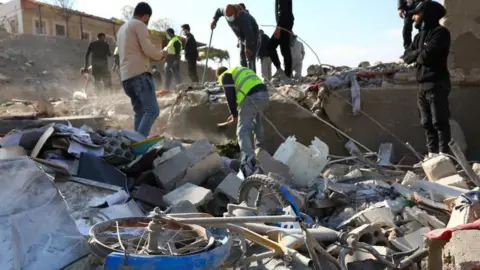
Reuters A group of men search through rubble following a strike in the town of Al-Ain in the Baalbek region on Wednesday. In the foreground of the image is a child's bike.Reuters

People search through rubble following a strike in the town of Al-Ain in the Baalbek region on Wednesday

At least 40 people were killed in Israeli strikes in eastern Lebanon on Wednesday, according to the Lebanese health ministry.

An Israeli official said the strikes, in the governorates of Baalbek and Bekaa, targeted operatives of the Iran-backed armed group Hezbollah.

Lebanon’s culture minister said one of the strikes also seriously damaged an Ottoman-era building in the vicinity of the Roman ruins in the city of Baalbek, which is a Unesco World Heritage site.

Israeli strikes also hit southern Beirut on Wednesday, after the IDF issued evacuation warnings. The military said it struck Hezbollah command centres, weapons stores and other infrastructure.

A later IDF warning covered four neighbourhoods in southern Beirut including an area near Lebanon’s international airport, which has continued to operate despite Israel’s air strikes on the capital city.

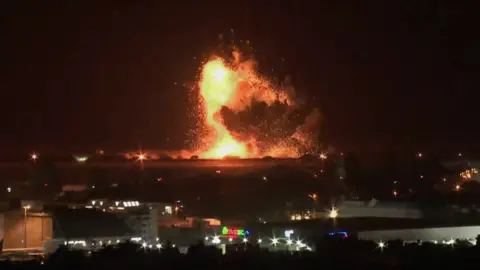
Soon after, pictures showed a large fireball and thick black smoke rising into the night sky above Beirut.

Meanwhile, a rocket fired by Hezbollah fighters from Lebanon killed an Israeli man near a kibbutz in northern Israel, paramedics said.

Reuters A fireball over the night sky in Beirut.Reuters

A large fireball was seen in Beirut after Israel issued evacuation warnings

Lebanon’s Civil Defence agency has also said the bodies of 30 people were recovered from a four-storey apartment building hit by an Israeli strike on Tuesday evening that destroyed one side of the building and sparked a fire.

The building, in Barja, a predominantly Sunni Muslim coastal town south of Beirut, was reportedly housing displaced people.

The Israeli military said it had struck “terror infrastructure” belonging to Hezbollah.

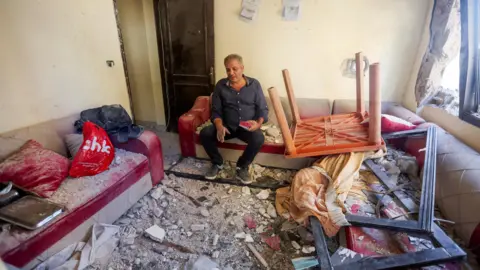
A man who lived on one of the upper floors of the apartment building that was hit said his son and wife were injured by falling masonry.

“These rocks that you see here weigh 100kg, they fell on a 13kg kid,” Moussa Zahran told Reuters news agency as he surveyed the damage.

“I removed [the rocks] and… handed my son to the civil defence through the window. I carried my wife and came downstairs and got out behind the building… I thank God, glory be to Him, for this miracle.”

An Irish Times correspondent cited a member of the civil defence at the scene as saying that those killed whose bodies were found complete included seven women and three children – a seven-month-old baby and two girls aged seven and 12.

Neighbours also said the building was housing displaced people who had fled from other areas, she added.

There was no evacuation warning ahead of the strike, according to Reuters.

The Lebanese health ministry gave a preliminary death toll of 20 from the strike on Barja late on Tuesday but did not provide an updated figure on Wednesday.

Reuters Moussa Zahran sits inside his damaged apartment in Barja, Lebanon (6 November 2024)Reuters

Moussa Zahran said his wife and son were injured by the air strike in Barja

On Wednesday evening, the ministry said 40 people had been killed and 53 others injured in a series of Israeli strikes in Bekaa and Baalbek governorates, which make up most of the eastern Bekaa Valley. They included 16 people killed in the village of Nasriyah and 11 in Baalbek city, it added.

Lebanese Culture Minister Mohammad Mortada also told the director-general of Unesco that one of the strikes had “caused serious damage to the ancient Manshiya building” in Baalbek city, which he said dated back to the Ottoman period and was located in the vicinity of the ruins of several Roman temples.

“The destruction of this exceptional monument next to a Unesco World Heritage site is an irremediable loss for Lebanon and for world heritage,” he warned.

An AFP news agency correspondent also reported that the famous 19th Century Palmyra Hotel near the Roman ruins was damaged by nearby strikes, which the health ministry said killed two people.

An Israeli military official said its aircraft had carried out strikes based on precise intelligence indicating the presence of Hezbollah operatives in the Baalbek area.

The military also said it had killed the commander of Hezbollah’s forces in the southern border region of Khiam, and that a number of other Hezbollah fighters had been killed by air strikes and by troops operating inside southern Lebanon over the past day.

Meanwhile, Hezbollah’s new secretary general, Naim Qassem, said in a speech that the group had “tens of thousands of trained resistance combatants” ready to fight and that nowhere in Israel was “beyond the reach of our drones and missiles”.

“I will tell you very clearly, our conviction is that only one thing can stop this war of aggression, and that is the battlefield,” he declared, adding that he did not believe “political action” would end the conflict.

The Israeli military said Hezbollah fired about 170 rockets into northern and central Israel on Wednesday.

In the evening, the Magen David Adom ambulance service said a man was killed by a rocket near the kibbutz of Kfar Masaryk, which is south of the coastal town of Acre.

Paramedics said the man was found in a field with severe shrapnel wounds and that he was pronounced dead at the scene.

Later, Israeli media identified him as Sivan Sade, an 18-year-old resident of Kfar Masaryk who had been working in the field.

Reuters Part of a rocket sticks out from a parked car in the Israeli town of Raanana, near Tel Aviv, central Israel (6 November 2024)Reuters

A large section of a Hezbollah rocket hit a parked car in the town of Raanana, near Tel Aviv

Also on Wednesday, Israeli media said one rocket hit a car park near Tel Aviv’s Ben Gurion International Airport, but the Israel Airport Authority said its operations were not affected. Hezbollah said it targeted the Tzrifin military base near the airport.

A large section of a rocket also hit a parked car in the town of Raanana, just north of Tel Aviv.

Since the escalation of the conflict between Israel and Hezbollah six weeks ago, at least 2,400 people have been killed and more than 1.2 million displaced across Lebanon, according to Lebanese authorities.

Israeli air strikes have eliminated most of the group’s leadership, including Qassem’s predecessor Hassan Nasrallah, and caused widespread destruction in parts of southern and eastern Lebanon and Beirut’s southern suburbs – areas where Hezbollah has a strong presence.

Israel went on the offensive against Hezbollah after almost a year of cross-border fighting sparked by the war in Gaza.

It says it wants to ensure the safe return of tens of thousands of residents of northern Israeli border areas displaced by rocket attacks, which Hezbollah launched in support of Palestinians the day after its ally Hamas’s deadly attack on Israel on 7 October 2023.

Israeli authorities say more than 70 people have been killed by Hezbollah attacks in Israel and the occupied Golan Heights over the past year.


Kamala Harris concedes election but vows to fight on | US Election 2024 News

0


US Vice President Kamala Harris delivered a televised concession speech to the nation after a whirlwind campaign that failed to stop Republican Donald Trump’s return to the White House.

“While I concede this election, I do not concede the fight that fuelled this campaign,” she told supporters on Wednesday at her alma mater, Howard University, a historically Black college.

Harris pledged to continue fighting for women’s rights and against gun violence and to “fight for the dignity that all people deserve”.

She said she had called President-elect Trump, congratulated him on his triumph and promised to engage in a peaceful transfer of power.

Harris addressed a crowd that included former House Speaker Nancy Pelosi, aides in President Joe Biden’s White House, and thousands of fans who listened to a soundtrack that included Beyonce’s Run the World (Girls) and Tye Tribbett’s We Gon’ Be Alright.

Her running mate, Minnesota Governor Tim Walz, also joined the crowd.

Harris rose to the top of the Democratic ticket in July after Biden stepped aside and brought new-found enthusiasm and cash to the Democratic ticket, but struggled to overcome voters’ concerns about the economy and immigration.

She was handed a resounding loss, with Trump winning a greater share of votes across most of the country compared with his performance in 2020, and Democrats failing to secure key battleground states that decide elections.

Thousands had gathered at Howard University on Tuesday night for what they hoped would be a historic victory for the first woman to become president. They came back on Wednesday to show their support after her.


Government on brink of collapse after key minister fired

0


Germany’s governing coalition is in crisis after Chancellor Olaf Scholz fired a key minister and said he would call a vote of confidence in his government early next year.

Scholz said he had no trust in Finance Minister Christian Lindner, who leads a rival party that has been part of the coalition along with Scholz’s Social Democrats and the Greens.

The move means Scholz’s government no longer has a majority in parliament. The confidence vote could lead to early elections by March.

The so-called “traffic light” coalition led by the chancellor has ruled Germany since 2021.

But the internal tensions had been bubbling up for weeks before exploding into the open on Wednesday night.

Scholz harshly criticised his former finance minister, saying he had “betrayed my confidence” and accusing him of putting the interests of his party base over those of the country.

He added that Germany needed to show it could be relied upon by other countries, particularly following the election of Donald Trump.

The crisis inside the coalition plunged Europe’s largest economy into political chaos, hours after Trump’s election triggered deep uncertainty about the future of the continent’s economy and security.

When the coalition between the chancellor’s centre-left Social Democrats, the environmentalist Greens and economically liberal FDP was formed in 2021, each party planned to spend big on its own individual core interest groups.

But then Russia launched its full-scale invasion of Ukraine, energy prices shot up and Germany was suddenly confronted with a huge and controversial increase in defence spending – and the cost of taking in 1.5 million Ukrainian refugees.

Now Germany is facing its second year without economic growth. The prospect of a Trump presidency is simply adding to the sense of urgency that Germany needs a strong government and policies to kickstart the economy.

For Chancellor Scholz and his Green partners, the answer to the crisis is to loosen constitutional rules on public debt to allow more spending. But that is something which the free-market FDP are strongly opposed to.

Instead, Lindner wants to get the economy going by cutting taxes, paid for by slashing welfare and social budgets and pushing back environmental targets.

Economy Minister Robert Habeck of the Greens said the party would not quit the government and that its ministers would remain in office.

Scholz announced that a vote of confidence would be held in Germany’s parliament, the Bundestag, on 15 January. If MPs vote down the government, the country would hold fresh elections within weeks, instead of the scheduled date in September.

The CDU is currently far ahead in the polls, usually ahead of either Scholz’s Social Democrats or the far-right Alternative for Germany.


Germany’s far-right AfD to expel members over links to ‘militant’ groups | The Far Right News

0


The political party that made gains in regional polls is defended by its leaders while labelled ‘right-wing extremist’ by Germany’s security services.

The far-right Alternative for Germany (AfD) political party has said it will throw out three of its members who have been arrested on suspicion of having joined an “extremist” paramilitary group.

The political party’s announcement comes after eight people were arrested and at least 20 properties were searched during a police operation on Tuesday.

The operation targeted the Saxonian Separatists, a group authorities consider a domestic “terrorist organisation”. It was founded in November 2020 and is driven by racist ideology and conspiracy theories.

Members had been training in warfare for the downfall of the modern German state before hundreds of police swooped on locations linked to it in eastern Germany, neighbouring Poland, and also in Austria.

Interior Minister Nancy Faeser said on Tuesday that the police operations had thwarted “early stage militant coup plans” and investigators noted that the group was planning to establish a new system in the country’s east inspired by Nazism.

Der Spiegel magazine reported on Wednesday that Tuesday’s police raids had also uncovered unregistered weapons, munitions – including Kalashnikov cartridges – and silencers, as well as the shell of a mortar grenade.

The AfD leadership in the eastern state of Saxony confirmed the exclusion of three party members and partially named them in a statement as Kurt H, Hans-Georg P and Kevin R.

A statement from the party said: “No matter on whose behalf the Saxonian Separatists have been operating, there is no place for them in our party of freedom, peace and national sovereignty.”

AfD co-leaders Alice Weidel and Tino Chrupalla added that an extraordinary meeting of the party leadership would be held on Wednesday with the sole purpose of excluding the three men.

In Germany, political parties need to demonstrate a serious violation in order to expel a member.

Weidel and Chrupalla said that the AfD stands for “the liberal democratic order and has nothing to do with this suspected neo-Nazi grouping”.

Meanwhile, the party’s leader in Saxony, Joerg Urban, said the AfD “rejects any form of violence in political debate” and that “preparations for violent acts or coups are also unacceptable”.

In September, the anti-immigrant AfD won regional elections in the eastern state of Thuringia, a first for a far-right party since World War II. It also performed strongly in neighbouring Saxony.

But German security services have labelled the party’s local branches in Thuringia and Saxony as “right-wing extremist” and its leader Bjorn Hocke has been fined twice for using Nazi slogans.