Monday, September 28, 2026
Home Blog Page 7470

Harris, Trump hit North Carolina in final weekend push before US election | US Election 2024 News

0


The fate of the election is expected to be determined by the seven battleground states, which are being heavily courted.

United States presidential candidates Kamala Harris and Donald Trump are touring southern swing states as they try to attract voters with just three days left until Election Day.

The Democratic and Republican leaders headed to the southern battleground state of North Carolina on Saturday.

It marked the fourth day in a row that Vice President Harris and former president Trump visited the same state on the same day, further emphasising how votes will likely decide the election outcome in a few key states that polls have projected will be close.

They were both in North Carolina on Wednesday, Nevada on Thursday and Wisconsin on Friday, at one point holding events just a few kilometres from each other as they fought over the swing states.

The two candidates took big hits against each other, focusing on how the other party would be bad for the US while also touching on a string of issues like the economy and immigration.

“We win this state, we’re gonna win the whole ball game,” Trump said in his Gastonia, North Carolina speech. “We won it twice before, and we’re gonna win it easily.” He also repeated the false claim that there had been “cheating” in the 2020 presidential election vote.

Trump was planning a visit to Salem, Virginia,  before heading back to North Carolina.

Harris said there is an opportunity to “turn the page on a decade of Donald Trump” in a speech.

“This is not someone speaking about how to make your life better,” she told the crowd in Georgia’s Atlanta, saying she plans to improve standards of living.

The vice president also tried to strike a message of unity, saying her priorities would include a middle-class tax cut and bringing down the cost of living for Americans.

After the Georgia speech, Harris will head to a rally in North Carolina where the rock star Jon Bon Jovi is expected to make an appearance.

In one of the latest clashes among the two parties, which brought highly differing takes on major issues, Democrats hit out at US House Speaker Mike Johnson. The Republican suggested that the GOP would probably try to cut government subsidies for semiconductor manufacturing if it wins.

Johnson later walked back his comments, claiming he meant that Republicans would “streamline” the bipartisan CHIPS and Science Act that has injected billions of dollars into producing computer chips in the US.

In the national polls, Harris is holding on to a slight lead. In polls of the seven key swing states, Trump is ahead in Arizona, Georgia and North Carolina, while Harris maintains single-point leads in Michigan and Wisconsin. Pennsylvania and Nevada are even.

The election looms on November 5, but millions have already cast their ballots in recent weeks.

As of Saturday, more than 72 million votes had already been cast, according to a tracker maintained by the University of Florida, which said that more than half of all voters are expected to cast their ballots before election day.


DNA-testing site 23andMe fights for survival

0


Getty Images The 23andMe logo at the company headquarters in CaliforniaGetty Images

Three years ago, the DNA-testing firm 23andMe was a massive success, with a share price higher than Apple’s.

But, from those heady days of millions of people rushing to send it saliva samples in return for detailed reports about their ancestry, family connections and genetic make-up, it now finds itself fighting for its survival.

Its share price has plummeted and this week it narrowly avoided being delisted from the stock market.

And of course this is a company that holds the most sensitive data imaginable about its customers, raising troubling questions about what might happen to its huge – and extremely valuable – database of individual human DNA.

When contacted by the BBC, 23andMe was bullish about its prospects – and insistent it remained “committed to protecting customer data and consistently focused on maintaining the privacy of our customers.”

But how did what was once one of the most talked-about tech firms get to the position where it has to answer questions about its very survival?

DNA gold rush

Not so long ago, 23andMe was in the public eye for all the right reasons.

Its famous customers included Snoop Dogg, Oprah Winfrey, Eva Longoria and Warren Buffet – and millions of users were getting unexpected and life-changing results.

Some people discovered that their parents were not who they thought they were, or that they had a genetic pre-disposition to serious health conditions. Its share price rocketed to $321.

Fast forward three years and that price has slumped to just under $5 – and the company is worth 2% of what it once was.

What went wrong?

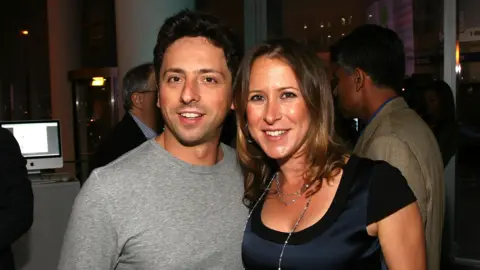
Getty Images Co-founder Anne Wojcicki with then husband Sergei Brin at a 23andMe so-called "Spit party" in New YorkGetty Images

Co-founder Anne Wojcicki with then husband Sergei Brin at a 23andMe “Spit party” in New York

According to Professor Dimitris Andriosopoulos, founder of the Responsible Business Unit at Strathclyde University, the problem for 23andMe was twofold.

Firstly, it didn’t really have a continuing business model – once you’d paid for your DNA report, there was very little for you to return for.

Secondly, plans to use an anonymised version of the gathered DNA database for drug research took too long to become profitable, because the drug development process takes so many years.

That leads him to a blunt conclusion: “If I had a crystal ball, I’d say they will maybe last for a bit longer,” he told the BBC.

“But as it currently is, in my view, 23andMe is highly unlikely to survive.”

The problems at 23andMe are reflected in the turmoil in its leadership.

The board resigned in the summer and only the CEO and co-founder Anne Wojcicki – sister of the late YouTube boss Susan Wojcicki and ex-wife of Google co-founder Sergei Brin – remains from the original line-up.

Rumours have swirled that the firm will shortly either fold or be sold – claims that it rejects.

“23andMe’s co-founder and CEO Anne Wojcicki has publicly shared she intends to take the company private, and is not open to considering third party takeover proposals,” the company said in a statement.

But that hasn’t stopped the speculation, with rival firm Ancestry calling for US competition regulators to get involved if 23andMe does end up for sale.

What happens to the DNA?

Companies rising and falling is nothing new – especially in tech. But 23andMe is different.

“It’s worrying because of the sensitivity of the data,” says Carissa Veliz, author of Privacy is Power.

And that is not just for the individuals who have used the firm.

“If you gave your data to 23andMe, you also gave the genetic data of your parents, your siblings, your children, and even distant kin who did not consent to that,” she told the BBC.

David Stillwell, professor of computational social science at Cambridge Judge Business School, agrees the stakes are high.

“DNA data is different. If your bank account details are hacked, it will be disruptive but you can get a new bank account,” he explained.

“If your (non-identical) sibling has used it, they share 50% of your DNA, so their data can still be used to make health predictions about you.”

The company is adamant these kinds of concerns are without foundation.

“Any company that handles consumer information, including the type of data we collect, there are applicable data protections set out in law required to be followed as part of any future ownership change,” it said in its statement.

“The 23andMe terms of service and privacy statement would remain in place unless and until customers are presented with, and agree to, new terms and statements.”

There are also legal protections which apply in the UK under its version of the data protection law, GDPR, whether the firm goes bust or changes hands.

Even so, all companies can be hacked – as 23andMe was 12 months ago.

And Carissa Veliz remains uneasy – and says ultimately a much robust approach is needed if we want to keep our most personal information safe.

“The terms and conditions of these companies are typically incredibly inclusive; when you give out your personal data to them, you allow them to do pretty much anything they want with it,” she said.

“Until we ban the trade in personal data, we are not well protected enough.”

Additional reporting by Tom Gerken