



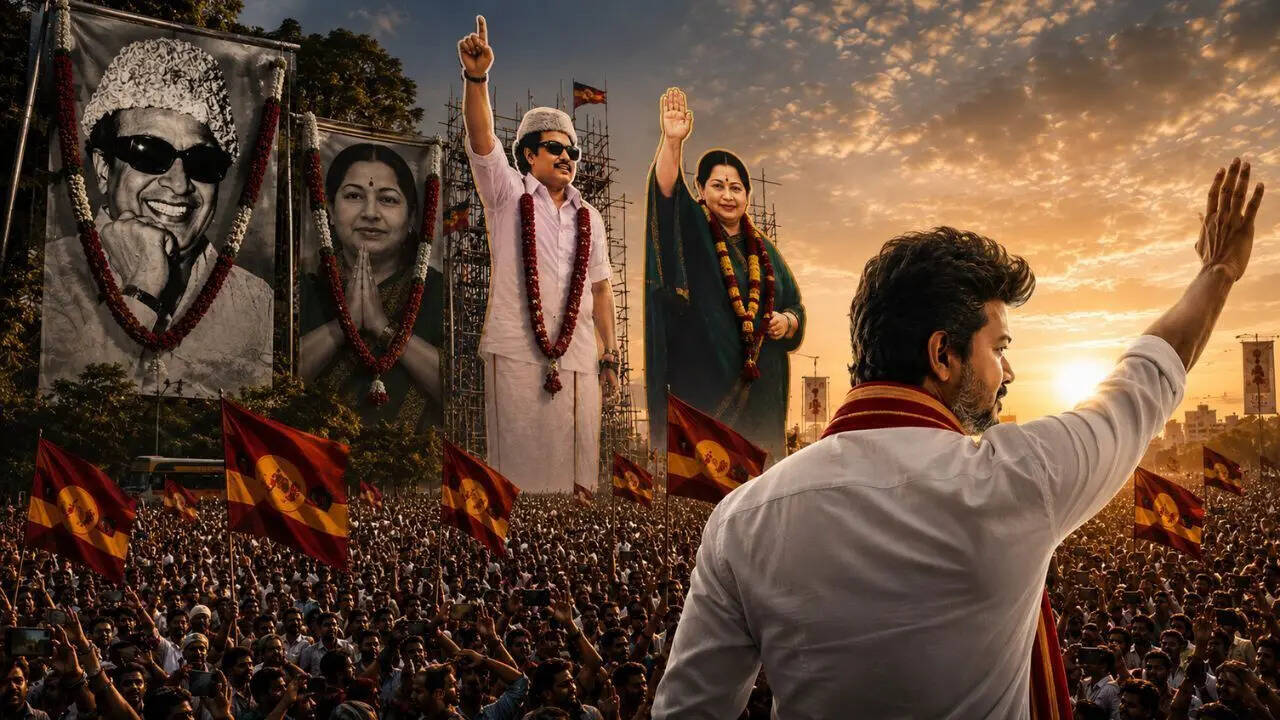
What kind of politics compels people to die for their leaders?In Tamil NaduThat is not rhetorical.It has happened again and again – in moments of sadness, in moments of defeat, and, as seen last week VictoryFrantic talks of government formation, even in anticipation of power.But this is not a new story. Tamil Nadu has seen this before.It is December 1987, and Tamil Nadu is in mourning.The streets are filled with mourners. Men cry openly outside party offices. Some supporters drink poison. Others set themselves on fire. The grief throughout the state turned deadly when the news spread that MG Ramachandran had died.He was the founder of the All India Anna Dravida Munnetra Kazhagam (AIADMK), a veteran of Tamil cinema and the first actor-Chief Minister of the state. But to millions he was much greater than any position he held. He was ‘Puraichi Thalaivar’, the revolutionary leader, the man who came out of the silver screen into their lives as a protector, provider and hero.
MGR at a public rally in Tamil Nadu
MGR ruled Tamil Nadu for more than a decade and won three consecutive terms before dying in office. His death does not mark the end of just one chief minister. For many, it felt like the loss of someone much closer to them – a parent, almost family.This would not be the last time Tamil Nadu would see sorrow turn into tragedy.This pattern returned again and again, each time reminding the state that its politics was never merely electoral.In 2001, when J Jayalalithaa had to step down after being convicted on corruption charges, her supporters took their own lives. In 2014, when he was once again sent to jail, the state witnessed another wave of mourning – suicide, self-immolation and heart attack due to shock.After her death in 2016, the AIADMK claimed that at least 470 supporters died mourning the death of the woman they affectionately called ‘Amma’.Then came Vijay.In September 2025, lakhs of people gathered in Karur to catch a glimpse of Tamil cinema’s current superstar as he moved closer to political power. People stood for hours in the hot sun, waiting for the man whom many already saw as their next savior. By the time the meeting ended, 41 people were dead.For a state that has long blurred the line between screen idol and political messiah, Vijay’s rise was no exception. It was the latest chapter in a familiar script.
After the stampede in Karur (Credits: PTI)
Voting for the Dalit class?
Tamil Nadu’s voting behavior often reflects a distinct political logic where identities are acknowledged but not always put forward politically. While there is deep social stratification in the state, with Scheduled Castes making up about 20% of the population and broader SC/ST/OBC groups more than 75%, electoral appeal often shifts away from narrow caste or religious integration towards figures who offer more universal identities of suffering and upliftment. Religious demography further underlines this complexity, with Hindus at 87.58%, Muslims at 5.86% and Christians at 6.12%, yet electoral mobilization rarely tracks these categories clearly. Instead, political legitimacy is often constructed through stories of deprivation, conflict, and moral security, allowing leaders to cross identity boundaries without abandoning them entirely. This is where the ‘underdog’ or ‘rescuer from within’ template becomes politically powerful. leaders like mg Ramachandran And Karunanidhi Gave an example of this change. His political identity was built less on elite authority and more on autobiographical suffering, poverty, hunger and the hardships of life, which he clearly translated into policy imagination. In fact, MGR’s His Cabinet’s first question about “who experienced childhood poverty” was not merely symbolic, it reinforced a governing ethos rooted in empathy as experience. Welfare schemes for school children and marginalized communities further institutionalized this ethos, while handing over administrative control to trusted officials allowed emotional leadership to co-exist with technocratic governance. In this framework, people like Vijay, who are socially identified with the Vellalar Christian community but from politically elite backgrounds, can be read as inheritors of a long pattern where leaders do not reject identity but rather strategically dilute it into a broader language of shared deprivation and moral universalism.
How did cinema become political training in Tamil Nadu?
In Tamil Nadu, the transition from cinema to politics is no exception to this pattern; It is integral to how the system evolved. Its foundation was laid when CN Annadurai and M Karunanidhi turned theater and screenwriting into political tools. Karunanidhi’s long career, from screenwriter to five-time chief minister, set an example that narrative skills could be translated into political authority.
But MG Ramachandran transformed that relationship into a mass political structure. Already a major film star, MGR took his on-screen persona of philanthropic patron straight into electoral politics, founding the AIADMK and becoming Chief Minister in 1977. His image as a “man of the people” made the boundary between character and leader increasingly irrelevant to large sections of the electorate.That model was consolidated and intensified by J Jayalalitha. After a successful film career, she entered politics under the mentorship of MGR and later created her political identity as “Amma”, establishing personal symbolism and authority in welfare delivery. MGR and Jayalalitha together transformed the actor-led leadership from a temporary political experiment into a sustainable governing structure.
Fan clubs got organized
Over time, this pattern ceased to be about individual figures and became a repeatable political template. Tamil Nadu politics began to regard cinematic visibility as pre-political legitimacy. The actor was not just a candidate, he was already a public figure with emotional reach to a large audience.This was strengthened by the Dravidian political tradition itself, which had long used cinema as a communication medium. As academic studies of Tamil cinema show, the boundary between cinema and politics in the state has become structurally blurred, with film serving as a vehicle for entertainment as well as ideological messages.Within this ecosystem, fan cultures played an important role. Fan clubs of stars like MGR and later Rajinikanth functioned as organized social networks, often involved in welfare activities and local mobilization. These structures later became informal political infrastructure, capable of becoming active during elections.The durability of this model is demonstrated by how often it reappears across generations. After MGR and Jayalalitha, subsequent leaders have attempted to retrace this path with varying success, including the anticipation surrounding Vijayakanth and, more recently, Rajinikanth, whose political entry was widely expected but ultimately did not happen.Yet the underlying structure remained intact: Tamil Nadu continues to create a political environment where cinematic identity is assumed as credibility, and where mass recognition often precedes organizational politics.
Vijay’s pre-election rally
‘Mother, Thalapathi ‘: When leaders get titles from fans
In Tamil Nadu politics, leaders are rarely treated as distant functionaries. They are included in the vocabulary of the family itself. Titles like ‘Thalaivar’ and ‘Amma’ are not stylistic choices – they are political gestures that replace institutional distance with emotional closeness. Once this shift occurs, the relationship between leader and follower ceases to be transactional and becomes personal.This form of attachment already existed with social media and continues to this day. Long before digital fans, Tamil cinema had already created a system of parasocial bonding where audiences formed one-sided emotional relationships with stars who appeared repeatedly on screen as protectors, providers, and moral anchors. In a state where cinema is deeply embedded in everyday life – from street posters to festival soundtracks – these screen identities easily spill over into political perception.The Dravidian political tradition enhanced this structure. Welfare politics reinforced the idea that the leader is not just a decision maker but a direct source of material dignity. For large sections of the electorate, access to rice, subsidies, housing or public services is symbolically linked to the personal commitment of the leader. Over time, political support became tied not only to ideology, but also to the feeling of being seen and provided for.
Jayalalithaa’s last journey (Credits: ANI)
Within this framework, personalities like MG Ramachandran and J Jayalalitha were transformed into emotional institutions. MGR’s on-screen image as a benevolent savior and Jayalalitha’s carefully constructed persona as “Amma” made political loyalty closer to familial dependence than civic preference.The same emotional architecture is visible in Vijay’s rise. Vijay, known as “Thalapathy” to his fan base, entered politics with an already established emotional economy built over decades of cinema. His films repeatedly position him as protector, arbiter, and moral force – roles that do not end when he exits the theater, in a context where screen identities constantly circulate in public life.What arises from this is not mere popularity, but an emotional contract. Advocates do not simply evaluate performance or policy; They invest identity, dignity and aspiration in a person who symbolically houses their social presence. In such a system, political loyalty is less about persuasion in the traditional sense and more about belonging – to a leader who is experienced not as a representative, but as an extension of oneself.
Why Vijay’s victory was not a surprise but a continuation of this culture
TVK chief Vijay won 110 seats and became the largest party in the Tamil Nadu elections. However, no exit poll had predicted a sweep of this level. But it was inevitable.In this historical context, the emergence of Vijay and his party TVK fits into, rather than breaks, a long-established pattern. His transformation reflected the same structural conditions that had shaped earlier actor-politicians: pre-existing fan bases, emotional identification with screen roles, and a political culture that already recognized cinematic popularity as a form of legitimacy.What has changed is the scale and urgency. By the time Vijay formally entered politics in mid-2020, Tamil Nadu had half a century of precedent for converting cinematic stardom into electoral mobilization. Their entry does not signal the invention of a new model, but rather a continuation of the old model, adapted to a new media environment and a larger, more organized fan ecosystem.


