



For much of the past three years, the artificial intelligence (AI) race appeared deceptively straightforward. The fastest, strongest and most powerful will likely win. The summer of 2026 has changed the contours significantly, and it is no longer that simple. An AI Cold War is getting properly frosty. For every powerful AI model that US companies build, Chinese frontier labs respond with more affordable models, but with similar capabilities.
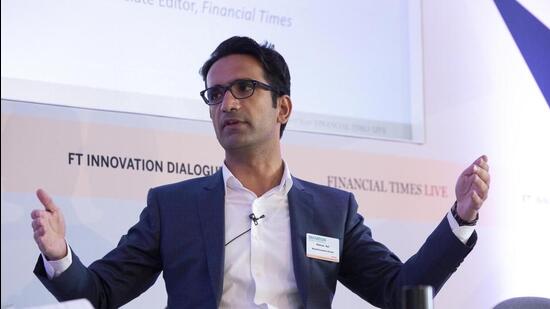
In a conversation with HT, Mehran Gul, author of ‘The New Geography of Innovation’, and former World Economic Forum, United Nations adviser, as well as a Fulbright Scholar at Yale, says the timing of Chinese AI Company Zhipu (also called Z.ai) releasing a powerful open weight GLM-5.2 model “couldn’t have been better”. It was released days after the US government abruptly forced Anthropic to pull its highly advanced Mythos 5 and Fable 5 models offline citing national security and cybersecurity concerns.
“All the questions that were raised by the restrictions on Mythos in places such as Europe, with people realising that they are not buyers of American technology but are at best renters of American tech, that can be cut off at any point in time,” says Gul. He says questions about trust and reliability, usually reserved for Chinese tech, are now being asked about tech from US companies as well.
A policy, and a way
He believes we’ll see more staggered and delayed rollouts for new AI models. “This is a new norm. What’s going to happen is a limited release within the US, followed by access for others after a gap of a few weeks. With Mythos, Europe still doesn’t have full access. You still cannot ask it questions related to security or biology, for instance,” he points out.
It isn’t just Anthropic. This month, OpenAI released the GPT-5.6 frontier model family consisting of the Sol, Terra and Luna models for everyone, following clearance from the US administration after a review of cybersecurity risks. AI companies are calling for a review of the methodology.
“AI capability is moving along an exponential curve, while the policy system still moves at traditional speed,” Anthropic CEO Dario Amodei wrote in an op-ed recently. OpenAI’s Sam Altman reportedly told employees via an internal memo, “We’ve made clear to the U.S. government that this is not our preferred long-term model, and will work with them and others in industry to achieve a more sustainable approach for future releases.”
“In the past, if questions about trust and reliability were asked of China, I think China is now positioning itself as the more reliable partner, and the same questions are now being asked of the American stack instead,” says Gul. Regarding Washington’s leverage, he points to an important lever: access to high-end GPUs.
This week, after a long pause, the US allowed chipmaker Nvidia to ship ‘very few’ H200 AI chips to fulfil orders placed by Chinese companies including Tencent and Bytedance. Jeffrey Kessler, the US Under Secretary of Commerce for Industry and Security, specified at the House Foreign Affairs Committee hearing these are a “very small quantity of chips, so it’s trivial.”
For context, Zhipu had claimed that the GLM-5.2 training happened solely on Huawei’s AI chips, and no Nvidia hardware was used. While the U.S. tightened its grip, China offered an open hand to the global market. The release of GLM-5.2 by Z.ai represents a critical milestone in the decoupling of global tech supply chains.
Case for a “mixed stack”, blending the best
Gul believes a “mixed stack,” as he calls it, will be the way forward. He links it to AI models being taken offline and AI chip exports being restricted, noting, “this is undermining the confidence countries have.” There is a realisation that most countries cannot compete with either the US or China in terms of foundation models or AI chips. “We will eventually end up having a situation where we will have a blended stack between the US and China. You’ll get the GPUs from one, the foundation models from the other,” Gul foresees.
There is uncertainty for India and the Global South—a point also raised by Prime Minister Narendra Modi earlier this year at the India AI Impact Summit in New Delhi. The blended stack could assuage concerns, to an extent. Gul names Vietnam and Brazil in the same thought, noting that greater acceptance of China as an interesting alternative is primarily because of cost. Chinese AI models have an affordability advantage, much like Chinese EVs and consumer electronics.
According to the 2026 Stanford HAI AI Index Report, the performance gap between top US and Chinese AI models has shrunk to a razor-thin 2.7%, with the US leading in total top-tier model quantity and private investment, while China leads in research volume, patents, and citations.
“The rationale is shifting, and is becoming more about, surprisingly, trust. Who would have ever thought there would be a trust reason to mix up your stack and have China in there as well? Maybe the global south needs to rely more on a stack that is in some parts, from the global south as well. China and India do not have the most comfortable of relationships, but the fact that there is even a discussion shows you the negative consequences of the path the US administration has been taking over the past 6 months, even among traditional US allies.”
By releasing GLM-5.2 under an unrestricted MIT license, China is positioning itself as a reliable, accessible alternative, a seemingly stark contrast to closed-door policies of US frontier labs.
Defining the price, and the value
How should US AI companies respond to the pricing challenges? There’s a cost advantage that Chinese AI models have continually exhibited since DeepSeek took the AI world by storm at the turn of last year. In terms of approximated token costs, GLM-5.2 costs $1.40 per million input tokens and $4.40 per million output tokens—in comparison, Anthropic’s Claude Opus 4.8 will cost developers and enterprises around $5 and $25 for the same usage, respectively.
The lack of a cogent response from US AI companies has Gul perplexed. “I don’t quite understand why American companies couldn’t also release lower-cost AI models. If Anthropic already has a high end model, I don’t see why it couldn’t take a loss on a model that competes on price with companies such as DeepSeek and Zhipu, and offer the hybrid model that makes switching that much easier,” he asks, pointing to an advantage for businesses and governments where all the data remains within one AI’s container.
What does this mean for enterprises? “There’s only really been one use case that we’ve seen, and that is coding. Other than coding, we haven’t really seen LLMs being deployed effectively for anything at scale for commercial purposes,” Gul points out, adding, “My contention would be that even for the heavier stuff, you can look at where GLM 5.2 is, and it’s at the same level as Opus 4.8 which wasn’t released 2 years earlier but came out 4 to 6 months ago. I would say that even for heavier workloads, it’s not as if the Chinese models are completely unsuitable.”
He pairs the capability lag of a handful of months that often defines Chinese AI models and points to a similar window of time it takes for enterprises to implement any consequential new piece of software.
Loud messages, and underlying meaning
This week, Google DeepMind CEO Demis Hassabis expressed an outline for regulating frontier AI, something Altman seemed to agree with too. Gul is clear that it is too soon to take either on their word, and says a lot of what is being said is pure alarmism.
“Both Dario and Demis, for every post that says we need more frontier regulation, you can see another interview in which they say we cannot slow down because if we do, then China gets ahead,” he says.
Yann André Le Cun, a French-American computer scientist, regularly dismissed security panic surrounding the Claude Mythos Preview model as exaggerated marketing and theatrics. “Mythos drama = BS from self-delusion,” his crisp post on X.
“I genuinely ask the question, to what extent is this fear-mongering? Marketing versus reality? Because when Mythos came out, by their own admission they were saying this is game-changing as far as cybersecurity is considered. But now that GLM-5.2 is out, which is almost as good as that, we haven’t seen the world change all of a sudden,” Gul says.
A few days ago, Microsoft CEO Satya Nadella said that enterprises pay for AI twice—first with money for subscription and token usage, and second with their proprietary data that eventually helps the model become useful. Gul links this to commoditisation that’s moving into the realm of what structures as “you can trust us more than you can trust the other person.”
“My obvious objection to that is if you have an open-weight model that can be run on-premises, you own your own data, and the model is essentially just an engine that you are strapping onto your existing database with no data sharing with any Chinese supplier, how does that fear really come in?” he asks.
The ‘third player’ conundrum
Is there a way for India, the Global South and indeed Europe, to make it a three-way battle for AI supremacy. Gul believes the answer to this must be answered by each country, and the question is simple—can they raise the performance of their models to a level where the gap to leading US and Chinese models isn’t 20% or 25%, but marginal?
“Even Europe isn’t able to effectively compete against China or the US, despite a tradition of developing technical talent. The only notable model is Mistral,” he points out. Gul believes many countries, including India, must decide if it is a battle worth fighting, or if the resources are better concentrated elsewhere.
South Korea has perhaps set the template, with Samsung and SK Hynix, each valued at a trillion dollars. “They managed to identify the niches that they want to play in early, such as high-bandwidth memory and being suppliers to semiconductors, instead of saying a foundation model seems to be a cool area, so we will try and compete over there as well,” Gul explains.
The US tightening its grip on its technological crown jewels has inadvertently accelerated the adoption of capable, cheaper alternatives. For enterprises and sovereign nations, the new era clearly requires flexibility, a pragmatic embrace of the blended stack, and an understanding that no one can afford to rely on a single supplier for compute.


