



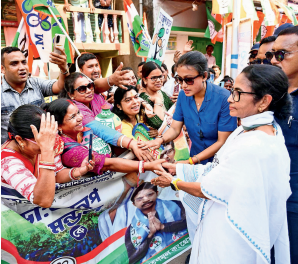
Protecting her bastion West Bengal for the fourth time and extending her tenure from five years to 20 years was never easy for Mamata Banerjee. He was up against a formidable challenger, the Bharatiya Janata Party, with its undoubtedly election-winning organization and immense resources and its star campaigner Narendra Modi.Banerjee was preparing for a fight to remove him from power for five years from 2021. Incidents such as the rape and murder of a junior doctor working at the Government RG Kar Medical College and Hospital, inside the college campus in Kasba, South Kolkata, a few meters away from the police station, and the continuous increase in incidents of violence against women in rural areas automatically brought people to the streets, resulting in an increase in the prevailing discontent. She may have taken to the streets to demand justice for the RG car victim, but that made no impact on voters with anti-incumbency sentiments.
.
In the regular course, Trinamool Congress Should have been in the dock regarding its performance as a government. Mamta Banerjee has been the Chief Minister for 15 years. Anti-incumbency wave should have been the main issue.Things changed. Instead of being a challenger, BJP He transformed into a persecutor following a nationwide crackdown on illegal Bengali-speaking immigrants, considered infiltrators from Bangladesh. The arrests, and even the deportation of some to Bangladesh, where they were trapped and tortured, angered Bengalis, whether they were loyal to Banerjee, or leaning towards the BJP, as it was the only option against dominance and abuse of power. Trinamool Congress in everyday experiences.The surprise declaration that Bengali is not a language, and the search for a translator of “Bangladeshi language” by the Delhi Police, was considered an attack on the cultural identity, pride and history of Bengalis. According to Bengali perception, BJP became the party involved in this attack, which attacked the idea of Bengali religion: eating fish and meat which in those days were considered important to the code of Sanatan Dharma.The Bengal State Assembly election of 2026 was not a regular election. It was designed as a once-and-for-all confrontation, an exercise to purge the increased number of ineligible voters, who were identified as infiltrators from Bengali-speaking – but mostly Muslim – Bangladesh who had been given asylum by the Trinamool Congress since 2011, when voting was held for the first time. The Election Commission issued warnings, even triggering a special intensive revision of voter lists in Bihar in June 2025, that Bengal would be next.It seems that the deep resentment among a very large and mixed section of voters over CM Banerjee’s Muslim “appeasement” politics has been buried by the SIR-decision-deletion process. Even his temple-building enthusiasm – laying the foundation stone of Jagannath Dham in Digha, or a Mahakal temple in Siliguri in BJP leader of opposition Suvendu Adhikari’s backyard, has faded from the public domain. SIR has become a personal issue for a large number of voters, those adversely affected and others who are troubled by the process of “othering” neighbours, friends, colleagues and acquaintances, as one in 10 people have been removed or placed under adjudication by the Election Commission.Instead, the political discourse has acquired a new classification of voters, termed “under decision”, and it has become so complex that the Supreme Court took the extraordinary step of invoking Article 142 of the Constitution, which gives it the power to “pass such decree or make such order as may be necessary for doing complete justice in any cause or matter pending before it”, because 34.45 lakh people, after the SIR, were required to vote in the Bengal elections. The fundamental right to exercise one’s choice was being deprived. The Election Commission’s decision to freeze the electoral rolls without a hearing has been overturned – which Banerjee has been quick to acknowledge as ‘her victory’ on behalf of the people.The BJP’s blind defense of the SIR exercise as a necessary intensive and customized process to verify the citizenship status of all voters, infiltrators and eligible citizens left its core voters stranded in many districts, covering more than 70 constituencies, including the Matuas, a Scheduled Caste community that had fled in large numbers after 1971. The objective of the SIR, as declared by Union Home Minister Amit Shah in Parliament, is to “detect, remove, deport”.SIR seems to have overtaken anti-incumbency as the major issue in this election. The reason is simple: the effect of SIR is that 91 lakh voters have been either removed or left subject to the decision, which is just under 12%; And the number of voters has decreased from 7.08 crore to 6.44 crore. The election has turned into a clash between the Trinamool Congress and the Election Commission on the one hand and the Trinamool Congress and the BJP on the other. As the only party that has consistently supported the implementation of the SIR process and the Election Commission, even after the Supreme Court invoked Article 142 for the purpose of “doing complete justice”, in the perception of a large number of voters, the Election Commission and the BJP are interchangeable entities.Discontent, which can be generalized as an anti-establishment wave, exists. There is also widespread satisfaction, especially among women, as Banerjee is perceived as someone who meets their needs through direct cash transfer programs like Lakshmi Bhandar and Swasthya Sathi cashless health services. This loyalty is not transactional; This cannot be bought by doubling the cash transfer, as the BJP promised under the Laxmir Bhandar, Matri Shakti Bharosa scheme. The disproportionate deletion of 57 lakh women from the voter list has cut into Banerjee’s most loyal vote bank, as more than 50% of women had voted for her in the last elections. Due to this, they may lean towards BJP as an alternative.The difference between 2021 and now is that there is no bloodshed in Trinamool like before; The process of defection in BJP has ended in 2021. There has been a reverse flow from BJP to Trinamool over the last five years, the most recent and significant being Adhikari’s close aide Pabitra Kar, who is also the Trinamool candidate from Nandigram.Instead of being a challenger offering a better alternative, the BJP – with its double-engine model and its campaign on “zero tolerance for infiltrators” – has become the party that aims to serve Bengal by prioritizing and deporting infiltrators from Bangladesh, most of whom are Muslims. As the campaign is progressing, the Home Minister has made it clear that after the elections are over, every ineligible voter removed by the tribunal constituted on the orders of the Supreme Court will be deported.When the context of a state election is about issues inherited after significant changes in India’s neighborhood and not a direct contest between rival political parties about better governance, politics becomes a competition to strike the most resonant emotional chords. The question is whether the BJP is able to blame Trinamool as the last and worst culprit of legalizing illegal immigrants from Bangladesh on a large scale, or whether Trinamool has accused the BJP of being “anti-Bengali”? The new variable in the electoral battle is the home-grown Indian Secular Front, which won one seat in 2021. The party is now contesting on more than 30 seats and hopes to carve out Muslim and Dalit votes, which it can do only at the expense of Trinamool.The major rivals, the Trinamool Congress and the BJP, have positioned themselves as champions of Bengali nationalism. In the BJP’s version, the Bengali nation needs to be freed from Muslims who have come from Bangladesh, who have been granted asylum illegally and who pose a threat to the Hindu majority. In Trinamool’s version, the idea of Bengal/India, shaped by generations of Bengali nationalist leaders who contributed to the narrative and politics of the freedom struggle, needs to be defended against distortions and mutations that destroy its essence as secular, inclusive and the guardian of that imagined space where the “streams of humanity” meet the ocean of great humanity.Trinamool Congress slogans in the 2026 election boast of how “Bangla” is suffering and how it will win: “Jataoi koro hamla, abar jeetbe Bangla (No matter how many attacks, Bengal will win)” is a war cry. By positioning herself as a champion of the Bengali identity, which includes the cultural pride of being plural and inclusive, Banerjee hopes to sway sentiments in her favor, while burying the perfectly legitimate discontent growing against her local leadership at the grassroots level in urban and rural areas.


