



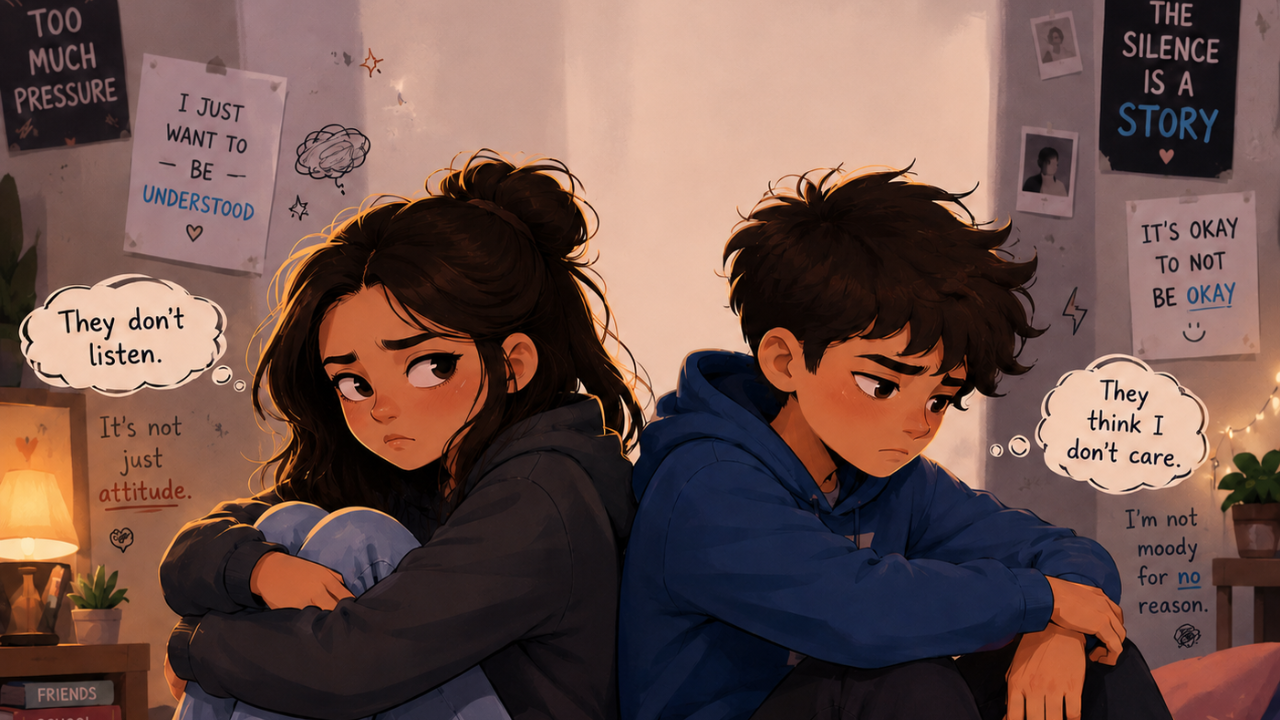
“Teenagers are dramatic.”“It’s just a phase.”“They’ll grow out of it.”Being a teenager sometimes means having your emotions questioned before they are even understood. Frustration is dismissed as “attitude”, sadness becomes “mood swings”, anger becomes “phase” and exhaustion is labelled “laziness”.Thus, for parents, teenage can often seem difficult to understand or manage as they navigate the complicated transition into adulthood. There is often little conversation about what it actually feels like to be a teenager today and what if there’s something actually wrong that no one seems to get.The key to understand here is, not every teenage reaction is serious, but not every emotional outburst is meaningless drama either. Sometimes, what adults dismiss as a “phase” may actually be stress, loneliness, anxiety, burnout, or simply the feeling of being misunderstood.As 19-year old Kritika told TOI, the disconnect often comes from how differently teenagers and adults experience pressure. “The kind of competitiveness and pressure teenagers face today has increased drastically, especially with academics, social media, and constant comparison online,” she said, adding that many struggles faced by teenagers today are “more mental and digital rather than physical or practical.”So let’s dive into why the gap between teenagers and adults comes up.
Mature or a child?
Teenagers exist in an awkward space between childhood and adulthood. They are expected to behave maturely, make decisions about their future, and take responsibility for their actions. At the same time, their emotions are frequently invalidated because they are considered “too young” to fully understand themselves.According to clinical psychologist Akshitara, co-founder of mental health-linked startup ‘That Desi Psychologist’, one of the biggest overlooked issues among teenagers today is “emotional invalidation.” She explained to TOI that many adolescents, in many cases, are navigating emotionally unavailable environments,” but are still frequently labelled “too sensitive” or accused of overreacting.
She added that teenagers often “may not always have the emotional vocabulary to explain distress,” which is why emotional struggles may appear through “irritability, withdrawal, anger, avoidance, poor academics, excessive phone use, or tantrums” instead of calm conversations adults expect.This contradiction often shapes how adults respond to teenage behaviour. Emotional reactions are dismissed more quickly because teenagers are expected to “grow out of it” rather than be understood in the moment.
‘Speaking different emotional languages’
Part of the disconnect also comes from the fact that teenagers and adults often approach emotional struggles very differently.As Kritika, 19, highlighted how generational differences often shaped conversations at her home, as she reflected on navigating the last year as teens and now stepping into the pressure-pool of adulthood.
Sometimes I was trying to explain how something affected me mentally or emotionally, while adults focused more on practical things like discipline, studies, or future consequences
Kritika, 19
Similarly, 17-year-old Dhruv told TOI that emotional conversations with adults often felt disconnected. “We say, ‘I feel overwhelmed,’ and they hear, ‘I can’t handle responsibility,’” he said, adding that “Sometimes it honestly felt like we were speaking two completely different emotional languages.”
He also pointed out that younger people today are far more comfortable openly discussing mental health struggles. “Just being able to openly say ‘I’m not okay’ is already a huge shift from previous generations,” he said.However, this openness around emotions is not always easy for older generations to immediately relate to. Many adults grew up in environments where mental health conversations were rare, emotional struggles were often internalised, and vulnerability was not openly encouraged.This disconnect often becomes visible in how adults interpret teenage behaviour. When a teenager becomes withdrawn, adults may assume they are simply being rude or antisocial instead of asking whether something is bothering them. Anger is often interpreted as bad behaviour before anyone tries to understand where the frustration is coming from. Even genuine stress is sometimes minimised with phrases like “you have no real responsibilities yet” or “wait till you become an adult”.This was something 14-year-old Mana Satija related while speaking to TOI about conversations with adults often feeling one-sided. “They only tell me what I need to do. They never ask what I want to do,” she said.Part of the gap is that teenagers rarely express emotions in ways adults find easy to deal with. Emotional distress during adolescence does not always appear calm or articulate. It may show up through irritability, silence, defensiveness, emotional outbursts, declining academic performance, or sudden isolation. Because these reactions can be frustrating, adults often focus more on correcting the behaviour than understanding the emotion behind it.
Growing up in a hyper-visible digital world
Social media has intensified the teenage-adult disconnect further. Teenagers today are constantly exposed to comparison, online validation, unrealistic beauty standards, and pressure to present perfect versions of themselves. Every insecurity can feel amplified online.Dr Lalita Anand, management trustee at ‘Teenage Foundation’, a NGO working for teen welfare in Hyderabad said loneliness has quietly become one of the biggest emotional struggles among teenagers today despite constant online connectivity. “They might have a social media following, but actually each one is terribly lonely,” she told TOI, adding that many teenagers deeply want meaningful friendships and acceptance among peers but often struggle with peer pressure, bullying, fear of missing out, and fear of disappointing their parents.Akshitara also spoke on similar lines, adding how teenagers today are growing up in a “hyper-visible world” where “social comparison follows teenagers home through social media.” She explained that many adolescents feel pressure to “look perfect, achieve constantly, be socially active, emotionally mature, and successful very early in life.”However, older generations sometimes dismiss these struggles because they did not experience adolescence in the same environment.This was something Kanika Jindal, founder and director of Harmony Therapy World, validated while talking to TOI. She said that today’s teenagers are “digital natives with exposure that extends far beyond their physical vicinity,” which is fundamentally changing how they experience identity, relationships, and emotional pressure, while citing a case example of 6-year old wanting his parents to be ‘Elon Musk’.
She also pointed out that while many adolescents may have hundreds of “followers,” they often lack “true friends,” contributing to loneliness and emotional isolation despite constant online interaction. “When adults dismiss these concerns as ‘just a phase,’ it invalidates their emotions and overlooks the unique complexities of their reality,” she said.
Growing up into gender roles
Adolescence is a stage when teenagers are trying to understand themselves as they go through a lot of physical, hormonal and emotional changes.Puberty, changing bodies, acne, weight fluctuations, voice changes, appearance-related comparisons, and growing awareness around attractiveness often make teenagers far more self-conscious than adults realise.Thus as the changes become “unique” to males and females, adolescence also becomes the stage where gender-role enforcement also becomes prominent. Teenage boys are frequently told to “man up”, suppress vulnerability, or avoid appearing emotional, while girls are often labelled “too emotional”, “dramatic”, or “over-sensitive” for expressing frustration openly.These expectations shape how teenagers communicate distress and how adults perceive it.As a young psychologist and the other co-founder of ‘That Desi Psychologist’, Chetna Arora explained to TOI how expectations around gender heavily shape how teenagers express emotions. According to her, girls are often expected to be “understanding, warm, soft, emotionally available, and nurturing,” while boys expressing anger, emotional withdrawal, or avoiding vulnerability have become socially normalised.
Chetna further explained that many boys grow up struggling with emotional vulnerability because sadness and fear are discouraged, while many girls gradually begin feeling emotionally responsible for everyone else around them.“Young children being constantly exposed to these notions definitely shapes their attitudes and behaviours towards themselves and others,” she said, adding that these expectations eventually begin reflecting in teenagers’ emotional expression and internal emotional states.Kanika Jindal also pointed out that phrases like telling boys to “man up” or dismissing girls as “dramatic” or “hormonal” can invalidate “developmentally appropriate responses” and contribute to long-term emotional suppression.
When emotions are repeatedly dismissed
Repeatedly invalidating teenage emotions can have consequences that extend far beyond adolescence.When young people grow up feeling unheard, they may begin believing their emotions are unimportant or “overdramatic”. Over time, this can make them less likely to openly communicate struggles, seek support, or express vulnerability.This was something 22-year-old Naveen highlighted while talking to TOI. He said that after a point, repeatedly trying to explain himself emotionally became “emotionally tiring”, adding that he eventually began handling situations on his own instead.
With so many other pressures and responsibilities going on in life, I started feeling that repeatedly talking about my emotions would not always change anything
Naveen, 22
Similarly, 27-year-old Nishu, while reflecting on her teenage years, said adolescence often comes with the pressure of navigating not just family expectations but also the wider social and political environment shaping young people’s lives. According to her, many children grow up feeling that choosing joy, passion, or individuality is “impractical” because society places constant emphasis on stability, achievement, and fitting into accepted ideas of success.
The social and political environment is a key factor that curtails a child’s potential. His/Her ability to achieve joy and choose passion often becomes like impractical subject to many.
Nishu, 27, while reflecting on lessons based on her teenage years
At the same time, she believes teenagers also carry some responsibility in trying to bridge the communication gap with adults. “It is important to believe in your own ability while also carefully assessing the situations around you,” she said, adding that while many teenagers feel the need to “break free” from their parents, the real challenge is often breaking free from the larger social thinking that quietly limits confidence, growth, and emotional understanding.However, when emotional struggles are repeatedly dismissed instead of understood, many teenagers gradually stop expressing themselves altogether. Adults who were constantly told to “stop overreacting” as teenagers may later struggle to openly discuss stress, anxiety, or emotional needs. Some develop difficulty trusting others with their feelings because they were conditioned to expect dismissal rather than understanding.At the same time, experts say another major barrier is the tendency to compare generations rather than understand changing realities.Kanika Jindal described this mindset as part of a larger “cycle of generational trauma,” where parents sometimes repeat what they themselves heard growing up without questioning its impact.Meanwhile, Chetna shared her thoughts on the “we had it tougher” mindset many teenagers hear from adults. She talked about teenagers today growing up in a far more emotionally overstimulating and hyper-connected environment. “Comparison often prevents compassion,” she said, especially when adults rely on “we had it tougher” responses.Offering his insight to parents, she added, “The goal is not to raise obedient children; the goal is to raise emotionally secure human beings.”
Listening instead of lecturing
It’s important to remember, addressing the key issues does not mean removing discipline or allowing harmful behaviour. Teenagers still require boundaries, accountability, and guidance. However, understanding emotions and correcting behaviour do not have to be opposites.Thus, the first step is listening without immediately dismissing or lecturing. Teenagers are more likely to communicate honestly when they feel they will not instantly be judged, mocked, or compared to others. Sometimes, they are not looking for solutions. They simply want reassurance that what they feel is being taken seriously.Schools and families can also play a role by encouraging healthier conversations around emotional wellbeing. Instead of treating emotional vulnerability as weakness or “bad attitude”, there needs to be greater emphasis on communication, empathy, and emotional awareness.
As Akshitara said, parents and schools need to shift from a “discipline-first approach to a curiosity-first approach.” Instead of reacting immediately to behaviour, she said adults should begin by asking: “What is this behaviour trying to communicate?”She also stressed that emotional support should not only be reserved for “serious cases” or crises. According to her, conversations around emotional literacy, coping skills, boundaries, and healthy communication need to become part of everyday environments at home and in schools.Dr Anand similarly stressed that teenagers need “time and attention” from adults rather than only instructions or criticism. According to her, parents need to “patiently listen to them, their challenges and suggest solutions” while creating environments where teenagers feel safe enough to “speak freely and confide in them.”
However, to reiterate, communication also requires effort from the other side. While teenagers may feel misunderstood, recognising that parents and close adults are often trying to help, even if imperfectly, can gradually make conversations easier.Like for 17-year-old Dhruv, communication with adults improved only gradually over time when he began expressing himself “more calmly instead of waiting until I was emotionally overwhelmed” and tried explaining modern pressures in ways adults could better relate to. According to him, understanding improved when “both sides keep trying instead of shutting each other down.”Adults also need to recognise that teenage struggles may not look the same as adult struggles or similar to what they experienced in their own teenage years, but that does not make them insignificant. Academic pressure, friendship conflicts, insecurity, bullying, identity confusion, and social isolation can feel deeply overwhelming during adolescence, especially when experienced for the first time.As Akshitara put it, “Some of the most distressed teens are high-achieving, quiet, funny, or well-behaved,” adding that emotional struggles can sometimes appear as “perfectionism, burnout, numbness, isolation, or silently feeling not good enough.”Thus, teenagers may not always express themselves perfectly. They may be impulsive, reactive, or emotionally inconsistent. But behind that behaviour is often someone trying to make sense of themselves while growing up in an increasingly overwhelming world.And sometimes, being heard can make more difference than being corrected.


