



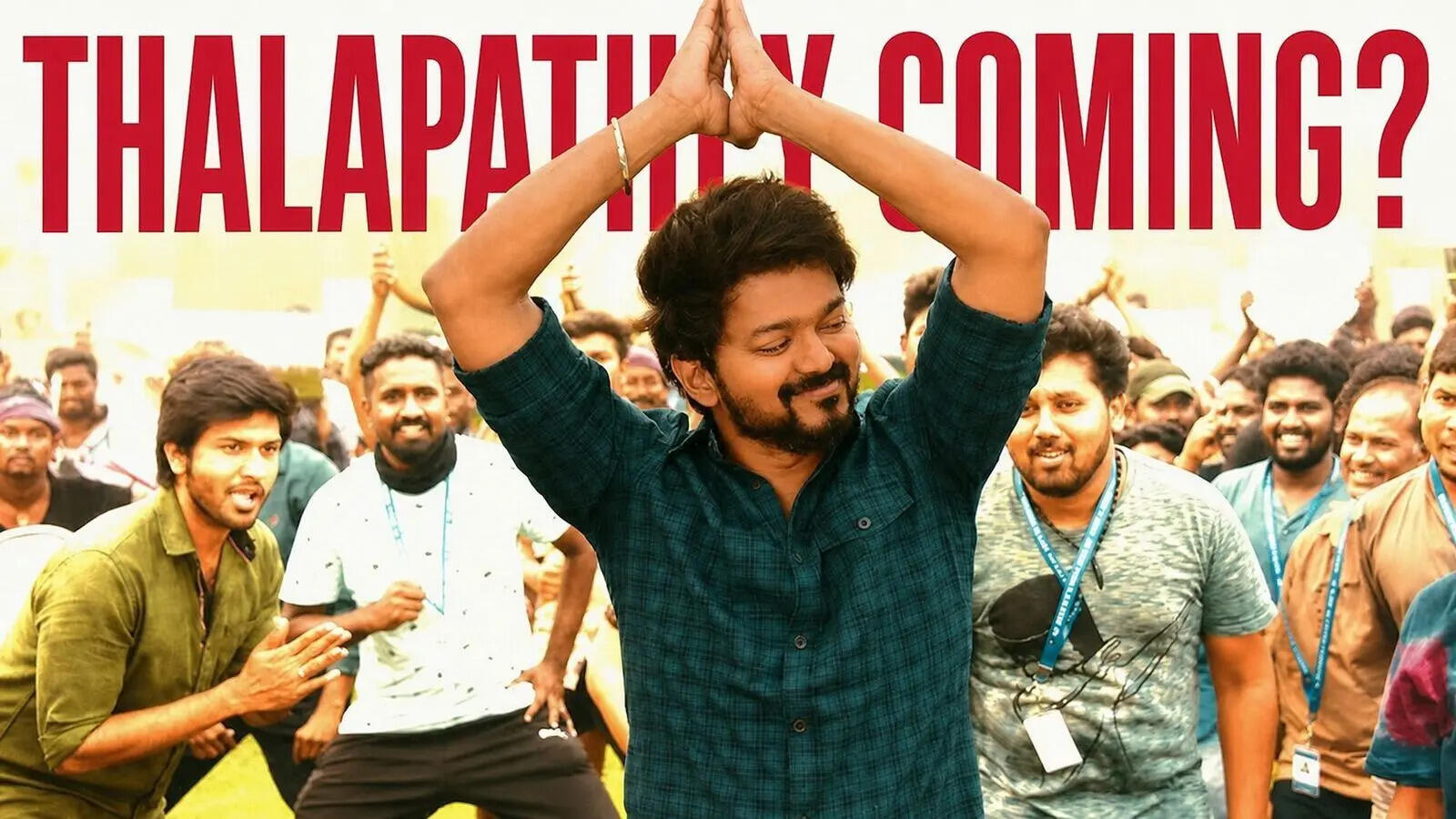
Tamil Nadu has a way of uplifting people that is unmatched anywhere in India, where stardom transcends art and enters the dangerous territory of worship. One can be a bus conductor from Maharashtra, a star from Karnataka or a cricketer from Jharkhand, but once the public embraces you, it becomes close to divinity. Yet even in such a place, it is very difficult for an actor to make a mark in politics immediately. The only person to truly cross the proverbial Rubicon in Tamil Nadu was MG Ramachandran, and even he didn’t do it overnight. MGR joined the DMK in the 1950s, used cinema as a loudspeaker for social-justice politics, built a support base for decades, and then, after falling out with Karunanidhi in 1972, formed the AIADMK. Five years later, in 1977, he became the Chief Minister of Tamil Nadu. In neighboring Andhra Pradesh, NT Rama Rao pulled off an even more cinematic version of this feat, turning the divinity of the Telugu screen into electoral power within months of founding the Telugu Desam Party. But Tamil Nadu’s own blueprint is MGR. And today, one of the most important results in the early trends is the performance of VictoryTVK. But who is Vijay, who, if the trend continues, can become the new leader of Tamil Nadu politics?From child actor to star For those unaware, Vijay’s name is Joseph Vijay Chandrasekhar, born in 1974 in Chennai, son of filmmaker SA Chandrasekhar and singer Shoba Chandrasekhar. He started as a child actor, moved into leading roles in the early 1990s, absorbed the criticism he faced after being dismissed in his early days, and gradually rose to become a commander. There’s something almost Chekhovian about that initial stage, where nothing dramatic happens and yet everything is being set in motion. Young Vijay struggled to convince the audience that he belonged. He did not enter Tamil cinema like Rajinikanth, whose cigarette flick seemed to violate Newtonian physics, or Kamal HaasanWho seemed determined to turn every frame into a doctoral thesis. Vijay’s initial appeal was more modest. He looked like someone who could dance awkwardly in the next wedding video, to the next class, to the next bus stop, before relatives arrived. That mediocrity mattered. Before Tamil cinema allowed Vijay to become a savior, it first allowed him to become familiar. He was the young man who could love honestly, suffer honestly and look wounded without dramatizing it. In early romantic and family dramas, his job was to win over the heroine, the family, and the audience, in roughly that order. Stardom seemed far away, but the foundation was being laid. then came ghilli.
Every star has such a film, watching which the audience stops asking questions. it was ghilli For Vijay, the film that established the legend. What changed was not just the scale of the film but the scale of the audience’s response. The hesitant young man had become a dynamic force. He can run, joke, fight, flirt and defend without changing species. This became a big advantage for Vijay. It can be larger than life while still looking locally made. He was the boy next door after the background score was upgraded. Commander gets up From that point on, Vijay Film developed its own grammar. The hero enters, and the theater behaves as if a democratic republic has briefly become a monarchy. is a song, generally designed less as music and more as public infrastructure. It is a comedy, because Vijay’s stardom has always required looseness. A villain who represents some social rot, personal cruelty, or institutional failure. There is a fight in which bodies fly in such a way that both doctors and engineers will be worried. And somewhere in the middle of all this, Vijay is doing the thing that made him Vijay: taking the common man’s complaint and giving it concrete form. This is the key to his cinema. Vijay’s characters are less complex from the literary point of view, but they are very clear from the emotional point of view. He stands where the audience wants someone to stand. Against the bullies, the corrupt officials, the rapacious corporations, the rigged elections, the medical rackets, the system that has become so big that the common man can only shout at it. His films tell audiences that anger is justified and dignity can be restored, preferably after an intermission and before the final song.
As his career progressed, the films became stronger and more outspoken. The lover became the fighter and the fighter became the social avenger. The change happened so gradually that it felt natural. The youth who once needed approval now sought reassurance. The audience who had seen him pleading now saw him giving orders. The change worked because it did not leave its original form. Even in the mass hero, traces of the familiar triumph remained: the smile, the dance, the slightly teasing humor, the ability to soften a scene before the sermon came. This explains why his political voice suddenly became unrealized. Long before he started the party, Vijay’s films were beginning to sound like campaign speeches smuggled inside commercial cinema. Farmers, corruption, healthcare, education, voting rights, women’s empowerment, corporate greed: the topics changed, but the moral order remained consistent. Society was failing. People were waiting. Vijay had seen it. There’s a reason the formula works so well. Tamil cinema, especially mass Tamil cinema, has never been shy of moral clarity. It doesn’t always want ambiguity. Sometimes it wants catharsis, and Vijay became one of its most reliable suppliers. His most famous screen persona is built on liberating certainty. The world may be in disarray, but Vijay Films ultimately knows where it stands. This does not mean that he should remain frozen. Later Vijay had to escape the changing Tamil cinema, where younger directors brought deeper textures, sharper violence and more controlled storytelling. He adjusted. The swagger became more controlled. The hero may have flaws before salvation comes. Films may be more moody, silences may be longer, violence may be more stylized. Yet even in these new worlds Vijay remained recognizable. He didn’t chase change as much as embrace it. That’s why their longevity is difficult to explain through box office alone. Many actors can dance, fight and deliver punchy dialogues. Vijay’s real skill has been calibration. He gives the audience enough emotion to feel invested, enough humor to keep it relaxed, enough action to feel rewarding, enough dance to create a memory and enough message to make the experience morally nourishing. It is commercial cinema in the form of a complete meal, with protein, masala, sugar and a little pretense for digestion. His viewership also increased. Children who watched the 1990s romantic film Vijay became young adults cheering on the action heroes of the 2000s, then voters who saw his 2010s films as social statements. By 2020, his cinema had become less about individual characters and more about cumulative belief. People were no longer just watching the film in front of them. They were watching the memories of three decades return in new attire. political trip His political journey follows the same cycle of accumulation. It did not begin with the formal launch of Tamilaga Vetri Kazhagam in 2024. It started with fan clubs, welfare programs, blood donation camps, relief work and appreciation and slowly transformed it into an organization. Vijay Makkal Iyakkam gave his fans a grassroots look before coming to the party. This matters because politics does not run on applause alone. It needs people who can stand in the sun, manage local outrage, identify voters and remain loyal even after the theater lights come up. When Vijay finally announced TVK, it felt less like an impulsive leap and more like the next scene in a long-running script. He announced that he would step away from cinema and commit to politics, giving the move a seriousness that celebrity politics often lacks. He has spoken in the broad language that Tamil Nadu understands: social justice, secularism, anti-corruption, Tamil identity and governance that claims to put the people at the centre. The danger, of course, is that every new entrant says some version of this. The difference is that victory comes with an emotional bank account built up over thirty years. The early trends of the Tamil Nadu elections have made that bank account impossible to ignore. TVK is on the verge of turning curiosity into results, with Vijay’s political experiment showing signs of becoming a real disruption rather than a fan-club fantasy. The final numbers will determine the scale of this moment, but trends have also changed the conversation. Tamil Nadu is no longer asking whether Vijay can draw crowds. It is asking whether it can regain power. This is the essence of Vijay’s story. He started off as a familiar young man trying to establish himself, became a mass hero who could rock the theatres, then transformed into a screen personality whose films smacked of politics long before the party flag came into existence. Commander was not made into a movie or a speech. They were patiently assembled through romance, rhythm, complaint, spectacle and trust. For three decades, Tamil cinema knew what happened when Vijay turned to the camera. Now Tamil Nadu is waiting to see what will happen when they move towards Fort St. George.


