



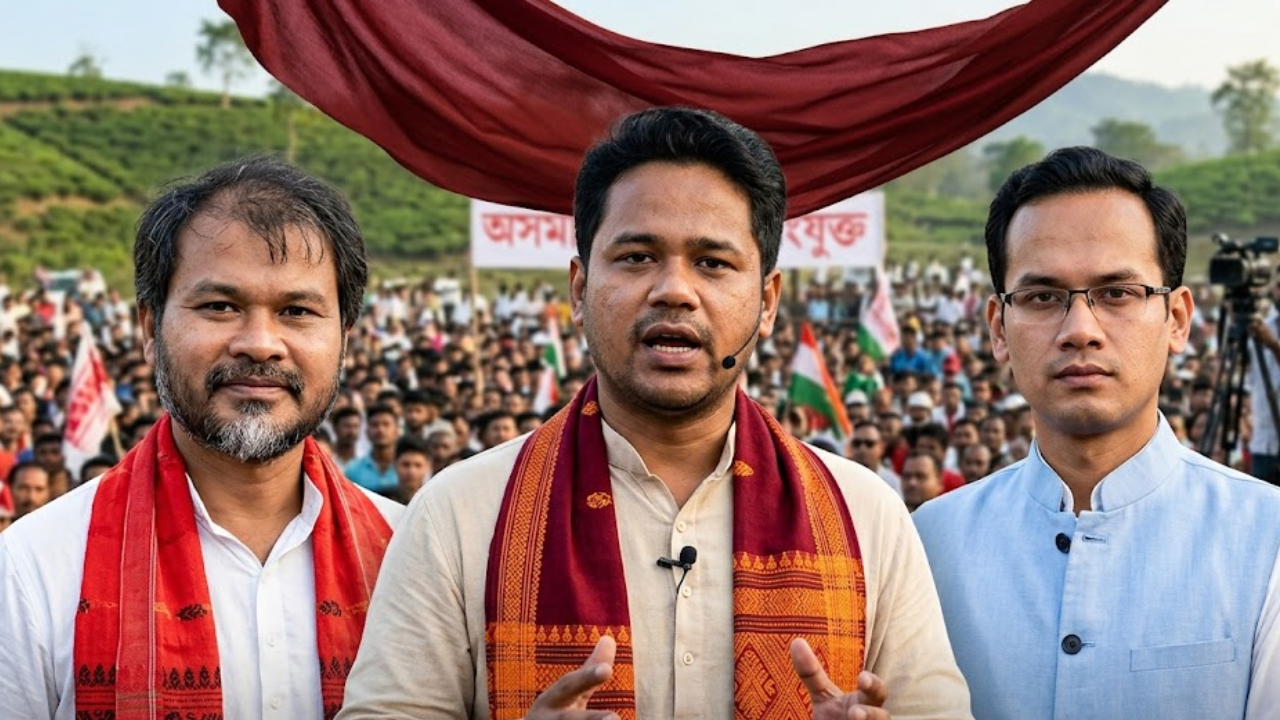
As Assam goes to the assembly elections on April 9, the political battle in the state is being seen as a fight between the Bharatiya Janata Party (BJP).BJP) and ‘Teen Gogoi’.At one level this is a direct election fight. Under the leadership of Chief Minister Himanta Biswa Sarma, the BJP is trying to gain power in the state for the third consecutive time. The opposition coalition led by the other side is CongressBringing together regional and leftist forces in an effort to change the political dynamics of the state.
.
Behind the joint alliance is a layered story made up of personal rivalries, shifting loyalties and identity politics.At the heart of Assam’s opposition are three leaders who share the same surname but follow very different political paths: Congress’s Gaurav Gogoi, Raijor Dal’s Akhil Gogoi and Assam Jatiya Parishad’s Lurinjyoti Gogoi. While Gaurav rose through his family’s political legacy, Akhil rose to fame through long-time grassroots activism and Lurinjyoti emerged as a prominent figure during the anti-Citizenship (Amendment) Act (CAA) movement.
The contest was framed as ‘3G vs BJP’
The BJP has weaponised this combination of surnames and turned it into a political narrative. Himanta has repeatedly lumped the three leaders together, portraying them as a united front that represents interests contrary to the BJP’s vision of Assam.In campaign speeches, Sarma has accused all three of supporting what he calls “Miyas”, a term used to refer to Muslims of Bengali origin. “Be assured, the day BJP is not in power, the entire Assam will be taken over by the Miyans, starting from the capital Dispur. If the three Gogois are doing politics secretly then we are openly working for the people. We have the blessings of the people and the opposition will not compete with us in any way in the elections. Himanta has framed the election as a fight to protect Assamese identity. The message is clear: The BJP is presenting itself as a protector of demographic and cultural balance, while portraying the opposition as aligned with forces that threaten it.
However, the opposition rejects this framing, arguing that it is a deliberate attempt to polarize voters and divert attention from governance issues. To take on the BJP, the three leaders have come together under the Congress-led broad alliance, Asom Sonmilito Morcha (ASM). The alliance formed with the aim of consolidating anti-BJP votes includes Congress, Raijor Dal, Assam Jatiya Parishad, CPI(M), CPI(ML) Liberation and All Party Hill Leaders Conference.Announcing the alliance, Gaurav said, “We felt that now is the time to take our ideas to the public together. Hence, we will start the joint campaign from now on.” On his party’s alliance with the Congress, Lurinjyoti said, “We have joined hands to give a clear message to the people that we are united in our journey to remove the communal BJP. Our united journey has begun.” In the 126-member Assam Assembly, the BJP currently has 64 MLAs along with allies AGP (9), UPPL (7), and BPF (3), while Congress has 26, AIUDF 15, CPM one and an independent.
.
Yet, despite the BJP’s efforts to bind them together, the three Gogois are not a monolithic faction. Each represents a specific political constituency, ideological position and strategy.
Gaurav Gogoi vs Himanta Biswa Sarma: A rivalry rooted in the past
The growing bitterness between Gaurav Gogoi and Himanta Biswa Sarma is at the center of Assam’s 2026 assembly elections.The latest controversy came after Sarma alleged that Gogoi has links with Pakistan, claiming that the Congress leader had made a ‘secret visit’ to the Islamic nation in 2013 and raised questions on his activities there. He even suggested that Gogoi could face serious charges if he failed to provide an explanation about the visit. “If Gogoi cannot clarify his stay in Pakistan, he will have to be charged with ‘rashtra-droho’ (treason),” Sarma alleged.
.
Gogoi dismissed the allegations as foolish and false and accused the chief minister of embarrassing himself and indulging in political theatrics. “No one is taking his words seriously in Assam. #SuperFlop.” He should explain how his family managed to acquire prime property of 12,000 bighas or 4000 acres across Assam,” Gaurav taunted. This war of words is not an isolated incident. It is the latest chapter in a rivalry that dates back to their days in Congress.Sarma was once one of the most influential leaders in the Congress government led by the former Chief Minister Tarun GogoiGaurav’s father. However, tensions began to surface when Gaurav started taking a more active role in party affairs. Sarma, who had ambitions of becoming chief minister, felt that he had been sidelined.The breaking point came before the 2016 assembly elections, when the Congress leadership appeared to favor Gaurav Gogoi as the future face of the party. Sarma left the Congress in 2015 and joined the BJP, taking several MLAs with him, a move that significantly weakened the Congress and paved the way for the rise of the BJP in Assam.Reflecting on his departure from the Congress, Sarma said, “Madam (Sonia Gandhi) had asked me to fix the date and I told her that I will take oath the day after the Ambubachi fair at the Kamakhya temple in June (2014). The situation changed after Rahul Gandhi’s call.Since then, the Sarma-Gogoi rivalry has become even more intense due to another famous ‘biscuit episode’. In 2017, Sarma recounted how Rahul Gandhi offered him a biscuit after he fed it to his dog, commenting, “Not only Rahul Gandhi but the entire family could not feed me that biscuit. I am proud to be an Assamese and an Indian. I refused to eat and resigned from the Congress.”What started as an internal power struggle within the Congress has now turned into one of the biggest political confrontations in the state.
Akhil Gogoi: Agitator turns challenger
Raijor Dal founder Akhil Gogoi brings a distinctive activist energy to the opposition camp in Assam.Activist-turned-politician Akhil Gogoi rose to prominence through his grassroots movements against corruption and land rights issues. His opposition to the Citizenship Amendment Act (CAA) made him a central figure in the protests in Assam, especially Upper Assam.
.
He also campaigned against senior BJP leader Sarbananda Sonowal in the 2019 Lok Sabha elections but lost. Now leading the Raijor Dal, he has established himself as a voice for regional assertion and anti-establishment politics. Despite being in jail due to protests, he won the Sivasagar seat in 2021. Akhil has repeatedly criticized the BJP and accused the party of neglecting regional issues and polarizing communities. Ahead of the 2026 elections, Raijor Dal withdrew its candidates from several constituencies to avoid division of votes against the BJP. His party is fielding candidates in 16 constituencies.
Lurinjyoti Gogoi: Regional Identity and the AJP Experiment
Assam Jatiya Parishad (AJP) president Lurinjyoti Gogoi represents another facet of Assam’s opposition politics, which focuses on regional identity and the legacy of the anti-CAA movement.The AJP was formed following protests seeking to transform the spirit of Assamese nationalism into an electoral force. Although the party has so far struggled to achieve major electoral success, it continues to have influence in parts of Upper Assam.
.
AJP is contesting on 10 seats for the 2026 assembly elections. Lurinjyoti Gogoi’s challenge is to expand this base and convert ideological support into votes. His contesting in constituencies like Khowang is being seen as a test of whether regional parties can still carve out a place in a political landscape dominated by national players.
Upper Assam: center of battle
If there is any region where this triangular dynamic is most visible, it is Upper Assam.This belt, which includes districts like Jorhat, Sivasagar and Dibrugarh, is important not only politically but also symbolically. It is home to the Ahom community, tea garden workers and has a deep sense of regional identity.For the BJP, maintaining its hold on Upper Assam is essential to securing a third term. For the opposition, making inroads here is the key to posing a credible challenge. What makes this contest unique is that all three Gogois have influence in the field.This has created a ‘Gogoi versus Gogoi’ narrative, where Himanta Biswa Sarma pits himself against the trio, seeing it as a fight between the ruling BJP and the United Opposition Front.
BJP’s strategy: identity, development and supremacy
The BJP’s campaign in Assam has depended on a combination of development promises and identity politics.On the one hand, the party highlights the achievements of infrastructure projects, welfare schemes and governance under both the state and central governments. On the other hand, it has intensified its rhetoric on issues such as illegal immigration, demographic change and cultural preservation.Sarma has been particularly vocal in warning that the Congress-led government will lose control over the state’s demographic balance.At the same time, BJP seems confident about its electoral prospects. Sarma has dismissed the opposition alliance as ineffective and claimed that BJP workers are active on the ground while opposition leaders are limited to meetings.
Opposition unity: strength or weakness?
The formation of the opposition alliance marks a significant development in the political scenario of Assam.By bringing together the Congress, Raijor Dal, AJP and the Left, the alliance wants to avoid division of votes and present a consolidated challenge to the BJP. However, such alliances are not without challenges.Seat-sharing talks, ideological differences and leadership questions continue to pose potential risks. The success of the alliance will depend not only on arithmetic but also on its ability to maintain unity and coherence throughout the campaign.
data behind politics
Beyond rhetoric and coalitions, data from the Association for Democratic Reforms (ADR) provide important insights into the nature of competition.Analysis of 722 candidates shows that 14% have declared criminal cases, while 11% are facing serious charges. Among major parties, 9% of BJP candidates have criminal cases, while 28% of Congress and 37% of AIUDF candidates have criminal cases.
.
The data also highlights the growing role of money in elections. About 39% of the candidates are millionaires, with the average wealth per candidate being Rs 3.25 crore.Perhaps the most surprising thing is that the assets of MLAs contesting re-election have increased. Their average wealth has increased from Rs 4.17 crore in 2021 to Rs 7.52 crore in 2026, an increase of 80% in five years.
what this election is really about
As the campaign is gaining momentum, the 2026 Assam elections are paving the way for two major possibilities. For the BJP, the stakes are clear: securing a third term and demonstrating that its dominance in the state is not dependent on allies.For the opposition, the election is a test of whether unity can translate into electoral success and whether leaders like Gaurav Gogoi, Akhil Gogoi and Lurinjyoti Gogoi can come together to challenge the BJP’s narrative.At a deeper level, this contest reflects competing visions of Assam’s future: one focused on strong centralized leadership and identity politics and the other focused on territorial claims and coalition-building.It is certain that the fight between the BJP and the ‘three Gogois’ has added a new dimension to the political scenario of Assam.As the state heads towards elections, the question is no longer just who will win, but what kind of politics will define Assam in the years to come.


