



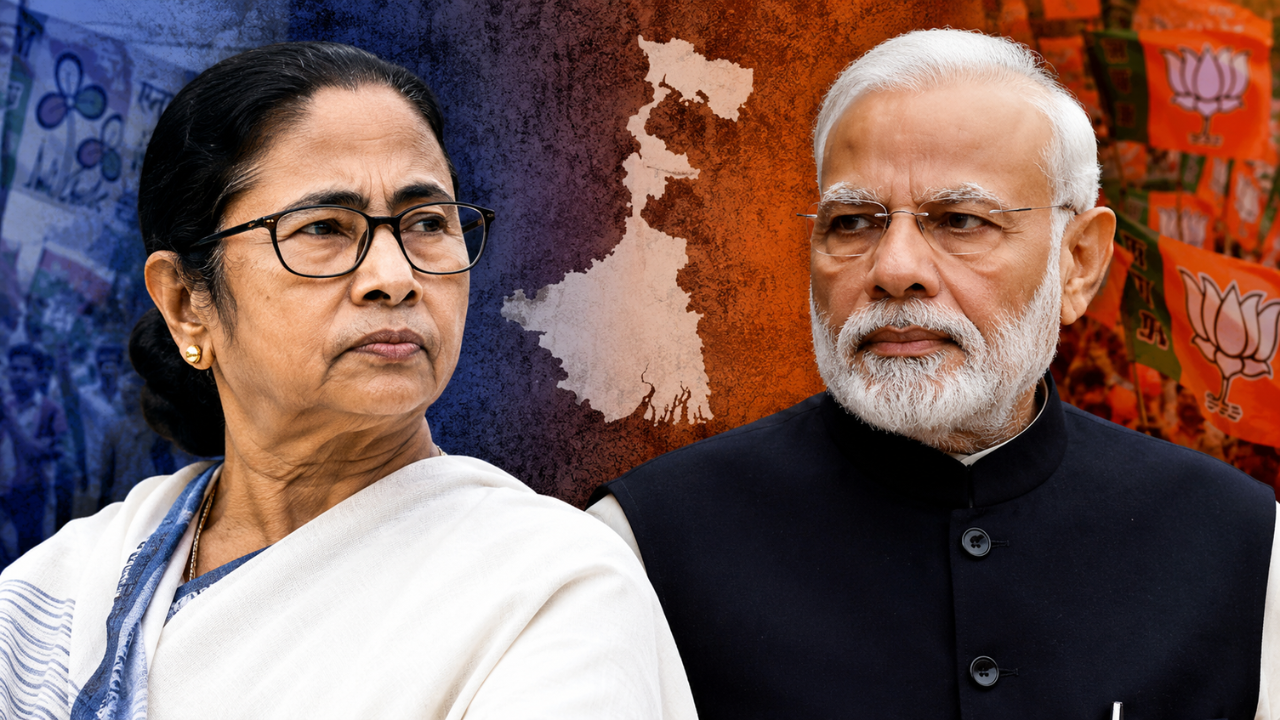
Trinamool Congress, born from the grassroots in 1998, is finding the ground slipping from under its feet as rebels are gaining ground in the Assembly and Parliament.in 2011, Mamata Banerjee’s party ended 34 years of Left rule in West Bengal, making her the first woman chief minister of the state and beginning her 15-year tenure in power. But when TMC faced its first electoral defeat at the hands of BJP in 2026, a big challenge emerged after the results.Within weeks a wave of rebellion swept through the party at local, state and national levels. Nearly three-fourth of the TMC MLAs rebelled against both Mamata Banerjee and her nephew Abhishek Banerjee, widely seen as her political successor. Dissidents took over the legislative branch of the party, installed their own leader of the opposition, and openly challenged the authority of the leadership.The unrest soon spread to Parliament. In the Rajya Sabha, TMC MPs Sushmita Dev and Sukhendu Shekhar Ray resigned from both the upper house and the party, while rebel Lok Sabha MP Kakoli Ghosh Dastidar claimed that around 20 TMC MPs were ready to support the BJP-led NDA. The development has sparked speculation over whether the TMC is moving towards a formal split – and, more importantly, who will benefit if that happens.This could have implications far beyond North Bengal. A fractured TMC could strengthen the BJP in both Parliament and the state, possibly following the pattern seen in Maharashtra, Bihar and other states OdishaOr create an opportunity for the Congress and the Left to reclaim political space after years of decline.
How does BJP benefit?
If the Trinamool Congress (TMC) splits, the BJP will benefit numerically and politically. The immediate advantage is in Parliament, where rebel MP Kakoli Ghosh Dastidar has claimed that about 20 of the party’s 28 Lok Sabha MPs are ready to support the BJP-led NDA. Even if the dissidents do not formally join the BJP, their support will weaken one of the BJP’s key rivals while strengthening the ruling coalition.The rebellion has revived speculation that the NDA could improve its chances of securing the numbers required for key constitutional amendments. Earlier this year, the Constitution (One Hundred and Thirty-First Amendment) Bill, 2026, popularly known as the Delimitation Bill, failed to be passed in Parliament after falling short of the required two-thirds majority. The Women’s Reservation Constitution Amendment Bill, which was related to the delimitation process, was also stalled for the same reason. The support of a large faction of TMC dissidents could potentially strengthen the NDA’s position on such legislation, even if it does not immediately lead to changes in the formal structure of the ruling coalition.However, the biggest benefit may be found in West Bengal. Despite BJP’s landslide victory in the 2026 assembly elections, the difference in vote share between the two parties was relatively small. While BJP won 207 seats against TMC’s 80 seats, it got 46.24 percent votes compared to TMC’s 41.16 percent. The numbers suggest that TMC still retains a substantial support base, but the split could further fragment that vote, making it easier for the BJP to consolidate its dominance in the state. A divided TMC will also give the BJP an opportunity to attract dissident leaders, MLAs and local organizers. Political observers say the BJP often benefits when regional parties are weak due to internal divisions, as has been seen in states like Maharashtra and Bihar. In Bengal, where the BJP has emerged as the dominant pole of politics, defection from TMC could further strengthen its organizational reach.The BJP may also benefit as there is little evidence that a weakened TMC will automatically help the Congress or the Left. In recent years, most of the anti-TMC votes have shifted towards the BJP rather than other opposition parties.Political commentator and former Congress spokesperson Sanjay Jha The argument is that this trend is partly rooted in TMC’s own political strategy over the past decade. According to him, the party steadily absorbed the organizational and electoral base of the Congress in Bengal, leaving little room for a viable third force. As the Congress and the Left weakened, anti-incumbency sentiment against the TMC increasingly found expression through the BJP.“Bipolar competition always helps the BJP a lot because it plays a more polarized game,” says Jha. He argues that if the TMC disintegrates further, the BJP could once again emerge as the major beneficiary rather than the Congress or the Left.
Maharashtra, Bihar, Odisha: Is Bengal following a familiar script?
The turmoil within the TMC is being compared with political developments in several states, where major regional parties either broke internally or gradually lost ground to the BJP. The closest parallel is Maharashtra, where the rebellion began among MLAs within the Shiv Sena and later the Nationalist Congress Party (NCP) before spreading to Parliament and eventually rival factions claiming legitimacy. In both cases, the split weakened the opposition parties and strengthened the BJP’s position.It seems that development in Bengal is also moving on the same trajectory. The rebellion began with dissident MLAs challenging the party leadership and has now reached Parliament, with the rebel MPs claiming the support of a significant section of the TMC Lok Sabha party. Veteran Rajya Sabha MP Sukhendu Shekhar Ray has already suggested that unrest within the party’s parliamentary ranks may deepen.Beyond Maharashtra, Bengal’s political churn also resembles a broader national trend. In Odisha, the BJP gradually displaced the Biju Janata Dal after being in power for more than two decades. In Bihar, regional formations like JD(U) and RJD have steadily lost political space as the BJP has expanded its footprint. In all states, parties once seen as major regional forces are finding it increasingly difficult to counter the organizational and electoral growth of the BJP.TMC’s troubles come at a time when many regional parties have either lost power, disintegrated or appear to be losing influence. Whether Bengal ultimately follows the Maharashtra model of formal partition or the Odisha model of substituting a major regional power is unclear. But the experience of other states shows that internal divisions often accelerate an already ongoing process – the weakening of regional parties and the strengthening of the BJP as the dominant pole of politics.
Can the Indian camp afford a weak TMC?
The impact of TMC’s crisis extends beyond West Bengal also. One of the largest constituents of the India Bloc and one of the BJP’s strongest opponents in Parliament, a weakened or divided TMC will reduce the collective strength of the opposition alliance at a time when it is already facing internal tensions.Therefore, Mamata Banerjee’s presence in the India Block meeting in Delhi was important. Amid rebellion within his party, it underlined his need for a broad opposition platform as the coalition seeks to maintain unity after recent electoral setbacks. With the DMK also distancing itself from the faction, the weakening of another major regional player could further complicate the opposition’s efforts to mount a united challenge to the BJP.
Some opposition voices argue that TMC’s troubles make greater coordination within the Indian faction even more important. Sanjay Jha argues that neither the Congress nor the TMC is currently strong enough in Bengal to effectively challenge the BJP on its own. He argues that a divided opposition will make it easier for the BJP to consolidate its lead in the state.“They are planning this game to ensure that TMC is not in a good position in the 2029 Lok Sabha elections, which is only two and a half years or three years away. Therefore, what should ideally happen in West Bengal is that TMC and Congress have to come together. TMC and Congress have no option but to come together,” he said.For the India Bloc, the question is not just whether TMC will survive, but also whether the opposition can remain united if one of its key pillars is weakened from within.
Opportunity for Left, Congress or just a mirage?
The split in TMC could, at least theoretically, create political space for the Congress and the Left. Both parties have struggled to remain relevant in West Bengal since the rise of Mamata Banerjee, and with the TMC weakened they could position themselves as an alternative for voters who are uncomfortable with both the BJP and the ruling party. If the TMC appears divided or unable to effectively challenge the saffron party, the Congress, in particular, may try to attract minority voters and sections of anti-BJP voters.Still others caution that Congress may not be in a position to take advantage of such an opening. Sanjay Jha argues that after being out of power for decades, the organizational structure of the party in Bengal has become very weak and it cannot be rebuilt overnight. After being out of power in the state for decades, the Congress will struggle to quickly fill any void left by the TMC split.“Congress has no organizational strength in West Bengal. I don’t think Congress is going to get any sudden opportunity and even if there is an opportunity, I don’t think it will be able to take advantage of it.”Even so, electoral trends suggest there is no guarantee of such gains. Data from the last 4 assembly elections shows that the Left-Congress position has collapsed dramatically. The CPM’s vote share fell from 30.08 per cent in 2011 to just 4.49 per cent in 2026, while the Congress’ vote share declined from 9.09 per cent to 2.99 per cent in the same period. In contrast, the BJP’s growth from 4.06 percent in 2011 to 46.24 percent in 2026 closely mirrors the Left Front’s decline, indicating that most of the anti-TMC votes have shifted to the BJP rather than returning to the traditional opposition parties. Therefore, the question is whether a weakened TMC will actually revive the Congress-Left alliance or simply accelerate the consolidation of the BJP. Some minority voters may become disillusioned if the TMC descends into prolonged factionalism, but there is little recent evidence to suggest a large-scale shift towards the Congress or the Left. TMC, despite its defeat, secured 41.16 per cent of the votes in 2026, which shows that it has a substantial social and electoral base which cannot be easily transferred.Sanjay Jha argues that the vote share is also a reminder that TMC remains a significant political force despite the current crisis. Even after a major electoral defeat, it still enjoys the support of more than four in ten voters, suggesting that assumptions about its sharp decline may be premature.Suggesting “the best way forward”, he said, “TMC still has more than 40% vote share. So, add Congress and they together will become a viable option.”It also raises a broader question about the future shape of Bengal politics. Is the state heading towards a bipolar BJP-versus-TMC contest, with other parties increasingly marginalised? Or could the TMC split create an opportunity for the Congress and the Left to re-emerge as a meaningful third force? Or can TMC find a way back into the Congress – the same party with which it broke away in 1998 to pursue an independent political path? For now, the poll data points more strongly towards the former scenario, but the answer may depend on where disgruntled TMC leaders, minority voters and anti-BJP constituencies choose to unite in the coming months.


