



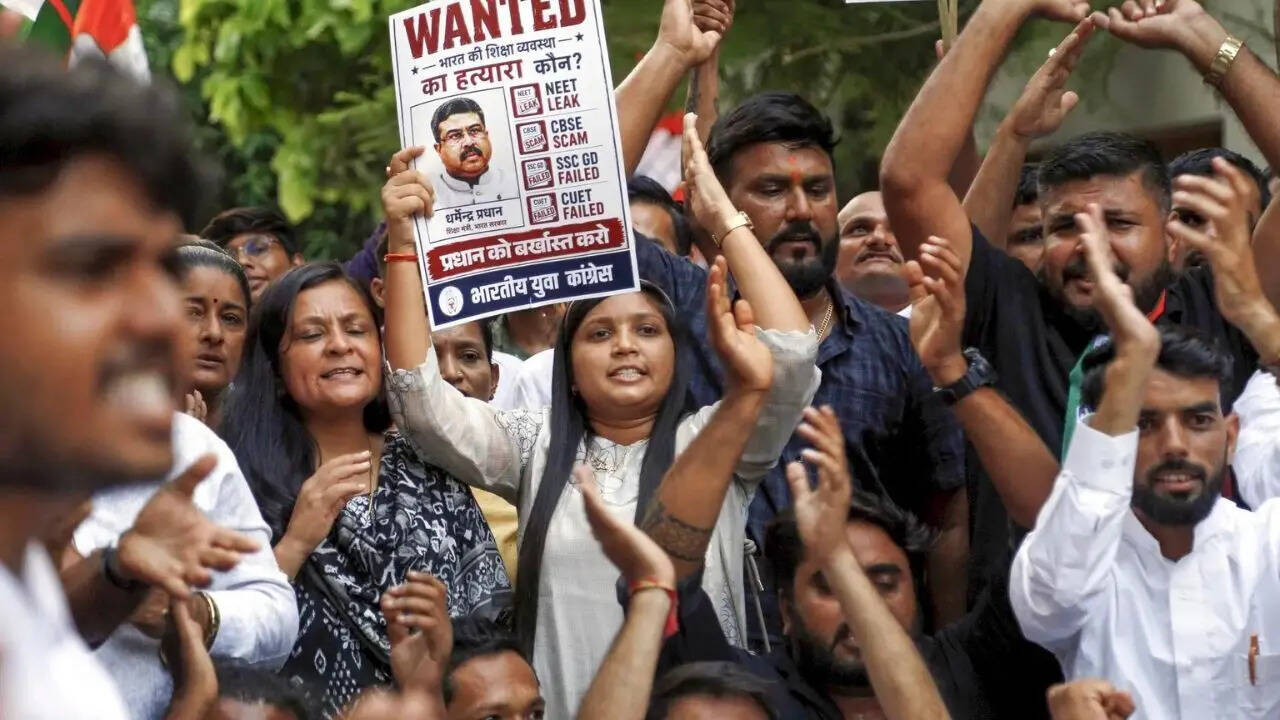
The NEET-UG paper leak, which has sparked protests, court battles and a Central Bureau of Investigation (CBI) probe, has put the examination system under unprecedented scrutiny.The controversy has exposed deep structural flaws in the testing ecosystem that determines college admissions and the future of millions of candidates every year.In recent years, a series of paper leaks, exam cancellations, technical glitches and evaluation errors have raised concerns about the efficiency and reliability of the exam system. Major exams including NEET, UGC-NET, SSC recruitment exams, Railway Recruitment Board exams and several state-level recruitment exams have been hit by allegations of question paper leaks, organized cheating rackets or procedural lapses.In many cases, these controversies have forced officials to cancel the exams, re-conduct the exams or order an investigation, leaving lakhs of candidates in limbo after months or even years of preparation. Repeated crises have again raised questions over the security, transparency and accountability of the high-stakes examination ecosystem.Be it paper leaks, technical failures, evaluation controversies or inadequate arrangements for candidates, each controversy impacts the lives of students and their families, raising widespread concerns about fairness, accountability and trust in India’s examination system.
How are India’s exam scams divided?
1. NEET 2026NEET 2026 emerged as the defining controversy in the examination system after paper leak allegations rekindled concerns over exam security. This episode is the second major controversy related to the medical entrance exam after the high-profile controversy of 2024.Nearly 2.3 million candidates appeared for the exam across India competing for less than 1.3 lakh medical college seats in 2026. The controversy deepened when officials ordered re-examination and launched a probe into the alleged leak.As concerns grew among candidates, the Center temporarily blocked Telegram, alleging that multiple channels were being used to circulate fake question papers, spread misinformation and cheat students by promising access to leaked exam material in exchange for money.Steps taken for solution: The National Testing Agency (NTA), in coordination with the authorities, temporarily blocked Telegram after it alleged that multiple channels were being used to circulate fake NEET question papers, run scams and mislead students ahead of the re-examination. More than 200 channels were reportedly targeted.Was it effective? The move helped curb the spread of fake papers and reduced opportunities for fraudsters to exploit anxious candidates. However, critics argued that a temporary ban addresses the symptom rather than the root cause, as scammers can quickly move to other platforms and encrypted services.
Major exam scams of India
2. CBSE 2026The 2026 CBSE result controversy raised new questions about transparency and evaluation systems.The controversy centered on CBSE’s newly introduced on-screen marking (OSM) system after students reported unexpectedly low marks, alleged answer-sheet mismatches, missing pages and technical glitches during the post-result verification process.CBSE later issued a clarification and opened channels for revaluation, while Union Education Minister Dharmendra Pradhan admitted that “some discrepancies” had been observed and promised corrective action.The issue gained national attention after Class 12 students Vedant Srivastava And Sanjana Publicly alleged that the scanned answer sheets provided to him by CBSE did not match his handwriting.another student meaningful theory Raised concerns about the implementation of the OSM system and presented its findings to a parliamentary panel investigating the matter.The episode highlighted how board exam controversies today extend beyond paper leaks to also include digital assessment systems, cyber security concerns and result-processing transparency.Steps taken for solution: Following complaints of discrepancies in the 2026 CBSE results and on-screen marking (OSM) system, CBSE allowed students to apply for answer sheet verification, get scanned copies and seek revaluation.Was it effective? The mechanism provided a formal avenue for grievance redressal and rectification of genuine errors. However, students and parents highlighted the financial burden of verification and revaluation fees, especially when multiple subjects were involved, arguing that students should not have to pay to correct potential mistakes during assessment. As the college admission deadline approached, the delay also added to the concern.3. Bihar unrestOne of the most recent flashpoints in India’s exam ecosystem emerged in June 2026, when thousands of candidates traveling to appear for the Bihar Prohibition and Excise Constable recruitment exam protested at the Patliputra railway station, alleging inadequate train services and overcrowding.What started as a frustration over travel arrangements soon turned into a major law and order situation. The protests turned violent, with incidents of stone pelting, vandalism and disruption of railway operations, leading to police intervention and train services being affected in the area. The candidates alleged that despite the scale of the recruitment exam, the authorities failed to anticipate the large influx of candidates.The incident highlighted a less-discussed challenge within India’s examination system: logistical preparation. For many candidates, especially those traveling long distances for recruitment examinations, issues such as transportation, accommodation and last-minute arrangements can become significant hurdles, adding to the stress and uncertainty already associated with highly competitive examinations.Steps taken: Following the Bihar Prohibition and massive protests by candidates traveling for the Excise Constable exam, officials and railway authorities announced additional train services and crowd-management measures to handle the influx of candidates. Was it effective? The extra trains helped ease congestion and demonstrated a sensitive approach following the unrest. However, the measures were largely reactive rather than preventive, with candidates arguing that transportation planning should have been done in advance to avoid the congestion, delays, and law-and-order situations that triggered the protests in the first place.Human cost: anxiety, delays and lives lostFor many candidates, the exam is not just an academic exercise but an investment of time, money and hope in the family. Canceled exams could mean another year of preparation, additional coaching expenses, postponed admissions or delayed employment opportunities. In some cases, the pressure and uncertainty have had tragic consequences, including reports of student suicides linked to exam disputes.When exams are canceled or results become controversial, the consequences go beyond academic inconvenience. Students lose preparation cycles, admission deadlines are disrupted, recruitment processes are delayed and families face additional financial burden.The 2026 NEET controversy brought this reality into focus. Reports of several student suicides linked to examination stress and uncertainty created nationwide concern. Student groups and opposition leaders cited several such cases while demanding accountability and reforms.The CBSE results controversy also had an emotional impact, with students worried about university admissions and future opportunities.
Recently reported cases
Economics of Exam CheatingIndia’s examination ecosystem is also a huge economic ecosystem. The country’s coaching industry serves millions of learners in school, entrance and government recruitment examinations.The intense competition for a limited number of seats has created a parallel economy around preparation, test series, counseling services and coaching centres.This pressure has also created opportunities for organized fraud networks. Investigations into recent paper leak cases reveal that leaked question papers and “estimate papers” are often sold for lakhs of rupees.In the NEET-UG 2026 paper leak investigation, the Special Operations Group of Rajasthan Police alleged that a paper leak network sold the leaked material as “estimate papers” for between Rs 10 lakh and Rs 25 lakh per copy.With millions of people competing for a limited number of seats on professional courses, even the promise of unfair benefits can generate huge amounts of money.What is happening now? A new organization called Cockroach Janata Party (CJP), led by Abhijit Dubke, emerged as one of the most visible youth-led movements campaigning against examination irregularities.The group has organized protests in several cities demanding accountability for the paper leak and the resignation of Union Education Minister Dharmendra Pradhan.The movement has gained significant popularity among students through social media campaigns and nationwide protests.Meanwhile, this issue has also become a political issue. Opposition parties have repeatedly accused the Center of failing to protect the integrity of the examinations and recruitment processes.congress leader Rahul Gandhi launched “Echoes of Umbrellas” (Voice of Students) campaign, setting it up as a platform for students and job aspirants to share their experiences with paper leaks, recruitment delays, exam cancellations and other complaints affecting their academic and professional future.
what comes next?For millions of students, exams are much more than academic tests. They represent years of preparation, family sacrifice, financial investment, and the hope of gaining admission into educational institutions. When exams are cancelled, question papers are allegedly leaked or evaluation errors are revealed, the consequences extend far beyond administrative failures. They can disrupt academic plans, career deadlines, and opportunities that often come only once a year.The challenge facing officials extends far beyond preventing paper leaks or deploying robust technology. This also includes improving examination procedures, strengthening safeguards against malpractices, ensuring timely grievance redressal and completing investigations into irregularities without unnecessary delays.Recent controversies have also focused renewed attention on broader reforms, including stricter safety protocols, greater use of technology, clearer accountability, and faster recruitment cycles. The effectiveness of these measures will depend not only on the new rules, but also on their consistent implementation across examination bodies.India’s examination system remains the primary gateway to higher education and public employment for millions of people. As the number of candidates continues to rise, ensuring that examinations are conducted in a secure, transparent and predictable manner will continue to be one of the major challenges for policy makers and testing agencies.


