



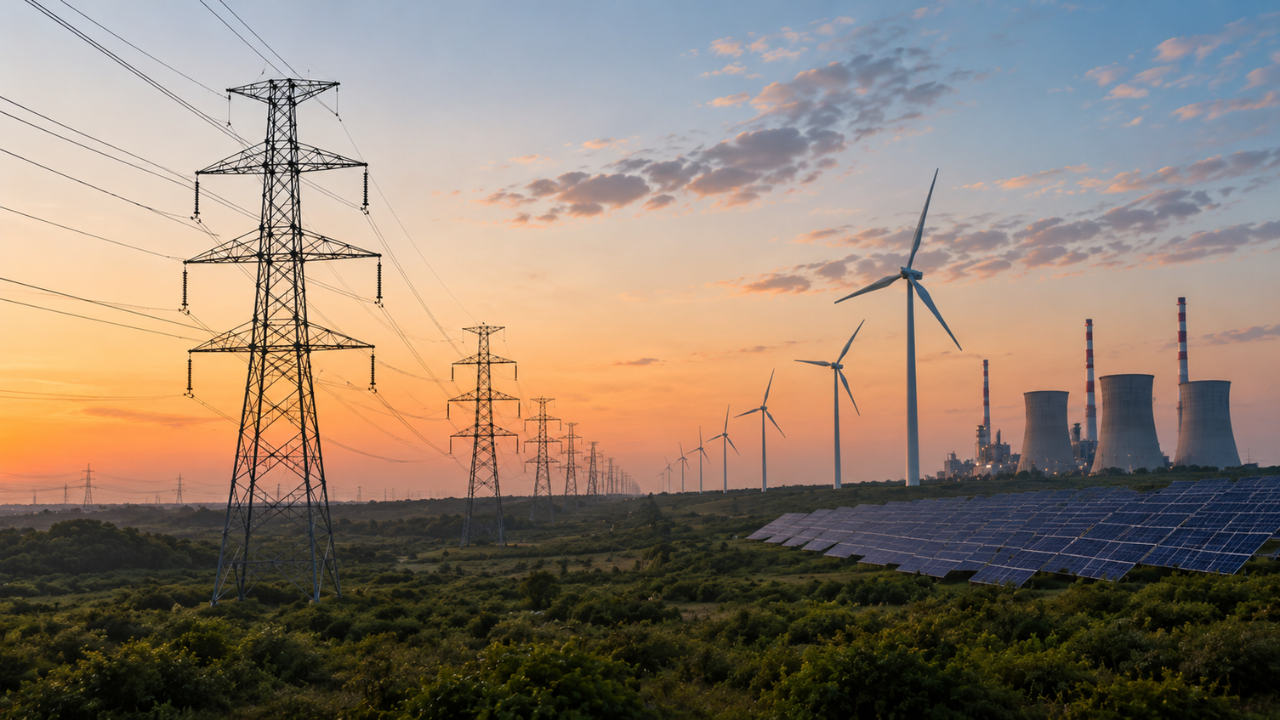
On May 21, India’s power grid was hit on a scale never seen before. The demand crossed 270 GW and reached 270.73 GW. To put this in context, the entire installed electricity capacity of the United Kingdom is approximately 80 GW. India were drawing more than three times as many in a single afternoon.The reason was heat. The extreme heat wave had spread across the northern and central plains, with temperatures reaching nearly 47 degrees Celsius in some areas. from Delhi to Rajasthan Uttar PradeshCrores of people switched on their air conditioners, coolers and fans almost at the same time. The grid absorbed it. The lights remained on. This was the fourth consecutive day that India set a new record for demand in May, Reuters reported. The jump comes barely a year after the country recorded the previous peak of about 243 GW in June 2025. The pace of development is astonishing. In May 2022, India’s maximum demand was about 211 GW. Over four years, this has increased by about 60 GW, roughly equivalent to adding another United Kingdom to the system.The nature of demand is also changing. For decades, industrial loads, factories, steel plants and agricultural pumping drove electricity consumption. He is changing. Residential cooling is now the dominant force. Uttar Pradesh, not an industrial powerhouse, recorded higher demand last year than Maharashtra and Gujarat. The urban household equipped with air conditioners is becoming the new swing factor in India’s power equation.
Vast network keeps India powered
Managing this kind of demand requires infrastructure on a scale that is easy to underestimate. Today India’s total installed power generation capacity is more than 530 GW, derived from coal, gas, nuclear, large hydro, solar and wind. By early 2026, the country alone would have achieved 258 GW of installed renewable capacity, including more than 150 GW of solar power. Nearly half of all installed capacity now comes from non-fossil sources, a milestone that India has crossed five years ahead of its target.Coal still dominates actual production. About 73 percent of electricity produced in 2025 is due to fossil fuels, with coal remaining the backbone of baseload supply. The contribution of solar and wind to the total generation that year was about 14 percent. The balance between dispatchable thermal power and variable renewable energy is the central challenge that India is now working on, and doing it on a scale that very few countries have ever attempted.What makes it more complicated is that this entire generation, across 28 states and 8 union territories, is distributed through a single national grid. India is one of the very few countries in the world operating an integrated grid of this size and complexity. It is called One Nation, One Grid, One Frequency.
The journey to this point was not fast. India started with separate regional grids in the 1960s. The North-East and Eastern regions were linked in 1991. The western and eastern grids were connected in 2003. The Northern and Eastern grids merged in 2006. The last piece connecting the southern region to the central grid was completed on December 31, 2013, when the 765 kV Raichur-Solapur transmission line was commissioned. From that point on, every state in India was drawing from and being nourished by the same pool of power, oscillating at the same frequency.The benefits are significant. A single grid allows surplus electricity to be transferred from one region to another in real time. when the wind blows hard Tamil Nadu And if demand is low, that power can go north. When Delhi experiences a heat wave, the southern hydro potential can be tapped to support it. Redundancy is improved. The risk of localized blackouts is reduced. And because the electricity market is national rather than regional, generators can be dispatched based on cost and availability throughout the country rather than across artificial boundaries.
15 minute rhythm that keeps the grid stable
Physical infrastructure is only half the story. Keeping a grid of this size stable is essentially an information problem. Each megawatt drawn from the grid must be matched by one megawatt being installed. At 270 GW, even a fraction of a percentage point of imbalance represents thousands of MW. That imbalance, if not corrected, causes frequency deviations that can trip the generator and, in the worst case, result in a blackout.In India, providing electricity from a power plant to a home is not the job of any one company or agency. It is a relay race involving dozens of organisations, public and private, Center and State, each responsible for a leg of a very long chain.At the generation end, central government-owned giants like NTPC and NHPC produce huge amounts of thermal and hydro power. As well as them, state-owned generators run their own plants, and a growing number of private companies contribute significant capacity. Then there are renewable energy developers, hundreds of them, injecting solar and wind into the grid from Rajasthan to Tamil Nadu. All these generators have to declare how much power they can supply, at what price and on what schedule, so that the system knows what it has to work with.The wires carrying this electricity are largely the domain of the Power Grid Corporation of India or POWERGRID, a central government public undertaking that operates interstate transmission networks. POWERGRID owns and maintains the high-voltage backbone through which electricity moves between states and territories. Each state also has its own transmission utility, which manages the interstate network that carries electricity from interstate lines to local substations.
At the extreme end of the chain sit the distribution companies, the DISCOMs. These are usually state-owned utilities that are responsible for the last mile: the poles, wires and meters that actually deliver electricity to homes, shops and factories. This is the Discom that every family knows. In cities like Delhi and Mumbai, parts of this function have been privatized, with companies like BSES running the networks. But in most parts of India, distribution remains a state government function.It is the job of the dispatch hierarchy to coordinate all these moving parts. This is where Grid Controller of India Limited, formerly known as POSOCO (Power System Operation Corporation Limited), comes in. POSOCO is headed by the National Load Despatch Centre, which oversees five regional load despatch centres, each covering a region of the country. Below them is a State Load Despatch Center in each state, which manages supply and demand within its borders in real time.The mechanism that holds it together is built in about a 15 minute time block. The day is divided into 96 such blocks, and each is treated as a separate planning unit. Each state is required to submit a schedule: a forecast, block by block, of how much electricity it expects to draw from the central grid over the next 24 hours. These are not casual guesses. They are the product of careful analysis.
State dispatch centers look at what happened on the same day last week. They look at what happened on the same day last year. They pay attention to whether any festival is coming or not, as Diwali or Eid can bring rapid changes in demand patterns. They keep track of predicted temperatures. They examine trends over the past week, looking for movement in demand, whether it is rising, falling, or remaining stable. All that gets compiled into a schedule, which is presented the day before the next day.But plans change. Sudden cloud cover can cause an unexpected drop in solar energy production. Local holidays may reduce industrial demand. The temperature can surprise even a good forecast. The system allows this. Each state can modify its schedule up to 90 minutes before the start of any 15-minute block. That revision window gives the system enough flexibility to absorb real-world variation while keeping the overall grid balanced.POSOCO continuously monitors the grid in real time, observing frequency, tracking generation against schedule, and directing improvements as needed.
The long journey from blackouts to near-universal access
There is another dimension to this story that gets overlooked in discussions about gigawatts and grid architecture. Some time ago, large parts of India had no electricity at all.In 2014, only about 79 percent of rural households had access to electricity. For millions of people, the question was not whether there would be enough electricity during the heat wave; It was whether there would be any power there. In 2000, only about 60 percent of India’s population had access to electricity.By 2023 this figure had reached 99.5 percent world bank data. Rural electrification has increased from 79 percent to 99 percent in a decade. Average electricity supply in rural areas has increased from 12.5 hours per day in 2014 to 22.6 hours in 2025. The average in urban areas is now 23.4 hours. Power shortfall, measured as the difference between demand and actually supplied, declined from 4.2 per cent in 2013-14 to just 0.1 per cent in 2024-25.This change matters for understanding the 270 GW peak. One reason demand is increasing is that more people now have electricity, and more people now have it reliably enough that buying an air conditioner makes economic sense. Per capita electricity consumption is expected to increase by about 46 per cent between 2013-14 and 2023-24. This is the identity of a rapidly progressing country.
Challenge after 270 GW
On paper, 270 GW is just a number. In practice, it represents one of the most complex engineering exercises carried out every day anywhere in the world. Thousands of generators, millions of kilometers of transmission and distribution lines, dozens of agencies, and more than a billion consumers all have to be in balance from one moment to the next. What is not noteworthy is that India reached a new record of demand in May. It’s like most people barely noticed.It’s easy to miss that mediocrity. A few decades ago, power cuts were part of daily life in most parts of the country. Today, millions of people expect electricity to be available at the flick of a switch, even as temperatures rise and demand reaches levels that seemed unimaginable not long ago.The next challenge is to ensure that expectations are sustained in the coming decades. India’s appetite for electricity is still growing, as summers get hotter and its economy continues to expand. The next step is to meet that demand by relying less on fossil fuels and more on renewable energy. The 270 GW milestone may seem remarkable today. Within a few years, it may look relatively normal.


