



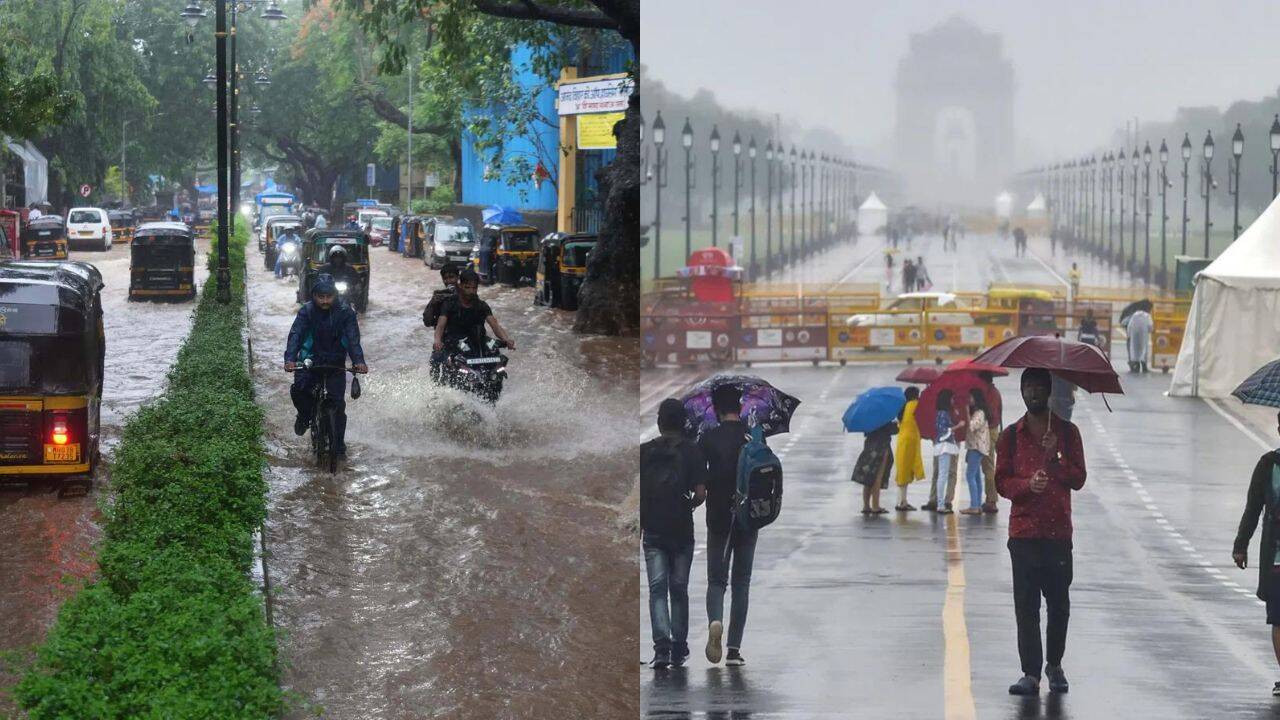
New Delhi: South West monsoon It finally reached Delhi on Thursday, five days after its usual onset date of June 27, bringing widespread rainfall and much-needed relief from weeks of heat and humidity. India Meteorological Department (imd) said that the monsoon has now advanced into the national capital as well as large parts of northwest India, while extremely heavy rainfall is expected to continue over Maharashtra, Goa, Konkan, south Gujarat and parts of central India for the next several days.The weather department said the southwest monsoon advanced into remaining parts of Uttar Pradesh, entire National Capital Territory of Delhi, most parts of Madhya Pradesh on July 2. Haryana and additional areas and parts of Punjab, Gujarat Rajasthan.With Thursday’s advance, the monsoon is now close to covering the entire country, about a week before its normal end date of July 8. According to IMD, conditions remain favorable for the spread of monsoon into remaining parts of Gujarat, Madhya Pradesh, Haryana, Punjab and Rajasthan in the next two to three days.
Monsoon started in Delhi for the first time after 2021 in July.
The arrival of the monsoon marked a significant weather change for Delhi after several weeks of extreme heat, dust storms and pre-monsoon storms.According to IMD, this is the first time after 2021 that the south-west monsoon has reached Delhi in July. In 2021, monsoon arrived on 13 July.
In comparison, monsoon reached Delhi:
- 29 June 2025
- 28 June 2024
- 25 June 2023
- June 30th in 2022
The weather office has predicted generally cloudy sky, moderate rain, thundershowers and strong winds over Delhi-NCR throughout the day. Yellow alert is in effect in the national capital.The rain has already caused a significant drop in temperatures. The maximum temperature in Delhi on Wednesday was recorded between 33°C and 34.8°C, much lower than those recorded during the recent heatwave. The IMD expects the maximum temperature to remain between 32 degrees Celsius and 34 degrees Celsius in the next 24 hours.
Monsoon is advancing rapidly across North India
The progress in Delhi comes as the south-west monsoon advances rapidly across north India.On July 1, the monsoon covered the entire Himachal Pradesh, six days late from its normal onset date of June 25. It also spread to remaining parts of Uttarakhand, Jammu and Kashmir and Ladakh, entering large parts of Haryana and Punjab.IMD officials said remaining parts of Punjab, Haryana and Rajasthan are expected to come under monsoon cover within the next two to three days.Senior IMD scientist Dr Naresh Yadav said the weather system will continue to move northwards and will cause widespread rainfall over many states.He warned that extremely heavy rainfall is likely over Konkan region, Goa and South Gujarat during the next four to five days. IMD has issued a red alert for these areas.Very heavy rainfall is also likely over Odisha and parts of Central India.
Rainfall shifts from relief to risk
While the arrival of monsoon has ended the prolonged heat conditions in most parts of North India, it is also increasing the threat of floods in many parts of Western and Southern India.Mumbai Metropolitan Region, Konkan, Coastal Maharashtra and Goa have already recorded heavy rainfall, leaving many low-lying areas waterlogged.Orange alert is in place for Mumbai, while Ratnagiri is under red alert due to possibility of extremely heavy rains.IMD officials said authorities including the Brihanmumbai Municipal Corporation and the State Disaster Management Authority have been alerted to the possibility of flooding in sensitive areas.The changing weather patterns reflect the strengthening circulation of the southwest monsoon, which is now drawing large amounts of moisture from both the Arabian Sea and the Bay of Bengal into the Indian mainland.
Why is it raining heavily in Mumbai, Konkan and South India?
While Delhi welcomed the arrival of the southwest monsoon, western and southern India is experiencing its most intense phase, with the India Meteorological Department (IMD) warning of extremely heavy rainfall over parts of Maharashtra, Goa, Konkan and south Gujarat over the next several days.According to the IMD, a combination of favorable monsoon winds coming from the Arabian Sea, several upper air cyclonic circulations and an offshore trough running from south Gujarat to Karnataka is promoting widespread rainfall over the west coast of India.The weather department has also said that a low pressure area is likely to form over north-west Bay of Bengal around July 3. Once it develops, the system is expected to further strengthen rainfall activity over eastern and central India before moving inland.Senior IMD scientist Dr. Naresh Yadav said that Konkan belt, Goa and South Gujarat are likely to receive extremely heavy rainfall in the next four to five days.A red alert has been issued for many parts of the Konkan coast and south Gujarat, while very heavy rain is also expected in parts of Odisha and central India.
Mumbai under orange alert
Widespread rainfall continued in Mumbai in the last 24 hours, with many weather stations recording heavy to very heavy rainfall.IMD scientist Bikram Singh said that there is a possibility of more heavy rain in the city in the coming days, due to which the department has had to issue an orange alert.Officials have warned that heavy rains could cause waterlogging in low-lying areas, disrupt road traffic and slow down suburban train services.Neighboring Ratnagiri is on red alert due to the possibility of extremely heavy rainfall, while Thane, Palghar and parts of Mumbai Metropolitan Region have also seen widespread flooding.Heavy rain overnight left roads submerged, residential colonies inundated and normal life disrupted in many areas. In Palghar district, educational institutions were closed after authorities declared holiday in view of inclement weather.
There is a possibility of more rain in Himachal, Uttarakhand
The southwest monsoon completed its progress across Himachal Pradesh on July 1, six days after the state’s normal onset date.The IMD has predicted widespread rainfall over the hill state in the coming week, with heavy to very heavy rainfall at isolated places. A fresh western disturbance is also expected to affect northwest India from July 2, potentially leading to increased rainfall activity across Himachal Pradesh.
The weather has already taken a heavy toll on the state.
According to the state emergency operations centre, weather-related incidents between March 1 and June 30 claimed 128 lives and caused losses of about Rs 30 crore.Dozens of roads have been blocked across Himachal Pradesh due to heavy rains, with Mandi district being the worst affected.Neighboring state Uttarakhand has also entered the active monsoon phase.The IMD has issued an orange alert for heavy to very heavy rainfall in parts of the state, prompting officials to activate emergency response systems and intensify surveillance along the Char Dham Yatra routes.The district administration has increased monitoring of highways, pilgrimage routes and landslide-prone areas as the rains are expected to intensify in the next few days.
Karnataka is struggling with the effects of Northeast Monsoon
Active monsoon continues to affect southern and northeast India.In Karnataka, three members of a family, including two girls, were killed in a rain-triggered landslide that buried their house in Mangaluru following incessant rain overnight.In Arunachal Pradesh, authorities are continuing relief and rehabilitation efforts after flash floods and landslides caused massive destruction last week. According to official figures, four people have died, 21 have been injured and two are missing.The Center has assured support to the state for relief operations and long-term flood mitigation measures.
What is the reason for active monsoon?
Meteorologists say the current spell of widespread rainfall is being caused by multiple weather systems working together.One upper air cyclonic circulation is over Punjab, while the other cyclonic circulation is active over central Uttar Pradesh. A distinct circulation over Saurashtra continues to strengthen moisture transport from the Arabian Sea.Meanwhile, the offshore trough extending from south Gujarat to Karnataka is helping to maintain heavy rainfall over the west coast.There is a possibility of further increase in rainfall over East, Central and North India in the coming days due to the formation of a low pressure area over the northwest Bay of Bengal.Overall, these systems are expected to bring vigorous monsoon activity over large parts of the country till the first week of July.


