



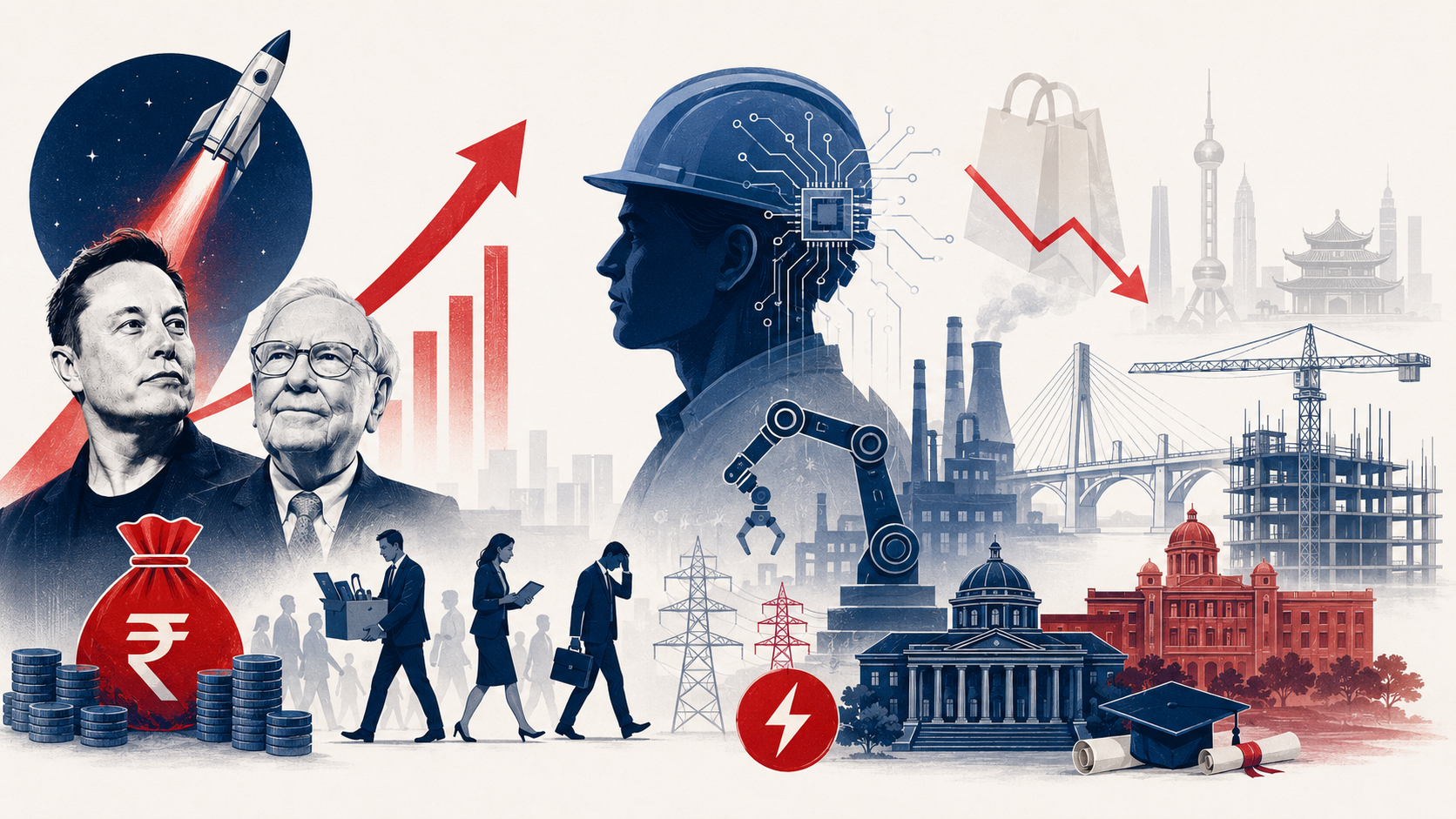
It would not be an exaggeration to say that we are living in a simulation Elon Musk Rule supreme.Rockets, AI, private space, trillion-dollar valuations, talk of Mars, market mania — man has made the future look less like science fiction and more like a quarterly update. This week, following SpaceX’s blockbuster market debut, the simulation got another software upgrade. While many things were highlighted about Musk becoming the first trillionaire, with the record breaking, one particular statistic stood out. It showed how much new technology has pushed the limits of what we can think of as imaginable wealth, when Musk surpassed the wealth of the biggest investment gurus in just one day. This and other extraordinary stats are part of our weekly numbers wrap-up, where we put seven statistics under a closer lens.
When one day beats a lifetime
According to Forbes data, on June 15, Elon Musk’s one-day wealth increased by $ 164.8 billion. was bigger than warren buffettHas an estimated net worth of $146.4 billion. The gap itself was huge: $18.4 billion. Musk’s one-day jump was bigger than Buffett’s entire wealth.
musk shows the way
The trigger was a surge in SpaceX’s stock, with the company reportedly rising 66% in three days. But this number was not just about one billionaire surpassing another. It captured the mood of the market at this moment.The patient capital introduced by Buffett is still revered. The old gospel was simple. Buy well, wait long, let compounding work its quiet magic. Frontier capital is different. Rockets, AI, private space and deep tech are being priced as if they were delivered to the doorstep yesterday.However, this appetite for the future is not evenly matched by the strength of the real economy.
China’s consumer wavered
China’s retail sales declined 0.6% in May, contrasting with April’s 0.2% rise and the first monthly decline since December 2022. This was not a fall, but a warning.
china retail figures
The broader picture was two-pronged. Industrial output rose 4.5% in May from a year earlier, helped by strong factory activity. But real estate investment declined 4.1% in the first five months of 2026, suggesting the recovery remains uneven.This is China’s puzzle in one frame, where factories are running but consumers are not showing that much confidence. This has global implications as China remains a central pillar of manufacturing, commodity demand and global trade. When Chinese consumers are hesitant, it sends signals far beyond Beijing.And this divide between headline growth and underlying stress is also visible in the labor market, especially in tech.
Tech’s white-collar squeeze
More than 56,000 Indian professionals from global technology companies are now actively looking for opportunities, reports Sriradha Basu in the Economic Times. A month ago, the count was a little more than 12,000. Six months ago, it was around 5,000. A year ago, it was less than 4,000.This is not the normal ups and downs of the recruitment market. This is a fast reset. An ET commissioned study by specialist staffing firm Xpheno points to a worrying trend.
large number of tech layoffs
The data covers professionals from 20 major tech companies, each of which has made more than 1,000 global layoffs since January. Mid-level professionals form the largest segment with 66%. Tech hiring is also at a 28-month low. Bengaluru contributed 36%, Hyderabad 19% and other places 45%.For years, the technology was seen as the safest escalator for India’s middle class. Coding was a shortcut to prosperity. It promised visas, apartments, ESOP dreams and the occasional standing desk with DSM and long pending Jira tickets.Routine technical work is now exposed to cost cutting, automation and AI-led restructuring. Mid-level professionals, once the backbone of performance, are in the most uncomfortable position: too experienced to be cheap, not always expert enough to avoid being fired.But there is another side to the AI story. It’s not just cutting down on white-collar comfort zones. It is also creating demand for manual work.
AI still needs people wearing helmets
The volume of blue-collar jobs is expected to increase by 93% between the beginning of 2022 and the beginning of 2026, outpacing the 40% increase in white-collar roles. reports Rupali Mukherjee in Times of India. Salaries in these roles are growing 5.7% year-over-year, compared to 4% for entry-level white-collar jobs. The data is based on information provided exclusively to TOI by talent firm Randstad after analyzing over 50 million job postings.
Changing nature of job demand
The biggest gains have been in the trades that physically keep the new economy running, with electricians up 242%, HVAC technicians up 200% and robotics technicians up more than 500%.This is the unseen reality of the AI boom. As AI becomes more and more incorporated into cutting-edge technology, the jobs running the systems are increasing. So yes, code can drive AI. But AI also runs on power, equipment, shopfloors and skilled hands.This shift is also changing how students and families view older engineering streams.
Unexpected return of civil engineering
There are signs of civil engineering making a comeback in the top IITs. reports Hemali Chapia for TOI. Movement in the opening and closing ranks tells the story. on civil engineering IIT Bhubaneswar has advanced by 3,204 ranks, IIT Patna by 2,978 ranks and IIT Roorkee by 2,454 ranks. At IIT Delhi, Civil Engineering started at AIR 179 (up 2851 ranks); At IIT Bombay, at AIR 385 (up 2281 ranks). People are finally coming back to core engineering.
iit admission trends
The reasons aren’t hard to see. India’s infrastructure creation is visible on the ground in expressways, metros, airports, bridges, urban redevelopment, housing, townships and industrial corridors. The improved job outlook, scale of public works, and renewed interest beyond pure coding have made civil engineering more attractive than it was during the peak software rush.However, Computer Science remains the most prestigious course. Students are not leaving tech. They are expanding the definition of what a future-ready career can look like.This brings us to the big talent race.
India is growing, China is still ahead
In the QS World University Rankings 2027, India has 52 ranked universities, while Mainland China has 85. India’s rise is visible, with the country’s strongest performance since the National Education Policy came into force in 2020, and 52 institutions making India the fifth largest contingent globally. Eighteen Indian institutions have achieved their highest ever ranking, and 13 of them are non-IITs. But China’s lead at the top remains considerable.
Comparison between Indian and Chinese universities
China has 10 universities in the global top 200, while India has 3 universities. Peking University is China’s best ranked university at #13, while India’s best ranked institute, IIT Delhi, is at #118. A comparison of the top five shows the difference more clearly. China’s leading universities are ranked 13th, 14th, 26th, 36th and 47th, while India’s top five universities are ranked 118th, 134th, 170th, 205th and 221st. China also added 13 new entrants in 2027 compared to India’s 2. India’s rise goes beyond the IITs, but the climb from reach and scale to global research excellence is long. There is no dearth of talent in India, the most difficult task is to convert it into institutions with global depth, research capital and international visibility. And that requires public spending choices, which leads to the final numbers.
subsidy the state expands
The last big number of the week is domestic and fiscal: ₹4.4 lakh crore.This is the total state subsidy bill in 2024-25, up from ₹1.4 lakh crore in 2015-16, an almost 3-fold increase. Subsidies now constitute 10.2% of revenue expenditure, compared to 7.7% in 2015-16.
subsidy bill
The sector mix is revealing. Energy accounts for 43.4%, agriculture 29.8% and others 26.8% in state subsidies. The top states in terms of subsidy as share in total expenditure are Karnataka 14.0%, Madhya Pradesh 13.7%, Tamil Nadu 13.6%, Punjab 13.5% and Chhattisgarh 11.4%.Subsidies have almost tripled, while total state expenditure has increased 2.3 times over the same period. This means that subsidies have increased faster than total expenditure.This is the political economy behind many of the week’s other statistics. As jobs have become less predictable, education has become more competitive, infrastructure has become central to development, and families face increasing pressures, states are spending more to promote citizens and regions. For some people, subsidies are doles and freebies; For others, they are investments in human capital. But whatever the outline, this is the reality of the times.Of course, the future is being reevaluated, and not equally. So yes, maybe we are living in a simulation. But this isn’t the neat, coded world of The Matrix, where you choose between a red pill and a blue pill and suddenly understand everything. This simulation is messier. Winners are moving forward fast. The rest of the economy is trying to catch up. And if there’s a flaw in this matrix, it’s that the future is coming quickly, but not evenly.


