



NEW DELHI: Two years after sweeping to power on a promise to reclaim Jammu and Kashmir’s political identity and dignity, Omar Abdullah’s government is confronting the limits of governing a Union Territory with constrained powers.What began as a historic return to power in October 2024 has increasingly turned into a political and administrative tightrope. While 89-year-old National Conference patron Farooq Abdullah has stepped in to contain simmering discontent among MLAs left out of the cabinet expansion, an ideological rupture has emerged with the exit of Srinagar MP Aga Syed Ruhullah Mehdi, who has accused the party leadership of abandoning its core promises.Caught between disgruntled legislators seeking a greater share in government and a prominent party voice questioning its political compromises, the National Conference faces a twin challenge. The party has accused the BJP of exploiting its internal divisions to engineer an ‘Operation Lotus‘ in Jammu and Kashmir. But is this an opposition attempt to destabilise the government, or does the turmoil point to a leadership crisis under Omar Abdullah?
The show of unity
The gates of the Abdullahs’ Gupkar residence in Srinagar opened to a familiar political spectacle last week as yet another party leadership put up a show of strength amid growing discontent within its ranks.Standing alongside 15 MLAs unhappy with the recent cabinet expansion, 89-year-old National Conference (NC) president Farooq Abdullah sought to project an image of an organisation firmly in control of its affairs.“The baseless reports being spread that the National Conference is divided are completely false. This organisation is united, and those who think they can break this organisation should understand that it has never been broken and will never be broken,” Farooq declared.He acknowledged that the legislators had genuine grievances and promised that some concerns would be addressed immediately, while others would be taken up gradually.But behind the show of unity, there’s a bigger contradiction confronting Jammu and Kashmir chief minister Omar Abdullah. The National Conference, which swept the 2024 assembly elections on the promise of reclaiming Kashmir’s political identity, dignity and special status, is caught between the compromises of governing a Union Territory and the expectations of the constituency that brought it to power.The party is facing two distinct challenges. While a section of its MLAs is demanding a greater share in the government and a say in decision-making, one of its most prominent political voices, Srinagar MP Aga Syed Ruhullah Mehdi, has walked out accusing the leadership of abandoning the very promises on which it sought votes.
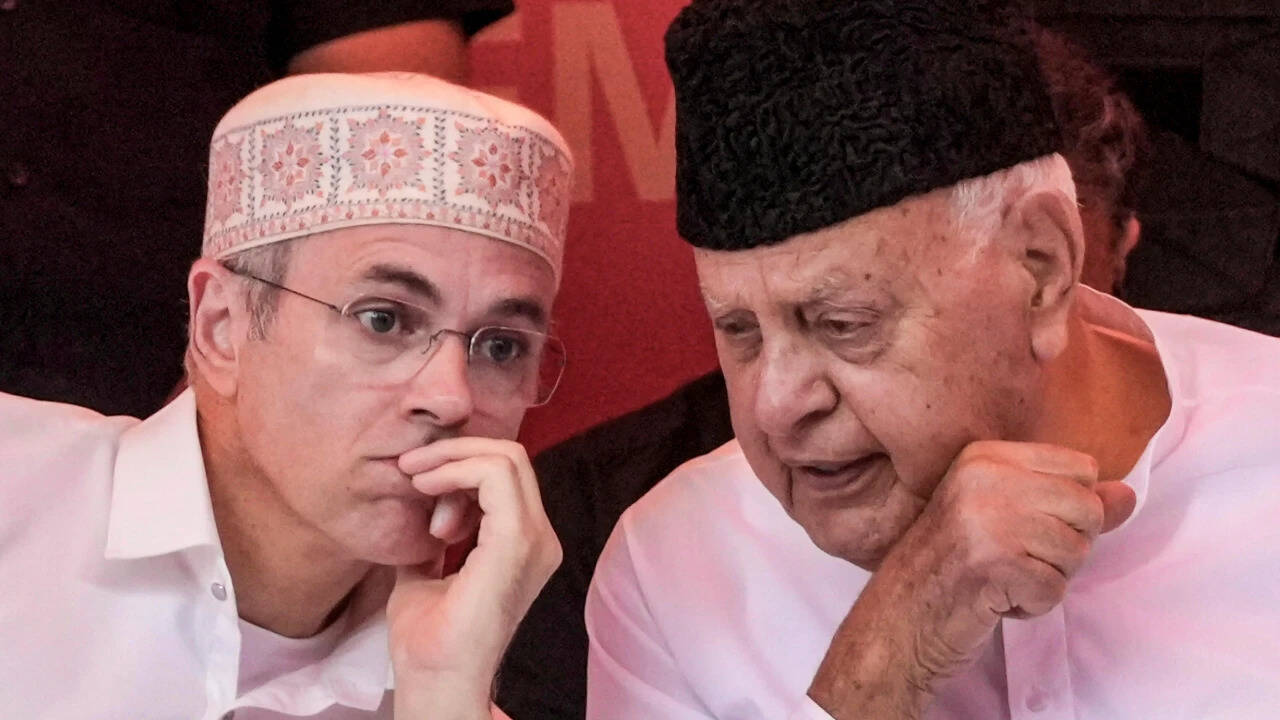
Farooq Abdullah dismisses reports of a split within the National Conference, asserting that the party remains united despite growing internal discontent.
The ideological rupture: Ruhullah’s ‘decree of freedom’
The fragility of the NC’s united front was exposed three days before Farooq met with the disgruntled legislators.On November 3, at a gathering in Behisht-e-Zehra Park in Budgam marking the 26th death anniversary of his assassinated father, Aga Syed Mehdi, Ruhullah announced his resignation from both the National Conference and the Lok Sabha.In an 80-minute address, the Srinagar MP launched a scathing attack on Farooq and Omar Abdullah, accusing the leadership of abandoning its promises on Article 370, political prisoners and public relief.Describing his departure as a “decree of freedom”, Ruhullah called the NC a “deceitful, corrupt organisation”.“You told people that you were the guardians of their dignity. You said that if anyone touched that dignity, it would be like grabbing you by the collar. That dignity was buried on August 5, 2019. Tell me now, where is that dignity? Where is that autonomy?” he asked, targeting the party leadership.He accused the NC of seeking power on promises it had failed to fulfil and said he could no longer lend his name to what he described as political humiliation.On November 6, Lok Sabha Speaker Om Birla formally accepted his resignation, creating a vacancy in the Srinagar parliamentary constituency.Ruhullah’s departure is more than an organisational setback for the NC. Elected to the Lok Sabha on the party’s ticket in 2024, he had emerged as one of its most vocal faces on the question of Kashmir’s political rights after the abrogation of Article 370 in August 2019.While Omar Abdullah has sought to pursue the restoration of statehood and special status through legislative and political channels, Ruhullah has demanded a more uncompromising approach. His exit gives him the opportunity to position himself as a voice of those who believe the NC has softened its stand after coming to power.He has hinted at launching a broader political movement rather than immediately forming a new party, saying he wants to bring together people committed to restoring the dignity and rights of Jammu and Kashmir.
Aga Syed Ruhullah Mehdi accused the NC leadership of abandoning its promises on Kashmir’s dignity and autonomy after the abrogation of Article 370.
The NC, meanwhile, has questioned his own record, asking why he did not move a resolution or private member’s bill in Parliament on special status or mobilise fellow MPs on the issue, despite having secured the support of more than 100 parliamentarians for an impeachment motion against an Allahabad High Court judge.The public exchange has exposed a larger ideological fault line: can the NC continue to claim ownership of the political struggle for Kashmir’s rights while defending its record in government?
The arithmetic ceiling
While the ideological dissent has played out in public, the discontent within the legislative wing has centred on the distribution of power.The immediate trigger was the October 27 cabinet expansion, in which four new ministers were inducted, taking the council of ministers to its maximum permissible strength of nine.The restriction is rooted in Section 53 of the Jammu and Kashmir Reorganisation Act, 2019, which caps the council of ministers at 10% of the total membership of the Legislative Assembly. With 90 elected seats, the permissible strength is nine, including the chief minister.This creates a structural constraint for Omar Abdullah. Unlike a full-fledged state, where the constitutional ceiling for the council of ministers is 15% of the assembly’s strength, Jammu and Kashmir’s Union Territory framework leaves the CM with a smaller pool of ministerial positions to distribute.With all nine positions occupied, accommodating more aspirants would require dropping or replacing existing ministers.Several senior legislators, including six-time MLA Mubarak Gul, were reportedly unhappy at being left out. The discontent was not limited to ministerial berths. The legislators also raised concerns about administrative functioning, organisational decisions and what they described as the concentration of authority among a small group of leaders and advisers.A group of 18 aggrieved legislators had met a week before the Friday meeting. The subsequent gathering of 15 MLAs at Gupkar brought their grievances directly to Farooq and Omar Abdullah.The legislators reportedly sought a review of the cabinet, changes in the functioning of the CM’s office and a mechanism to ensure that elected representatives have a greater say in government decisions.One of the legislators, Nazir Gurezi, sought to play down speculation about the emergence of a separate faction.“A few days ago, we sat together at a place, and from there, social media hyped it up as if a separate faction had emerged from the National Conference. No separate faction or party has emerged,” he said.Gurezi added that the legislators had placed their concerns before the CM and the party president, who had assured them that the issues would be addressed.For Omar Abdullah, however, the problem is not merely placating a group of unhappy MLAs. The cabinet expansion has exhausted the government’s primary instrument of political accommodation. Any reshuffle could create fresh resentment among those who have already secured ministerial positions.Farooq’s intervention may have prevented the discontent from turning into an open confrontation for now, but the leadership will have to find ways of accommodating senior legislators without triggering another round of dissatisfaction.
Omar Abdullah’s Union Territory dilemma
The constraints facing Omar Abdullah go beyond cabinet arithmetic. They strike at the heart of the political contradiction of running an elected government in a Union Territory where the Lieutenant Governor and the Centre retain significant powers.Omar has repeatedly complained about the limits placed on his government, particularly in matters involving administration and the functioning of the bureaucracy.During the September 2026 assembly proceedings on a resolution seeking immediate restoration of full statehood, he revealed that the Law Secretary had written to the Speaker questioning whether the resolution should be discussed because the matter was sub judice. The chief secretary had also written to the Speaker.Omar, who also holds the law portfolio, expressed surprise at the communications.“I am a law minister and I don’t know that my law secretary is giving you an opinion. As a CM I don’t know the chief secretary is writing to the Speaker against my resolution. I don’t know on whose behalf it is being done,” he said.He went on to question whether such a situation would arise in a full-fledged state.“Would you think such a thing would happen in any State? This happens only in UT where a CM moves a resolution and the law secretary gives an opinion against it,” he said.The episode illustrates the difficult position in which the chief minister finds himself. To deliver on everyday governance, including infrastructure, electricity, welfare schemes and administrative decisions, Omar has to work within the existing institutional arrangement. But the same arrangement limits his authority and has become a source of political frustration for his government.Every compromise with the Centre risks being interpreted by sections of the electorate as a dilution of the NC’s political promises. Every confrontation, meanwhile, can further constrain the government’s ability to function.The NC’s August 19, 2024 manifesto had made restoration of Articles 370 and 35A a key promise. It also pledged to work towards restoration of statehood, repeal of the Public Safety Act and release of political prisoners.
CM Abdullah on statehood resolution.
The party subsequently sought to demonstrate its commitment through the assembly. On November 6, 2024, the House passed a resolution seeking restoration of special status, a move Ruhullah had initially welcomed.But two years after the abrogation of Article 370, the Centre has given no indication of reversing its decision. Statehood, too, remains unresolved, while the reservation policy has become another source of friction between the government and sections of the electorate.The NC has defended its record on reservations, saying its cabinet sub-committee has initiated changes but that the decisions are awaiting action from the Centre and the Lieutenant Governor’s administration.Farooq Abdullah, after Friday’s meeting, reiterated that the party would continue its fight for statehood and Articles 370 and 35A, taking the struggle to its “logical conclusion”.
Political space opening up beyond NC
Ruhullah’s exit could challenge the NC’s claim to represent Kashmir’s political aspirations. Having been elected on its ticket in 2024, he may now seek to occupy the political space he believes the party has vacated.The political implications will depend on whether Ruhullah can translate his criticism into an organised platform and attract support beyond his existing constituency. His resignation has already created a vacancy in Srinagar, and the eventual by-election could become an important test of the political space he hopes to occupy.The BJP has been quick to seize on the National Conference’s internal troubles. On November 3, BJP national vice president Ram Madhav said Ruhullah’s rally in Budgam had the blessings of “our people”. The NC subsequently accused the BJP of attempting “Operation Lotus” in Kashmir, a charge the party has denied. For the BJP, the public friction within the ruling party offers an opportunity to question its cohesion and, more importantly, Omar Abdullah’s leadership.The Congress, the NC’s alliance partner, has taken a more cautious line. It has sought to play down the developments, attributing Ruhullah’s departure to ideological differences while expressing confidence that the NC would resolve its internal disagreements.
Share your thoughts in the comments
Be respectful · TOI community guidelines
But the strains within its ally also pose a political concern for the Congress, given its investment in the governing arrangement.For the Abdullahs, however, the challenge is that the two crises have unfolded back-to-back on different fronts.Farooq Abdullah’s show of unity at Gupkar may have helped contain the immediate optics of the MLAs’ rebellion. It does little, however, to answer the larger questions raised by Ruhullah’s exit.The next few months will answer whether Omar Abdullah can hold his flock together and retain the public’s trust at the same time.


