



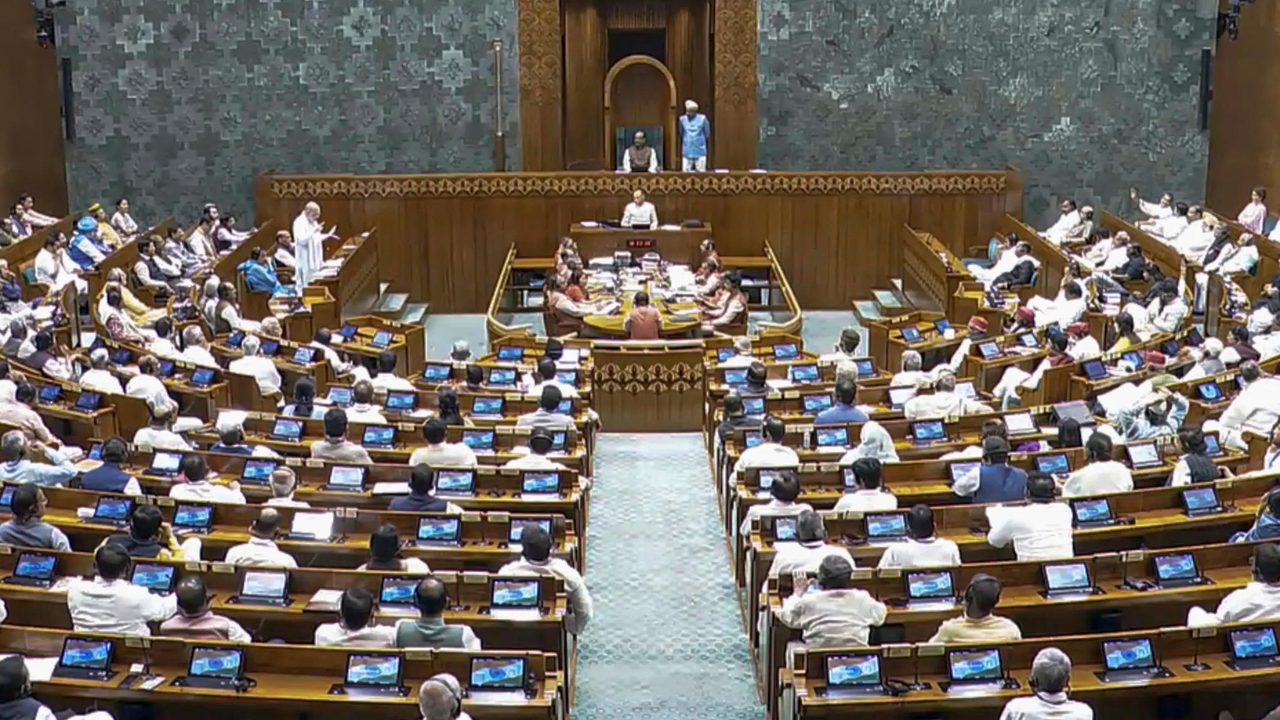
New Delhi: The monsoon session of Parliament, starting on Monday, may give the Narendra Modi government a second chance to pass its delimitation-related flagship women’s reservation bill after it faced defeat on the floor of Parliament for the first time since 2014 during the budget session earlier this year.A lot has changed in the three months since then. The opposition has been hit by electoral defeats, defections and the collapse of key alliances, while the NDA has swelled its numbers – changing the arithmetic ahead of what could be one of the biggest legislative battles of the session.What’s on the agenda?The government has listed a detailed legislative agenda for the monsoon session.Major bills scheduled for consideration or introduction include:
- Foreign Contribution (Regulation) Amendment Bill, 2026
- Developed India Education Foundation Bill
- Income Tax (Amendment) Bill, 2026
- Supreme Court (Number of Judges) Amendment Bill, 2026
- Registration of Births and Deaths (Amendment) Bill, 2026
- Prevention of Insults to National Honor (Amendment) Bill, 2026
- Micro, Small and Medium Enterprises Development (Amendment) Bill, 2026
Among them, the Foreign Contribution (Regulation) Amendment Bill and the Developed India Education Foundation Bill are expected to trigger the most heated political debates.The FCRA amendments aim to strengthen transparency and accountability in the receipt and utilization of foreign funds. However, this has emerged as a politically sensitive issue ahead of the Kerala Assembly elections, with opposition parties alleging that the proposed changes could adversely impact Christian organizations and NGOs receiving foreign contributions.The Developed India Education Foundation Bill, earlier known as the Higher Education Commission of India (HECI) Bill, proposes major changes to India’s higher education regulatory framework by replacing the UGC, AICTE and NCTE with a single regulator, bringing institutions of national importance under its ambit.There has been criticism of the provisions in the law that bind the proposed commission to policy directions issued by the Centre.Apart from these, the government is expected to bring in an Income Tax (Amendment) Bill to replace an ordinance, bring in legislation to increase the approved number of Supreme Court judges from 33 to 37, make amendments to tighten the norms for delay in registration of births and deaths, make changes to the Prevention of Insults to National Honor Act, and modernize the MSME law by strengthening the mechanism for delayed payments, enforcement of arbitral awards and simplifying business rules. Will bring a bill for. opposition playbook Meanwhile, the opposition is expected to corner the government on several political and governance issues. The first sign of a stormy session emerged on Sunday, when the entire opposition staged a symbolic walkout from the all-party meeting convened ahead of the monsoon session. The protest started over the invitation given to rebel TMC MPs and demand for a discussion on alleged Ram Temple donation theft, NEET paper leak and ethanol blending in petrol.On the temple donation embezzlement controversy, opposition parties as well as Congress have indicated that they will raise the issue in both the Houses and demand accountability from the government.However, the Center will maintain that the matter falls under the jurisdiction of the Uttar Pradesh government.Outside Parliament, pressure on the Center continues to mount as the cockroach Janata Party (CJP) has called for a march to Parliament on Monday over alleged NEET irregularities.Protest gained momentum after activist Sonam Wangchuk He was taken to hospital by Delhi Police during his hunger strike, with protesters now demanding resignation of Education Minister Pradhan.The issue is expected to reach Parliament, where opposition parties may put pressure on the government to respond.where parliament left thingsIn the budget session, the government failed to secure the required two-thirds majority to pass the Constitution Amendment Bill.The bill seeks to enable new delimitations to implement the 33 percent women reservation quota in Parliament. It proposed to amend Article 81 to increase the maximum number of members of the Lok Sabha from 550 to 850.However, regional parties in the opposition accused the government of weakening federalism by imposing delimitation through the backdoor.He argued that if the redistribution of Lok Sabha seats was done only on the basis of the 2011 census, the southern states’ share in the House would be reduced, leading to their irrelevance in national politics.However, Prime Minister Narendra Modi said adding 33 per cent more seats for women in the Lok Sabha will not change the existing ratio of seats allocated to states.PM Modi had said in Parliament, “The ratio of seats will not change, the increase will also be in the same proportion.” If you want a guarantee or a promise I will say no. If there is any good word in Tamil then I will use it. When the intention is good then we do not need to play with words.how things changedSoon after the conclusion of the budget session, things turned sour for the opposition faction. The regional components of the India faction had to fight one battle after another.In the assembly elections held in May, the BJP ousted the Trinamool Congress in West Bengal, while the DMK lost to the TVK. Also, Congress replaced the Left government in Kerala.Things didn’t stop falling apart for these parties there. The election results triggered an exodus in the TMC as 20 of its 28 MPs rebelled against party supremo Mamata Banerjee and merged with the previously obscure Nationalist Citizens Party of India – now the second largest constituent of the National Democratic Alliance in the Lok Sabha.Meanwhile, the “iron-clad” alliance between the Congress and the DMK broke down after the fractured mandate in the Tamil Nadu elections. After falling short of the magic number to form the government, Congress supported actor Vijay-led TVK, leading to DMK breaking ties with the India Bloc.To make things worse, Shiv Sena (UBT) faces another vertical split after 2022. Six of its nine MPs decided to jump ship and join rival Eknath Shinde’s faction.return of delimitation billAlthough the government has not listed any new constitutional amendment bill on women’s reservation and delimitation, it is hopeful that it will succeed where it failed in the budget session.With the hurt opposition reduced to where it was three months ago and the NDA’s numbers strengthened, the government is now considering “suitable adjustments” to the bill to garner support from regional opposition parties.How do numbers add up?The Lok Sabha has an effective strength of 540 members, which means that a constitutional amendment bill requires the support of at least 360 MPs to pass it.In April, the bill received 298 votes in favor and 230 against it.NDA currently has the support of 293 MPs. With the support of 20 MPs from NCPI and six MPs from Shiv Sena (UBT), the ruling alliance’s strength has increased to 319.The YSRCP, which has four MPs in the Lok Sabha, has also reiterated its support to the government, taking its tally to 323.YSRCP MP PV Midhun Reddy said, “Our leader YS Jagan Mohan Reddy has clearly said that we will support the Women’s Reservation Bill and the Delimitation Bill. We have already supported it. If these bills are introduced during this session, we will support them.”He said, “As far as other bills are concerned, we will take a decision only after examining their contents. If they are in the interest of our state and its people, we will definitely support them; however, if they are not, we will raise the issue in the House and oppose those bills.”Where NCP, Sena (UBT) and DMK standMeanwhile, opposition parties like NCP (SP), Shiv Sena (UBT) and DMK have indicated that they may support the bill if their concerns are addressed.NCP (SP) working president Supriya Sule said if the delimitation bill proposes a uniform 50 per cent increase in Lok Sabha seats in all states, “there will be no reason to oppose it.” If Sharad Pawar’s party, which has eight MPs, supports the constitutional amendment bill, the NDA-backed tally could increase to 331.Similarly, Shiv Sena (UBT) MP Sanjay Raut said the opposition may reconsider its stand if the government’s proposed amendments address their concerns. “We will oppose the delimitation bill, but if necessary amendments suggested by us are made, the opposition can consider it,” Raut said. This will add three more MPs, taking the total to 334.There is also speculation that after breaking ties with Congress, DMK may support the government with its 22 MPs.DMK leader Tiruchi Siva said the party is in favor of the Women’s Reservation Bill, but wants more clarity on the delimitation issue.“The DMK is in favor of the Women’s Reservation Bill based on the current strength in the Lok Sabha, but we want more clarity on the delimitation issue,” she told reporters after the meeting.Earlier speaking to The Times of India, a senior DMK functionary had said the party was ready for talks if the government guarantees that the interests of Tamil Nadu and other southern states will not be compromised by delimitation and the share of each state is made clear in advance.“The government should explain the concrete stake of each state to rule out any possibility of the southern states losing out and this can be the basis for negotiations,” the official said. He said no formal consultation has taken place with the government yet. If DMK also supports the bill, the number will increase to 356.final hurdleEven if the government succeeds in garnering the support of all the parties currently seen as potential supporters, it will still fall about four votes short of the required two-thirds majority.The remaining number will likely come from cross-voting or absenteeism on polling day. If reports are to be believed, BJP is also trying to encourage cross-voting from opposition parties.According to reports, the party is reaching out to several opposition MPs in the hope of garnering more support than the NDA’s formal numbers.On the other hand, Congress is also contacting various Indian block parties to find out what numbers are left with the opposition alliance after the defection of TMC and Shiv Sena (UBT).Meanwhile, the Center has called an all-party meeting on July 19 ahead of the monsoon session, where opposition parties and other stakeholders are expected to brief them about their legislative agenda and the bills to be introduced during the session.The monsoon session of Parliament will begin on July 20, followed by the NDA parliamentary party meeting on July 21, where PM Modi is expected to address alliance MPs.


