Wednesday, September 30, 2026
Home Blog Page 1137

Danish Iqbal reacts to section of audience calling Dhurandhar 2 propaganda

0
Danish Iqbal reacts to section of audience calling Dhurandhar 2 propaganda


Danish Iqbal reacts to section of audience calling Dhurandhar 2 propaganda

The enigma surrounding Bade Sahab and Dawood Ibrahim`s persona was busted with Danish Iqbal’s appearance in Dhurandhar 2. In conversation with Mid Day, Danish Iqbal opens up about Dhurandhar’s record breaking success and the mystery surrounding Bade Sahab. He also praises Ranveer Singh’s hard work, reacts to the audience calling the film propaganda, and breaks silence on speculation around part 3.

Danish Iqbal on Dhurandhar success

Dhurandhar 2 has shattered all records within a day of release. Reflecting on the love and adulation, Danish Iqbal says, “Dhurandhar has broken all the records, and there are no fake figures. So, if you make good cinema, people will come.”

He underscores that every film has its own space and scale, implying that not all projects need to match Dhurandhar’s magnitude to be successful. He explains, “Every content and every film has its own audience and its own space. Not all films can be Dhurandhar, or of that scale.”

With Aditya Dhar keeping key details under wraps, even the actor was unaware of the two part plan, while the growing buzz and wild fan speculation around Bade Sahab only added to the intrigue. He asserts, “We never knew that it would be in two parts. What I was told was that my character would enter post interval. Most of the plan, Aditya Dhar kept to himself, which was very much required in a film like this, because the script is God in this film.”

He adds, “I initially thought it was just one film and that I would be a part of it. But when the first part released, I realised I would be in part two. Meanwhile, the mention of Bade Sahab created such a buzz. Even I was surprised. There was so much speculation, with people guessing names like Emraan Hashmi, Salman Khan, and many others. Everyone was casting their favourite actor as Bade Sahab.”

Danish on Ranveer Singh

Danish reflects on sharing screen space with some of Bollywood’s most admired actors and the impact it had on him. “I have watched Ranveer Singh on screen for years and have always been a big fan of his work. His energy and charisma are unmatched. Arjun Rampal is such a dashing personality, and Rakesh Bedi is someone we have all grown up watching. I used to wonder if I would ever meet them and hoped I would not feel intimidated.”

He adds, “Ranveer’s energy, focus, dedication, and hunger for good work are evident on set. When you work with him, he ensures the best comes out of every scene.”

Danish on donning prosthetics

Bade Sahab’s striking on screen appearance became one of Dhurandhar’s biggest highlights. It took Danish around 9 to 10 hours to get into the look. He shares, “My call time was usually 4 to 5 hours before everyone else. By the time my makeup was done, I was already feeling half sick. It is a very long and tedious process. You have to stay in that makeup for 16 to 20 hours at times. It is extremely demanding and quite challenging.”

On audience calling Dhurandhar propaganda

While Dhurandhar has been widely praised for its scale and storytelling, a section of the audience has also sparked debate by labelling the film as propaganda. Reacting to such conversations, Danish says, “I do not pay attention to such theories because that is not my job as an actor. My responsibility is to listen to my director, focus on the script, and give my best. People can say what they want, but the audience is enjoying the film. Cinema is made for the audience, and their love is the real success of Dhurandhar. I believe this is the time to celebrate cinema.”

On part 3 speculations

Amid part 2 success, speculations are rife that the film may also have a part 3. Danish Iqbal reveals, “I wish there were 10 Dhurandhar films and I was a part of all of them. But it ultimately depends on what Aditya Dhar decides. I would love for the story to continue with more sequels, but he is not someone who changes his plans due to external pressure. If he wants to make it, he will, and if he does not, he will not. That is the beauty of his filmmaking. He does not get carried away.”


Pinarayi Vijayan says that this time also BJP will not get any benefit

0
Pinarayi Vijayan says that this time also BJP will not get any benefit


Kerala Chief Minister and CPI(M) politburo member Pinarayi Vijayan is leading the Left Democratic Front (LDF) charge in the elections, as the alliance seeks an unprecedented third consecutive term in the state assembly elections on April 9. At 81, he exudes confidence of victory, regrets Congress being the ‘B team of the BJP’ and predicts the BJP will once again get no seats, as he sits for an interview. The Hindu Pinarayi in his constituency, Dharmadam. Edited excerpts:

A large number of outgoing MLAs have been re-nominated by the Left Front. No anti-incumbency wave?

There is no anti-incumbency because people feel that the government has tried to the best of its abilities to implement what the people wanted. Ten years ago, Kerala was in a dilapidated condition, but we brought about a paradigm shift in all sectors. Now, our Vision 2031 outlines achievable goals in each sector to develop Kerala with modern times.

Our youth want the higher education sector to be further strengthened. If in 2016 no institute from Kerala was included in the top 100 institutes at the national level, now eighteen colleges from Kerala are in the list. It is the result of proactive interventions, which demands continuity.

We have promoted research, modern courses and skill development of youth, linked academia with industry. Our industry-friendliness is attracting top players from around the world and all except red industries are welcome. We have an excellent startup ecosystem.

But despite this, the Left has suffered a severe setback in the recent local body elections.

Each election follows a unique pattern. This was a local election and we faced setbacks at some places which does not reflect the public sentiment in the entire state. We are now feeling a favorable environment.

The BJP is pushing the slogan of ‘Develop Kerala’ but the Left accuses the Center of suppressing the state.

While it is now chanting ‘Develop Kerala’, has the Center done anything for the development of Kerala? Despite repeated appeals and great achievements in public healthcare, we have not got AIIMS. When the state was hit by disasters, the Center not only turned its back but also stopped aid from countries that have close ties with Kerala. Has any other state in India been treated so disrespectfully in the event of a disaster? It was just us. Does this not reflect a mentality that wants to see the state destroyed?

The Center sided with those who had opposed the K-Rail project on political grounds to enhance our transport infrastructure.

Was there any help when Wayanad was hit by landslides? Now, when it offers to ‘develop Kerala’, don’t people see the duplicity? They do!

The state has not been given its fair share in taxes and our borrowing limits have been significantly reduced. Isn’t this all a spirit of vengeance?

What is your opinion on BJP’s Christian outreach and the Left’s relationship with the community?

We have good relations with all communities. All sections of Christians together form a large community in the state and have good relations with the government. BJP may make many wishes, but nothing is going to be accomplished and there will be no unity in its favor.

Will SIR affect election results?

Concerns have been raised about SIR in some constituencies, where voter turnout has fallen sharply. But there should be more clarity on this.

How will you stop BJP in its tracks? Who is better prepared to do this, Congress or the Left?

Congress is unable to do this. It also acts as the B-team of BJP at the national level. Only the Left has staunchly opposed the BJP, which it will continue to do even more strongly. And this time also BJP is not likely to get any electoral advantage.

At the national level, a united fight against the BJP is possible, but Congress always thwarts such efforts by spoiling the atmosphere and giving the BJP an edge. Congress leaders including Rahul Gandhi refuse to learn from their mistakes.

What sir? Sudhakaran, Ayesha Potty, S. Rajendran, CC Mukundan, P.K. Are the Left in Kerala on the defensive after Sasi and former MLAs like him joined Congress and BJP? There is rebellion in Kannur also.

It is the greed for position and the loss of values ​​that has driven them all. Despite being well recognized, G. Sudhakaran could not cope with the party’s policy of age-retirement from committees. He betrayed the party, conspired with UDF and is contesting elections.

Same is the condition of others also. It is heard that S. Rajendran also needs the help of BJP to resolve some issues. TK Govindan’s grievance was that no one proposed his candidature in the committee and he chose to become the ax in the hands of the UDF against the CPI(M).

All of them betrayed the party. But we will achieve a massive victory in all the constituencies where they are contesting.

Sudhakaran is in Alappuzha, our most beloved district, in whose soil the memories and traditions of the Punnapra-Vayalar rebellion are deeply rooted. Alappuzha will not be influenced by any misguided person who behaves like himself.

And TK Govindan decided to hide his greed by questioning the candidature of PK Shyamala, who is married to CPI(M) state secretary MV Govindan. Her candidature is most suitable, as she has held many responsibilities in the party and even before her marriage she was a DYFI worker and active party member. It has its own identity.

There are allegations of collapse of the public health sector.

Media houses like yours should investigate why there is sudden uproar over health sector issues. The public health sector in Kerala has grown significantly since 2016, when it was in a state of decline, and this has helped us overcome challenges including the pandemic. We went ahead and got better IMR 5 from US. Even the affluent are now using public health institutions. But multinational monopolies are taking over our private hospitals, increasing health expenditure. The smear campaign against the public health system is for their benefit.

Sabarimala gold theft and government’s arguments in Supreme Court – will it impact the elections?

This is not going to have any impact on us because people have understood its truth. The High Court is monitoring the investigation and has made it clear that there is no outside interference. The investigation is in the right direction and no culprit will be spared.

As far as the presentations are concerned, we answered a bunch of questions with clarity. The issue of women’s entry into the temple was not part of the questions. We reiterate what we said in 2007: that religious scholars, experts and social reformers should be consulted when addressing the question of temple customs and rituals.

Your repeated statements against Jamaat-e-Islami (Hind) are being interpreted as an attack on the Muslim community.

To silence us, an attempt is made to portray us as anti-Hindu when we attack RSS and anti-Muslim when we speak against JEI. We have not and will not continue to speak against both majority and minority communalism. A large section of the majority and minority communities are secular and we stand with them.

Is the loss of livelihood and increase in fuel prices the reason?War in West Asia an election issue?

Any issue that affects people can become an election issue. A large number of people who vote in our state have to travel from abroad to do so. Despite difficulties, they come down and vote. But they are all worried about the emerging situation. Our home kitchens are being affected. There are people who depend on eateries for food and are now facing hardship. Fuel shortage is being felt on a large scale.

If we had implemented the gas pipeline from Iran, we would not have been in this situation. It was the Manmohan Singh led government that closed the project under pressure from the US. This was done during the nuclear deal when it was said that America would give us fuel. Are they giving anything? Still, we are promoting America’s interests.

Was the Global Ayyappa Sangamam a wrong move?

Never. It was the Travancore Devaswom Board that organized the event. Sabarimala is the most important temple managed by the board, and people from all over the world visit this temple. The intention of the board was to bring them all together and highlight it. Was no step taken to organize a parallel Ayyappa Sangamam? It failed miserably. Our Ayyappa Sangamam was a resounding success and attracted a secular community.


Ayushmann Khurrana calls Ranveer Singh ‘lion of Hindi cinema', says he 'can't get over the brilliance' of Dhurandhar 2

0
Ayushmann Khurrana calls Ranveer Singh ‘lion of Hindi cinema', says he 'can't get over the brilliance' of Dhurandhar 2


Bollywood actor Ranveer Singh is currently receiving praise for his performance in Dhurandhar: The Revenge. Many stars like Allu Arjun, Anupam Kher and Mahesh Babu have applauded his act in the film. Now, Ayushmann Khurrana has also praised his performance, calling him the “lion of Hindi cinema”.

Ayushmann Khurrana hails Ranveer Singh's performance in Dhurandhar The Revenge.
Ayushmann Khurrana hails Ranveer Singh’s performance in Dhurandhar The Revenge.

Ayushmann Khurrana reviews Dhurandhar The Revenge

On Sunday, Ayushmann took to Instagram and shared a review of Dhurandhar: The Revenge. He wrote, “It’s been three days, and I can’t get over the brilliance of #Dhurandhar2. We are living in the era of @adityadharfilms. If you think he’s just a master of this particular genre, you’re mistaken coz the beats, the graph, the coolth and the synchronicity between all departments of the film show that he can nail ANY genre. He’s multidimensional of another kind.”

He then praised Ranveer’s performance and wrote, “And my super talented contemporary @ranveersingh is on his GOAT journey. Whatta wholesome crazy performance. He didn’t just become the lion of Lyari but the lion of Hindi cinema. @rampal72 is pure grace and @actormaddy sir is so nuanced. @saraarjunn looked lovely. @duttsanjay sir had his usual swag, @gauravgera was so endearing. @therakeshbedi sir nailed his foxy character. Kudos to @castingchhabra. Well done @shashwatology for such a brill score. Hindi cinema has peaked yet again within 2 months. Congrats @dhar_lokesh #jyotideshpande.”

Anupam Kher also praised Ranveer’s performance and said, “I’m a teacher of acting. For me to really salute somebody, it takes a lot of time and conviction. You are outstanding… Your body language, your simmering anger, understanding your pain… In one or two scenes, your pain is so visible and made me sad. My heart went out to you.” His praise left Ranveer emotional.

About Dhurandhar: The Revenge

Helmed by Aditya Dhar, the film delves into the origin story of Ranveer’s character, Hamza Ali Mazari or Jaskirat Singh Rangi, and shows how he turned into an Indian spy. The film also depicts him climbing the ranks of the political structure in Pakistan’s Lyari while completing his mission to dismantle the terror network.

The film received positive reviews from both audiences and critics, minting ₹145 crore domestically on Day 1. So far, it has crossed the ₹350 crore mark at the domestic box office within just three days and continues to perform strongly.

The film has been performing well not only in India but also worldwide, and has so far collected over ₹500 crore, beating hits like War and Dunki’s lifetime collections.


Rishabh Pant under pressure, LSG captain’s leadership credentials questioned: ‘He will have to do the heavy lifting’

0
Rishabh Pant under pressure, LSG captain’s leadership credentials questioned: ‘He will have to do the heavy lifting’


Lakshmipathy Balaji expects Lucknow Super Giants captain Rishabh Pant will need to step up his game if he intends to take the LSG team deep in the tournament, stating that the southpaw batter will need to be ready for heavy responsibility as the star Indian name in the team.

Lucknow Super Giants' captain Rishabh Pant reacts after their loss in the IPL 2025 match against Sunrisers Hyderabad (AP)
Lucknow Super Giants’ captain Rishabh Pant reacts after their loss in the IPL 2025 match against Sunrisers Hyderabad (AP)

LSG finished the IPL 2025 season in seventh, but were a dangerous and threatening team throughout thanks to the power they held at the top of the batting. The same couldn’t quite be said for captain Pant – he came in with 269 runs in the full season, and extremely disappointing number after he became the most expensive player in IPL history last year, with 118 of those coming in one innings at the end of the tournament.

While the top three for LSG is arguably the best in the tournament, it is the remainder of the batting and bowling which will need to step up – but with no bonafide stars in the middle and lower order, it will come down to Pant, according to Balaji.

“The top order, especially with Marsh, Aiden Markram, and of course Pooran, is stacked. They have given solid starts and out-batted the opposition on multiple occasions last season,” said Balaji, breaking down LSG’s team for JioStar.

“The concerns were the bowling, the captaincy, and the tactical side of the leadership group. They definitely depend heavily on their overseas trio of batters,” he pointed out. Pant did receive plenty of question marks over his captaincy credentials, as he struggled to leave much of a mark as he finds his footing as a leader.

What should LSG’s combination be?

The big concern for LSG will be that exposed middle order, particularly after losing the experience of David Miller: suddenly, Pant is the senior figure in that group.

“You have the likes of Badoni, Abdul Samad, and Shahbaz Ahmed, all of whom can chip in. But the top order and Rishabh Pant will have to do the heavy lifting,” said Balaji.

Lower down the order, the former fast bowler expected the three overseas batters to necessitate the use of an overseas bowling star. With Wanindu Hasaranga in the team, it is a question that the LSG think-tank must ponder, regarding whether an all-Indian unit led by Mohammed Shami would succeed. But there are options at their disposal.

“On the overseas combination, normally I would pick three batters, so the first-choice players, Marsh, Markram, and Pooran, walk in. Then, you need to strengthen the bowling attack with one overseas fast bowler, as we are still unsure whether Hasaranga will be fully fit or not. If not, Anrich Nortje would be my choice as the fourth overseas player,” concluded the IPL great.


‘Risk of escalation is extremely high as Iran shows it can retaliate’ | Donald Trump News

0
‘Risk of escalation is extremely high as Iran shows it can retaliate’ | Donald Trump News


Military analyst Elijah Magnier says the risk of escalation is extremely high as Iran responds to US and Israeli strikes on nuclear and energy facilities in a growing cycle of retaliation.


Organisational changes are being made to reach every part of India, says Sunil Ambekar of RSS

0
Organisational changes are being made to reach every part of India, says Sunil Ambekar of RSS


From defending BJP ruled State’s restrictions on Namaz on roads to supporting the idea of allowing only Hindus to enter the Char Dham temples, RSS national publicity in-charge Sunil Ambekar in an exclusive interview to Ishita Mishra spoke at length on topics like demographic change and population imbalance and Gen Z protest in Nepal and Bangladesh. He also defended Narendra Modi’s government on ongoing West Asia conflict and appointment of Naitin Anbin as BJP chief.

It’s been 100 years since the RSS was founded in 1925. How does the Sangh define its core ideology, and how has it changed over these 100 years?

The founding vision of the Sangh was clear from the very beginning: to guide the nation toward a state of the highest prosperity and glory. The most essential requirement to achieve this goal is having unity among Hindus and unity within society as a whole. For this purpose, individuals fully dedicated to this mission were needed. With such people and these objectives in mind, the work of the Sangh began.

The core idea has always been that this is a Hindu nation, where Hindutva is understood as a way of life. This way of life is not opposed to anyone, nor is it meant to eliminate or harm others; rather, it is intended for the welfare of all. Therefore, its establishment is beneficial not only for India but for the entire world and all of humanity. It was with this pure and selfless spirit that the Rashtriya Swayamsevak Sangh was founded.

This foundational thought has remained unchanged over time. However, as time, circumstances, and societal needs evolve, and as the number of workers grows, the Sangh engages with a wider range of issues. While doing so, it continues to express its ideas based on its original principles. The nation remains supreme in its thinking, and this reflects in its approach to national security, development, and unity. The core vision remains consistent and continues to guide its path.

So far, how many people have joined the Sangh Parivar in India?

In terms of shakhas, we currently have around 88,000 daily shakhas running across the country. Each shakha connects with many individuals—some have around 100 participants, others 200 or more. So overall, the number of people associated with the Sangh runs into several lakhs.

As the Sangh completes 100 years, is it planning any new expansion strategy? Was any such decision taken in your Akhil Bharatiya Samanvay Baithak held in Samalakha?

The number of shakhas has been steadily increasing, and the organisation continues to expand at a consistent pace. To manage this growth, we are working on strengthening and restructuring the organisation. Earlier, we had around 46 provincial (prant) units. Now, we are introducing an additional layer below that—the divisional (sambhag) level—to make the structure more decentralized. This will help us effectively address the growing needs of expansion. We have already reached villages, tehsils, mandals, and grassroots levels, and our goal is to reach every part of India. These organisational changes are being made to support that objective. People from all walks of life are joining us, and we aim to collaborate with all such individuals. This presents both a challenge and an opportunity. By working together with society, we hope to take up new initiatives and expand our work further.

In the coming years, will we see more offshoots of the Sangh or like-minded organisations?

I cant say this with certainty. However, as new needs arise in different areas of work, new systems, organisations, and institutions will naturally emerge. At the same time, the institutions that are already functioning will continue to expand and incorporate new dimensions into their work.

The relationship between the Sangh and the BJP is often discussed. The BJP has recently chosen Nitin Nabin as its party president after a long wait. It is being said that Mr. Nabin has not had any direct association with the Sangh or its affiliated organisations. How do you see this?

As far as I know, his family has had some connection with the Sangh. Beyond that, he has been working within the political sphere, specifically with the BJP, for many years. He is a long-time and experienced party worker.

But wouldn’t this create an ideological gap? For example, someone trained in the Sangh’s ideology versus someone who has only grown within the party?

I believe that Sangh volunteers work across all spheres of society and contribute to various organisations, often playing important roles in running them. In the BJP as well, there are many such volunteers who hold significant and decision-making positions. They understand the Sangh’s ideas just as well as we do and have similar experience. So, I believe he they will continue to take their organisation forward effectively.

So because already so many Sangh volunteers are part of the BJP, is this the reason why the RSS has not been providing organisational general secretaries to the party in several states for a long time?

No, that is more of a situational matter. Decisions depend on immediate needs, local circumstances, and the availability of individuals. Leave BJP, there are many other organisations as well where we are currently unable to provide workers despite the need—for example, Saksham, which works for persons with disabilities. Many organisations working in the field of women’s welfare are also waiting. As more organisations are formed, the demand for dedicated workers continues to grow.

The Sangh has been vocal about issues like population imbalance, demographic change, and cross-border infiltration. How do you see these as concerns in present Indian society?

Going to another country for work through legal means is normal and acceptable, but illegal infiltration is not.
In any country, a large influx of illegal migrants becomes a matter of concern for national security and social unity. India is a democratic nation, and illegal entry does not only cause economic strain but also affects the democratic system by allowing unlawful participation. This raises questions about the country’s unity, security, and integrity. Given India’s historical background—especially the Partition in 1947—this issue becomes even more sensitive. It is the responsibility of every citizen to ensure that such a situation never arises again. The Partition itself is often linked to demographic imbalances, and this concern is not limited to the Sangh; it is shared by many citizens across the country. Sangh workers, who regularly engage with people at the grassroots level, often hear these concerns directly from society. When such concerns arise, the Sangh raises them openly. While some may avoid speaking on these issues due to political interests or pressures, the Sangh considers them a priority and addresses them. Its volunteers also try to raise awareness through constitutional and lawful means and work toward solutions.

How does the Sangh create awareness among people on issues like cross-border infiltration and demographic change?

Most illegal infiltration in India is from Bangladesh. There is data available on these issues. We reach out to people in regions where this is happening the most and spread awareness. Whenever senior leaders, including the Sarsanghchalak (Mohan Bhagwat), speak at public platforms, they highlight these concerns to society. Awareness is spread through campaigns and direct interaction with communities. I would also say that platforms like yours can play an important role in creating public awareness and contributing to informed discussion on these issues.

Are there any States where you feel cross-border infiltration and demographic imbalance are increasing?

States like Assam, West Bengal, Bihar, and Jharkhand are particularly affected. In general, regions that share international borders tend to face this issue more. In some cases, even places like the Andaman Islands have reported instances of illegal infiltration. A positive development is that institutions such as the Election Commission and administrative authorities are now taking action at various levels, and such cases are increasingly being identified and addressed.

When the Sangh says that this is a Hindu nation and that all people living here are Hindu, then how does the issue of demographic imbalance arise if everyone belongs to the same broader identity?

In our country, there are many people who see themselves as connected to its traditions, unity, integrity, and heritage. As has been said by the Sarsanghchalak, people share common DNA (ancestry) and a shared historical and cultural background. For those who recognize this, even if their mode of worship changes, their connection to the nation does not change. However, there have also been instances where changes in religious identity led some to feel that they no longer belonged to this nation and instead identified with another. This mindset contributed to events like the Partition. Similar situations have occurred in other parts of the world as well—for example, Lebanon. RSS is working on ground to make people understand that they all belong to Hindu Rashtra and have same history and DNA but at the same time, it is equally important to ensure that until everyone understands this, no section of society acts in a way that harms the unity and integrity of the nation. Both these efforts—awareness and outreach—need to continue side by side.

In today’s context, how does the Sangh view SIR, CAA, and NRC? How can these help in preserving the country’s culture?

I believe these are essentially constitutional and administrative processes. For example, exercises like SIR are not happening for the first time—they have been conducted earlier as well. Such measures are generally seen as being in the national interest. If someone is found to be an illegal entrant, then appropriate legal action should follow—it is a straightforward matter, not something overly complicated. At the same time, if someone feels their name has been wrongly excluded, there are provisions to reapply and seek correction. The system provides mechanisms for review and rectification.

What is the Sangh’s view on the ongoing war in West Asia?

This is an international issue. As a nation, India’s official stance and policies are determined by the Government of India. In such situations, it is important that all sections of society—including opposition parties—set aside differences and stand together in the national interest, keeping the country’s priorities above all else. The Sangh’s approach is aligned with this broader national perspective. It is believed that any conflict should be guided by truth and the welfare of people, not by selfish interests. Ideally, the world should move away from war and toward peace. India, in its approach, appears to be moving in that direction.

How does the Sangh view the Gen Z–led movements happening in neighboring countries like Nepal and Bangladesh? Why do you think India seems unaffected?

What is happening in Bangladesh or Nepal is largely an internal matter of those countries. In a democracy, people have the right to express dissatisfaction with their governments and organise movements if they feel the need. That is what we are seeing there. In India’s case, the youth are highly aspirational. They are focused on taking the country forward and contributing to its growth. There is also a sense among many that the government is working in alignment with their aspirations. Indian youth have strong faith in the Constitution and prefer to bring change within its framework.

Historically too, whenever the country has faced challenges, young people have stepped forward—whether during the freedom movement, the Emergency, or public movements around issues like corruption and women’s safety. They have largely used democratic and peaceful means to express themselves. Today, much of the younger generation is channeling its energy into areas like technology, AI, startups, and innovation, with the aim of strengthening India’s global position. They are also thinking about governance, law and order, and long-term national development. Overall, today’s youth appear more optimistic about India’s potential compared to earlier generations, and many also feel a strong connection to their cultural and value systems.

When you speak about unity in diversity and youth enthusiasm, how do incidents—such as restrictions on offering namaz in certain places or controversies around religious practices—impact young people?

I think even Muslim majority countries have rules about where namaz can be offered. It’s usually not allowed to pray on roads there. From what I’ve seen and understood—for example, if you go to Dubai—you’ll notice that people don’t pray on the streets. They go to designated places for namaz. So, I feel this is not really a religious issue, but more about maintaining discipline in society. It should be seen in that way—discipline should be maintained. Every religious group arranges proper places for their followers, and those places are meant for worship.

In a democracy, if people don’t like a certain arrangement, they can speak up. There are simple ways to do that, like through media or public discussion. Overall, I think this is a broader issue involving the government, society, and communities. The government makes rules based on law and order, and people also express their views on it. In many countries, including some Muslim-majority nations, there are designated places for offering prayers, and public spaces like roads are generally not used for that purpose. From this perspective, such issues can be seen less as religious matters and more as questions of public order and discipline. The idea is that arrangements should be made so that people can practice their faith in an organised manner without disrupting public life. These are broader societal issues involving government, communities, and different sections of society. Governments may take decisions based on law and order considerations, while people are free to express their views.

But don’t such incidents affect social unity?

These situations should not necessarily be seen as threats to unity. They are better understood in the context of maintaining public discipline and order. Dialogue remains important—if concerns are raised, discussions can take place with all stakeholders. So far, such issues have not prominently come up in our direct interactions, but if they do, they can always be addressed through conversation and mutual understanding.



Vedanta moves NCLAT, challenges NCLT nod to Adani’s bid for acquiring Jaiprakash Associates

0
Vedanta moves NCLAT, challenges NCLT nod to Adani’s bid for acquiring Jaiprakash Associates


Vedanta moves NCLAT, challenges NCLT nod to Adani's bid for acquiring Jaiprakash Associates

Business conglomerate Vedanta Group has approached the National Company Law Appellate Tribunal (NCLAT), challenging the NCLT’s approval to Adani Group‘s bid for acquiring Jaiprakash Associates Ltd for Rs 14,535 crore. Anil Agarwal-led Vedanta Group was in the race to acquire Jaiprakash Associates Ltd (JAL) through an insolvency process, but the lenders in November last year approved the resolution plan or bid of Adani Enterprises Ltd. On March 17, the National Company Law Tribunal (NCLT), Allahabad bench, approved Adani Enterprises Ltd’s Rs 14,535 crore bid to acquire Jaiprakash Associates Ltd (JAL) through the insolvency process. In a regulatory filing, JAL had informed that the NCLT, Allahabad bench, has “orally pronounced an order on March 17, 2026” approving the resolution plan submitted by Adani Enterprises Ltd. Now, mining giant Vadanta has filed an appeal against the said NCLT order before the appellate insolvency tribunal NCLAT. The matter is listed for hearing on Monday before a two-member bench comprising Chairperson Justice Ashok Bhushan and Member (Technical) Barun Mitra. In November last year, a Committee of Creditors (CoC) approved the resolution plan by business tycoon Gautam Adani to acquire JAL. Adani Enterprises had outbid Vedanta and Dalmia Bharat to win the bid for JAL. Adani got the maximum 89 per cent votes from creditors, followed by Dalmia Cement (Bharat) and Vedanta Group. The committee of creditors (CoC), however, defended their decision, saying the process complied with all insolvency and Bankruptcy Code (IBC) rules. They maintained that no bidder has a guaranteed right to win, even if it offers the highest value. They said plans were evaluated on multiple factors, including upfront cash, feasibility, and execution, not just headline value. Adani’s bid was preferred as it offered around Rs 6,000 crore upfront and faster payments within two years, compared with Vedanta’s longer payment timeline of up to five years. Lenders also rejected Vedanta’s revised offer, saying it was submitted after bidding had closed and accepting it would require restarting the process. They added that all bidders were given equal opportunity and multiple chances to improve their bids. JAL, which has high-quality assets and business interests spanning real estate, cement manufacturing, hospitality, power and engineering & construction, was admitted to the CIRP in June 2024 after it defaulted on payments of loans aggregating Rs 57,185 crore. JAL has major real estate projects like Jaypee Greens in Greater Noida, a part of Jaypee Greens Wishtown in Noida (both on the outskirts of the national capital), and the Jaypee International Sports City, located near the upcoming Jewar International Airport. It also has three commercial/industrial office spaces in Delhi-NCR, while its hotel division has five properties in Delhi-NCR, Mussoorie, and Agra. JAL has four cement plants in Madhya Pradesh and Uttar Pradesh, and a few leased limestone mines in Madhya Pradesh. It also has investments in subsidiaries, including Jaiprakash Power Ventures Ltd, Yamuna Expressway Tolling Ltd, Jaypee Infrastructure Development Ltd, and several other companies.


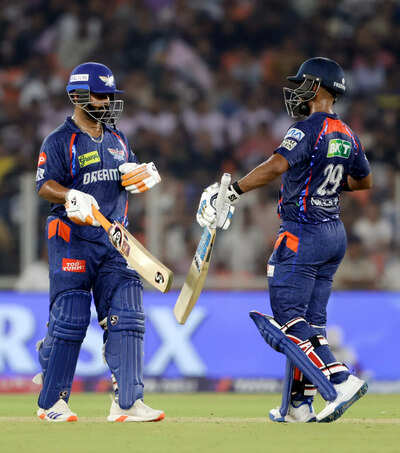
LSG’s big call for IPL 2026: Rishabh Pant to bat no.3, Pooran pushed down? | Cricket News

0
LSG’s big call for IPL 2026: Rishabh Pant to bat no.3, Pooran pushed down? | Cricket News


LSG's big call for IPL 2026: Rishabh Pant to bat no.3, Pooran pushed down?
Rishabh Pant and Nicholas Pooran (ANI Photo)

Lucknow Super Giants captain Rishabh Pant is set to bat at number three in a potentially make or break IPL season beginning on March 28. Stakes are high for Pant going into second season as LSG skipper with the franchise having shelled out a record Rs 27 crore for his services at the 2025 mega auction.Following the disappointment of last year, a successful season as a leader as well as a top-order batter can make him part of India’s T20 plans going forward. Across formats, Pant is only an integral member of the Indian Test side while being a back up wicket-keeper to K L Rahul in ODIs.

Watch

Ajit Agarkar knocks BCCI door, makes a huge extension request | World Cup

Fight for India T20 Comeback

The 28-year-old lost his place in the T20 side following India’s World Cup triumph in 2024 and would need to do something special to make a comeback considering Sanju Samson and Ishan Kishan have made themselves automatic picks by the sheer weight of their recent performances.Therefore, the upcoming IPL is not just about delivering on a exorbitant price tag, it is also about staying relevant in the shortest format.Pant majorly batted at number four last season before rightly pushing himself to number three towards the end of the season by when it was too late to turn LSG’s fortunes. Nicholas Pooran will move down the order to make way for Pant with number four, five, six being used as floating positions.The squad had a camp in Chennai and at the moment, they are going through the paces at their home ground in Lucknow ahead of their opener against Delhi Capitals on April 1. The Justin Langer-led support staff and Pant are on the same page when it comes to their leader’s batting position.“It is clear to the team management as well as Pant that his game is best suited for number three. This season the top-order is locked in with Aiden, Marsh and Pant. The middle-order is flexible and players will be floated as per the game situation,” an IPL source told PTI.

Flexible Middle Order Setup

Pant batted at an underwhelming strike rate of 133.17 last year and 118 not out of his 269 runs came only in one innings. The LSG middle-order comprises Pooran, Ayush Badoni, Abdul Samad and Shabaz Ahmed.Bowling was LSG’s weakest link last season with pacers including Mayank Yadav and Mohsin Khan not available due to injuries. The other pace options include Avesh Khan and Anrich Nortje, who is another injury prone quick.“The batting is settled. The bowling group looks a lot better than last year but combinations are yet to be worked. Mayank is fit but needs to bowl a lot more in the nets. Hopefully he will repay the faith the team has shown him over the past four to five years,” the source added.

Banner Insert


'Dhurandhar 2' actor Mustafa started with Rs 10,000 a month as a gym trainer

0
'Dhurandhar 2' actor Mustafa started with Rs 10,000 a month as a gym trainer


'Dhurandhar 2' actor Mustafa Ahmed who played Hamza's aide Rizwan, started his journey with Rs 10,000 a month as a gym trainer

Celebrity trainer turned actor Mustafa Ahmed got a lot of love for his role in ‘Dhurandhar 2’. He played Rizwan, Hamza’s trusted aide in the film. But his journey to the spotlight has been anything but easy. Years ago, he was earning just Rs 10,000 a month as a gym trainer in Delhi’s Janakpuri. Nearly 15 years later, he would go on to train none other than Hrithik Roshan.Mustafa’s path was far from conventional. He wasn’t someone people expected to “make it big.” Much like the protagonist in Taare Zameen Par, he struggled with dyslexia and eventually dropped out of formal education.

Watch

From Protests To Bans, Dhurandhar 2 Becomes Bollywood’s Biggest Off-Screen Drama

Speaking on the Jag Of All Trades podcast, Mustafa Ahmed recalled, “I was not a bright kid. I was dyslexic and come from an Afghani background. But I was always physical—I was good at sports, picked up dancing naturally. Anything that involved using my body, I was good at it.”At just 21, he was already earning Rs 1 lakh a month as the youngest team leader at a call centre in 2001—a dream job for many. But a seemingly small moment ended up changing his life completely. While working out at a gym in Janakpuri, he noticed a woman in her 40s being ignored by a trainer. He stepped in to help her, unaware of how pivotal that moment would become.On the Alpha Coach podcast, he shared, “A couple of months later, she handed me an envelope and asked me to read it at home. It scared me. But in that letter, she wrote that working out had brought the spark back into her marriage. She told me this was my life calling—and not following it would be criminal.”That message stayed with him. Soon after, Mustafa made the bold decision to quit his high-paying job. “My manager called me crazy,” he said. His mother, too, stopped speaking to him after he left a stable career, especially given that he had already stepped away from academics.Starting from scratch, he took up a job at a West Delhi gym for Rs 10,000 a month, waking up at 4 am daily to open the shutters. Around the same time, a visit to Fitness First in Connaught Place became another turning point. Despite lacking formal qualifications, his honesty and passion earned him a job.“They offered me Rs 18,000 plus Rs 600 per session out of which, they kept Rs 300 and gave me the other Rs 300. I couldn’t believe people would pay me that for an hour. That’s when I felt—sky is the limit,” he said.What followed was sheer grit and consistency. Within three months, Mustafa became the No. 1 trainer for Fitness First in Asia. He was conducting up to 14 sessions a day, six days a week—clocking nearly 400 hours a month and earning over Rs 1.4 lakh. By 2009, he had firmly established himself.As his career progressed, so did his vision. Seeing international trainers dominate the Indian fitness space, Mustafa questioned why Indian trainers weren’t given the same recognition. “I believed I was at par with them. So why not me?” he said.Before the release of Dhurandhar, Mustafa had penned an emotional note for Aditya Dhar in 2025: “‘Main hoon na. Tu kar.’ He would say this whenever I doubted myself. ‘Tu theek hai na’ when I wasn’t okay. ‘Tu khush hai na’ when I got emotional.” Reflecting on his acting debut, he added, “Aditya Dhar, you took me on a journey I never imagined. You saw in me what I didn’t know existed. But most importantly, you gave me your friendship and love—and for that, you have my loyalty for life.”


India to play T20Is against Ireland on June 26 and June 28: BCCI

0
India to play T20Is against Ireland on June 26 and June 28: BCCI


India to play T20Is against Ireland on June 26 and June 28: BCCI

Reigning world champions India will play two T20 Internationals in Ireland on June 26 and June 28 respectively, the BCCI said on Saturday about the games that will precede their white-ball assignment in England.

Both match will be held at Belfast, where the Indian team will play for the first time since 2007.

“Team India (Senior Men) will travel to Ireland for a two-match T20I series in June 2026. Having toured Ireland three times in the past eight years (2018, 2022 and 2023). This tour will mark India`s return to Belfast for the first time since 2007,” BCCI secretary Devajit Saikia said in a statement.

The BCCI statement comes two days after Ireland`s director of high performance Graham West confirmed the series while announcing Paul Stirling`s decision to step down as their T20I captain.

India, who host Afghanistan for a one-off Test and a three-match ODI series ending on June 20, will travel to England for five T20Is and three ODIs from July 1-19.

India have toured Ireland three times in the past seven years, drawing strong crowds at Malahide on the outskirts of Dublin.

West had said on Thursday the India series is part of their plans for the upcoming summer.

“With qualification secured for the T20 World Cup in 2028, Paul`s (Stirling) decision to stand down as T20 captain provides the opportunity for the new captain to begin implementing their style and methodology, starting with the India series in June,” West had said.

This story has been sourced from a third party syndicated feed, agencies. Mid-day accepts no responsibility or liability for its dependability, trustworthiness, reliability and data of the text. Mid-day management/mid-day.com reserves the sole right to alter, delete or remove (without notice) the content in its absolute discretion for any reason whatsoever.