As tensions escalate across West Asia, Gulf Cooperation Council nations possess significant military capabilities to respond to Iranian attacks. According to a military analysis, Iran has launched thousands of ballistic missiles, cruise missiles and drone attacks against Saudi Arabia, the UAE, Qatar, Kuwait, Bahrain and Oman over 16 days. Despite having capable militaries, these countries have not responded yet, possibly due to US pressure. Key weapon systems available for potential retaliation include the Storm Shadow cruise missile in the inventories of Saudi Arabia, UAE and Qatar, with a range of 550 kilometres. Bahrain possesses the Army Tactical Missile System (ATACMS) ballistic missile with a 350-kilometre range. Saudi Arabia operates the Chinese Wing Loong UCAV drone with 30-hour endurance and the Chinese-made Dong Feng 21 ballistic missile with over 2,500-kilometre range, making it the only GCC country with such long-range ballistic capability. These systems could target Iranian infrastructure if these nations decide to retaliate.
Jayasurya’s ‘Aadu 3’ is experiencing a positive box office run, with a notable increase in collections on its second day. The film has grossed over Rs 14 crore, driven by improved audience occupancy. Introducing a time-travel plot with dual roles for Jayasurya, the movie garners mixed reviews, praising its music and some comedic moments while critiquing forced humor.
Jayasurya starrer ‘Aadu 3’ is showing a steady upward trend at the box office. The film has recorded a slight but important jump on its second day.According to Sacnilk, the film collected Rs 6.20 crore on Day 2 and this marks a 4.2 percent increase compared to its Day 1 collection of Rs 5.95 crore.
Collections cross Rs 14 crore gross
Reports say that the film’s net collection now stands at Rs 12.15 crore. Meanwhile the gross collection has crossed Rs 14.03 crore.While the opening day numbers were moderate, the Day 2 growth gives the film some stability. Overall, the movie seems to be doing a decent box office performance and all eyes are on the weekend collections.
Occupancy shows strong improvement
On Day 1 the film recorded an occupancy of 67.0 percent. This increased to 74.0 percent on Day 2. Even though the number of shows slightly reduced from 1,803 to 1,784, the improved occupancy shows better audience turnout.
Time-travel plot expands franchise
Directed by Midhun Manuel Thomas, ‘Aadu 3’ takes a new narrative approach as the film introduces a time-travel element along with multiple timelines.The story follows Shaji Pappan and his team in another chaotic chase. This time, the plot moves between the familiar Aadu universe and a timeline set in the 1700s.Jayasurya plays dual roles, appearing both as Shaji Pappan and as Padmanabha Thamburan, a local king. Vinayakan plays Azam Khan in the alternate timeline, while Sunny Wayne appears as a British officer. The film also features Vijay Babu in a key role.
Mixed reviews
ETimes rated it 2.5 out of 5 stars and noted, “The main timeline follows the familiar Aadu universe, while the other major timeline dates back to the 1700s. The transitions between the timelines are handled well, but there is a noticeable lack of excitement until the very last moment.”The review further adds, “The time-travel concept, while intriguing, only serves as a teaser towards the latter part, hinting at a more exciting continuation. However, that doesn’t help this part stay afloat.”At the same time, it highlights some positives: “The songs by Shaan Rahman and the background score by Dawn Vincent work well, and there are a few comic dialogues and moments—like the High Range Che Guevara reference—that make you laugh heartily.”However, the criticism remains clear: “The supposed comedy, unfortunately, feels forced in places, and there is little spontaneity or organic humor in situations that are meant to be funny.”DISCLAIMER: The box office numbers and the data in this article are compiled from diverse public and industry sources. All figures are approximate unless explicitly mentioned, offering a fair representation of the movie’s box office performance. These totals may change as official studio data is updated or as additional international market reports are finalized. This data is provided by us for informational and entertainment purposes only.
How an engineer’s innovative gun made plastic surgeons’ jobs easier
Pune: Pacify Medical Technologies was born out of a need to address a gap in the Indian dermatology spectrum. Wounds, whether big or small, leave scars. While superficial acne such as those caused by acne can be faded by applying specific creams or lotions, deeper and larger acne such as those caused by burns shrink the skin and leave permanent scars unless they are treated with advanced medical care such as skin grafting.
But, the problem here is in pre-Covid ears. There was a shortage of good quality skin grafts in the Indian market and dermatologists, cosmetologists and plastic surgeons raised concerns that the few existing options were not good enough.
When engineer Saiprasad Poyarekar heard this, the entrepreneur in him saw an opportunity. And the keen observer in him studied the market deeply and came up with a solution. But, first, he founded a company called ‘Pacifi Medical Technologies’ where he would nurture the idea planted in his mind until it came to fruition and fruition.
background check
Poyarekar is a mechanical engineer and has worked for some time as a Project Research Assistant in the Biomedical Engineering and Technology Innovation Center (BETIC) lab at COEP Technological University in Pune – experiences and training that would come in handy in shaping his idea.
In his own words: “My journey began at the intersection of clinical insight and engineering in Pune. When I was a research student
Under the leadership of Dr. Sandeep Anasane, Assistant at BETIC-COEP, we collaborated with Dr. Nikhil Panse, Plastic Surgeon, Sassoon General Hospital, to understand the ground reality of the surgery theatre. This gave me an insight into what a surgeon looks for. So, I didn’t want to just make a tool; “I wanted to solve the problems surgeons face.”
market study
Knowing where to start made it easier for Poyrekar to study the market carefully. Soon they realized that in India, the prevalence rate of people requiring skin grafts for major wounds such as trauma, burns, chronic wounds including diabetic ulcers is 15.03 per 1000. Such wounds are treated with skin grafts often harvested from the patient’s own healthy skin area or from a donor site. Although it may seem simple enough, this specific solution comes with its own set of problems.
Obtaining skin tissue from the patient or donor is performed through a surgical procedure in an operating room under anesthesia, which creates a secondary wound at the donor site and also increases the cost of wound care. Although this was a challenge that the medical world dealt with in its own way, it was still a problem.
Poyarekar began to look into this more closely by visiting hospitals and meeting doctors to hear their views.
“I realized that there was a problem with the amount of skin tissue required for larger wounds. For example, a 20 square cm wound required the same amount of healthy skin tissue, often taken from the patient’s own healthy skin because it was very difficult for doctors to obtain skin tissue of such a large size from a donor,” he explained. “Then, the standard of care for extensive wounds such as severe burns or trauma often faces a ‘healthy skin crisis’. When a patient has a large wound but very little healthy skin left to harvest for a graft, traditional methods such as ‘meshing’ reach their limits. This leads to delayed healing, higher infection risks and longer hospital stays.”
engineering a solution
Poyrekar took an engineering approach to the problem. If the same route was not working, he had to look for a different route.
“So I thought, what if skin tissue was used in liquid form? But, then, I realized that the liquid wouldn’t stay on the wound; it would find its way out because of its flowing property, and the human body is cylindrical. This just wasn’t going to work!” He said while remembering that time.
Poyrekar then thought of using the concepts of fluid dynamics that he had learned during his mechanical engineering days.
What if he could cut the liquid into droplets and then use a gas medium to spray it to cover a larger surface? But, what should be the dimensions of the skin tissue used? These and many other questions began to bother him.
He said: “Normally, they use skin tissue that is the same size as the lesion. But I considered what the size might be
Reduced.”
closing the gap
Poyrekar had witnessed many skin grafting surgeries firsthand and knew how the wound heals – the process it goes through.
He said, “I realized one important thing. The wound heals from the outer rim to the center. Healing starts at the ‘border’ and then moves inwards. The border is the decision maker. So I thought, what if I divided the skin into more parts so that each part got its own border from which healing would begin. The higher the borders, the larger area the skin tissue would cover.” That was the viola moment! Cutting the skin tissue to uniform size helped increase the efficiency of skin grafting.
“When I saw this, I applied for a provisional patent in 2017. If you take a 5-sq cm skin graft, it will give you 5×5 cm i.e. 25 sq cm. But, if you divide the same 5-sq cm skin graft into five parts, you will be able to cover 225 sq cm because each ‘cut’ part will start healing from the border giving a much larger coverage,” Poyrekar said, still excited. Her eyes are shining as she remembers that moment of truth.
solution in a spray
Poyarekar calls it precision farming in the human body. He explained: “We take a small sample of the patient’s skin, process it in a tissue-rich solution, and use our proprietary spray system to distribute it evenly across the wound. The science is that each droplet contains microscopic seeds of skin tissue, and the result is that when the droplets are spread evenly, the skin regenerates from thousands of points simultaneously, covering large areas with minimal donor tissue. Human skin can regrow. These particles act like ‘seeds’, which help new skin grow naturally over time.”
But, how does one seat the skin tissue where it is needed? “When you pour oil on water, it will float on top because water and oil have different densities. So before spraying, I matched the density of the tissue solution with the density of body fluids to make sure the solution didn’t separate,” Poyrekar said.
tests
Since it was a medical innovation, it had to go through many tests. Dr. Nikhil Panse and Dr. Vineeta Puri of KEM Hospital, Mumbai performed the first graft on cadavers. Poyrekar said, “Doctors often use cadaver skin to cover the wound like a Band-Aid, so that no infection occurs. The cadaver skin trial lasted about a year. The initial clinical feedback from surgeons was consistently positive, leading me to believe that this approach could improve outcomes.”
However, not everything went smoothly. There were many usability issues such as how to hold the spray gun (as this was something new to doctors) and how to control the force of the spray.
wait for the pandemic
But, before Poyrekar could resolve these issues, the pandemic arrived with a bang, causing chaos and stagnation.
Post-Covid, Poyrekar started human trials after obtaining necessary regulatory approvals.
“You have to do this in NABL laboratories, where each test is repeated 80 times. After that, the plastic surgeon with the pharmacology department, in consultation with our company, will write the protocol, which will then have to be approved by the Ethics Committee. And finally, only after we get insurance for the patient, the human trial begins,” Poyrekar explained, emphasizing how this was a tricky path to navigate.
human trials
In 2024, the company conducted its first human trials at KMC Manipal under Dr. Joseph Thomas.
“This was a male patient who was an accident victim. The response was positive. After thirty more trials, it was published at the Asia Pacific Burns Conference. The spray gun technology using shredded skin tissue particles in liquid form was working!” Poyarekar said, remembering that decisive moment.
raise money
They had to pay the price of this project ₹Rs 3 crore till now. In the initial phase, grants and CSR funds helped them accelerate their plans. Later, he was able to raise more funds from the market which helped in mitigating the early stage risks. Currently, it is on the verge of closing another round of funding to build the sales engine and clinical data repository.
How much? Pat replied: “I can’t disclose the amount at this time.” “But”, he added, “Sine IITB played a vital role in supporting us during the development phase. We are moving from validation to commercialization. Our initial clinical feedback from surgeons has been encouraging for us, confirming that the device is not only technically robust, but also practical.”
Best in OT environment. Therefore, we have received purchase orders from some government hospitals in Maharashtra.
The Indian Council of Medical Research (ICMR) is also helping them advance their technology with real-world clinical evidence generation. “I want this to be a part of the National Health Mission,” Poyarekar said.
It also provides this technology to the armed forces “at nominal charges”. He said he charges normal rates from private hospitals which barely cover his operating expenses.
looking ahead
But, they hope to be out of losses even in three years. “To be profitable, I will need to scale it up. The aim is to make this technology affordable so that one can use it in minor OTs under local anaesthesia. If we can go to that stage, it can also go to smaller towns where there are no tertiary care services,” Poyarekar said.
There are many plans, but currently they are looking for a co-founder with surgical commercialization experience who can help lead the way.
The next chapter in marketing and scale-up.
He reasoned: “Having a co-founder taking care of marketing would free me to focus more deeply on the technology.”
Competition
As far as competition is concerned, Poyrekar said there are many players in the market who are using different technologies. “They are much like petrol and diesel engines – some use artificial skin, some use skin or collagen substitutes derived from animals or plants. But, there are no big players. Most are still in the experimental stage. So, we have to compete with our technology,” he quipped.
expansion plans
Poyarekar first wants Pacify Medical Technologies to reach across India. “Once this is completed, we will approach regulatory bodies abroad, starting with the European Union (EU), and seek our services there as well,” he said.
It seems the sky is no limit for Pacifi, as its creator doesn’t believe in being confined within boundaries. With grit, resilience, and the ability to spot opportunity in a problem, she has overcome obstacles, raised hurdles, and opened a new path to get to where she is today. He, like so many others like him, somehow always manages to see the proverbial silver lining in a cloud!
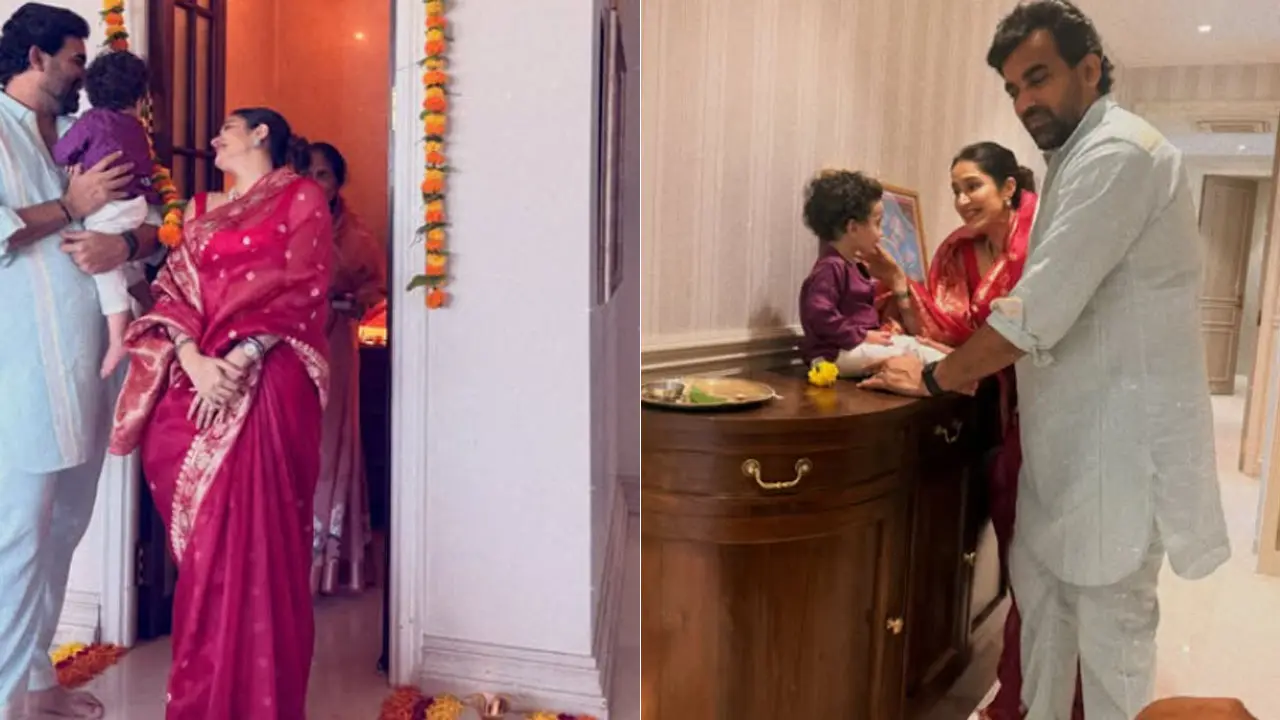
Actress Sagarika Ghatge shared glimpses of her family’s traditional Maharashtrian Gudi Padwa celebrations at home, revealing how her little baby boy Fateh loved the traditional Maharashtrian delicacy, Puran Poli.
Posting a carousel post of pictures featuring husband and former Indian cricketer Zaheer Khan and their son Fateh, Sagarika gave a sneak peek of her beautiful Gudi Padwa celebrations.
Taking to her social media account, Sagarika wrote in the caption, “Wishing everyone a very happy Gudi Padwa”
“Today feels especially special – a moment to pause, look back, and feel quietly grateful for it all. Fateh made sure the puran polis didn’t stop at one. We also found ourselves discovering little corners of Aajis new home, now nearly complete.”
She added, “Happy Gudi Padwa to all.”
The pictures reflect a traditional Maharashtrian Gudi Padwa celebration at home. The actress also highlighted how she discovered ‘little corners of her Aaji`s new house.’
One of the pictures shows Sagarika dressed in a pink saree standing at the entrance decorated with marigold garlands, while Zaheer Khan is seen holding their son Fateh.
In another picture, a visual captures the ceremonial gudi adorned with flowers and the holy cloth around it.
The post also features a festive thali with puran poli and traditional Maharashtrian dishes served on a silver plate.
Talking about Sagarika, the actress married former Indian cricketer Zaheer Khan in November 2017 in a private ceremony followed by wedding celebrations attended by friends from the film and cricket fraternity.
The couple later welcomed their son, Fateh, in 2025.
On the professional front, Sagarika Ghatge is best known for her role as hockey player Preeti Sabharwal in the 2007 sports drama Chak De! India.
She has also appeared in films such as Fox, Rush, and the Marathi film Premachi Goshta.
This story has been sourced from a third party syndicated feed, agencies. Mid-day accepts no responsibility or liability for its dependability, trustworthiness, reliability and data of the text. Mid-day management/mid-day.com reserves the sole right to alter, delete or remove (without notice) the content in its absolute discretion for any reason whatsoever
Brendon McCullum is set to remain as England head coach, and the update is expected to be officially shared on Monday. According to Telegraph Sport, McCullum held talks with Test skipper Ben Stokes, fixing their relationship after the pair grew apart in Australia.
Brendon McCullum and Ben Stokes had differences during the Ashes series. (Action Images via Reuters)
According to the report, both were critical of each other during the ECB review. Meanwhile, Stokes also went public with his criticism of McCullum during the Ashes tour. “I think that we are now playing against teams who have answers to the style of cricket that we have been playing over quite a long period of time now,” he said.
On the other hand, McCullum accused Stokes of failing to stick to their attacking approach, which confused players. Final talks between McCullum and Stokes were held this week, as the ECB also completed its review.
The former New Zealand player also accepted changes from the ECB bosses. Performance director Ed Barney will take on a more significant role and oversee the selection of new coaching staff. He will also focus on strength and conditioning, as reportedly some players were not fit during the Ashes.
When does Brendon McCullum’s contract end?
McCullum’s contract runs until the end of the ODI World Cup in October 2027. According to the report, the ECB’s decision wasn’t influenced by the alternative of paying him off. McCullum would have received a huge pay-off, and it would also have destroyed the coaching staff setup.
Stokes also needs to find his form. He will turn 36 by the time the next Ashes begins in England in 2027. He has failed to finish his last two five-Test series without sustaining an injury. He also didn’t bowl in the closing stages of the fifth Ashes Test in Sydney due to a groin issue.
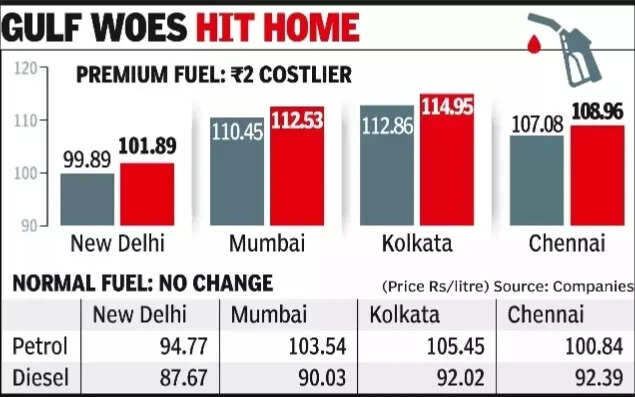
NEW DELHI: Feeling the pinch of a surge in global crude prices, oil marketing companies on Friday increased the retail price of 95-octane premium petrol by nearly Rs 2 a litre and jacked up the rates of industrial diesel by Rs 22 a litre.At the same time, IndianOil, the country’s largest fuel retailer vowed to adopt a “responsible pricing” strategy in an indication that pump prices for normal petrol and diesel may not be raised immediately. In a social media post, IndianOil said there is no automatic fuel price revision in India despite a surge in global fuel prices. “A limited revision applies only to premium petrol XP-95, with minimal impact on overall consumption. Through evolving global conditions, the focus remains clear: consistent supply, responsible pricing, and service you can rely on.”
The retail price of normal petrol and diesel, and aviation turbine fuel, remain unchanged. Officials said less than 5% of people use the premium category of petrol in their vehicles.“Some increase is reported in the premium category, which hardly makes up 2-4% of the entire petrol sold in the country,” said Sujata Sharma, joint secretary in the petroleum ministry. Sharma added that the prices of petrol and diesel were deregulated in 2010 and 2014, respectively, and are decided independently by oil companies.The cost of crude for Indian refiners has soared 120% since the conflict in the Gulf broke out on Feb 28, hitting $156.29 a barrel on Friday, wiping out the profits for domestic oil marketing companies. The price of global benchmark Brent crude also reached close to $110 a barrel, nearly 50% higher than the pre-conflict price of $72.87.Officials said the OMCs make profits when rates are low, absorbing losses when crude prices are high.According to oil companies, high-speed diesel for industrial users in Delhi is now available at Rs 109.59 per litre. Officials in oil marketing companies said prices of this category of diesel are linked to international prices and are automatically revised every fortnight.A litre of normal petrol – with an octane rating of 91 and suitable for standard engines – in Delhi continues to cost Rs 94.77, while the same grade of diesel costs Rs 87.67 per litre. The retail prices of normal petrol and diesel were last revised in April 2022.India imports nearly 90% of its crude oil needs and roughly half of its natural gas requirement, which has been disrupted due to the closure of the Strait of Hormuz.
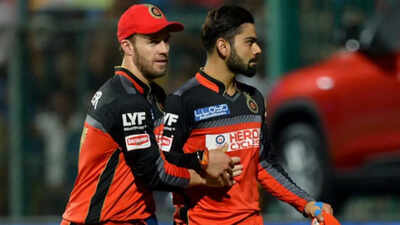
AB de Villiers and Virat Kohli (Image credit: BCCI/IPL)
NEW DELHI: As the cricket world gears up for IPL 2026, one of the tournament’s most iconic “bromances” is back in the spotlight. AB de Villiers, the legendary South African batter and former Royal Challengers Bengaluru (RCB) stalwart, has made a candid admission regarding his first impression of former captain Virat Kohli.While the duo eventually became the most feared batting pair in T20 history, De Villiers revealed that it wasn’t exactly “friendship at first sight”. Speaking about their early encounters on Mbangwa Media YouTube channel, the man known as Mr. 360 confessed that Kohli’s initial demeanour rubbed him the wrong way.“I didn’t initially like him a lot, to be honest. He was a bit cocky, you know, and I’ve told him that before. I’ve said it in many interviews. We sort of laugh at that now,” De Villiers remarked.
Watch
Jay Shah calls 2019 to 2026 as Indian cricket’s golden period
However, the Proteas legend was quick to clarify that this perceived arrogance was actually a mirror image of his own personality. “Why I say cocky is because I probably saw a similar kind of thing that I have in him; it’s that competitive drive,” he added. “It’s that thing that you’re born with, that I don’t like losing, nothing is going to change that. So I probably saw that in Virat initially when I met him.”The ice began to melt as the two spent more time together on the international circuit. De Villiers noted that beneath the aggressive exterior was a cricketer driven by a profound sense of duty to his team.“Then in the second or third meeting, getting to hear his voice and hear him speak, I’m like, oh okay, he’s also just human, you know, just a nice guy who’s got a deep drive of wanting to perform and win games of cricket for his country,” he added.The foundation of their legendary RCB partnership was actually laid during a tense Test match at the Wanderers after RCB picked Kohli. Despite being in the heat of an international battle, Kohli reached out to his future teammate.“And I remember in that tunnel, he came up to me, he’s like, ‘I’m glad you’re on our team.’ And we sort of vibed, like we’re going to be good friends. In the middle of a Test match, we would hardly ever speak to each other, and he just went like, ‘Yes, I’m so glad we got you.’ I’m like, okay, this guy actually likes me, we can maybe be mates,” De Villiers recalled
KKR has received a boost ahead of the IPL 2026 season as Matheesha Pathirana has received clearance from the Sri Lankan cricket board to join the franchise.
Pathirana was seriously doubtful for the forthcoming season after sustaining an injury during the 2026 T20 World Cup. Pathirana`s return would be a relief for KKR, given their fast bowling woes even before the start of the season.
Pathirana has finished his rehabilitation and received the required clearance to play in the IPL, Sri Lanka Cricket Secretary Bandula Dissanayake informed PTI. Pathirana suffered a hamstring injury during Sri Lanka`s T20 World Cup 2026 group game against Australia and went on to miss the remainder of the tournament as the co-hosts were eliminated in the Super 8 stage.
“As far as I know, he`s fit and we have given him NOC to participate in the IPL, that`s all I know at this point of time. He has completed rehab and he is fit. But the franchise will be tasked to assess his readiness. At the moment we don`t know anything about that. As far as we know he is fit and ready to join IPL.” Dissanayake told PTI.
Pathirana was highly sought after at the IPL auction
Pathirana was purchased by KKR for Rs 18 crore at the IPL 2026 auction as the three-time champions looked to change their team combination after finishing in eighth place during IPL 2025.
Since joining the IPL, the Sri Lankan pacer has become a specialist T20 bowler for the Chennai Super Kings. He has taken 47 wickets in 32 games for CSK since making his debut in 2022. The pacer had a tough last season for CSK, as he took 13 wickets in 12 games with an average of 32.62 and an economy rate of 10.14.
Pathirana`s inclusion will ease the pressure on KKR`s depleted bowling lineup. It is expected that Harshit Rana would miss the upcoming season while he recovers from a strained ligament in his right knee. Blessing Muzarabani of Zimbabwe replaced Bangladeshi seamer Mustafizur Rahman, who was freed earlier this year per a BCCI directive.
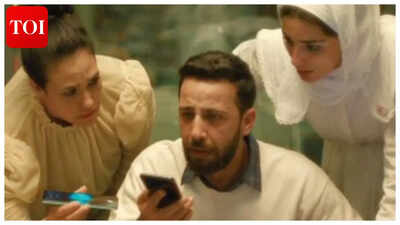
The Indian theatrical release of the Oscar-nominated film ‘The Voice of Hind Rajab’ has reportedly been blocked by the Central Board of Film Certification (CBFC). According to the latest reports, the board halted the film’s planned release citing ‘political relationships’ behind the decision.According to a report on Variety, the film’s distributor, Manoj Nandwana, revealed that the Oscar-nominated film was submitted for certification in February with the hope of releasing it in time for the Oscar season. The film’s release was planned for March 6, giving the Indian audience over a week to watch the film before it could face off at the Oscars in the Best Foreign Film category. However, it was not cleared by the CBFC for a theatrical release.Nandwana claimed that the film which tells the story of a real five-year-old Palestinian girl trapped in a car during an attack in Gaza, is being censored as it is “very sensitive”. He further claimed that a CBFC member told him that “if it gets released, it would break up the India-Israel relationship.”“I told them: the India-Israel relationship is so strong that it’s idiotic to think this movie will break it,” Nandwana added, noting that the film has already been released in the U.S., U.K., Italy, France and many other countries. “But they want to censor it anyway,” he said. The reported move has drawn criticism online, with politician Shashi Tharoor slamming the CBFC. Replying to a post on the same, he tweeted, “That’s pretty disgraceful. In a democracy, screening a film is a reflection of our society’s freedom of expression and has nothing to do with government to government relations. This practice of banning films or books because of the offence they might cause to foreign countries must stop immediately. It’s unworthy of a mature democracy.”This is not the first time that the CBFC has halted an Oscar-nominated film’s release in the country. Last year, the board also blocked the release of ‘Santosh’, a Hindi film which had been shortlisted for the Oscars as the UK’s official entry in the Best International Feature Film category.












-1773982652028_d.png?w=696&resize=696,0&ssl=1 "IPL 2026: Matheesha Pathirana back from injury, to join KKR camp soon")
-1773982652028_d.png "IPL 2026: Matheesha Pathirana back from injury, to join KKR camp soon")