Sunday, September 27, 2026
Home Blog Page 1384

Ishan Kishan gets annoyed after winning T20 World Cup 2026 title: ‘Ispe mein kya bolun?’ | Cricket News

0
Ishan Kishan gets annoyed after winning T20 World Cup 2026 title: ‘Ispe mein kya bolun?’ | Cricket News


'Ispe mein kya bolun?': Ishan Kishan gets annoyed after winning T20 World Cup 2026 title - Watch
Ishan Kishan (Screengrab)

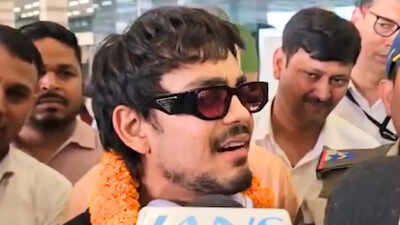
NEW DELHI: India’s T20 World Cup 2026 win sparked both celebration and controversy. Wicketkeeper-batter Ishan Kishan was visibly annoyed when reporters asked him about comments made by former cricketer Kirti Azad regarding the team taking the trophy to a Hindu temple in Ahmedabad. Kishan dismissed the question and said, “Kitna accha World Cup jitte hai, kitna accha sawal aaplog kijiyega, yeh Kirti Azad ne kya bola ispe mein kya bolun? Kuch accha sawal kijiye na ki mazza aya (Winning the World Cup is such a great thing. You people should ask good questions. What can I say about what Kirti Azad said? Please ask some good questions so that it’s enjoyable).”

Sanju Samson opens up on T20 World Cup journey, and title win

Azad had criticised the move on social media, questioning why the trophy was taken only to a temple. He wrote, “Why NOT a Mosque? Why NOT a Church? Why NOT a Gurudwara?… The Trophy Belongs to 1.4 BILLION Indians of EVERY Faith — NOT ONE RELIGION’S VICTORY LAP!” He added that India’s 1983 World Cup team represented many religions and said, “When we won the World Cup under Kapil Dev in 1983, we had Hindu Muslim Sikh and Christian in the team.”

Poll

Which aspect of India’s T20 World Cup win impresses you the most?

Azad also stressed that the team represents the whole country, writing, “This Team Represents INDIA — not Surya Kumar Yadav’s or Jay Shah’s Family,” and pointed out that players like Siraj or Sanju Samson never took the trophy to their own places of worship.Watch Ishan Kishan speaking to journalists:After winning the T20 World Cup, Kishan spoke about his personal journey. After being dropped earlier, he worked his way back through domestic cricket and described the experience as a “rollercoaster.” In this tournament, the left-handed batter scored 317 runs at a strike rate above 190, including three half-centuries.On Sunday, India sealed the title with a dominant performance in the final against New Zealand. After losing the toss, India piled up a record 255/5 thanks to quick fifties from Abhishek Sharma, Sanju Samson and Kishan. New Zealand never recovered in the chase and were bowled out for 159.The victory made India the first team to win three T20 World Cups and the first to claim back-to-back titles while also winning the tournament on home soil.


‘A decided lack of class’: Quentin Tarantino fires back at Rosanna Arquette for

0
‘A decided lack of class’: Quentin Tarantino fires back at Rosanna Arquette for


‘A decided lack of class’: Quentin Tarantino fires back at Rosanna Arquette for

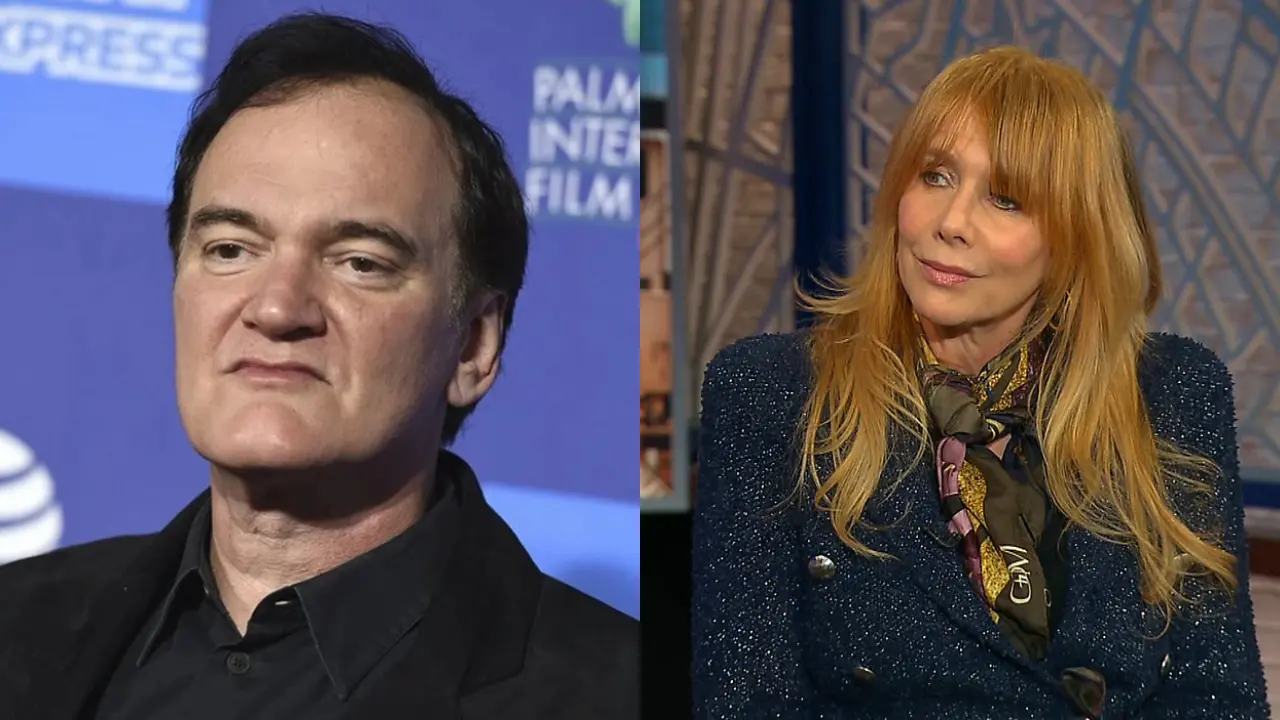
Quentin Tarantino has responded strongly to actor Rosanna Arquette’s criticism of his use of a racial slur in his films. The filmmaker did not hold back while expressing his displeasure at Arquette criticising his script choices and use of language. Tarantino said it was poor of Arquette to publicly speak ill of a film that contributed to her financial success.

Quentin Tarantino hits back at Rosanna Arquette

On Monday, Tarantino responded to Arquette’s criticism in a letter, accusing the actor of trashing the film and showing “a decided lack of class, no less honour.”

“I hope the publicity you’re getting from 132 different media outlets writing your name and printing your picture was worth disrespecting me and a film I remember quite clearly you were thrilled to be a part of? Do you feel this way now? Very possibly (sic),” the 62-year-old wrote.

“But after I gave you a job, and you took the money, to trash it for what I suspect is very cynical reasons, shows a decided lack of class, no less honour. There is supposed to be an esprit de corps between artistic colleagues. But it would appear the objective was accomplished. Congratulations (sic),” he added.

What did Rosanna Arquette say?

According to Deadline, Arquette made the remarks while reflecting on her experience working in Tarantino’s 1994 cult classic Pulp Fiction. While acknowledging the film’s enduring influence and iconic status, the Emmy-nominated actor said she strongly disagrees with the director’s approach to dialogue involving racial language.

“It’s iconic, a great film on a lot of levels. But personally, I am over the use of the N-word-  I hate it,” Arquette said in the interview. She added, “I cannot stand that he has been given a hall pass. It’s not art, it’s just racist and creepy.”

The debate surrounding Tarantino’s dialogue is not new. The slur has appeared numerous times across several of the filmmaker’s projects, including The Hateful Eight, Django Unchained and Jackie Brown.

Filmmaker Spike Lee had publicly criticised Tarantino’s use of the word as early as 1997, the year Jackie Brown was released. Lee argued that while the word may appear in certain contexts, Tarantino tends to use it excessively.


Tata Motors PV eyes return to EV dominance with Punch EV even as CAFE-III looms| Business News

0
Tata Motors PV eyes return to EV dominance with Punch EV even as CAFE-III looms| Business News


Tata Motors Passenger Vehicles Ltd. is betting that a refreshed, budget-friendly version of its Punch EV will be the catalyst that it needs to recapture a majority of India’s fast-growing but fiercely contested electric vehicle market—a share it has watched erode as new rivals drove in.

(From left) TMEV Chief Product Officer Anand Kulkarni, TMEV Chief Commercial Officer Vivek Srivatsa, Tata Motors PV CEO Shailesh Chandra and TMEV Chief Strategy Officer Balaje Rajan at the launch of the new Punch EV in Mumbai. (Handout)

But Vivek Srivatsa, chief commercial officer at Tata Motors Electric Mobility Ltd., says the company’s ambitions extend well beyond defending existing turf. The new Punch EV, he argues, is designed to unlock a segment that’s skips the EV segment—the first-time car buyer.

“Punch EV always used to attract a good amount of first-time car buyers—not just first-time EV buyers. But with the new Punch EV, the enhancements that we have done, we want to attract even more,” Srivatsa had told HT Business in an exclusive interview ahead of the model’s commercial launch. “We want the Punch EV to become the ideal choice for the first-time car buyer.”

He declined to offer forward guidance on sales target for the Punch EV in the ongoing calendar year or upcoming fiscal, citing company policy.

Still, the strategic pivot is significant. Tata Motors PV once commanded well over 70% of India’s electric-car market. That share has slipped below 50% as the likes of Mahindra & Mahindra Ltd. and JSW MG Motor Pvt. Ltd. muscled in, even as largest carmaker Maruti Suzuki India Ltd. waits in the wings.

Yet, Srivatsa frames the retreat as a structural feature of market evolution—and insists Tata Motors is playing a longer game.

India’s total electric-car market is running at roughly 200,000 units annually—a fraction of total industry volume at nearly 4.5 million. Srivatsa’s argument is that mainstream EV adoption will only happen when an entry-level buyer choosing between a ₹10-12 lakh petrol or CNG car sees an EV as genuinely credible. Until now, they haven’t.

The new Punch EV targets that inflection point precisely. Tata Motors PV is positioning it against the Punch AMT CNG—arguing that customers drawn to alternative fuels and automatic transmissions are natural EV converts. On that basis, Srivatsa claims near price parity has been achieved at entry trim level—a feat that had eluded the company at lower price points until now.

The chart tells a nuanced story. After a firm start to FY26, Tata’s monthly EV sales softened through August-October window—a dip Srivatsa attributed to the government’s GST restructuring for ICE vehicles, which widened the effective price gap between petrol and electric at a critical juncture.

“It was a temporary setback for sure,” he said. “Suddenly we moved backwards in terms of price parity because ICE got a big GST benefit. EVs did not get any additional benefit, and the gap between ICE and EVs increased.”

The CAFE-III wildcard

Whatever temporary relief the GST revision gave ICE vehicles, India’s incoming Corporate Average Fuel Efficiency Phase III norms—or CAFE-III norms—threaten to reverse. Set to take effect from April 2027, the norms mandate a fleet-average CO2 emission ceiling of approximately 91.7 g/km, a steep tightening from the current CAFE-II threshold of 113 g/km.

For manufacturers overwhelmingly reliant on internal combustion engines, the arithmetic is punishing. To bring down fleet averages, automakers must either dramatically improve ICE efficiency—expensive and technically bounded—or rapidly scale EV portfolios to dilute the emissions average. EVs, which produce zero tailpipe emissions, are the most effective compliance lever available.

Industry analysts estimate that without meaningful EV volumes, several mid-sized Indian automakers could face an existential crisis. That financial overhang is already reshaping investment decisions across the sector, accelerating both EV launches and localisation that might otherwise have taken years longer.

For Tata Motors, which enters the CAFE-III era with the broadest EV portfolio of any domestic manufacturer—spanning the Tiago EV, Punch EV, Nexon EV, Curvv EV and the new Harrier EV—the incoming norms represent a competitive moat. The accumulated EV production experience built since the Nexon EV’s 2020 launch gives Tata a structural headstart rivals will struggle to replicate quickly.

Localisation is central to that advantage. Srivatsa confirmed the new Punch EV carries localisation content in excess of 50%, underpinning both its eligibility for government incentives and its resilience to currency-driven cost pressures on imported battery components. Manufacturing is anchored at Tata’s Pune facility rather than the emerging EV ecosystem in Sanand, Gujarat—a deliberate diversification to avoid concentration risk in any single supply geography.

Charging ahead

Tata Motors PV is simultaneously moving to dismantle range anxiety—the persistent psychological barrier keeping entry-level buyers wary of EVs. The company currently operates more than 200,000 home chargers installed with customer vehicles, and has built a growing network of co-branded “Tata Mega Chargers”—high-speed DC fast chargers at high-footfall locations.

Srivatsa said the company plans to more than double its public mega charging points from 450 to over 800 within the next year.

A ‘verified charger’ audit programme—under which Tata Motors PV teams inspect and rate third-party chargers on uptime and interface quality—aims to tackle chronic unreliability at public charging stations. Over 5,000 community chargers have been deployed in apartment complexes and residential societies where dedicated parking is absent, removing a structural barrier to EV ownership in India’s dense urban centres.

On the product front, Srivatsa confirmed the Sierra EV remains on track for a Q2 or Q3 launch in 2026, with all-wheel drive (AWD) as standard. The Avinya—Tata Motors PV’s purpose-built next-generation EV platform—remains scheduled for a debut in 2027.

Whether the Tata Punch EV can single-handedly reverse Tata’s market share slide remains an open question. Mahindra’s electric SUVs have generated strong early demand, and the broader industry expects several new entrants in the sub- ₹15 lakh EV segment over the next 18 months.

ALSO READ | Tata Motors PV banks on Punch, Sierra to outsell the wider SUV market in 2026

But with CAFE-III approaching and the entry-level segment largely unclaimed, Tata’s timing to launch the refreshed Punch EV may be shrewder than it looks. The first brand to make a sub- ₹12 lakh EV feel genuinely mainstream—reliable, fast-charging, and emotionally reassuring for a first-time buyer—will not merely gain market share. It can potentially reshape the wider EV ecosystem.


Randeep Hooda announces arrival of baby girl with wife Lin Laishram

0
Randeep Hooda announces arrival of baby girl with wife Lin Laishram


Randeep Hooda announces arrival of baby girl with wife Lin Laishram

Randeep Hooda and Lin Laishram have announced the arrival of their first child, a baby girl, marking a deeply special and joyous moment for the couple and their families. The baby is healthy, and both the mother and daughter are doing well.

Randeep Hooda and Lin Laishram welcome baby girl

The couple shared the news on social media, revealing that their daughter arrived on a day that already held immense significance for the family. The newborn shares her birthday with Randeep Hooda’s father, Ranbir Hooda, turning the occasion into a double celebration for the Hooda household.

They wrote on social media, “Dada aur poti ne janamdin ki ghaniya badhai. Today, as I become a father, my appreciation for you has only grown deeper, Papa. And most importantly — Lin, thank you for making me a father and for bringing our little girl into this world. A little girl and a lifetime of love.”

The arrival of the baby girl has brought immense happiness to both families, making the day particularly emotional and memorable as three generations of the family now share a milestone moment together.


View this post on Instagram


A post shared by Randeep Hooda (@randeephooda)

With the newborn granddaughter arriving on the same day as her grandfather’s birthday, the day has taken on even greater meaning for the family.

When Lin and Randeep announced the pregnancy

It was on November 29, that Lin and Randeep announced that they are set to embrace parenthood. Making the announcement on social media, they wrote in a joint post, “Two years of love, adventure, and now… a little wild one on the way (Tiger Face, red heart and infinity emojis)”. Randeep and Lin first met at veteran star Naseeruddin Shah’s theatre group Motley. Eventually, having fallen for one another, the lovebirds started living together during the lockdown.


View this post on Instagram


A post shared by Randeep Hooda (@randeephooda)

Earlier, on Randeep Hooda’s 49th birthday, Lin wished her forever “Netflix & Chill partner”. She took to Instagram, where she shared a video montage featuring Randeep’s pictures from their various romantic getaways. She added the track ‘Thodi Si Daru’ by AP Dhillon and Shreya Ghoshal as the background score for the reel she made for her husband.

Randeep and Lin first met at veteran star Naseeruddin Shah’s theatre group Motley. Eventually, having fallen for one another, the lovebirds started living together during the lockdown. They made their relationship Instagram official back in 2022. The couple finally tied the knot on November 29, 2023, in a traditional Meitei ceremony in Manipur.


Rishabh Pant looks up to Yuvraj Singh for Sanju Samson-like career revival

0
Rishabh Pant looks up to Yuvraj Singh for Sanju Samson-like career revival


The Indian cricket team has witnessed some remarkable comeback stories over the past few months at the T20 World Cup. First, it was Ishan Kishan, who earned a spot in the squad after a stellar domestic season with Jharkhand. His selection surprised many, as he wasn’t part of the plans earlier and was picked ahead of then regulars Shubman Gill and Jitesh Sharma. The left-handed batter played a pivotal role in India’s title win. Then came Sanju Samson, who turned his fortunes around on the biggest stage. The opener fought his way back into the XI and went on to become Player of the Tournament, delivering crucial back-to-back performances in the knockouts, including a superb 89-run knock in the final.

Rishabh Pant has trained with Yuvraj Singh ahead of IPL 2026 (X/@LucknowIPL)

And now, another wicketkeeper batter is looking to script a comeback – Rishabh Pant. A regular in Test cricket, he is still trying to cement his place in the white ball formats. A couple of years ago, Pant was comfortably ahead of Sanju Samson and Ishan Kishan in the pecking order, but the landscape has shifted sharply since then.

Pant has to take some responsibility for that slide. The attacking instinct is very much there, yet consistency in limited-overs cricket has often eluded him. At times, when the pressure has mounted, he has retreated into his shell – a stark contrast to Test cricket, where he has repeatedly embraced high-pressure moments and delivered.

The wicketkeeper has reached out to India’s white ball great Yuvraj Singh, who has been doing quiet work behind the scenes with a few Indian players, helping them find clarity and direction. During the COVID-19 break, Yuvraj took Shubman Gill and Abhishek Sharma under his wing, training them closely and helping them realise their potential. With Abhishek in particular, he put in extensive work to unlock his range, and the left-hander announced himself on the Indian stage in style and is now sitting at the top of the ICC T20I batting charts.

When things were not going well for Samson, he too turned to Yuvraj ahead of the World Cup. The two spent time together during Samson’s off days, working separately and discussing his approach. During that difficult phase, Samson interacted with a few mentors, with Yuvraj playing a key role in those conversations.

Pant turns to Yuvraj for a reset

Pant has now followed a similar path and begun training with Yuvraj ahead of the upcoming Indian Premier League season. Pant became the most expensive player in the IPL auction at a staggering INR 27 crore, but barring a lone century, he endured a disappointing season with the bat and fell well short of expectations. That three-figure knock also came when his team was already out of contention. He managed 269 runs in 14 matches, with a highest score of 118 not out and a strike rate of 133.16.

Also Read – How India moved on from Rohit Sharma, Virat Kohli and Rahul Dravid to build an even more dangerous T20I side

The upcoming IPL season is vital for Pant to push himself back into contention and prove his calibre, especially after a few underwhelming seasons. Captaincy has only added to the burden as he leads Lucknow Super Giants, a role that often brings extra pressure. We have seen that before with KL Rahul as well while leading LSG.

Working with Yuvraj could help Pant bring method to the madness that has crept into his white ball batting. Samson discovered that balance while training with him, and it paid off on the biggest stage with scores of 97 not out, 89 and 89 when everything was on the line for India. Pant is searching for that same spark to rediscover the form that once made him one of Indian cricket’s brightest stars. To return to the white ball scheme of things, he needs clarity as much as flair, and Yuvraj’s guidance could prove decisive, just as it did for Samson. Pant has almost every shot in the book, but that abundance can sometimes work against him. He needs someone to help him stay clear about what to play and when, and Yuvraj, one of India’s greatest match winners, understands exactly how to pass that mindset on to the next generation.


Dhurandhar 2 paid previews: How to watch Aditya Dhar, Ranveer Singh film before it releases

0
Dhurandhar 2 paid previews: How to watch Aditya Dhar, Ranveer Singh film before it releases


Dhurandhar: The Revenge is arguably the most anticipated Hindi film in years. The Aditya Dhar directorial brings back Ranveer Singh as Hamza aka Jaskirat, an Indian spy in Pakistan. The unprecedented success of Part 1 in December has paved the way for the sequel to generate immense buzz. In fact, the buzz is so huge that the makers are organising preview shows for fans on the eve of the release, but on a scale never-seen-before in Hindi cinema.

Dhurandhar 2: Ranveer Singh in a still from the Aditya Dhar sequel.

Dhurandhar 2 paid previews

The trailer of Dhurandhar 2 was launched on Saturday, as Jio Studios and B62 Studios released the 4-minute glimpse into the world of Jaskirat Singh Rangi. The important announcement came at the end of the trailer as the makers announced paid previews for the film on March 18. Online ticketing platforms like BookMyShow and District opened the bookings for paid previews on Saturday afternoon itself.

As of Tuesday, the paid previews of Dhurandhar 2 are set for the evening of March 18, the eve of its release. Many theatres across India are starting shows at 4-5 PM with some screens keeping multiple shows that evening. The paid previews are spread across India, but not in all locations. As per trade estimates, Dhurandhar 2 paid previews will be shown on around 5000 screens across India. The film’s release, the following day, will be wider as more screens will be added in more cities.

Dhurandhar 2 advance bookings

Fans have noted that the prices of the tickets for the paid preview of Dhurandhar 2 were abnormally high. Across India, the average ticket price for the Hindi version is around ₹417. In multiplexes, this figure is around ₹550, according to trade sources. Even the Kannada dub has tickets priced over ₹400 on an average. But despite this, tickets are selling like hot cakes. By Tuesday evening, the film had sold over 3 lakh tickets for paid previews, grossing over ₹16 crore domestically. Overseas, it has amassed over $700K for paid previews in North America, and is set to exceed $2 million for the weekend. With eight days to go for the release, these are promising numbers.

All about Dhurandhar 2

Directed by Aditya Dhar, Dhurandhar 2 brings back Ranveer Singh as an Indian spy in Pakistan. The heavily-anticipated film also stars R Madhavan, Arjun Rampal, Sanjay Dutt, Danish Pandor, Rakesh Bedi, and Sara Arjun. Part 1 was a mega success, earning ₹1300 crore worldwide. The sequel is expected to repeat its success.


India slides down in 2026 Gender Equality in Chess Index rankings: How can it be improved? | Chess News

0
India slides down in 2026 Gender Equality in Chess Index rankings: How can it be improved? | Chess News


India slides down in 2026 Gender Equality in Chess Index rankings: How can it be improved?
Gukesh Dommaraju, Arjun Erigaisi, Divya Deshmukh, and Harika Dronavalli (from left to right) (Photo by Maria Emelianova/Chess.com)

NEW DELHI: Last Sunday was International Women’s Day. Unless you’ve been on a total digital detox, your feed was likely buried under a mountain of Instagram stories and WhatsApp statuses celebrating the day. You probably liked a few, reciprocated a few wishes, and projected the vision of your values perfectly aligned with the cause.In keeping with the occasion, the FIDE Women in Chess Commission (WOM) and the University of Queensland published the 2026 Gender Equality in Chess Index (GECI) on Sunday. In this index, India has slipped one place to 25th in the global rankings since the inaugural 2023 edition.

From No Laptop to Chess World Cup Dreams: GM Pranesh M Exclusive Interview

In isolation, a one-place drop might not appear alarming. But in a country currently hailed as the fastest-growing chess powerhouse on the planet, this ranking points towards a deeper structural imbalance. While there are certainly worse-performing countries on the list, questions may arise as to why India isn’t near the top.

What is the Gender Equality in Chess Index (GECI)?

The Gender Equality in Chess Index is essentially an attempt by FIDE, the global chess body, to quantify gender balance across federations worldwide. The idea behind it is to measure where countries stand so they can improve.“When we created the GECI in 2023, we wanted to give federations a clear, evidence-based picture of where they stand on gender equality. You can’t improve what you don’t measure,” said Grandmaster (GM) David Smerdon, associate professor at the University of Queensland and the report’s lead author.
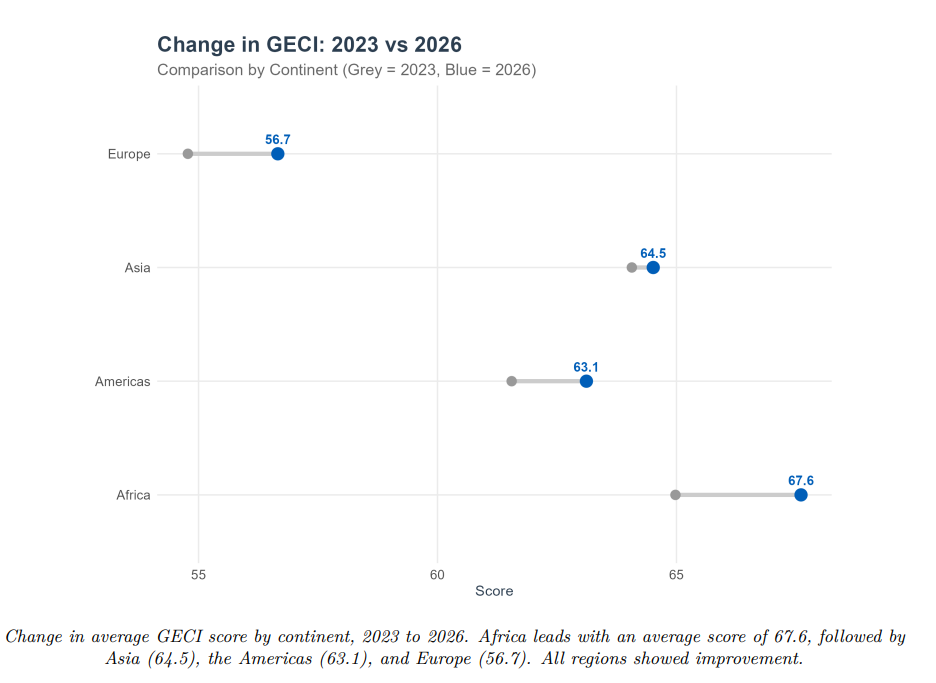
Change in GECI

Change in average GECI score by continent (Grahpic from GECI Report 2026)

The report uses FIDE’s global ratings database and youth championship participation records to build a composite score that reflects female participation, performance, and development pathways. According to the report, there are 1,446,605 active chess players worldwide, but only 238,716 are women, meaning female participation overall stands at just 16.5%.

How the rankings are measured

The GECI score is calculated using three key pillars:

  • Participation – the share of women among active rated players in a federation. (The closer the figure is to 50%, the more balanced the ratio between male and female players)
  • Performance – the strength gap between men and women based on average Elo ratings.
  • Progress – the proportion of girls representing a country in international youth championships.

In the 2026 release, India’s overall GECI score stands at 71.04, resulting in that single-place drop to 25th globally. However, when you look under the hood, the numbers tell a story of two different Indias.
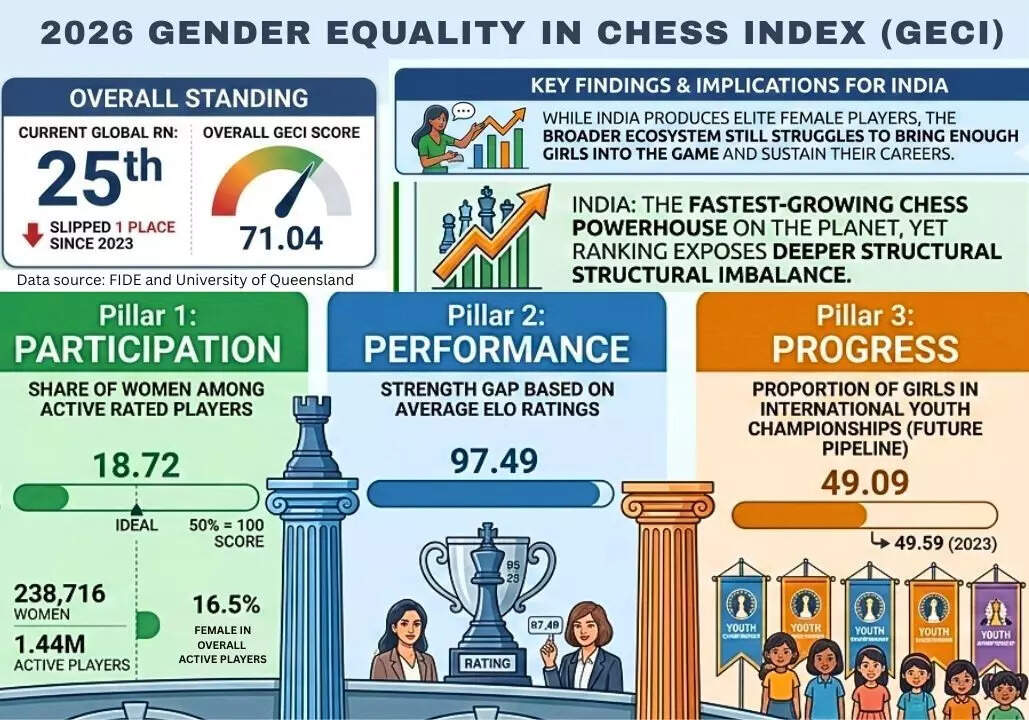
2026 GECI Report

India’s numbers in 2026 GECI Report

In Performance, India holds a staggering 97.49 (up from 88.31 in 2023), which proves that our elite women are world-class. Nevertheless, Participation lags at a meagre 18.72, and Progress, the metric for the next generation, saw a slight decline to 49.09.The metrics suggest that while India is phenomenal at producing top-rated female players, the broader ecosystem is still struggling to get girls to the board and keep them there.

Where is India lacking?

From Viswanathan Anand inspiring a generation to teenage prodigies dominating global tournaments, the country now boasts more than 90 Grandmasters. Yet, in a nation of more than a billion people, only four women have reached chess’s highest title and become a GM.As GM Harika Dronavalli explained, the issue begins long before players reach the elite level. “Girls are not pushed to pursue ambitious goals in the same way boys are. The talent is certainly there, but societal expectations often clip those wings early,” she told TimesofIndia.com.The drop-off is particularly visible during adolescence. Coach GM Srinath Narayanan, who has worked with several of India’s top female players, says many promising girls leave the game between 13 and 15 years of age.“Girls in India often face more pressure to prioritise academics or domestic responsibilities over sports. Chess demands sustained investment, time, travel and coaching, and families may hesitate to support girls long-term in such a career,” he explained.
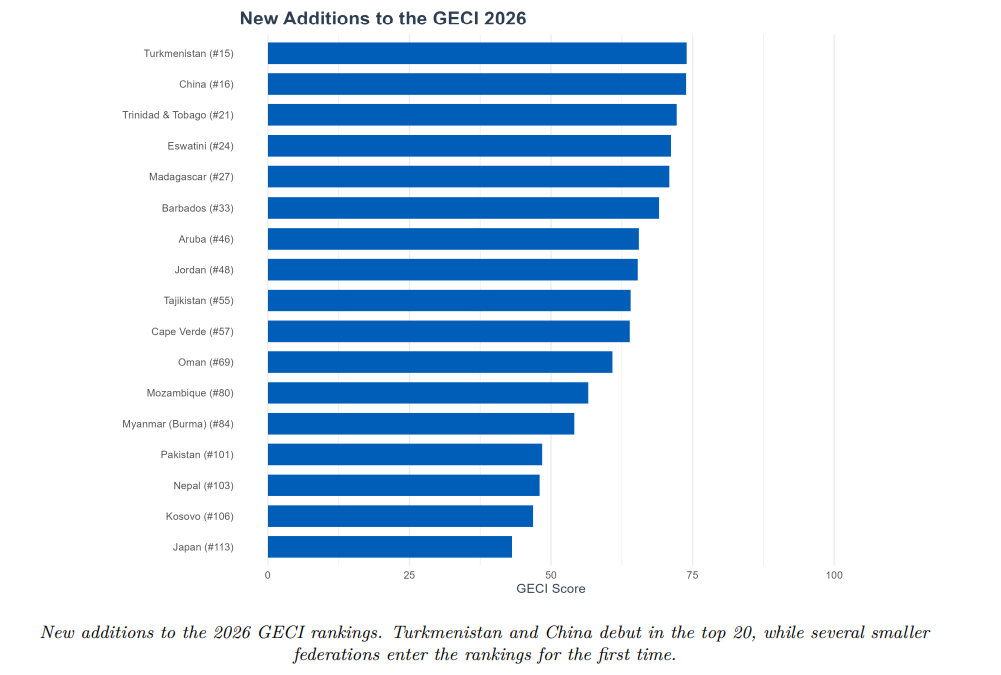
GECI Report 2026

New additions to the GECI 2026 report

Even those who remain in the system face structural challenges. International Master (IM) Vantika Agrawal reiterates that competing internationally, a crucial step toward earning Grandmaster norms, is far harder for female players.“It is financially challenging to play a lot of tournaments abroad,” she said. “Female players don’t get much opportunity to play with stronger players, which hampers their growth. And our society is still male-dominated. Women don’t get equal opportunities and support.”Young girls often compete in women-only events rather than stronger open sections, limiting exposure to tougher opposition during crucial development years.

What can India do to improve and close the gap?

While recently speaking to this website, India’s veteran Grandmaster Pravin Thipsay broke down the reality of ‘individualism’ within the Indian chess ecosystem.“There is no system in Indian chess which will produce champions. It is basically the efforts of the parents and the players that are in place. Players have spent a lot of time and energy, and parents have sacrificed their careers; only then have some emerged as champions,” he elaborated.“Just because three players are doing well, it doesn’t mean that after five years we will have another three or five players who will do the same. We cannot say it is like the Soviet school where one champion goes and another comes. Even in China, they have a continuous chain of players, particularly among the women. Whenever one generation is no longer strong, a different generation has already been coming through. These are things which do not happen here; what we have is the individual effort of a person.“While some notable individuals have helped sow the seeds of chess culture in India, this growth has remained limited to certain pockets of the nation rather than expanding pan-India. And the movement may not reach its full potential without direct intervention from the All India Chess Federation (AICF). But how do they achieve this?

There is no system in Indian chess which will produce champions. It is basically the efforts of the parents and the players that are in place.

GM Pravin Thipsay

The GECI framework itself offers clues about the solution.First, female participation must increase at the grassroots level. Even a modest rise in the percentage of girls playing chess would significantly strengthen the talent pipeline.Second, exposure to stronger competition is essential. Coaches argue that talented girls should be encouraged to play in open events early in their careers.Third, the ecosystem needs financial backing, from travel grants and sponsorships to structured training programmes designed specifically for promising female players.
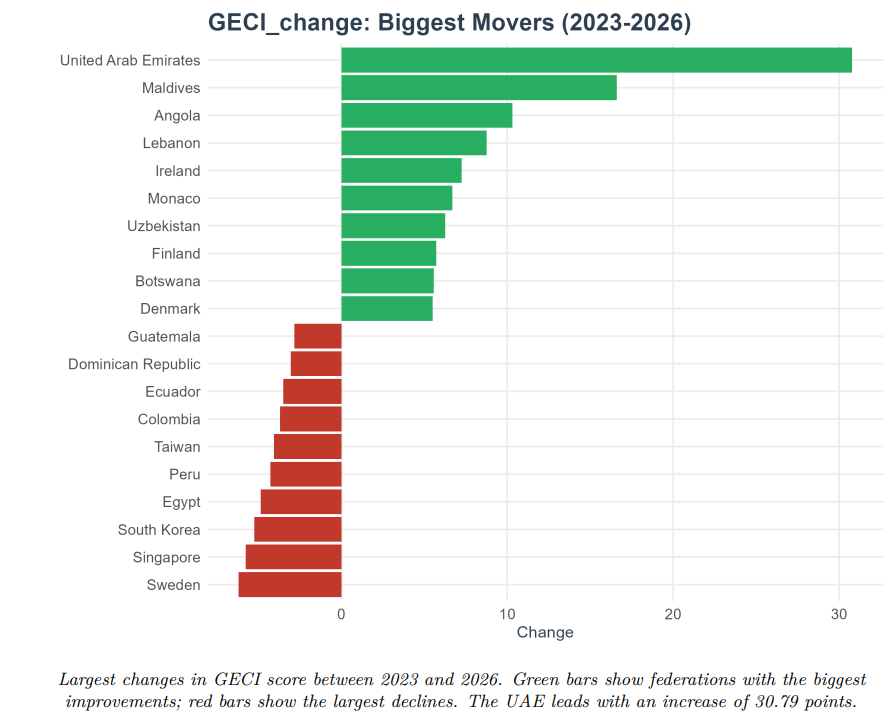
GECI Report

Biggest Moves in GECI Report 2026

In all, the UAE blueprint mentioned in the 2026 GECI report could prove highly effective.The UAE climbed 73 places in the rankings, from 77th in the last edition to 4th now, largely by dramatically increasing the number of girls sent to youth championships. The country boosted female participation in youth delegations from 12.5% to 43.75% in the “progress” indicator, demonstrating how targeted policy decisions can rapidly transform representation.Backed by their sports ministry and national councils, the UAE has institutionalised female chess through a specialised network of seven chess clubs with dedicated girls-only sections and two girls-only clubs. They have also made female representation mandatory in their governing body.By providing logistical support for families and embedding women in leadership roles, such as Secretary-General Dr. Maliha Mahmoud Al Mazmi, the federation has created a sustainable professional pipeline.READ ALSO: India gets its 93rd GM. Mother quit job for chess — the making of Aarav Dengla influenced by D Gukesh and Arjun ErigaisiFurthermore, the system is anchored by a year-round competitive calendar for girls, ranging from school-level events to national championships of all age categories. Away from the board, the federation has also invested in the inclusion of female international and national arbiters.For India, the lesson is simple. As the data shows, the country already has the talent. What it needs now is a system that keeps girls in the game long enough to create a sustainable model of development.



Head coach Gautam Gambhir pinpoints Team India`s turning point in marquee event

0
Head coach Gautam Gambhir pinpoints Team India`s turning point in marquee event


Head coach Gautam Gambhir pinpoints Team India`s turning point in marquee event

Team India emerged victorious by 96 runs against New Zealand in the final of the T20 World Cup 2026 at the Narendra Modi Stadium in Ahmedabad.

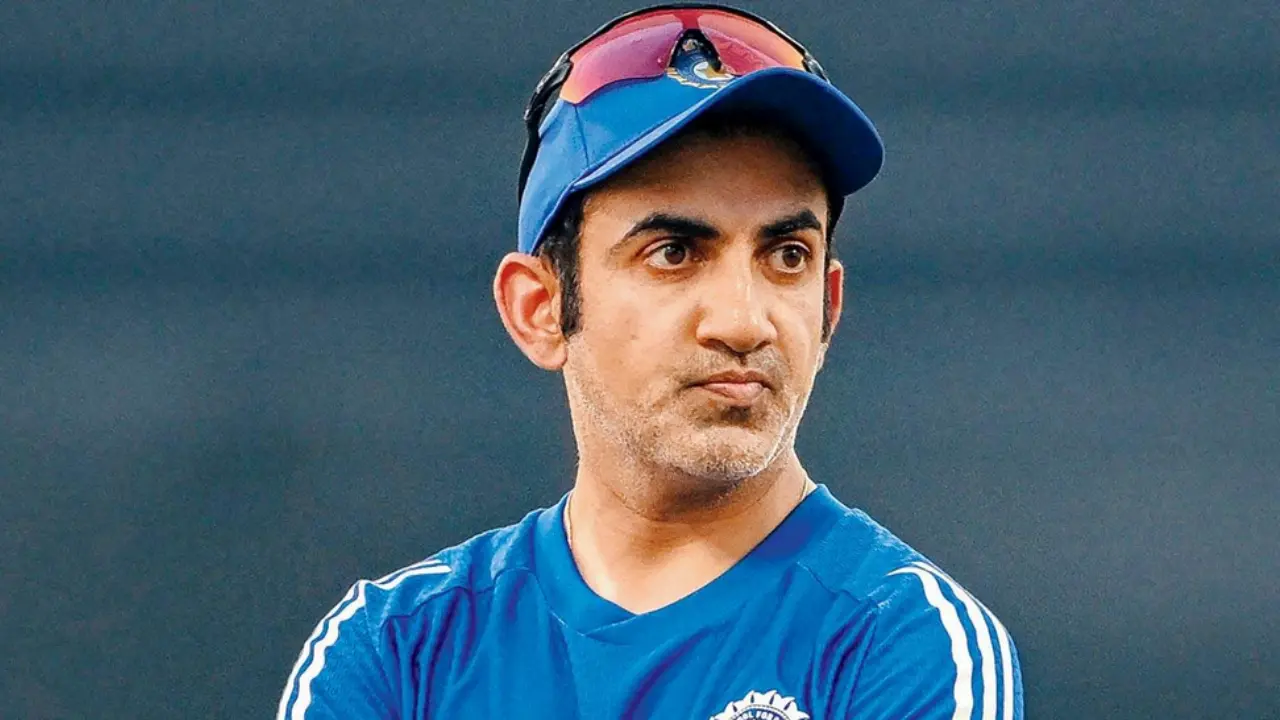
After winning the title, Team India`s head coach Gautam Gambhir feels that Sanju Samson`s knock of 97 runs against the West Indies was the turning point of the hosts` campaign.

“It is very difficult to say, but I still believe that Sanju`s 97 against West Indies was the turning point of this campaign because again, it was a virtual quarter-final and someone making a comeback who did not play four or five matches before the Zimbabwe game. Chasing 195 in a virtual quarter-final, irrespective of whatever the ground is, in a World Cup game, is never easy. With the ease and the calmness that he batted, I think it gave us a lot of confidence in the group that now, probably, we are on the right track,” he said.

In the match against the Caribbeans, the Kerala-born cricketer played a knock of an unbeaten 97 runs off 50 balls, including 12 boundaries and four maximums. He continued his rich vein of form in the match against England as well, in which he garnered 89 runs in 42 balls, laced with eight boundaries and seven maximums.

He then stated that things started falling in place after the game against the West Indies.

“Before that, there was a lot of talk that we play very aggressively in the bilaterals but not in the ICC tournaments. After the West Indies game, when Sanju got going and how Ishan Kishan batted at three, I thought that a lot of things actually started taking shape,” said Gambhir.

The triumph helped the “Men in Blue” to successfully defend the shortest format world title. With this, India also became the first team to win three T20 World Cup titles.

T20 World Cup 2026: Player of the Tournament

Team India`s wicketkeeper-batsman Samson was named as the “Player of the Tournament”, and the side`s lead pacer Jasprit Bumrah was the “Player of the Match” for his heroics in the title clash.

Samson scored 89 runs in 46 balls, with the help of five boundaries and eight maximums, whereas Bumrah returned with the figures of four wickets for 15 runs in four overs.

(With ANI Inputs)


'Aishwarya Rai was hesistent to wear a backless dress,' recalls celebrity stylist

0
'Aishwarya Rai was hesistent to wear a backless dress,' recalls celebrity stylist


'Aishwarya Rai was hesistent to wear a backless dress, was a simple girl,' reveals celebrity stylist recalling her modelling days

Aishwarya Rai started her career as a model and was already a household name with a soft drink commercial, before she won an international pageant title. People who have worked with her, even in her early days have always showered praise on her. In a recent interview, celebrity stylist Ashley Rebello reminisced about working with the actress long before she became a global icon. He recalled how she was hesitant to wear a revealing outfit. In an interview with Beyond the Frame with Avinash Tripathi, Ashley said, “Actually, when I first met her, she wasn’t ‘the Aishwarya Rai’ yet; she was just a simple girl. The first advertisement she did was a suiting campaign, and at that time, I used to conduct trials in my bedroom. Our first meeting happened when she came to my house for her fitting, and it was a backless dress. She asked, ‘Will I have to wear a dress like this?’ And I told her, ‘Yes, what’s the problem with it?’”Rebello also recalled that Aishwarya had arrived for the trial with her mother, who initially felt the outfit was too bold. However, he reassured her family that everything would be handled tastefully.“I remember she was very young and in the middle of her college days. She had come for the trial with her mother. Her mother said that the dress was too revealing. But I told her, ‘No, aunty, don’t worry. These ad films shoot everything very aesthetically, nothing will happen, and I’m here.’ I told her to first see the fitting and be happy with it. She was convinced, and from that point onward, I feel she developed a sense of trust in me.”According to Rebello, that trust gradually developed into a long-standing professional relationship. When Aishwarya travelled to compete at Miss World, he designed several outfits for her to wear during the event. He added, “When she went for Miss World, I gave her at least 20 sarees. I made chiffon sarees in different colours: rani pink, yellow, turquoise blue, black, white, and red. I also gave her lots of bangles and matching bindis and told her that when you go for breakfast every day, you must wear a new saree.”The stylist said the idea soon became a talking point among other contestants at the pageant. Aishwarya later called him to share how the colourful sarees had captured everyone’s attention. “I can’t tell you how every morning everyone just wants to see which colour saree I will wear today. Everyone has been asking me for my bindis, so all my bindis are finished and all my bangles are gone. My mother is coming, so please send more with her. That’s when I realised that she is not just beautiful but also such a nice person,” he said. Meanwhile, film producer Shailendra Singh, also recently spoke about spotting Aishwarya in her early advertising days. During an interview with Siddharth Kannan, he recalled how she began her career in commercials. He recalled, “I spotted Aishwarya when she was 18 or 19 at Marine Drive, if I recall correctly. She came to meet Kunal Kapoor and me at 8:30 at night with her parents. She was just 18 or 19, and she did our first three advertisements for just Rs 5,000. She was first, I think, an extra tied to a pole in Mukesh Mills for a commercial. Then she did a Ghrit Kumari Hair Oil ad with Malvika Tiwari, and then another commercial with Arjun Rampal. That’s how she started.”


Iran war: Saudi Arabia, Iraq, UAE and Kuwait cut oil output as Hormuz disruption rattles energy markets

0
Iran war: Saudi Arabia, Iraq, UAE and Kuwait cut oil output as Hormuz disruption rattles energy markets


Iran war: Saudi Arabia, Iraq, UAE and Kuwait cut oil output as Hormuz disruption rattles energy markets

The ongoing crisis in the Middle East has brought the Strait of Hormuz to the brink of closure, disrupting global oil supplies and forcing Gulf nations like UAE, Iraq and others, to slash production. With storage tanks filling rapidly, analysts warn of the growing risk of a total production shutdown if output is not carefully managed.The latest addition to this list is Saudi Arabia, the world’s largest oil exporter, which has reduced production by between 2 million and 2.5 million barrels a day. The kingdom is rerouting some supplies through the Red Sea to maintain exports, although the pipeline there cannot fully handle the usual volumes.“Saudi Arabia, the world’s largest oil exporter, is also rerouting some supplies through the Red Sea to maintain exports,” a source told Bloomberg.Earlier, the UAE also lowered output by between 500,000 and 800,000 barrels per day, rerouting some exports through Fujairah, which has also been struck by Iran. While this alternative route helps maintain shipments, it covers only a fraction of the Gulf’s usual exports. “The ongoing war in the Middle East has brought maritime traffic through Hormuz nearly to a halt, with mostly only Iranian shipments moving through,” Bloomberg reported.Kuwait Petroleum Corporation began cutting oil output last week and declared force majeure. The company said the reduction was precautionary and would be reviewed as the situation develops, adding that it remained ready to restore production levels when conditions allow. Back in February, Kuwait produced around 2.6 million barrels per day of crude oil. The production cut comes as the disruption of oil flows through the Strait of Hormuz begins to fill storage tanks, prompting proactive reductions to prevent storage facilities from reaching capacity too quickly.Iraqi oil production from its main southern fields has fallen by 70%, to just 1.3 million barrels per day, down from 4.3 million barrels per day before the war. Exports dropped sharply to an average of around 800,000 barrels per day, with only two tankers loading because vessels cannot move freely through the Strait of Hormuz.Iraq’s storage capacity has likely been exhausted, prompting output cuts of around 1.5 million barrels per day last week. Rystad Energy warned that Iraq’s remaining operational oil fields “face an imminent, near-certain shutdown.”Qatar, India’s largest supplier of imported natural gas, declared force majeure on LNG deliveries following a halt in production after an Iranian drone strike. Sources said the disruption has cut supplies to Indian industry by up to 40%, affecting power generation, fertiliser production, CNG distribution, and piped cooking gas networks.“Gas importer Petronet LNG Ltd has informed gas marketers of Qatar halting its liquefied natural gas production after Iran continued to strike Gulf countries in retaliation for Israeli and US strikes against it,” sources said.

Impact on global oil prices

The conflict has pushed oil prices to nearly $120 a barrel after Israel struck Iran’s energy infrastructure and Tehran announced Mojtaba Khamenei as Iran’s new Supreme Leader. Earlier on Monday, Brent crude reached $119.50 before easing to around $100 per barrel, still over 20% higher than pre-war levels.The war has created fresh fears for energy infrastructure across the Middle East, with producers already grappling with damaged sites from Iranian attacks and the closure of the Strait of Hormuz, the world’s most critical oil shipping route.

How much more can their tanks store?

With storage tanks nearing capacity, Gulf oil-producing nations face the risk of a complete production halt. The Strait of Hormuz carries roughly one-fifth of global oil and LNG flows, making its closure a worst-case scenario for energy markets.“Collectively, Gulf nations can store about 343 million barrels of oil to delay an inevitable production stoppage,” JP Morgan said as cited by Deutsche Welle. However, with around 15 million barrels per day of crude and over 4 million barrels per day of refined products typically flowing through the Strait, storage buffers are extremely limited. Iraq, which had just six days of storage, has likely already reached its limit, prompting Baghdad to cut output by around 1.5 million barrels per day last week. Rystad Energy, a Norwegian research firm, warned on Monday that Iraq’s remaining operational oil fields “face an imminent, near-certain shutdown.”Saudi Arabia, by contrast, had 66 days of storage as of 28 February, according to JP Morgan, assuming the kingdom could reroute some exports through alternative routes. Rystad Energy cautioned, however, that the Saudis may have only seven to nine days of “effective runway before forced output cuts,” as cited by Deutsche WelleSaudi Aramco is redirecting as much oil as possible to the Red Sea port of Yanbu, while the UAE is sending some of its exports through Fujairah, despite the port also being targeted by Iran. These alternative routes currently handle only about a third of the volume that normally passes through the Strait of Hormuz.Bloomberg News reported that Saudi Arabia has reduced oil production by up to 2.5 million barrels per day, with the UAE cutting output by 500,000 to 800,000 barrels daily. Kuwait has also lowered production by half a million barrels per day, and Iraq by roughly 2.9 million, according to sources familiar with the matter.