Tuesday, September 29, 2026
Home Blog Page 349

CCPA issues notices to Amazon, Flipkart, Meesho and JioMart over ‘cyclosinone herbicide’ sale

0
CCPA issues notices to Amazon, Flipkart, Meesho and JioMart over ‘cyclosinone herbicide’ sale


Four major e-commerce platforms– Amazon, Flipkart, Meesho and JioMart– have removed listings of the allegedly unregistered “Cyclosinone Herbicide” following notices issued by the Central Consumer Protection Authority (CCPA), which has now ordered a detailed investigation into the matter.In a statement issued on Saturday, the regulator said the platforms informed it that listings of the product had been taken down with immediate effect and that seller accounts associated with such listings had been placed under scrutiny.However, the CCPA said the initial responses were only the first step and directed a comprehensive examination of the matter.“The CCPA has placed the matter for detailed investigation,” the regulator said.The notices were issued after the Crop Care Federation of India (CCFI), through the ministry of agriculture and farmers welfare, raised concerns over the online sale and promotion of the herbicide despite it not being listed under the Schedule to the Insecticides Act, 1968.The complaint also alleged that product listings did not disclose key information such as the active ingredient and precise chemical identity, details considered important for informed purchasing decisions, particularly by farmers.Following its review, the CCPA said the listings lacked mandatory disclosures including product chemical composition, valid licence numbers and their validity period, statutory warnings regarding hazardous nature and details relating to Principal Authorisation Certificates wherever required.The authority said such omissions had the potential to mislead consumers.“The authority noted that such omissions had the potential to mislead consumers,” particularly farmers and agricultural users relying on product disclosures for safe usage of agro-chemicals, it said.The regulator also referred to Rule 10(E) of the Insecticides (Second Amendment) Rules, 2022, which governs online sale of insecticides and requires e-commerce platforms to verify seller licences before allowing such products to be listed.According to the CCPA, failure to undertake such checks could amount to violations under the Consumer Protection Act, 2019 and the Consumer Protection (E-Commerce) Rules, 2020.As part of the notices, the platforms were asked to provide details including the date of initial listing, total number of listings since January 2024, complete details of sellers involved and mechanisms used for ensuring regulatory compliance.“Digital convenience cannot come at the cost of consumer protection, statutory non-compliance, or public safety,” the CCPA said.The authority added that it would continue taking action against misleading advertisements, unfair trade practices and online sale of products that could pose risks to consumers, particularly in sectors linked to agriculture, health and public safety.


Man drives car into pedestrians in Italy, injuring eight

0
Man drives car into pedestrians in Italy, injuring eight


Seven people were injured, two seriously, before passers-by gave chase and stopped the man.


Delhi government reduces VAT on aviation turbine fuel from 25% to 7%

0
Delhi government reduces VAT on aviation turbine fuel from 25% to 7%


Delhi government reduces VAT on aviation turbine fuel from 25% to 7%

The Delhi government on Saturday announced its decision to reduce the Value Added Tax (VAT) on Aviation Turbine Fuel (ATF).According to the the chief minister’s office Value Added Tax (VAT) on Aviation Turbine Fuel (ATF) from 25 per cent to 7 per cent, according to the chief minister’s office, as quoted by ANI, claiming it to be a move to to benefit airlines, passengers.“Delhi government has decided to reduce the value-added tax (VAT) on aviation turbine fuel (ATF) from the existing 25 per cent to 7 per cent, a move which is likely to benefit the airlines and common passengers,” the official statement said.This comes a day after Maharashtra reduced Value Added Tax (VAT) on Aviation Turbine Fuel (ATF) to 7 per cent from 18 per cent for six months, effective May 15, to ease fuel costs for airlines amid high global crude prices and West Asia-related disruptions.ATF, which accounts for nearly 30–40 per cent of airline operating costs, has come under sustained price pressure due to geopolitical tensions, supply chain disruptions, and volatility in global crude oil markets, particularly amid Middle East conflicts and periodic airspace restrictions. The elevated fuel costs have significantly impacted airline balance sheets, forcing carriers to adjust fares, especially on high-demand domestic routes.The recent policy move is said to to provide some cost relief to airlines, improve operational viability, and help moderate ticket prices during peak summer travel demand. It is also likely to support route expansion and capacity planning by reducing variable input costs, thereby strengthening overall aviation connectivity and reinforcing India’s key airport hubs, including Mumbai and Delhi, in a highly competitive aviation environment.

Which state do you think made a better decision regarding ATF VAT reduction?


Thousands march in central London to mark 78th Nakba anniversary | Newsfeed

0
Thousands march in central London to mark 78th Nakba anniversary | Newsfeed


NewsFeed

Thousands of protesters marched through central London on Saturday to mark the 78th anniversary of the Nakba, the forcible displacement of 800,000 Palestinians during the creation of Israel in 1948.


EV maker raises US prices of Model Y variants by up to $1,000

0
EV maker raises US prices of Model Y variants by up to ,000


Tesla cars price hike: EV maker raises US prices of Model Y variants by up to $1,000

Tesla has increased prices of its Model Y variants in the United States, according to updates on the company’s website, Reuters reported.The electric vehicle maker raised the price of the Model Y Premium All-Wheel Drive and Model Y Premium Rear-Wheel Drive variants by $1,000 each to $49,990 and $45,990, respectively.Tesla also increased the price of the Model Y Performance All-Wheel Drive variant by $500, taking its price to $57,990 in the US market, the website showed.


Taiwan reaffirms independence despite Trump warning

0
Taiwan reaffirms independence despite Trump warning


“Taiwan will continue to deepen co-operation with the US to achieve peace through strength, ensuring that peace and stability across the Taiwan Strait are not threatened or undermined, which serves the common interests of Taiwan, the US, and the global democratic community.”


BlackRock in talks for up to $10 billion investment in SpaceX IPO: Report

0
BlackRock in talks for up to  billion investment in SpaceX IPO: Report


BlackRock in talks for up to $10 billion investment in SpaceX IPO: Report

BlackRock has held discussions to invest between $5 billion and $10 billion in SpaceX’s planned initial public offering next month, Reuters reported citing news outlet The Information on Saturday.Bloomberg News reported on Friday that a majority of SpaceX shareholders have approved a 5-for-1 stock split recommended by the company’s board. According to the report, shareholders of IPO-bound SpaceX were informed through email that the stock’s fair market value had been adjusted to $105.32 per share from $526.59 following the split. The report said the stock split will be processed during the week of May 18 and is expected to be completed by May 22. The development comes as Elon Musk’s rocket and satellite maker prepares for one of the most closely watched public listings in recent years. Reuters reported on Friday that SpaceX is targeting a stock market debut as early as June 12 and has selected Nasdaq as the venue for its proposed listing, citing people familiar with the matter. Set to trade under the ticker symbol “SPCX”, the company is aiming to make its prospectus public as early as next week, with a roadshow expected to begin around June 4 and share sales potentially starting from June 11, according to Reuters. The company is likely to seek to raise about $75 billion at a valuation of roughly $1.75 trillion, which would make it the largest stock market flotation of all time. The planned valuation would mark a sharp increase from the $1.25 trillion combined valuation established when SpaceX merged with Musk’s artificial intelligence startup xAI in February. The listing is also expected to be a key test for the IPO market, which has been recovering after prolonged volatility linked to US tariff policy and broader geopolitical uncertainties. Morgan Stanley, Bank of America, Citigroup, JPMorgan and Goldman Sachs are serving as lead bookrunners for the offering.


Hamas confirms killing of Qassam Brigades leader in Israeli attack | Hamas News

0
Hamas confirms killing of Qassam Brigades leader in Israeli attack | Hamas News


Israel targeted Izz al-Din al-Haddad, the head of Hamas’s armed wing in Gaza, in an attack that killed seven people.

Hamas has confirmed the killing of Izz al-Din al-Haddad, the head of the armed wing of the Palestinian group in Gaza, in an Israeli attack a day earlier.

Hamas condemned Israel’s “treacherous and cowardly assassination” of al-Haddad, who led the Qassam Brigades, in a statement on Saturday.

Recommended Stories

list of 3 itemsend of list

Israeli Prime Minister Benjamin Netanyahu and Defence Minister Israel Katz said on Friday that Israeli forces had targeted and killed al-Haddad, calling him “one of the architects” of the October 7, 2023, attacks.

Hamas said al-Haddad was killed along with his wife, his daughter, and other Palestinian civilians on Friday evening.

The Israeli strikes targeted the Remal neighbourhood west of Gaza City. Three Palestinians were killed in a strike on a civilian vehicle, and four others died in a strike on a building, medical sources said.

Three women and a baby were among those killed, sources told Al Jazeera. Dozens of other people were wounded.

Al Jazeera’s Ibrahim Al Khalili, reporting from Gaza on the attack that killed al-Haddad, said the strikes caused “panic” at the scene as dozens of Palestinians were forced to flee the “massive fire” that engulfed the residential building.

Hamas said al-Haddad’s killing marks the latest Israeli breach of the Gaza “ceasefire” agreement, as well as its “ongoing aggression against innocent civilians” in the enclave.

Such attacks reaffirm “the criminal and fascist nature” of Israel, the group said.

“It demonstrates its disregard for all international laws and conventions, and its failed attempts to impose political and military realities that it has been unable to achieve by force,” its statement added.

The Palestinian Mujahideen Movement and its military wing, the Mujahideen Brigades, also mourned al-Haddad.

“We commend his immense sacrifices and long struggle, and we recall his rich history of resistance against the Zionist enemy, fighting it until he was martyred,” their joint statement said.

It added that the “cowardly assassination” will not “weaken the resolve of the” resistance group. “It will not be able to resolve the conflict, despite the war machine and annihilation it has unleashed for over two and a half years.”

Last December, Israel killed senior Hamas commander Raed Saad, then Haddad’s second-in-command, in attack that wounded at least 25 people.

Since the so-called “ceasefire” began in October last year, the death toll from Israeli attacks has reached 870, and the number of injured has climbed to 2,543, according to the Gaza Health Ministry.

Hospitals across Gaza received 13 bodies and 57 wounded patients over the past 24 hours, according to the Gaza Health Ministry.


Why the government is identifying 100 products to cut import dependence

0
Why the government is identifying 100 products to cut import dependence


India’s next manufacturing push: Why the government is identifying 100 products to cut import dependence

India is preparing a fresh manufacturing push centred on identifying nearly 100 products that are either not produced domestically or are inadequately manufactured despite existing capability, signalling a sharper industrial policy focus amid shifting global supply chains, geopolitical tensions and the country’s ambition to emerge as a global manufacturing hub.The initiative, outlined by Department for Promotion of Industry and Internal Trade (DPIIT) Secretary Amardeep Singh Bhatia, comes alongside a broader policy push that includes faster foreign investment approvals, easing of FDI norms, expanded free trade agreements (FTAs) and a proposed “Made in India” branding framework aimed at improving the global positioning of Indian products.The government’s approach reflects a broader shift in industrial strategy — from focusing primarily on attracting investment to identifying gaps in domestic manufacturing ecosystems and attempting to address them sector-by-sector.

What is the government planning?

Speaking at a Confederation of Indian Industry (CII) event, DPIIT Secretary Amardeep Singh Bhatia said the government is working with industry stakeholders to identify around 100 products that are either not manufactured in India or are being produced in insufficient quantities, as quoted by PTI.The list includes components from the automobile sector such as axles and motorcycle parts, though officials indicated the exercise spans multiple industrial segments.“Another area where we have been working is to bring in another 100 products which are either not getting manufactured in India as of now or which are not sufficiently being manufactured at the moment,” Bhatia said.The objective is to expand domestic manufacturing capacity for both local consumption and exports.“We are working closely with the industry (on that),” DPIIT secretary said, adding that many products are not manufactured in India despite existing capability, with gaps often linked to technology or scale.The initiative also reflects a structural challenge within Indian manufacturing. Several industrial products and intermediate components continue to be imported despite India possessing engineering capabilities, labour scale and market demand to support local production.

Why this push matters now

Over the past few years, India has increasingly attempted to position itself as an alternative manufacturing destination amid global supply-chain diversification efforts and geopolitical tensions.Disruptions caused first by the Covid-19 pandemic and later by the Russia-Ukraine conflict and the ongoing Middle East crisis exposed vulnerabilities in concentrated global production networks.India now increasingly views manufacturing resilience as both an economic and strategic priority.The government’s Production Linked Incentive (PLI) schemes, semiconductor initiatives, electronics manufacturing incentives and logistics reforms have already aimed to deepen domestic industrial capacity. The latest 100-product identification exercise appears intended to extend that effort into component ecosystems and industrial sub-sectors.The focus on auto components is particularly significant because India already has a strong automobile manufacturing base but still depends on imports for several high-value precision components and specialised industrial inputs.

Where FDI comes from and the manufacturing gap in which sectors

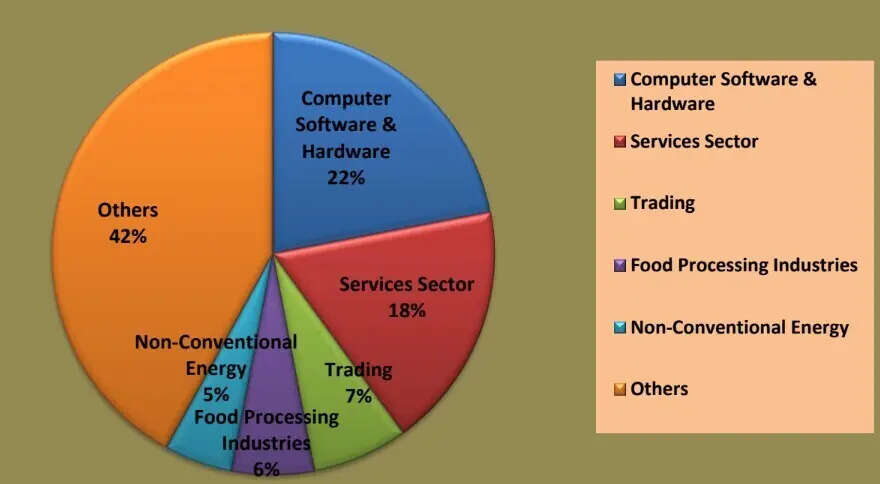
India’s total foreign direct investment (FDI), including equity inflows, reinvested earnings and other capital, has crossed $1.14 trillion since April 2000, according to government data. Fresh equity inflows alone stood at $776.75 billion during April 2000-December 2025.During April-February 2025-26, total FDI inflows crossed $88 billion. The services sector remains the largest FDI recipient, followed by software and hardware, telecom, trading, automobiles, construction and pharmaceuticals. Yet India continues to import large quantities of industrial machinery, electronic components, precision engineering goods and intermediate manufacturing products.

-

Sector-wise distribution of FDI equity inflows (April to December 2025)

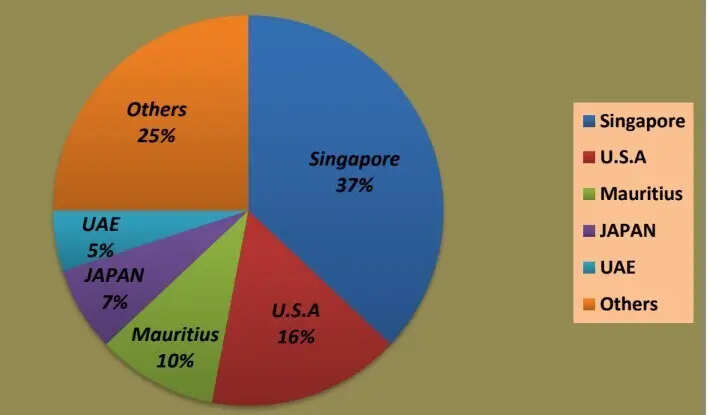
Singapore accounted for 37 per cent of FDI equity inflows during April-December 2025, followed by the US at 16 per cent and Mauritius at 10 per cent.

-

FDI equity inflow in top 5 countries, (April to December 2025)

At the same time, technology-intensive manufacturing economies such as Germany, South Korea and Taiwan continue to account for a relatively modest share of overall inflows.Policy analysts have argued that attracting a greater share of manufacturing-linked FDI from technology-exporting economies will be important if India wants to move beyond assembly-led growth towards deeper value addition and industrial capability building.Government officials increasingly acknowledge that without stronger domestic supplier ecosystems, India’s manufacturing expansion risks remaining dependent on imported intermediate goods and high-value components.

Faster approvals and easing FDI norms

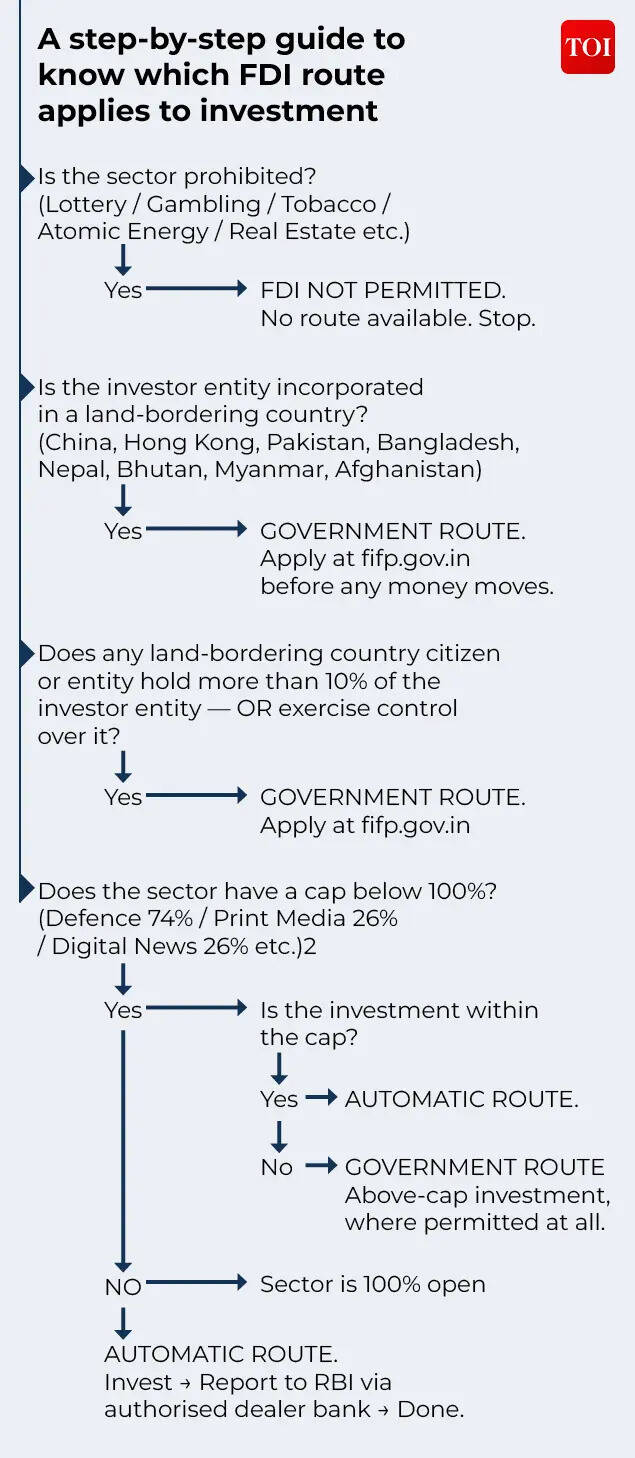
Alongside the manufacturing push, the government has updated its Standard Operating Procedure (SOP) for processing FDI proposals.Under the revised framework, all FDI applications requiring government approval are to be cleared within 12 weeks, compared with the earlier 10-week timeline prescribed in 2017.The process is also being made fully paperless through the National Single Window System portal.

-

The updated SOP further introduces stricter timelines for consultations with ministries and regulators such as the RBI, Ministry of Home Affairs and Ministry of External Affairs. In cases where comments are not received within the stipulated period, it will be presumed that the concerned department has no objections.The changes come after the government eased certain provisions linked to Press Note 3 (PN3) — the 2020 framework introduced after the Galwan clashes to scrutinise investments from countries sharing land borders with India.Under the latest relaxation, foreign companies with up to 10 per cent Chinese or Hong Kong shareholding can now invest through the automatic route in sectors already open to automatic FDI approval, provided the stake remains non-controlling.The government has also announced expedited 60-day clearances for investments in sectors such as capital goods, electronic components, advanced battery components, polysilicon wafers and rare earth processing.

Why FTAs are central to the strategy

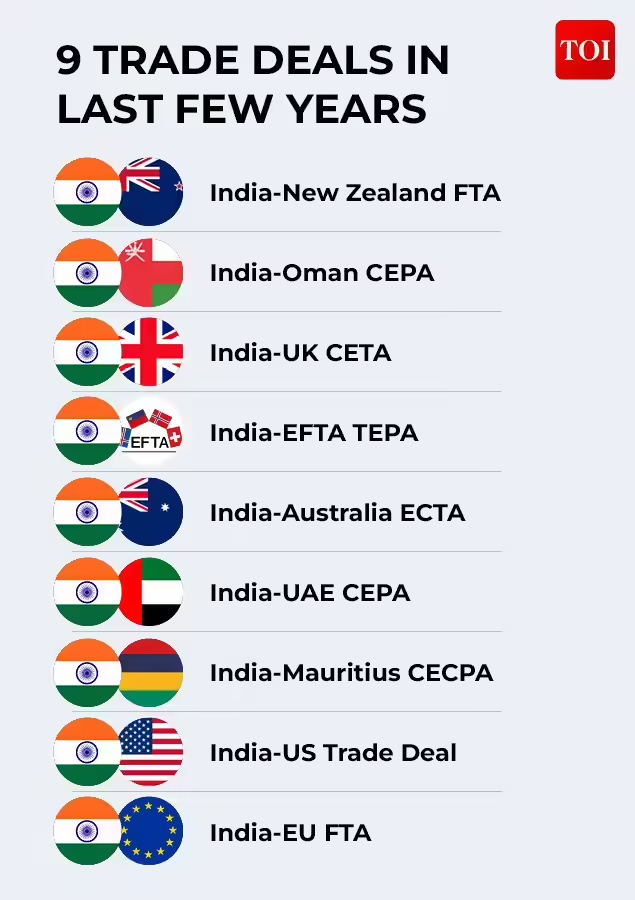
The manufacturing push is also closely linked to India’s expanding trade agreement network.Commerce Minister Piyush Goyal recently said India aims to take exports to $1 trillion in the current financial year after achieving record goods and services exports of $863.11 billion in 2025-26.India has concluded multiple FTAs in recent years, including agreements with the UAE, UK, Australia, New Zealand, Mauritius and the European Free Trade Association (EFTA) bloc, while negotiations continue with several other economies.

-

For policymakers, the strategy increasingly involves integrating investment, manufacturing and trade policy — attracting investment, strengthening supplier ecosystems, integrating Indian firms into global value chains and using FTAs to secure overseas market access.

The proposed ‘Made in India’ branding push

Alongside industrial reforms, DPIIT is also preparing to launch a “Made in India Brand Scheme”.The programme, currently being piloted in the steel sector, aims to create a quality-assurance and value-addition certification system supported by a common logo.Officials say the objective is not merely to label products as Indian-made but also to build greater global confidence around manufacturing quality and standards.The approach mirrors strategies previously adopted by countries such as Germany, Japan and South Korea, where manufacturing identity became closely associated with quality and reliability over time.

The bigger challenge

Despite the renewed policy push, India’s manufacturing sector continues to face structural constraints that have persisted for decades. Manufacturing’s contribution to GDP has largely remained stuck in the 15-17 per cent range over the past two decades, well below the ambitions outlined in the National Manufacturing Policy, 2011, which had targeted raising the sector’s share to 25 per cent of GDP and generating 100 million jobs.While India has improved its ease of doing business, expanded infrastructure spending and rolled out production-linked incentives, industry continues to flag deeper bottlenecks ranging from high logistics costs and fragmented supply chains to regulatory complexity, uneven infrastructure quality, skill shortages, research & development, innovation and technology adoption like AI.DPIIT secretary Bhatia said that artificial intelligence is advancing fast and is affecting manufacturing through higher productivity and innovation.”We should be ready for that…world over, this change has been felt,” Bhatia said.A parliamentary standing committee on commerce, in a March 2026 report, urged stronger efforts to reduce import dependence in sectors such as electronics, crude petroleum and gold, while emphasising domestic value addition.“Department should undertake a strategic diversification of India’s merchandise export basket with a clear shift towards high-value sectors and emphasise the need to revitalising labour-intensive industries through targeted policy support and effective utilization of existing schemes.” ” The parliamentary standing committee on commerce noted.

The Committee further recommends strengthening of domestic manufacturing capabilities to reduce dependence on imports particularly in crude petroleum, gold and electronic components and also focus on capacity building measures and strengthening supply chain. Value addition initiative should be at priority to enhance competitiveness and improve overall trade balance with focus on real ‘Make in India’ and ‘Aatmanirbhar Bharat’

The parliamentary standing committee on commerce, March 2026 report.

The Economic Survey 2025-26 similarly argued that manufacturing capability should increasingly be treated as a strategic national asset, with the state playing a larger coordinating and capability-building role.The challenge for India, therefore, is no longer limited to attracting factories. It increasingly involves building complete industrial ecosystems capable of competing with established global manufacturing networks.As India advances towards its long-term economic ambitions, policymakers appear to be recognising that the next phase of manufacturing growth may depend less on headline investment announcements and more on whether the country can successfully localise the products, components and technologies it still imports at scale.


Nietzsche said free will is a lie but in 2026 it is a vibe

0
Nietzsche said free will is a lie but in 2026 it is a vibe


What does it mean to have free will in 2026?Why are young people across the world filming themselves eating lunch on ladders, rearranging their homes into fake hotel suites, or doing completely irrational everyday activities simply because they can?And how did a 19th-century philosopher who believed human beings were never truly free become strangely relevant to a generation raised by algorithms, lockdowns, surveillance and social media?Across social media, thousands of young users are posting videos under captions such as “POV: You suddenly realise you have free will”. The intent is to carry out the daily mundane activities in deliberately impractical but harmless waysVideos of people climbing the maintenance ladder while having lunch just to finish the meal in the air or other laying out buffets of the same meal just to recreate a wedding vibe have become a well-participated trend.What looks like unserious internet humour has almost become an emotional reaction to a world that feels increasingly controlled by economics, technology, politics and invisible systems.In a time when algorithms predict behaviour, governments shape consumption habits during crises and social media constantly influences thought patterns, free will is no longer viewed as a stable philosophical truth. For the new generation, it has become a feeling, a performance and, in many ways, a vibe.

From philosophy to TikTok rebellion

Long before social media transformed rebellion into short-form content, German philosopher Friedrich Nietzsche had already questioned whether free will existed at all.In his 1886 work Beyond Good and Evil, Nietzsche argued that human beings do not make choices in the pure, independent way they imagine. Instead, he believed people are shaped by instincts, conditioning, emotions, physiology and social structures that operate beneath conscious awareness. According to Nietzsche, free will was less a spiritual truth and more a psychological sensation.“The will is not only a complex of feeling and thinking, but it is above all an emotion, and in fact the emotion of the command,” Nietzsche wrote.In simple terms, Nietzsche believed people experience freedom when one desire inside them defeats another. A person feels powerful not because they escaped cause and effect, but because they managed to overpower competing impulses within themselves.That framework unexpectedly mirrors the current internet trend.A person eating lunch on a ladder is not operating outside social conditioning. Rather, they are experiencing the thrill of temporarily defeating the instinct to behave normally. The action itself may be meaningless, but the feeling attached to it is emotionally real.

A generation shaped by crises and control

This modern obsession with “performative autonomy” is emerging at a time when many young people feel their actual control over life has sharply decreased.The Covid-19 pandemic left a lasting psychological mark on an entire generation. Lockdowns suddenly restricted movement, social gatherings and everyday behaviour. Basic actions such as travelling, meeting friends, or simply being outside became matters of public regulation. As trainee clinical psychologist Yukta Sharma puts it, “Free will feels less like “I can do anything I want” and more like: “With all the limitations that the world is placing on me, what are things that I can still choose to do happily and not feel guilty or ashamed or wrong about doing and find satisfaction and joy, without offending anybody in?”,” as she adds that these were the very things that shaped the generation’s response to the Covid-19 lockdown.And while many accepted these measures as necessary for public health, Suyog Shetti, 26, recalls resisting social pressure during the Covid pandemic.“I think people still have free will,” Shetti maintains. “People’s own fear and self-consciousness are what hold their free will back. Like during Covid, I didn’t take the vaccine. Although everyone was telling me to, I felt some scam was happening and thought the whole situation was a tool being used to push the vaccine on us.”

Pop culture and collapse of certainty

Popular culture has started reflecting this anxiety in increasingly direct ways.Indian comedian Kenny Sebastian has repeatedly explored the absurdity of human behaviour through observational comedy. His routines often focus on how people unconsciously follow social scripts in relationships, public spaces and daily interactions.Fantasy-comedy series Good Omens also explores similar philosophical territory. Based on the novel by Neil Gaiman and Terry Pratchett, the show questions whether human beings genuinely possess agency or merely act within systems controlled by larger cosmic structures. Throughout the story, characters constantly struggle between obedience, fear and moral independence.Meanwhile, neuroscientist and author Sam Harris has become one of the most influential contemporary voices arguing that free will does not exist at all.Harris believes human thoughts arise from prior neurological and environmental causes that individuals never consciously chose. According to his framework, understanding the illusion of free will can actually become liberating. Instead of obsessively blaming themselves for every impulse, mistake or emotional reaction, people can develop greater self-awareness and compassion.For many young adults overwhelmed by the constant self-improvement culture, this perspective feels strangely comforting.The modern economy constantly tells people they are fully responsible for their success, productivity and happiness. At the same time, those same individuals are navigating unstable job markets, impossible housing costs, digital addiction and algorithmic manipulation. The contradiction creates emotional exhaustion.As a result, the idea that “free will is limited” no longer sounds depressing to many young people. Instead, it feels realistic.

What young people think free will means today

That realism becomes clearer when listening to how young adults themselves describe freedom.

The pragmatic view

For 26-year-old Kamal Mishra, free will exists, but only within practical limitations.“Free will is not absolute independence, but maximum ownership of one’s choices,” Mishra explains. “Free will is like having your own shop, where you are not bound by anyone else’s control, order, or dependency and you make your own decisions. But yes, you will have to open that shop to earn a living.”Mishra’s comparison reflects a broader generational compromise. Young adults may desire independence, but they also recognise that survival still depends on participating in economic systems they cannot fully escape.

The sceptical view

Others are far more sceptical.Aanshi Kanaujia, 25, believes modern information culture has deeply compromised individual thought.“I believe free will is a golden cage,” she says. “Most of our will is influenced by people, and rarely do individuals have their own mind. Yes, it is polarised to a great extent, especially in this era of unstoppable information consumption, where our will and thinking are systematically borrowed from someone else. Yes, there are some doing their own mind, but that’s not a big number. The question is: Is your thought of free will truly yours?”Her argument reflects growing concerns around algorithmic influence.Social media platforms increasingly curate what users watch, buy, believe and discuss. Recommendation systems shape political opinions, aesthetics, humour and even emotional reactions. As these systems become more sophisticated, distinguishing personal desire from manufactured preference becomes increasingly difficult.

The fatalist view

For some, this has produced outright fatalism.“Free will does not exist; it’s just an illusion,” says 26-year-old Sumant Singh. “Everything depends entirely on the situation, and that same situation decides our will. Overall, nothing is ‘free.’ My thoughts might sound a bit extreme, but I feel this is the ultimate reality.”Singh’s view reflects a generation raised amid repeated crises.Many people currently in their mid-to-late twenties entered adulthood during economic uncertainty, climate anxiety, political polarisation and a global pandemic. The belief that individuals fully control their destinies feels increasingly disconnected from lived reality.

The restrained view

Yet not everyone believes freedom has disappeared entirely.Some young adults argue that free will survives in smaller forms.Chirag Thakur, 27, describes free will as the pause between impulse and action.“I think free will is like any other power or impulse that you have, which is often restrained by your mind which is, of course, a necessity,” Thakur states. “Without the mind as the charioteer, it would be like an aimless chariot, which can be chaotic and quickly turn into a disaster. In any ‘free will’ decision, the pause that makes you think about whether to do it or not is the real free will. And of course, this can change with changes in region, society, and circumstances.”His interpretation aligns closely with modern mindfulness practices, where awareness itself becomes a form of agency.Rather than viewing freedom as unlimited action, many younger people now define it as conscious interruption. In a world designed to trigger instant reactions, the ability to stop, reflect and resist impulse feels increasingly valuable.

The structuralist view

At the same time, conversations around free will are also becoming deeply political.Srabastee Biswas, 25, argues that freedom is unevenly distributed and shaped heavily by class, gender and social privilege.“Free will is not absolute, total independence,” Biswas argues. “It is more like what one creates out of the given resources and only where access is allowed to choose for themselves. If we take a feminist point of view, that space has never been equal. Gender roles, safety concerns, and economic gaps, especially for women and marginalized people, have always created a narrower lane of acceptable choices.”Biswas believes recent years have exposed just how fragile autonomy can be.“When we look at our generation, we’ve witnessed massive backtracks of individual rights, from the stripping away of bodily autonomy and reproductive freedom to economic crises and a massive surge in digital surveillance. This reveals how incredibly fragile it truly is. When the state deprives people of basic rights and autonomy, so-called free will becomes a luxury accessible only to the privileged class. For many of us, practicing free will isn’t just picking what we want, it’s questioning the central belief of what we were told to want.”Her comments reflect a broader shift in how younger generations discuss freedom.For previous generations, free will was often framed as personal ambition or individual achievement. For many Gen Z adults, however, freedom is increasingly understood through systems of power. Access to safety, money, healthcare, privacy and rights now determines how much autonomy someone can realistically exercise.

The commercial view

The role of technology in shaping behaviour remains one of the strongest recurring concerns.Riddhi Jain, 25, believes modern consumer culture actively narrows independent thought.“We don’t move by free will,” Jain reflects. “In my opinion, it’s like the more choices we are presented with, the more our actual free will is limited. We are not just influenced; we are rather controlled by brands and conditioned to think about things in a very specific, curated way.”Her observation reflects what psychologists often call the paradox of choice.While digital platforms offer endless options, many users ultimately end up following highly predictable patterns shaped by advertising, trends and algorithmic recommendations.Ironically, this has also made small acts of irrationality feel emotionally significant.Choosing to behave inefficiently, absurdly or unpredictably becomes a way of resisting optimisation culture. In a world obsessed with productivity, branding and measurable outcomes, doing something pointless simply because it feels amusing can feel deeply personal.

The subversive view

At the opposite end of the spectrum, some young adults believe the greatest act of autonomy today may simply be disengagement.“Our generation grew up with algorithms, lockdowns, trends, and constant chaos deciding things for us,” says 25-year-old Anurag Krishna. “So honestly, maybe real free will today is me choosing not to answer this question at all… which I almost did out of pure freedom.”That quiet refusal captures the exhaustion sitting beneath many contemporary conversations about agency.Young adults today are constantly asked to perform opinions, maintain online identities, produce content, optimise careers and remain permanently visible. In such an environment, withdrawal itself can feel rebellious.

The rise of micro-rebellions

This is precisely why the internet’s strange “free will” trend resonates so strongly.The videos are not revolutionary in any traditional political sense. Nobody is overthrowing governments by eating noodles on ladders or pretending their bedroom is a five-star resort.Yet these acts matter symbolically because they interrupt predictability.Algorithms thrive on patterns. Modern institutions thrive on compliance. Consumer economies thrive on habit. Absurd behaviour momentarily breaks those systems, even if only emotionally.In that sense, Nietzsche’s philosophy has accidentally found new life online.He believed free will was never pure freedom. It was merely the sensation of command, the emotional experience of asserting one desire over another.Today’s generation appears to have transformed that insight into cultural practice.They may fully understand that algorithms influence them, capitalism constrains them and crises shape their futures. They may even agree that absolute autonomy is impossible.But instead of responding with complete despair, many are choosing irony, absurdity and micro-rebellion.The result is a generation that no longer treats free will as a grand philosophical certainty.Instead, free will has become something smaller, stranger and more emotional.It is the pause before reacting.It is the decision to log off.It is refusing to optimise every second of existence.It is questioning inherited desires.And sometimes, it is climbing halfway up a maintenance ladder with a plate of lunch in hand simply to remind yourself that, despite everything, you can still choose to do something completely pointless.For Nietzsche, free will may have been an illusion.For Gen Z, the illusion itself has become the experience.