Sunday, September 27, 2026
Home Blog Page 377

‘It’s not COVID-19’: Why your boss isn’t ready to approve working from home yet explainer news

0
‘It’s not COVID-19’: Why your boss isn’t ready to approve working from home yet explainer news


Last updated:

While Covid-era WFH was about survival, the current pressure is about economics. This creates a very different policy mindset

There is no legal order forcing companies to close offices or allow remote work. This means that companies, not governments, will decide how far WFH will go. (AI-generated image)

“We worked completely from home during COVID-19. Why can’t we do it again?” Across offices in India, this has become a familiar question Prime Minister Narendra Modi Urged companies and employees to revive the practice of working from home to help save fuel amid rising global oil prices.

But for many workers hoping to return to pandemic-style remote work, the response from employers has been clear: It’s not Covid-19. And that difference is why India is unlikely to see another Nationwide WFH Revolution Like the one that changed workplaces in 2020.

At that time, offices were closed as governments imposed lockdowns during the public health emergency. Companies had no option but to send employees home. Today’s situation is very different. The current pressure is voluntary, economically motivated and largely dependent on whether the companies themselves want to allow it or not.

Read this also Work from home, vocal for local and more: India rethinks Covid-era lessons amid US-Iran war

This means employees can use their successful COVID-era remote work record as an argument, but companies still make the final decision. If bosses agree, the result is likely to be selective hybrid flexibility, not a return to a permanent culture of empty offices and working from home.

voluntary, not mandatory

The biggest difference is simple: No one is being forced to stay at home.

During COVID-19, offices closed as governments imposed lockdowns under emergency laws. Companies had little choice but to shift operations online.

But in 2026, PM Modi’s comment is an appeal The “voluntary public cooperation” aims to reduce fuel consumption and conserve foreign exchange reserves amid high crude oil prices.

Read this also From airlines to gold: PM Modi’s speech has put 5 sectors on alert

There is no legal order forcing companies to close offices or allow remote work. This means that companies, not governments, will decide how far WFH will go.

And many employers are already signaling caution. According to Business Standard, manufacturing firms, retail chains and operations-intensive sectors argue that widespread remote working complicates supervision, shift planning and on-ground coordination.

WFH has no legal right

A big misconception after the pandemic was that remote work had become a permanent employee privilege.

Legally this never happened.

News18 had reported this indian labor law Employees are still not given the statutory “right to work from home”. In most employment contracts, employers retain managerial authority over where work is performed. This means companies can allow WFH, restrict it, convert it to hybrid, or cancel it altogether.

Unless an appointment letter explicitly guarantees permanent remote work, employers can legally insist on office attendance.

This is why PM Modi’s comments matter politically and symbolically, but do not automatically translate into enforceable workplace rights.

Even employee groups acknowledge this limitation. The nascent Information Technology Employees Senate (NITES) has formally urged the Labor Ministry to issue a Mandatory WFH Advice For India’s 5.8 million IT/ITES workforce, as no such right currently exists.

India Inc has spent years reversing pandemic WFH

Time also matters.

By the beginning of 2026, many of India’s largest IT companies had already completed a major return-to-office exercise. According to The Times of India, major companies including TCS, Infosys and Wipro had either reinstated five-day office schedules or tightened hybrid attendance rules after years of gradual office returns.

For management teams, reversing those policies again is considered disruptive.

Companies now argue that Collaboration works better than individuallyJunior employees learn faster physically, team cohesion is weaker remotely, and long-term innovation suffers without in-office interaction.

Business Standard reported that many companies now view pandemic-era WFH as an emergency arrangement rather than a sustainable long-term operating model.

‘Can’t compare crises’

While Covid-era WFH was about survival, the current pressure is about economics.

According to News18, the government’s concerns today are to reduce fuel demand, ease urban congestion and manage pressure from volatile oil markets due to geopolitical tensions in the Middle East.

This creates a very different policy mindset.

The aim was to prevent physical activities during Covid-19. The aim is to reduce unnecessary traffic by 2026. That difference means the government is unlikely to support closing offices across the country.

Instead, the current appeal primarily targets urban commuters, metro cities, fuel-heavy traffic corridors and areas where remote work is operationally possible.

Moneycontrol’s report identifies IT, consultancy, ed-tech, digital media and back-office BFSI operations as sectors that are best able to shift to remote work rapidly.

Hybrid work is the real goal

The likely outcome is not “WFH 2.0” but hybrid expansion.

According to The Economic Times, many companies are open to one or two additional remote days, staggered office hours, less non-essential travel and temporary flexibility during periods of fuel stress.

Industry body Nasscom has said member companies are already enabling remote or hybrid work “where operationally appropriate”, while also making efforts to optimize energy use on campuses.

That wording matters. “Operationally fit” means that companies still retain sanity.

Experts quoted by The Times of India and The Economic Times expect companies to adopt a middle-ground model with flexible attendance, role-based remote work, selective WFH during fuel spikes, but not office closures.

Entire urban economies now depend on office attendance

In contrast to the pandemic, governments and businesses today are also thinking about the broader economic ecosystem built around offices.

Business districts support transportation operators, restaurants, cafes, delivery workers, rental markets, commercial real estate and thousands of informal jobs.

Business Standard reported that prolonged mass WFH could harm these office-dependent ecosystems, which is one reason why governments and corporates are reluctant to adopt Covid-scale remote work again.

“Successfully worked from home” is not a good enough reason

During COVID-19, millions of Indians proved that large parts of the economy can work remotely. But companies now counter that argument differently.

Employers are increasingly saying that while individual productivity may have been strong, mentorship, culture building and seamless collaboration have weakened over time.

This is why many companies now support it hybrid work Instead of completely remote structures.

Even though employees can cite successful remote performance during COVID-19, labor experts say it still does not create a legal right to WFH without a contractual guarantee or government mandate.

Employee groups like NITES are now lobbying for more formal protections, while some advocates point to emerging remote-work frameworks like the “Employees’ Welfare Act, 2026” to argue for standardized urban WFH practices.

But as of now, the final decision is up to the employers.

No relief?

The pandemic normalized remote work in India. But it did not permanently transfer control over workplace policies from companies to employees.

Covid-era WFH happened because governments locked down the country. The 2026 call is an economic appeal asking companies and workers to voluntarily reduce fuel consumption.

This means companies will take decisions, hybrid work is likely to expand selectively, and any new WFH phase will be far more limited, temporary and employer-controlled than the remote-work revolution India experienced during COVID-19.

news explainer ‘It’s not COVID-19’: Why your boss may not be ready to approve working from home yet
Disclaimer: Comments represent the views of users, not of News18. Please keep discussions respectful and constructive. Abusive, defamatory, or illegal comments will be removed. News18 may disable any comments at its discretion. By posting you agree with us terms of use And Privacy Policy.

read more


Israel passes law to allow death penalty and public trials for those linked to October 7

0
Israel passes law to allow death penalty and public trials for those linked to October 7


“Look, this law is cruel, it’s a law that tries to take away the hope that you’re living on,” Hisham al-Wahad, the brother of missing journalist Haitham al-Wahad, told the BBC. “We as families of prisoners and families of the missing are calling on states and public opinion – international, Arab and Islamic – to take action to stop such a law and such a matter.”


US, UK sanctions target Iran-linked network accused of plotting attacks and moving funds

0
US, UK sanctions target Iran-linked network accused of plotting attacks and moving funds


US, UK sanctions target Iran-linked network accused of plotting attacks and moving funds

The United States and the United Kingdom on Monday announced seperate sanctions aimed at increasing pressure on Iran by targeting individuals, companies and networks accused of facilitating oil sales, financial transactions and “hostile activities”.The US measures focus on disrupting Iran’s oil exports to China and cutting off funding linked to the Islamic Revolutionary Guard Corps, while also tightening restrictions on front companies and intermediaries.The UK, meanwhile, targeted Iran-linked individuals and entities accused of shadow banking, financing destabilising activities and conducting operations linked to criminal and proxy networks, with both countries seeking to limit Tehran’s financial reach and international operational capacity.

Watch

Iran Threatens U.S. Surrender as Oil Prices EXPLODE!| OPEN COLLAR

US sanctions on Iran

The US imposed sanctions on 12 individuals and entities it said were involved in facilitating the sale and shipment of Iranian oil to China, just days ahead of US President Donald Trump’s visit to Beijing.In a statement, the US Treasury said Iran’s Islamic Revolutionary Guard Corps (IRGC) “relies on front companies in permissive economic jurisdictions to obfuscate its role in oil sales and funnel the revenue to the Iranian regime.”The measures cover three Iran-based individuals and nine companies based in Hong Kong and the United Arab Emirates.Any US-based assets belonging to those designated will be blocked, while American individuals and companies are prohibited from engaging in transactions with them.US Treasury Secretary Scott Bessent said, “As Iran’s military desperately tries to regroup, Economic Fury will continue to deprive the regime of funding for its weapons programs, terrorist proxies, and nuclear ambitions,” referring to the ongoing pressure campaign.The sanctions come amid continuing disruption to global energy flows, with Tehran having effectively blocked the Strait of Hormuz, a key passage through which nearly a fifth of the world’s oil and gas is transported.While the US eased some restrictions on Iranian oil in March to address global supply concerns, it has since reinstated tighter measures.A significant portion of Iranian oil continues to flow towards Asia, with China remaining one of its largest importers and a key trading partner.The timing of the US action comes ahead of President Trump’s visit to Beijing later this week, where he is expected to meet Chinese President Xi Jinping for talks focused largely on trade disputes.Iran is also expected to feature in discussions, with Washington seeking greater pressure from Beijing on Tehran.Earlier, the US State Department sanctioned three China-based satellite companies on Friday over alleged support for Iran’s military operations, while the Treasury has previously targeted firms in mainland China and Hong Kong linked to Iranian weapons supply chains.

UK sanctions on Iran

Separately, the United Kingdom on Monday imposed sanctions on 12 Iran-linked individuals and entities accused of involvement in “hostile activities” against the UK and other countries.The UK Foreign Office updated its sanctions list to include nine individuals, two shadow banking exchange houses, and the Zindashti network, which it described as criminal.The UK had already sanctioned alleged network leader Naji Ibrahim Sharifi-Zindashti in 2024 alongside the United States, identifying him as head of an international drug and trafficking cartel.The European Union sanctioned the same network last year, with London, Washington and Brussels all alleging links to Iran’s Ministry of Intelligence and Security and accusing it of involvement in assassination and kidnapping operations targeting critics of Tehran.The latest UK measures come amid a series of recent incidents targeting the Jewish community in Britain, with officials warning that hostile states are increasingly using proxy networks.Among those sanctioned was Ekrem Abdulkerym Oztunc, a Turkish national and nephew of Zindashti.The UK also targeted five members of the Zarringhalam family: Farhad, Fazlolah, Mansour, Nasser and Pouria, accusing them of helping finance efforts to “destabilise” the country.Mansour, Nasser and Fazlolah Zarringhalam were previously sanctioned by the United States last year for their role in Iran’s “shadow banking” system.The US Treasury stated that the trio had “collectively laundered billions of dollars” for Iran through front companies operating in the United Arab Emirates and Hong Kong.London also added Berelian Exchange and GCM Exchange, both Iran-based exchange houses previously sanctioned by the US, to its sanctions list due to their links to the same network.Other individuals sanctioned by the UK include Iranians Nihat Abdul Kadir Asan and Reza Hamidiravari, along with Azerbaijani national Namiq Salifov, all of whom face travel bans and asset freezes.


Tamil Nadu, Kerala Government News Live: Vijay issues huge order for liquor in Tamil Nadu; Still no Chief Minister of Kerala has been elected by Congress

0
Tamil Nadu, Kerala Government News Live: Vijay issues huge order for liquor in Tamil Nadu; Still no Chief Minister of Kerala has been elected by Congress


Updated: May 12, 2026 10:35:41 am IST

Top: Leader of Opposition in Kerala Assembly VD Satheesan, with state party unit chief Sunny Joseph, party general secretary KC Venugopal and senior Congress leader Ramesh Chennithala. Below: Newly appointed Chief Minister of Tamil Nadu C Joseph Vijay

Tamil Nadu, Kerala Government News Live Updates: More than a week after the UDF got a decisive victory in the Kerala Assembly Elections 2026 results, the Congress is yet to reach a consensus and announce its choice for the chief minister’s post, for which there are reportedly three main contenders – KC Venugopal, VD Satheesan and Ramesh Chennithala.

The Congress-led United Democratic Front returned to power in Kerala on May 4 after a decade of Left rule. However, the party has so far failed to choose a chief ministerial candidate for the state.

Meanwhile, actor-turned-politician C Joseph Vijay or ‘Thalapathy’ Vijay was sworn in as the Chief Minister of Tamil Nadu on May 10 after a four-day long struggle to reach the majority mark of 118 in the 234-member state assembly. His party won 108 seats in the Tamil Nadu elections, 10 short of the magic figure.

Tamil Nadu, Kerala Government News | key points

-While suspense continues over the Kerala Chief Minister, several Congress leaders have reportedly gone to Delhi to discuss and choose the new leadership of Kerala, even as most of them have maintained silence about who might get the post.

-The discussions were expected to take place on Tuesday as former Kerala Congress chiefs K Muraleedharan and VM Sudheeran confirmed they would be in Delhi for the discussions at the invitation of the high command.

-Ever since the Congress-led faction in Kerala won 102 of the total 140 seats in the state assembly, several names have emerged as potential candidates for the post of chief minister – the most prominent: KC Venugopal, VD Satheesan and Ramesh Chennithala.

-In Tamil Nadu, actor-politician and Tamilaga Vetri Kazhagam (TVK) supremo Vijay took oath as the Chief Minister on Sunday, May 10. Since then he has issued several orders, the most recent of which is to close 717 TASMAC liquor shops located within 500 meters of places of worship, educational institutions and bus stations.

-Currently, 4,765 liquor retail shops are being operated by Tamil Nadu State Marketing Corporation (TASMAC). Of these, CM Vijay ordered an audit to identify shops located within 500 meters of places of worship, educational institutions and bus stations, an official release said on Tuesday.

…read more

The Congress-led United Democratic Front returned to power in Kerala on May 4 after a decade of Left rule. However, the party has so far failed to choose a chief ministerial candidate for the state.

Meanwhile, actor-turned-politician C Joseph Vijay or ‘Thalapathy’ Vijay was sworn in as the Chief Minister of Tamil Nadu on May 10 after a four-day long struggle to reach the majority mark of 118 in the 234-member state assembly. His party won 108 seats in the Tamil Nadu elections, 10 short of the magic figure.

Tamil Nadu, Kerala Government News | key points

-While suspense continues over the Kerala Chief Minister, several Congress leaders have reportedly gone to Delhi to discuss and choose the new leadership of Kerala, even as most of them have maintained silence about who might get the post.

-The discussions were expected to take place on Tuesday as former Kerala Congress chiefs K Muraleedharan and VM Sudheeran confirmed they would be in Delhi for the discussions at the invitation of the high command.

-Ever since the Congress-led faction in Kerala won 102 of the total 140 seats in the state assembly, several names have emerged as potential candidates for the post of chief minister – the most prominent: KC Venugopal, VD Satheesan and Ramesh Chennithala.

-In Tamil Nadu, actor-politician and Tamilaga Vetri Kazhagam (TVK) supremo Vijay took oath as the Chief Minister on Sunday, May 10. Since then he has issued several orders, the most recent of which is to close 717 TASMAC liquor shops located within 500 meters of places of worship, educational institutions and bus stations.

-Currently, 4,765 liquor retail shops are being operated by Tamil Nadu State Marketing Corporation (TASMAC). Of these, CM Vijay ordered an audit to identify shops located within 500 meters of places of worship, educational institutions and bus stations, an official release said on Tuesday.

Follow all updates here:

May 12, 2026 10:35:40 am First

Kerala CM announcement news live: Split in AIADMK? Anti-EPS faction supports Vijay, insists on MLA ‘majority’

Kerala CM announces news LIVE: Actor-turned-politician Vijay’s spectacular political rise has created a complete internal crisis within the AIADMK, with rival camps now openly sparring over whether to support the new Tamil Nadu government or continue under party chief Edappadi K Palaniswami.

Just days after Vijay was sworn in as Chief Minister, a major faction within the AIADMK publicly supported his government, exposing deep divisions in the party that once dominated Tamil Nadu politics.

The AIADMK faction led by senior leaders CV Shanmugam and SP Velumani on Tuesday announced support to the ruling Tamilaga Vetri Kazhagam government. Congratulating the new Chief Minister and supporting the government, Shanmugam said, “The people’s mandate is not for TVK. The mandate is for Vijay to become the Chief Minister.”

The faction also claimed that a majority of the party’s 47 MLAs are supporting them and not party chief Edappadi K Palaniswami. The camp stressed that while the EPS retained the support of only 20-22 MLAs, the majority of the MLAs favored ceding support to the Vijay-led TVK government in the interest of political stability. Read more.

May 12, 2026 10:25:57 am First

Kerala CM’s announcement News Live: VCK welcomes TVK’s action on liquor

Kerala CM’s announcement News Live: VCK welcomes Tamil Nadu government’s order to close over 700 government-run retail liquor shops in the state. MLA Vanniyarasu praised CM Vijay for this step.

May 12, 2026 10:23:23 am First

Kerala CM announces news LIVE: No alliance with anyone other than DMK, says AIADMK’s CV Shanmugam

Kerala CM announces news LIVE: AIADMK’s CV Shanmugam said he and his party faction are “not in alliance with any party except TVK”.

May 12, 2026 10:16:11 am First

Kerala CM announcement News Live: BJP mocks Congress over failure to choose CM

Kerala CM announcement News Live: Pending On Kerala CM announcement, BJP national spokesperson Shehzad Poonawalla mocked the Congress for not reaching a consensus and said, “…Congress has got the absolute majority. Even after so many days, the Congress party has not been able to decide who will be the Chief Minister. It is being said that Priyanka Gandhi, under pressure from the Jamaat, is putting forward the name of VD Satheesan, while Rahul Gandhi is putting forward the name of KC Venugopal. Moving the name forward.”

Speaking to ANI news agency, Poonawalla said some people are bringing forward Ramesh Chennithala, and added that “some people want to make Shashi Tharoor the chief minister”.

He said, “It seems that the Congress party has planned to give five chief ministers in five years…”

May 12, 2026 10:12:09 am First

Kerala Chief Minister Announcement News Live Updates: Who is leading the race?

Ever since the Congress-led faction in Kerala won 102 of the total 140 seats in the state assembly, several names have emerged as possible candidates for the post of chief minister.

The party is in internal talks to decide the selection of its Kerala Chief Minister, for which senior leaders KV Venugopal, VD Satheesan and Ramesh Chennithala are said to be the main contenders.

Discussions are expected to take place in Delhi today as former Kerala Congress chiefs K Muraleedharan and VM Sudheeran have confirmed that they will be in the city for talks on the CM post at the invitation of the high command.

May 12, 2026 10:06:45 am First

Tamil Nadu Government News Live: CM Vijay orders closure of over 700 TASMAC liquor shops

Tamil Nadu Government News Live: Newly appointed Tamil Nadu Chief Minister Vijay on Tuesday issued orders to close 717 TASMAC liquor shops located within 500 meters of places of worship, educational institutions and bus stations, the government said on Tuesday.

It said the order should be implemented within two weeks for the welfare of the public.

“Currently, 4,765 liquor retail shops are being operated by the Tamil Nadu State Marketing Corporation (TASMAC). Of these, Tamil Nadu Chief Minister S Joseph Vijay has ordered an audit to identify shops located within 500 meters of places of worship, educational institutions and bus stations,” an official release on Tuesday said. Read full report Here

May 12, 2026 9:56:09 am First

Kerala Chief Minister News Live: Still no Chief Minister chosen by Congress

Tamil Nadu, Kerala Government News Live: Congress has not announced the post of Kerala Chief Minister even a week after the assembly election results were declared in which the party-led UDF alliance won the decisive mandate.

The Congress-led United Democratic Front returned to power in Kerala on May 4 after a decade of Left rule.


California ex-mayor admits acting as agent of China, US authorities say | Crime News

0
California ex-mayor admits acting as agent of China, US authorities say | Crime News


Ex-mayor of wealthy Los Angeles suburb promoted pro-China propaganda at behest of Chinese officials, prosecutors say.

The former mayor of a wealthy suburb in the United States city of Los Angeles has admitted to acting as an illegal agent of China, according to authorities.

Eileen Wang, the former mayor of Arcadia, agreed to plead guilty to one count of acting as an illegal agent of a foreign government from late 2020 until 2022, the US Department of Justice said on Monday.

Recommended Stories

list of 4 itemsend of list

Wang admitted that she did not notify the US government that she was acting on behalf of China while promoting pro-Beijing propaganda, the Justice Department said.

Wang, 58, operated a website, called the US News Center, that published content supportive of the People’s Republic of China (PRC) while purporting to provide news for Chinese Americans, the department said.

Wang ran the site with Yaoning Sun, a Californian man who was sentenced to four years in prison after pleading guilty to acting as an illegal agent of a foreign government in October 2025, according to US prosecutors.

Wang’s activities included republishing a “PRC official-written essay” that denied allegations that the Chinese government was committing genocide against ethnic-minority Uighurs in its far-western region of Xinjiang, according to prosecutors.

Wang resigned as mayor on Monday, according to a statement published on the City of Arcadia’s website.

She faces a maximum penalty of 10 years in prison.

Her lawyers, Brian A Sun and Jason Liang, said Wang wished to apologise for “mistakes she has made in her personal life”.

“It is important to note, however, that the conduct underlying the information and the agreement with the government relates solely to Ms. Wang’s personal life – i.e., a media platform that she once operated with someone whom she believed to be her fiancé – and not to her conduct as an elected public official,” Sun and Liang said in a statement.

“Her love and devotion for the Arcadia community have not changed and did not waver,” they added.

“She asks for the community’s understanding and continued support.”

US Assistant Attorney General for National Security John A Eisenberg issued a statement expressing deep concern over Wang’s activities.

“Individuals elected to public office in the United States should act only for the people of the United States that they represent,” he said.

“It is deeply concerning that someone who previously received and executed directives from PRC government officials is now in a position of public trust at all, but particularly so because that relationship with that foreign government had never been disclosed.”

China’s embassy in Washington, DC, did not immediately respond to a request for comment.

Wang’s prosecution comes as US President Donald Trump and Chinese President Xi Jinping are set to meet in Beijing on Wednesday for a summit expected to focus on the US-Israel war on Iran, trade, and the status of Taiwan, among other issues.

The summit comes after the two leaders agreed to a yearlong pause in their trade war during a meeting in South Korea last October.


Sensex, Nifty open in the red again as worries over US-Iran war fallout continue

0
Sensex, Nifty open in the red again as worries over US-Iran war fallout continue


Indian markets opened sharply lower on Tuesday as rising crude oil prices and uncertainty around the ongoing United States-Iran war rattled investor sentiment, while concerns over inflation and foreign fund outflows added to the pressure.

Sensex and Nifty fell for a second day in a row (PTI)

The BSE Sensex opened at 75,573.63, down 441.65 points or 0.58%, tracking weak global cues and persistent worries over the economic impact of elevated oil prices.

The selloff follows a sharp decline in the previous session, when the Nifty 50 and Sensex fell 1.5% and 1.7%, respectively. The rupee also hit a record closing low of 95.31 against the US dollar on Monday.

Ten of the 16 major sectors logged losses. The broader small-caps and mid-caps dropped 0.5% and 0.3%, respectively.

Other Asian markets fell 0.5%, as oil prices rose to about $105 a barrel following U.S. President Donald Trump’s comment that the ceasefire with Iran was “on life support” after dismissing Tehran’s response to a U.S. peace proposal as “stupid”. [MKTS/GLOB]

Higher crude prices are detrimental for the world’s third-largest oil importer, as they exacerbate inflationary pressures and weigh on growth and corporate earnings.

Investors also awaited India’s April retail inflation data, due later in the day, which could offer clues on how the Iran war has affected price pressures in the economy.


China should stop hoarding food and fertiliser, says former World Bank chief

0
China should stop hoarding food and fertiliser, says former World Bank chief


David Malpass also said that Beijing’s claim to be a developing nation is no longer credible.


Top stocks to buy or sell today: Stock market recommendations for May 12, 2026 – check list

0
Top stocks to buy or sell today: Stock market recommendations for May 12, 2026 – check list


Top stocks to buy or sell today: Stock market recommendations for May 12, 2026 - check list
Top stocks to buy or sell today (AI image)

Stock market recommendations: Somil Mehta, Head of Retail Research at Mirae Asset ShareKhan has picked Max Healthcare Institute, and Coal India as the top stocks to buy today (May 12, 2026). AU Small Finance Bank is a sell call from the analyst.Max Healthcare Institute: Buy in the range between Rs 1040 & Rs 1041; Stop Loss: Rs 992; Target: Rs 1100The weekly chart shows a double bottom formation with a strong reversal candle. On the daily chart, the stock is breaking out of a consolidation zone after finding repeated support at the 20 and 40-day EMAs. Simultaneously, momentum indicators are showing a positive crossover above the zero line, confirming bullish strength. The main resistance is at 1060, and the key support is at 1000.AU Small Finance Bank: Sell in the range between Rs 1022 & Rs 1021; Stop Loss: Rs 1065; Target: Rs 956The weekly chart shows the stock consolidating in a broad range, while the RSI indicates a negative divergence. On the daily chart, there is a breakdown of the ascending trendline below the 10-day exponential moving average. Momentum indicators are showing a negative crossover, which suggests bearish weakness. The key resistance is at 1050, and the support is at 985.Coal India: Buy in the range between Rs 463 & Rs 464; Stop Loss: Rs 442; Target: Rs 500On the weekly time frame, the stock is forming a higher top and higher bottom pattern above the 20 and 40-week exponential moving averages. On the daily chart, it is taking support from the 40-day DEMA with a strong reversal candle. Momentum indicators are positive, showing bullish strength. The key resistance is at 475, and the support is at 450.(Disclaimer: Recommendations and views on the stock market, other asset classes or personal finance management tips given by experts are their own. These opinions do not represent the views of The Times of India.)


Roads blocked in Bolivia as protesters demand president’s resignation | Workers’ Rights

0
Roads blocked in Bolivia as protesters demand president’s resignation | Workers’ Rights


NewsFeed

Bolivia faces growing unrest as widespread road blockades disrupt travel across major cities including La Paz and El Alto. Protesters are demanding the resignation of President Rodrigo Paz amid fuel shortages, rising costs, and wage disputes.


Sensible ask, India Inc on PM Modi’s WFH appeal

0
Sensible ask, India Inc on PM Modi’s WFH appeal


Sensible ask, India Inc on PM Modi's WFH appeal

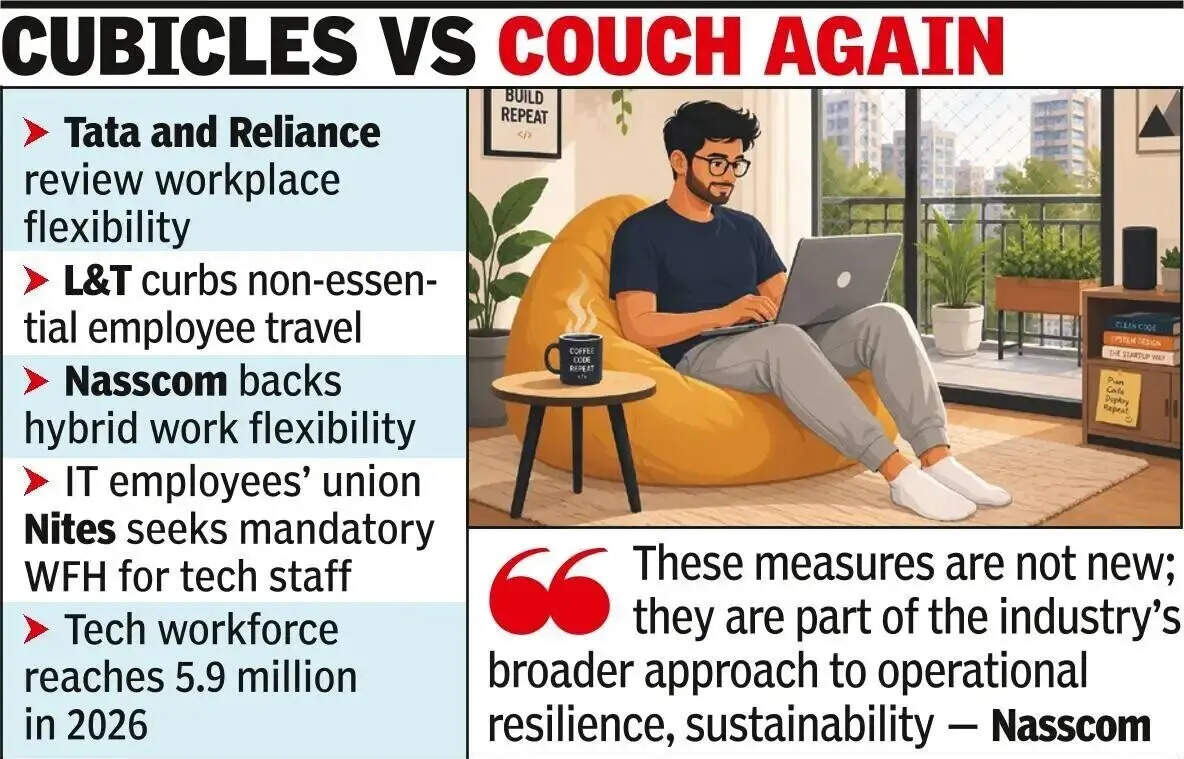
A day after Prime Minister Narendra Modi’s call for austerity measures to curb fuel consumption, including reviving work-from-home, companies have begun reviewing the possibility of getting at least some employees to come to office on fewer days.Large conglomerates, including the Tata Group and Reliance Industries, are reassessing workplace policies and exploring greater flexibility for employees amid ongoing concerns over fuel and supply disruptions.Reliance Industries, controlled by billionaire Mukesh Ambani, currently requires employees to work from office without a hybrid option. “We are assessing the situation,” a Reliance spokesperson said. The Tata Group is also said to be examining flexibility measures across several operating companies, though no broad group-wide decision has been taken.For infrastructure and engineering firms such as Larsen & Toubro and KEC International, the issue is more complex because a large section of employees work at project sites, making blanket work-from-home policies impractical. However, following the escalation in West Asia, L&T has issued internal advisories asking employees to avoid non-essential travel and conduct meetings virtually where possible.CII president Rajiv Memani, who is EY’s chairman for the India region, said PM’s message must be taken seriously. “I don’t view it as a crisis. I view this as a sensible and pragmatic ask to the country to ensure we are mindful of the current geopolitical challenges. One way is to moderate consumption and the PM’s request is to say that if we can moderate consumption, especially in areas where we are importing, we should take necessary measures.“Vir S Advani, chairman and managing director of Blue Star, said the measures may have a modest impact on business, but are in the country’s larger interest.But it may complicate return-to-office plans in the IT sector, where companies are steadily increasing office attendance mandates. Firms argue that working from office helps build social capital, strengthens collaboration, and improves productivity monitoring. India’s technology sector workforce rose by 1.3 lakh to 5.9 million in 2026. Many IT firms currently require employees to work from office two to five days a week under hybrid models.

.

Industry body Nasscom said the sector already operates on well-established hybrid models, balancing WFH and office attendance based on business and customer requirements. Amid the ongoing tensions, companies have stepped up energy-saving measures across campuses, including optimising non-essential power consumption, rationalising select facility services, and enabling remote or hybrid work where operationally feasible to reduce commuting and energy use.“These measures are not new; they are part of the industry’s broader approach to operational resilience and sustainability,” Nasscom said, adding that the sector’s distributed delivery models allow companies to operate seamlessly and flexibly when required.TCS, for instance, has mandated five days of office attendance and linked compliance to variable pay and career progression. Wipro requires employees to work from office at least three days a week, while HCLTech has mandated 12 compulsory in-office days a month. Cognizant, Tech Mahindra, and Capgemini have also tightened office attendance norms.Meanwhile, IT employees’ union Nites has urged the labour ministry to mandate work-from-home for the technology workforce.