The three time Oscar-winning filmmaker Steven Spielberg has revealed the reason behind shelving the sci-fi epic ‘Robopocalypse’. The director shared that he shelved the film because it was on course to become “the most expensive movie” he`d ever made.
The director wanted to bring Daniel H. Wilson`s 2011 novel to the big screen, but he worried it would be a “company-ender” if it failed to make back its estimated USD 200 million budget, reports ‘Female First UK’.
He told ‘Empire’ magazine, “It was gargantuan. It was a company-ender. It would have ended a whole studio that would have never made its money back”.
He further mentioned, “My company, DreamWorks, financed all these films, and I did not want to bring Robo into my own company, because it would have just been too expensive for us to produce. And then I took it out to other companies”.
“I didn’t want to pay for it, but other companies were interested in paying for it, as long as I was the director. The budget was so high that I didn’t want to do that to anybody because I couldn’t guarantee the audience. I couldn’t even hope for a crowd that big that would justify that kind of a financial overreach. So, I literally decided it was going to be the most expensive movie I ever directed, and I wasn’t ready to take that on”, he added.
As per ‘Female First UK’, the director went on to reveal he has plenty more sci-fi films he still wants to make and he still hopes to eventually make his first horror movie.
It comes after the director recently acknowledged he also wants to make a Western and he`s got a project already in development, teasing the film will have “horses and guns” but he is trying to steer away from other conventions and “tropes” typically associated with the genre, though he didn`t give any plot details.
Speaking with The Big Picture at SXSW in Austin, Texas last month, he said, “Well, I`m developing a Western. And it`s gonna have horses. There will be guns. But there`ll be no tropes, I can just tell you that. There are gonna be no stereotypes, no tropes”.
The Jaws director has long discussed his desire to work on a Western.
This story has been sourced from a third party syndicated feed, agencies. Mid-day accepts no responsibility or liability for its dependability, trustworthiness, reliability and data of the text. Mid-day management/mid-day.com reserves the sole right to alter, delete or remove (without notice) the content in its absolute discretion for any reason whatsoever
It is a community that has historically voted as a block, guided by the legacy and leadership of Matua matriarch Binapani Devi.
Thakurnagar: Matua temple and headquarters of the All India Matua Federation. (Image: News18)
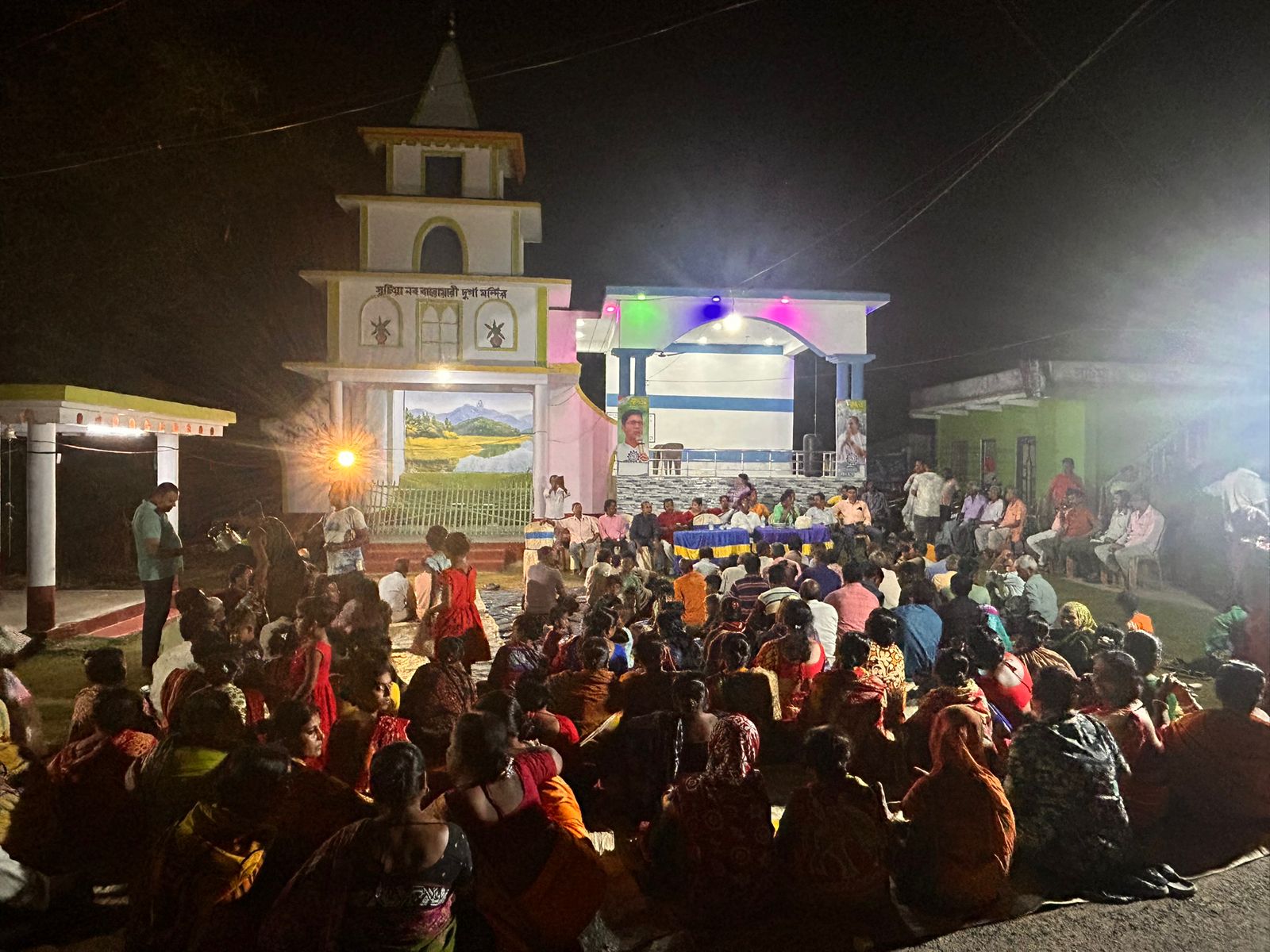
Elections in Matua Garh Thakurnagar (North 24 Parganas) have always been about identity. But in 2026, identity itself feels in danger. The political battle here is no longer just between parties, it is within families, within communities and increasingly within voter lists. Special Intensive Modification (SIR) has triggered mass extinction, and its impact has been intense in the Matua Belt. Booth level conversations are no longer about candidates or campaigns or even the All India Matua Sangh (the apex body of Matuas). They are now about names missing from the rolls, documents under investigation and growing concern over political invisibility.
It is a community that has historically voted as a block, guided by the legacy and leadership of Matua matriarch Binapani Devi. But today that unity is broken. The Matua vote is disintegrating not only politically, but also socially. And at the center of it all is a deep personal competition within the Thakur family.
Fractures are no longer metaphors. The political fight in constituencies like Gaighata and Bagda has turned into a family feud. At the center of this division are three members of the influential Thakur family, aligned with different political forces, each laying claim to the Matua inheritance. What was once a unified voice is now a contest of legacies.
This division has confused the community. For decades, Matua refugees remained united around a shared identity rooted in history and cultural claim. Today, that identity is being pulled in multiple directions by party lines, personal rivalries, and competing narratives of representation. Political parties, sensing the opportunity, have leaned into this divide. Campaigns here are no longer just about governance, they are about who actually represents the Matuas. And increasingly, there is no clear answer to that question on the ground.
However, the Matua community dominates at least 34 assembly seats, while the community plays an influential role in another 24 seats in districts along the international border with Bangladesh. Therefore, electorally, Matua has been important for both the political parties – Trinamool Congress and BJP.
a community divided
Three members of the same family are in the election fray. All India Matua Mahasangh president Subrata Thakur is the BJP candidate from Gaighata constituency. He is also the brother of sitting MLA and MP from Bongaon and Union Minister Shantanu Thakur. The headquarters of Matua federation is located in Gaighata constituency. The SC population in Gaighata constituency is approximately 43.81 per cent to 49.13 per cent. The Matua community, consisting mainly of Namasudras, is the dominant SC group in this belt.
Subrata’s cousin Madhuparna Thakur is the Trinamool Congress candidate from the neighboring seat – Bagda. As per 2011 census and updated assembly records, SCs constitute 53.14 per cent to 54.81 per cent of the total population in Bagda. According to the estimates of political parties, the share of Matua community in the total vote bank in Bagda is more than 40 percent. BJP has fielded Soma Thakur against Madhuparna in Bagda. Soma Thakur is the wife of Union Minister Shantanu Thakur and sister-in-law of Madhuparna. Madhuparna is the daughter of former Trinamool MP Mamata Bala Thakur, another senior member of the Matua family.
A fractured family is the mirror of a fractured community. After the SIR, members of the community who had earlier voted for the BJP in 2021 and also in 2024 and were hoping that their names would be included as citizens under the Citizenship Amendment Act (CAA), now seem to be in a dilemma. Courtesy- Delayed and sluggish implementation of CAA. Community members, who earlier struggled to get their names registered under the CAA, have now had their names removed.
However, Subrata Thakur held the Mamata Banerjee administration responsible for the delay in implementing the CAA. “All the officials engaged in this work are puppets of Mamata Banerjee. They deliberately delayed the process and created confusion,” he told News 18 in Thakurnagar. However, the CAA is technically the responsibility of the central government. “It’s true. The monitoring is in place. And we are trying to speed up the process. No legitimate Matua will lose citizenship,” he said.
Sir jerk
Layered upon this social cleavage is the disruptive power of SIR practice. Large-scale annulments and decisions have changed the electoral landscape, leaving many people uncertain about their participation in the democratic process. The scale of impact in some parts of the Matua belt is higher than the state average. There are reports of missing names, conflicting entries in many pockets and a feeling that the system itself is in flux.
A senior BJP leader who attended the CAA support camp said, “We know that hundreds of local people, who were in the queue to get citizenship under the CAA, have now had their names removed. We have been able to help clarify some of the names which were subject to the decision. We are trying to mobilize our support base and making every possible effort to keep it intact. But this may have some impact on the elections.”
For the BJP, this is being framed as a necessary reform, a purge of the voter rolls that aligns with its broader citizenship narrative. For the Trinamool Congress, this is a direct attack on the refugee communities, many of whom form the backbone of the Matua population. Speaking to News18, Madhuparna Thakur said, “The maximum number of votes were deleted in Bagda constituency, from where I am contesting. Of the nearly 15,000 votes deleted here, around 90 per cent are from Hindus and mainly from the Matua community.”
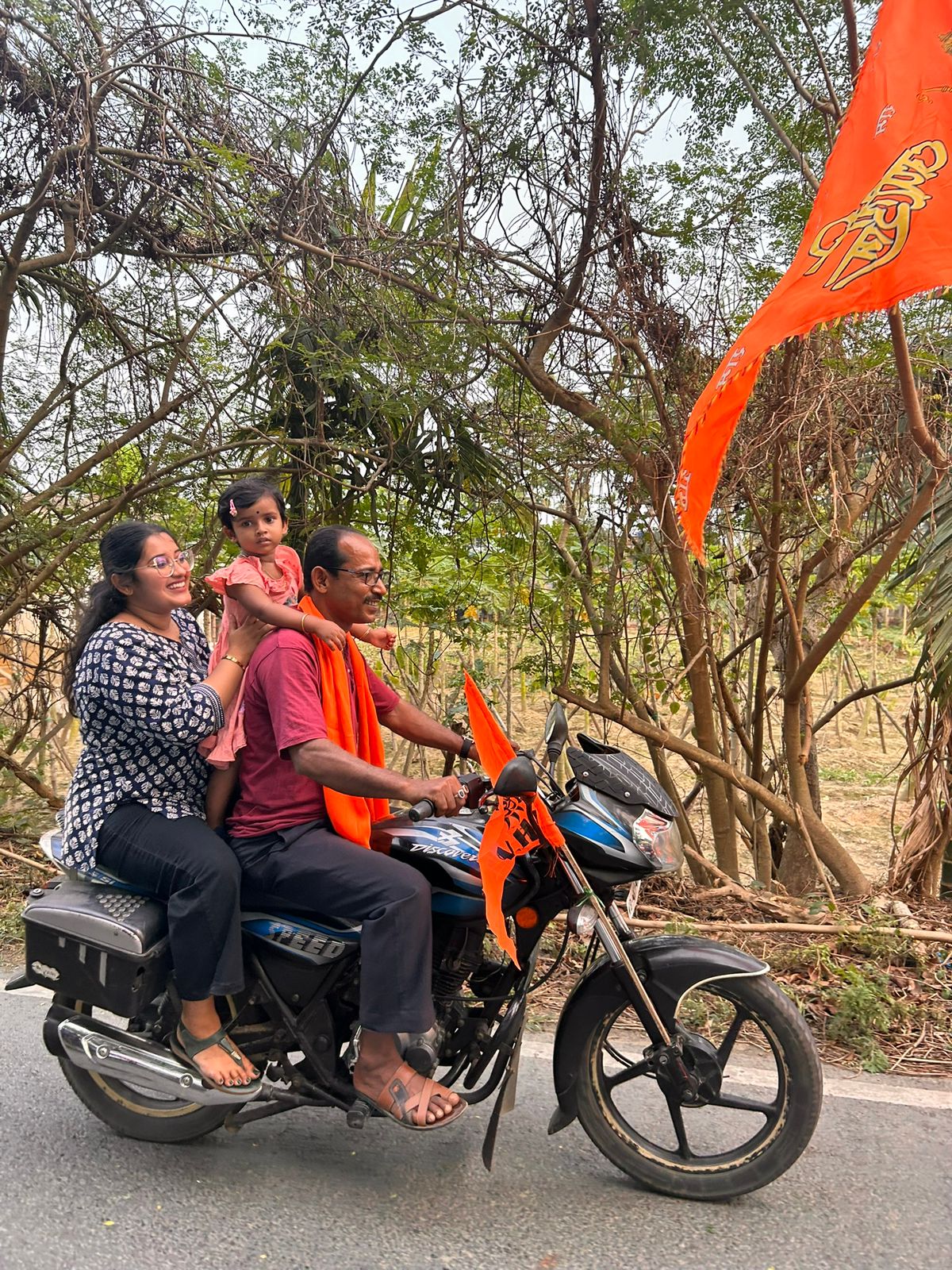
Despite the situation in the border constituencies being sensitive and politically unstable, the BJP is trying to unite Hindus. Ram Navami played an important role during the campaign as the party took out huge processions in the border villages. Even though there is talk of polarization in the city, such a big Ram Navami rally in Bongaon could not have been imagined a few years ago.
Meanwhile, beyond the political framework, the ground reality is stark. Voters are unsure whether they will be able to vote or not. And that uncertainty is reshaping political behavior. The conversation that once centered around development, welfare or even polarization has now been reduced to a single concern, and that is about their survival on paper.
Today the atmosphere in Thakurnagar is not of election enthusiasm but of calm uneasiness. Campaign slogans compete with bureaucratic concerns. Identity, once ensured through voting, now depends on documentation. The Matua belt, long seen as a decisive electoral block, is no longer predictable. It is fragmented, worrying and deeply controversial.
political legacy
Except for occasional squabbles, the Matua people have largely voted as a united block, and shifted allegiance not on ideological but strategic grounds. The roots of this political journey are very deep.
Pramath Ranjan Thakur (PR Thakur), great-grandson of Matua founder Harichand Thakur, was elected to the Constituent Assembly in 1946 with Congress support. He later won the 1962 West Bengal Assembly election as a Congress candidate, became a minister, revived the Matua federation and played an important role in the establishment of Thakurnagar. He became MP from Nabadwip as a candidate of Bangla Congress under the leadership of Ajoy Mukherjee.
Since then, the community’s political representation has largely remained within the Thakur family and has been closely associated with parties and generations across parties and generations, from Manjul Krishna to Mamatabala, Shantanu to Subrata and Soma to Madhuparna Thakur. The Matua vote has thus become increasingly associated with those in power or who are perceived as capable of protecting their refugee status and settlements. Unlike Muslim voters, who are generally attracted to ‘secular’ structures, the Matua calculus is rooted in security and continuity. However, the 2026 elections and the impact of the SIR have disrupted this pattern. For the first time, the community is clearly divided – not just politically, but also over electoral rolls.
Disclaimer: Comments represent the views of users, not of News18. Please keep discussions respectful and constructive. Abusive, defamatory, or illegal comments will be removed. News18 may disable any comments at its discretion. By posting you agree with us terms of use And Privacy Policy.
Russia’s oil and fuel export revenues rebounded in March, recovering from February’s lows as global prices surged amid the Iran war, according to the International Energy Agency (IEA).Russia’s revenues from crude oil and refined products rose in March after falling to their lowest level since the start of the Ukraine conflict in 2022 in February, Reuters reported.
Watch
Putin Formally Joins Iran war? Russia Up In Arms Against Trump’s Naval Blockade | Mideast On Edge
The IEA said Russia’s oil and oil product export revenues nearly doubled to $19 billion in March from $9.75 billion in February, driven by higher global oil prices.Russia’s commodity revenues are a vital component of the state budget and are required to support rising military spending.Crude oil exports rose by 270,000 barrels per day from February to 4.6 million bpd, largely driven by higher seaborne shipments as the Druzhba pipeline remained offline.Flows via the Druzhba pipeline to Hungary and Slovakia through Ukrainian territory have remained shut following attacks on the infrastructure at the end of January.Russia’s crude production increased to 8.96 million bpd in March from 8.67 million bpd in February.However, the agency cautioned that Russia may struggle to raise oil production beyond early first-quarter levels in the near term due to damage to port and energy infrastructure.Russian Baltic and Black Sea ports, along with refineries, have been repeatedly hit by Ukrainian drone strikes.
Legendary singer Asha Bhosle`s granddaughter Zanai Bhosle was visibly devastated by the passing of her grandmother on Sunday, April 12. A day after the legendary singer`s funeral, Zanai has now shared an emotional note, urging fans to celebrate her life and expressing how deeply she misses her grandmother. For the unversed, Asha passed away at Breach Candy Hospital in Mumbai on April 12 due to multiple organ failure.
Zanai Bhosle says Asha Bhosle will come back to her
Taking to her Instagram handle on Tuesday, April 14, Zanai posted a video of Asha singing her iconic track Dil Cheez Kya Hai to her. The video captured a light-hearted moment, wherein both are seen laughing and enjoying their playful bond. In the caption, Zanai wrote, “As I wake up this morning, I realise I have lost my partner in crime, my bestfriend, a person who completed my entire world and the first person to hold me when I was born. What do I do now? Who am I supposed to wake up and give a hug to in the morning and have chai with? Who’s going to be waiting for me everyday when I come home or who am I supposed to crack lame jokes with..”
Zanai further added, “She’s looking down on us all, especially her family and I believe she’s going to comeback to me very soon, because that is what she promised me and told me always!! I have lost the love of my life and there is no bigger grief in the world so I urge you guys to live life to your fullest and celebrate her that way and celebrate her life!! I love you ashaai, and goodbye for now my love.. I know you are always going to be with me no matter what, just waiting for you to come back to me and hug me once again.”
Zanai`s emotional note
Earlier on April 14, Zanai Bhosle, took to her Instagram stories to express gratitude for the love and respect shown to her late grandmother. Zanai wrote, “So overwhelmed with emotions. I’ll write something when I can, but I have to say that there were so many people who respected her, honoured her today and beyond, and showed her so much love.”
She added, “I thank you from the bottom of my heart. She deserved every bit of it. I realise that she lives on in every one of us, in our hearts forever, and she has seen it all from above. RIP, legend. asha tai.”
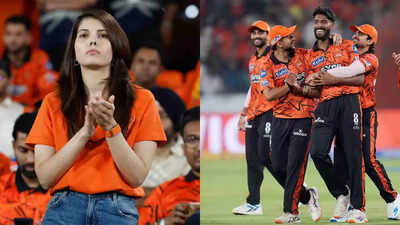
NEW DELHI: The Sunrisers Hyderabad dugout – led by captain Ishan Kishan, along with match-winners Praful Hinge and Sakib Hussain – erupted in celebration, as did the team staff and owner Kavya Maran, after a commanding win over Rajasthan Royals on Monday. Hinge claimed four wickets after Kishan’s blistering 91, as Sunrisers Hyderabad crushed Rajasthan Royals by 57 runs at the Rajiv Gandhi International Stadium.After SRH sealed the emphatic victory, a fan approached Kavya Maran and offered her flowers in celebration. She smiled, accepted the gesture, and said “thank you”.Debutant pacers Hinge and Hussain picked four wickets each as Sunrisers Hyderabad ended table-toppers Rajasthan Royals’ winning streak in emphatic fashion.On a surface where the odd ball held up, Kishan struck eight fours and six sixes in a blistering 44-ball 91 to power SRH to 216/6. Anything full and wide was punished through the off side with ease, while short balls were dispatched with authority, helping the skipper bring up his 19th IPL fifty.However, that effort was overshadowed by a sensational spell from Hinge. The Nagpur pacer, who was initially in line to debut earlier but missed out, scripted a fairytale as he became the first bowler in IPL history to take three wickets in the opening over. He dismantled RR’s formidable top order, including removing Vaibhav Sooryavanshi for a duck, to finish with 4/34.
Hussain, hailing from Gopalganj in Bihar, provided the finishing touch with an impressive 4/24 as Rajasthan Royals were bowled out for 159 in 19 overs.SRH’s bold move to field two debutants in place of experienced campaigners proved to be a masterstroke. The win was their second in five matches and lifted them to fourth place in the points table.Hinge made an immediate impact, dismissing Sooryavanshi off the very first ball of his spell — something even top pacers hadn’t managed this season. Attempting a pull, Sooryavanshi edged the ball to wicketkeeper Salil Arora, sparking celebrations.The spell only got better as Hinge had Dhruv Jurel chop onto his stumps on the very next delivery, before Lhuan-dre Pretorius flicked straight to long leg. From the other end, Hussain struck early too, dismissing Yashasvi Jaiswal with a well-directed short ball.The collapse deepened when Hinge removed RR skipper Riyan Parag with a fine outswinger, reducing the inaugural champions to five wickets down within three overs.With the match slipping away, Ravindra Jadeja and Donovan Ferreira stitched together a crucial partnership to steady the innings and avoid a major dent to the net run rate. Their stand ensured RR crossed 49, preventing the lowest total in IPL history.The duo added 118 runs for the sixth wicket — RR’s highest for that position — with Ferreira reaching his maiden IPL fifty in just 31 balls. But the resistance ended when Hussain bowled Ferreira with a slower delivery, while Jadeja edged behind off Eshan Malinga.Hussain then struck twice more, dismissing Jofra Archer and Ravi Bishnoi, while Malinga accounted for Tushar Deshpande to seal a thumping win for SRH.Earlier, Archer had stunned the Uppal crowd by dismissing Abhishek Sharma off the very first ball, marking his fourth first-ball wicket in IPL history.But Kishan soon took control, counterattacking with authority. He brought up his fifty in just 30 balls and powered SRH past 100 with a six off Bishnoi. Alongside Heinrich Klaasen, he built a rapid partnership, with the duo adding 50 runs in just 26 deliveries.Kishan looked set for a century before falling for 91, miscuing a pull shot. Klaasen contributed 40 before departing, while Nitish Kumar Reddy added a quickfire 28 with a flurry of boundaries.A late flourish from Arora ensured SRH crossed the 200-mark, setting the stage for Hinge and Hussain to complete a memorable victory.
CSK vs KKR IPL 2026 Live Score: Ajinkya Rahane for KKR and Ruturaj Gaikwad for CSK.
CSK vs KKR IPL 2026 Live Score: Chennai Super Kings and Kolkata Knight Riders arrive at Chepauk overloaded with pace, which gives this game an edge. Between them, eight IPL titles, but the table is showing no respect for history right now. CSK are in ninth place with only two points from four matches, while KKR are in an even worse position, still without a win and having only one point after their defeat against Punjab Kings.
For Chennai, relief came two nights ago when Sanju Samson finally shaped a new-look batting line-up, hitting an unbeaten 115 off 56 balls as CSK reached 212 for 2 and defeated Delhi Capitals by 23 runs. Ayush Mhatre’s 59 off 36 added a layer of intent that was missing from Chennai’s start, and Jamie Overton’s four wickets underlined that this side can find a new way to win at home. This is also the interesting part of tonight’s contest: CSK’s identity looks to be less about the old Chepauk spin orthodoxy and more about pace, tough lengths and scoreboard pressure.
Meanwhile, KKR are living a far more chaotic season. They have shown enough batting to offer a hint of threat, including 220 for 4 against Mumbai Indians and 181 for 4 against Lucknow Super Giants, but neither score has taken them to victory. Mumbai chased 221, and LSG made the breakthrough in the last after KKR were reduced to 125 for six. This pattern has hurt them more than a simple lack of talent. Questions regarding Sunil Narine’s role, Cameron Green’s return and control of the bowling group in the death overs are following them in Chennai.
The rivalry is still tilted towards CSK, who lead 21-12 in 34 meetings without a result, but the more relevant detail is that the gap has narrowed in recent seasons, with the teams sharing three wins each since 2022. Hence, it will be a stress test for both the teams. Chennai is trying to prove that the Delhi result was not an overnight result, and Kolkata is trying to show that its season is not already leaking out almost midway through the series. This makes it less about reputation and more about nerve, adaptability, and better handling loads of early-table damage.
…read more
For Chennai, relief came two nights ago when Sanju Samson finally shaped a new-look batting line-up, hitting an unbeaten 115 off 56 balls as CSK reached 212 for 2 and defeated Delhi Capitals by 23 runs. Ayush Mhatre’s 59 off 36 added a layer of intent that was missing from Chennai’s start, and Jamie Overton’s four wickets underlined that this side can find a new way to win at home. This is also the interesting part of tonight’s contest: CSK’s identity looks to be less about the old Chepauk spin orthodoxy and more about pace, tough lengths and scoreboard pressure.
Meanwhile, KKR are living a far more chaotic season. They have shown enough batting to offer a hint of threat, including 220 for 4 against Mumbai Indians and 181 for 4 against Lucknow Super Giants, but neither score has taken them to victory. Mumbai chased 221, and LSG made the breakthrough in the last after KKR were reduced to 125 for six. This pattern has hurt them more than a simple lack of talent. Questions regarding Sunil Narine’s role, Cameron Green’s return and control of the bowling group in the death overs are following them in Chennai.
The rivalry is still tilted towards CSK, who lead 21-12 in 34 meetings without a result, but the more relevant detail is that the gap has narrowed in recent seasons, with the teams sharing three wins each since 2022. Hence, it will be a stress test for both the teams. Chennai is trying to prove that the Delhi result was not an overnight result, and Kolkata is trying to show that its season is not already leaking out almost midway through the series. This makes it less about reputation and more about nerve, adaptability, and better handling loads of early-table damage.
Follow all updates here:
April 14, 2026 5:47:04 pm First
CSK vs KKR IPL 2026 Live Score: Batsmen’s impact
CSK vs KKR IPL 2026 Live Score: On batting impact alone. KKR has the upper hand in this match. Angkrish Raghuvanshi leads both teams with a total batting score of 124.57 (as per our method), followed by Ajinkya Rahane at 108.12 and Finn Allen at 89.78. CSK’s best batting-impact return came from Ayush Mhatre at 99.35, with Shivam Dubey (89.24) and Sanju Samson (85.08) following behind him. Sarfaraz Khan’s 76.92 adds another useful layer for CSK.
April 14, 2026 5:36:04 pm First
CSK vs KKR IPL 2026 Live Score: KKR’s batting is strong, but where are they struggling?
CSK vs KKR IPL 2026 Live Score: KKR have scored the fastest runs in the powerplay at 10.75 per over, which shows how often they have come out strongly. But the bigger story lies in the middle. In overs 7-11, their score is still at 9.67, yet the innings starts to falter, and in overs 12-16, the rate drops sharply to 7.47, while they lose 9 wickets, their worst phase for batting losses. This is where KKR’s innings has often lost direction. However, they recovered strongly in the end and scored at the rate of 12.13 runs per over in the death overs.
April 14, 2026 5:27:08 pm First
CSK vs KKR IPL 2026 Live Score: CSK’s batting and its difficulties
CSK vs KKR IPL 2026 Live Score: CSK have scored the fastest runs in the powerplay at 9.77 runs per over, but they have also lost the most wickets in that phase: 8, so the fast starts haven’t always been obvious. Their real problem has come in overs 7-11, where the rate has dropped to 8.40, and 7 more wickets have also fallen, making this the stage where the innings starts to lose shape. He made a better comeback in overs 12–16, scoring at 9.44 while losing only 6 wickets, before finishing at 10.26 in the death overs.
April 14, 2026 5:14:30 pm First
CSK vs KKR IPL 2026 Live Score: Last Out
CSK vs KKR IPL 2026 Live Score: The last time Chennai Super Kings and Kolkata Knight Riders met, it was CSK who secured a tense two-wicket win at the Eden Gardens in IPL 2025. KKR scored 179 for 6, which looked competitive on a difficult surface, but Chennai kept their composure and reached home with two balls to spare. It was the kind of ending that gave Kolkata more to regret, as they had the game in their hands for long periods before CSK fell behind. It resulted in KKR’s path to the playoffs being hampered, while CSK got one of their rarest wins in an uneventful season.
April 14, 2026 5:00:21 pm First
CSK vs KKR IPL 2026 Live Score: Bowling Chart
CSK vs KKR IPL 2026 Live Score: Chennai Super Kings have the highest wicket-takers in both the teams. Anshul Kamboj leads the charts with 8 wickets, giving CSK the clearest striking option so far. They are followed by Jamie Overton with 5, meaning CSK’s bowling returns have largely come through that pair. For Kolkata Knight Riders, Blessing Muzarabani has taken 4 wickets in just two matches, while Vaibhav Arora has taken five wickets in three, making them the main wicket sources for KKR. The decline after that is noticeable, Anukul Roy and Karthik Tyagi are at 3-3.
April 14, 2026 4:51:12 pm First
CSK vs KKR IPL 2026 Live Score: Batting Chart
CSK vs KKR IPL 2026 Live Score: Chennai Super Kings come into this contest with a huge run bank. Among both sides, Sanju Samson leads the charts with 137 runs, followed by Ayush Mhatre with 133 runs. Kolkata Knight Riders’ best returner is Angakrish Raghuvanshi, who has 155, making him the overall leader between the two sides, while Ajinkya Rahane is second with 124. For CSK, Sarfaraz Khan’s 99 runs in just three matches are also key, while KKR’s next layer includes Finn Allen (80) and Rinku Singh. (72). So this game brings together two different batting patterns: CSK’s runs are spread out a bit more, while KKR rely more on Raghuvanshi and Rahane to keep the scoreboard moving.
April 14, 2026 4:38:00 pm First
CSK vs KKR IPL 2026 Live Score: Points Table Check
CSK vs KKR IPL 2026 Live Score: Chennai Super Kings and Kolkata Knight Riders are ahead of the bottom end of the table in this game, which is why the pressure feels stronger than usual. CSK are ninth after losing three of their first four matches, with just two points and little margin for another stumble. KKR are last without a win after three matches, with their only point coming from a washout. They leave them chasing the herd before the season gets into dangerous patterns. The paradox is simple: CSK are trying to convert a win into momentum, while KKR are still trying to prevent their campaign from almost becoming a series.
April 14, 2026 4:09:26 pm First
CSK vs KKR IPL 2026 Live Score: Hello and Welcome!!!!
CSK vs KKR IPL 2026 Live Score: Hello and welcome to Hindustan Times’ live coverage of Chennai Super Kings vs Kolkata Knight Riders, a game that already feels heavier than a regular league match. CSK finally got the win and Sanju Samson’s century to go along, but they are still stuck at the bottom and need proof that the Delhi result was a proper turn, not a brief spark. Meanwhile, KKR are still searching for their first win, with consecutive losses and washouts leaving them short on points and less certain. Chepauk now gets a contest between two decorated teams whose reputations will matter little until the table starts changing from 3 to 4 pm today at 7:30 pm IST.
Bollywood actor Ranveer Singh‘s recent advertisement with father-in-law Prakash Padukone has sparked a conversation on the internet. His eagle-eyed fans spotted a moment which they believe is a dig at Dhruv Rathee‘s criticism of Dhurandhar, and they cannot stop talking about the subtle jibe.
Ranveer Singh with father-in-law Prakash Padukone in new advertisement.
Ranveer Singh’s new ad sparks speculations about him taking a dig at Dhruv Rathee
The RuPay advertisement shows Ranveer Singh telling his father-in-law and badminton legend that his app can pay anywhere and everywhere. The two can be seen outside a cinema hall buying tickets and popcorn. The poster behind them shows Ranveer Singh’s image with “Bhavandar” written on it. It did not take fans too long to wonder if the poster was a dig at Dhruv Rathee’s criticism of Dhurandhar.
YouTuber Dhruv Rathee had shared videos criticising Dhurandhar and Dhurandhar: The Revenge while discussing an imaginary film with the same name, Operation Bhavandar. In his videos, the YouTuber alleged that both films were “propaganda” for the ruling party.
Fans flooded social media with hilarious comments. One fan commented, “This is so meta joke… Bhavandar…” Another commented, “How Ranveer Singh trolls @dhruv_rathee.” Another wrote, “Wait I’m crying, the movie advertised behind them is BHAVANDAR.” Another fan said, “Bhavandar movie. I see what y’all did there.” Another commented, “No Dhruv Rathee was harmed.” Another wrote, “Ranveer has no chill. He roasted Dhruv Rathee so silently.” Another comment read, “He roasted Dhruv Rathee without saying a word. Absolute peak moment.”
Dhruv Rathee’s criticism of Dhurandhar
In his YouTube video, Dhruv said, “Well-made propaganda is more dangerous. Films like The Taj Story and The Bengal Films were not dangerous, kyunki wo bakwaas films thi (because they were bad films). But Dhurandhar is an engaging film.”
Dhruv also dismissed people defending Dhurandhar by calling it ‘just a film’. He said, “The problem is that Dhurandhar repeatedly shows you it’s inspired by real events. It says so in the trailer. It shows the real footage from the 26/11 attacks. The real audio recordings of conversations between the terrorists and their handlers have been used. It also uses real-life gangsters and cops based in Pakistan’s Lyari.”
About Ranveer Singh’s recent and upcoming movie
Ranveer is currently enjoying the success of his recent release, Dhurandhar: The Revenge. Helmed by Aditya Dhar, the film has collected over ₹1,000 crore at the domestic box office and over ₹1,700 crore worldwide in just four weeks. The film, which also stars R Madhavan, Arjun Rampal, Sara Arjun, Rakesh Bedi and Sanjay Dutt among others, continues its dream run at the box office. It is the first Bollywood film to have earned over ₹1,000 crore net in India.
Ranveer will next be seen in the movie Pralay. Helmed by Jai Mehta, the film also stars Kalyani Priyadarshan in the lead role and is scheduled to go on floors later this year.
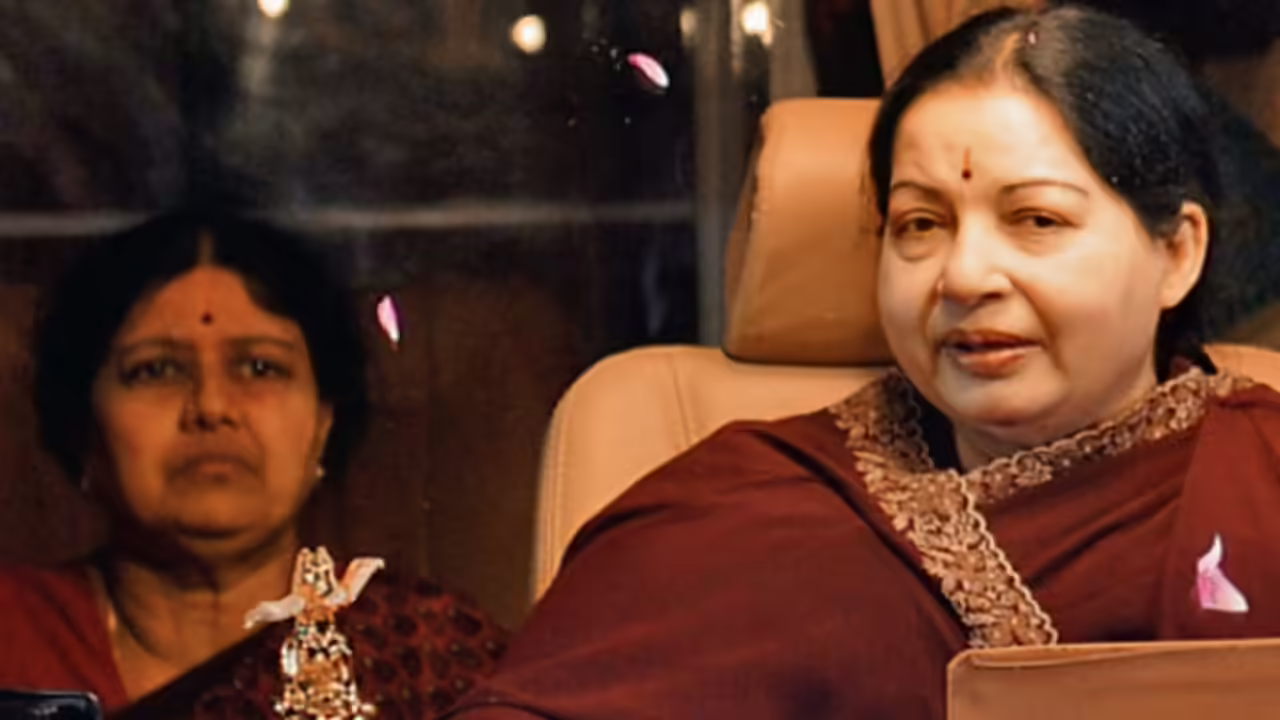
In Tamil Nadu In politics, memory is not just an emotion, it is a currency. And no political memory is more important than the memory of late J Jayalalitha AIADMK The supremo is revered as “Amma”, whose political legacy continues to shape electoral calculations almost a decade after her death.Now former AIADMK chief V.K. Sasikala It is attempting a political comeback through a new organisation, the All India Puratchi Thalaivar Makkal Munnetra Kazhagam, and is presenting itself as the natural heir to the Dravidian legacy. Her claim is based on her experience, her relationship with Amma and the argument that she alone can reclaim political space from the ruling DMK.But will this nostalgia be enough to secure their votes in the upcoming Tamil Nadu elections?
Amma’s legacy
Under Jayalalitha’s leadership, governance became a carefully crafted mix of welfare delivery and emotional politics. Subsidies accounted for more than a third of Tamil Nadu’s revenue expenditure, the backbone of a populist model that resonated deeply with women, rural voters and low-income families.His government was also marked by social interventions that reinforced his “protective leader” image. Tamil Nadu became the first state in India to allow government hospitals to perform medical procedures on transgender people to help them fight infections, a move widely considered progressive in a traditionally conservative political climate.
From subsidized goods to targeted welfare schemes, the administrative machinery of the state often functions as an extension of Amma’s personal brand. That direct connection between leader and beneficiary created an unusually strong emotional voter contract, which still influences political behavior today.It is this legacy that Sasikala is trying to capitalize on not only politically, but also emotionally.
From center of power to political outsider
Sasikala’s political story is inseparable from Jayalalitha’s inner circle. Known as “Chinnamma”, she acted as a powerful arbiter within the AIADMK ecosystem for decades, controlling access to the leadership and influencing cadre-level decisions without holding formal office.After joining the AIADMK in the early 1980s, she gradually became a frequent presence at Jayalalitha’s Poes Garden residence. Over time, she evolved from confidant to gatekeeper and became one of the most influential but informal figures in the party structure.After Jayalalitha’s death in 2016, Sasikala was unanimously promoted as AIADMK general secretary during the leadership vacuum. At the time, the party was founded by MG Ramachandran, and Sasikala’s rise established her as its central authority for some time.His claim then was ambitious: “Amma is no longer with us but our party will rule here for the next 100 years.”But within a few weeks, his political trajectory began to unravel.In the years that followed, the AIADMK transformed from a disciplined party into a fragmented political structure. Competing factions led by EPS and OPS attempted to assert legitimacy, eventually partially merging, but without restoring earlier emotional unity.What was once a tightly controlled cadre machine under Jayalalitha has now become a compromise-based coalition of leaders, where authority is distributed rather than centralized.
The party that once functioned as a single-command structure under Jayalalitha is now working through a negotiated leadership balance, which is organizationally strong, but emotionally weak.Sasikala is trying to take advantage of this fragmentation, but this also limits her reach. The AIADMK’s “two leaves” symbol still commands loyalty among core voters, and organizational continuity remains intact at the booth level, even if internal cohesion is strained.In this sense, Sasikala is not entering a void, she is entering a structure that has already adapted without her.
Can Amma’s emotional capital be transferred?
Sasikala’s current political strategy rests on the same assumption, that Amma’s emotional capital can be transferred to her own leadership project. But the political history of Tamil Nadu tells something else.Jayalalitha’s appeal was highly personal and strictly centralized. His governance created a direct leader-to-voter relationship that bypassed middlemen. Despite her closeness, Sasikala was always a supporter, not the face, of that contract.That gap is now the main challenge to his political resurgence.
Wary of the growing “Sasikala factor”, the all-India Anna Dravida Munnetra Kazhagam leadership has moved to re-establish Jayalalitha’s monopoly on political memory.Senior leader Edappadi K Palaniswami issued a call to workers ahead of Jayalalitha’s birth anniversary on February 24 and asked them to take a pledge in her name.The workers were instructed to light lamps in their homes at 6 pm, pray to Amma’s “spirit” and swear to protect the party till their last breath. The leadership framed it as a spiritual-political exercise, warning against “enemies and betrayers” attempting to undermine the organization.Although Sasikala was not named explicitly, the political signal was clear – a pre-emptive mobilization against internal and external challengers.The directive comes amid the political churn triggered by Sasikala’s re-entry into Tamil Nadu politics after her release from jail and the re-activation of her nephew. TTV DinakaranIn 2017, AIADMK expelled both of them.
DMK’s integration: Nostalgia rules
At the same time, the ruling Dravida Munnetra Kazhagam under the leadership of Chief Minister MK Stalin has strengthened its position through welfare expansion, institutional governance and cadre stability.In contrast to personality-driven mobilization, the DMK’s strategy increasingly relies on plan-based outreach and bureaucratic delivery systems that reduce reliance on emotional recall.Moreover, O Panneerselvam’s entry into the MK Stalin-led DMK camp marks a significant political shift, especially in the battle for J Jayalalitha’s legacy. OPS, once the loyal and symbolic inheritor of his political legacy within the AIADMK, is now aligning himself with Stalin, even seeking the blessings of both Amma and MG Ramachandran for the DMK’s return to power. This move has not only intensified his rivalry with Sasikala. In doing so, OPS is molding itself from an internal dissident to a broader political player, leveraging the emotional weight of Amma’s legacy into a new alliance ahead of the 2026 elections.
Crowded protest: Victory Factors and vote division
The entry of actor-politician Vijay through Tamilaga Vetri Kazhagam has further reshaped the battle field.What was once a bipolar contest is now a multipolar arena, with anti-incumbency sentiments scattered among multiple challengers. This fragmentation reduces the chances of any one opposition force converting emotional appeal into electoral dominance.In this environment, even strong emotional narratives risk being diluted into overlapping voter bases rather than consolidated support groups.During the campaign, Sasikala has relied heavily on Jayalalithaa-era symbolism, invoking Amma, making references to MGR, and presenting herself as part of the original Dravidian ideological lineage.His party’s flag incorporates Dravidian symbols, reinforcing continuity with political tradition rather than breaking from it. But political observers note an important difference: symbolism does not automatically translate into cadre mobilization.Jayalalithaa’s rallies were defined by precision, order and a tightly controlled message that turned emotions into electoral machinery. Sasikala’s current political style, though emotionally charged, lacks the same disciplined mass organizing.There are ongoing legal and political setbacks behind Sasikala’s return. Civil suits filed by him and Dhinakaran challenging organizational decisions of the AIADMK are pending. Additionally, state-level actions related to disproportionate assets investigations, including confiscation of properties belonging to his relatives, are casting a shadow over his political rehabilitation.These unresolved disputes ensure that his political comeback is being fought simultaneously in the courts, party structures and the battle of public perception.There is no doubt that Amma’s memories continue to influence the political psyche of Tamil Nadu. This is visible in welfare memory, symbolic politics and emotional memories of all sections of voters.But old memories are not the only vote bank. Converting emotions into seats requires organizational depth, leadership credibility and electoral machinery.For Sasikala, the challenge is not just to invoke Amma’s legacy, but to prove that she can work outside it as well. AIADMK is calling on Amma to save itself. DMK is countering this through governance. And Sasikala is trying to claim it as heritage.
Amidst this is the central question of Tamil Nadu politics today – can memory survive without machinery, and can machinery be rebuilt only through memory?
Muzarabani had agreed to join Islamabad United, but switch to India’s Kolkata Knight Riders led to Pakistan cricket ban.
Published On 14 Apr 202614 Apr 2026
Blessing Muzarabani has been banned from the Pakistan Super League (PSL) for two years after the Zimbabwe fast bowler joined Indian Premier League (IPL) side Kolkata Knight Riders, despite having agreed to play for PSL team Islamabad United.
The 29-year-old, who went unsold in the IPL and PSL auctions, was signed by Islamabad, but he chose to play for Kolkata instead as the IPL franchise’s replacement for Mustafizur Rahman, who was released following instructions from the Indian Cricket Board (BCCI).
Recommended Stories
list of 4 itemsend of list
The IPL and the PSL have been held almost simultaneously since last year, making it impossible for an international player to participate in both leagues.
“Despite a clear offer and an unequivocal acceptance of essential terms, the player chose to disregard these obligations in favour of a conflicting arrangement,” the Pakistan Cricket Board (PCB) said in a statement on Tuesday.
“The attempt to move away from such commitments without valid cause is a violation of contractual obligations and principles of good faith that govern global professional sports.”
South African bowler Corbin Bosch, who last year snubbed Peshawar Zalmi to play for Mumbai Indians in the IPL, was banned from the PSL for one year.
Pakistani cricketers have not competed in IPL since 2008, when 12 players were selected by five franchises.
Following the 2008 attacks in Mumbai, the Indian league has not selected players from across the western border due to geopolitical tensions.
There had been concerns that Pakistan players would not be selected to play in English cricket’s The Hundred, given the number of teams under Indian ownership.
Those fears were allayed, however, when Abrar Ahmed was signed by Indian-owned Sunrisers Leeds for this year’s competition.
The move did, though, lead to some fierce backlash on social media, while former India cricketer turned commentator Sunil Gavaskar said the signing of Abrar “indirectly contributes to the deaths of Indian soldiers and civilians”.
Four years after Shane Warne’s death shook the cricketing world, his son Jackson has claimed that the spin legend’s demise may have been linked to the COVID-19 vaccines he was “forced to take for work.” Warne, widely regarded as one of the greatest bowlers in the history of the game, died at the age of 52 in Thailand in 2022 after suffering a heart attack.
Speaking on the ‘2 Worlds Collide’ podcast, Jackson said he believes the vaccines played a role, even as he acknowledged that his father had underlying health issues. “I definitely think that it (COVID vaccine) was involved. I don’t even think saying that is controversial anymore. Even if dad had underlying health issues, I think this brought it out right to the surface and that’s one thing that I’ve always struggled with,” he said.
Jackson revealed that his first reaction after hearing the news of his father’s death was to look for reasons beyond natural causes. “My first impression, as soon as I hung up the phone, I instantly blamed the government. I instantly blamed COVID and the vaccine,” he said, adding that he had to restrain himself from voicing those thoughts publicly during the memorial service.
“It was probably smart I didn’t, I would be in a very different position if I did. But that was how I felt,” he said.
He went on to claim that Warne had taken multiple vaccine doses despite his reluctance. “Yes, a lot of people were dying of heart attacks before. But dad was okay. I think he might have got three or four (vaccine doses). He didn’t want to get them, he was forced to get them for work. He was forced to get them like everybody else,” Jackson said.
At the same time, he admitted that dwelling on such thoughts had been difficult. “I try not to think about it too much because all that does is fester into anger. That anger is not good for anybody,” he added.
Offering a glimpse into his father’s lifestyle, Jackson described Warne as being in good shape in the lead-up to his death. “Dad, at the time, was healthy, he was happy. He looked the best he had in a while. Yes, he smoked and drank, but so many more people in their 80s and 90s still smoke and drink a lot more than dad,” he said.
Warne had contracted COVID-19 a few months before his death during his 2021 coaching stint with The Hundred in England. However, he was not known to have any major ailment at the time of his sudden demise, which continues to be a subject of discussion years later.