Thursday, October 1, 2026
Home Blog Page 6914

Live Updates: Israel’s Cease-Fires in Lebanon and Gaza Appear Fragile

0
Live Updates: Israel’s Cease-Fires in Lebanon and Gaza Appear Fragile


Israeli troops were preventing Palestinians from returning to their homes in the north of the Gaza Strip on Sunday as Israel said Hamas had violated the terms of the cease-fire agreement that went into effect a week ago while Hamas accused Israel of stalling.

Officials on both sides said they were in contact with mediators to try to resolve the crisis — one of the most significant between the parties since the cease-fire brought at least a temporary halt in fighting after 15 months of devastating war.

Under the terms of the initial phase of the deal agreed to this month, Israel had been expected to withdraw some of its forces to allow hundreds of thousands of displaced Gazans to head north after a hostage and prisoner exchange on Saturday.

But the Israeli government said Hamas had violated the deal by not returning female captive Israeli civilians first and by failing to provide Israel with information regarding the status of other hostages, as stipulated by the agreement.

Israeli officials said that under the agreement, Arbel Yehud, an Israeli civilian held hostage in Gaza, was supposed to be one of the four women released on Saturday.

The hostages released were all soldiers who had been lookouts at a base on the Gaza border and were abducted from there on Oct. 7, 2023, during the Hamas-led attack on Israel that began the war.

The office of Prime Minister Benjamin Netanyahu of Israel said that it would not allow Gazans to head north “until the release of the civilian Arbel Yehud has been arranged,” leaving the timing of the troop withdrawal and the residents’ return unclear.

The Israeli government reiterated in a statement on Sunday that Mr. Netanyahu was “standing firm” on that decision. Ms. Yehud had also been expected to be released along with about 100 other hostages during a weeklong cease-fire in Nov. 2023.

In addition, Hamas was supposed to have provided Israel with a list by late Saturday detailing the condition of the remaining 26 hostages expected to be released over the next five weeks. An Israeli official, speaking on the condition of anonymity to discuss a sensitive issue, said on Sunday afternoon that Israel had still not received the list.

Israeli officials have said that they believe many or most of the hostages scheduled to be released in the first phase of the deal are alive, but the status of some of them is not clear.

Hamas on Sunday accused Israel of stalling and of breaching the agreement by preventing displaced Gazans from moving north.

In a statement, Hamas said that it had informed the mediators that Ms. Yehud was alive and had given “all the necessary guarantees for her release,” adding that it was following up with the mediators in the hope of resolving the dispute.

The cease-fire deal was mediated by the United States, Qatar and Egypt. The Israeli official said on Sunday that Israel had not received any proof from Hamas regarding the status of Ms. Yehud.

But it appears that Hamas may not be holding Ms. Yehud. In a statement issued on Sunday, Al-Nasser Salah al-Din Brigades, one of the smaller armed groups that is supported by Hamas in Gaza, said Ms. Yehud had been captured during the 2023 attack by a joint force of its fighters and the Quds Brigades of Palestinian Islamic Jihad, another armed group that sometimes rivals Hamas. Ms. Yehud would be handed over according to whatever agreements were reached between the Hamas negotiators and the mediators, the statement added.

Images of a large crowd of displaced Palestinians waiting near the Netzarim corridor, a zone built by Israeli forces that splits Gaza in two, to return to the north were circulating in Palestinian media on Sunday.

Wafa, the Palestinian Authority’s news agency, reported that one person was killed and several others were wounded west of Nuseirat in central Gaza after Israeli forces fired at the crowd of people waiting to return to the north. The Israeli military did not immediately respond to a request for comment on the reports.

Ghada al-Kurd, 37, said she had chosen to remain in central Gaza on Sunday despite longing to return to her home in the north. “I will not leave until everything becomes clear,” she said. “I will not risk my life — those soldiers cannot be trusted,” she added.

Ms. al-Kurd, who left her home and her two daughters behind in Gaza City in the early weeks of the war, was once again left wondering when she would finally get to see them. “Here we are just waiting, feeling stressed and anxious,” she said. “They are playing with our fate,” she added.

This is a developing story. Check back for updates.

Iyad Abuheweila contributed reporting from Istanbul.


What’s behind Hamas’s slogans and ‘gift bags’ during captive release? | Gaza

0
What’s behind Hamas’s slogans and ‘gift bags’ during captive release? | Gaza


NewsFeed

The second release of Israeli captives held in Gaza was an opportunity for Hamas to convey a message, according to analysts. Slogans against Zionism were displayed behind the four Israeli women soldiers, who were also given ‘gift bags’, in an effort to shift the narrative around the group’s cause.


Ten reported killed by Israeli forces after withdrawal deadline missed

0
Ten reported killed by Israeli forces after withdrawal deadline missed


Hugo Bachega

BBC News, Beirut

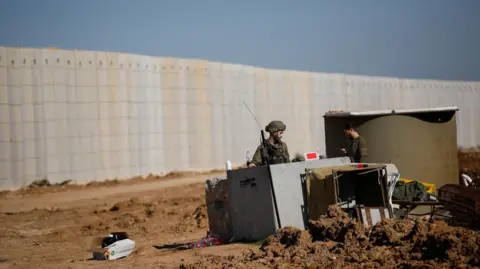
Reuters Israeli military forces stand near Israel's border with Lebanon, in northern Israel, earlier in January Reuters

Israeli soldiers have killed at least 10 people and wounded more than 80 in southern Lebanon, the Lebanese health ministry says, as the Israeli military remained in parts of the country after the deadline for their withdrawal, and the removal of Hezbollah fighters from the area, expired.

On Sunday morning, thousands of residents returned to towns and villages along the border, despite warnings by the Lebanese and Israeli armies, and the UN, that the region remained unsafe.

Israel said the 60-day ceasefire agreement with Hezbollah had not been fully implemented, and it remained unclear how many of its soldiers remained in Lebanon or how long they would stay.

According to the Lebanese health ministry, Israeli forces attacked people as they tried to enter locations that were still under occupation. The Lebanese army said one of its soldiers had been killed and another wounded by Israeli fire.

The Israeli military said it had fired “warning shots in multiple areas” of southern Lebanon, without specifying if people had been hit, and apprehended several people it claimed posed an “imminent threat”.

The ceasefire deal, which was brokered by the US and France and put an end to 14 months of conflict, stipulated the withdrawal of Israeli troops from southern Lebanon and the removal of Hezbollah fighters and weapons from the area. At the same time, thousands of Lebanese soldiers are set to be deployed to the area where, for decades, Hezbollah has been the dominant force.

A Western diplomatic official familiar with the negotiations, who spoke on the condition of anonymity, said Israel had said it needed more time to destroy Hezbollah’s infrastructure in southern Lebanon, and that the initial plan was for a 30-day extension.

The passing of the ceasefire deadline is the first major test for the new Lebanese president, army chief Joseph Aoun, who is keen to bring stability to a country exhausted by multiple crises.

In a statement issued on Sunday, he said Lebanon’s “sovereignty and territorial integrity are non-negotiable”, adding that he was “following this issue at the highest levels”.

The conflict escalated last September, leading to an intense Israeli air campaign across Lebanon, the assassination of Hezbollah’s senior leaders and a ground invasion of southern Lebanon. The offensive killed around 4,000 people in Lebanon – including many civilians – and led to the displacement of more than 1.2 million residents.

On Friday, the office of the Israeli prime minister said the withdrawal outlined in the ceasefire was “conditioned on the Lebanese army deploying in southern Lebanon and fully and effectively enforcing the agreement, while Hezbollah withdraws beyond the Litani”, a river about 30km (20 miles) from the the unofficial border between Lebanon and Israel known as the Blue Line.

“Since the ceasefire agreement has yet to be fully enforced by the Lebanese state, the gradual withdrawal process will continue, in full coordination with the US,” the statement said.

In a statement on Saturday, the Lebanese army said it continued to “implement the plan to enhance deployment” in areas along the border, but that there had been “delays in some stages due to the Israeli enemy’s procrastination in withdrawing, complicating the army’s deployment mission”.

There has been no immediate reaction from Hezbollah. On Thursday, the group said failure to comply with the deadline would be a “blatant violation of the agreement, an infringement on Lebanese sovereignty, and an entry into a new phase of occupation”.

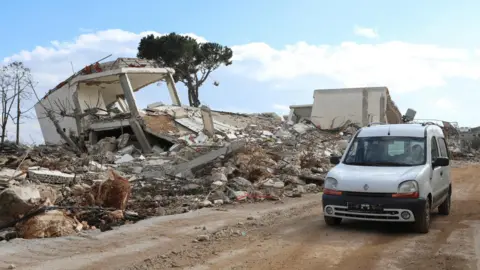
Reuters People drive past a damaged site in the southern Lebanese village of Khiam, near the border with Israel
Reuters

However, the statement did not say how the group would respond if Israeli troops remained in the country.

This is possibly an indication of the delicate position the group finds itself in. The Iranian-backed militant, political and social movement, was severely weakened in the conflict with Israel, although it continues to enjoy significant support among Shia Muslims in Lebanon.

The ceasefire deal was widely considered as a surrender by the group, after it saw its infrastructure and weapons arsenal depleted and hundreds of fighters and key figures killed, including long-time leader Hassan Nasrallah.

Despite some violations before the withdrawal deadline, the truce put an end to the violence which caused billions of dollars in destruction and damage, allowing thousands of residents to return to their homes in Lebanon.

If it decides to resume its attacks, Hezbollah will face opposition from critics, who had accused the group of dragging Lebanon into a war that was not in the country’s interests, and possibly even from some of its own supporters.

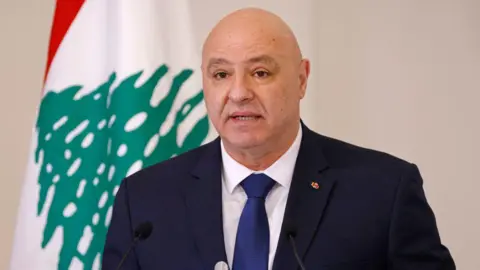
Getty Images Joseph Aoun, a bald man wearing a blue suit and blue tie with white shirt stands in front of the Lebanese flag.Getty Images

Lebanon’s new president Joseph Aoun has promised a series of ambitious reforms to the state.

Hezbollah’s political influence has diminished, too.

Earlier this month, Lebanon’s parliament was able to elect a president after more than two years of political impasse blamed by critics on the group.

Aoun has promised ambitious reforms to rebuild state institutions long plagued by corruption, revive the collapsed economy after years of crisis, and the right to monopolise the possession of weapons, which would mean trying to curb Hezbollah’s military power.

It remains unclear whether the army is able – and willing – to do so, amid concerns that any action against the group could spark internal violence.

Israel’s stated goal in its war against Hezbollah was to allow the return of about 60,000 residents who had been displaced from communities in the country’s north because of the group’s attacks, and to remove it from areas along the border.

Hezbollah launched its campaign the day after the Hamas attacks on southern Israel on 7 October 2023, saying it was acting in solidarity with Palestinians in Gaza.


Israel Blocks Gazans From North, Accusing Hamas of Cease-Fire Breach

0
Israel Blocks Gazans From North, Accusing Hamas of Cease-Fire Breach


Israeli troops were preventing Palestinians from returning to their homes in the north of the Gaza Strip on Sunday as Israel and Hamas accused each other of violating the terms of the cease-fire agreement that went into effect a week ago.

Under the terms of the initial phase of the deal agreed to this month, Israel had been expected to withdraw some of its forces to allow hundreds of thousands of displaced Gazans to head north after a hostage and prisoner exchange on Saturday.

But Rear Adm. Daniel Hagari, an Israeli military spokesman, accused Hamas on Saturday of violating the deal by not returning captive Israeli civilians first. Israeli officials said that under the agreement, Arbel Yehud, an Israeli held hostage in Gaza, was supposed to be one of the four women released on Saturday.

The hostages released were all soldiers who had been lookouts at a base on the Gaza border and were abducted from there on Oct. 7, 2023, during the Hamas-led attack on Israel that began the war.

The office of Prime Minister Benjamin Netanyahu of Israel said that it would not allow Gazans to head north “until the release of the civilian Arbel Yehud has been arranged,” leaving the timing of the troop withdrawal and the residents’ return unclear.

Hamas on Sunday accused Israel of stalling and of breaching the agreement by preventing displaced Gazans from moving north.

In a statement, Hamas said that it had informed the mediators that Ms. Yehud was alive and had given “all the necessary guarantees for her release,” adding that it was following up with the mediators in the hope of resolving the dispute — one of the most significant between the parties since the cease-fire took effect after 15 months of devastating war.

The cease-fire deal was mediated by the United States, Qatar and Egypt. Israeli officials did not immediately respond to requests for comment on Hamas’s claims.

This is a developing story. Check back for updates.


A Hardened Detective and an Angry Rock Star: How a Vast Art Fraud Was Cracked

0
A Hardened Detective and an Angry Rock Star: How a Vast Art Fraud Was Cracked


Two art fraud rings in a remote Canadian city produced thousands of paintings sold in galleries as works by Norval Morrisseau, Canada’s most celebrated Indigenous artist.


Tim Tait put two and two together when he went to sell some of his paintings to a law firm in downtown Thunder Bay two decades ago. He spotted one of his other works already there — but with somebody else’s signature on it.

And not just anybody’s. It read “Copper Thunderbird,” a.k.a. the “Picasso of the North.” Real name Norval Morrisseau, Canada’s most famous Indigenous artist whose original style shattered the country’s idea of art and elbowed its way into its most important museum.

“I called the cops,” said Mr. Tait, a local artist in Thunder Bay, Ontario, who is also Indigenous. “All they did was laugh at me and ridicule me on the phone.”

“And I said, ‘When it comes out, I’ll be singing like a bird.’”

By the time it all came out — decades later — two criminal rings in Thunder Bay had knocked off thousands of bogus Norval Morrisseaus that collectively fetched millions of dollars across Canada. The fakes, which included rebranded paintings by Mr. Tait and other Indigenous artists, made it onto the walls of the country’s top galleries and universities. They were purchased by retired schoolteachers, billionaire art collectors and even a rock star.

The leaders of the Thunder Bay rings have pleaded guilty to fraud in the past year and are now imprisoned. Thunder Bay — an isolated city on Lake Superior’s north shore that drug dealers from Toronto have turned into Canada’s homicide capital — has also emerged as the epicenter of the biggest art fraud in the country’s history.

The convictions came a quarter-century after the authenticity of many Morrisseaus was first publicly questioned — and only after a series of unusual events linking the rock star; a cold-case murder of a teenager; his aging, grieving parents; and the hard-boiled homicide detectives initially skeptical of art fraud. The detectives ended up mastering the finer points of Morrisseau’s Woodlands style of art.

“None of us knew anything about art,” Det. Jason Rybak of the Thunder Bay Police Service said during a recent drive through the city, whose muted colors were further drained by fresh snow and a cloud-filled sky.

Recalling the first raid of a ringleader’s house, Detective Rybak, who led the investigation, said: “Next thing you know, we have these paintings. And we’re like, ‘Oh yeah, what now?’”

The police knew of Morrisseau, though. A member of the Ojibwe First Nation, he was born on a reserve northeast of Thunder Bay. But Morrisseau had long been a fixture on the city’s streets where he hawked his artwork.

Morrisseau became famous for creating the Woodland School of painting, a fusion of Ojibwe and European styles. His paintings touched on Indigenous beliefs, depicting people, animals and the physical and spiritual worlds in bright colors and X-ray-like motifs.

Canada’s artistic establishment had long considered works by Indigenous artists to be ethnography, not fine art. But Morrisseau’s work changed that starting in the 1960s, as it earned acclaim in Toronto, the United States and France, where he became known as the Picasso of the North.

In 2006, a year before his death at 75, the National Gallery of Canada, the country’s most important museum, held a retrospective of Morrisseau’s art — the first time a contemporary Indigenous artist was given such a spotlight. But the homage was marred by news reports of the proliferation of suspected knockoffs. Morrisseau himself had spoken out against the fraud and identified fakes with his forged signature.

The stories never led anywhere because gallery owners, auctioneers and others with a financial stake in counterfeit Morrisseaus fiercely denied the existence of widespread fraud, said Jonathan Sommer, a lawyer who represented three people who sued galleries for selling them counterfeits.

Many wealthy collectors were too embarrassed to admit they had bought fakes, Mr. Sommer said. But one client happened to be a rock star: Kevin Hearn, the keyboardist for the Barenaked Ladies, a Canadian band that has sold more than 15 million albums.

Mr. Hearn, a onetime choirboy, loved “the bold colors and the black lines” in the paintings of Morrisseau, whose work was influenced by stained-glass church windows. In 2005, he bought a painting of animals in a circle on a green canvas called, “Spirit Energy of Mother Earth,” paying 20,000 Canadian dollars, about $16,500 at the time, at a Toronto gallery that reassured him of its authenticity.

After learning a few years later that it was a fake, Mr. Hearn successfully sued the gallery even as he weathered online attacks from people at risk of losing financially by the exposing of sham Morrisseaus.

“I was scared for my family,” Mr. Hearn said in an interview. “They were posting photos of my special-needs daughter online saying that I was a bad father for pursuing this litigation.”

Mr. Hearn also backed the making of a documentary, “There Are No Fakes,” on the broader fraud involving Morrisseau.

“I feel like the relationship between an artist’s work and the people that take that work into their heart is sacred,” he said.

The documentary featured information on Gary Lamont, a Thunder Bay man convicted of sexual abuse who was also, according to the police, a small-time drug dealer and a suspect in the 1984 killing of a 17-year-old named Scott Dove.

When Scott’s parents learned he had been mentioned in the documentary, they reached out to an investigator who had been looking into the cold case: Detective Rybak, who said that Mr. Lamont was still a suspect in the murder.

Detective Rybak, 49, had spent his career on homicides and drugs. When the detective called Mr. Hearn and his lawyer, Mr. Sommer, he was focused on the cold case and showed little interest in the fake Morrisseaus, Mr. Sommer said. But that changed when the detective became aware of the potentially strong case against Mr. Lamont — for art fraud.

“Once he got it,” Mr. Sommer said, “he became like a pit bull.”

Detective Rybak and two colleagues, Det. Sean Verescak and Det. Kevin Bradley, said they carried out their investigation by reconstructing Morrisseau’s life so they could understand how and what he painted, and how he signed his works.

Morrisseau, who was sexually abused at the Roman Catholic residential school he was sent to at 6, according to biographies, battled alcoholism for most of his life and, at one point, was homeless in Vancouver.

“He had lots of demons,” Detective Rybak said.

After his international success, Morrisseau returned to Thunder Bay in the 1970s.

It was a blue-collar town where people worked at paper mills and grain elevators. Toronto was a 16-hour drive, a place children visited for the first time on eighth-grade field trips. Few in Thunder Bay were aware of Morrisseau’s accomplishments. Locals knew him simply as the Indigenous artist who milled around downtown offering his drawings outside a bank in exchange for money, food or alcohol.

During one winter storm, Peter Kantola was driving when Morrisseau appeared out of nowhere and flagged him down. The artist had his hands deep in the pockets of a flimsy jacket.

“He was half frozen, the snow was blasting his whole face,” recalled Mr. Kantola, 84, a retired high school science teacher.

Mr. Kantola gave Morrisseau a lift, and, after that, would do so whenever he ran into him. Morrisseau, Mr. Kantola said, gave him two large paintings that now grace his living room.

Morrisseau also befriended Gary Lamont, the future art-fraud ringleader, in the 1970s, according to Mr. Lamont’s guilty plea statement. During the course of their friendship, Mr. Lamont occasionally set up Morrisseau in an apartment and covered the rent.

Mr. Lamont’s longtime partner, Linda Tkachyk, would take money, food and alcohol to the artist, her niece Amanda Dalby recalled. Ms. Dalby, 40, lived with her aunt and Mr. Lamont when she was a child.

On one visit, Morrisseau gave Ms. Dalby and her sister a painting.

“He said it would be enough to pay for our schooling,” Ms. Dalby said, adding that Mr. Lamont later took it.

According to Mr. Lamont’s guilty plea, he started producing counterfeit Morrisseaus in 2002 and continued until 2015. He was sentenced last December to five years in prison.

In the house where Ms. Dalby stayed, Indigenous artists, including a nephew of Morrisseau’s, painted nonstop inside a tiny room that Mr. Lamont kept locked, she said.

According to his guilty plea, Mr. Lamont also traded money and marijuana for paintings by Mr. Tait — the local artist who vowed to sing like a bird and helped expose Mr. Lamont. Mr. Tait stopped supplying him with paintings after realizing they were being passed off as Morrisseaus.

“He took advantage of me pretty bad,” Mr. Tait said one recent evening as he painted on a large canvas, his granddaughter bounding around their apartment. “That was my biggest weakness, drugs. I’m not like that anymore — 20 years in August.”

Hundreds of paintings produced by the Indigenous artists were rebranded with Morrisseau’s signature in Cree syllabics — “Copper Thunderbird” — and sold for 2,000 to 10,000 Canadian dollars.

By the end of their investigation, the detectives had unearthed a second forgery ring in Thunder Bay. Under its leader, a housepainter named David Voss, fake Morrisseaus were made in assembly-line fashion with Mr. Voss sketching outlines that were colored in by multiple individuals, each responsible for a single hue. Mr. Voss pleaded guilty to fraud in June. The case of a third ring, based in southern Ontario, is still working its way through the courts.

According to the detectives, Mr. Lamont used drugs and alcohol to turn Indigenous artists into Morrisseau forgers.

Gil Labine, Mr. Lamont’s lawyer, said his client was not a drug dealer, though he supplied the Indigenous artists with drugs. Mr. Labine added that Mr. Lamont has denied any involvement in the 1984 murder.

The artists regularly showed up at the arts supply shop in town, the Painted Turtle, to pick up large orders for Mr. Lamont, said the owner, Lorraine Cull.

Late one December, Mr. Lamont showed up with four young men.

“He almost cleaned us out of all the canvases we had,” Ms. Cull said. “I asked him, ‘What are you doing with all this?’ And he said they were Christmas gifts for all the artists up North.”

“And it was after Christmas.”


A Storm, a Spill and a Disaster for the Black Sea’s Beaches

0
A Storm, a Spill and a Disaster for the Black Sea’s Beaches


When a 28-year-old volunteer named Nikolai stepped onto a sandy beach on Russia’s Black Sea coast in a hazmat suit just before New Year’s Eve, he was so overwhelmed by the amount of thick oil film that he almost broke down.

He and other volunteers were tasked with shoveling away the oil-drenched sand, but “the scale is just too big,” he said.

Two weeks into the new year, and four weeks after the spill, President Vladimir V. Putin acknowledged the extent of the disaster and dispatched senior officials to deal with Russia’s largest oil spill in years, which has befouled some of the country’s most popular beaches.

The oil was released by two aging Russian tankers that were damaged during a heavy storm in the Kerch Strait on Dec. 15. At least 2,400 metric tons of oil spewed into the sea, Russian officials said.

The disaster in the strait, which separates the Crimean Peninsula from mainland Russia, raised questions about whether the vessels were part of the so-called shadow fleet that Moscow uses to evade sanctions on its oil industry, sometimes employing ships in shoddy conditions.

One of the vessels, the Volgoneft-212, split in half and sank, killing one crew member. The other, the Volgoneft-239, ran aground near the port of Taman. The two vessels were loaded with a total of 9,000 tons of heavy fuel oil, and the authorities are now working not only to clean up the shores, but also to try to contain additional spills from the ship that ran aground.

Russian officials originally claimed that the spill was contained, but soon after the disaster, sightings of floating oil and tarred birds were reported all along Russia’s Black Sea coast.

On Thursday, Mr. Putin ordered a report on the condition of Russia’s tanker fleet, and also asked a deputy prime minister to review Russian legislation covering oil shipments by sea and river and to look into the “scientific advances on the cleanup of similar disasters,” his press office said.

Last week, the Ukrainian Navy warned that oil from the spill could reach Ukraine’s Black Sea coast near Odesa and Mykolaiv, but Ukraine’s Environmental Ministry said a day later that it saw no immediate threat.

Nikolai was among hundreds of volunteers who have lent a hand to the cleanup. A Moscow entrepreneur, he had viewed information from photographs and videos posted by local residents and officials, and traveled to the resort town of Anapa as the new year approached.

In a phone interview with The New York Times after he returned home, he said he had spent a week shoveling away the oil that was washing onto the shore. He asked that his surname not be used because he fears he might lose out on state contracts.

Individuals and businesses chipped in to provide some volunteers with hazmat suits and some basic equipment, but the task was daunting.

“I had seen the photos before I arrived,” Nikolai said. “Yes, it looked bad — but it’s different when you see it in real life. You take the shovel and scoop out that black blob of oil, and it feels like just a drop in the ocean.”

The air along the coast was so heavy with oil fumes, Nikolai said, that he felt dizzy and weak after walking there without a respirator.

Cleanup teams have been responding to oil spills along a coastline of almost 500 miles, collecting over 160,000 tons of contaminated sand and soil as well as 25 tons of “oil-containing liquid,” Russia’s Emergency Situations Ministry said this week.

But the spill risks becoming a “long-term environmental disaster,” according to Greenpeace Ukraine, which criticized the slow Russian response and warned of a deadly impact on Black Sea marine life.

Environmentalists say the spill is particularly difficult to clean up because of the tankers’ cargo. Heavy fuel oil, unlike ordinary regular crude oil, does not stay on the surface of the water, but instead sinks to the bottom.

“If it is not promptly removed from the surface, it remains to wait until it is biodegraded by marine microorganisms,” said Natalia Gozak, the office director of Greenpeace Ukraine. “This can take decades.”

The lack of an immediate response means that large masses of contaminated sand need to be scooped out, essentially gutting the portions of the beaches around Anapa, according to Georgy Kavanosyan, an independent Russian environmentalist and hydrogeologist who arrived at the scene two days after the spill.

“The oil started sinking down into the sand in the initial days because there were not enough responders there,” Mr. Kavanosyan said.

Satellite images published by Mr. Kavanosyan showed two elongated stains near the tanker that ran aground, indicating new oil spills from it after two minor earthquakes in the area over the weekend.

“That vessel is a ticking bomb,” he said. “The most important thing right now is to pump out that oil and extract the ship.”

Officials reported that they had collected most of the oil from that spill by last Monday.

When Mr. Putin finally spoke out about the disaster, he described it as “one of the most serious environmental challenges we have faced in recent years.”

Mr. Putin ordered senior officials dispatched to oversee the efforts. A task force set up this month brought in several ministers to make plans for the cleanup and reconstruction, as well as for removing the tankers.

The oil spill’s longer-term effect on wildlife remains to be seen.

At least 58 dead dolphins have been found so far, the Delfa Dolphin Rescue and Research Center said in a statement on Saturday. The group sent a team out to the sea last Friday to reach the sunken tanker and confirm reports that the oil was still seeping out from it.

“Contamination was along the entire route,” it said. “Just five kilometers from the shore, common bottlenose dolphins and harbor porpoises were swimming in oil film and small fractions of fuel oil, to our great regret and alarm.”

At least 6,000 oil-smeared birds have been caught and cleaned by volunteers, but many are unlikely to survive, experts said. The spills are likely to kill tens of thousands of local birds, according to Greenpeace Ukraine.

Russian oil companies have increasingly turned to using dilapidated tankers that are not regulated or insured by Western companies.

President Volodymyr Zelensky of Ukraine and other Ukrainian officials have suggested the two 50-year-old tankers were part of Russia’s shadow fleet, which emerged after Western nation moved to punish Moscow economically over the invasion of Ukraine.

But Elisabeth Braw, a senior fellow at the Atlantic Council who has written several articles on the shadow fleet, said the ships were “rickety old tankers” that lacked several characteristics of shadow fleet vessels, which typically operate in the Baltic Sea and sail under the flags of other countries.

Both tankers involved in the spills are Russian-owned, and one of them had its license suspended and should not have been allowed to sail, according to the state-owned RIA Novosti news agency.

Questions were also raised about why the tankers, originally built for river navigation, were allowed at sea in winter storms in the first place.

Cassandra Vinograd contributed reporting from Kyiv, Ukraine.


Ethnic cleansing feared as Trump asks Jordan, Egypt to take Gaza residents | Israel-Palestine conflict News

0
Ethnic cleansing feared as Trump asks Jordan, Egypt to take Gaza residents | Israel-Palestine conflict News


United States President Donald Trump says he would like to “just clean out” Gaza, urging Egypt and Jordan to take in more Palestinians from the coastal enclave.

Speaking with reporters on board Air Force One on Saturday, Trump said he had a call earlier in the day with King Abdullah II of Jordan and would speak with Egypt President Abdel Fattah el-Sisi later on Sunday.

“I would like Egypt to take people,” Trump said. “You’re talking about probably a million and a half people, and we just clean out that whole thing and say: ‘You know, it’s over.’”

Trump said he complimented Jordan for having successfully accepted Palestinian refugees and that he told the king, “I would love for you to take on more, ‘cause I am looking at the whole Gaza Strip right now, and it’s a mess. It’s a real mess.”

Israel’s genocide in Gaza displaced almost the entire 2.3 million people in Gaza, some of them multiple times. Trump said Gaza’s inhabitants could be moved “temporarily or could be long term”.

“It is literally a demolition site right now, almost everything is demolished and people are dying there,” he said.

“So, I would rather get involved with some of the Arab nations and build housing in a different location, where they can maybe live in peace for a change.”

But Abdullah Al-Arian, associate professor of history at Georgetown University in Qatar, told Al Jazeera that Israeli officials had indicated “very early on in the course of the war” to “ethnically cleanse” as much of the Palestinian territory as possible.

“That plan failed for multiple reasons, one of which is that Arab leaders who were approached at that point in time simply declined to take on an additional Palestinian refugee population, in part because it was politically unviable in Egypt in particular, which was mooted as a possible destination for a mass ethnic cleansing of Palestinians from Gaza,” he said.

Al-Arian said Palestinians themselves would not be interested in such a proposal by Trump. “They know all too well what it means to leave their home and what the status of Palestinian refugees has looked like for the past 70 years,” he said, adding that the US president’s remarks “should not be taken seriously”.

Meanwhile, far-right Israeli Finance Minister Bezalel Smotrich welcomed Trump’s idea to relocate Gaza’s residents to Egypt and Jordan.

“The idea of helping them find other places to start a better life is a great idea. After years of glorifying terrorism, they will be able to establish new and good lives in other places,” Smotrich said in a statement.

“Only out-of-the-box thinking with new solutions will bring a solution of peace and security,” he said.

“I will, with God’s help, work with the prime minister and the cabinet to ensure there is an operational plan to implement this as soon as possible,” Smotrich said.

For Palestinians, any attempt to move them from Gaza would evoke dark memories of what they call the “Nakba” or catastrophe – the mass displacement of Palestinians during Israel’s creation in 1948.

Egypt has previously warned against any “forced displacement” of Palestinians from Gaza into the Sinai desert, which el-Sisi said could jeopardise the peace treaty Egypt signed with Israel in 1979.

Jordan is already home to around 2.3 million registered Palestinian refugees, according to the United Nations.

Sending 2,000-pound bombs

Israel’s 15-month war on the Palestinian enclave killed more than 47,000 people, though residents and activists say the actual toll could be much higher. The relentless bombing has also left much of the territory in ruins, with the United Nations estimating the reconstruction will take many years.

However, Trump also said he has ended his predecessor’s hold on sending 2,000-pound (907kg) bombs to Israel. “We released them today,” Trump said of the bombs. “They’ve been waiting for them for a long time.”

Asked why he lifted the ban on those bombs, Trump responded, “Because they bought them.”

INTERACTIVE - Israel 2000lbs mk 84 mk-84 bomb-1726052230

Then-President Joe Biden had put a hold on the delivery of those bombs due to concerns over the effect they could have on the civilian population.

A 2,000-pound bomb has a destruction radius of 35 metres (115 feet), according to the Project on Defense Alternatives (PDA).

The US has historically supplied substantial foreign aid to Israel; a total of $297bn (adjusted for inflation) between 1946 and 2023, $216bn of which was in military aid and $81bn in economic aid, according to data from the US Agency for International Aid (USAID).

Israel is the largest cumulative recipient of US aid since its founding.

A ceasefire in Gaza went into effect a week ago and has led to the release of some Israeli captives in exchange for Palestinian prisoners held by Israel.


Thieves use explosives to steal gold ‘masterpieces’ from Dutch museum

0
Thieves use explosives to steal gold ‘masterpieces’ from Dutch museum


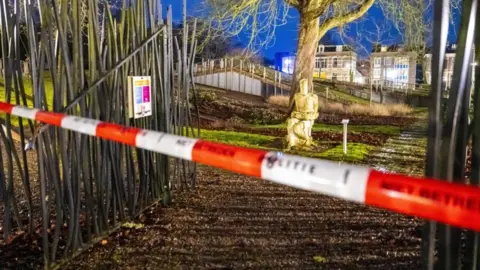
EPA Red and white police tape crosses a gate before a statue in front of a tree outside Drents Museum in Assen, the NetherlandsEPA

Four ancient gold artefacts were stolen from a Dutch museum in an overnight raid in the early hours of Saturday morning.

Thieves used explosives to blast their way into the Drents Museum in Assen, which was hosting an exhibition of priceless Romanian jewellery made from gold and silver.

They left with three Dacian spiral bracelets and the exhibit’s central piece – the strikingly decorated Helmet of Cotofenesti, which was crafted almost 2,500 years ago.

Romania’s ministry of culture has promised to take all possible steps to recover the stolen items, which had been loaned to the Dutch museum from Bucharest.

Drents Museum director Harry Tupan said staff were “intensely shocked” by the burglary, which he said was the biggest incident in its 170-year history.

Police were called to the scene after reports of an explosion at 03:45 local time (04:45 GMT) on Saturday.

Officers carried out forensic investigation and reviewed CCTV footage throughout the day.

Police are also investigating a burning vehicle which was found on a nearby road, which they suspect may be linked to the burglary.

“A possible scenario is that the suspects switched to another vehicle in the vicinity of the fire,” a Dutch police statement said.

No arrests have been made, but authorities suspect multiple individuals were involved. Police have called global policing agency Interpol to help with the investigation.

Getty Images A strikingly decorated ancient golden helmet, with eyes an snakesGetty Images

The Helmet of Cotofenesti, pictured in the Romanian Museum of Antiquities, is strikingly decorated with mythological beasts and a pair of eyes

A statement from the museum said four “archaeological masterpieces” were taken, including the Cotofenesti helmet, which dates from around 450 BC, and three ancient Dacian royal bracelets.

All four stolen items are of huge cultural significance to Romania, with the Helmet of Cotofenesti considered a national treasure.

In the late 1990s, 24 bracelets from the same era were dug up by treasure hunters and sold abroad.

The Romanian state worked for years to get them back from collectors in Austria, Germany, France, the UK and the United States.


New Leaders in Lebanon Face Test as Israel Is Poised to Keep Troops There

0
New Leaders in Lebanon Face Test as Israel Is Poised to Keep Troops There


When Israel and Hezbollah signed a temporary truce in November, the agreement was hailed as a first step toward ending Lebanon’s deadliest war in decades.

Both Hezbollah and Israel agreed to withdraw their forces from southern Lebanon within 60 days. The Lebanese Army and U.N. peacekeepers would secure the area. And if the truce held, negotiators hoped the agreement would become permanent, returning a measure of calm to a turbulent region.

But as the 60-day truce expired on Sunday, a very different scenario was taking shape.

Israeli forces appeared poised to remain in parts of southern Lebanon, stoking fears among Lebanese of a sustained Israeli occupation and renewed hostilities between Israel and Hezbollah. Averting those prospects is a critical test for Lebanon’s new leaders, President Joseph Aoun and Prime Minister-designate Nawaf Salam, as they seek to wrestle back political control from Hezbollah, the country’s dominant political and military force.

Any prolonged Israeli occupation of southern Lebanon could breathe new life into Hezbollah, a group that was founded to liberate Lebanon from Israeli occupation and that has portrayed itself as the only force capable of protecting Lebanon’s borders, experts say.

It also threatens to derail the current political momentum in Lebanon, where for the first time in decades there is a serious push to consolidate all military power within the state, and do away with Hezbollah’s justification for its vast arsenal.

The focus in Lebanon now is toward “disarming Hezbollah and transitioning from the era in which Hezbollah was seen as having the right to acquire weapons,” said Mohanad Hage Ali, deputy director for research at the Carnegie Middle East Center in Beirut. Any prolonged Israeli occupation “would put the breaks on that momentum, which is happening organically,” he added.

Israeli officials have cited concerns that Hezbollah remains active in southern Lebanon and doubts about the Lebanese Army’s ability to stymie the group. Hezbollah officials did not respond to these accusations but said they were “committed” to upholding the terms of the truce.

On Saturday, Lebanese Army officials said they were prepared to complete their deployment in the south but had been delayed “as a result of the procrastination in the withdrawal by the Israeli enemy,” according to a Lebanese Army statement.

The 60-day truce took effect more than a year after Hezbollah began firing rockets toward Israeli positions in solidarity with its ally Hamas, the Palestinian militant group in Gaza that led the Oct. 7, 2023, attack on Israel. Israel retaliated by assassinating Hezbollah’s leadership, leveling towns and villages along the border and invading southern Lebanon.

Before Sunday’s deadline, thousands of Lebanese who were displaced by the war from homes along the southern border were preparing to return home. On Saturday, the main highway leading from the capital, Beirut, to southern Lebanon was packed with cars. Few people seemed deterred by the news of Israeli forces remaining in parts of the south or the automated phone calls from the Israeli military on Saturday warning them not to return home.

“You are forbidden to go back to your home until further notice,” the automated voice said. “Anyone driving south is putting their life at risk.”

Israeli forces appeared to be continuing efforts that persisted during the 60-day truce to bulldoze and block roads between some villages in southern Lebanon, according to local media. Israel currently occupies roughly 70 percent of the areas that it captured after invading Lebanon last fall, according to the United Nations peacekeeping force in southern Lebanon.

The Lebanese Army also warned about the dangers of unexploded ordnance in some villages and towns. Still, few Lebanese appeared dissuaded from returning home.

“The people of the land will force their way in,” said Abed al Karim Hasan, a banana farmer in Maaliye, a village in southern Lebanon, whose home was destroyed during the war. “If I had a house there, I would go there first thing tomorrow.”

Hezbollah has not said how it plans to respond to Israel’s continued occupation of Lebanese soil. On Friday, Hezbollah officials warned in a statement that if Israeli forces remained in Lebanon beyond Sunday, it would amount to “an attack on Lebanese sovereignty and the beginning of a new chapter of occupation.”

Some Hezbollah lawmakers have vowed retaliation. But other officials from Hezbollah — which has been militarily and politically battered in recent months — instead shifted responsibility for responding to Israel to the Lebanese government. The group’s statement on Friday said that it was up to the state “to reclaim the land and wrest it from the grip of the occupation.”

That shifting of responsibility is a tried-and-true tactic for Hezbollah, which just a few months ago had called on the state to provide for thousands of Lebanese displaced by a war it had pulled the country into. Still, the political posturing from a group whose founding principle is resisting Israeli occupation reflects Hezbollah’s current weakened state.

After 14 months of fighting, the Shiite Muslim group’s military ranks are battered, and its loyal support base is weary after months of displacement and destruction. Its patron Iran has also been weakened by Israel, casting doubt over Iran’s ability to provide millions of dollars for rebuilding the homes of Hezbollah supporters in Lebanon, as it did after Hezbollah’s monthlong war with Israel in 2006.

And in neighboring Syria, rebels toppled an Iran ally, the dictator Bashar al-Assad, cutting off Hezbollah’s land bridge for receiving weapons and cash from Iran.

These blows have loosened Hezbollah’s once iron grasp on political power in Lebanon, shifting the country’s political sands for the first time in decades. Earlier this month, Lebanese lawmakers elected a new president, Mr. Aoun, after years of political gridlock that many analysts had attributed to Hezbollah. Days later, lawmakers named Mr. Salam, a prominent diplomat whom Hezbollah had long opposed, as prime minister.

In a country where no major political decision had been made without Hezbollah’s blessing for years, those developments underscored just how much ground the group has lost.

But Middle East experts have warned against writing off Hezbollah’s political weight just yet. And if Israel continues to occupy Lebanon, it could revitalize the group’s mostly Shiite Muslim support base as it looks for a patron and protector against Israeli forces.

“I believe neither parties have an interest in resuming the war,” said Sami Nader, the director of the Institute of Political Science at Saint Joseph University of Beirut. “But as long as Israel is occupying Lebanon, it’s reviving the narrative of Hezbollah.”

Sara Chaito contributed reporting.


India, a Big Source of Illegal Migration, Hopes to Navigate the Trump Storm

0
India, a Big Source of Illegal Migration, Hopes to Navigate the Trump Storm


The family arrived at the ornately carved temple in western India bearing a special sweet of dried milk and clarified butter. It was a desperate offering for their son’s safety: He had just crossed into the United States, only days before President Trump took office promising a fierce crackdown on illegal immigration.

In their village in Gujarat, the home state of Prime Minister Narendra Modi, the markers of migration are everywhere. Plaques on buildings trumpet donations from Indians in America. Houses sit locked and empty, their owners now in the United States — many legally, many not.

Mr. Trump’s threats of mass deportations of illegal immigrants have raised the loudest alarms in countries closer to the United States, like in Mexico and Central America. But the fear and uncertainty — and the potential for political repercussions — are also rippling through India.

India is one of the top sources of illegal immigration to the United States, according to the Pew Research Center. As of 2022, more than 700,000 undocumented Indians were living in the United States, the center estimates, making them the third-largest group, behind Mexicans and Hondurans.

Some Indians arrive legally and overstay their visas. Others cross the borders without authorization: In 2023 alone, about 90,000 Indians were arrested as they tried to enter the United States illegally, according to U.S. government data.

India’s government, which has expanded defense, technology and trade ties with the United States, has expressed confidence that it is better positioned than most to weather the global reckoning with another “America First” administration. Mr. Modi has a bond with Mr. Trump, calling him “my dear friend” as he congratulated him on taking office for a second time.

Nevertheless, there are signs that India is trying to keep Mr. Trump on its good side by cooperating with his clampdown on illegal migration.

Indian news outlets reported this past week that the government had been working with the new administration to take back 18,000 Indian illegal immigrants who are under so-called final removal orders.

According to those reports, India’s goal is to protect its legal pathways for immigration to the United States, like skilled-worker visas, and avoid the punitive tariffs Mr. Trump has threatened to impose over illegal migration. Helping his administration could also spare India the embarrassment of being caught up in the publicity of Mr. Trump’s crackdown.

Indian officials would not confirm the specifics of the news reports to The New York Times. But they noted that deportations from the United States to India were not new — more than 1,000 Indians were sent back last year — and said that they were working with the Trump administration.

“Our position is that we are against illegal migration,” said Randhir Jaiswal, the spokesman for India’s Foreign Ministry. “We have been engaging with U.S. authorities on curbing illegal immigration, with the view of creating more avenues for legal migration from India to the U.S.”

Those legal routes — namely, H-1B visas for skilled workers and visas for students — have been a subject of heated debate among Mr. Trump’s supporters. Elon Musk and other tech moguls say the H-1B visas are needed to recruit the best talent to the United States. More nationalist voices say the jobs filled by those visa holders should go to Americans.

The State Department said the Trump administration was working with India to “address concerns related to irregular migration.” The new secretary of state, Marco Rubio, held his first bilateral meeting on Tuesday with India’s foreign minister, S. Jaishankar — an indication of the growing importance of the U.S.-India relationship.

The intensified focus on migration is politically sensitive in India.

Mr. Modi, the country’s most powerful leader in decades, has cast himself as a driving force behind economic growth that he says will eventually make India a developed nation. But his own home state, Gujarat, once hailed as an economic miracle under his leadership, is one of India’s largest sources of illegal migration to the United States, according to police officials.

Though Washington is looking to India as an alternative to China in global industrial dominance, its uneven economy — by some measures, one of the most unequal in the world — still impels large numbers of Indians to take enormous risks to make it to the United States.

In the Mehsana district of Gujarat, almost every family has a member in the United States, legally or illegally. Some return only for annual visits to see aunts and uncles. Mehsana is frequently in the news, with reports of its migrants dying while trying to climb a border wall into the United States, reach its shores by boat or make their way over the frozen northern border during winter.

Migration to the United States has traditionally been a status symbol among Gujaratis. Families who have no members in the United States have trouble matching their children in marriages, said Jagdish, 55, a worker at the local college in the village of Jasalpur whose son and daughter-in-law are in the United States illegally.

Jagdish, who asked that his last name not be used, said his son had spent five months in Mexico waiting to cross the border five years ago. Upon entering the United States, he was jailed for three months before being released. He now works at a cafe there, and his wife joined him last year.

It cost the family more than $70,000 to get them to the United States — a mix of “hard-earned money, my life’s savings” and loans, Jagdish said.

“I don’t buy new clothes, I have cut down on fruits and milk,” he said. “I need to repay the loans.”

Outside the village temple, a husband and wife who run a Subway franchise in the United States, where they have lived for two decades, were on their once-a-year visit. The husband, Rajanikant Patel, tried to offer some reassurance about Mr. Trump, couched in the “no one knows” air that characterizes much talk about the new administration.

“Trump will do what he has to do,” Mr. Patel said. “But Trump needs people to work there. We are laborers there. It’s such a huge country. Who will work and manage there?”

Indians began moving to the United States in large numbers in the 1960s, when India was among the world’s poorest nations and American immigration policy was easing.

The pull is strong even today, with India now the world’s fifth-largest economy. Given its immense inequality, economic growth has not necessarily translated into better services or higher standards of living for most.

“The quality of life here and there cannot be compared,” said Mr. Patel’s wife, Nila Ben.

Immigration consultants said they had seen a decline in visitors as word spread that it was becoming harder to enter the United States, a tightening that began during the Biden administration and that Mr. Trump is moving to drastically increase.

Varun Sharma, the director of an immigration consultancy, said about half of his potential clients inquired about illegal routes into the United States. He politely turns them down, he said.

Many undocumented immigrants now come from the new middle class. In some cases, Indians who arrive on student visas stay past the expiration date. In other cases, migrants first fly to a third country on a visitor’s visa, then slowly make their way to the United States by land or sea.

Vishnu Bhai Patel, a lemon trader from a nearby village, said he hoped that Mr. Trump “shows some leniency for divided families like mine — half of the family is here and half there.” He said he hoped that his daughter, who is studying engineering in the United States, could stay on after graduating and then invite him to come legally, too.

“My dream is for her to never come back,” he said.

Mujib Mashal contributed reporting from New Delhi.