Thirteen soldiers serving with peacekeeping forces in the Democratic Republic of Congo have been killed in clashes with rebels from the M23 group.
The South African military said nine of its soldiers died helping to push back a rebel advance on the city of Goma, in eastern DR Congo, while three Malawians and a Uruguayan were also killed.
French President Emmanuel Macron said he had spoken to the leaders of both DR Congo and Rwanda amid global calls for the violence to end.
The United Nations is pulling all non-essential staff out of Goma – a city of more than one million people – as the fighting intensifies.
A UN Security Council meeting about the deadly clashes, originally set for Monday, has been moved to Sunday due to the escalating conflict.
The M23 group has called on Congolese troops in Goma to surrender in order to avoid bloodshed. While DR Congo has severed diplomatic ties with neighbouring Rwanda, accusing the country of being behind the rebellion.
The move comes after M23 fighters killed a Congolese military governor who was visiting the frontline on Thursday. Earlier in January, they captured the key eastern Congolese towns of Minova and Masisi.
Macron called for an end to the fighting in separate calls with the leaders of DR Congo and Rwanda on Saturday, his office said.
The EU’s foreign policy chief Kaja Kallas urged the M23 to halt its advance and condemned Rwanda’s support for the group, the AFP news agency reports.
Further condemnation came from Angolan President Joao Lourenco, the African Union’s mediator between Rwanda and DR Congo, who denounced “irresponsible actions by the M23 and its supporters” and called for the “immediate cessation” of fighting to preserve civilian lives, according to the AFP news agency.
Fighting between the M23 and DR Congo’s army has intensified since the start of the year, with the rebels seizing control of more territory than ever.
The conflict has already led more than 400,000 people to flee their homes this year, according to the UN.
Local leaders last week said more than 200 civilians had been killed in areas captured by the M23, with hospitals in Goma treating hundreds of patients.
Martin Gordon, an Anglican bishop in Goma, told the BBC fighting in the country had gone on “way too long” and people “will do anything for peace”.
In the past few days, several countries have urged their citizens to leave Goma, including the UK, France, Germany and the US.
Human Rights Watch has warned of escalating risks to civilians as the Congolese army battles the M23 rebels. The humanitarian group has accused both sides of committing grave abuses against civilians.
The UN has warned that the ongoing conflict is worsening the humanitarian crisis in the region.
The M23 has taken control of vast swathes of mineral-rich eastern DR Congo since 2021. Hundreds of thousands of people have been displaced as a consequence.
DR Congo and the UN say the M23 is backed by Rwanda. The Rwandan authorities have neither confirmed nor denied this.
Rwanda has previously said the authorities in DR Congo were working with some of those responsible for the 1994 Rwandan genocide against ethnic Tutsis and moderate Hutus.
The M23 formed as an offshoot of another rebel group in 2012, ostensibly to protect the Tutsi population in the east of DR Congo, which had long complained of persecution and discrimination.
However, Rwanda’s critics accuse it of using the M23 to loot eastern DR Congo’s minerals such as gold, cobalt and tantalum.
Hamas released four female Israeli army soldiers on Saturday as part of a hostage-for-prisoner exchange, more than a year after the women were taken captive during the Hamas-led attack on southern Israel on Oct. 7, 2023, that started the war.
In a choreographed release, the four hostages wore military-style fatigues as they walked onto a stage in Gaza City. They waved and smiled at a cheering crowd, grinning at one another as Hamas fighters in balaclavas surrounded them.
The hostage release is part of a 42-day cease-fire deal that went into effect on Sunday, pausing the fighting between Israel and Hamas. Hamas agreed to incrementally release 33 of the nearly 100 remaining hostages in exchange for more than 1,000 Palestinians jailed by Israel and a partial Israeli withdrawal.
The hostages had been recent recruits, working as “spotters” for Israel’s army, reporting on suspicious activity across the border. During the Hamas-led attack, militants stormed the Nahal Oz military base in Israel, killing more than 50 soldiers and abducting the women, who were teenagers at the time, and three other female soldiers.
In May, the Israel military released a three-minute edited collection of videos, verified by The New York Times, showing Palestinian fighters, some wearing Hamas headbands, binding the hands of five women, including the four who were released on Saturday. The footage was recorded by body cameras worn by the Hamas militants who abducted them, according to the Hostages and Missing Families Forum, which represents relatives of many of the captives.
Here is what else we know about the four released hostages.
Liri Albag
Liri Albag, a soldier who was seized from her army base in southern Israel during the Oct. 7, 2023, attack, in a photograph released by Bring Them Home Now.Credit…via Reuters
Ms. Albag, who has dreamed of becoming an architect and interior designer, joined the Israeli military soon after graduating from high school, according to a statement by the Hostage Families Forum.
Her family expressed relief and joy at seeing her being released. “Far from what I expected, she looks vibrant,” Ruhama Albag, her aunt, said on live television. “She is cheerful, waving her hand, her spirit unbroken.”
In January, Hamas’s military wing released an edited video of Ms. Albag, now 19, speaking for three and a half minutes, in which she said she had been held for more than 450 days.
In a statement at the time, Ms. Albag’s family said that “her severe psychological distress” was evident in the video and asked Israel’s prime minister, Benjamin Netanyahu, and other leaders to “make decisions as if your own children were there.”
“She is just dozens of kilometers away from us, yet for 456 days we have been unable to bring her home,” the family said.
Karina Ariev
Karina Ariev, a soldier who turned 20 in captivity, in a photograph released by Bring Them Home Now.Credit…via Reuters
Ms. Ariev, 20, is the daughter of immigrants from Ukraine, and her family described her as “the connecting force” among friends and family, the families forum said.
She called her parents during the attack, describing militants firing guns and rockets, and told them she loved them, according to the Israeli news media. Her family later that day found a Hamas video posted on social media that showed Ms. Ariev and two other women in a jeep, her face bleeding, they said.
In August, Ms. Ariev’s older sister, Sasha Ariev, said at an event in Jerusalem spoke of moving home after the Oct. 7 attack to help her struggling parents who were feeling increasingly helpless.
Ms. Ariev’s sister said the hostage crisis was consuming her. “How can I sleep when we haven’t succeeded in bringing Karina and all the other hostages home?” she said. “How can I sleep when I’m in my bed and she’s a hostage?”
Daniella Gilboa
A photo released by Hostages Family Forum showing Daniella Gilboa.Credit…via Associated Press
Daniella Gilboa, 20, is from Petah Tikva, in central Israel. At the time of her abduction, Ms. Gilboa had been studying piano and hoped to perform professionally one day, the forum said.
In an interview with Maariv, an Israeli newspaper, the father of Ms. Gilboa’s boyfriend said the family was feeling mixed emotions over the video. “In her family, there is a feeling of relief alongside a feeling of disappointment,” he was quoted as saying.
Naama Levy
Naama Levy, a soldier who was seized from her army base in southern Israel, in a photograph released by Bring Them Home Now.Credit…via Reuters
Naama Levy, who is also now 20, is a triathlete who grew up in Raanana, a leafy town north of Tel Aviv, the forum said.
She texted her mother from a safe room on the day of the attack, according to a website focused on campaigning for her release. “I’ve never heard anything like this,” she wrote.
A Hamas video of her being taken to Gaza circulated on social media shortly after the attack.
In an interview for a documentary about sexual violence during the attack, Ayelet Levy Sachar, Naama’s mother, spoke of her daughter’s kidnapping. She was seen in a Hamas video in pajama bottoms, drenched in blood.
“They’re grabbing her by the hair, and she’s all, like, messed up,” she said, adding: “We would like to think that this couldn’t be possible, that nobody would harm a young girl. But then you just see it there.”
Speaking at President Trump’s inauguration event this week, Elon Musk slapped his right hand on his chest before shooting his arm diagonally upward, palm facing down. He did it twice.
It looked a lot like the salute used in Nazi Germany and fascist Italy. But almost immediately, a striking number of different interpretations began to circulate.
Some commentators called it a “Roman salute.” Others described it as a “heartfelt” expression of joy, or dismissed it as merely clumsy.
The website of the Anti-Defamation League, which campaigns against anti-Semitism, defines the Nazi salute as “raising an outstretched right arm with the palm down,” and ranks it as “the most common white supremacist hand sign in the world.”
But after Mr. Musk’s stiff-arm salute, the Anti-Defamation League called it “an awkward gesture in a moment of enthusiasm, not a Nazi salute.”
Andrea Stroppa, known as Mr. Musk’s emissary in Italy, posted on the social media platform X: “The Roman Empire is back, starting from the Roman salute.” He later deleted the post, saying that people were interpreting “the whole thing as a reference to Nazi-fascism.”
Mr. Musk, who owns X, posted in response to the criticism: “The ‘everyone is Hitler’ attack is soo tired.”
The straight-arm salute has meant very different things in different places and during different periods of history. But at a time when the far right is once again on the rise, the interpretation of this gesture being performed deliberately and publicly was straightforward — especially in Germany, where the salute’s history lingers most powerfully.
‘There is no need to make this complicated’
In Germany, gestures like the one Mr. Musk made are illegal, along with other symbols and slogans from the Nazi era. (On Wednesday night, anti-Musk protesters projected an image showing his salute and the words “Heil Tesla” onto the facade of his company’s German factory.)
For the German establishment, the situation was very clear.
“There is no need to make this unnecessarily complicated,” the editorial said. “Anyone on a political stage giving a political speech in front of a partly right-wing extremist audience,” — present at the inauguration were several far-right politicians from Germany, Italy, France and Britain — “anyone who raises their right arm in a swinging manner and at an angle several times is doing the Hitler salute.”
“Anyone who now thinks they have to discover the older ‘Roman salute’ as a supposed Musk reference is, above all, demonstrating their willingness to reinterpret it in a benign way,” it concluded.
“Roman salute” is indeed trending on social media — along with images of toga-clad actors in grainy films set in ancient Rome raising their right arm alongside Mr. Musk raising his.
But was there a Roman salute in ancient times? No: There is no evidence that the salute was ever used in ancient Rome.
The actual history of the salute is little-known — and much shorter: It was used in late 19th century theater productions and early 20th century films, which then inspired its use by fascists in Italy and Germany. And it was actually performed for decades by American school children for entirely different reasons.
From silent films to European fascists
“The Roman salute is a modern invention,” said Martin Winkler, professor of classics at George Mason University in Virginia, and author of “The Roman Salute: Cinema, History, Ideology.”
“There is no evidence whatsoever from the Roman art and paintings that survive that ancient Romans ever used that gesture,” he added.
The salute first became popular in stage productions and silent cinema, when films began using the gesture for costume dramas set in ancient Rome, Greece and Egypt.
“It’s simply a visual gesture that was heavily deployed in the silent cinema era when many films were set in antiquity,” Mr. Winkler said. “Why? Because in the absence of sound, dramatic gestures and what we would now consider overacting were pretty much ubiquitous. Saluting gestures were no exception.”
The salute had a real-life breakthrough in 1919. Gabriele D’Annunzio, a soldier and Italian poet turned nationalist (who had worked on “Cabiria,” an Italian silent film set in antiquity) invaded Fiume, a coastal city that is now part of Croatia.
He ruled Fiume for 15 months as a kind of mini-Caesar, calling his soldiers legionnaires and addressing them from his balcony. And he adopted a ceremony that involved a straight arm salute he called “Il saluto Romano,” or the Roman salute.
“This Roman salute resembled a stab: You extend your arm, angled upwards with your fingers together, as if it were a dagger that you symbolically thrust into an enemy’s throat,” Mr. Winkler said. “It’s a very militarized, politicized kind of gesture.”
The Roman salute was adopted soon after by the Italian fascist dictator Benito Mussolini, who came to power in 1922. Adolf Hitler’s Nazi Party adopted it in 1926, calling it the German salute.
Intriguingly, there was an American salute that preceded both.
A salute to the American flag
To modern eyes, it would be jarring to see a group of schoolchildren giving the stiff-armed salute to the American flag. But the gesture was commonplace for decades.
In 1892 — in the run-up to the Chicago World’s Fair marking the 400th anniversary of Columbus arriving in America — Francis Bellamy, a Baptist minister’s son from upstate New York, wrote the Pledge of Allegiance, a version of which is recited by many American school children to this day.
Along with his boss, James Upton, Bellamy also came up with a salute to accompany the recital of the pledge: Stand up, hand on heart, then extend the right arm to salute the Stars and Stripes. It became known as the Bellamy salute.
The pledge itself was part of an Americanization program for immigrant children. But in 1942, when the United States was fighting the Nazis in World War II, the extended arm gesture was abandoned. “It looked too close to the Nazi salute,” Winkler said.
Whatever Elon Musk was trying to invoke on Monday, his salute looked pretty close to a Nazi salute even if it was not identical. He first put his hand on his chest, which is not part of the Nazi salute, and could be closer to what those American school children did until 1942.
But the pledge of allegiance salute was dropped in a way that left no room for misinterpretation: The gesture had become inextricably tied to the Nazis.
“The common American perception was, ‘These are our enemies and we don’t want to be like them,’” Winkler said.
Mr. Musk is now courting far-right parties in several European countries. His audience in Washington on Inauguration Day included Tino Chrupalla, a co-leader of Germany’s Alternative for Germany party; Giorgia Meloni, the prime minister of Italy, whose party is descended from the post-Fascist movement; Nigel Farage of Britain’s Reform Party; and Eric Zemmour of France, who is to the right even of the French National Rally’s Marine Le Pen.
“What is happening now is predictable,” Die Zeit said in its editorial. “Neo-Nazis and right-wing radicals can interpret the stretched right arm as a gesture of fraternization and empowerment.”
Emma Bubola in Rome contributed reporting. Audio produced by Parin Behrooz.
Nine South African and three Malawian peacekeeping soldiers have been killed by M23 rebels, authorities say.
At least 12 peacekeepers, including two from the UN peacekeeping force MONUSCO, have been killed in fighting in eastern Democratic Republic of Congo (DRC), authorities said.
Congolese troops and peacekeepers have been battling in recent days to stop an advance by M23 rebels on the city of Goma, the capital of North Kivu province.
The three-year M23 rebellion in Democratic Republic of Congo’s mineral-rich east has intensified in January with rebels seizing control of more territory, prompting the UN to warn of the risk of a broader regional war.
As of Friday, nine South African soldiers had been killed in the clashes with M23 rebels, the South African armed forces said in a statement on Saturday.
Two South Africans deployed with the UN peacekeeping mission and seven others in the Southern African regional bloc’s force in DRC were killed over two days of fierce fighting, it said.
“The members put up a brave fight to prevent the rebels from proceeding to Goma as was their intention,” it said, adding that the M23 had been pushed back.
An UN official, speaking to The Associated Press news agency, confirmed the death of two UN soldiers.
The peacekeepers were killed on Friday, the UN official told the agency on condition of anonymity.
Malawi’s military spokesman confirmed that three of its peacekeepers deployed with the SADC mission had been killed in fighting with M23 rebels.
“We confirm the loss of three of our courageous soldiers who were part of the SADC Mission in the DRC,” spokesperson Emmanuel Mlelemba said, referring to the South African Development Community’s SAMIDRC mission.
“These soldiers fell in the line of duty during an encounter with the M23 rebel group operating in eastern DRC. As the situation remains volatile, further details will be shared later,” he added.
M23, or the March 23 Movement, is an armed group composed of ethnic Tutsis who broke away from the Congolese army more than 10 years ago. Since its resurgence in 2022, M23 has continued to gain ground in eastern DRC.
The DRC and the United Nations accuse Rwanda of supporting M23 with troops and weapons – something Rwanda denies.
UN to relocate nonessential staff
M23 has made significant territorial gains in recent weeks, encircling the eastern city of Goma, which is home to about two million people and a regional hub for security and humanitarian efforts.
The UN said that it would temporarily relocate nonessential staff from Goma, such as administrative staff.
“Essential personnel remain on the ground, sustaining critical operations such as food distribution, medical assistance, shelter, and protection for vulnerable communities,” the UN statement read.
M23 is one of about 100 armed groups that have been vying for a foothold in mineral-rich eastern DRC, along the border with Rwanda, in a decades-long conflict that has created one of the world’s largest humanitarian crises.
Since 1998, approximately six million people have been killed while roughly seven million have been displaced internally.
More than 237,000 people have been displaced by the fighting in eastern Congo since the beginning of this year, the United Nations refugee agency said in a report on Monday.
On Thursday, M23 took control of the town of Sake, which is only 27km (16 miles) west of Goma and one of the last main routes into the provincial capital still under government control, according to UN Secretary-General Antonio Guterres.
Hamas on Saturday released four female Israeli soldiers held hostage in the Gaza Strip, in a choreographed ceremony that was the latest sign of the group’s effort to project power despite Israel’s 470-day military campaign to dislodge them.
It was the second release of hostages as part of a cease-fire deal that went into effect nearly a week earlier. Per the agreement, Israel released 200 Palestinian prisoners on Saturday who had been held in Israeli jails.
A line of white buses carrying prisoners left Ofer prison in the Israeli-occupied West Bank. Prisoners were also released from another facility near Beersheba in southern Israel, the Israeli prison service said.
Many of the 200 prisoners released on Saturday were serving life sentences for involvement in attacks against Israelis. Around 70 are being exiled abroad as part of the agreement and will not be allowed to return to their homes in the West Bank and Jerusalem, according to a list provided by the Palestinian authorities.
But the prisoner-hostage swap on Saturday did not go entirely to plan. Rear Adm. Daniel Hagari, an Israeli military spokesman, accused Hamas of violating the deal by not returning captive Israeli civilians first. Israeli officials said that under the agreement, Arbel Yehud, an Israeli woman held hostage in Gaza, was supposed to be one of the four women released on Saturday.
Israel had been expected to withdraw some of its forces to allow hundreds of thousands of displaced Gazans to head north after Saturday’s exchange. But the Israeli prime minister’s office said that it would not allow Gazans to head north “until the release of the civilian Arbel Yehud has been arranged,” leaving the timing of the troop withdrawal and the residents’ return unclear.
Hamas accused Israel of hesitating to fully implement the cease-fire agreement. The dispute is one of the most significant between the parties since the cease-fire took effect.
Israeli officials said they believed that Ms. Yehud wasn’t being held by Hamas, suggesting she was possibly being held by another party, and that the holdup was not solely Hamas’s responsibility.
The four Israeli hostages released by Hamas on Saturday, who were dressed in military-style clothes, had been working as lookouts for Israel’s army, reporting on suspicious activity across the border, when they were captured. During the Hamas-led attack on Oct. 7, 2023, militants stormed the Nahal Oz military base in Israel, killing more than 50 soldiers and abducting the four women and three other female soldiers.
Under the terms of the cease-fire deal, fighting between the Israeli military and Hamas militants stopped in the morning of Sunday, Jan 19. The first hostages, three women seized in the 2023 attack, were released on Sunday, in exchange for 90 Palestinian prisoners being held in Israel, who were released hours later.
The current phase of the cease-fire is to last just 42 days and free only 33 of about 100 hostages still in Gaza, some of whom are believed to be dead. Significant diplomatic hurdles to extending the cease-fire lie ahead. Israel and Hamas reached the deal in part by putting off their most intractable disputes until a vaguely-described “second phase,” which may be difficult to negotiate.
During the hostage handover ceremony on Saturday, armed Hamas fighters dressed in pristine uniforms, their faces covered, escorted the four hostages to a stage at Palestine Square in the center of Gaza City. Then they were handed over to a representative of the Red Cross.
The stage-managed ceremony, seemingly meant to convey Hamas’ strength and control in Gaza, included some jarring juxtapositions.
The backdrop to the handover was a large banner printed with slogans, one of which described Palestine in English as “The Victory of the Oppressed People vs the Nazi Zionism.”
The ceremony was held in an area devastated by Israel’s bombing campaign and ground incursion, with hundreds of uniformed fighters and civilians gathered nearby. Hamas fighters were showered with confetti.
The hostages incongruously smiled and waved at the cheering and whistling onlookers. In the past, Israeli officials have said that Hamas has forced hostages to appear cheerful to suggest that they were well treated.
Adm. Hagari, the Israeli military spokesman, derided the ceremony as “cynical.”
Hamas “presented a false show of taking care of the hostages, when in fact, it has cruelly held men and women for 477 days,” Adm. Hagari said.
Before the four hostages were released, Hamas held a signing ceremony on the stage, between one of its members and a representative of the Red Cross. The hostages were then driven by the Red Cross to Israeli troops stationed in the territory.
Two Israeli helicopters ferried the hostages to Beilinson Hospital in Petah Tikva, a city in central Israel, to the excited cheers of hundreds who gathered to welcome their arrival with Israeli flags.
“We wanted to show the hostages and their families how much we care for them,” said Helena Dabush, 42, who lives nearby and brought her four children along.
The released hostages were all teenagers and recent recruits into the military when they were abducted. Karina Ariev, now 20, is the daughter of immigrants from Ukraine; Daniella Gilboa, 20, is an aspiring concert pianist from central Israel; Naama Levy, 20, was a triathlete who grew up in a town north of Tel Aviv; and Liri Albag, 19, is an aspiring architect and interior designer.
There was also jubilation in the occupied West Bank city of Ramallah, where hundreds of Palestinians gathered at a municipal building to welcome the released Palestinian prisoners and pushed to get hold of their loved ones as they stepped out of Red Cross buses.
Some freed prisoners, still wearing gray uniforms apparently issued by the Israeli prison authority, were held on the shoulders of the chanting crowd.
“We leave our jail but the price is high for our freedom,” Mohammad Arda, one of the freed prisoners, told reporters, as family and friends huddled around him. “I’m thinking about the families of the inmates we lost during the past year and a half.”
The 90 prisoners released nearly a week earlier by Israel were mostly women and minors. This time, the Israeli authorities freed many people who were convicted of much heavier offenses, including the murder of Israeli civilians.
According to the Israeli government, Mr. Arda — an activist in the militant group Palestinian Islamic Jihad — had been sentenced to life for attempted murder and planting an explosive device, among other offenses. He was one of six prisoners who briefly escaped from an Israeli prison in 2021, stunning Israelis and Palestinians, before he was caught.
More than 1,500 Palestinians jailed by Israel are supposed to be released as part of the first stage of the cease-fire and hostage-release agreement. Hamas has pledged to release 33 hostages; 97 — around a third of whom the Israeli military believes are deceased — were being held in Gaza when the deal went into effect last Sunday, according to the Israeli authorities.
About 120 of the Palestinian prisoners released on Saturday were serving life sentences for involvement in attacks on Israelis, according to lists provided by the Hamas-linked prisoners’ office. Those released on Saturday included Mohammad Odeh, Wael Qassim and Wissam Abbasi, who were arrested in 2002 for a string of deadly bombings targeting Israelis in crowded civilian areas. All three were serving life sentences.
One of the group’s most infamous attacks, which took place at the Hebrew University of Jerusalem, killed nine people, including five Americans.
The three men are among those slated to be exiled abroad and will never be allowed to return to their homes in Jerusalem, according to the terms of the agreement.
Still uncertain on Saturday was when displaced Palestinians in southern and central Gaza would be able to return to their neighborhoods in the north, many of which were destroyed by Israel’s bombing campaign.
The holdup in the Israeli troop withdrawal left many Palestinians in a state of anxious waiting as they were already packing their belongings, including kitchen supplies, clothing and mattress pads.
“My husband and I have been waiting for this day with so much anticipation, but I can’t help feeling frightened about the great destruction I’ll see on the way back,” said Nour Qasim, 22, originally a resident of Gaza City.
The cease-fire had been brokered by mediators from Qatar, Egypt, and representatives of both the outgoing Biden administration and the incoming Trump administration. It was a rare instance of high-profile cooperation between the two teams, but the difference in how they may regard the conflict became clear on Friday.
The Trump administration said it would proceed with a shipment of 2,000-pound bombs to Israel that last summer, then-President Joseph R. Biden Jr. abruptly halted to try to dissuade the Israeli military from destroying much of the city of Rafah, which the Israeli forces did anyway.
The shipment includes 1,800 MK-84 bombs, said a White House official, who agreed to discuss sensitive weapons aid on the condition of anonymity. Such bombs are judged by U.S. military officers to be generally too lethal and destructive for urban combat. Until the halt, the Biden administration had shipped the bombs to Israel as its military fought Hamas in Gaza.
Reporting was contributed by Fatima AbdulKarim, Afif Amireh, Natan Odenheimer, Rawan Sheikh Ahmad, Bilal Shbair, Aritz Parra and Edward Wong.
A sudden and sweeping halt to U.S. foreign aid by the Trump administration does not apply to weapons support to Israel and Egypt and emergency food assistance, according to a memo issued by the department to bureaus and U.S. missions overseas on Friday.
The same day, the White House told the Pentagon it could proceed with a shipment of 2,000-pound bombs to Israel that President Biden abruptly halted last summer to try to dissuade the Israeli military from destroying much of the city of Rafah. Israeli forces went ahead with bombing the city.
The shipment has 1,800 MK-84 bombs, a White House official said who agreed to discuss sensitive weapons aid on the condition of anonymity. Such bombs are judged by U.S. military officers to be generally too lethal and destructive for urban combat. Until the halt, the Biden administration had shipped the bombs to Israel as its military fought Hamas in Gaza.
The memo on foreign aid was sent by Secretary of State Marco Rubio and lays out how the State Department, the linked United States Agency for International Development, or U.S.A.I.D., and other agencies are expected to execute an executive order halting foreign aid during a 90-day reassessment period. President Trump signed the executive order on Monday, soon after his inauguration.
The memo requires any employee working on foreign aid to refrain from designating new funding and taking applications, and to issue “stop-work” orders to groups that have received grants. The memo has circulated online and has ignited panic among groups around the world that rely on foreign aid from the United States for their programs — which range from disease prevention to curbing infant mortality to alleviating the impact of climate change.
Some groups say they will likely stop work immediately and begin laying off employees or suspending salaries.
The State Department also oversees military aid to allies and partner nations. A line in the memo specifically exempts Israel and Egypt and any salaries paid to people who manage that aid. Both nations receive foreign military financing, which is direct money from the U.S. government for them to purchase weapons and other military equipment. They then use that money to buy arms and equipment from U.S. weapons makers, as well as to pay for military training.
The halt to foreign aid applies to military assistance to Ukraine, Taiwan, Lebanon and other partner nations, including members of NATO. Much of the recent urgent aid for Ukraine in its defensive war against Russia has been sent out already. Officials in the Biden administration anticipated that Mr. Trump would try to halt arms aid to Ukraine since he had expressed skepticism about it. Mr. Rubio was one of 15 Republican senators who voted last April against legislation centered on weapons aid to Ukraine.
The State Department did not have an immediate response when asked to comment for this story.
Military support of Israel has become a divisive issue in the United States. Israel’s devastating strikes against Palestinians in Gaza, mostly using American bombs, since Hamas attacked Israel in October 2023, have galvanized widespread criticism of the decadeslong bipartisan policy of sending military aid to Israel. Former President Joseph R. Biden Jr. approved $26 billion in military aid to Israel after the war began, and Mr. Trump has said he intends to continue supporting Israel.
Some lawmakers, particularly Democrats, also criticize the long-running U.S. policy of giving substantial arms aid to Egypt. Last year, Congress approved $1.3 billion of military aid to Egypt, but said $320 million would be conditioned on a review by the State Department of whether Egypt had improved practices around human rights. Last September, the secretary of state, Antony J. Blinken, approved that entire amount, despite persistent criticism of Egypt’s human rights record from some Democratic lawmakers and watchdog groups.
The State Department memo also orders officials to set up a central repository or database of all foreign aid given out by the U.S. government, and it says all aid must be reviewed and approved by Mr. Rubio or people whom he designates with approval authority. This is to ensure that aid is “in keeping with one voice of American foreign policy.” People who have seen the memo confirmed its authenticity to The New York Times.
The memo says the director of the office of policy planning in the department will develop guidelines for review of all foreign aid within 30 days. The director is Michael Anton, who worked on the National Security Council in the first Trump administration. Mr. Anton is known for writings that include a 2016 essay, “The Flight 93 Election,” that said conservatives must take radical action to remake America in their vision rather than stick with the status quo.
Every day families stream over a dry and dusty path into Chad, fleeing war and famine in Sudan – scenes that have clearly shaken the UK’s foreign secretary.
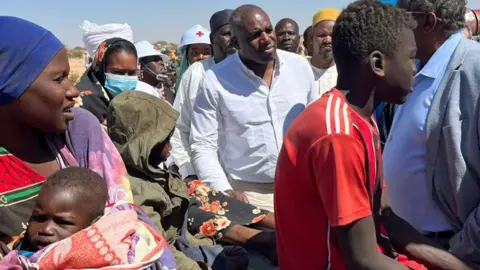
Under the sweltering sun, David Lammy visited the Adré border post on Friday to witness first-hand the impact of Sudan’s civil war which erupted when the army and its former ally, the paramilitary Rapid Support Forces (RSF), fell out.
Those who make it over the border have often been separated from their families in the chaos to escape and are desperate to see if their relatives have made it over safely.
“It’s some of the most horrific things I’ve ever heard and seen in my life,” said Lammy.
“Overwhelmingly, what I’ve seen here in Chad, on the border with Sudan, are women and children fleeing for their lives – telling stories of widespread slaughter, mutilation, burning, sexual violence against them, their children. And amongst it all, famine, hunger – such unbelievable plight.”
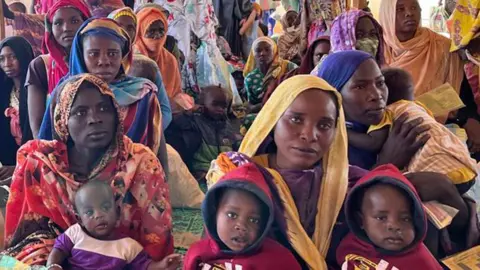
The foreign minister saw the dozens of women wrapped in light, multicoloured shawls and holding children of different ages crossing over on horse-drawn carts.
They looked weary sitting on bags holding the few belongings they could bring with them in the long journey to safety.
“Alhamdulillah” meaning “praise be God”, remarks Halima Abdalla when I asked her how she felt to have made it over the border.
The 28-year-old is relieved despite the tragedy she has suffered losing one of her children as she fled from Darfur, Sudan’s western region, which has suffered some of the most devastating violence over the last 21 months – much of it alleged to have been perpetrated by the RSF.
“I first went to el-Geneina, but I had to run again when fighting broke out there,” she says, explaining how she then became separated from her husband and two other children.
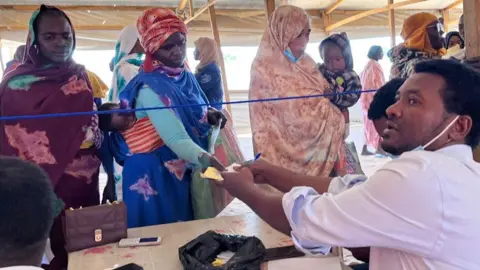
Aid workers registering the newly arrived try and reunite those who became separated from relatives and children as they fled
Aid workers in Adré say they have been trying to reunite families once they crossed the border.
“Some mothers have told us they had to choose which children to run with as they couldn’t carry all of them at one go,” an aid worker told the BBC.
Some abandoned children have been brought by humanitarian workers across the border and are put in foster care while efforts are made to find their families.
Standing on the Chadian side of the border, Lammy spoke to families that were fleeing and aid workers who were receiving them.
After meeting some of the refugees, he told the BBC: “All of these people have stories – very, very desperate stories of fleeing violence, of murder in their families, of rape, of torture, of mutilation.”
“I just sat with one woman who showed me burn marks. She had been burned by soldiers up and down her arms, she had been beaten and she had been raped. This is desperate, and we must bring the world’s attention to it and bring the suffering to an end.”
But he decried what he described as a “hierarchy of conflict” that has seemingly placed Sudan’s at the bottom, even though it is currently the world’s largest humanitarian crisis.
In November last year, the UK foreign secretary spearheaded a resolution calling for a ceasefire at the UN Security Council, which Russia vetoed.
“How could you veto the plight that is going on here?” he asked, sounding exasperated.
He told the BBC he now planned to convene, in London, a meeting of Sudan’s neighbours like Chad and Egypt and other “international partners to broker the peace”.
Several attempts at peace talks led by the US and Saudi Arabia have failed to yield a solution to the conflict.
Since the mediation stalled, the US subsequently sanctioned the generals leading both sides of the war. It also determined that the RSF and its allies had committed genocide.
More than 12 million people have fled their homes since fighting broke out in April 2023.
These women and children pictured on Friday had just crossed over into Chad fleeing the atrocities being committed in Darfur
Caught in the middle of the bitter fighting are more than 50 million civilians, almost half of whom desperately need humanitarian aid, according to UN agencies.
Malnutrition rates are among the world’s highest here. At the tented clinic in Adré, health workers measure the circumference of the upper arm of six-month-old Rasma Ibrahim.
The colour-coded tape goes all the way to the red end. The impact of her health status could last her entire lifetime. One in every seven children here in Adré is malnourished.
The UK would continue to push for a ceasefire, said Lammy.
It has already doubled aid to £200m ($250m), and is calling for other donor countries to step up.
Aid agencies are however concerned by the announcement by newly inaugurated US President Donald Trump of a 90-day freeze on foreign aid.
A disruption in the support of one of the world’s largest donors will no doubt have devastating consequences on crises like Sudan. The UN is already struggling to meet its targets for badly needed aid money.
In 2024, an appeal for $2.7bn (£2.2bn) to support Sudan was put out, but only 57% of this money was provided.
At the food distribution centre in Adré, sacks of split yellow peas, millet, sorghum, and boxes of cooking oil and other supplies have been arranged neatly on top of tarpaulins as families from the nearby refugee camp queue for their quotas.
The cries of infants tied by shawls to their queueing mothers’ backs fill the air. One-by-one, the families are called to collect their rations.
A man helps lift a sack of dry food on to the shoulder of another, who then hums as he makes his way back to his makeshift home.
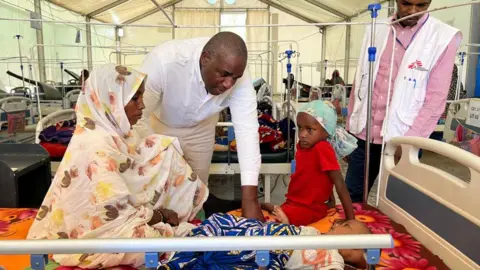
David Lammy, who also visited a MSF clinic in Adré, urged donors to step up aid for Sudan
The population of Adré was about 40,000 before Sudan’s civil war began and now it has grown more than five-fold, according to local volunteers.
The refugees here are among the lucky few. Just across the border, in Darfur, famine was declared in August in Zamzam camp, near the city of el-Fasher, which the RSF has besieged for more than a year.
On Friday came the devastating news that one of el-Fasher’s last functioning hospitals was hit by a drone, killing at least 30 people. Regional authorities said RSF paramilitaries were the culprits, but they have not responded to the claim.
Back in December, the UN-backed Famine Review Committee said famine had spread to more areas – in Darfur to Abu Shouk and al-Salam camps and to parts of South Kordofan state.
The famine spread despite the re-opening of the Adré border that had been shut by the army on suspicion it was being used to transport weapons to its rivals.
As we left the border, three or four lorries with UN World Food Programme banners slowly rumbled down the dusty road crossing into Sudan.
They will be delivering much-needed aid to villages, towns and displacement camps beyond the border. But it is still far from sufficient.
“We have to step up and wake up now to this huge, huge crisis,” said Lammy.