US president says venture will be the largest AI infrastructure project in history ‘by far’.
United States President Donald Trump has announced a $500bn joint venture with Texas-based tech firm Oracle, Japan’s SoftBank and ChatGPT-maker OpenAI to advance artificial intelligence infrastructure.
Trump made the announcement at a White House event on Tuesday that was joined by Softbank CEO Masayoshi Son, OpenAI CEO Sam Altman, and Oracle Chief Technology Officer Larry Ellison.
Trump said the venture would be the largest AI infrastructure project in history “by far” and represented “a resounding declaration of confidence in America’s potential” under his new administration.
“It’s all taking place right here in America. As you know, there’s great competition for AI and other things and they are coming in at the highest level,” Trump said.
Shares of Tokyo-based Softbank Group soared more than 8 percent on Wednesday following the announcement.
The so-called Stargate venture will see the three companies initially commit $100bn, rising to $500bn over the next four years.
The funding will be used to build “colossal data centres” and other infrastructure needed to support AI, helping ensure the future of the technology, Trump said.
“What we want to do is keep it in this country,” Trump said. “China is a competitor and others are competitors and we want it to be in this country.”
The project will be led by Softbank and Open AI, according to a statement by OpenAI. Softbank’s Son will serve as chairman.
Trump’s announcement came a day after he revoked an executive order by former US President Joe Biden that established safety guidelines for AI development.
The rules would have required companies to share the results of safety tests with the US government, among other provisions.
After Trump’s executive order, Stargate and other US-based AI projects will no longer be subject to national development guidelines, although states may still impose restrictions.
In brief remarks on Tuesday, Son said Stargate would be the “beginning of our golden age”.
Stargate will also bring some of the US’s top tech companies into the fold, according to Open AI.
SoftBank, OpenAI, Oracle and MGX will serve as equity funders, while Arm, Microsoft, NVIDIA, Oracle and OpenAI are the “key initial technology partners”, the company said in a statement on X.
“The build out is currently underway, starting in Texas, and we are evaluating potential sites across the country for more campuses as we finalise definitive agreements,” Open AI said, promising that Stargate would “not only support the re-industrialisation of the United States but also provide a strategic capability to protect the national security of America and its allies”.
US President Donald Trump has said he is considering imposing a 10% tariff on imports of Chinese-made goods as soon as 1 February.
Trump said discussions with his administration were “based on the fact that they’re sending fentanyl to Mexico and Canada.”
It followed threats by Trump to levy import taxes of 25% on Mexico and Canada, accusing them of allowing undocumented migrants and drugs to come into the US.
In a press conference in Washington on Tuesday, Trump also vowed to hit the European Union with tariffs.
“China is an abuser, but the European Union is is very, very bad to us,” he said.
“They treat us very, very badly. So they’re going to be in for tariffs. It’s the only way you’re going to get back. It’s the only way you’re going to get fairness.”
Shortly after he was sworn in on Monday, the new president also instructed federal agencies to conduct a review of existing trade deals and identify unfair practices by US trading partners.
Meanwhile, a top Chinese official spoke out against protectionism at the World Economic Forum in Davos.
China’s Vice Premier, Ding Xuexiang, called for “win-win” solutions to trade disputes without mentioning the US.
On the campaign trail Trump had promised to place tariffs as high as 60% on Chinese goods.
The Canadian Prime Minister Justin Trudeau has promised to fight back.
“If the [US] president does choose to proceed with tariffs, Canada will respond – and everything is on the table,” Trudeau said.
Ottawa is preparing counter-tariffs in response to the threat, reportedly worth billions of dollars.
Canada, China and Mexico are the top US trading partners.
Tariffs are an important part of Trump’s economic plans. The president believes they can boost growth, protect jobs and raise tax revenue.
But many economists say such measures could lead to higher prices for Americans and harm companies hit by foreign retaliation.
But this elation, for Ahmad and Areej, does not — cannot — translate into an intention to return to Deir al-Zour, at least in the foreseeable future. ISIS has remained active in eastern Syria, and U.S.-backed and Kurdish-led Syrian Democratic Forces, who control large parts of the region, are currently clashing with the Syrian National Army, a Turkey-backed proxy. Ahmad and Areej see ethnic conflict ahead. And they aren’t considering returning to other parts of Syria.
“The problem is not in geography,” says Ahmad, who wants to live in a secular state and does not want to live under a government led by the rebel group Hayat Tahrir al-Sham. “Can these people who are now in charge take the right steps to build a civil state — one that respects human rights — secure lasting peace and deliver full services?” He notes that Israeli forces are only kilometers outside Damascus, that U.S. planes still fly over Syrian skies and that many countries are calling the shots in Syria. It’s not the Syria he dreamed of when he joined the early demonstrations or that he has been striving for in his near decade in Turkey, where he has worked with civil-society organizations focusing on initiatives that include peace building, human rights advocacy, youth and female empowerment and planning for a political and democratic transition of power in Syria. And of course, there is the trauma of having lived under ISIS, which Ahmed al-Shara, the leader of H.T.S., once had ties to. “Our experience, personally and as a family, are among the main reasons we are not going back,” Ahmad says. “We are seeing signs that look a lot like ISIS. In how they are running the country and treating the people. Maybe not as intense or as obvious, or the same high level of severity, but the thoughts are one and similar.” The family still hopes to be resettled outside Turkey, where their attempts to build their lives have not been easy for any one of them. Since 2021, their application for asylum has been pending at the United Nations’ refugee agency.
For his part, Rami quit waiting for permission from the Turkish government to cross legally into Syria via the countries’ shared border. He flew from Gaziantep to Istanbul to Beirut and drove to the Syrian border, arriving at midnight on Dec. 27. The checkpoint — once a place of corrupt border guards and officials who regularly expected bribes at best, or at worst abducted and disappeared Syrians entirely — was unmanned. The road to Damascus was now open.
Rami reached the capital at 1:30 a.m., nearly 30 hours after leaving Hiba and Pamela. His plan was to stay a few nights before heading north to Aleppo. On his first afternoon, he attended a somber gathering, a vigil of sorts, for the disappeared Syrians, who still number in the thousands. In silence, relatives stood holding their loved ones’ photos, demanding to know their fates. When Rami saw a young woman with her father’s picture, he thought of Pamela, imagined her in such a situation and realized he didn’t have it in him to delay.
It would take him another 10 hours to make the 220-mile trip to his city, just on the other side of the border from Gaziantep. He was in an old car, and the road had no lights, no signs. “It was like a horror film,” he says. When he arrived at the entrance of Aleppo, again at midnight, there was no electricity, so the city was completely dark. It didn’t matter. “The beauty was, I didn’t need GPS,” he says. “I know all the roads.” He memorialized the moment, filming it on his phone. In the footage, he can be heard laughing hysterically, interrupted by gasps that could be sobs.
Decades of trade integration across North America are on the precipice of major disruption by tariffs that President Trump says he wants to impose on Canada and Mexico, the United States’ top trading partners.
And while tariffs are predicted to inflict pain on all three nations, they would cause more damage to Canada and Mexico, smaller economies that are deeply dependent on the United States.
Officials in both countries breathed a brief sigh of relief on Monday, when Mr. Trump stopped short of making tariffs part of his blizzard of executive orders on his first day in office. But the relief was short-lived: later in the evening, Mr. Trump told reporters he was still planning to pursue tariffs.
“We’re thinking in terms of 25 percent on Mexico and Canada,” Mr. Trump said in the Oval Office. “I think we’ll do it February 1.”
Trade experts are gauging whether tariffs will materialize or whether the threat alone is a negotiating tactic aimed at winning concessions from Mexico and Canada. Both countries avoided steep tariffs during the first Trump administration, and both are wagering that the United States needs Mexico and Canada to take on China, a much larger rival.
Economists and policymakers say tariffs would cause a loss of income and jobs and force consumers to pay more for many products.
Mr. Trump on Monday signed an executive order directing federal agencies to conduct a sweeping review of U.S. trade policies, which could result in further actions against Mexico and Canada.
The tariffs Mr. Trump is promising would most likely be met with retaliatory tariffs from Canada and Mexico and would unravel closely integrated production lines and supply chains across North America.
More than $1.5 trillion worth of items would be on the line — the total value of all goods traded between the United States and Canada, and the United States and Mexico. (This is the 2023 total value of these trading relationships, the most recent available, according to U.S. government data.)
Economists predict that the initial effect would be negative for all three nations, which are bound by a free-trade agreement known as USMCA (United States-Mexico-Canada).
The negative effect is tricky to translate into hard numbers: not only is it unclear exactly what items Mr. Trump would target and how Mexico and Canada would respond, but the consequences can shift over time, including a rise in inflation as goods become more expensive, loss of jobs and a chill on spending as consumers worry about diminished incomes.
And governments often intervene to lessen some of these negative effects. Canadian government officials have already said that they would consider bailing out businesses and supporting workers who are most affected.
But some industries would be swiftly disrupted: Agriculture, automobiles and energy suppliers, pillars of all three economies, would be upended by blanket tariffs.
United States
A few pockets of industry in the United States might welcome a 25 percent tariff on goods from Canada and Mexico — for example, American growers of tomatoes and other seasonal fruits and vegetables that have trouble competing with their Mexican counterparts.
But most industries would be hit hard by the economic disruption of such high tariffs.
Even groups that might prefer more protections against Mexican exports, like U.S. autoworkers, could be harmed if tariffs suddenly caused auto-supply chains to grind to a halt. Both the United Auto Workers and the United Steelworkers International Union also stretch across the U.S.-Canada border and include members in Canada, meaning they typically oppose any restrictions on Canadian exports.
Since the United States is North America’s largest economy and the least dependent on trade, the proportional effect on the U.S. economy would be less than on the Mexican or Canadian economies.
But tariffs would raise prices for consumers and add inflation. American households and businesses could expect to pay higher prices for a variety of goods subject to tariffs, including avocados, beer, steel, cars and petroleum.
Those higher prices would discourage purchases and most likely end up slowing the economy. Researchers at the Peterson Institute for International Economics in Washington estimate that a 25 percent tariff on all exports from Mexico and Canada would lower U.S. gross domestic product by about $200 billion for the duration of the second Trump administration.
U.S. industries that export to Canada and Mexico would also presumably be hurt if those countries turned around and imposed duties on U.S. goods. The Canadian government has made plans to target orange juice from Florida, whiskey from Tennessee and peanut butter from Kentucky, while the Mexican government has been drawing up its own retaliation plans.
Canada
The U.S.-Canada trade relationship is characterized by some eye-popping facts highlighting the countries’ close economic, industrial and trading ties.
Some $2.5 billion worth of goods is traded over the border every day, making it an $800 billion-a-year trade relationship.
For the auto industry, the U.S.-Canada border can often seem irrelevant, with a single vehicle crossing back and forth up to eight times before it is fully assembled.
Canada exports 80 percent of its oil to the United States, which gets half of its imported oil from Canada. And Canadian energy powers homes and businesses across the United States, especially in New England, where Quebec exports hydroelectric power.
And Canada sends other crucial commodities to the United States, like potash, which is used in fertilizer, and uranium, which is needed for nuclear energy production.
Should Mr. Trump pursue tariffs, the repercussion would depend on how extensive they are or if certain Canadian goods, like oil, might be exempt. But the fallout for Canada could be devastating.
Economists predict a 2 percent to 2.6 percent loss of economic output annually. More than a million Canadian jobs would be in jeopardy, including about half a million in the auto industry in Ontario, according to the province’s premier, Doug Ford.
If tariffs were placed on Canadian energy and Canada retaliated by limiting exports of oil, the effect would be felt across the country, particularly in Alberta, Canada’s oil-exporting hub.
Alberta’s provincial leader has rejected a federal government plan that would use oil as a lever to pressure the Trump administration into backpedaling from imposing tariffs.
Mexico
Mexico stands out among major economies for its dependence on trade with the United States, sending about 80 percent of its exports to its neighbor, with many coming from factories operating within 30 miles of the border.
Since those plants are overwhelmingly focused on serving the U.S. market, that makes Mexico far more vulnerable to tariffs than a large industrial economy like Germany that can more easily reorient its exports to an array of different markets.
Tariffs of 25 percent would be ruinous for Mexico, said Marcus Noland, executive vice president and director of studies at the Peterson Institute for International Economics.
“In effect, it would initiate a process of deindustrialization of Mexico,” he said.
Mr. Noland estimated that such tariffs could reduce Mexico’s economic output growth by about 2 percentage points, potentially resulting in large-scale factory closures and job losses. The automobile industry, which employs more than one million people in Mexico and relies heavily on complex supply chains moving parts across the border, could be especially vulnerable.
Other sectors of Mexico’s economy could come under severe pressure in the face of steep tariffs. Automobiles, computers, cables, phones and medical instruments are among Mexico’s largest exports.
Agriculture is another weak spot for Mexico, which supplies 63 percent of U.S. vegetable imports and 47 percent of its fruit and nut imports. The tariffs could hit emblematic products like avocados, which have experienced skyrocketing demand among American consumers since the United States began importing them from Mexico.
Mexico’s ability to soften the blow from tariffs is also limited because of budgetary challenges, said Kimberley Sperrfechter, an emerging markets economist at Capital Economics in London, citing a budget shortfall in 2024 that reached its highest level in decades.
One sector of Mexico’s economy that could benefit from tariffs is the tourism industry. If tariffs are imposed, the country’s currency, the peso, could weaken, Ms. Sperrfechter said, and make Mexico even more appealing to U.S. tourists, who represent the country’s largest international visitor group.
“But,” she added, “that’s unlikely to offset the hit to other sectors.”
Secretary of State Marco Rubio walked into the State Department on Tuesday for the first time in his new job, taking the reins of the main agency carrying out U.S. foreign policy at a time of violent global crises and as other nations begin engaging with President Trump.
After greeting employees at a ceremonial gathering, Mr. Rubio went into a meeting with his counterparts from India, Japan and Australia to discuss issues in the Indo-Pacific region, an area that, in his eyes, China seeks to dominate.
The State Department and the United States Agency for International Development, which works under Mr. Rubio’s authority, have begun halting the disbursement of foreign aid money, following an executive order signed on Monday by Mr. Trump.
The move immediately affects programs aimed at alleviating hunger, disease and wartime suffering around the globe, as well as ones that help nations with economic development.
Mr. Rubio was sworn in as secretary of state at 9:30 on a frigid Tuesday morning by Vice President JD Vance. He arrived at the flag-festooned entrance hall of the State Department at 1 p.m. to applause, as hundreds of employees strained to get a glimpse of him and his wife, Jeanette Rubio, and their four children. Lisa Kenna, a career diplomat who is serving as Mr. Rubio’s executive secretary, as she did for Mike Pompeo in the first Trump administration, introduced the new secretary.
Mr. Rubio thanked the many diplomats working overseas, then laid out Mr. Trump’s foreign policy goal: “That mission is to ensure that our foreign policy is centered on one thing, and that is the advancement of our national interests, which they have clearly defined through his campaign as anything that makes us stronger or safer or more prosperous,” he said.
“There will be changes, but the changes are not meant to be destructive, they’re not meant to be punitive,” he added.
He said that “things are moving faster than ever” around the world, and that the department had to act at “the speed of relevance.”
“We need to move faster than we ever have because the world is changing faster than we ever have,” he said, “and we have to have a view that some say is called ‘look around the corner,’ but we really need to be thinking about where are we going to be in five, seven, 10 or 15 years.”
That analysis of a troubled world and the challenges to American foreign policy overlap with concerns that Mr. Rubio’s predecessor, Antony J. Blinken, expressed in several of his final public interviews.
“We all have this intravenous feed of information, and we’re getting new inputs every millisecond, and the pressure to simply react is more intense than it’s ever been,” Mr. Blinken said in an interview on Jan. 14 with David Remnick, the editor of The New Yorker. “And no one has the distance, the buffer, to really try to reflect and to think before you act. At least it’s really much harder to do that. The speed with which things is happening is much harder.”
Mr. Rubio also sent out a cable outlining his vision to the department’s employees.
The meeting at State Department headquarters on Tuesday among the top diplomats from the Asian nations, which form a nonmilitary coalition known as the Quad, had been scheduled before the transition from the Biden to the Trump administrations. Mr. Rubio planned to have bilateral meetings with each of the foreign ministers after the Quad talks.
Mr. Rubio was the first cabinet secretary named by Mr. Trump to be confirmed. He had been in the Senate representing Florida since 2011 and served on the Foreign Relations and Intelligence Committees. He was unanimously approved by the Senate on Monday evening.
Mr. Rubio, the son of Cuban immigrants, has been especially outspoken on the need to confront the Chinese Communist Party.
Mr. Trump’s executive order on foreign aid is the presidential directive that has had the most immediate effect on operations at the State Department and at the United States Agency for International Development, or USAID. On Monday, Mr. Trump signed an order to halt any disbursement of foreign aid funds and designation of new funds pending a 90-day review under guidelines to be issued by the secretary of state.
That means millions of dollars that would usually go to support programs across continents — programs that provide basic daily sustenance for many people — are being frozen.
Nongovernmental groups and contractors who have been using the money on programs are scrambling to figure out what to do, and many programs in impoverished and war- or disaster-stricken parts of the world could suddenly end, a U.S. official said.
The executive order said the 90-day assessment would look at “programmatic efficiencies and consistency with United States foreign policy.”
“The United States foreign aid industry and bureaucracy are not aligned with American interests and in many cases antithetical to American values,” it said. “They serve to destabilize world peace by promoting ideas in foreign countries that are directly inverse to harmonious and stable relations internal to and among countries.”
The cabinet of United States President Donald Trump has started to take shape, with its first nominee confirmed to a role: Florida lawmaker Marco Rubio.
On Tuesday, Rubio, 53, was sworn in as secretary of state, the country’s chief diplomat and the highest-ranking role in the cabinet, second only to the vice president and president.
The ceremony came after a rare unanimous vote in the Senate to elevate him to the role.
All 99 members voted in favour: The only vote missing in the 100-seat chamber was Rubio himself, as he had to step down as senator to take up his new position.
Speaking at the swearing-in ceremony, Vice President JD Vance described Rubio as a “needed departure from a generation of failed foreign policy”.
“He is a bipartisan solutions-seeker, a guy who can actually get things done, but a conservative of great principle and vision,” Vance said. “And I think more than anybody that I’ve met in Washington over the last few years, Senator Rubio, I think, understands the distinctive priorities of President Trump.”
But what has Rubio pledged to do in his new role? And what did Tuesday’s ceremony reveal about the newly-minted diplomat? Here are three takeaways.
Secretary of State Marco Rubio is sworn into office by Vice President JD Vance, as he places his hand on a bible held by his wife, Jeanette Rubio [Evan Vucci/AP Photo]
Rubio defends State Department employees
In his first remarks as secretary of state, Rubio praised the federal employees who conduct day-to-day operations at the US Department of State, the executive agency he is now charged with running.
“This is an extraordinary honour and a privilege to serve in this role, to be here — frankly, to oversee the greatest, the most effective, the most talented, the most experienced diplomatic corps in the history of the world,” Rubio said.
“ I want to also thank the locally employed staff, the nationals of those countries who work with us,” he added. “Without their help, without their support, it would be impossible for us to conduct our mission.”
Rubio’s remarks come at a sensitive time for federal civil servants, as Trump sweeps into office with a raft of executive actions designed to rein in government bureaucracy.
Just one day earlier, on the first day of his second term, Trump threatened to fire those employees he perceives as loyal to his predecessor, Democrat Joe Biden.
“To gain immediate control of the vast federal out-of-control bureaucracy, I will implement an immediate regulation freeze, which will stop Biden bureaucrats from continuing to regulate,” Trump told supporters gathered at the Capitol One Arena in Washington, DC.
“Most of those bureaucrats are being fired. They’re gone. Should be all of them, but some sneak through.”
By contrast, Rubio entered his new role defending the work of the State Department and praising its employees.
“ There’s no other agency in the world, there’s no other agency in our government, that I’d rather lead because of the talent that’s collected here in this room and those watching around the world,” he said.
State Department staff listen as Secretary of State Marco Rubio addresses them on Tuesday in Washington, DC [Jacquelyn Martin/AP Photo]
Rubio pledges to advance ‘America First’
Still, Rubio once again restated his firm commitment to advancing Trump’s “America First” policy platform, and warned that changes would come to the State Department as a result.
“There will be changes, but the changes are not meant to be destructive. They’re not meant to be punitive,” he told the audience at his swearing-in, made up largely of State Department employees.
Rubio outlined a vision where the State Department takes more of a leading role in government affairs.
“Sometimes, the Department of State has been sort of relegated to a secondary role because some other agency can move faster or seems to be bolder or more creative,” Rubio said.
“It’s not your fault. But we’re going to change that. We want to be at the centrepiece. We want to be at the core of how we formulate foreign policy.”
The former senator explained that the department’s role moving forward would be more inward-looking, seeking to craft policies that would make the US “stronger or safer or more prosperous”.
He also advised employees to look at Trump’s election to a second term in November as a mandate to centre US priorities.
“Our job, across the world, is to ensure that we have a foreign policy that advances the national interest of the United States,” he said, adding: “I expect every nation on earth to advance their national interests.”
Secretary of State Marco Rubio speaks to State Department staff next to his wife, Jeanette Rubio [Jacquelyn Martin/AP Photo]
Balancing hawkishness with peace
But despite his unifying tone on Tuesday, Rubio faced protesters as he sat for Senate hearings about his nomination over the past week.
“Little Marco, keep your hands off our country!” one protester shouted, denouncing the US’s involvement in “forever wars”.
Another, speaking Spanish, criticised hardline US policies abroad: “The sanctions of Marco Rubio are killing kids in Nicaragua, Cuba and Venezuela.”
Rubio brushed aside the interruptions with light-hearted remarks. “I get the bilingual protesters,” the lawmaker, a child of Cuban immigrants, quipped. He will be the first Latino person to serve as secretary of state.
But the protests were a reminder of Rubio’s reputation as a foreign-policy hawk, known for his aggressive stance to US adversaries overseas.
One particular target during Rubio’s confirmation hearings was China, which has sanctioned the Florida politician for his support of Hong Kong’s autonomy. He told senators last week that he believed the US-China rivalry would “define the 21st century”.
“The Communist Party of China that leads the PRC [People’s Republic of China] is the most potent and dangerous near-peer adversary this nation has ever confronted,” Rubio said.
He explained the threat of China dwarfed that of the US’s Cold War rival, the Soviet Union.
“They have elements that the Soviet Union never possessed. They are our technological adversary and competitor, an industrial competitor, an economic competitor, a geopolitical competitor, a scientific competitor now — in every realm.”
Still, despite his hawkish posture, Rubio told State Department employees on Tuesday that he planned to follow through with Trump’s promises of delivering world peace.
“That’s what we endeavour to do: to promote peace around the world because that’s in our national interest,” Rubio said. “Without peace, it is hard to be a strong nation, a prosperous nation.”
He did, however, admit that “there will be conflict”. In explaining how he viewed US policy abroad, he echoed rhetoric popular among the Christian right: namely, that the US is founded on a religious mandate.
“We are, at the end of the day, a nation founded on a powerful principle. And that powerful principle is that all men are created equal because our rights come from God, our creator — not from our laws, not from our governments,” Rubio said.
“We hope the entire world can one day live under that. And we will always, always be strong defenders of that principle.”
Lt Gen Herzi Halevi (L) called for a commission of inquiry into the 7 October 2023 attack
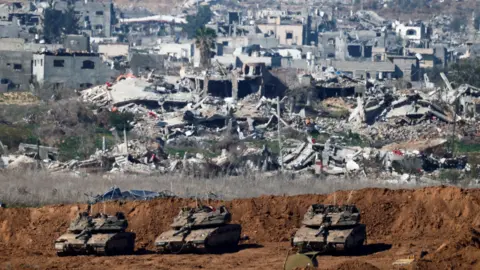
Israel’s military chief has resigned, saying he recognised his responsibility for its failure on 7 October 2023, when the Palestinian armed group Hamas carried out a deadly attack on the country that triggered the Gaza war.
In a letter to the defence minister, Lt Gen Herzi Halevi admitted the Israel Defense Forces (IDF) had “failed in its mission to protect the citizens of Israel”.
“My responsibility for the terrible failure accompanies me every day, every hour, and will be so for the rest of my life,” he added.
The general said he would leave his role on 6 March at a time of “significant achievements” for the IDF, although he acknowledged that “not all” of Israel’s war goals had been achieved.
“The military will continue to fight to further dismantle Hamas and its governing capabilities, ensure the return of the hostages” and enable Israelis displaced by attacks by armed groups to return home, he added.
Shortly afterwards, the chief of the IDF’s Southern Command, Maj Gen Yaron Finkelman, also announced he was also stepping down, saying he had had failed in his “duty to protect the Western Negev and its beloved, heroic residents”.
Their resignations come three days after the start of a Gaza ceasefire and hostage release deal agreed with Hamas, which is proscribed as a terrorist organisation by Israel, the US and others.
Israeli military and intelligence officials missed or ignored many warnings before hundreds of Hamas gunmen breached Israel’s Gaza perimeter fence at multiple locations 15 months ago and attacked nearby Israeli communities, IDF bases and a music festival. About 1,200 people were killed and 251 were taken hostage.
The IDF responded by launching an air and ground campaign in Gaza, during which more than 47,100 Palestinians have been killed, according to the territory’s Hamas-run health ministry.
Gen Halevi said in a televised address on Tuesday that Hamas’s military wing had been “severely damaged”, with most of the group’s leadership and military commanders have been killed along with almost 20,000 “operatives”.
He also promised that the IDF’s inquiry into the events of 7 October, which he plans to complete before leaving his role, would be “high quality, thorough, and fully transparent”.
However, he warned that the military inquiry “is focused solely on the IDF and does not encompass the broader factors that could prevent similar events in the future”.
“A commission of inquiry or any other external body can investigate and examine and will receive full transparency from the IDF,” he said.
Prime Minister Benjamin Netanyahu thanked Gen Halevi “for his many years of service and for commanding the IDF” during the war, saying it had “led to major achievements for Israel”.
Up to now, Netanyahu has said only that he is deeply sorry about what happened on 7 October and that he will have to answer “some tough questions” over his role, without acknowledging any responsibility. He has also said an independent commission of inquiry should wait until the end of the Gaza war.
Opposition leader Yair Lapid praised Halevi’s decision and called on Netanyahu to follow suit.
“Now, it is time for them to take responsibility and resign – the prime minister and his entire catastrophic government,” he said.
Reuters
Gen Halevi’s resignation comes three days after the start of a ceasefire in Gaza
Gen Halevi is currently overseeing the IDF’s compliance with a three-phase Gaza ceasefire deal with Hamas that should see the remaining Israeli hostages released in exchange for hundreds of Palestinian prisoners in Israeli jails.
In total, 33 hostages should be released during the first phase lasting six weeks. Hamas handed over three women on Sunday, when the ceasefire took effect, and has said it will free another four women on Saturday.
Israeli forces should also withdraw from densely populated areas of Gaza, displaced Palestinians should be allowed to begin returning to their homes, and hundreds of aid lorries should be allowed into the territory each day.
Negotiations for the second phase – which should see the remaining hostages released, a full Israeli troop withdrawal and “the restoration of sustainable calm” – should start in just over two weeks.
The third and final stage should involve the reconstruction of Gaza, which could take years, and the return of any remaining hostages’ bodies.
However, there is high anxiety among Palestinians in Gaza and the hostages’ families about whether the deal will hold.
Netanyahu has said Israel already has US backing to return to the fighting if it “reaches the conclusion that the second phase negotiations are ineffectual”.
Israeli security forces on Tuesday embarked on a military operation in Jenin, a Palestinian city in the Israeli-occupied West Bank, as Israel turned its focus to an area seen as a hotbed of militancy just days after a temporary cease-fire took hold in Gaza.
Prime Minister Benjamin Netanyahu of Israel said in a statement that the operation, the latest in a string of West Bank raids over the past year, was aimed at “eradicating terrorism” and would be “extensive and significant.” The Palestinian Authority’s health ministry reported that eight people had been killed and at least 35 injured during the first hours of the operation.
For Mr. Netanyahu, the operation in the West Bank could serve as a distraction from Gaza, where Hamas gunmen paraded through the streets even before the cease-fire started on Sunday, a show of force signaling that it had survived the 15-month war despite Mr. Netanyahu’s vows to destroy it.
But with its strength severely diminished in Gaza, Hamas has intensified its efforts to arm militants in the West Bank to open another front against Israel, analysts said, making an Israeli offensive there almost inevitable.
The Jenin operation comes amid sharply rising tensions in the West Bank, as the militants have grown in power and settler violence against Palestinian civilians has soared.
On Monday, President Trump rescinded sanctions imposed by the Biden administration last year on dozens of far-right Israeli individuals and settler groups accused of violence against Palestinians and the seizure or destruction of Palestinian property.
The move came shortly after Mr. Trump took office, even as Jewish extremists raided several Palestinian villages, setting fire to vehicles and properties, according to Palestinian officials and the Israeli military.
The Palestinian Authority, which exercises limited control over parts of the West Bank and is a rival of Hamas, has been carrying out its own operation against armed militants in Jenin in recent weeks after largely leaving security in the area to Israel. Deadly Israeli raids and drone strikes in the northern West Bank over the past year have chewed up streets and left many Palestinian civilians in fear.
Residents and witnesses in Jenin said on Tuesday that a local private hospital, Al-Amal, was surrounded by Israeli forces and had come under fire.
“It’s as if they came to us straight from Gaza with large vehicles, aggressive gunfire and drones,” said Kamila Mahmoud, 22, a resident of Jenin, in a telephone interview.
Residents said that Palestinian Authority security officers and medics were among the injured. Brig. Gen. Anwar Rajab, the spokesman for the Authority’s security forces, said one Palestinian officer was killed.
The Israeli military did not immediately respond to questions about the accounts.
Presaging the raid in Jenin, Lt. Gen. Herzi Halevi, Israel’s military chief, said in a statement on Monday, the day after the cease-fire in Gaza came into effect, that Israel “must be ready for significant counterterrorism operations” in the West Bank in the coming days “to pre-empt and apprehend the terrorists before they reach our civilians.” Mr. Halevi announced his resignation on Tuesday, citing in part the military’s failure to protect Israel from the Oct. 7, 2023, Hamas-led assault that prompted the Gaza war.
Nearly half a million settlers and roughly 2.7 million Palestinians live in the West Bank. The Palestinians, and much of the world, have long envisioned the territory as part of a future independent Palestinian state, alongside Israel, and consider the Jewish settlements to be illegal.
Though Mr. Trump has sent mixed signals, his administration is expected to be staunchly pro-Israel. Some settler leaders have nurtured close ties over the years with Trump associates like Mike Huckabee, Mr. Trump’s pick as the next ambassador.
Hard-line members of Israel’s right-wing government had been requesting the removal of the Biden administration sanctions, one of a long list of executive orders that Mr. Trump signed immediately after his inauguration. Palestinian officials strongly criticized the move, saying it was likely to encourage further violence.
The cancellation coincided with a second consecutive night of violence in the West Bank as extremist settlers protested the cease-fire. Yisrael Ganz, the leader of an umbrella council representing all the settlements, welcomed Mr. Trump’s decision but said he condemned all violence, even if it was perpetrated by a “handful” of settlers.
Far-right members of Mr. Netanyahu’s government oppose the cease-fire, the first phase of which calls for a six-week truce and the incremental exchange of 33 hostages held in Gaza for hundreds of Palestinian prisoners.
Pressure from Mr. Trump and his envoy, Steve Witkoff, was instrumental in helping seal the deal between Israel and Hamas, as were Biden administration officials and other mediators. Mr. Trump had warned that there would be “all hell to pay” if Israeli hostages were not released by his inauguration.
But asked on Monday if he thought the cease-fire in Gaza would hold, Mr. Trump said that he was “not confident” and signaled a lack of interest in the conflict. “That’s not our war,” he said. “It’s their war.”
“But I think they’re very weakened on the other side,” he added, apparently referring to Hamas.
Hamas has become increasingly isolated with its allies decimated in Lebanon, toppled in Syria and weakened in Iran. Seeking to ignite another front against Israel, Hamas issued a statement on Tuesday calling on the Palestinian masses to mobilize and confront the Israeli forces in the West Bank.
“That’s the only front where they see a potential,” said Ehud Yaari, an Israel-based fellow of the Washington Institute for Near East Policy.
Noting that Israel had already raided Jenin more than a dozen times over the past year, Mr. Yaari said that Israel had no choice but to mount a large-scale operation there because the Palestinian Authority’s efforts appeared to be failing. Hamas was supplying the West Bank gunmen with funds and more sophisticated weapons, and attacks against Israel were intensifying, he noted.
General Rajab, the spokesman for the Palestinian Authority’s security forces, said the Israeli raids were “aimed at undermining the security campaign being conducted by the Palestinian Authority” and “intentionally sabotaging Palestinian efforts to enforce law and order” by creating chaos.
Settler extremists have also been trying to destabilize the West Bank and said they would try to block Palestinian prisoners released under the terms of the Gaza cease-fire deal from returning to their homes. Israeli security chiefs have labeled the settler attacks on Palestinians as Jewish terrorism.
One of the Palestinian towns that came under settler attack on Monday was Al-Funduq, in the northern West Bank, where Palestinian gunmen who are believed to have come from another town shot at a civilian bus and cars, killing three Israelis earlier this month.
Louay Tayem, the mayor of Al-Funduq, said that dozens of Israeli settlers began raiding the village, as well as neighboring Jinsafut, at around 9:15 p.m. on Monday and that the assault continued for roughly three hours before the settlers were finally dispersed by Israeli security forces. They smashed car windows, torched a plant nursery and two bulldozers, and attempted to set a house on fire, he said in a phone interview.
Two Israeli men were shot and seriously wounded during one of the assaults on Monday, according to Israel’s emergency services, apparently by Israeli security forces who came under attack. The Israeli authorities said they were investigating.
Aaron Boxerman and Myra Noveck contributed reporting from Jerusalem and Rawan Sheikh Ahmad from Haifa, Israel.
As panic sank in, two men strung ladders together with rope and placed them over the steel border wall that separated Tijuana from Southern California.
“Hurry up, hurry keep moving!” shouted the smugglers at the bottom of the ladder. A young girl from Zimbabwe stood on top and looked down with wide eyes, hesitating before taking her next step.
On Monday, people waiting to enter the United States learned that President Trump had canceled all asylum appointments moments after taking office and planned to sign several executive orders sealing the border.
Yet at least one group still made a desperate and perilous last-ditch effort to cross into the United States.
One by one, they ascended the wobbling structure, then slid down the other side. Those who made it over helped catch the women and children. But one woman fell to the ground on her way down and lay wailing in pain, grabbing her leg.
“We do this out of need, not because we want to, and that is it,” said Carlos Porras, 39, from Peru, speaking through the wall slats. He also hurt his ankle while jumping and was limping.
Moments later, the group was approached by U.S. Border Patrol officers and taken away.
The scene revealed the desperation of migrants who on Monday learned that the border was now effectively closed. All were left to process the emotions, from bewilderment to despair.
“I feel rage, I feel sadness, I feel everything,” said Katherine Romero, 36, a Venezuelan who had waited a year in Mexico City for her Monday asylum appointment, working different jobs to save up for the plane ticket to Tijuana. “I just can’t believe it.”
In a series of orders he signed on Monday evening, Mr. Trump moved to close the nation’s borders to migrants, part of a policy barrage that included broadly blocking asylum seekers and a national emergency declaration to deploy the military to the border.
His administration shut down the CBP One app just minutes after Mr. Trump took the presidential oath on Monday. The app was used by the Biden administration to allow migrants to schedule appointments to gain entry into the United States but had been a target of Republicans.
The program allowed 1,450 people a day to schedule a time to present themselves at a port of entry and request asylum. More than 900,000 entered the country using the app from its launch to the end of 2024.
In a migrant encampment in Mexico City on Monday, Cristian Morillo Romero, a Venezuelan who arrived in Mexico over a year ago, learned that Mr. Trump had ended the CBP One program — but he didn’t know what that meant for his Jan. 26 appointment in Calexico, Calif.
Then he opened his email. There was a message in English with the subject line “CBP One Appointment Canceled” that explained that existing appointments “are no longer valid.”
“I want to cry,” said Mr. Morillo Romero, 37. When it finally hit him later in the day, he did.
In Ciudad Juárez, across the border from El Paso, only one group of 100 people was allowed to cross into the United States for their early morning appointments. Then, just before 11 a.m., Mexican border officials said they received a notification from their American counterparts: No more appointments were being accepted.
“I’m in shock,” said John Flores Bonalte, 36, a Venezuelan who never got to his 1 p.m. appointment. “It’s unfair. We were waiting to cross legally for a long time. It’s been seven months waiting in Mexico for this appointment.”
José Antonio Zuchite, 40, said he left Honduras in September and waited five months in Mexico City before coming to Ciudad Juárez over the weekend “with a lot of hope.” His appointment on Monday was then canceled.
“I don’t have a place to stay,” he said, as his voice cracked. “I don’t have family or acquaintances here. I’m on the street.”
On social media, migrants shared images and videos of themselves, crying or with their heads in their hands, along with captions detailing how long they had been waiting for appointments. Many said they had been biding their time in Mexico. Some said they had waited more than a year.
Many of the videos featured the same clip from a song that had also served in recent years as a sort of anthem for people who finally made it to the United States.
Now many were scrambling. In Tijuana, some people considered staying while praying for some sort of miracle. Others said they were thinking about going to places like Mexico City, where there were more job opportunities. Some said returning to their native countries was out of the question because they were escaping violence or threats.
“Going back to Haiti means going back to death,” said Rose Joseph, 28, who left the country’s violence-torn capital more than two years ago.
In her Monday news conference, President Claudia Sheinbaum of Mexico strongly urged Mr. Trump’s team to replace the CBP One app with another mechanism so that people could again apply for asylum in an orderly way.
“We want something similar to be established, because it has had results,” she said.
The program was a key part of the Biden administration’s effort to gain control over migration through the southern border. U.S. officials at the time believed that by offering migrants an organized way to enter legally through an app, they could discourage unauthorized crossings.
Coupled with Mexico’s hardened restrictions, unlawful crossings dropped markedly in 2024 and officials and analysts say the app was a significant reason.
“That was a massive change,” said Ariel Ruiz Soto, a senior policy analyst at the Migration Policy Institute in Washington. “It provided more stability and an opportunity to have better control on both sides of the U.S.-Mexico border, because it made the path of migrants more predictable.”
Critics, though, viewed the program as a way to allow those who otherwise had no legal pathway into the United States to come and remain for years as their immigration cases languished in the courts.
“They made an application to facilitate illegal immigration,” Vice President JD Vance said in a post on X last week. “It boggles the mind.”
Without a replacement program, migrants stranded in Mexico likely face three scenarios: try to cross illegally into the United States, return to their home countries or apply for asylum in Mexico.
“Maybe it’s not what many migrants would like, but it’s an alternative,” Mr. Ruiz Soto said. Still, he added, that would not be of much help for Mexicans seeking to flee their own country. “For them, I don’t see many options.”
Francisco González, a pastor who oversees a network of migrant shelters, including one in Ciudad Juárez, said he expected migrants to stay longer at shelters as they planned their next steps. He worried, he said, that people might now assume more risk by hiring smugglers or members of organized crime to cross the border illegally.
“They’re going to keep trying,” he said.
Aline Corpus contributed reporting from Tijuana and Emiliano Rodríguez Mega and Annie Correal from Mexico City.
If President Trump has his way, the auto industry’s transition to electric vehicles will soon slam into reverse. He will erase tax credits for electric-vehicle purchases, federal grants for chargers, and subsidies and loans to help retool assembly lines and build battery factories.
Executive orders issued by Mr. Trump on Inauguration Day amount to a sweeping repudiation of a centerpiece of former President Joseph R. Biden Jr.’s multibillion-dollar program to address climate change, which Republicans cast as a campaign to ban gasoline cars.
The orders also present a challenge to automakers that have invested billions of dollars in electric vehicles, in part because the Biden administration encouraged them to. But some of the orders appear to bypass Congress or federal rule-making procedures, which could make them vulnerable to lawsuits and even resistance from within the Republican Party.
While framed as a way to revive the American auto industry, the orders could cause U.S. carmakers to fall behind if they scale back their electric-vehicle programs while Asian and European automakers continue perfecting the technology, analysts say. Already, 50 percent of car sales in China are electric or plug-in hybrids, and Chinese automakers like BYD are selling more cars around the world, taking customers away from established car companies, including American manufacturers.
An executive order entitled “Unleashing American Energy” and signed by the president on Monday instructs federal agencies to immediately pause disbursement of funds allocated by Congress that were part of the Biden effort to push the auto industry toward vehicles with no tailpipe emissions.
Among other things, the funds helped states to install fast chargers along major highways and provided tax credits of up to $7,500 for buyers of new electric vehicles and $4,000 to buyers of used models. The credits effectively made the cost of buying some electric cars roughly on par with prices for cars with gasoline or diesel engines.
Mr. Trump also rescinded an aspirational Biden executive order that called for 50 percent of new vehicles sold in 2030 to be fully electric, plug-in hybrids or vehicles that run on hydrogen fuel cells.
And Mr. Trump said the administration would seek to revoke California’s authority to establish air-quality standards that are stricter than federal rules. That would have a broad effect. California is aiming for 100 percent of new-car sales to be electric by 2035, and some of its standards are copied by at least 17 other states.
“The impact of this will be significant,” said Shay Natarajan, a partner at Mobility Impact Partners, a private equity firm that invests in sustainable transportation.
If demand for electric vehicles flags, as it has in other countries like Germany that cut incentives, she noted, carmakers could be left with costly, underused electric-vehicle and battery factories.
“Federal funding for E.V. and battery manufacturing will be harder to access, increasing the risk of stranded capital for manufacturing projects already underway,” Ms. Natarajan said in an email.
Representatives of the fossil-fuel industry celebrated the president’s action, while environmentalists lamented what they said was a serious setback to efforts to cut greenhouse gas emissions and reduce urban air pollution caused by cars.
“This is a new day for American energy,” Mike Sommers, the president of the American Petroleum Institute, said in a statement, “and we applaud President Trump for moving swiftly to chart a new path where U.S. oil and natural gas are embraced, not restricted.”
Katherine García, a transportation expert at the Sierra Club, said: “Rolling back vehicle emission safeguards harms our health, our wallets and our climate. We will fight him at every turn of the road.”
But the end effect may not be as broad as the forceful language in Mr. Trump’s executive orders suggests.
Funds to encourage electric-vehicle sales and manufacturing were enshrined in legislation that the president cannot unilaterally repeal. Mr. Trump also cannot revoke rules that the Treasury Department and other government agencies established to determine how the money would be handed out merely with a stroke of the pen. Any attempt to short-circuit the laborious process of proposing new regulations that includes seeking comments from the public will almost surely invite credible legal challenges.
The Department of Energy has agreed to lend billions to carmakers like Rivian, which will receive $6 billion for a factory near Atlanta to produce electric sport utility vehicles. The loan agreements, some finalized in the waning days of the Biden administration, are binding contracts.
Much of the money has flowed to congressional districts in states like Georgia, Ohio, South Carolina and Tennessee where Republicans dominate local politics. Their representatives may hesitate to repeal laws that have brought their districts jobs and investment. That is a challenge for Republican leaders wrangling slim majorities in the House and Senate.
Ultimately, individuals and families will decide what cars they buy. Electric vehicles and plug-in hybrids are gaining market share not only because of subsidies, but also because they offer rapid acceleration and lower fuel costs. Cars that run on fossil fuels have been losing share, though that could change if financial incentives are removed from battery-powered cars and trucks.
The abrupt shift in political direction presents a quandary for automakers. Some may welcome promises by the president to rescind emissions and air-quality standards that force manufacturers to sell more electric cars than they might like. But elimination of federal subsidies could upset their financial planning when most are struggling to earn or increase profits.
The about-face on electric-vehicle policies adds to a climate of uncertainty and peril heightened by the president’s promise to impose 25 percent tariffs on goods from Canada and Mexico, which are major suppliers of cars and car parts to the United States.
The U.S. auto industry “will be shattered by tariffs on assembled vehicles or parts at this level,” Carl Weinberg, chief economist at High Frequency Economics, said in a note to clients Tuesday.
Some carmakers seemed to applaud the president’s actions, while others were noncommittal.
“President Trump’s clear focus on policies that support a robust and competitive manufacturing base in the United States is hugely positive,” Stellantis, which owns Dodge, Jeep, Ram, Chrysler and other brands, said in a statement.
Mary T. Barra, the chief executive of General Motors, congratulated Mr. Trump on Monday on X and said that the company “looks forward to working together on our shared goal of a strong U.S. automotive industry.”
There is no sign that Elon Musk — the chief executive of Tesla and head of what Mr. Trump is calling the Department of Government Efficiency — is using his influence to blunt the attack on electric vehicles. Tesla accounts for slightly less than half the electric cars sold in the United States, and almost all its vehicles qualify for $7,500 tax credits.
Four of the 16 cars and trucks that can be purchased with the help of that tax break are made by Tesla. G.M. is the only automaker that has more eligible models, at five. No other company has more than two qualifying vehicles.
Mr. Musk has previously said that the government should get rid of all subsidies and that Tesla would suffer less than other automakers. But analysts note that Tesla’s sales and profits would be hit hard if Mr. Trump successfully repealed or truncated the electric-vehicle tax credit, California’s clean-air waiver and other such policies.
Tesla did not respond to a request for comment.
During an appearance before Trump supporters in Washington on Monday, Mr. Musk, who is also the chief executive of SpaceX, exulted that the president had promised to send astronauts to Mars. “Can you imagine how awesome it will be to have astronauts plant the flag on another planet for the first time?” Mr. Musk said. He did not mention cars.