Thursday, October 1, 2026
Home Blog Page 6926

Mother of Missing U.S. Journalist Asks Syria’s New Leaders for Help

0
Mother of Missing U.S. Journalist Asks Syria’s New Leaders for Help


The mother of Austin Tice, an American journalist abducted in Syria, said on Monday that she had met with Syria’s new leader in Damascus and expressed hope that “a page will be turned” in the more than decade-long search for her son.

Debra Tice gave a news conference in Damascus on Monday after the meeting with Ahmed al-Shara, whose rebel group Hayat Tahrir al-Sham led the sudden offensive last month that toppled President Bashar al-Assad, ending more than 50 years of Assad family rule in Syria. Syria’s state news agency also reported on the meeting, posting pictures of her in conversation with Mr. al-Shara at the presidential palace.

Although she had no new information on her son’s whereabouts, Ms. Tice, who arrived in Damascus on Saturday, said she felt optimistic that Syria’s new rebel leaders would help her and Syrian families searching for loved ones still missing after being held in the old regime’s notorious prisons.

“It was so wonderful to learn that they are dedicated and determined to bring home my son and your sons,” Ms. Tice said, addressing Syrians searching for missing loved ones as well. “They know what we are going through.”

Ms. Tice said that as far as she knew, her son was still being held captive, but the turmoil since Mr. al-Assad’s ouster made it much more difficult to ascertain his whereabouts.

“It’s like starting all over again,” she said.

Mr. Tice was kidnapped at a checkpoint in a suburb of Damascus in 2012. He appeared not long after in a video, blindfolded and held by masked men with assault rifles. Former U.S. officials said they believed that the video was a ploy by the government to blame rebels for his disappearance.

Former and current U.S. officials have said they believe Mr. Tice managed to escape several weeks after his capture through a window of a prison cell, but was caught by Syrian intelligence.

President Joe Biden said in December, after Mr. al-Assad’s ouster, that U.S. officials believed Mr. Tice was still being held captive and hoped to bring him home, while adding that they had “no direct evidence” about his status.

Officials in his administration spent years looking for Mr. Tice, including a visit to Damascus in December by his special envoy on hostages. The White House also gave the rebel group a list of former Syrian officials who might have knowledge about Mr. Tice, a freelance journalist from Houston who wrote for The Washington Post and other outlets.

But Ms. Tice has recently been critical of the Biden administration, saying it did not negotiate hard enough for her son’s release.

Ms. Tice said she felt hopeful about the incoming administration of Donald Trump. “Things are going to change,” she said. “I’m looking forward to that. His people have already reached out to me.”

It was Ms. Tice’s first visit to Syria since 2015, when she met with officials of the Assad government, who never confirmed whether they held her son and later stopped issuing her visas.

During her meeting with Mr. al-Shara, Ms. Tice said, he spoke to her of his own time in prison. In 2003, Mr. al-Shara joined Al Qaeda to fight the U.S. occupation of Iraq, where Mr. Tice once served as a Marine. Mr. al-Shara spent years in a U.S. prison in Iraq, according to Arab media accounts.

After leading Al Qaeda’s Syrian branch in the early days of the 13-year rebellion against Mr. al-Assad, Mr. al-Sharaa reformulated the group as Hayat Tahrir al-Sham in 2017 and has sought to distance it from its Al Qaeda past.

Former and current U.S. officials have said they believe Mr. Tice was held in several security-service detention facilities, including Branch 248 and Branch 215, both believed to be military intelligence sites.

During her visit to Syria she visited both places, Ms. Tice said, describing them as an “awful, terrible nightmare.”


Latin American Leaders Welcome and Warn Trump

0
Latin American Leaders Welcome and Warn Trump


In the weeks before he took office, Donald J. Trump repeatedly vowed to carry out the largest deportations in U.S. history and to militarize the border, all while his transition team rebuffed requests from regional leaders to meet over the effects of his promised moves.

He made countries such as Mexico targets of his attacks, claiming migrants were flooding the United States with fentanyl and threatening to enforce devastating tariffs. He also zeroed in on Panama, repeatedly asserting that the country had permitted China to take control, compelling the United States to intervene and reclaim the Panama Canal.

So as Mr. Trump was inaugurated in Washington on Monday, the typical congratulatory messages were also accompanied by some from Latin American leaders that deviated sharply from the usual diplomatic norms.

“There is no reason why Mexico should keep its head down or feel lesser than. We are a great country, a cultural power,” said President Claudia Sheinbaum during her daily morning news conference. “Our relationship with the United States will be one of equals.”

She also tried to reassure unauthorized Mexicans living in the United States who might face removal. “Mexicans are very important to the U.S. economy, and the Trump administration knows it,” Ms. Sheinbaum said. “To our countrymen and women: You are not alone, and you must remain calm.”

Mexico is the country with the highest number of undocumented immigrants in the United States, with around four million Mexicans living there without authorization as of 2022, according to the Pew Research Center.

Mexico’s foreign minister, Juan Ramón de la Fuente, also said on Monday that Mexico would not support the anticipated move to reinstate a policy known as Remain in Mexico, which under the first Trump presidency forced migrants applying for asylum to wait in Mexico until the time of their hearings in immigration court. The policy was a boon for drug cartel members, who targeted asylum seekers to extort, kidnap and rape them, human rights groups say.

“Yes, they can do it; it is their right,” Mr. de la Fuente said of the United States. But while allowing that “some agreements” could be reached, he pointed out that Mexico had no legal obligation to process migrants’ asylum requests for the United States.

Hours later, in a message on social media, Ms. Sheinbaum congratulated Mr. Trump. “As neighbors and trading partners, dialogue, respect and cooperation will always be the symbol of our relationship,” she wrote.

But during a marathon session of signing executive orders, Mr. Trump said Monday that he would slap 25 percent tariffs on Mexico and Canada on Feb. 1, accusing both countries, as he has in the past, of allowing undocumented immigrants and fentanyl into the United States. Ms. Sheinbaum and some of her administration officials have previously said Mexico would have to hit back on the United States with their own tariffs.

Following Mr. Trump’s inauguration, the president of Honduras, Xiomara Castro, who warned earlier this month that she was prepared to expel the U.S. military from the country if Mr. Trump pursued mass deportations, limited herself to sending a polite message welcoming him back into office.

But the country’s deputy foreign minister, Tony García, said in a telephone interview on Monday afternoon that his country and several of its neighbors did not plan to accept large numbers of flights carrying deportees without first negotiating the process with the incoming administration.

“They can’t be done unilaterally,” he said, of mass deportations.

Mr. García said that while there are currently no plans to end Honduras’s military agreement with the United States, which permits U.S. operations from a large military base, the Castro administration is still considering it as a potential option, so “they take us more seriously.”

The foreign ministers of several countries met last week to discuss their response to the incoming Trump administration in Mexico City, including Belize, Brazil, Colombia, Cuba, El Salvador, Guatemala, Haiti, Honduras, Mexico and Venezuela. According to Mr. García, the countries agreed that they would not “allow anyone to be deported by force. If a country says no one can come in, not one plane can touch down.”

Honduras is estimated to have about 525,000 unauthorized immigrants living in the United States, according to the Pew Research Center. Mr. García said it had received flights carrying more than half a million deportees from the United States in the last decade. He said the country planned to continue receiving such flights, but the two governments had to work out a plan first.

“We are in favor of coordination,” he said. “Not subordination.”

His were some of the sharpest words for the new president.

In Panama, a target of Mr. Trump’s recent criticisms, including his false claims that China controls the Panama Canal and that the United States should take it back, President José Raúl Mulino roundly rejected the president’s assertions, which he repeated during his inaugural speech.

“The Canal is and will continue to belong to Panama and its administration will continue to be under Panamanian control,” Mr. Mulino said in a statement posted on X.

However, later in the day, the Panamanian comptroller’s office announced that auditors had visited the county’s maritime authorities to initiate an audit of Panama Ports Company, a Hutchison Ports Holding subsidiary. The company is a major ports operator and the country’s main port concessionaire. It is also part of CK Hutchison Holdings, a Hong Kong-based conglomerate.

“The purpose of this exhaustive audit is to ensure the efficient and transparent use of public resources,” the comptroller’s office said.

Mr. Trump’s inaugural address — in which he said he would “repel the disastrous invasion of our country” — frequently took aim at the region, as did many of the executive orders he signed Monday night.

But some leaders reaffirmed their intention to work with the new president and support his policy goals.

President Nayib Bukele of El Salvador, who has close ties to Mr. Trump and his family, was invited to the inauguration but did not attend, said Cindy Portal, a Salvadoran senior foreign ministry official, in a radio interview. Instead, the country was represented by its ambassador to the United States.

Ms. Portal didn’t mention any plans to push back again deportations of Salvadorans, which also make up one of the largest groups of unauthorized immigrants in the country. El Salvador had 750,000 unauthorized immigrants living in the United States in 2022, according to the Pew Research Center.

Instead, Ms. Portal emphasized the Bukele administration’s ties both to Mr. Trump’s son and Marco Rubio, Mr. Trump’s secretary of state, who was confirmed Monday night.

“The message we’re giving Salvadorans as the government of El Salvador is to wait and not get ahead of ourselves,” she said. “President Trump has been clear about returning bad people who went in to destroy.”

She said if Salvadorans have not committed a crime in the United States, they have nothing to fear.

Countries in the region that have been economically isolated by U.S. sanctions had a variety of responses to Mr. Trump’s return to power and his flurry of orders. Nicaragua’s government remained silent, while Venezuela’s interior minister wished Mr. Trump “the best.”

Cuba’s President Miguel Díaz-Canel denounced “the fraudulent designation of Cuba as a state sponsor of terrorism,” in a message on social media. “The result of the extreme economic siege measures imposed by Trump has been to provoke shortages among our people and a significant increase in the migratory flow from Cuba to the United States,” the statement said.

But, in a shift, countries that have been close trading partners of the United States also saw their economies menaced. By late Monday, Mexican leaders had not yet responded to Mr. Trump’s tariffs threat. But Canada’s finance minister, Dominic LeBlanc, did.

“Our country is absolutely ready to respond to any one of these scenarios,” Mr. LeBlanc said. “We still continue to believe that it would be a mistake.”

Reporting was contributed by Simon Romero, James Wagner and Yubelka Mendoza from Mexico City; Matina Stevis-Gridneff from Toronto; Genevieve Glatsky from Bogotá, Colombia; Mary Triny Zea from Panama City; Gabriel Labrador from San Salvador; Jody García from Guatemala City; and Joan Suazo from Tegucigalpa, Honduras.


Trump grants clemency to all charged over January 6 US Capitol attack | Politics News

0
Trump grants clemency to all charged over January 6 US Capitol attack | Politics News


US president sweeps away years-long effort to punish those responsible for trying to overturn the 2020 election.

United States President Donald Trump has granted clemency to everyone charged over the January 6, 2021 attack on the US Capitol in one of his first official acts in the Oval Office.

In a sweeping reversal of the years-long drive to punish those responsible for trying to overturn the outcome of the 2020 US election, Trump on Monday pardoned about 1,500 of his supporters and commuted the sentences of 14 others.

“This proclamation ends a grave national injustice that has been perpetrated upon the American people over the last four years and begins a process of national reconciliation,” Trump said in a proclamation posted on the White House website.

Trump’s pardons wiped the slate clean for many of those convicted of committing the most serious crimes on January 6, including Enrique Tarrio, the former leader of the far-right Proud Boys, who was sentenced to 22 years in prison for seditious conspiracy.

The pardons also erased the criminal records of more than 700 people convicted of misdemeanour offences, such as trespassing, and put a halt to hundreds of pending prosecutions.

Among the most high-profile figures to have their sentences commuted was Stewart Rhodes, the leader of the far-right Oath Keepers, who was sentenced to 18 years in prison for seditious conspiracy, obstruction of an official proceeding and tampering with documents and proceedings.

Asked if those who assaulted police should be punished, Trump said they had been in prison for a “long time already”.

“I see murderers in this country get two years, one year and maybe no time. So they’ve already been in jail for a long time. These people have been destroyed,” Trump said, describing their treatment as “outrageous”.

While Trump pledged to pardon many of the January 6 defendants during his re-election campaign, it had been unclear how far he would go to extend clemency to those who participated in the attack.

In an interview with Fox News last week, Vice President JD Vance said only those who had protested “peacefully” on January 6 should receive pardons.

“If you committed violence on that day, obviously you shouldn’t be pardoned,” Vance said. “And there’s a little bit of a grey area there.”

Trump’s act of clemency drew swift condemnation from Democrats and other critics of the president.

“The President’s actions are an outrageous insult to our justice system and the heroes who suffered physical scars and emotional trauma as they protected the Capitol, the Congress and the Constitution,” former Democratic House of Representatives Speaker Nancy Pelosi said in a post on X.

“It is shameful that the President has decided to make one of his top priorities the abandonment and betrayal of police officers who put their lives on the line to stop an attempt to subvert the peaceful transfer of power.”

Interactive__US_JAN6_ARRESTS_PARDONS

A total of 1,583 people were charged over the events of January 6, when a mob of Trump supporters attempted to block a joint session of the US Congress from certifying US President Joe Biden’s election victory.

Rioters injured more than 140 police officers and inflicted economic losses of about $2.8m, according to US prosecutors.

More than 1,200 people were convicted of offences, including about 250 people convicted of assault.

Of the total, more than 700 people were sentenced to prison time.

Trump himself had faced charges over his role in the January 6 riot until the US Justice Department in November dismissed the case in line with its longstanding policy of not prosecuting a sitting president.


Gaza rescuers reckon with scale of destruction

0
Gaza rescuers reckon with scale of destruction


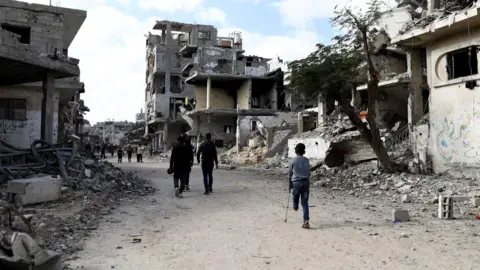
Reuters People, including a child on a crutch, missing the lower half of his left leg, walk past the grey, dusty rubble of houses and buildings destroyed during the war in Al-Bureij in central Gaza
Reuters

Palestinians walk past the rubble of houses and buildings in central Gaza

On the first full day of peace in Gaza on Monday, rescue workers and civilians began to reckon with the sheer scale of the destruction to the Strip.

Gaza’s Civil Defence agency – the strip’s main emergency response service – said it feared there were more than 10,000 bodies still buried under the vast sea of rubble.

Spokesman Mahmoud Basal told the BBC that they hoped to recover the dead within 100 days, but were likely to be delayed by a deficit of bulldozers and other essential equipment.

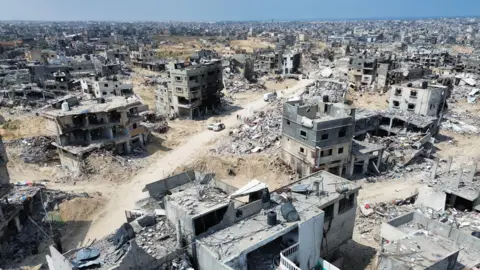
New images from Gaza following Sunday’s ceasefire showed scenes of total devastation wrought during 15 months of Israeli offensive, particularly in the north of the enclave.

The UN has previously estimated that 60% of structures across Gaza have been damaged or destroyed.

Though the sounds of bombing were replaced by celebrations as the ceasefire began on Sunday, the reality facing people across Gaza remains desperate.

According to the UN World Food Programme (WFP), the war has left more than two million Gazans homeless, without income, and completely dependent on food aid to survive.

That aid began to enter Gaza immediately after the ceasefire on Sunday and the UN said at least 630 lorries went into the Strip before the end of the day – the highest number since the start of the war 15 months ago.

EPA Destuction in Khan Younis in the Gaza Strip following the Israeli army withdrawal from the regionEPA

Destuction in Khan Younis in the Gaza Strip following the Israeli army withdrawal from the region.

Sam Rose, acting director of Unrwa, the UN’s Palestinian refugee agency in Gaza, said the aid supplies were just the beginning in the challenge of bringing the strip back to life.

“We’re not just talking about food, healthcare, buildings, roads, infrastructure, we’ve got individuals, families, communities that need to be rebuilt,” he said.

“The trauma that they’ve gone through, the suffering, the loss, the grief, the humiliation, and the cruelty that they’ve endured over the past 16 months – this is going to be a very, very long road.”

In Israel, the families of the three hostages who were freed in the first exchange spoke at a news conference in Tel Aviv on Monday night. Mandy Damari, the mother of dual Israeli-British citizen Emily Damari, said Emily was in “high spirits” and “on the road to recovery” despite losing two fingers in the Hamas attack on 7 October 2023.

Meirav Leshem Gonen, the mother of Romi Gonen, said: “We got our Romi back, but all families deserve the same outcome, both the living and the dead. Our hearts go out to the other families.”

Before the news conference, Israeli authorities released new footage showing Damari, 28, Gonen, 24, and Doron Steinbrecher, 31 tearfully greeting their mothers on Sunday just moments after being taken out of Gaza.

If the first phase of the ceasefire holds, 30 more hostages will be released from Gaza over the next 40 days in return for about 1,800 Palestinians freed from Israeli jails.

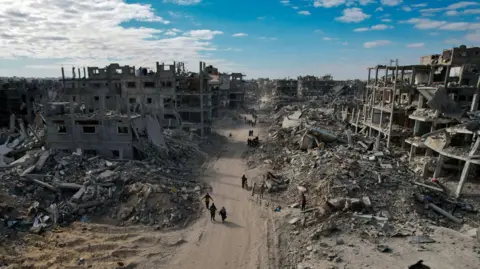
EPA An aerial view taken with a drone shows internally displaced Palestinians walking along a street among the grey, dusty rubble of destroyed buildings in Rafah EPA

Internally displaced Palestinians walk in Rafah on Monday

Palestinian health authorities estimate that more than 46,900 people were killed in Gaza during the more than 15 months of war and more than 110,700 were wounded.

The ministry does not distinguish between civilians and combatants but it says the majority of the dead are women and children – an assertion backed by the UN.

A UK-led study published by the medical journal The Lancet this month suggested that the health ministry figures may underestimate the death toll by more than 40%.

The Gaza Civil Defence agency said in a statement on Monday that 48% of its own personnel had been killed, injured or detained during the conflict, and 85% of its vehicles and 17 out of 21 facilities had been damaged or destroyed.

Though the risk from air strikes is gone, for now, the grim work continues for the remaining Civil Defence workers. Pictures shared with the BBC by members of the agency in northern Gaza on Monday showed them performing harrowing work, including the recovery of dead babies and of human remains in poor condition.

“In every street there are dead. In every neighbourhood there are people under the buildings,” said Abdullah Al-Majdalawi, a 24-year-old Civil Defence worker in Gaza City.

“Even after the ceasefire we received many calls from people saying please come, my family is buried under the rubble.”

Malaak Kasab, a 23-year-old recent graduate displaced from Gaza City, told the BBC on Monday that members of her own family were among those yet to be recovered.

“We have lost a lot of members of our family and some are still under the destroyed buildings,” she said. “There are a lot of people under the rubble – everybody knows about this.”

Kasab’s family home in an apartment building was not completely destroyed, she said, but very badly damaged. “There are no doors, no windows, no water, no electricity, nothing. Not even wood to make a fire. It is unliveable.”

Movement is still dangerous for displaced Gazans as the Israeli military begins the process of withdrawing from populated areas of the Strip.

The Israel Defence Forces (IDF) has warned people not to approach its personnel or installations, nor enter a buffer zone it created around the border of Gaza and around the Netzarim corridor, which bisects Gaza separating north from south.

‘I want to fulfil my dead brother’s dream’ – Gazans face a daunting task as they try to rebuild their lives

But many residents were eager to see what was left of their homes sooner than they had been advised. Hatem Eliwah, a 42-year-old factory supervisor from Gaza City, said he was considering setting out on foot from his shelter in Khan Younis in the south.

“We have been waiting for this ceasefire like people waiting to enter heaven,” Eliwah said. “I lost two of my brothers and their families. I lost cousins, uncles. The only thing I still hope for is to go home.”

There are grave concerns on both sides that the deal could collapse even before the first phase is complete in roughly six weeks, and Israel has stressed it reserves the right to resume military action in Gaza at any time.

Speaking at a meeting of the UN Security Council on Monday, Secretary-General Antonio Guterres welcomed the deal as a “ray of hope” and said its obligations must be met.

But Guterres warned of a worsening situation in the occupied West Bank, which has seen a huge rise in Israeli settler attacks against Palestinian villages since the Hamas attack on Israel of 7 October 2023.

“Senior Israeli officials openly speak of formally annexing all or part of the West Bank in the coming months,” Guterres said, adding: “Any such annexation would constitute a most serious violation of international law.”

Muath Al-Khatib contributed to this report


Hamas Official Says Group Is Ready for ‘Dialogue With America’

0
Hamas Official Says Group Is Ready for ‘Dialogue With America’


Hours after the cease-fire between Israel and Hamas took effect, a senior Hamas official said that the militant group was ready to start a dialogue with the United States, making a rare overture to a country that Hamas has long excoriated for supporting Israel.

The comments made by the official, Mousa Abu Marzouk, who is based in Qatar, suggest that at least some senior members of Hamas hope it can engage directly with the incoming Trump administration even though the United States has designated Hamas as a terrorist organization since 1997.

Mr. Abu Marzouk’s remarks may also indicate that Hamas feels buoyed by the cease-fire and believes there could be an opportunity to expand the group’s international relations.

“We’re prepared for a dialogue with America and achieving understandings on everything,” Mr. Abu Marzouk, the first leader of Hamas’s political office, said in a phone interview on Sunday.

Beyond the United States, numerous Western countries also consider Hamas to be a terrorist organization, including Britain and Canada. But Hamas has made some efforts to improve relations with Western governments, including by issuing a policy document in 2017 that took more moderate positions than its founding charter. The document called the establishment of a Palestinian state along the pre-1967 borders between Israel and the West Bank and Gaza a “formula of national consensus,” but it also rejected recognition of Israel.

The group has refused to renounce violence and recognize Israel, and after the Hamas-led assault on southern Israel on Oct. 7, 2023, it was forcefully condemned by the United States and European countries. The attack, analysts say, was a reflection of the ascendancy of hard-line leaders in the group advocating for violent conflict over long-term understandings with Israel.

President Trump, however, has previously demonstrated willingness to meet with longtime foes of the United States such as Kim Jong-un, the leader of North Korea.

Mr. Abu Marzouk, a native of Gaza and a former resident of Northern Virginia, is a member of Hamas’s political office, but it is not clear whether he speaks on behalf of all senior Hamas leaders, including Mohammed Sinwar and Izzeldin al-Haddad, hard-line military commanders in Gaza.

He is considered to be one of the more pragmatic voices in Hamas and leads Hamas’s foreign relations office. Other senior Hamas officials have invested more in developing ties with members of the so-called axis of resistance, including Iran, the Lebanese militant group Hezbollah, Iraqi militias, and the Houthis in Yemen.

Mr. Abu Marzouk, 74, said Hamas was also ready to welcome an envoy from the Trump administration in the coastal enclave, despite longstanding American policy to provide Israel with billions of dollars in weapons and defend it at international institutions. Hamas, he added, would even provide such a visitor with protection.

“He can come and see the people and try to understand their feelings and wishes so that the American position can be based on the interests of all the parties, and not only one party,” he said.

On Saturday, NBC News reported that Steve Witkoff, Mr. Trump’s Middle East envoy, was weighing a visit to Gaza to help maintain the cease-fire agreement, citing an anonymous Trump transition official with direct knowledge of the cease-fire process.

The comments by the Hamas leader were in stark contrast to many Hamas statements during the first Trump administration that blasted the relocation of the U.S. Embassy in Israel to Jerusalem, the recognition of Jerusalem as Israel’s capital, cutting off aid to Palestinians, and a peace plan that heavily favored Israeli positions.

After the previous Trump administration presented its plan, Hamas referred to it as “the deal of shame.”

One reason Hamas may want to reach out to the United States is to secure the entry of materials needed to reconstruct Gaza without conditions that could undermine its ability to remain the most dominant Palestinian group in the territory.

Hamas will likely need to offer some compromises if it wants enough aid to rebuild Gaza to flow into the enclave. Until now, Hamas leaders have expressed readiness to give up civilian governance in Gaza, but without dismantling its military wing — a dynamic that analysts have said would be similar to Hezbollah’s role in Lebanon before its last conflict with Israel.

Steven Cheung, Mr. Trump’s incoming White House director of communications, didn’t immediately respond to a request for comment.

Mr. Abu Marzouk also offered high praise for Mr. Trump for his involvement in helping broker the cease-fire agreement between Israel and Hamas and called him a “serious president.”

“If not for President Trump, his insistence on ending the war, and his dispatching of a decisive representative, the deal wouldn’t have happened,” said Mr. Abu Marzouk, referring to Mr. Witkoff.

While the deal calls for an eventual “cessation of military operations and hostilities permanently,” Prime Minister Benjamin Netanyahu of Israel has repeatedly suggested that the Israeli military will resume attacking Hamas after some hostages held by militants are released.

Alongside Qatar and Egypt, members of the Biden administration, including White House official Brett McGurk and C.I.A. director Bill Burns, played critical roles in putting together the cease-fire deal. But Mr. Witkoff helped encourage Israel to approve it by telling Mr. Netanyahu that Mr. Trump wanted it completed, according to officials briefed on the talks who spoke on condition of anonymity to discuss sensitive diplomacy.

Still, Mr. Abu Marzouk insisted Mr. Trump’s role was crucial to getting the agreement across the finish, especially in applying pressure on Mr. Netanyahu.

“Truthfully, Trump gets the credit for ending the war,” he said.


Scores of Senior Diplomats Are Leaving Posts as Trump Takes Office

0
Scores of Senior Diplomats Are Leaving Posts as Trump Takes Office


A transition team for President Trump has asked scores of senior career diplomats to resign from their positions on Monday, as soon as Mr. Trump takes office, and many of those asked to step down intend to do so, two U.S. officials said.

The practice is common when a presidential transition occurs, but it is happening faster and on a larger scale than with previous administrations, one U.S. official said. That means a possible loss of valuable knowledge of both the American institution and global affairs at the start of the administration.

The Trump transition team at the State Department is led by aides to Marco Rubio, the Florida senator picked by Mr. Trump to replace Antony J. Blinken as secretary of state. Mr. Rubio is expected to be confirmed quickly by the Senate.

Some of the officials stepping down are at the level of assistant secretary or higher and run large bureaus in the department that focus on regions of the world or broad issues. Many of those positions were held by political appointees and will be vacated, which is expected during a transition. The Trump transition team asked for the resignations on Friday.

It is unclear what kinds of jobs the veteran diplomats, known as foreign service officers, will seek or get in the coming weeks or months. Career diplomats are members of a union that would try to protect them from being fired from the State Department if that were to happen unfairly.

Every president and their appointed secretary of state replaces all or most of the people in those senior positions early in an administration. In some cases, foreign service officers decide to retire, especially if they have served for more than two decades. In some cases, they have held top positions throughout the department already and have no clear advancement path when a new administration comes in.

Among the top department officials who had earlier planned to step down is Daniel J. Kritenbrink, a longtime diplomat who has served as assistant secretary of East Asian and Pacific affairs in the Biden administration and is a former ambassador to Vietnam. He retired last Friday after 31 years in the State Department.

Ambassadors also offer their resignations, which the incoming president and secretary of state accept in most cases.

Ambassadors have been announcing their departures. Jeffrey Prescott, a political appointee representing the United States at United Nations agencies in Rome, posted on social media about his departure on Monday and his work on U.N. food programs during his tenure.

Like top officials at the State Department in Washington, ambassadors are a mix of political appointees and career diplomats. Many of the political appointees are wealthy donors to the president’s campaign, whether a Democratic or Republican one, and have little experience in diplomacy or global affairs.

At a confirmation hearing for Mr. Rubio last week, Senator Tim Kaine, Democrat of Virginia, asked him to leave career diplomats serving as ambassadors in place until new ones appointed by Mr. Trump are confirmed and in place to do their jobs.

On Jan. 13, R. Nicholas Burns, the ambassador to China, said in an email that he was departing Beijing for Washington and then would leave the State Department. Mr. Burns had an unusual career: He was a foreign service officer for many decades and eventually became the third-ranking official at the department. He left for other jobs, including a teaching post at the Harvard Kennedy School, and then returned to serve as an ambassador under President Biden.

Mr. Burns said he was proud to have represented the United States during an “enormously difficult and challenging time” in U.S.-China relations.

And he defended the federal government and its many employees, saying that “we have truly outstanding men and women in public service” and that “they are working very hard and often at great personal sacrifice to represent us in seriously challenging circumstances in China and around the world.”

“I believe they deserve our full support going forward,” he added.


Trump gives preview of next four years as president

0
Trump gives preview of next four years as president


It is only Donald Trump’s first day back in office as US president, but he has given a clear preview of what to expect.


Deportation looms for Uyghurs held in Thailand

0
Deportation looms for Uyghurs held in Thailand


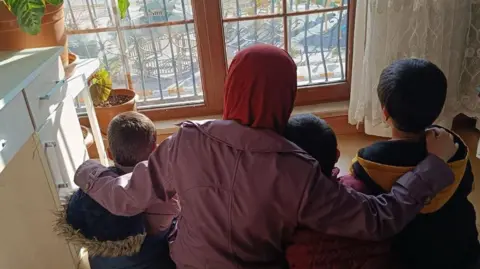
Niluper Niluper in a red headscarf and a mauve jacket with her arms around her three children, all of them in winter jackets - their backs are to the camera as they look out sit on the floor and look out the window.   Niluper

Niluper and her three children in Turkey

Niluper says she has been living in agony.

A Uyghur refugee, she has spent the past decade hoping her husband would join her and their three sons in Turkey, where they now live.

The family was detained in Thailand in 2014 after fleeing increasing repression in their hometown in China’s Xinjiang province. She and the children were allowed to leave Thailand a year later. But her husband remained in detention, along with 47 other Uyghur men.

Niluper – not her real name – now fears she and her children may never see him again.

Ten days ago, she learned that Thai officials had tried to persuade the detainees to sign forms consenting to be sent back to China. When they realised what was in the forms, they refused to sign them.

The Thai government has denied having any immediate plans to send them back. But human rights groups believe they could be deported at any time.

“I don’t know how to explain this to my sons,” Niluper told the BBC on a video call from Turkey. Her sons, she says, keep asking about their father. The youngest has never met him.

“I don’t know how to digest this. I’m living in constant pain, constant fear that at any moment I may get the news from Thailand that my husband has been deported.”

‘Hell on earth’

The last time Thailand deported Uyghur asylum seekers was in July 2015. Without warning, it put 109 of them onto a plane back to China, prompting a storm of protest from governments and human rights groups.

The few photos that were released show them hooded and handcuffed, guarded by large numbers of Chinese police officers. Little is known about what happened to them after their return. Other deported Uyghurs have received long prison sentences in secret trials.

The nominee for Secretary of State in the incoming Trump administration, Marco Rubio, has promised to press Thailand not to send the remaining Uyghurs back.

Their living conditions have been described by one human rights defender as “a hell on earth”.

They are all being held in the Immigration Detention Centre (IDC) in central Bangkok, which houses most of those charged with immigration violations in Thailand. Some are there only briefly, while waiting to be deported; others are there much longer.

Driving along the narrow, congested road known as Suan Phlu it is easy to miss the non-descript cluster of cement buildings, and difficult to believe they house an estimated 900 detainees – the Thai authorities give out no precise numbers.

The IDC is known to be hot, overcrowded and unsanitary. Journalists are not allowed inside. Lawyers usually warn their clients to avoid being sent there if at all possible.

Getty Images A tall meshed fence topped with barbed wire guards the immigration detention centre where 48 Uyghurs are being held in Bangkok - the building is behind a blue gate and has walls that are white, alongside some built with brown bricks. Getty Images

The immigration detention centre in Bangkok has been described by rights groups as “hell on earth”

There are 43 Uyghurs there, plus another five being held in a Bangkok prison for trying to escape. They are the last of around 350 who fled China in 2013 and 2014.

They are kept in isolation from other inmates and are rarely allowed visits by outsiders or lawyers. They get few opportunities to exercise, or even to see daylight. They have been charged with no crime, apart from entering Thailand without a visa. Five Uyghurs have died in custody.

“The conditions there are appalling,” says Chalida Tajaroensuk, director of the People’s Empowerment Foundation, an NGO trying to help the Uyghurs.

“There is not enough food – it is mostly just soup made with cucumber and chicken bones. It is crammed in there. The water they get, both for drinking and washing, is dirty. Only basic medicines are provided and these are inadequate. If someone falls ill, it takes a long time to get an appointment with the doctor. And because of the dirty water, the hot weather and bad ventilation, a lot of the Uyghurs get rashes or other skin problems.”

But the worst part of their detention, say those who have experienced it, is not knowing how long they will be imprisoned in Thailand, and the constant fear of being sent back to China.

Niluper says there were always rumours about deportation but it was difficult to find out more. Escaping was hard because they had children with them.

“It was horrible. We were so scared all the time,” recalls Niluper.

“When we thought about being sent back to China, we would have preferred to die in Thailand.”

China’s repression of the Muslim Uyghurs has been well documented by the UN and human rights groups. Up to one million Uyghurs are believed to have been detained in re-education camps, in what human rights advocates say is a state campaign to eradicate Uyghur identity and culture. There are many allegations of torture and enforced disappearances, which China denies. It says it has been running “vocational centres” focused on de-radicalising Uyghurs.

Niluper says she and her husband faced hostility from Chinese state officials over their religiosity – her husband was an avid reader of religious texts.

The couple made the decision to flee when people they knew were being arrested or disappearing. The family were in a group of 220 Uyghurs who were caught by the Thai police trying to cross the border to Malaysia in March 2014.

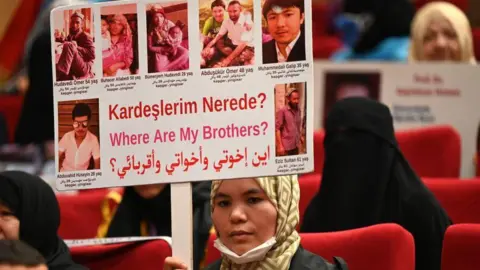
Getty Images A Muslim Uyghur woman holds up a sign with pictures of her brother and the word: Where are my brothers?Getty Images

Members of Muslim Uyghur minority present pictures of their relatives detained in China during a press conference in Istanbul in 2022

Niluper was held in an IDC near the border, and then later in Bangkok, until with 170 other women and children, she was allowed in June 2015 to go to Turkey, which usually offers Uyghurs asylum.

But her husband remains in the Bangkok IDC. They were separated when they were detained, and she has had no contact with him since a brief meeting they were permitted in July 2014.

She says she was one of 18 pregnant women and 25 children crammed into a room that was just four by eight metres. The food was “bad and there was never enough for all of us”.

“I was the last one to give birth, at midnight, in the bathroom. The next day the guard saw my condition and that of my baby was not good, so they took us to the hospital.”

Niluper was also separated from her eldest son, who was just two years old at the time and held with his father – an experience which she says has traumatised him, after experiencing “terrible conditions” and witnessing a guard beating an inmate. When the guards brought him back to her, she says, he did not recognise her.

“He was so scared, screaming and crying. He could not understand what had happened. He did not want to talk to anyone.”

It took a long time before he accepted his mother, she says, and after that he would not leave her even for a moment, even after they had arrived in Turkey.

“It took a really, really long time for him to understand that he was finally in a safe place.”

Pressure from Beijing

Thailand has never explained why it will not allow the remaining Uyghurs to join their families in Turkey, but it is almost certainly because of pressure from China.

Unlike other inmates in the IDC, the fate of the Uyghurs is not handled by the Immigration Department but instead by Thailand’s National Security Council, a body chaired by the prime minister in which the military has significant influence.

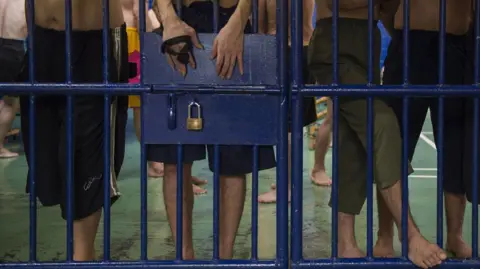
Getty Images Foreign detainees stand behind bars at an immigration detention centre in Bangkok.They are wearing dark-coloured shorts and pants, with some of their bare torsos and legs visible. One man's hands are also visble above the lock on the cell door.  Getty Images

Foreign detainees at the IDC in 21 January, 2019, during a rare visit organised by authorities for journalists

As the influence of the US, Thailand’s oldest military ally, wanes, that of China has been steadily increasing. The current Thai government is keen to build even closer ties to China, to help revive the faltering economy.

The United Nations Refugee Agency has been accused of doing little to help the Uyghurs, but says it is given no access to them, so is unable to do much. Thailand does not recognise refugee status.

Accommodating China’s wish to get the Uyghurs back is not without risk though. Thailand has just taken a seat on the UN Human Rights Council, for which it lobbied hard.

Deporting 48 men who have already endured more than a decade of incarceration would badly tarnish the image the Thai government is trying to project.

Thailand will also be mindful of what happened just a month after the last mass deportation in 2015.

On 17 August that year a powerful bomb exploded at a shrine in Bangkok which was popular with Chinese tourists. Twenty people were killed, in what was widely assumed to be a retaliation by Uyghur militants, although the Thai authorities tried to downplay the link.

Two Uyghur men were charged with the bombing, but their trial has lasted for nine years, with no end in sight. One of them, say his lawyers, is almost certainly innocent. A veil of secrecy surrounds the trial; the authorities seem reluctant to let anything from the hearings tying the bomb to the deportation to get out.

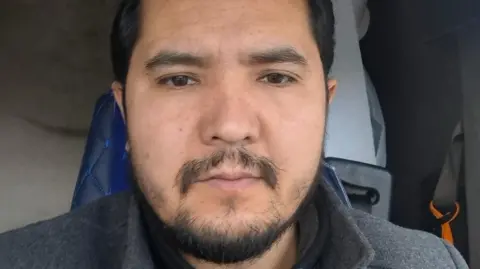
Hassan Imam Hassan Imam in his truckHassan Imam

Hassan Imam made it to Turkey but only after he escaped from detention in Thailand

Even those Uyghurs who have managed to get to Turkey must then deal with their uncertain status there, and with the severance of all communications with their families in Xinjiang.

“I have not heard my mother’s voice for 10 years,” says Hasan Imam, an Uyghur refugee who now works as a lorry driver in Turkey.

He was in the same group as Niluper caught by the Malaysian border in 2014.

He remembers how the following year the Thai authorities deceived them about their plan to deport some of them to China. He says they were told some men would be moved to a different facility, because the one they were in was too crowded.

This was after some women and children had been sent to Turkey, and, unusually, the men in the camp were also allowed to talk to their wives and children in Turkey on a phone.

“We were all happy, and full of hope,” Hassan says. “They selected them, one by one. At this point they had no idea they would be sent back to China. It was only later, through an illicit phone we had, that we found out from Turkey that they had been deported.”

This filled the remaining detainees with despair, recalls Hasan, and two years later, when he was moved temporarily to another holding camp, he and 19 others made a remarkable escape, using a nail to make a hole in a crumbling wall.

Eleven were recaptured, but Hasan managed to cross the forested border into Malaysia, and from there reached Turkey.

“I do not know what condition my parents are in but for those still detained in Thailand it is even worse,” he says.

They fear being sent back and imprisoned in China – and they also fear that it would mean more severe punishment for their families, he explains.

“The mental strain for them is unbearable.”

Read more of our coverage on Thailand


Gaza Residents Return to Vast Destruction in Old Neighborhoods

0
Gaza Residents Return to Vast Destruction in Old Neighborhoods


Gazans took in the scale of devastation to their old neighborhoods and Israelis awaited news about three newly released hostages as a day-old cease-fire between Hamas and Israel continued to hold on Monday.

With the 15-month war paused, Palestinians have been returning to parts of the Gaza Strip they had fled, picking their way through vast swaths of rubble and trying to salvage what they could — a sofa, a mattress, a chair or a crate — from the wreckage of their former homes.

“People can barely recognize the crushed places where they used to live,” said Montaser Bahja, an English teacher, a day after visiting his old neighborhood in the northern city of Jabaliya.

In a video shared with The New York Times, Mr. Bahja, 50, can be seen hurrying through the streets with his son Alhassan, 21, and trying to reconcile the piles of rubble that loom on either side with their memories.

“This is Fahmy Abu Warda’s home; this is Abu Shaaban’s home,” Alhassan is heard saying.

In Israel, which celebrated the return of the first group of hostages released by Hamas as part of the truce, the authorities offered only the broadest of descriptions of their conditions. The Israeli health ministry and Sheba Medical Center, where the three women are staying in a closed wing with family members, said their primary commitment was to safeguard the former captives’ privacy as they received medical and psychological care.

“I’m happy to report that they are in stable condition,” said one of their doctors, Prof. Itai Pessach. “That allows us, and them, to focus on what is the most important thing for now: uniting with their families.”

But Israelis did hear from one of the women on Monday.

“I have returned to life,” Emily Damari, 28, said on social media, describing herself as “the happiest person in the world.”

Ms. Damari was one of about 250 people taken hostage in the Hamas-led attack of Oct. 7, 2023. About a hundred are believed to still be in Gaza, and about a third of those are believed to be dead. The militants also killed some 1,200 people that day, Israel says.

Under the terms of the cease-fire, Hamas agreed to free 33 hostages in exchange for the release of more than 1,000 Palestinians from Israel’s prisons. The return of the three hostages was followed by the release of 90 prisoners, and the exchanges are to take place once a week during the 42-day truce.

Palestinians in the Gaza have rejoiced at the pause in fighting. Gazan health officials say more than 47,000 people have been killed during the Israel assault that began after the 2023 Hamas attack; they do not distinguish between civilians and fighters.

But the scenes playing out in the enclave and in Israel on Monday embodied the bittersweet emotions felt on both sides of the border.

As the truce came into effect on Sunday, celebrations replaced explosions, and hundreds of trucks with aid began rolling into Gaza, where residents have endured a harsh year of hunger and deprivation. In Israel, the returned hostages were met with jubilant embraces from relatives and friends. And fireworks and cheering crowds greeted the newly freed Palestinian prisoners in the Israeli-occupied West Bank.

But joy was shadowed by uncertainty. The next round of negotiations between Hamas and Israel are expected to be even more difficult than the ones that led to the 42-day cease-fire.

The fate of more than 60 other hostages and thousands of other Palestinian prisoners in Israel, to say nothing of the prospect of a long-term end to the fighting, depends on the extension of the deal.

“This is a moment of tremendous hope — fragile, yet vital,” Tom Fletcher, the United Nations undersecretary general for humanitarian affairs, said on social media.

The rejoicing has also been dimmed by the expectations of prolonged hardship to come and the knowledge that there is as yet no comprehensive plan for how Gaza will be rebuilt. Many of the two million residents there have been displaced at least once,

The task ahead is unimaginably daunting.

Gazans returning to the southern city of Rafah found it mostly flattened. The mayor said that 60 percent of homes had been destroyed, as well as 70 percent of the city’s sewage system.

But after 15 months of hunger and scarcity, food and other vital supplies are now surging into Gaza. More than 630 trucks entered the enclave on the first day of the cease-fire, according to United Nations officials.

During the fighting, far fewer made it in — and when they did, it was often too dangerous to get aid to where it was needed. Israel’s military campaign beat Hamas back without replacing it, creating a power vacuum. As the enclave descended into lawlessness, desperate crowds and organized gangs swarmed the trucks in hopes of securing a package of food or a bag of flour.

The scenes were not repeated on Sunday and Monday.

“What was very noticeable is that none of the trucks that entered yesterday were looted,” said Nebal Farsakh, a spokeswoman for the Palestinian Red Crescent, a humanitarian aid organization.

But violence did break out in the West Bank, where Israeli settlers set upon Palestinian villages amid anger over the planned release of Palestinian prisoners, some of whom were convicted of deadly attacks against Israelis, in the cease-fire deal.

In Sinjil, a village south of Nablus, dozens of men, some carrying slingshots, threw stones and set houses on fire, according to residents and videos verified by The Times.

“People screamed as their homes were burning,” said one resident, Ayed Jafry, 45. Several people were injured, including an 86-year-old man, he said.

In the aftermath of the Hamas attack that set off the war in Gaza, Israeli leaders vowed to wipe out the militants once and for all. But in the first two days of the cease-fire, Hamas has been making clear that it intends to remains a major force in the territory.

In an interview with The Times, a Hamas official, Mousa Abu Marzouk, suggested that at least some senior members of the group hoped to engage in “dialogue” with the United States, even though the American government has designated it as a terrorist organization since 1997.

Mr. Abu Marzouk, who is based in Qatar, said Hamas was ready to welcome an envoy from the Trump administration despite a longstanding American policy to provide Israel with weapons and defend it at international institutions.

“He can come and see the people and try to understand their feelings and wishes,” he said of the envoy, “so that the American position can be based on the interests of all the parties, and not only one party.”

Reporting was contributed by Hiba Yazbek, Natan Odenheimer, Fatima AbdulKarim, andAfif Amireh.


Trump Plans to Pull the U.S. Out of the Paris Agreement on Climate

0
Trump Plans to Pull the U.S. Out of the Paris Agreement on Climate


The White House on Monday said that President Trump would withdraw the United States from the Paris Agreement, the pact among almost all nations to fight climate change.

By withdrawing, the United States would join Iran, Libya and Yemen as the only four countries not party to the agreement, under which nations work together to keep global warming below levels that could lead to to environmental catastrophe.

The move, one of several energy-related announcements in the hours immediately following his inauguration, is yet another about-face in United States participation in global climate negotiations. During his first term Mr. Trump withdrew from the Paris accord, but then President Biden quickly rejoined in 2020 after winning the White House.

Scientists, activists and Democratic officials assailed the move as one that would deepen the climate crisis and backfire on American workers. Coupled with Mr. Trump’s other energy measures on Monday, withdrawal from the pact signals his administration’s determination to double down on fossil-fuel extraction and production, and to move away from clean-energy technologies like electric vehicles and power-generating wind turbines.

“If they want to be tough on China, don’t punish U.S. automakers and hard-working Americans by handing our clean-car keys to the Chinese,” said Gina McCarthy, former White House climate adviser and former head of the Environmental Protection Administration. “The United States must continue to show leadership on the international stage if we want to have any say in how trillions of dollars in financial investments, policies and decisions are made.”

To pull the United States out of the Paris Agreement, the Trump administration will need to formally submit a withdrawal letter to the United Nations, which administers the pact. The withdrawal would become official one year after the submission. It was not immediately clear whether the administration had already submitted the formal withdrawal letter.

U.S. efforts to reduce greenhouse gas emissions were already stalling in 2024, and Mr. Trump’s entry into office makes it increasingly unlikely the United States will live up to its ambitious pledges to cut them even further. Emissions dropped just a fraction last year, 0.2 percent, compared with the year earlier, according to estimates published this month by the Rhodium Group, a research firm.

Despite continued rapid growth in solar and wind power that was spurred by the previous administration’s signature climate legislation, the Inflation Reduction Act, emissions levels stayed relatively flat last year because demand for electricity surged nationwide, which led to a spike in the amount of natural gas burned by power plants.

The fact that emissions didn’t decline much means the United States is even further off-track from hitting Mr. Biden’s goal, announced last month under the auspices of the Paris Agreement, of slashing greenhouse gases 61 percent below 2005 levels by 2030. Scientists say all major economies would have to cut their emissions deeply this decade to keep global warming at relatively low levels.

In a scenario where Mr. Trump rolled back most of Mr. Biden’s climate policies, U.S. emissions might fall only 24 to 40 percent below 2005 levels by 2030, the Rhodium Group found.

“President Trump is choosing to begin his term pandering to the fossil fuel industry and its allies,” the Union of Concerned Scientists said in a statement. “His disgraceful and destructive decision is an ominous harbinger of what people in the United States should expect from him and his anti-science cabinet.”

Since 2005, United States emissions have fallen roughly 20 percent, a significant drop at a time when the economy has also expanded. But to meet its climate goals, U.S. emissions would need to decline nearly 10 times as fast each year as they’ve fallen over the past decade.

The United States is also a major exporter of emissions. Because of policies promoted by both Republicans and Democrats, the United States is now producing more crude oil and natural gas than any nation in history. Mr. Trump has vowed to further ramp up production and exports.

While the United States may not be party to the Paris Agreement, it will still be part of the U.N. Framework Convention on Climate Change, which hosts annual climate negotiations known as COPs. This year’s COP will be held in Brazil in November and nations will be announcing new pledges for emissions reductions.

One recent study by Climate Action Tracker, a research group, found that, if every country followed through on the pledges they have formally submitted so far, global average temperatures would be on track to rise roughly 2.6 degrees Celsius, or 4.7 degrees Fahrenheit, above preindustrial levels by the end of the century, well above the 1.5 degrees Celsius the Paris Agreement originally set as a goal.

“Trump’s irresponsibility is no surprise,” said Christiana Figueres, a Costa Rican diplomat and an architect of the Paris Agreement in 2015. “In time, Trump will not be around but history will point to him and his fossil fuel friends with no pardon.”