


Former US President Joe Biden has departed the Capitol in Washington, DC following Donald Trump’s inauguration.
Former US President Biden leaves Capitol as Trump assumes presidency

Jake Paul, Zuckerberg and Musk: Who’s at Trump’s inauguration?

A host of less familiar faces mingled with former presidents, family members and US officials at Donald Trump’s inauguration.
From tech billionaires to social media influencers, here’s your guide to the star-studded guest list.
Tech billionaires
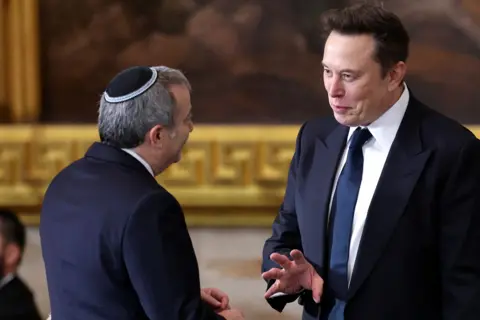
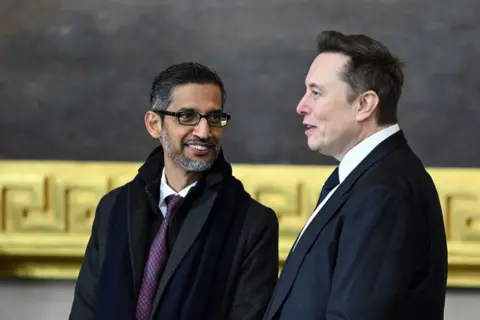
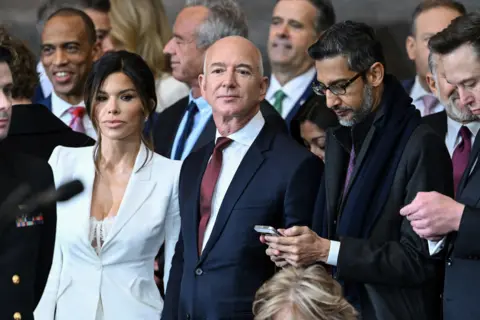
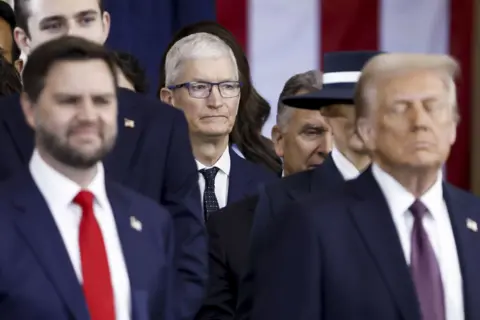
Trump’s close and controversial friendship with X owner Elon Musk is well known but Musk isn’t the only tech chief at Monday’s inauguration.
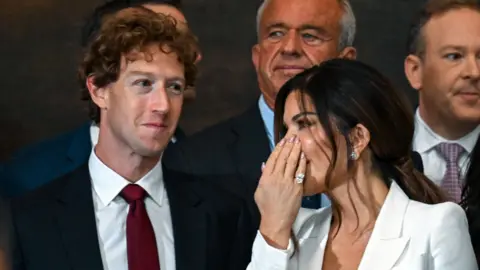
Mark Zuckerberg, who earlier this month announced Meta was to get rid of factcheckers and “dramatically reduce the amount of censorship” on its platforms, is also in attendance.

 Getty Images
 Getty Images
 Reuters
 Reuters
 Reuters
 EPA-EFE/REX/Shutterstock
Influencers
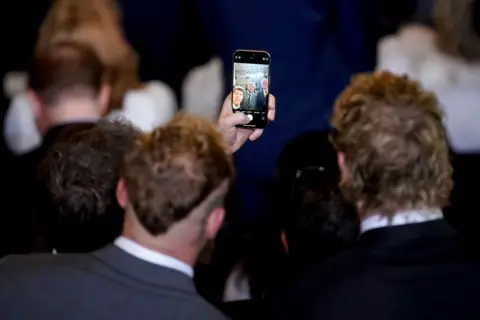
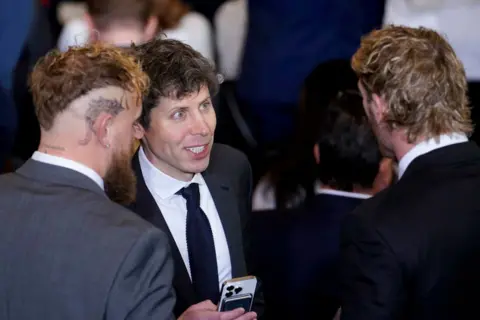
Another tech billionaire in the audience is Sam Altman, CEO of OpenAI, who was pictured posing for a group selfie with boxer and influencer Jake Paul, and Paul’s brother, wrestler and influencer Logan.
 Getty Images
 Getty Images
Allow Twitter content?
This article contains content provided by Twitter. We ask for your permission before anything is loaded, as they may be using cookies and other technologies. You may want to read and before accepting. To view this content choose ‘accept and continue’.
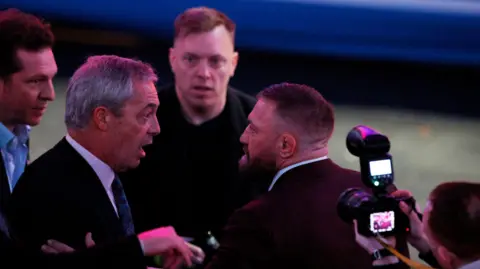
McGregor was also pictured alongside the head of the Reform UK political party, Nigel Farage, at a Trump rally on Sunday night.
 Reuters
Media names
 EPA-EFE/REX/Shutterstock
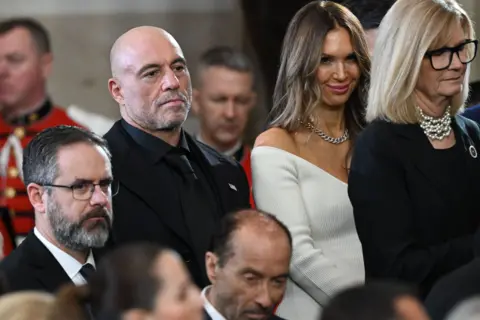
Controversial podcaster Joe Rogan was also seen in the inauguration crowd.
In 2020, Rogan endorsed Democrat candidate Bernie Sanders but shortly before the 2024 election, he endorsed Trump.
At times, Rogan’s editorial approach has landed him in controversy – for example, during the Covid pandemic, when he was accused of spreading vaccine misinformation.
In 2022, Rogan apologised after footage emerged of him repeatedly using the n-word in early episodes of his show.
 Getty Images
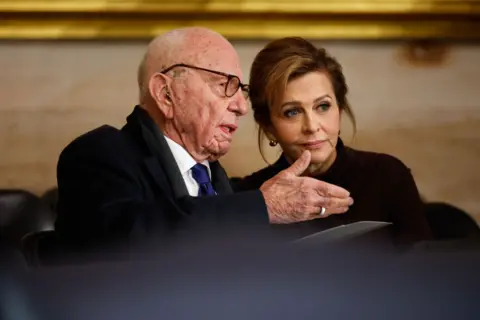
Rupert Murdoch, chairman emeritus of News Corporation, which owns Fox News, the Wall Street Journal, the Sun and the Times, is pictured among the crowd with his fifth wife Elena Zhukova.
Mr Murdoch, 93, married the retired Russian biologist last year in a ceremony at his Californian vineyard.
Politicians and former presidents
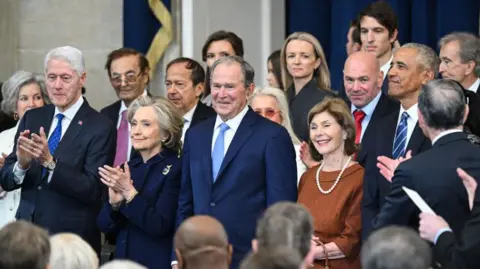
As is customary at presidential inaugurations, a host of former US presidents are in attendance.
Much has been made in the media of Michelle Obama not accompanying her husband Barack to Monday’s event.
There alongside Obama, who was in power before Trump’s last term began, are former presidents including Bill Clinton and George W Bush.
 Getty Images
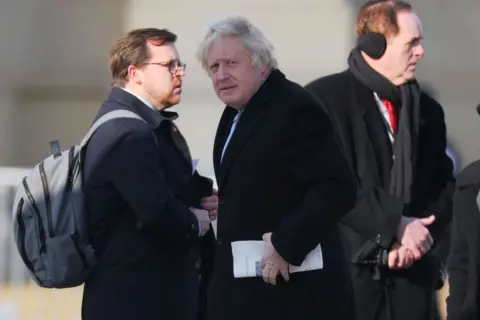
Another familiar face is former British Prime Minister Boris Johnson.
When Johnson took to power in 2019, Trump described him as “a good man”, adding: “They call him Britain’s Trump.”
 Getty Images
Food and Other Vital Aid Surges Into Gaza After 15 Months of Scarcity

The amount of humanitarian aid entering Gaza surged dramatically on Sunday, with more than 630 trucks entering the impoverished and hungry enclave on the first day of the cease-fire, according to United Nations officials — the highest figure since the start of the war more than 15 months ago.
The truce allowed the U.N. World Food Program to “bring in urgently needed food aid at scale and begin pulling the war-ravaged territory back from starvation,” the agency said in a statement on Sunday. Tom Fletcher, the U.N. relief chief, said in a statement on Monday that more than 300 of the trucks went to northern Gaza, where aid had been the most scarce and humanitarian officials have warned of a possible famine.
During the war, fewer than 100 trucks per day had been entering the enclave, and deliveries had at times been suspended. Relief agencies accused Israel of overly restricting deliveries with stringent inspections and the closure of border crossings, which Israel denied, and have said that at least 200 trucks per day were required to provide food, medicines, fuel, clean water and other essentials.
With the cease-fire between Israel and Hamas taking effect, aid convoys seemed to enter Gaza without issues, and no attempts at stealing or looting the aid were reported on Sunday or Monday, according to Juliette Touma, a spokeswoman for the main U.N. agency that assists Palestinians. She added that local police officers were present in some parts of Gaza to secure the convoys, while in other areas security was not needed.
Uniformed police officers and armed fighters, rarely seen in the open during the war, were visible in cities and towns across Gaza after the cease-fire took effect. It was an apparent show by Hamas, which had controlled the enclave for years, that it is still in charge and plans to hold onto power.
Videos posted to social media showed convoys driving through Gaza on Sunday, as people gathered calmly on roadsides, refraining from approaching the trucks. It was a stark contrast to the apocalyptic scenes of wartime aid deliveries, when desperate crowds swarmed and climbed onto the trucks in hopes of securing a food package or bag of flour, sometimes resulting in violence.
“What was very noticeable is that none of the trucks that entered yesterday were looted,” said Nebal Farsakh, a spokeswoman for the Palestinian Red Crescent. “And this was the first time in 15 months that this many trucks entered Gaza,” she added.
What was less clear was how efficiently and equitably aid was being distributed after it entered Gaza, and some residents said they have yet to receive or even see the aid. Ms. Touma said that UNRWA staff and aid workers from other agencies were still sorting through the aid that has come in since Sunday before it is eventually delivered to people.
“It’s the second day of the cease-fire and they said that aid and flour have come in but unfortunately we haven’t seen any of it yet,” said Moustafa al-Aloul, a 22-year-old from northern Gaza. “Currently, the markets literally have nothing,” he added.
The Gazan ministry of social development, a part of the Hamas-led administration, said in a statement on Monday that it had “made all preparations to receive aid” and will provide all the permits needed for aid organizations to receive and distribute the aid. “Work will be done in a coordinated manner between all partners to ensure the fair distribution of aid to all citizens,” the ministry said, adding that aid will be provided to families inside and outside shelter centers and tent encampments.
Israeli officials have accused Hamas of hoarding essential supplies to serve its own members and to wield control over the population, and there have been reports of profiteers seizing aid and then selling it on the black market. Aid officials say the solution is to end the scarcity.
Ms. Touma said the convoys entering Gaza have included some trucks carrying commercial goods for sale, which have rarely reached Gaza during the war.
“There were several goods that people take for granted that were very much missing from the market,” Ms. Touma said in an interview on Monday. “So it’s very good that commercial supplies have also come in because you can’t turn the two million people in Gaza into a nation that is solely dependent on aid,” she added.
The World Food Program said that on Sunday it delivered ready-to-eat meals and bags of wheat flour. It aims to send at least 150 truckloads of food into Gaza every day, along with other supplies, as well as restocking bakeries and providing nutritional supplements for children facing malnutrition.
Ameera Harouda contributed reporting from Qatar, Matthew Mpoke Bigg from London and Vivian Yee from Cairo.
At Least 80 Dead in Colombia Amid a New Surge of Violence

At least 80 people are dead and more than 11,000 have been forced to flee their homes in Colombia, officials say, amid fierce clashes between two rival armed groups on the border with Venezuela.
The violence, in a northeast region called Catatumbo, is some of the worst the country has suffered through in recent years, raising concerns that the country is moving in the opposite direction of “total peace” — a goal made a priority by the country’s leftist president, Gustavo Petro, who is more than halfway through his four-year term.
The Colombian leader visited the region on Friday, writing on X that his government “stands with the people of Catatumbo.” He has also sent troops and humanitarian assistance.
Displaced families are taking refuge in a stadium in Cúcuta, a border town better known in recent years for receiving Venezuelan migrants. In some places, Colombians are fleeing into Venezuela — home to its own humanitarian crisis — and the Venezuelan autocratic leader there, Nicolás Maduro, has promised to send them aid.
The clashes in Catatumbo are a stark departure from the hope that swept across parts of Colombia less than a decade ago, when the country signed a peace deal with its largest rebel group, the Revolutionary Armed Forces of Colombia, or FARC.
The nation had suffered through decades of internal conflict, with left-wing guerrilla groups, including the FARC; paramilitary organizations; and the government fighting for control of the country and for lucrative industries like narcotrafficking.
Thousands of FARC fighters laid down their arms in the 2016 agreement, and at the time it felt like a seismic moment for one of the world’s most violent countries. But old rebel groups, including the National Liberation Army, or ELN, persisted, while new ones emerged, all fighting for control of territory and industry left behind by the FARC.
In some cases, these new groups consist of former FARC fighters, and they have divided and subdivided, helping fuel an ever more complicated conflict.
Most of the violence has played out in rural parts of the country with many Colombians living in cities only dimly aware of the violence that has been unfolding not far from their homes.
In past, the FARC fought the government, seeking to topple and replace it. Today’s armed groups are more focused on fighting each other, battling over land and profits, with the military trying to contain them.
Catatumbo is home to vast fields of coca, the plant that is a base product in cocaine. Two groups control the territory, the ELN and a group of former FARC members called the 33rd Front, said General Luis Emilio Cardozo, the head of the Colombian army, speaking to reporters over the weekend.
A precarious peace between the two groups broke down last week. General Cardozo said there had been four or five clashes between the groups in recent days, and in other cases armed fighters were going door-to-door, targeting former FARC fighters they suspected of being part of the 33rd Front.
“It was a very well planned criminal operation,” he said, “they went with a list in hand looking for the people they wanted to kill.”
In a message posted on X on Sunday, the ELN called the 33rd Front the “only objective of our actions.”
But many victims, including those fleeing their homes, appear to be civilians.
In response to the violence, Mr. Petro has suspended ongoing peace talks with the ELN.
With the military distracted, a separate conflict broke out in recent days between two former FARC groups in Guaviare, a department in the south-central part of Colombia, according to the country’s ombudsman’s office.
Organizations including the International Crisis Group have warned for years that the country’s security situation has deteriorated since 2016, and could erupt into violence at any moment.
“We are very concerned that moment is now,” said Elizabeth Dickinson, a Colombia-based analyst for the nonprofit organization. “Escalations on various front lines have taken the conflict to a very dangerous inflection point.”
Ms. Dickinson called the scale of conflict in Guaviare “very significant,” and said it had the potential to spread across several departments in southern Colombia. She added that there are “many children” in the ranks of the armed groups in that region.
The clashes in Catatumbo, in the north, on the border with Venezuela, come amid growing tensions between Mr. Petro and Mr. Maduro, who has provided safe haven to members of the ELN.
Both Mr. Petro and Mr. Maduro call themselves leftists, and just two years ago, the two were shaking hands in Caracas and promising more productive relations.
But Mr. Petro has turned more critical of the autocrat in recent weeks, reprimanding him for locking up political opponents and refusing to release the results of a recent presidential vote that Mr. Maduro claimed to win, but that many countries agree was actually won by a top opposition leader.
This has provoked the ire of Mr. Maduro, who has accused Mr. Petro and other leaders in meddling in Venezuela’s internal affairs.
The International Committee of the Red Cross said last year that it was tracking eight different armed conflicts inside Colombia.
On Sunday night the country’s ombudsman, Iris Marin, said 11,000 people had been displaced in Catutumbo in just four days, including many children. William Villamizar, the governor of North Santander, a border department, said the death toll had risen to more than 80 people.
Ms. Marin said that the violence amounted to “one of the largest and most serious humanitarian crises that Catatumbo has faced, if not the worst.”
She blamed the conflict on a “few people” in the region and called on them to end it. “Those few people have the ability to stop the suffering.”
Federico Rios contributed reporting.
As Cease-Fire Takes Hold, Gazans Return to Destroyed Homes: Israel-Hamas War Live Updates

Hours after the cease-fire between Israel and Hamas took effect, a senior Hamas official said that the militant group was ready to start a dialogue with the United States, making a rare overture to a country that Hamas has long excoriated for supporting Israel.
The comments made by the official, Mousa Abu Marzouk, who is based in Qatar, suggest that at least some senior members of Hamas hope it can engage directly with the incoming Trump administration even though the United States has designated Hamas as a terrorist organization since 1997.
Mr. Abu Marzouk’s remarks may also indicate that Hamas feels buoyed by the cease-fire and believes there could be an opportunity to expand the group’s international relations.
“We’re prepared for a dialogue with America and achieving understandings on everything,” Mr. Abu Marzouk, the first leader of Hamas’s political office, said in a phone interview on Sunday.
Beyond the United States, numerous Western countries also consider Hamas to be a terrorist organization, including Britain and Canada. But Hamas has made some efforts to improve relations with Western governments, including by issuing a policy document in 2017 that took more moderate positions than its founding charter. The document called the establishment of a Palestinian state along the pre-1967 borders between Israel and the West Bank and Gaza a “formula of national consensus,” but it also rejected recognition of Israel.
The group has refused to renounce violence and recognize Israel, and after the Hamas-led assault on southern Israel on Oct. 7, 2023, it was forcefully condemned by the United States and European countries. The attack, analysts say, was a reflection of the ascendancy of hard-line leaders in the group advocating for violent conflict over long-term understandings with Israel.
President Trump, however, has previously demonstrated willingness to meet with longtime foes of the United States such as Kim Jong-un, the leader of North Korea.
Mr. Abu Marzouk, a native of Gaza and a former resident of Northern Virginia, is a member of Hamas’s political office, but it is not clear whether he speaks on behalf of all senior Hamas leaders, including Mohammed Sinwar and Izzeldin al-Haddad, hard-line military commanders in Gaza.
He is considered to be one of the more pragmatic voices in Hamas and leads Hamas’s foreign relations office. Other senior Hamas officials have invested more in developing ties with members of the so-called axis of resistance, including Iran, the Lebanese militant group Hezbollah, Iraqi militias, and the Houthis in Yemen.
Mr. Abu Marzouk, 74, said Hamas was also ready to welcome an envoy from the Trump administration in the coastal enclave, despite longstanding American policy to provide Israel with billions of dollars in weapons and defend it at international institutions. Hamas, he added, would even provide such a visitor with protection.
“He can come and see the people and try to understand their feelings and wishes so that the American position can be based on the interests of all the parties, and not only one party,” he said.
On Saturday, NBC News reported that Steve Witkoff, Mr. Trump’s Middle East envoy, was weighing a visit to Gaza to help maintain the cease-fire agreement, citing an anonymous Trump transition official with direct knowledge of the cease-fire process.
The comments by the Hamas leader were in stark contrast to many Hamas statements during the first Trump administration that blasted the relocation of the U.S. Embassy in Israel to Jerusalem, the recognition of Jerusalem as Israel’s capital, cutting off aid to Palestinians,and a peace plan that heavily favored Israeli positions.
After the previous Trump administration presented its plan, Hamas referred to it as “the deal of shame.”
One reason Hamas may want to reach out to the United States is to secure the entry of materials needed to reconstruct Gaza without conditions that could undermine its ability to remain the most dominant Palestinian group in the territory.
Hamas will likely need to offer some compromises if it wants enough aid to rebuild Gaza to flow into the enclave. Until now, Hamas leaders have expressed readiness to give up civilian governance in Gaza, but without dismantling its military wing — a dynamic that analysts have said would be similar to Hezbollah’s role in Lebanon before its last conflict with Israel.
Steven Cheung, Mr. Trump’s incoming White House director of communications, didn’t immediately respond to a request for comment.
Mr. Abu Marzouk also offered high praise for Mr. Trump for his involvement in helping broker the cease-fire agreement between Israel and Hamas and called him a “serious president.”
“If not for President Trump, his insistence on ending the war, and his dispatching of a decisive representative, the deal wouldn’t have happened,” said Mr. Abu Marzouk, referring to Mr. Witkoff.
While the deal calls for an eventual “cessation of military operations and hostilities permanently,” Prime Minister Benjamin Netanyahu of Israel has repeatedly suggested that the Israeli military will resume attacking Hamas after some hostages held by militants are released.
Alongside Qatar and Egypt, members of the Biden administration, including White House official Brett McGurk and C.I.A. director Bill Burns, played critical roles in putting together the cease-fire deal. But Mr. Witkoff helped encourage Israel to approve it by telling Mr. Netanyahu that Mr. Trump wanted it completed, according to officials briefed on the talks who spoke on condition of anonymity to discuss sensitive diplomacy.
Still, Mr. Abu Marzouk insisted Mr. Trump’s role was crucial to getting the agreement across the finish, especially in applying pressure on Mr. Netanyahu.
“Truthfully, Trump gets the credit for ending the war,” he said.
Did Trump’s promise bring back TikTok in the US? | Social Media News

TikTok users in the United States gained partial access to the popular social media app on Sunday, just hours before President-elect Donald Trump’s promised reinstatement order was expected to take effect.
Earlier on Saturday, the app was taken offline after the US Supreme Court refused to rescue TikTok from a new law requiring the owner, ByteDance, to sell popular short-video app to an American company – the first such action against a widely used social media site.
Trump, who is set to be sworn in on Monday, has promised to issue an executive order immediately after he takes office and to grant the company more time to comply. On Sunday, during a rally held ahead of his inauguration, Trump proclaimed that “as of today, TikTok is back” and credited the app for winning him young voters in the November general elections.
Here’s what you need to know about the ban and Trump’s promise:
How was Trump able to reverse the TikTok ban?
President-elect Trump, who previously backed a TikTok ban, promised on Sunday to pass an executive order to halt the federal ban temporarily.
In a post on his Truth Social platform, Trump said the order would “extend the period of time before the law’s prohibitions take effect” and allow TikTok to find a US company to share 50 percent ownership with.
Trump had previously said in media interviews that the order would last for an initial 90 days.
Is TikTok working in the US now?
TikTok confirmed it was in the “process of restoring service” in a Sunday statement on X. The company also thanked Trump for providing “clarity and assurance to our service providers that they will face no penalties”.
According to the US news outlet NPR, TikTok’s hosting providers, Oracle and Akamai, have also restored their services.
US users were greeted with a “welcome back” message on the app on Sunday and are now able to use it. The message read in part: “As a result of President Trump’s efforts, TikTok is back in the US.”
Earlier on Saturday, users accessing the site could only see a notification stating: “A law banning TikTok has been enacted in the US. Unfortunately, that means you can’t use TikTok for now.”
TikTok president Shou Zi Chew also sent a memo to advertisers on Sunday, saying the app would be back online for a “majority of US users”, according to a report by the tech website The Verge. “We anticipate some temporary service instability that may affect advertising in the US,” he wrote, including live ad campaigns.

Is TikTok available again in the app stores?
Not yet. New downloads via the Google or Apple app stores were not possible by Monday and only users who had downloaded the app before the ban could potentially access it. Google said it had paused downloads and cited “US legal requirements”.
Meanwhile, the Apple store said TikTok and ByteDance apps “are not available in the country or region you are in”.
The law banning TikTok stipulates steep fines for companies that provide support services for the company.
Why was the app banned?
Concerns over TikTok have persisted for years. In 2020, Trump, then US president, spearheaded a failed initial effort to ban the platform and pushed for Microsoft to acquire it. TikTok, however, agreed at the time to partner with Oracle on data protection technology.
Republicans and Democrats continued to push for a TikTok ban on national security grounds and amid concerns about data privacy leaks. Officials claimed the Chinese government could access the data of more than 170 million American users through parent company ByteDance and could manipulate the algorithm to push Chinese propaganda.
In March 2023, Congress grilled TikTok president Chew for five hours, questioning China’s alleged influence over the app. Chew insisted he had no evidence the Chinese government had accessed or requested data to access the data of US users.
However, in March 2024, lawmakers passed the Protecting Americans from Foreign Adversary Controlled Applications Act (PAFACA). Under it, ByteDance was given an ultimatum: either divest ownership to a US entity or cease operations. In April, outgoing US President Joe Biden signed it into law. The new policy gave TikTok a January 19, 2025 deadline by which it must comply or be banned.
TikTok challenged the ban in an appeal court and then the US Supreme Court, arguing that it violated freedom of speech rights. On Friday, the court upheld the law in a stunning blow to the company. Other ByteDance applications, such as the video-editing app CapCut and the video-sharing platform Lemon8, were also blacklisted.
Are there allegations of racial scapegoating?
Analysts have voiced concern over what they say is perceived bias in the case and point out that other social media sites pose similar data-mining risks but that Tiktok is being singled out because Chinese entrepreneurs own it.
Some Chinese Americans, in particular, have labelled the ban as prejudiced and an example of racial scapegoating. There are fears that other Chinese-owned companies, like Alipay, could also be targeted, should the TikTok ban hold.
Rights groups such as Asian Americans Advancing Justice (AAJC) have opposed the ban in strong terms, calling it “xenophobic”.
“Calls to single out and ban TikTok for privacy-based offences that are regularly committed by American-owned companies like Meta and Alphabet are extremely hypocritical and steeped in xenophobia,” AAJC said in a statement following the bill’s signing into law last April.

What have been the reactions to the Trump order?
Some Republican lawmakers have pushed back against Trump’s announcement. On Sunday, Senators Tom Cotton and Pete Ricketts, in a joint statement, said there was no legal basis for “any kind of ‘extension’” unless ByteDance agreed to sever “ties” between TikTok and China.
The senators praised Apple, Google, Microsoft, and Amazon for complying with the law. “We encourage other companies to do the same,” they added, warning that companies cooperating with TikTok risked “ruinous bankruptcy”.
Elon Musk, founder X and a close ally of Trump, has spoken out against a TikTok ban that he said could violate freedom of speech and expression. On Sunday, Musk reiterated his stance but said that “the current situation where TikTok is allowed to operate in America, but X is not allowed to operate in China is unbalanced”.
Twitter is also officially banned in China. Companies and government accounts use the platform, but only through a government-approved virtual private network (VPN).
Despite this, at a press conference on Monday, Chinese Foreign Minister Mao Ning urged the US to provide an “open, free, just and non-discriminatory” business environment, saying that TikTok had boosted employment in the US.
Ning also reacted to Musk’s statement, saying, “We welcome internet enterprises from all countries to develop in China as long as they comply with Chinese laws and regulations and provide safe and reliable products and services.”
What Trump might do on day one in the White House

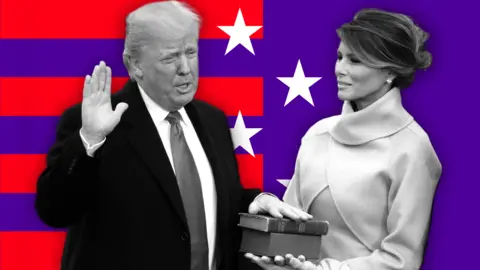 BBC
BBCDonald Trump has promised he will “make heads spin” on his first day back in office on Monday, with a blitz of executive orders expected in the hours after he is sworn in as the 47th US president.
He has offered a preview of some of these yet-to-be-signed directives, saying they will target issues like illegal immigration, climate rules, diversity policies, classified documents and more.
It is common for presidents to sign a range of executive orders when they enter office. Such orders carry the weight of law but can be overturned by subsequent presidents or the courts.
But the scale of what Trump has planned could be unprecedented, with legal challenges expected.
Here is what to know.
Immigration and the border
Deportations
Trump has vowed to “launch the largest deportation program in American history”, starting from day one.
He is expected to declare a national border emergency, and order the military to help secure the southern border, according to Fox News.
Trump has also said he will end a longtime policy that has kept federal immigration authorities from conducting raids on churches and schools.
Any mass deportation programme is expected to face logistical difficulties, billions in costs and a flurry of legal challenges.
Remain in Mexico
Trump may quickly move to re-implement his “Remain in Mexico” policy, which during his first term returned about 70,000 non-Mexican asylum seekers across the border to Mexico to await hearings.
End birthright citizenship
Trump has called the 150-year-old constitutional right that says anyone born on US soil is an American citizen “ridiculous” and vowed to scrap it on day one.
But doing that is much more difficult than simply issuing an executive order, because birthright citizenship is explicitly guaranteed by the US Constitution.
Closing the border on health grounds
A 1944 measure called Title 42 allows the US government to curb migration to protect public health. It was last used during the pandemic, but US media reports that the incoming administration is looking for a disease that would help justify its plans to close the southern US border with Mexico.
Drug cartels
Trump is expected to classify drug cartels as “foreign terrorist organisations”, putting them on a list alongside groups like Al Qaeda, so-called Islamic State and Hamas.
Build the wall
When Trump was first elected president in 2016, he signed an executive order to build a border wall. Although parts of the wall have been built, there is still much left uncompleted, and he may try to finish what he started.
Trade and economy
Tariffs
Trump has vowed sweeping tariffs on imported goods as part of his promise to prioritise American manufacturing.
Trump introduced tariffs in his first term, including some on China that Joe Biden retained.
But this time he is promising 10% tariffs on all imports, 25% on Canadian and Mexican goods and 60% on things coming from China. He has said he will begin signing executive orders imposing these on day one.
Tariffs are likely to make consumer goods more expensive and could fuel inflation, experts say. Some countries are considering retaliatory tariffs.
Crypto pile
Trump has championed cryptocurrency and his election saw the value of Bitcoin increase by 30%.
Some believe Trump will move quickly to create a federal “Bitcoin stockpile” – a strategic reserve similar to the US’s stockpile of gold and oil – that he has said would serve as a “permanent national asset to benefit all Americans”.
Climate and energy
Scrap Joe Biden’s climate policies
The outgoing president sees the series of directives, laws and funding programmes he championed to boost green jobs, regulate pollution and fund infrastructure as one of his biggest accomplishments.
Trump has made it clear he wants to undo much of it. He is expected to use executive orders to remove drilling restrictions offshore and on federal land – fulfilling his promise to “drill, baby drill” and increase US energy production and independence.
He has also pledged to ban new wind projects and cancel electric vehicle mandates.
Pull out of the Paris Agreement (again)
Within six months of taking office in 2017, Trump withdrew from the Paris climate agreement – a landmark international deal designed to limit rising global temperatures.
Biden moved to rejoin the accord on his first day in office in 2021, but Trump is expected to again pull out of it.
Capitol riot
Free Jan 6 ‘hostages’
Hundreds of people convicted after the 2021 US Capitol riots are awaiting potential pardons on Monday, when Trump returns to office.
”I am inclined to pardon many of them,” he told CNN over the summer. “I can’t say for every single one, because a couple of them, probably they got out of control.”
More than 1,500 individuals were arrested in relation to the event. At least 600 were charged with assaulting or impeding federal officers.
Secret documents
At his pre-inauguration victory rally on Sunday, Trump said he would release classified documents related to the assassination of President John F Kennedy in 1963, a subject of countless conspiracy theories.
He said he would do the same for files related to the 1968 killings of Senator Robert Kennedy and civil rights leader Martin Luther King Jr.
Foreign policy
Ukraine war
Trump claimed during the campaign that he would end the conflict on day one of his presidency. He has since said that he may need six months. It’s unclear what he might do in his first days.
Cuba and Venezuela
Trump could use executive orders to undo Biden’s recent decision to remove Cuba from the US list of state sponsors of terrorism. He could also reinstate sanctions against Venezuela. Both countries were frequent targets of his ire during his first administration.
Diversity and gender
DEI
In recent years, schools and businesses across the US have adopted policies designed to support women and racial minorities.
These practices, often classified under “diversity, equity and inclusion” (DEI), have angered many conservatives and faced legal challenges. Trump has promised to dissolve them and major corporations including Meta, Walmart and Amazon have already begun rolling back related initiatives.
Trump could use an executive order to forbid federal funding going to schools or other institutions that have DEI programmes. He could also ban funding for schools that teach “critical race theory” (CRT).
Abortion
Like most Republican presidents before him, Trump is expected to reinstate the “Mexico City policy”, which bans federal aid to international groups that provide abortion counselling.
He is also expected to reinstate an abortion rule that prohibits Title X federal health providers, a low-income family planning programme, from mentioning abortion to patients. The change effectively stripped tens of millions of dollars from organisations that offer abortion or provide referrals.
Transgender women in sports
Trump has repeatedly criticised what he calls “transgender lunacy” in schools and healthcare, and has specifically vowed to bar transgender women from competing in women’s sports.
TikTok
On Sunday morning, Trump promised to issue an executive order that would postpone a law banning Chinese-owned social media platform TikTok from being implemented.
His order, he said, would give them time to find a US partner to buy a 50% stake in the company.
Trump previously backed a TikTok ban, but recently reversed his stance, pointing to the billions of views he says his videos attracted on the platform during last year’s presidential campaign.
On a Raid With Syria’s New Security Forces

new video loaded: On a Raid With Syria’s New Security Forces
transcript
transcript
On a Raid With Syria’s New Security Forces
After the fall of the Assad regime in Syria, The New York Times joined a group of former rebel soldiers trying to enforce law and order in a country grappling with the ghosts of its past.
-
We’re in Latakia, riding with security forces just 10 days after the collapse of the Syrian government led by former President Bashar al-Assad. They tell us one of their missions here is trying to find and arrest members of the old regime. The greater goal, they say, is to secure a city that until recently was an Assad family stronghold. We wanted to see whether they would do it differently from their predecessors. We arrive at a house belonging to a former Syrian Army officer. Only he isn’t the one being arrested. These two suspects in custody are former rebel fighters. They are, in theory, allies, part of a coalition of groups that joined forces to overthrow the Assad regime. They’ve been targeting Assad’s army for years, but today it’s landed them in trouble. We go inside to find out what happened. Throughout our time with this security unit, they insisted on their commitment to due process, even if it means helping a former enemy. The two fighters accused of looting are brought back to base, to a complex which was previously the military security headquarters here under Assad. Our guides were eager to call attention to the legacy of the Assad government, one of systemic repression, brutality and torture. Just down the hall, the arrested fighters are about to become prisoners here too. Despite efforts to contrast themselves with the old regime, questions remain about whether new leadership can deliver a more equitable system of justice in a Syria grappling with the ghosts of its past.
Recent episodes in Conflict in Syria
How Mexico Is Preparing for Tariffs Negotiations With Trump

For the second time in less than decade, Mexico is preparing to negotiate with President-elect Donald J. Trump, who is threatening the neighboring country with sky-high tariffs, mass deportations and military strikes on cartels.
The stakes are huge for Mexico’s 130 million people. Among major economies, Mexico is exceptionally dependent on the United States, sending about 80 percent of its exports to the American market.
Mexico’s top negotiators are adopting an assertive stance to negotiating with Mr. Trump this time around. Some of them can draw from experience dealing with the first Trump administration: Mexico’s populist president at the time, Andrés Manuel López Obrador, forged a warm relationship with Mr. Trump, and Mexico avoided steep tariffs while acceding to demands to curb migration.
“We will find a solution because we have structural advantages,” Marcelo Ebrard, the economy minister, said this month, listing factors like greater economic interdependence between the two countries and declines in fentanyl deaths and migration.
President Claudia Sheinbaum of Mexico has set the tone of this approach. While Mexico’s government has been unable to meet with the incoming Trump administration, she has blended conciliatory words for Mr. Trump with rhetorical pushback and vows that Mexico could hit back with retaliatory tariffs of its own.
“We coordinate, we collaborate, but we will never become subordinated,” Ms. Sheinbaum said in a speech this month.
At the same time, Ms. Sheinbaum’s government has already mobilized to respond to some of Mr. Trump’s concerns, expanding migration deterrence efforts and increasing seizures of illicit opioids.
The cornerstone of this strategy is a wager that the new administration in Washington needs Mexico, and its fast-expanding, low-cost industrial base, if the United States hopes to counter its largest rival: China.
Here are four factors informing Mexico’s preparations for dealing with the new Trump administration.
Mexico is increasingly important to the U.S. economy.
Mexico’s economic relationship with the United States has changed considerably since Mr. Trump was last in the White House, especially as a result of the coronavirus pandemic’s disruption of global supply chains.
Mexico eclipsed China in 2023 as the United States’ top trading partner in goods, as manufacturers shifted operations to Mexico to be closer to the American market.
Trade ties deepened even further last year, when Mexico displaced China to become the top source of imports for the United States and the top destination for American food exports.
“It’s an unprecedented level of interdependence,” said Diego Marroquín Bitar, a scholar who specializes in North American trade at the Wilson Center, a Washington research group.
Mexico’s government is showcasing these trade ties as it makes the case that imposing U.S. tariffs on Mexico could raise inflation and hurt American consumers.
But those deepened ties also leave Mexico with heightened vulnerabilities.
One may be remittances. Mexicans working in the United States sent home $63 billion in 2023, twice as much as when Mr. Trump took office eight years ago, and mass deportations could cause that figure to plummet.
Proposals to tax remittances, including a bill sponsored by Vice President-elect JD Vance, are also gaining momentum.
Migration flows and fentanyl deaths are falling.
While Mr. Trump has repeatedly raised alarms about migration from Mexico, illegal crossings along the U.S.-Mexico border are at their lowest level since the summer of 2020. Only about 46,000 people crossed the border illegally in November, the lowest number under President Biden.
The Biden administration’s restrictions on asylum for migrants contributed to this decline. But so did policies in Mexico, which has sought to dissuade migrants, largely from other Latin American countries, from reaching the U.S. border.
Mexico has broken up migrant caravans and expanded a shadowy busing program that has transported thousands of migrants from the country’s northern border to sites deep in its south.
Just in the last quarter of 2024, Mexico intensified this crackdown by detaining about 475,000 migrants, the authorities said, more than double the number held in the first nine months of the year. Most of these migrants are quickly released, allowing them to stay in Mexico; only a small fraction are deported to their home countries.
Another issue that Mr. Trump has cited frequently is the impact of illegal drugs, particularly fentanyl, flowing across the border. After surging to horrifying levels, overdose deaths from illegal drugs are also falling. They were down about 14.5 percent in the 12 months that ended in June 2024 from the same period a year earlier.
Experts say that expanded treatment, prevention and education efforts in the United States played a role in this decline. While more evidence is needed, U.S. efforts to crack down on chemical precursors from China and the Mexican cartels using these chemicals to make fentanyl also may be restricting supplies.
Ms. Sheinbaum has also begun targeting the fentanyl trade. Last month, Mexican security forces captured 20 million doses of the drug in the country’s largest synthetic opioid seizure.
Cartel violence is still rising over vast areas.
Neither declines in border crossings or fentanyl overdoses could much make a difference if Mr. Trump chooses to focus on the cartel bloodshed gripping large parts of Mexico as justification for imposing tariffs on its exports.
Clashes between rival cartel factions have recently turned the northwest state of Sinaloa into a war zone. Brutal political assassinations have cast a pall over Guerrero in southwest Mexico.
Turf battles in Guanajuato, a center for car manufacturing northwest of Mexico City, have been marked by one massacre after another in recent weeks.
During his previous term, and again while campaigning for his new term, Mr. Trump raised the possibility of taking military action against cartels as a way of limiting their smuggling of illicit drugs into the United States. A potential designation of these groups as “terrorist organizations” could open the way for such moves.
Mexico’s government has long viewed such a possibility as a nearly unthinkable violation of its sovereignty. But some former officials with previous experience negotiating with Mr. Trump warn that Mexico needs to take such threats seriously.
Ms. Sheinbaum highlighted last week the willingness of Marco Rubio, Mr. Trump’s pick for secretary of state, to collaborate on curbing cartel activities.
“We take him at his word,” Ms. Sheinbaum said of Mr. Rubio.
“Trump 2.0 is going to be a different Trump,” said Ildefonso Guajardo, a former economy minister who negotiated with the Trump administration in 2017 and 2018. “His team will be far less balanced in terms of trying to make him aware of the consequences of some decisions.”
And while fentanyl deaths are declining in the United States, the drug is still claiming tens of thousands of lives each year. The explosion of violence in Sinaloa highlights how the groups responsible for the fentanyl trade remain active and well armed.
So is China’s economic profile in Mexico.
A recent flood of imported Chinese cars into Mexico has increased tensions over the inroads that China is making into key industries in North America.
Mexico, which has a $105 billion trade deficit with China, moved quickly in recent weeks to assuage concerns that China could use its foothold in Mexico as a way to gain greater access to U.S. markets.
Mexico imposed tariffs viewed as targeting online Chinese retailers like Temu and Shein, then unveiled a new industrial policy last week aimed at reducing imports from China while bolstering supply chains to the United States.
With such measures, Mexico’s government is seeking to drive home its contention that the United States needs Mexico to confront the greater economic threat of China. But will that be enough for Mr. Trump?
If not, and if ties with Washington sour significantly, Mexico still has a kind of “nuclear option” involving strengthening its economic ties with China, according to Scott Morgenstern, a professor of political science at the University of Pittsburgh.
“Mexico could turn to Washington’s biggest economic rival at a time when Beijing is seeking to assert more influence across Latin America,” Mr. Morgenstern said.
Trial Begins of Suspect in Southport Stabbing Attack at Dance Class

The trial began on Monday for Axel Rudakubana, 18, who is accused of carrying out a knife attack at a dance class last July in the northern English town of Southport that left three children dead and 10 other people injured.
Mr. Rudakubana faces three charges of murder for the deaths of Bebe King, 6, Elsie Dot Stancombe, 7, and Alice da Silva Aguiar, 9, who were taking part in a Taylor Swift-themed dance and bracelet-making class during their summer break from school.
He is also charged with the attempted murder of 10 people, including eight other children and two adults, and with possession of a knife for the attack on July 29.
After the stabbings, the police searched Mr. Rudakubana’s house and said they found ricin, a lethal toxin, and a PDF file titled “Military Studies in the Jihad Against the Tyrants: The Al Qaeda Training Manual.” Mr. Rudakubana was subsequently charged with production of a biological toxin and with “possessing information of a kind likely to be useful to a person committing or preparing an act of terrorism.”
However, the authorities have not so far declared the episode an act of terrorism. Serena Kennedy, the chief constable of the Merseyside Police, which oversees policing in the region, said in a statement in October that “for a matter to be declared a terrorist incident, motivation would need to be established.” She added: “We would strongly advise caution against anyone speculating as to motivation in this case.”
Not-guilty pleas have been entered on Mr. Rudakubana’s behalf for all the charges. Throughout the legal proceedings so far, he has declined to speak.
The trial will take place at Liverpool Crown Court and is expected to last around four weeks.
Mr. Rudakubana was born in Cardiff, Wales, to parents who were originally from Rwanda. He was living in Banks, a village north of Southport, at the time of the attack.
Last week, Britain’s attorney general, Richard Hermer, issued an official advisory reminding social media users and journalists about the risks of contempt of court and warning that inaccurate or speculative commentary could influence the jury’s deliberations. Anything that asserts or assumes Mr. Rudakubana’s guilt could jeopardize the criminal trial, he warned.
After the Southport attack, Britain was convulsed by a series of violent riots, as disinformation about the attacker’s identity swirled on social media and messaging apps. False claims that the suspect was an undocumented immigrant or newly arrived asylum seeker were amplified by anti-immigration activists and members of the far right.
Several people, including a neo-Nazi, were later found to have helped coordinate outbreaks of unrest, which included attacks on mosques and hotels where asylum seekers were staying, and which led to dozens of police officers being injured.
Mr. Rudakubana was 17 at the time of the attack and, under English court rules, he would usually have retained his anonymity until he turned 18. But a few days after the attack, a judge took the unusual step of releasing his name in an attempt to combat the spread of misinformation.
Since the riots last summer, hundreds of people have been charged for their involvement in the violent disorder across the country, and dozens of people have been sentenced to prison time.
Yvette Cooper, Britain’s home secretary, said in a statement on Monday morning that the trial would be a “deeply traumatic and distressing time for the families of Alice, Bebe and Elsie, the survivors, and the people of Southport and the whole country.”
“The most important thing for all of us is to ensure that the legal process can take its course, to respect the difficult job the court has to do so there is a fair trial and justice can be done,” she added.
