Thursday, October 1, 2026
Home Blog Page 6928

How does Trump’s age at inauguration compare to other presidents? | Donald Trump News

0
How does Trump’s age at inauguration compare to other presidents? | Donald Trump News


At 78 years and 7 months, Donald Trump will become the oldest president in US history on inauguration day.

Donald Trump is set to be sworn in as the 47th president of the United States on Monday.

The 78-year-old will commence his second term as president, becoming the oldest individual to ever assume the office. He will be five months older than Joe Biden, who previously held the record for the oldest president on Inauguration Day in 2021.

In the following explainer, Al Jazeera visualises the ages of all US presidents on Inauguration Day, along with their lifespans and years in office.

The oldest and youngest US presidents

Donald J Trump was born in Queens, New York on June 14, 1946, less than a year after the end of World War II.

In 2017, at the age of 70, Trump was sworn in as the 45th president of the United States, making him the oldest president to be inaugurated, surpassing Ronald Reagan, who was just about to turn 70 on Inauguration Day in 1981.

The average age of US presidents at their inauguration is 57, a figure that spans from George Washington, the first president, who was 57 in 1789, to the present day.

The youngest US president at the time of his inauguration was Theodore Roosevelt, who became president at the age of 42 after the assassination of William McKinley in 1901.

The US presidents who lived the longest

The longest-living US president was Jimmy Carter, who died on December 29, 2024 at the age of 100. He lived 43 years after serving one term as president from 1977 to 1981 – longer than any other president.

Out of the 41 presidents who have died, six lived to be over 90, five lived between 80 and 90, and the average age of death was 72.

John F Kennedy, the 35th president, lived the shortest of all US presidents. He was assassinated in 1963 at the age of 46.

Longest-serving US presidents

Prior to 1951, there was no formal limit to how many terms a US president could serve. The two-term limit was officially established by the 22nd Amendment, ratified on February 27, 1951, largely in response to Franklin D Roosevelt four terms in office.

Roosevelt, the longest-serving US president, served from 1933 to 1945, completing more than 12 years in office before his death at the age of 63 during his fourth term.

Most US presidents have served one term rather than two. Of the 46 presidencies, only 15 presidents have served two or more terms.

The shortest-serving president was William Henry Harrison who died on April 4, 1841, just one month into his term.


China executes man for car rampage that killed dozens

0
China executes man for car rampage that killed dozens


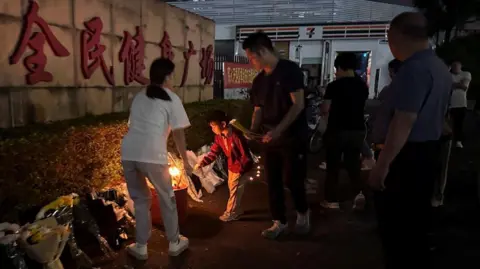
Reuters Mourners laid flowers outside the stadium in Zhuhai after the attackReuters

People placed flowers outside the stadium in Zhuhai after the attack

China has executed a man found guilty of killing at least 35 people in a car attack in November, in what is thought to be the deadliest attack in the country for a decade.

Fan Weiqiu, 62, injured dozens more when he drove his car into people exercising outside a stadium in the southern city of Zhuhai.

State media said a second man was executed for a separate attack that came days later. Xu Jiajin, 21, killed eight people in a stabbing spree at his university in the eastern city of Wuxi.

Authorities said Fan was driven by “dissatisfaction” over how his property had been divided following his divorce, while Xu carried out his attack after “failing to obtain his diploma due to poor exam results”.

Fan was detained at the scene on 11 November, where police said he was found with self-inflicted wounds.

In December, he was found guilty of “endangering public safety”, with the Zhuhai Intermediate People’s Court describing his motive as “extremely vile” and the methods used “particularly cruel”.

His execution on Monday comes less than a month after the court sentenced him to death.

In the case of Xu, police said he confessed to his crime “without hesitation” on 16 November. He was sentenced to death on 17 December, with the court hearing that the circumstances of his crime were “particularly bad” and “extremely serious”.

Human rights groups believe China is the world’s leading executioner, killing thousands of people every year. The country does not release details about its use of the death penalty, so reliable numbers are unavailable.

China has been grappling with a spate of public violence, with many attackers believed to have been spurred by a desire to “take revenge on society” – where perpetrators target strangers over their personal grievances.

The number of such attacks across China reached 19 in 2024.

Within days of the Zhuhai and Wuxi attacks, a man drove into a crowd of children and parents outside a primary school in Changde city, injuring 30.

Authorities said the man, Huang Wen, wanted to vent his anger after dealing with investment losses and family conflict.

Huang was handed a suspended death sentence last month, which could be commuted to life imprisonment if he does not commit another crime in the next two years.

Analysts earlier told the BBC that the string of mass killings raised questions about how people in China have been dealing with various sources of stress, such as the country’s sluggish economy.

“The tensions do seem to be building, and it doesn’t look like there is any way it is going to ease up in the near future,” says George Magnus, an economist at Oxford University’s China Centre.


Musk Said to Have Intervened to Help Free Italian Jailed in Iran

0
Musk Said to Have Intervened to Help Free Italian Jailed in Iran


When an Italian journalist was arrested in Iran in December, her boyfriend back home feared she might linger in prison for years. So, amid talk that Iran and Italy were negotiating a prisoner swap that involved the United States, he says, he decided to try to get a message to someone who might be in a position to help.

His name was Elon Musk.

Not only was Mr. Musk close to President-elect Donald J. Trump, a month before the journalist was detained, the tech billionaire had a secret meeting with the Iranian ambassador to the United Nations.

Last week, the journalist, Cecilia Sala, 29, was released from prison in Iran, and days later an Iranian engineer whom Italy had detained on an American extradition request was also freed. The engineer was accused of providing material for drones used in an Iranian-backed militia attack on a U.S. military base that killed three American servicemen.

Mr. Musk helped secure the release of Ms. Sala by reaching out to Iran’s ambassador to the U.N., Amir Saeid Iravani, according to two Iranian officials, one a senior diplomat at the Foreign Ministry, who are both familiar with the terms of the prisoner exchange. They asked that their names not be published because they were discussing a sensitive issue.

Neither Mr. Musk nor representatives of the Trump transition responded to repeated requests for comment.

How Mr. Musk, an increasingly active if uncredentialed player on the world stage since the Trump victory, came to take up the journalist’s cause remains unclear. He is close with Italy’s prime minister, Giorgia Meloni, who traveled to Mar-a-Lago, the Trump estate in Florida where Mr. Musk has been a regular, and met with the president-elect on Jan 4.

Ms. Meloni said at a news conference last week that Ms. Sala’s release was the result of a “complex work of diplomatic triangulation with Iran, and obviously also with the United States of America.” Her office and the Italian Foreign Ministry declined to comment for this article.

A senior Biden administration official said the American government had not been consulted about the negotiations, had not been given advance word about the releases, and disapproved of the deal. John Kirby, the spokesman for the National Security Council, said that the deal had been “an Italian decision from soup to nuts.”

At the news conference, Ms. Meloni said she did not know what part if any Mr. Musk had played in Ms. Sala’s release. “If he had a role, I am not aware of it,” she said.

The ambiguity highlights the unusual role Mr. Musk has been playing as he sits at Mr. Trump’s side, backing far-right parties in Europe even as he continues to promote his business interests abroad. Italy, for example, is currently exploring a potential deal with Mr. Musk’s SpaceX to provide secure communications for government and military officials through Starlink. And Ms. Meloni has been one of Mr. Musk’s ever-present European allies, hosting him at her party’s conference in 2023 and attending a gala with him last October.

By the time of Ms. Meloni’s trip to Mar-a-Lago, Ms. Sala’s boyfriend, Daniele Raineri, had already sought out Mr. Musk’s help through an intermediary, he said. In an interview, Mr. Raineri said that he had thought of him because he had read that there was “a channel between Musk and the Iranian diplomats, and that Musk also works in close contact with Trump.”

Mr. Raineri, who is also a journalist, said he fired off a message on Dec. 29 to an Italian computer expert and associate of Mr. Musk’s to ask if he could bring Ms. Sala’s case to the billionaire’s attention and seek his help.

The computer expert, Andrea Stroppa, said in an interview that Mr. Musk had acknowledged the request, but that he did not know whether he had become involved in the case.

In November, weeks before Ms. Sala was arrested, Mr. Musk met for more than an hour with the Iranian ambassador at the Iranian’s residence in Manhattan to discuss defusing tensions between Tehran and Washington as a new administration prepared to take power.

The Iranian officials interviewed for this article said that Mr. Musk contacted the ambassador again shortly after Prime Minister Meloni visited Mar-a-Lago.

The prisoner exchange between Iran and Italy then unfolded rapidly. Iran released Ms. Sala on Jan. 8, and four days later, Italy freed the Iranian engineer, Mohammad Abedini Najafabadi.

Mr. Abedini had been detained at the request of the U.S. Justice Department. A federal court in Massachusetts accused him of procuring drone technology for Iran that was used in the attack on the American base, which was in Jordan, in January 2024. The two Iranian officials said that when Mr. Musk spoke with the ambassador, he requested that Iran release Ms. Sala and reassured him that the United States would not pressure Italy to extradite the Iranian engineer.

Iran’s mission to the U.N. declined to comment on the recent engagement between Mr. Musk and the ambassador. In a statement, it said the two detainees had been released as a result of “bilateral cooperation and coordinated efforts of the political and intelligence sectors of Iran and Italy.”

All sides are being circumspect in public about what transpired, but to many observers the speedy release of the prisoners following the meeting between Mr. Trump and Ms. Meloni suggested that the topic had been discussed and a resolution was reached.

“The most likely reconstruction is that she got a signal of understanding from Trump that the incoming administration would not raise huge problems if it released Abedini,” said Ferdinando Nelli Feroci, a former Italian diplomat.

Italy detained Mr. Abedini in mid-December as he was transiting through Milan’s airport. Three days later, agents from the intelligence wing of the Revolutionary Guard raided Ms. Sala’s hotel room in Tehran and threw her into solitary confinement at Evin prison. She had traveled to Iran on a journalist visa.

A member of Iran’s Revolutionary Guards, and the two Iranian officials said the journalist had been arrested to pressure Italy to release Mr. Abedini. Iran has made the detention of foreign and dual nationals a centerpiece of its foreign policy for nearly five decades.

“It doesn’t matter who you are,” Shahin Modarres, a Rome-based expert on Iran and international security, said in a telephone interview. “You can be a journalist, a diplomat, a tourist.” He said, “What matters is if Iran thinks it can use you as leverage.”

Ms. Sala said in an interview that she had been held in a cell with no mattress and had slept on the floor with one blanket on top and another below. For weeks, she was denied her glasses, and throughout her detention she did not see a human face. She could hear the sound of other inmates crying and vomiting, she said, and was blindfolded and interrogated for hours nearly every day, she said.

What she feared the most, she said, was “that I would go insane.”

Mr. Raineri, her boyfriend, said that on Jan. 2, Ms. Meloni told Ms. Sala’s mother that within the next 48 hours there would be an important development.

Mr. Stroppa, the programmer, dropped hints on his account on X. He posted a portrayal of Mr. Trump, Ms. Meloni and Mr. Musk in ancient Roman attire on the day the prime minister visited Mar-a-Lago. And on the day Ms. Sala was released, he posted an AI-generated photo of Mr. Musk eating spaghetti with an Italian flag emoji.

Ms. Sala said she understood that Italy’s government did what it had to do to free her. “And whoever it was they needed to talk to, they talked to,” she said.

Ryan Mac and Mattathias Schwartz contributed reporting.


Melania Trump launches cryptocurrency on eve of inauguration

0
Melania Trump launches cryptocurrency on eve of inauguration


Disclaimers on the websites of both the $Trump and $Melania coins said they were “not intended to be, or the subject of” an investment opportunity or a security.

According to the CoinMarketCap website, $Trump currently has a total market valuation of about $8.7bn (£7.1bn), while $Melania’s stands at around $1.3bn.

Trump had previously called crypto a “scam” but during the 2024 election campaign became the first presidential candidate to accept digital assets as donations.

On the campaign trail, Trump also said he would create a strategic bitcoin stockpile and appoint financial regulators that take a more positive stance towards digital assets.

That spurred expectations that he would strip back regulations on the crypto industry.

In the wake of Trump’s victory, bitcoin jumped to a record high is currently trading at $140,000, according to crypto trading platform Coinbase.

On Friday, the incoming artificial intelligence (AI) and crypto tsar David Sacks held a “Crypto Ball” in Washington, DC.

Other cryptocurrencies, including dogecoin – which has been promoted by high-profile Trump supporter Elon Musk – have also risen sharply this year.

Under President Joe Biden, regulators cited concerns about fraud and money laundering as they cracked down on crypto companies by suing exchanges.


Hamas Tries to Show It’s Back in Charge of Gaza

0
Hamas Tries to Show It’s Back in Charge of Gaza


As the cease-fire in Gaza was coming into effect on Sunday, masked gunmen, crowded into white pickup trucks, paraded through the streets of Gaza while supporters chanted the name of Hamas’s military wing. By sending its fighters out in an unmistakable show of force, Hamas was trying to deliver an unequivocal message to Palestinians in Gaza, to Israel and to the international community: that despite heavy losses during the war among Hamas’s fighters, police officers, political leaders and government administrators, it remains the dominant Palestinian power in Gaza.

“The message is that Hamas is ‘the day after’ for the war,” said Ibrahim Madhoun, an analyst close to Hamas based in Turkey, using a phrase that refers to the future administration of Gaza.

“They’re conveying that Hamas must be a part of any future arrangements, or at least, be coordinated with,” he added.

On Sunday, the Hamas-run government media office announced that thousands of police officers were beginning to deploy throughout the territory to “preserve security and order.” Government ministries and institutions, the media office said, were prepared to start working “according to the government plan to implement all the measures that guarantee bringing back normal life.”

At the Nasser Medical Complex in the southern city of Khan Younis, at least three uniformed police officers were standing as the Palestinian national anthem played in the background, according to a video posted on social media and verified by The New York Times.

Later on Sunday, dozens of uniformed, gun-toting Hamas militants were seen in Saraya Square in Gaza City next to a car holding Israeli hostages before they were handed over to the Red Cross. The militants were attempting to push away crowds of people pressing toward the car.

Even as Hamas attempts to project that it still controls Gaza and plans to play a key role in its administration, its future there remains uncertain. Israeli officials have said they have not given up on their stated war goal of dismantling Hamas’s military wing and government, strongly suggesting that they could resume the war against the militant group after the freeing of some hostages.

Gideon Saar, the Israeli foreign minister, said on Sunday that Hamas’s rule was dangerous for Israel’s security and emphasized that Israel had not agreed to a permanent cease-fire that leaves Hamas in power.

“We are determined to achieve the objectives of the war,” he said.

While some analysts say Israel could eventually remove Hamas from power, others say it would struggle to resume the war in the face of international pressure. And even if it does, those analysts say, Israeli forces will face immense challenges in uprooting Hamas from Gaza without carrying out a direct occupation.

Ali Jarbawi, a political science professor at Birzeit University, said Hamas’s parades through Gaza on Sunday were more than a message to the international community that it was in control. They also reflect the reality on the ground, he said.

“Hamas was there before the war and they’re there now,” he said.

Aritz Parra contributed reporting.


Trump Vowed to End the Ukraine War Before Taking Office. The War Rages On.

0
Trump Vowed to End the Ukraine War Before Taking Office. The War Rages On.


After they win elections and move into the White House, plenty of presidents at some point eventually break a campaign promise. Donald J. Trump will not even wait that long. He will break an important campaign promise the moment he takes the oath of office.

While stumping for a return to power in the fall, Mr. Trump repeatedly made a sensational if implausible pledge with profound geopolitical consequences: He would broker an end to the war in Ukraine in 24 hours. And not just in 24 hours — he would do so before being sworn in as president.

“Before I even arrive at the Oval Office, shortly after we win the presidency, I will have the horrible war between Russia and Ukraine settled,” Mr. Trump vowed in a June rally. “I will get it settled before I even become president,” he said during his televised debate with Vice President Kamala Harris in September. “I will settle Russia-Ukraine while I’m president-elect,” he said again during a podcast in October.

This was no offhand comment, no one-off that he did not repeat. It was a staple of his public argument when it came to the biggest land war in Europe since the fall of Nazi Germany. Yet he not only has failed to keep his promise; he has also made no known serious effort to resolve the war since his election in November, and the fighting will still be raging even after noon on Monday when President-elect Trump becomes President Trump again.

“Wars can’t be settled by bombast,” Senator Richard Blumenthal, Democrat of Connecticut, said in an interview. “And the missing link in his thinking is the failure to understand that Ukrainians will reach the settlement only if they are at the negotiating table from a position of strength. He’s in effect undermined their position, and that’s one reason why he hasn’t reached a solution before his inauguration.”

Mr. Trump, of course, is no stranger to hyperbole. The brash assertion that he could easily, expeditiously and single-handedly halt the war with the proverbial snap of his fingers was in keeping with the longstanding I-alone-can-fix-it image that Mr. Trump likes to present to the public.

But time and again over nearly a decade in national politics, rhetoric has run into reality and grandiose promises have fallen by the wayside. And while other presidents paid a price when they broke a promise (ask George H.W. Bush about reading his lips on taxes), Mr. Trump just plows forward without evident consequence.

He did not, for instance, fully build his much-heralded border wall, much less force Mexico to pay for it. He did not wipe out the federal budget deficit or shrink the national trade deficit. He did not forge a permanent peace between Israel and the Palestinians, which he said would be “not as difficult as people have thought over the years.” He did not repeal and replace Obamacare. He did not boost economic growth to “4, 5 and even 6 percent.”

During this transition to a second term, Mr. Trump did help force a temporary halt in the fighting in Gaza that took effect on Sunday, dispatching an envoy to press Israel to agree to the longstanding cease-fire President Biden had first put on the table. While the deal was hashed out by Mr. Biden’s team, Mr. Trump’s pressure played a critical role in finally getting it enacted, a major success for the incoming president.

But Ukraine in many ways is a far more daunting challenge for Mr. Trump because he will be starting from scratch. Unlike Gaza, there is no existing peace plan from his predecessor, with all the intricate logistics, timetables and formulas already worked out, for Mr. Trump to simply adopt and push across the finish line.

Just this month, Keith Kellogg, the new president’s designated special envoy for the Ukraine war, postponed plans to travel to Kyiv, the Ukrainian capital, and other European cities to begin exploring the situation until after the inauguration. He told Fox News that he hoped to resolve it within 100 days, which would be 100 times as long as Mr. Trump originally promised even if successful.

“It was an absurd promise,” said Kathryn Stoner, a senior fellow at Stanford University’s Freeman Spogli Institute for International Studies. “The only person who can actually end the war in 24 hours is Vladimir Putin, but he could have done it years ago. Any negotiation is going to take more than 24 hours regardless of when Trump starts the clock.”

Michael Kimmage, the author of the book “Collisions,” about the Russia-Ukraine conflict, and the newly named director of the Wilson Center’s Kennan Institute, said that Mr. Trump’s campaign promises were always delivered “very freely” and perhaps were more about sending signals than being interpreted precisely.

“His goals with this language may be as follows: to put the government on notice that his approach to Russia and to the war will be different from Biden’s, that his key objective is to end the war and not for Ukraine to win” and “that he will be in charge and not the deep state that entrenches the U.S. in forever wars.”

Those signals have left murky how Mr. Trump imagines he will get to an agreement, but given his longstanding affinity for President Vladimir V. Putin of Russia, his hostility toward Ukraine and his resistance to U.S. military aid to Kyiv, analysts expect any settlement he seeks to be favorable to Moscow. Vice President-elect JD Vance has suggested letting Russia keep the 20 percent of Ukraine it has illegally seized through aggression and forcing Ukraine to accept neutrality rather than alignment with the West, a framework echoing Russian priorities.

Asked by email why Mr. Trump had not fulfilled his campaign promise to end the war before his inauguration, Karoline Leavitt, Mr. Trump’s incoming White House press secretary, did not respond directly, but instead repeated that he will make it “a top priority in his second term.”

Since his November election, Mr. Trump met with President Volodymyr Zelensky of Ukraine and has spoken about meeting with Mr. Putin after his inauguration.

Representative Michael Waltz, Republican of Florida, who is set to become Mr. Trump’s national security adviser, stressed on Sunday that ending the Ukraine conflict remained a top priority for the new president, calling the war “literally a meat grinder of people” akin to World War I trench warfare “with World War III escalation consequences.”

But the thinking Mr. Waltz described during an appearance on “Face the Nation” on CBS sounded like the formula for a process that could take a while: “The key pieces of it: Number one, who do we get to the table? Number two, how do we drive them to the table? And then three, what are the frameworks of a deal?”

“President Trump is clear: This war has to stop,” Mr. Waltz added. “Everyone, I think, should be on board with that.”

Even if everyone is on board with that goal — and there is room for doubt — the possible terms remain thorny. Even assuming NATO membership is not in the cards, Ukraine wants serious security guarantees from the United States and Europe, especially if it is forced to give up its territory, something that Russia would object to.

Then there are questions of reparations and consequences. Who would pay to rebuild Ukraine’s devastated cities and countryside? What would happen to the International Criminal Court’s arrest warrants for Mr. Putin and other Russian figures for alleged war crimes? Would the United States and Europe ease sanctions imposed after the 2022 full-scale invasion, and if so on what conditions? Who would police a line of de-confliction and what would happen if any cease-fire is violated?

Mr. Trump has not publicly addressed such questions in any depth, leaving many to guess. He has, however, expressed distress at the continuing casualties in Ukraine and an urgency to find the answers, whatever they may be.

“Part of the point — and this may shed a bit of light on his administration’s eventual course of action — may be not to have a script and therefore to speak in ways that obscure rather than reveal what the actual script is,” Mr. Kimmage said. “The less we know what he is up to, the more he can improvise.”


‘My children, my children’: The Gaza family killed minutes before ceasefire | Israel-Palestine conflict News

0
‘My children, my children’: The Gaza family killed minutes before ceasefire | Israel-Palestine conflict News


Khan Younis, Gaza Strip, Palestine – The ceasefire in Gaza was supposed to start at 8.30am (06:30 GMT). The al-Qidra family had endured 15 months of Israeli attacks. They had been displaced more than once and were living in a tent. Their relatives had been among the more than 46,900 Palestinians killed by Israel.

But the al-Qidras had survived. And they wanted to go home.

Ahmed al-Qidra packed his seven children onto a donkey cart and headed to eastern Khan Younis. It was finally safe to travel – the bombing should have stopped.

But the family did not know that the ceasefire between Israel and Hamas had been delayed. They did not know that, even in those additional few hours, Israeli aircraft were still flying over the skies of Gaza, ready to drop their bombs.

The explosion was loud. Ahmed’s wife Hanan heard it. She had stayed behind at a relative’s home in the centre of the city, organising their belongings, planning on joining her husband and children a few hours later.

“The blast felt like it hit my heart,” Hanan said. She instinctively knew that something had happened to her children, whom she had only just said goodbye to.

“My children, my children!” she screamed.

The cart had been hit. Hanan’s eldest son, 16-year-old Adly, was dead. So was her youngest, six-year-old Sama, the baby of the family.

Yasmin, 12, explained that a four-wheel drive was in front of the cart carrying people celebrating the ceasefire. Perhaps that was the reason the missile hit.

“I saw Sama and Adly lying on the ground, and my father bleeding and unconscious on the cart,” Yasmin said. She pulled her eight-year-old sister Aseel out before a second missile hit the spot where they had been. Eleven-year-old Mohammed also survived.

But Ahmed, Hanan’s partner in life, was pronounced dead in the hospital.

Man stands in skeleton of a vehicle
The vehicle travelling ahead of the al-Qidras’ donkey cart may have been targeted in the Israeli air attack [Abdelhakim Abu Riash/Al Jazeera]

‘My children were my world’

Sitting on the edge of her injured daughter Iman’s hospital bed in Khan Younis’s Nasser Hospital, Hanan was still shell-shocked.

“Where was the ceasefire?” she asked. In their excitement to finally return to whatever was left of their home, the family had missed Israeli Prime Minister Benjamin Netanyahu declaring that the Palestinian group Hamas had not sent over the names of the three Israeli captives who would be released on Sunday as part of the ceasefire deal.

They had not seen Hamas explain that there were technical reasons for the delay, and that the names would be provided, as they eventually were.

They would not know that in the three-hour delay before the ceasefire eventually began, three members of their family would be killed. They were among the 19 Palestinians killed by Israel in those last few hours, according to Gaza’s Civil Defence.

Hanan al-Qidra sits with a daughter, her other daughter lays on hospital bed
Hanan al-Qidra has to take care of her remaining children on her own after her husband Ahmed was killed in the Israeli attack in Khan Younis on January 19 [Abdelhakim Abu Riash/Al Jazeera]

Hanan broke down in tears. She would now have to face life without her husband and without two of her children. The loss of Sama, “the last of the bunch” as she described her with the Arabic saying, was particularly hard.

“Sama was my youngest and the most spoiled. She’d get angry whenever I talked about having another child.”

Adly had been her “pillar of support”. Her children were her world.

“We endured this entire war, facing the harshest conditions of displacement and bombardment,” Hanan said. “My children dealt with hunger, a lack of food and basic necessities.”

“We survived more than a year of this war, only for them to be killed in its last minutes. How can this happen?”

A day of joy had been turned into a nightmare. The family had celebrated the end of the war the night before.

“Hasn’t the Israeli army had enough of our blood and the atrocities they committed for 15 months?” Hanan asked.

Then, she thought of her future. With her husband and two of her children ripped away from her, and with tears coming down her face, she asked: “What’s left?”


Trump promises blizzard of executive orders on first day of presidency

0
Trump promises blizzard of executive orders on first day of presidency


Watch: Trump promises ‘brand new day’ at pre-inauguration rally

Hours before he will be sworn into office, Donald Trump promised to sign a host of executive orders on his first day as president while celebrating at a victory rally.

Trump addressed the crowd of thousands of supporters in Washington DC on the eve of his inauguration, offering a preview of the next four years and celebrating his election victory over Democrats.

The Republican promised to act unilaterally on a wide array of issues, using his new presidential powers to launch deportation operations and slash environmental regulations.

“I will act with historic speed and strength and fix every single crisis facing our country,” he promised the crowd.

“You’re going to have a lot of fun watching television tomorrow,” he told those gathered at the “Make America Great Again Victory Rally”. “Every radical and foolish executive order of the Biden administration will be repealed within hours of when I take the oath of office.”

Trump promised executive orders that will ramp up artificial intelligence, form the Department of Government Efficiency (DOGE), make records available related to the assassinations of former presidents, direct the military to create the Iron Dome missile defence shield and eliminate diversity, equity and inclusion (DEI) policies from the military.

Media reports indicate Trump may issue more than 200 executive actions on Monday, which is different than an executive order.

Executive orders are recognized by courts, legally binding and published in the Federal Register. They can be overturned by future presidents.

Executive actions, however, carry less weight and aren’t subject to legal review. They serve more as a “wish list” of policies a president hopes to accomplish, political writer Tom Murse writes.

“You’re going to see going to see executive orders that are going to make you extremely happy,” he told the crowd. “We have to set our country on the proper course.”

Many of these executive orders are expected to be challenged in court.

Trump also pledged to sign executive actions that will address illegal immigration at the border by launching what he claims will be the largest deportation operation in history.

Experts say Trump’s promise to deport millions of migrants will face enormous logistical hurdles, and potentially cost tens or hundreds of billions of dollars.

Trump also promised to act on crime in America’s cities, eliminate left-leaning policies in government and take on trans people competing in American sports.

He took credit during his rally speech for the restoration of TikTok after it was briefly banned over the weekend and for the ceasefire deal in the Middle East.

The ceasefire deal was struck days ago under the Biden administration.

Watch: What Trump’s biggest fans want him to do on day one

The rally took place at the Capital One Arena in downtown Washington DC, which has a capacity of around 20,000.

It began with a performance by Kid Rock and featured speeches from TV personality Megyn Kelly, actor Jon Voight and Trump senior adviser Stephen Miller.

Elon Musk also gave a brief speech after Trump touted his creation of DOGE, an advisory agency dubbed the Department of Government Efficiency that Mr Musk is set to run with Vivek Ramaswamy.

Trump’s family also joined him on stage, including Donald Trump Jr., Eric and Lara Trump.

Trump supporters – wearing red Make America Great Again hats and other pro-Trump apparel – have flooded the nation’s capital this weekend despite bitter cold temperatures and snow on Sunday.

The poor weather conditions caused the relocation of the inauguration ceremony, making it a less public event with reduced access.

Trump will take the oath of office in the Rotunda of the US Capitol on Monday morning.

Getty Images A man holds up a red Trump flag at the president-elect's pre-inauguration rally in Washington. Getty Images


Gazans and Israelis Dare to Hope as Cease-Fire Takes Hold

0
Gazans and Israelis Dare to Hope as Cease-Fire Takes Hold


The sounds of celebration replaced those of explosions in the Gaza Strip on Sunday as a fragile cease-fire came into effect after 470 days of war, allowing some hostages to return home to Israel, Palestinians imprisoned in Israel to be released, and displaced Gazans to search for what was left of their homes.

Under the terms of the laboriously reached deal, fighting between the Israeli military and Hamas militants stopped at 11:15 a.m., raising hopes for a more lasting end to a war that has plunged the Middle East into fear and uncertainty.

The first hostages — three women seized when Hamas attacked Israel on Oct. 7, 2023 — were released shortly afterward, and, with the danger diminished, stepped-up aid deliveries began making their way in the opposite direction, crossing border checkpoints. Early Monday morning, the Israelis said they had released 90 Palestinian prisoners being held in Israel.

Joyous Palestinians honked car horns and blasted music in the central Gaza city of Deir al Balah, where children ran around in the streets. Israelis celebrated, too, as the hostages began returning, with anxious families anticipating the release of still more.

But underlying the relief was the knowledge that this phase of the cease-fire is to last just 42 days and free only some of the hostages, and that big diplomatic hurdles lie ahead if it is to be extended. Israel and Hamas reached the deal in part by putting off their most intractable disputes until a nebulous “second phase” that neither side is sure it will reach.

Almost as soon as the bombs stopped falling, masked gunmen and uniformed Hamas police officers came out of hiding and showed themselves on the streets of Gaza. The show of force was unmistakable, demonstrating that even after an overwhelming Israeli military campaign bent on destroying Hamas, the militant group remains the dominant Palestinian power in Gaza.

On Saturday night, as the cease-fire neared, Israel’s prime minister, Benjamin Netanyahu, reminded enemies and allies alike that the first phase of the deal was temporary and that Israel could still go back to fighting if the talks on the next stage of the cease-fire broke down.

“We retain the right to return to the war, if necessary, with the backing of the United States,” Mr. Netanyahu, whose coalition has been sharply divided by the cease-fire deal, said in a televised address.

Still, whatever the anxieties over the next weeks and months, on Sunday there were moments of joy.

One of the freed hostages, Emily Damari, could be seen smiling and leaning out the open window of a van as she was transported to Sheba Hospital in Tel Aviv. Ms. Damari had last been seen free 15 months ago, when she was kidnapped from her home at a kibbutz in southern Israel. She had been shot in the hand, and was driven away in her own car, a militant at the wheel.

A picture of Ms. Damari released by the Israeli military on Sunday showed her still smiling, though missing two middle fingers from her left hand. All three hostages later reunited with their relatives, who wept and gripped them tightly after over a year apart, according to footage released by the Israeli government. Their parents, siblings and friends had fought an international campaign for their freedom.

Under terms of the deal, Hamas is to gradually free 33 hostages, and in exchange Israel is to release more than 1,000 Palestinians being held Israeli prisons, including some serving life sentences for brutal attacks against Israelis. Ninety of them — all women and minors — were to be freed on Sunday.

Friends of the three hostages released on Sunday danced, sang, and waved Israeli flags in the air as they gathered at a hospital’s helipad. Gal Kubani, 28, a friend of Ms. Damari’s, said she was “overjoyed” by news of her release and “proud of Emily for surviving this madness.”

In Gaza, the celebration was tempered by grief. More than 46,000 Palestinians were killed in the Israeli military campaign, according to Gazan health officials, who don’t distinguish between civilians and combatants. Vast swaths of the enclave lie in ruins, and many displaced people have no homes to which to return.,

Soon after the fighting stopped, waves of displaced Palestinians began heading north, anxious to see whether any parts of their homes still stood.

Many people said they were determined to start to reclaim the lives they had once known, despite the huge amount of destruction across the enclave. “The joy of returning home is overwhelming, but it’s mixed with sadness,” said Ahed al-Okka, 52, a construction worker from Gaza City.

For others like Suhaila Dawaas, a displaced Gazan who said she had lost eight relatives in the war, grief overshadowed any hope for the future. Her home was mostly destroyed, although she hoped to find a few reminders of the life her family once had in the rubble.

“I can’t say I’m happy about this truce,” said Ms. Dawaas, a 55-year-old mother of eight. “What is left for us after everything? After the endless losses, the destruction, the pain?”

Drone videos taken over Gaza showed people fanning out across a wasteland. Gaza’s dense neighborhoods had been reduced to pancaked slabs of concrete, the roads turned to dust. With an untold number of bodies still trapped under the rubble, members of the Gaza Civil Emergency Service set to work.

The war began after Hamas invaded southern Israel, killing roughly 1,200 people, Israel says, and capturing 250 hostages. Some 100 hostages are still in Gaza, though around a third are believed to be dead.

Israel and Hamas have both preserved some of their bargaining chips. At the end of the first phase of the truce, Hamas will still have around two-thirds of the hostages. And Israel will still occupy parts of Gaza, and hold major prisoners, including Marwan Barghouti, a militant leader and iconic Palestinian political figure.

On Sunday, United Nations trucks carrying humanitarian supplies began entering Gaza just 15 minutes after the cease-fire took effect, according to Jonathan Whittall, the head of the U.N. humanitarian office for the Palestinian territories. Months of lawlessness and restrictions on humanitarian deliveries had reduced aid to a trickle.

Two convoys carrying ready-to-eat food parcels and wheat flour arrived in the enclave on Sunday, one through the Kerem Shalom crossing in southeastern Gaza, and another at a crossing in the north, according to Martin Penner, a spokesman for the United Nations’ World Food Program. The cease-fire deal calls for 600 trucks to be allowed to bring aid to Gazans daily, although it was not clear how the supplies would be distributed.

In the Israeli-occupied West Bank, the mood was anxious as families and friends waited for the first of 90 Palestinian prisoners to be released from Israel’s Ofer prison. Some in the crowed wondered if the releases would actually happen.

“The people are too exhausted, and their feelings are mixed with sorrow over Gaza,” said Zuhair Yousef, a taxi driver. “So we are waiting until the last minute.”

The cease-fire has already opened deep fissures within Prime Minister Netanyahu’s governing coalition.

Itamar Ben-Gvir, the far-right national security minister, resigned in protest from the cabinet and withdrew his Jewish Power party from the coalition on Sunday. The Religious Zionism party, led by Bezalel Smotrich, has suggested it could do the same unless Mr. Netanyahu continues the war after the initial truce.If it does so, Mr. Netanyahu’s government would hold fewer than half of the seats in the Knesset, Israel’s Parliament, which could eventually force the government to fall and force new elections.

Teams of diplomats representing both President Biden and President-elect Donald J. Trump played a major role in brokering the cease-fire, and both men took credit for it on Mr. Biden’s penultimate day in office.

In remarks in South Carolina, Mr. Biden defended his unwavering support for Israel, over the advice of some who had warned him that it could draw the U.S. into a wider war. “Abandoning the course I was on would not have led us to the cease-fire we’re seeing today,” he said.

Reporting was contributed by Adam Rasgon, Natan Odenheimer, Ephrat Livni, Johnatan Reiss, Gabby Sobelman, Myra Noveck, Vivian Yee, Fatima AbdulKarim and Yan Zhuang.


Monday Briefing: A Gaza Cease-Fire Begins

0
Monday Briefing: A Gaza Cease-Fire Begins


Several Israeli hostages were released from captivity in Gaza yesterday and were reunited with their families, the Israeli military said, as a 42-day cease-fire agreement between Israel and Hamas went into effect. Follow our live coverage.

The first hostages released were three women: Romi Gonen, Emily Damari and Doron Steinbrecher. Israel was expected to release 90 Palestinian prisoners, all women or minors, in exchange for the hostages. The truce prompted celebrations in Gaza, relief for families of Israeli captives and Palestinian prisoners, and hope for an end to a devastating 15-month war.

Israeli officers said their forces had begun to withdraw from parts of Gaza. Hamas sought to reassert control, with masked gunmen taking to the streets in several cities.

The start of the initial six-week phase yesterday was delayed by almost three hours, with Israel saying it had not formally received the names of the first three hostages to be released. During the delay, the Israeli military continued striking targets in Gaza.

Hostages and prisoners: Hamas is expected to stagger the release of 33 hostages — of the roughly 100 it still holds — during the first phase of the cease-fire; a “vast majority” of the 33 are still alive, an Israeli military spokesman said. In exchange, Israel is expected to begin releasing more than 1,000 Palestinian prisoners held in Israeli jails.

What’s next: Israel and Hamas reached the cease-fire agreement in part by putting off their greatest disputes until a nebulous “second phase” that neither side is sure it will reach. During the first phase, 600 trucks will be allowed to bring aid to Gazans daily. Israel will still occupy parts of Gaza and hold high-profile prisoners.


TikTok began to reappear yesterday, mere hours after the social media platform had been removed from major app stores and had gone dark for U.S. users. The shift came after President-elect Donald Trump said yesterday on his platform Truth Social that he would issue an executive order to stall a federal ban.

A unanimous Supreme Court decision on Friday upheld a law that called for the app’s parent company, ByteDance, to sell the app by Sunday or face a ban over national security concerns around its Chinese ties.

In his post on Sunday, Trump floated the idea that he “would like the United States to have a 50% ownership position in a joint venture,” but did not provide further details.

Background: Trump’s promise of an executive order caps a whirlwind of decisions concerning TikTok. He tried to orchestrate a sale of the app to American companies in 2020, and later tried to ban TikTok before reversing course last March. He then enjoyed success on the platform during the election.

Impact: If Trump issued an executive order, it would constitute an attempt to temporarily neuter a law that passed with broad bipartisan support in Congress, and his action could face a legal challenge. TikTok has said in legal filings that even a temporary disappearance could kneecap it.

Donald Trump visited Arlington National Cemetery yesterday for the first time since last summer, one of a series of stops on the eve of his presidential inauguration. He also held a rally at an indoor arena, his first such event in Washington since Jan. 6, 2021, the day of the Capitol riot. Read our coverage here.

Peter Thiel, a venture capitalist and an early supporter of Trump, hosted a party at his home in Washington on Saturday, with guests that included Vice President-elect JD Vance, Mark Zuckerberg and several other tech titans, including Sam Altman, the chief executive of OpenAI. The powerful attendees illustrated Silicon Valley’s trend toward the right.

Joe Biden, on his final day as president, pardoned five activists and public servants. He offered a posthumous grant of clemency to the civil rights leader Marcus Garvey, who mobilized the Black nationalist movement and was convicted of mail fraud in 1923.


In the weeks leading up to the presidential inauguration of Donald Trump, migrants headed north through Mexico on foot as part of small caravans, hoping to somehow reach the U.S. border before Jan. 20 in anticipation of a crackdown on illegal immigrants.

The journey can be treacherous — the weather oscillates between extremes, and cartels in the region have been known to kidnap and kill travelers. A Times photographer followed along on some of their treks. Read about them here.

Lives lived: Zilia Sánchez was a Cuban-born minimalist painter who was in her 80s when she began to find serious acclaim outside the Caribbean. She is dead at 98.

  • In with the new: In trendy Mexico City neighborhoods, boutique hotels are reviving historic buildings.

  • Writing in Africa: A robust publishing ecosystem has grown in Africa, transforming the literary landscape there and expanding the range of stories being told about the continent.

  • Age as industry: Whatever the maximum human life span may be, people — particularly men — appear increasingly determined to find it.

The contenders for this year’s Oscar nominations are full of sex. “Anora” revolves around a sex worker, “Babygirl” focuses on a woman exploring her desires and “Nosferatu” centers on lust.

But their steamy scenes don’t always showcase the eroticism of cinema past, and come with an asterisk: The directors are using the moments to explore complex power dynamics between characters. Here are fives scenes that do this particularly well.

Lynchian visuals: The director David Lynch, who died last week, developed such a distinct style that “Lynchian” became a go-to term for onscreen surrealism. Watch five scenes that define his vision.