Thursday, October 1, 2026
Home Blog Page 6930

Gaza Cease-Fire Between Israel and Hamas Nears: Live Updates

0
Gaza Cease-Fire Between Israel and Hamas Nears: Live Updates


Israel is due to release more than 1,000 Palestinian prisoners over the course of the 42-day initial cease-fire, according to the terms of the agreement, beginning with at least 90 on Sunday in exchange for three Israeli hostages held by Hamas in Gaza.

Israelis say that many of the prisoners are terrorists and murderers. Many Palestinians see the imprisoned militants as freedom fighters against Israeli rule, and they argue that others were jailed by an unfair Israeli military justice system.

Here are several of the most prominent Palestinian prisoners set to be released under the cease-fire, according to the Israeli Justice Ministry.

Zakaria Zubeidi

Over the past two decades, Zakaria Zubeidi, 49, has been a militant, a theater director, and an escaped prisoner whose flight stunned Israelis and Palestinians alike.

Mr. Zubeidi rose to prominence as a militant leader during the Second Intifada, or uprising, in the early 2000s, during which Palestinian militants committed deadly attacks against Israelis, including suicide bombings targeting civilian thoroughfares.

Israel responded by reoccupying major Palestinian cities amid street battles. Some of the toughest fighting took place in the Palestinian city of Jenin, Mr. Zubeidi’s hometown. He later emerged as a top commander in the Al-Aqsa Martyrs’ Brigades, an armed militia loosely linked with the secular Fatah party, the dominant Palestinian political faction in the West Bank.

After the uprising, Mr. Zubeidi worked at a theater inside the hardscrabble Jenin refugee camp. In 2019, Israel arrested him again on charges that he had returned to militancy.

Two years later, Mr. Zubeidi and five other Palestinian prisoners conducted a jailbreak by crawling nearly 32 yards through an underground tunnel outside one of Israel’s maximum-security prisons. Although they were later recaptured, the security breach shook Israelis and thrilled Palestinians.

An Israeli drone strike killed Mr. Zubeidi’s son, Mohammad, in September. The Israeli military called the son a “significant terrorist” and said he had been involved in shooting at Israeli troops.

Wissam Abbasi, Mohammad Odeh and Wael Qassim

Wissam Abbasi, 48, Mohammad Odeh, 52, and Wael Qassim, 54, were jailed in 2002 on accusations of carrying out Hamas attacks against Israelis during the Second Intifada. According to Israel’s justice ministry, the three men were given life sentences for murder and a string of other crimes.

According to contemporary Israeli media reports, the men were among several convicted of being involved in a Hamas cell in Jerusalem that was responsible for a string of bombings that killed over 30 Israelis in crowded civilian areas.

The attacks included a Hamas bombing at the Hebrew University of Jerusalem that killed nine people, including four U.S. citizens, according to the Israeli authorities.

Mr. Odeh, who was working as a painter at the university, planted the bomb in a cafeteria and covered it with a newspaper, The New York Times reported at the time, citing Israeli officials. When he left, he remotely detonated the explosive with a cellphone, the officials said.

Under the terms of the cease-fire deal, the men will not be allowed to return to their homes in Jerusalem, according to the Israeli justice ministry. They will be required to live in exile, although it is unclear where they will be allowed to go.

Khalida Jarrar, center, in the occupied West Bank city of Ramallah in February 2019 after being released from an Israeli jail.Credit…Abbas Momani/Agence France-Presse — Getty Images

Khalida Jarrar

One of the most prominent Palestinian prisoners expected to be released as early as Sunday is Khalida Jarrar, 62, a leader in the left-wing Popular Front for the Liberation of Palestine.

Ms. Jarrar, a prominent activist for the rights of Palestinians jailed by Israel, was elected to the Palestinian Parliament in the 2006 elections.

The United States and the European Union consider the Popular Front a terrorist organization. The group became notorious in the late 1960s for a series of plane hijackings, as well as other attacks, including during the Second Intifada.

Ghassan Jarrar, her husband, said in a telephone interview that the Israeli authorities had not allowed him to visit his wife since her arrest in December 2023. He has grasped for any news of her condition he could get from rare visits by her lawyer, he said.

Ms. Jarrar has spent much of the past decade in and out of Israeli prison, although she has not been convicted of direct involvement in the Popular Front’s military activities. In 2015, she was sentenced to 15 months for incitement and belonging to a banned organization.

In recent years, Israel has mostly held Ms. Jarrar without formal charges. Rights groups call the practice a severe violation of due process, while Israel says it is necessary at times to protect sensitive intelligence.

In 2021, her daughter Suha died while Ms. Jarrar was being held in an Israeli prison. Israel denied a request to grant her a humanitarian furlough to attend the funeral.


Coco Gauff reaches Australian Open quarterfinals, laments TikTok shutdown | Tennis News

0
Coco Gauff reaches Australian Open quarterfinals, laments TikTok shutdown | Tennis News


The world number two wrote ‘RIP TikTok’ on a camera after the match in reference to the app’s discontinuation in the US.

Coco Gauff wrote “RIP TikTok USA” and drew a broken heart on a camera lens shortly after reaching the Australian Open quarterfinal after the popular app, used by 170 million Americans, stopped working in the United States.

TikTok disappeared from Apple and Google app stores in advance of a law that takes effect on Sunday, requiring the shutdown of the social media platform.

The former US Open champion, who has more than 750,000 followers on TikTok, said at a news conference she would probably have more time to pursue other interests with the app inaccessible on her phone in Melbourne.

“I honestly thought I’d be able to get away with it because I was in Australia,” said Gauff, who beat Belinda Bencic 5-7, 6-2, 6-1 on Sunday to advance. “I guess it’s something to do with my number. I don’t know. I have to do some research.

“Hopefully it comes back. It’s really sad. I love TikTok. It’s like an escape. I honestly do that before matches.

“I guess it’ll force me to read books more, be more of a productive human probably. Maybe it’s a blessing in disguise.”

US President-elect Donald Trump said he would “most likely” give TikTok a 90-day reprieve from the ban after taking office on Monday, and Gauff said she had a feeling it would somehow come back.

Defending champion Aryna Sabalenka, who lives in Miami and is a huge TikTok fan, said she too was hoping for a quick resolution.

The Belarusian has more than 500,000 followers on TikTok and she recreated one of her viral dance videos with fans on Rod Laver Arena after her opening round victory a week ago.

“This isn’t something we can control and I hope they’re going to figure it out, because I love TikTok,” she said.

 Coco Gauff in action.
Coco Gauff, 20, plays a backhand against Belinda Bencic of Switzerland in the Women’s singles fourth-round match on day eight of the Australian Open at Melbourne Park on January 19, 2025, in Melbourne [Janelle St Pierre/Getty Images]


TikTok goes offline in the US hours before ban comes in

0
TikTok goes offline in the US hours before ban comes in


TikTok has gone offline in the US, hours before a new law banning the platform was due to come into effect.

A message appearing on the app for US users said a law banning TikTok had been enacted, meaning “you can’t use TikTok for now”.

“We are fortunate that President Trump has indicated that he will work with us on a solution to reinstate TikTok once he takes office,” it read.

It comes after the social media platform warned it would “go dark” on Sunday unless the outgoing Biden administration gave assurances the ban will not be enforced.

President-elect Donald Trump has said he would “most likely” give TikTok a 90-day reprieve from a ban once he takes office on Monday.

Users reported the app had also been removed from both Apple and Google’s US app stores and TikTok.com was not showing videos.

“The 90-day extension is something that will be most likely done, because it’s appropriate,” Trump told NBC News on Saturday.

“If I decide to do that, I’ll probably announce it on Monday.”

The White House said that it was up to the incoming administration to take action.

“We see no reason for TikTok or other companies to take actions in the next few days before the Trump administration takes office on Monday,” press secretary Karine Jean-Pierre said in a statement.

The Supreme Court on Friday upheld the law, passed in April last year, banning the app in the US unless its China-based parent company, ByteDance, sold the platform by Sunday, which it has not done.

TikTok has argued that the law violates free speech protections for its 170 million users in the country.

After the ruling, TikTok’s chief executive, Shou Zi Chew, appealed to Trump, thanking him for his “commitment to work with us to find a solution.”

Mr Chew is expected to attend Trump’s inauguration on Monday.

In the hours leading up to the social media platform going offline, content creators had been posting videos to say goodbye to their followers.

Creator Nicole Bloomgarden told the BBC that not being on TikTok would result in a significant salary cut.

Another user, Erika Thompson, said educational content on the platform would be the “biggest loss” for the community.

TikTok users were met with a message earlier on Saturday that said the law would “force us to make our services temporarily unavailable. We’re working to restore our service in the U.S. as soon as possible.”


Two Prominent Judges Are Shot Dead Outside Iran’s Supreme Court

0
Two Prominent Judges Are Shot Dead Outside Iran’s Supreme Court


An unidentified gunman killed two high-profile judges outside Iran’s Supreme Court on Saturday in what the authorities are calling a terrorist attack, according to state-run media.

The attacker opened fire on a square near the Supreme Court headquarters in the capital, Tehran, the Islamic Republic News Agency reported.

The judges, Ali Razini and Mohammad Moqiseh, had long careers and had presided over cases involving national security, espionage and terrorism, according to a statement by the judiciary and published by state media.

Both were heads of branches of the Supreme Court. A third judge was wounded in the attack.

The Iranian judiciary described the episode as a terrorist attack and the shootings as targeted assassinations, according to Mizan, another state news outlet

The attacker killed himself before the police could arrest him, Mizan reported. The police opened an investigation.


Inside South Korean President Yoon Suk Yeol’s Life in Jail

0
Inside South Korean President Yoon Suk Yeol’s Life in Jail


As president of South Korea, Yoon Suk Yeol lived in a luxurious hilltop mansion, threw parties and had a small army of personal guards. These days, he is alone in a 107-square-foot jail cell, eating simple food like noodles and kimchi soup, and sleeping on the floor.

This will be his new reality for a while yet, after he was formally arrested on insurrection charges early Sunday as part of an investigation into his ill-fated declaration of martial law last month.

Mr. Yoon, 64, has been in the Seoul Detention Center, a government-run jail south of Seoul, since Wednesday, when he became the first sitting president in South Korean history to be detained in a criminal investigation. When a district court in Seoul issued the warrant to arrest him, he went from being a temporary detainee to a criminal suspect facing an indictment and trial.

That change in status meant that Mr. Yoon was unlikely to leave jail any time soon. Within the next 18 days, criminal investigators and prosecutors were expected to indict him on charges of leading an insurrection during his short-lived martial law last month. If he is convicted, he will face life imprisonment or ​the death penalty.

Mr. Yoon’s new circumstances were symbolic of his dramatic fall from grace: from a swaggering head of state to an impeached president to an inmate accused of committing one of the worst offenses in South Korea’s criminal code. He is the first South Korean to face insurrection charges since the former military dictator Chun Doo-hwan, who was convicted in the 1990s.

As president, Mr. Yoon loved to throw parties, often inviting like-minded politicians to evening drinks and even cooking and serving ​rolled egg and barbecue to his presidential press corps. He showed off his well-honed entertaining skills ​abroad when he belted out “American Pie” during a White House dinner in 2023.​

Now, ​Mr. Yoon will wake up ​not to presidential aides and chefs catering to his needs, but to a simple jail breakfast usually made up of dumpling soup, bread or cereals. ​An average meal in jail costs $1.20.

The dramatic political upheaval he unleash​ed appears to have stunned him as much as everyday South Koreans.

“Ironically, it was after I was impeached that I truly realized​ that I am, indeed, the president,” Mr. Yoon said in a lengthy statement on Wednesday.

Many South Korean politicians and dignitaries​ — including two former presidents and Lee Jae-yong, the head of the Samsung conglomerate​ — have been held at the Seoul Detention Center in Uiwang, a city south of Seoul. When he was a prosecutor, Mr. Yoon helped put one of the two former presidents, Park Geun-hye, there on corruption charges. The jail also holds some of the country’s most infamous death row inmates​, including serial killers.

​Government officials said Mr. Yoon would get no special treatment, except that he ​would be kept in a room of his own, away from other detainees and inmates.​ After his formal arrest, he was expected to go through a simple medical checkup and receive a toothbrush and other necessities for ​jail life​. He would be assigned an inmate number​ and a pea​-green​ jail uniform.

His cell will have a TV set, a sink, a small cupboard, a reading desk that doubles as a dinner table, and a foldable mattress for sleeping. The cell has a toilet but no shower. The space will be monitored around the clock through closed-circuit television.

Mr. Yoon has been an avid follower of right-wing YouTubers who supported his government and spread conspiracy theories ​that depicted his domestic enemies as dangerous sympathizers with North Korea and China. Since he declared martial law on Dec. 3, Mr. Yoon has said his action was inspired ​in part by the same fear, indignation and suspicions spread by the extremists on YouTube.

The ​jail TV shows only programs authorized by the Ministry​ of Justice. ​Inmates have ​no access ​to the internet, including YouTube. At rallies calling for Mr. Yoon’s arrest in recent weeks, some protesters held signs that read: “Yoon Suk Yeol: It’s time for a digital detox!”

Yang Kyeung-soo, ​a labor union leader who had spent time in a solitary cell in the Seoul Detention Center​, posted jail survival tips on X. “You have to learn how to save warm water because you wash your own dishes​. If you eat everything they serve, you will gain weight quickly.”

​Mr. Yoon was expected to meet frequently with his attorneys in a visiting area to prepare for his trial​s. ​Separately, the country’s Constitutional Court is deliberating whether the National Assembly’s vote on Dec. 14 to impeach ​him was legitimate and if he should be formally removed from office.

Mr. Yoon’s martial law lasted only six hours because the opposition-dominated National Assembly voted it down. But during that brief ​period, he ordered military commanders to ​seize the Assembly​ and arrest his political enemies, according to prosecutors who have ​arrested and indicted the military generals accused of helping Mr. Yoon commit insurrection.

Mr. Yoon ​and his lawyers insisted that his imposition of martial law was a legitimate use of presidential power.

After they detained Mr. Yoon on Wednesday, officials from the country’s Corruption Investigation Office For ​High-ranking Officials ​questioned him until he was sent to rest in a cell at the Seoul Detention Center. But ​he has since refused to leave his cell to face more questioning​.

“He made his basic positions known during the first day of questioning, and he no longer feels a reason or need to subject himself to a question-and-answer type of interrogation,” said one of his lawyers, Seok Dong-hyeon.

When Ms. Park, the former president, was held in the detention center, die-hard supporters ​gathered near its walls every morning and shouted “Good morning, President Park Geun-hye!”

Since Mr. Yoon’s arrival, some supporters have camped outside, calling his impeachment and his arrest ​“null and void.​”


South Korea’s impeached president, Yoon Suk Yeol, formally arrested | News

0
South Korea’s impeached president, Yoon Suk Yeol, formally arrested | News


A court in Seoul grants request for an arrest warrant, saying there was ‘concern’ that Yoon could ‘destroy evidence’.

A court in South Korea has approved the formal arrest of President Yoon Suk Yeol over his decision to declare martial law last month.

The Seoul Western District Court on Sunday granted law enforcement’s request for an arrest warrant for Yoon following an hourslong deliberation, saying there was “concern” that Yoon could “destroy evidence”.

Last Wednesday, Yoon became the first sitting South Korean president to be arrested. South Korean investigators probing Yoon for alleged insurrection asked a Seoul court on Friday to extend his detention after he refused to be questioned.

Yoon and his lawyers on Saturday appeared before the court’s judge during a hearing and argued for his release. His arrest could mark the beginning of an extended period in custody for him, lasting months or more.

He faces potential rebellion charges linked to his declaration of martial law on December 3, which set off the country’s most serious political crisis since its democratization in the late 1980s.

The Corruption Investigation Office for High-Ranking Officials, which is leading a joint investigation with police and the military, can now extend his detention to 20 days, during which they will transfer the case to public prosecutors for indictment.

Yoon’s lawyers could also file a petition to challenge the court’s arrest warrant.


Thousands hold anti-Trump rally in Washington before inauguration

0
Thousands hold anti-Trump rally in Washington before inauguration


Watch: People’s March brings thousands to streets of Washington DC

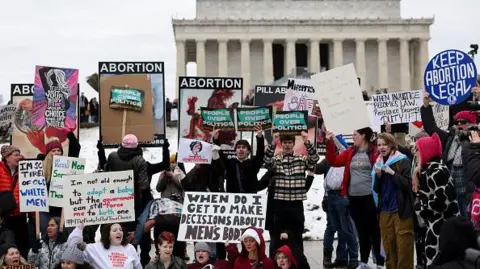
Thousands of mostly female demonstrators took to the streets of Washington DC on Saturday to rally against President-elect Donald Trump two days ahead of his inauguration.

The People’s March – previously known as the Women’s March – has taken place every year since 2017.

A coalition of groups organised the movement with the stated aim of confronting “Trumpism”, according to its website. Smaller protests against Trump were held in New York City and on the other side of the country in Seattle.

The rallies coincide with Trump’s arrival to the nation’s capital for a series of weekend events in the lead-up to his swearing-in ceremony on Monday.

Watch: Thousands gather in Washington to protest Trump inauguration

Saturday’s People’s March in Washington DC drew smaller numbers than its predecessors.

Organisers had expected 50,000 people. About 5,000 turned up.

The protesters gathered at three parks before marching to the Lincoln Memorial for the rally.

Getty Images A crowd holds signs outside the Lincoln memorial Getty Images

The groups behind the march are described on its website as holding “intersecting identities” and having “varied issue-based interests” with different causes such as climate change, immigration and women’s rights.

Organisers said they aimed to confront Trump by “drawing on past successes and effective strategies against autocrats”.

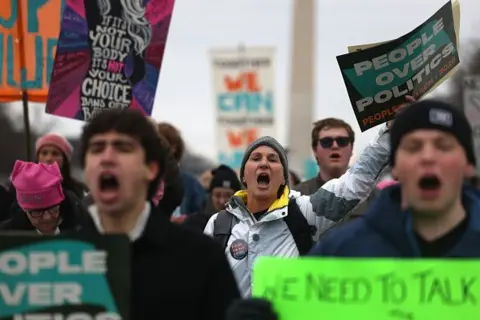
A small group of Trump supporters were at the Washington Monument on Saturday. Noticing the men in red Make America Great Again hats, one People’s March leader with a megaphone approached chanting: “No Trump, no KKK.”

One of the men, Timothy Wallis, told the Associated Press news agency his friends had just bought the Trump hats from a street vendor.

Mr Wallis, 58, of Pocatello, Idaho, said the People’s March protesters had “every right” to demonstrate, though he said he was confused by the rancour.

“It’s sad where we’re at as a country,” he said.

Getty Images Protesters yell during the People's MarchGetty Images

The first iteration of the People’s March came together after Trump defeated Democratic presidential nominee Hillary Clinton in 2016.

Women called for a protest the day after Trump’s first inauguration and hundreds of thousands responded.

The movement spread beyond the nation’s capital with millions of women across the US carrying signs railing against the Republican president and sporting pink knit “pussy hats” – a reference to a leaked tape in which Trump had bragged about grabbing women’s genitals.

The Women’s March remained a key part of the so-called resistance to Trump’s agenda in the years that followed.

But none of the subsequent marches have been on the same scale.

Trump, meanwhile, arrived in Washington DC later on Saturday to begin his inaugural festivities with a private event featuring fireworks at his golf club in the Virginia suburbs.

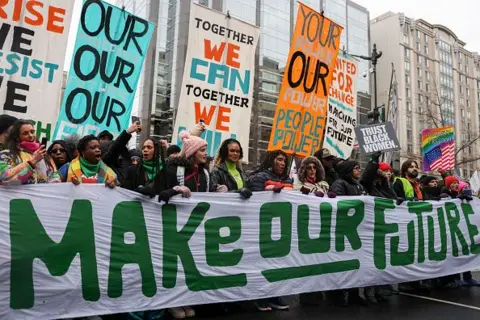
Getty Images Protesters hold a banner that reads "Make our Future"Getty Images

Women who gathered in Washington to join the People’s March told the BBC they had a variety of motivations.

One protester, Brooke, said she wanted to show her support for abortion access.

“I’m really not happy with the way our country’s voted,” she said. “I’m really sad that our country’s leaned towards a president that’s already failed us once and that we did not nominate a female candidate.”

Another woman, Kayla, said it’s a mix of emotions that brought her out to the streets of the nation’s capital.

“Honestly, I’m just mad, I’m sad, I’m overwhelmed,” she said.

Getty Images Protesters walk along the National Mall near the Washington MonumentGetty Images

Susie came in from the San Francisco area to demonstrate with her sister, Anne, who lives nearby. They both attended the Women’s March after Trump’s first inauguration and came back in their “pussy hats”.

Susie recalled the crowds of people in 2017. She said she hoped people would still take to the streets against Trump’s policies.

“This time the stakes are higher,” she said. “Trump has been emboldened. He’s got the billionaire class and the tech class bowing down.”

Anne also said she recognised the protesters are “out of touch” with a lot of America. Trump won all seven swing states and the popular vote last November.

But she added: “We’re still here, and we will resist.”

Holly Honderich and Alex Lederman contributed to this reporting


What Trump Could Do on Ukraine, Iran, China and Crises Around the Globe

0
What Trump Could Do on Ukraine, Iran, China and Crises Around the Globe


Putting aside that argument, there are certainly some diplomatic opportunities Mr. Trump can seize, though history and ominous recent warnings suggest that he may soften up his adversaries and his allies with threats of military action if he doesn’t get what he wants. (See: Iran, Greenland, Panama.)

Here is a scorecard to keep handy in the first few months.

There is very little evidence that Mr. Putin is eager for a deal that would extract him from a war that has already cost Russia nearly 200,000 dead and more than half a million wounded. But the assumption is that he must be looking for an off-ramp. Since his televised debate with Vice President Kamala Harris, Mr. Trump has been promising just that — a deal “in 24 hours,” or even one completed before he takes the oath of office.

Now, unsurprisingly, it looks a little more complicated. His special envoy for Ukraine, Keith Kellogg, an 80-year-old retired general who served on Mr. Trump’s first National Security Council, told Fox recently “let’s set it at 100 days” to make sure a “solution is solid, it’s sustainable, and that this war ends so that we stop the carnage.” Mr. Trump has said he will meet Mr. Putin “soon,” a notable timing, particularly because Mr. Biden has not talked to the Russian leader in nearly three years.

What might a deal look like? First, most Biden and Trump officials acknowledge, at least in private, that Russia would most likely keep its forces in the roughly 20 percent of Ukraine it now occupies — as part of an armistice similar to the one that halted, but did not end, the Korean War in 1953. The harder part of any agreement is the security accord. Who would guarantee that Mr. Putin wouldn’t use the halt in the fighting to rearm, recruit and train new forces, learn from the mistakes of the past three years, and re-invade?

Jake Sullivan, Mr. Biden’s national security adviser, argues that the Biden team spent the past year “putting the architecture in place” to provide for that security. But Volodymyr Zelensky, Ukraine’s president, is suspicious that it’s all talk. Remembering that no one paid much attention to the 1994 security agreement that Ukraine signed with the U.S., Britain and Russia, among others, he says only NATO membership will keep Mr. Putin from attacking again.


Bolsonaro Hid at Hungary’s Embassy. Not For Asylum, He Says, Maybe Love.

0
Bolsonaro Hid at Hungary’s Embassy. Not For Asylum, He Says, Maybe Love.


When we first watched the surveillance footage, we were stunned.

There was the Hungarian ambassador to Brazil pacing nervously in the embassy. There was Jair Bolsonaro, the former Brazilian president — fresh off court orders not to leave the country because of an intensifying criminal investigation — arriving at the gate. There were the embassy staff members hustling to the guest quarters with linens and a coffee maker.

And then, for two days, there was Mr. Bolsonaro wandering the parking lot, looking bored, and there were his security guards fetching pizza.

Given the circumstances — a politician facing potential imprisonment sleeping at a foreign embassy controlled by a political ally — it had all the hallmarks of a man seeking political asylum. Foreign embassies can be considered sovereign territory and have historically been used as refuge for people fleeing custody.

Colleagues and I published an article saying so, complete with clips from the footage.

In response, Mr. Bolsonaro’s lawyers issued a statement saying he had merely gone to the embassy to talk politics. Any suggestion otherwise, they said, was “fake news.”

Alexandre de Moraes, the Brazilian Supreme Court justice leading sprawling criminal investigations into the former president, later decided that Mr. Bolsonaro had not broken the law by sleeping at the embassy.

So when I sat down with Mr. Bolsonaro for an interview this week, I was eager to finally ask him why — in the middle of Brazil’s carnival, four days after the police confiscated his passport — he had decided to sleep in the small guest room of the Hungarian Embassy.

Here is an excerpt from our exchange, translated from Portuguese and edited for clarity.

Why did you sleep at the Hungarian Embassy for two nights?

Look, it was a question of time zones with whom I was talking. And that’s final.

But you slept there for two nights?

Yes.

Is that normal?

That’s up for me to decide.

You don’t have a bed in Brasília? (Brasília is Brazil’s capital.)

I do. I could’ve been fighting with my wife. I’m not saying. Just like when I talk to the authorities, I don’t say I did. Nothing leaks from me. Zero.

Have you slept at another embassy?

Who knows? I’m friends with Israel. I get along with countries in the Arab world. I’m not going to say what I do because that gives them a narrative to chase. I’m a free citizen.

The team of Alexandre de Moraes wanted to arrest me because I went without a passport. You don’t need a passport to enter an embassy.

You are a private citizen. You’re also a former president who talks about the importance of the truth. So it’s natural to want to understand why you slept at a foreign embassy four days after the authorities searched your home.

They could have arrested me during the search if they wanted. Anything I do is an attempt to hide to them. Was it refuge? Asylum? With asylum, you deal directly with the president.

Was it a bid for asylum? It seems strange to sleep in an embassy.

Isn’t it strange that I’m being persecuted? Everything I might say, the other side could go after me. I met with [President Viktor Orban of Hungary] in Argentina at [President Javier] Milei’s inauguration. I get along well with him.

It wasn’t a crime what I did. If there had been any crime, they would have arrested me.

[The embassy’s surveillance footage also showed a person visit Mr. Bolsonaro for 38 minutes. A Brazilian news outlet later reported it was his son, Carlos. Carlos was in the room with us.]

Carlos, you visited your father, right? What happened?

Carlos Bolsonaro: I just talked to my father about …

[Lawyer in the room interrupts to request to talk off the record.]

Jair Bolsonaro: Do you think I would have trouble leaving Brazil right now? No passport? Don’t a ton of illegal immigrants go to the United States? I’m an army captain. I’m used to the hardships out there.

OK. So why were you at the embassy?

Who knows? Maybe I have a lover there.

I’m not trying to be difficult, but I care about the truth, and you say you do, too. So I just want to understand.

It’s a secret. Maybe one day you’ll find out.


Israel and Palestinians Prepare for Long-Sought Truce in Gaza

0
Israel and Palestinians Prepare for Long-Sought Truce in Gaza


The mediating country Qatar on Saturday announced a time for the cease-fire agreement between Israel and Hamas to take effect the next day, setting off final preparations for a truce that much of the world hopes will end 15 months of destruction in Gaza.

The deal should go into effect at 8:30 a.m. local time on Sunday, said Majed al-Ansari, a spokesman for the Foreign Ministry of Qatar, which spent months alongside the United States and Egypt struggling to broker an agreement.

Israel’s government approved the deal early Saturday morning after hours of deliberations and amid internal rifts in the governing coalition of Prime Minister Benjamin Netanyahu. The approval cleared a final obstacle, raising hopes for Israelis who want to see loved ones returned and Gazans who have survived one of the most intense bombing campaigns of the 21st century.

“It’s a mix of joy, sadness and longing for a new beginning,” said Mariam Moeen Awwad, 23, who has been displaced from her home in northern Gaza six times since the war began.

Ms. Awad had planned to move into her newly furnished apartment with her husband in November 2023. The war derailed those plans, leaving the couple in an overcrowded property and eager to return home, she said, “if it’s even still there.”

In Israel, the authorities have started preparations to welcome home dozens of hostages, without knowing whether they will return malnourished, traumatized or dead.

In his first remarks since the cease-fire’s approval, Prime Minister Benjamin Netanyahu said in an address on Saturday night that 33 hostages would be released in the first phase of the deal, “most of them alive.”

Defending the deal, he argued also listed that Israel had made major strategic gains over the past several months, including the killing of top Hamas leaders. “As I pledged to you — we have changed the face of the Middle East,” he said.

Three reception points have been established to receive the hostages along the Gaza border, according to an Israeli military official. Those will be staffed by Israeli soldiers, as well as doctors and psychologists, said the official, who spoke on condition of anonymity in accordance with protocol.

The hostage release is expected to be the first such major exchange since a weeklong cease-fire early in the war.

“The ones who were freed back then were already poorly nourished,” Hagar Mizrahi, a senior Israeli health ministry official, said of the hostages freed during the 2023 truce. “Imagine their situation now, after an additional 400 days. We are extremely worried about this.”

Of the women, older men and other hostages set to be returned, many are believed to have been held in Hamas’s network of tunnels in Gaza, under conditions likely to leave physical and psychological scars. Israeli hospitals are preparing isolated areas where the hostages can begin recuperating in privacy.

“Last time, we saw the Red Cross transferring the hostages, and some of them were running to the relatives, hugging them,” said Einat Yehene, a clinical psychologist working with the Hostage Families Forum, an advocacy group. “It’s not going to be easy and similar this time, given the physical and the emotional conditions we expect.”

In exchange, hundreds of Palestinian prisoners are to be freed. The total number of prisoners to be released and their identities were among the many contentious points involved in the negotiations for a deal.

The new deal also calls for allowing 600 trucks carrying aid to enter Gaza daily and negotiations on the withdrawal of Israeli forces from the territory and a permanent end to the war.

Those negotiations are likely to be bitter and difficult, like the months of talks that yielded this week’s cease-fire agreement. Mr. Netanyahu is already facing an internal revolt within his governing coalition, which his far-right partners have threatened to quit over their opposition to the deal.

They have called for the war to continue to eradicate Hamas, which led the October 2023 attack on Israel that killed about 1,200 people, took another 250 hostage and started the war.

Mr. Netanyahu also faces pressure from the many Israelis who want all the hostages returned, and from the outgoing U.S. president, Joseph R. Biden Jr., and the president-elect, Donald J. Trump, who both want the war ended.

In his address, Mr. Netanyahu said the agreement preserves Israel’s right to return to the war against Hamas if it so chooses. The agreement also allows Israeli forces to remain in a buffer zone along Israel’s border with Gaza and Gaza’s border with Egypt, he added, at least during the initial phase.

“If we need to go back to fighting, we will do it in new ways and with great might,” he said.

Another uncertainty in how the deal might unfold arises from the chaotic, ruined conditions within Gaza, where tens of thousands of people have been killed since the war began and hundreds of thousands of others live without homes, clean water or ready supplies of food or medicine.

Israel’s campaign has left a power vacuum across much of Gaza, and lawlessness has proved a dangerous factor in efforts to get aid to people in need. Organized looting has repeatedly stripped trucks of supplies, including from a convoy of 100 trucks holding U.N. aid late last year.

Israel has continued striking Gaza since the cease-fire was announced, and over the past 24 hours, 23 Palestinians were killed and 83 others wounded, Gaza’s health ministry said on Saturday morning. More than 46,000 people have been killed in Gaza since the war began, according to the ministry, which does not distinguish between combatants and civilians.

Desperately needed aid is expected to pour into Gaza once the cease-fire begins. Egypt, which shares a border with the enclave, was intensifying preparations on Friday to deliver assistance including food and tents, according to Al Qahera News, an Egyptian state broadcaster.