Thursday, October 1, 2026
Home Blog Page 6931

Trump admin to launch immigration raids on day one amid deportation push | Migration News

0
Trump admin to launch immigration raids on day one amid deportation push | Migration News


Several large cities are reportedly expected to be hit by Trump’s immigration authorities shortly after inauguration.

Donald Trump’s top border official has said the new Republican administration will launch large operations to detain and deport undocumented immigrants beginning on the day of the United States President-elect’s inauguration on Tuesday.

The incoming administration’s so-called “border czar”, Tom Homan, told Fox News on Saturday that he would not categorise the expected actions as “raids”.

“There are going to be targeted enforcement operations,” he said, adding that Chicago would be among cities that will see raids shortly after Trump takes office for a second four-year term.

Homan also suggested the Trump administration would target city jails in so-called sanctuary cities that house a large number of migrants. He said the government wants to “arrest a bad guy in the safety and security of a county jail”.

Homan, a former acting director of US Immigration and Customs Enforcement (ICE), said the agency was planning operations carefully and would know which homes to hit.

Amid reports by US media that Chicago could be hit as early as Tuesday by hundreds of border agents and that New York and Miami could also be targets, he did not comment on the exact timing of the operation or elaborate further.

Trump immigration
People take part in a rally against Trump’s policy of immigration in New York City, January 18, 2025 [Eduardo Munoz/Reuters]

Homan’s latest comments come a day after he said, “We’re gonna take the handcuffs off ICE and let them go arrest criminal aliens.” He had also said there would be a “big raid across the country”.

Just like during his first presidential campaign, Trump has pledged to crack down on undocumented immigrants in his second run. But there have been disagreements on some aspects among Republicans, including surrounding the issue of the H-1B visas.

Trump has pledged he would launch “the largest domestic deportation operation in American history” to quickly remove people without saying exactly how many will be affected.

The president-elect has said he would reinstate a programme to make tens of thousands of migrants seeking asylum to await their hearings in Mexico, reinstate a controversial travel ban on Muslim-majority countries from his first term, and end birthright citizenship for US-born children of some noncitizens.

Trump’s officials have been considering how to withhold funds from sanctuary cities that refuse to participate in deportations, even for local authorities who have maintained that they do not have the resources to implement his plan, or are concerned about adverse effects on their communities.

Immigrant rights groups have been bracing for the crackdowns promised by the incoming administration, with some US media reporting “self-deportations” by people who have chosen not to wait for Trump to forcibly remove them.

Meanwhile, thousands of people gathered in Washington, DC on Saturday to protest Trump’s inauguration, as activists for women’s rights, racial justice and other causes rallied against incoming policies they say will threaten their constitutional rights during the Republican’s second term.

Some in the crowd wore the pink hats that marked the much larger protest against Trump’s first inauguration in 2017. They wound through downtown amid a light rain, past the White House and towards the Lincoln Memorial along the National Mall for the “People’s March.”

Protests against Trump’s inauguration are smaller this time, in part because the US women’s rights movement seems more fractured, according to many activists, after Trump defeated Democratic Vice President Kamala Harris in November.


Benjamin Netanyahu issues warning ahead of Gaza ceasefire

0
Benjamin Netanyahu issues warning ahead of Gaza ceasefire


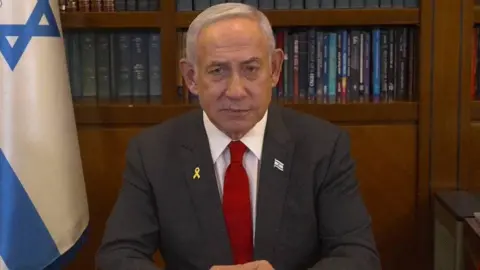
Israeli PM's office Netanyahu looks at the screen as he addresses the Israeli nation.Israeli PM’s office

Benjamin Netanyahu says Israel reserves the right to resume fighting Hamas “if needed”

Israeli Prime Minister Benjamin Netanyahu says his country is ready to resume the war against Hamas should talks for a second phase of the ceasefire fail.

In a televised speech just hours before it was due to start on Sunday, Netanyahu stressed that the ceasefire was “temporary” and Israel reserved the right to resume strikes in Gaza – and had the backing of US President-elect Donald Trump to do so.

Netanyahu also outlined what he called the success of Israel’s military campaign over the last 15 months – including the killing of Hamas leader Yahya Sinwar.

“We changed the face of the Middle East,” Netanyahu said, before adding that Hamas was now “completely alone”.

The ceasefire is due to come into force at 08:30 local time (06:30 GMT).

Prior to Saturday’s speech, Netanyahu said Israel would not implement the deal until it received the list of hostages to be released by Hamas.

“Israel will not tolerate violations of the agreement,” he said.

A longer list of the 33 hostages due to be freed by Hamas has already been published by Israeli media but not confirmed by officials.

But Israeli authorities say they have yet to receive the names of the three hostages due to be released on Sunday.

Meanwhile Israel has continued air strikes on what they say are Hamas and Islamic Jihad sites in Gaza – more than 120 people have been killed since the deal was announced on Wednesday, Hamas officials say.

Over the next few weeks, the 33 hostages are set to be released in exchange for 1,890 Palestinian prisoners. Under terms of the agreement, Israel will also begin pulling back its forces from Gaza.

The location at which the first hostages will be handed over is unclear. A senior Israeli military official said three reception points had been prepared near the border in northern, central, and southern Gaza.

Previously, a source close to Hamas told the AFP news agency that the first three hostages to be released would be women.

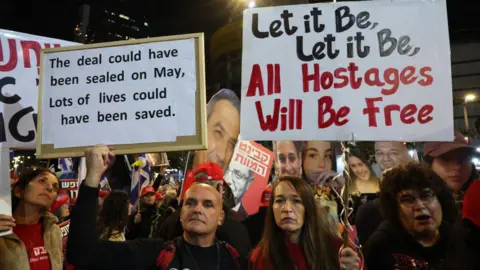
Getty Images Pro-hostage deal demonstrators hold signs in a demonstration saying 'the deal could have been sealed on May, lots of lives could have been saved' and 'let it be, let it be, all hostages will be free'.Getty Images

Thirty-three of the 94 hostages still in Gaza are expected to be freed during the first stage of the ceasefire

Talks about the terms of the second phase of the ceasefire are set to start on Day 16 of the first phase and will focus on achieving “a permanent end to the war”.

Details of the second phase of the deal are still uncertain but the expectation is that remaining hostages, including men, would be freed at this stage as more Palestinian prisoners detained in Israeli prisons are released.

There would also be a full withdrawal of Israeli troops from Gaza. It is also understood that Hamas police – who will be unarmed unless absolutely necessary – will manage the return of hundreds of thousands of displaced Palestinians to northern Gaza

The third and final stage will involve the reconstruction of Gaza – something which could take many years – and the return of any remaining hostages’ bodies.

On Friday night, Israel’s government approved the ceasefire and hostage release deal after hours of discussions.

Two far-right cabinet ministers voted against it, including national security minister Itamar Ben-Gvir.

The drawn-out structure of the agreement is also causing anxiety and division among the families of the hostages. Some fear relatives will be abandoned in Gaza after the first phase is done.

On Saturday evening, thousands of protesters gathered in Tel Aviv to demand the government ensures the release of further hostages by abiding by the first phase of the ceasefire.

Gal Alkalay, a member of the Hostages and Missing Families Forum, told Reuters news agency: “We could have saved the lives of 200 soldiers and more than 10 hostages.” She added that people had died unnecessarily because the government “couldn’t take a decision and waited for Trump”.

Reuters An Israeli police officer walks at the scene of a suspected attack in Tel Aviv,Reuters

Police said the stabbing victim was taken to hospital with serious wounds

Earlier on Saturday, several people were wounded in a stabbing attack near a restaurant In Tel Aviv, Israeli police said. The attacker was reportedly shot and killed at the scene by a civilian.

The suspect came to Tel Aviv “illegally” from Tulkarm in the occupied West Bank, Israeli media said.

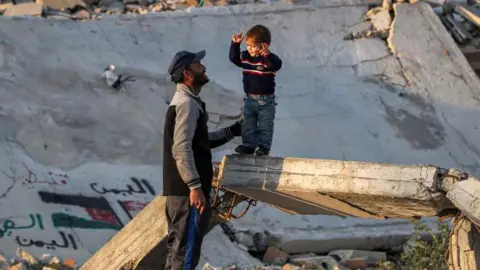
Getty Images A man speaks with a boy standing on a broken concrete beam by the rubble of a collapsed building at a camp for people displaced by conflict in Bureij in the central Gaza.Getty Images

Palestinians in Gaza still face bombardment ahead of the ceasefire

There has been no respite for Palestinians on the ground in Gaza since the ceasefire deal was announced on Wednesday night.

The Palestinian health ministry said 123 people – including dozens of women and children – have been killed in strikes since then.

On Saturday, Gaza’s Hamas-run civil defence rescue agency said at least five members of one family were killed when a strike hit their tent in Khan Yunis, in southern Gaza, AFP reports.

Since Thursday afternoon, the Israeli military said it had struck 100 Hamas and Islamic Jihad fighters who were among several “terror targets” hit across Gaza, according to the Reuters news agency.

The Israeli military launched a campaign to destroy Hamas – which is proscribed as a terrorist organisation by Israel, the US and others – in response to an unprecedented cross-border attack on 7 October 2023, in which about 1,200 people were killed and 251 taken hostage.

Around 46,899 people have been killed in Gaza since then, according to the territory’s Hamas-run health ministry. Most of the 2.3 million population has also been displaced, there is widespread destruction, and there are severe shortages of food, fuel, medicine and shelter due to a struggle to get aid to those in need.


How Many Hostages Remain in Gaza, and When Could They Be Released?

0
How Many Hostages Remain in Gaza, and When Could They Be Released?


When Hamas led the Oct. 7, 2023, raids into Israel, killing about 1,200 people, about 250 people were taken into Gaza as hostages, including citizens of Israel, the United States, Britain, Mexico, Thailand and other countries.

Among the captives were the bodies of 37 people killed in the attack, Israeli officials said. Now, about 100 hostages, living and dead, are still being held in the enclave, officials say.

The cease-fire deal announced on Wednesday between Israel and Hamas would begin with an initial phase lasting six weeks, and involve the release of 33 hostages and hundreds of Palestinian prisoners. The agreement requires Hamas to release three female hostages on Day 1, four more on Day 7 and 26 more over the next five weeks, according to a copy of the document obtained by The New York Times. The deal still has to be formally ratified by Israel’s cabinet.

Here’s a closer look at the hostage situation in Gaza.

Early in the war, Hamas released four hostages — two Israeli-American women, Judith Raanan, then 59, and her daughter, Natalie Raanan, then 17, and two Israeli women, Nurit Cooper, then 79, and Yocheved Lifshitz, then 85, citing humanitarian reasons. More than 100 hostages were freed in November 2023 during a staggered truce between Israel and Hamas. In exchange, about 240 Palestinians held in Israel were released.

Eight hostages have been freed in Israeli military operations, including one in the first month of the war, when the military rescued one soldier, Pvt. Ori Megidish, then 19, who had been abducted from her base.

In February 2024, a military operation in the southern Gazan city of Rafah freed two hostages: Fernando Simon Marman, then 60, and Louis Har, then 70.

In June, the Israeli military freed four people kidnapped from the Nova music festival on Oct. 7, 2023: Noa Argamani, then 26; Almog Meir Jan, then 22; Andrey Kozlov, then 27; and Shlomi Ziv, then 41. Ms. Argamani’s case received outsize attention after viral footage showed her being taken into Gaza on the back of a motorcycle as she cried out in desperation.

About 100 Palestinians were killed during the operation, according to the Israeli authorities, but officials in Gaza put the death toll at more than 270, including 64 children. (Neither toll distinguished between civilians and combatants.)

In August, the Israeli military rescued Farhan al-Qadi, then 52, a member of Israel’s Bedouin Arab minority, in an operation that killed at least 20 Gazans, local authorities said.

Of the 250 hostages, about three dozen were presumed dead early in the war, according to the Israeli authorities.

Some of their bodies have since been found in Gaza and repatriated, while other captives initially believed to be alive were subsequently declared killed.

The discoveries have raised questions about the extent to which intense Israeli military operations targeting Hamas have also endangered the captives.

The Israeli military has killed several hostages in error. In December 2023, the military said its soldiers had mistakenly shot and killed three hostages who fled their captors in Gaza: Yotam Haim, 28, and Alon Shamriz, 26, who were taken from Kibbutz Kfar Aza; and Samer Talalka, 24, who was kidnapped from Kibbutz Nir Am while at work.

Last July, Israel’s military retrieved the bodies of five hostages — two soldiers and three civilians, ages 20 to 56. They were found in a tunnel shaft in southern Gaza.

Israeli officials said the captives were killed during the October 2023 attack and their bodies taken as bargaining chips. The next month, Israeli forces said they had recovered the bodies of six hostages in a Gaza tunnel.

In September, the Israeli military recovered the bodies of another six hostages, ages 23 to 40, who it said had been killed in captivity. Among them was Hersh Goldberg-Polin, an Israeli-American whose parents spoke at the Democratic National Convention in August.

In March, the family of Itay Chen — a 19-year-old American born in Israel who was serving in the Israeli military — said it had learned he was killed on Oct. 7, 2023.

In December, the family of Omer Neutra, 21, an Israeli-American serving in the Israeli military, said it had learned he, too, was killed that October. His parents spoke at the Republican National Convention in July.

This month, the Israeli military said Youssef and Hamza Ziyadne were dead. Youssef Ziyadne, 53, was taken hostage from a kibbutz with three of his children, including his 23-year-old son Hamza and two teenagers, Bilal and Aisha, who were freed during the truce in November 2023. The family is part of Israel’s Bedouin Arab minority.

Secretary of State Antony J. Blinken, in a speech on Tuesday, said seven Americans were still being held captive.

Edan Alexander and Sagui Dekel-Chen were believed to be alive as of December, according to the American Jewish Committee.

A few of the remaining five were declared dead early in the war. Their bodies remain in Gaza.


When the U.S. Hit Canada With Steep Tariffs Before, Canada Had a Plan B

0
When the U.S. Hit Canada With Steep Tariffs Before, Canada Had a Plan B


After Donald J. Trump’s presidential inauguration on Monday, Canadians will learn whether he intends to follow through on his threat to immediately impose 25 percent tariffs on exports from Canada to the United States.

Many people here have told me they are looking forward to the details of the federal government’s response to any American trade action. Matina Stevis-Gridneff, our Canada bureau chief, reports that it will be much like Canada’s response to the tariffs on aluminum and steel that Mr. Trump introduced during his first administration. Any coming retaliatory tariffs, she writes, will “focus on goods made in Republican or swing states, where the pain of tariffs, like pressure on jobs and the bottom lines of local businesses, would affect Trump allies.”

[Read: Canada’s Plan for a Trade War: Pain for Red States and Trump Allies]

But given the size of Canada’s economy, the country cannot inflict the same amount of harm that the United States can. That raises the question of whether retaliation, no matter how politically targeted, will be effective.

There is, of course, no way to answer that question. But an earlier trade war between Canada and the United States might offer some indications of what’s to come.

Back in 1930, as today, the North American neighbors were each other’s largest trading partner. But the mix of goods was quite different: For one thing, Canada was importing most of its oil from the United States, while today oil and gas are Canada’s largest exports.

A movement by American farmers to close off competition from imports, including those from Canada, to bolster prices ballooned into a sweeping piece of legislation known as the Smoot-Hawley Tariff Act. It raised already high U.S. tariffs, eventually bringing the average import duty to a staggering 59.1 percent.

Then as now, the tariffs were denounced by many economists. Over 1,000 of them unsuccessfully petitioned President Herbert Hoover to veto the bill.

Historians and economists still debate the effect of Smoot-Hawley on the Great Depression. But a 1997 paper by three economists at Lehigh University in Pennsylvania documents how it harmed Canada’s economy and profoundly influenced its politics.

Most of the seven largest exports from Canada to the United States at the time, the paper says, had large declines. Exports of milk and cheese plunged by 65 percent, and cattle sales to the United States fell by 84 percent.

Before Smoot-Hawley, William Lyon Mackenzie King, the Liberal prime minister, had been planning to reduce tariffs on Canadian imports of U.S. goods. In the hope of avoiding a trade war, Mackenzie King matched the new U.S. tariffs on only 16 products, which accounted for 30 percent of imports from the United States.

Like Prime Minister Justin Trudeau today, Mackenzie King led a minority government. He passed bills with the support of the Progressives, a party supported largely by farmers.

During the 1930 election campaign, R.B. Bennett, the Conservative leader, relentlessly attacked Mackenzie King for not retaliating more forcefully against the United States.

Bennett’s speeches about the merits of high tariffs were remarkably similar to Mr. Trump’s social media posts on the topic today.

“How many tens of thousands of American workmen are living on Canadian money today?” he said while campaigning in Quebec. “They’ve got the jobs, and we’ve got the soup kitchens.”

He promised the crowd that he would use tariffs to “blast a way into markets that have been closed.”

A vote analysis in the Lehigh paper concludes that tariff issues were a key factor in Bennett’s victory in the 1930 election, which brought the Conservatives their only majority government between 1911 and 1958.

While Bennett did increase tariffs, they failed to blast a way into any market, according to Robert Bothwell, an emeritus professor of Canadian history at the University of Toronto.

But, Professor Bothwell told me, Bennett found another solution, which involved expanding on one of Mackenzie King’s actions: When he imposed the tariffs on U.S. goods, Mackenzie King also cut them on 270 products from Britain and other countries within its empire.

Bennett hosted a conference in Ottawa that led to a series of agreements between Britain and its former colonies that greatly opened up trade between them by reducing and in some cases eliminating tariffs.

That arrangement, Professor Bothwell said, could neither offset the economic collapse of the Depression nor fully replace the American market for Canadian exports, but it did greatly mitigate the harm caused by Smoot-Hawley.

“We had an out of sorts, and it really did work in the ’30s,” he said. “Every time the Americans jacked up their tariffs, we would tend to trade more with the British.”

When Franklin D. Roosevelt succeeded Hoover as U.S. president in 1933, Professor Bothwell said, his administration soon noticed the loss of exports to Canada, driven by the combination of American tariffs and the Imperial arrangement with Britain, and moved to compromise on trade.

Today there is talk that Canada will again try to build up exports with nations other than the United States. But Professor Bothwell said that changes in trade, manufacturing and transportation have made a repeat unlikely.

“We don’t have an obvious alternative,” he said. “I don’t see us having a way to absorb the same amount of exports as we did in the ’30s.”


Ian Austen reports on Canada for The Times based in Ottawa. He covers politics, culture and the people of Canada and has reported on the country for two decades. He can be reached at austen@nytimes.com. More about Ian Austen


How are we doing?
We’re eager to have your thoughts about this newsletter and events in Canada in general. Please send them to nytcanada@nytimes.com.

Like this email?
Forward it to your friends, and let them know they can sign up here.


What We Know About the Hostage Release

0
What We Know About the Hostage Release


The cease-fire agreement reached between Israel and Hamas this week sets in motion the release of dozens of hostages that Hamas and its allies have been holding in Gaza since the start of the war more than a year ago.

About 100 hostages, living and dead, are thought to be held captive in Gaza, most of whom were seized when Hamas stormed into Israel on Oct. 7, 2023, killing about 1,200 people and capturing about 250. According to the deal, 33 of those remaining hostages will be released during an initial six-week phase of the cease-fire, the first major release since a weeklong truce seven weeks into the war. In exchange, Israel will release more than 1,000 imprisoned Palestinians.

The first hostage-for-prisoner swap will begin no earlier than 4 p.m. on Sunday, according to the deal. Here is what else we know about how the plan foresees their release.

The 33 hostages who will be released in the first phase include female captives who are alive and dead, civilian teenage boys and children, men 50 and older, female soldiers and sick and wounded civilians.

Israeli authorities believe that around 35 of the remaining captives in Gaza are dead. According to the agreement, human remains will be released after hostages who are alive have been freed.

In a televised address on Saturday evening, Benjamin Netanyahu, the Israeli prime minister, said “most” of the 33 hostages who will be freed under the agreement are alive.

The releases will be staggered, according to the plan. On the first day, Hamas will release three female hostages who are alive in exchange for Palestinian prisoners. On the seventh day, four female hostages who are alive will be exchanged for Palestinian prisoners.

From the 14th day through the fifth week of the agreement, Palestinian prisoners will be released every seven days in exchange for three male and female hostages.

The remaining hostages agreed to in the first phase will be released in exchange for Palestinian prisoners during the sixth week.

Also during the sixth week, once all 33 hostages have been freed and returned to Israel, Israel will release 47 prisoners who were rearrested after being released in a 2011 deal that saw over 1,000 Palestinians freed in exchange for a captive Israeli soldier, Gilad Shalit.

Israeli authorities have established three reception points to receive the hostages along the Gaza border, according to an Israeli military official who spoke on condition of anonymity in accordance with protocol. Those reception points will be staffed by Israeli soldiers, doctors and psychologists, said the official.

Dozens of Palestinians held in Israel will be released for each hostage in the initial six week phase, including some serving life sentences.

The deal outlines the criteria of the hostage-for-prisoner swap. According to the agreement, the release of a hostage or Israeli civilian who is 18 or younger and is alive requires the release of 30 Palestinian prisoners who are women or children.

An Israeli civilian man who is 50 or older and is alive can be freed in exchange for 30 Palestinian prisoners. An Israeli female soldier who is alive requires the release of 50 Palestinian prisoners. A total of 110 Palestinian prisoners will be released in exchange for nine Israeli male civilians who are wounded or sick.

Early in the war, Hamas released four hostages — two Israeli-American women, Judith Raanan, then 59, and her daughter, Natalie Raanan, then 17, and two Israeli women, Nurit Cooper, then 79, and Yocheved Lifshitz, then 85, citing humanitarian reasons. More than 100 hostages were freed in November 2023 during a staggered truce between Israel and Hamas. In exchange, about 240 Palestinians held in Israel were released.

In addition to those who have already been released, eight hostages have been freed in Israeli military operations since the start of the war.

In a speech on Tuesday, Secretary of State Antony J. Blinken said seven Americans were still being held captive. Edan Alexander and Sagui Dekel-Chen were believed to be alive as of December, according to the American Jewish Council.

A few of the remaining five were declared dead early in the war. Their bodies remain in Gaza.

Ephrat Livni and Aaron Boxerman contributed reporting.


Liverpool leave it late as Nunez brace downs Brentford | Football News

0
Liverpool leave it late as Nunez brace downs Brentford | Football News


Liverpool striker Darwin Nunez scores twice in injury time at Brentford as Reds’ extend lead at top to seven points.

Darwin Nunez scored twice in stoppage time as Liverpool beat Brentford 2-0 to strengthen its spot in first place in the Premier League on Saturday.

Second-placed Arsenal will look to restore the four-point gap to Liverpool by defeating Aston Villa later.

Nunez was derided by Brentford’s fans after going on as a substitute in the 65th minute, but the Uruguay striker responded by turning home a cross from Trent Alexander-Arnold in the first minute of added-on time.

Nunez then finished off a counterattack two minutes later and secured a first victory in three league games for Liverpool, which drew with Manchester United and Nottingham Forest either side of a loss to Tottenham in the first leg of the English League Cup semifinals.

Liverpool has still lost only one league game all season, at home to Forest in September. The Reds had 37 shots against Brentford and scored with their final two.

BRENTFORD, ENGLAND - JANUARY 18: Darwin Nunez of Liverpool scores his team's first goal past Mark Flekken of Brentford during the Premier League match between Brentford FC and Liverpool FC at Gtech Community Stadium on January 18, 2025 in Brentford, England. (Photo by Ryan Pierse/Getty Images)
Darwin Nunez of Liverpool scores his team’s first goal past Mark Flekken of Brentford [Ryan Pierse/Getty Images]

Justin Kluivert scored his second hat-trick of the season in the league to inspire Bournemouth to 4-1 at Newcastle, whose nine-match winning run in all competitions came to an end emphatically.

The Dutch midfielder netted in the sixth, 44th and second-half stoppage time at St James’ Park. Milos Kerkez added the fourth goal in the sixth minute of added-on time. Bruno Guimaraes equalised for fourth-placed Newcastle.

Kluivert, whose father is former Netherlands striker Patrick Kluivert, also scored three goals against Wolverhampton in November. In that match, all of Kluivert’s goals were penalties, but he scored from open play each time against Newcastle.

Six of Newcastle’s nine straight victories came in the league, helping to lift the Saudi-controlled team into the top four in its bid to return to the Champions League.

Newcastle striker Alexander Isak failed to score, having previously netted in eight league games in a row. That left him three games short of Leicester striker Jamie Vardy’s record for the longest scoring run in Premier League history.

NEWCASTLE UPON TYNE, ENGLAND - JANUARY 18: Justin Kluivert of AFC Bournemouth holds the match ball as he acknowledges the fans at the end of the Premier League match between Newcastle United FC and AFC Bournemouth at St James' Park on January 18, 2025 in Newcastle upon Tyne, England. (Photo by George Wood/Getty Images)
Justin Kluivert of AFC Bournemouth holds the match ball as he acknowledges the fans at the end [George Wood/Getty Images]

Bournemouth dominated Newcastle despite being hampered by a long list of injuries. The south coast team extended its unbeaten run to 11 games and climbed to sixth place, tied for points with fifth-placed Chelsea. A fifth-place finish could earn a place in the Champions League next season for the first time. “Why not dream big?” Kluivert posed. “We never know where we can end up.”

Next-to-last Leicester lost a seventh straight game in the league, 2-0 to Fulham, to pile the pressure on recently hired manager Ruud van Nistelrooy.

Van Nistelrooy has won only one of his nine league games in charge — the first against West Ham on December 3. Emile Smith Rowe and Adama Traore scored for Fulham.

Crystal Palace won at West Ham 2-0 thanks to two second-half goals by Jean-Philippe Mateta, the second from the penalty spot.


Ski lift collapse injures at least 30 people in the Pyrenees

0
Ski lift collapse injures at least 30 people in the Pyrenees


At least 30 people are reported to have been injured after a ski lift collapsed in northern Spain.

The Astún resort in the Spanish Pyrenees, where the incident happened, was closed as rescue services attended the scene.

Images and video circulating on social media showed a number of people lying on the snow beneath the ski lift.

Spain’s Prime Minister Pedro Sánchez said he was “shocked” by the news of the incident.

Seventeen people needed medical attention, according to local media reports.

Ambulances and helicopters took some of the injured to nearby hospitals.

Dozens of people left hanging on the 15m (50ft) high chairlift have since been rescued, according to a regional official cited in local media.

A witness told the state broadcaster TVE that it looked like a cable had come off, the chairs had bounced and people were thrown from the lift.

An eyewitness who was on the lift told the BBC he saw a cable “lose tension” before the chairs on his side of the structure fell.

“It was very scary, but very fast,” Jamie Pelegri said – adding that ambulances and helicopters arrived at the scene within about 15 minutes.

Previously in a post on social media he had said it was the resort’s Canal Roya chairlift that had collapsed.

“Luckily we are fine but there are injured people, we have seen several stretchers coming down,” the Spotify commercial director said on X.

“We are talking about around 30 to 35 people injured, including serious, very serious and less serious injuries,” Miguel Ángel Clavero, the director of emergencies for the Aragon region, where the incident occurred, told TVE, according to AFP.

“Apparently, there was a failure in the return pulley of one of the chairlifts and this caused the cable to lose tension, causing some chairs to fall and others to remain hanging,” he said.

Images on social media purport to show one of the chairlift’s flywheels off its upright.

The cause of the incident is not yet known.

Regional president Jorge Azcón and Spain’s Minister of the Interior Roberto Bermúdez de Castro went to the ski resort to understand the extent of the accident.

Azcón wrote on X: “All the necessary services of the [government] are working to assist the affected and injured people.”

The Spanish prime minister, Pedro Sánchez, said he had spoken with Azcón “to offer him the “full support” of the government.

A telephone line has been set up for the families of those affected.

The Astún resort, which is popular with Spanish skiers, is located in the Aragon region of the Pyrenees mountains, near the border with France.


Some Prominent Palestinian Prisoners Set to Be Released in the Israel-Hamas Cease-Fire Agreement

0
Some Prominent Palestinian Prisoners Set to Be Released in the Israel-Hamas Cease-Fire Agreement


Israel is due to release more than 1,000 Palestinian prisoners over the course of the 42-day initial cease-fire, according to the terms of the agreement, beginning with at least 90 on Sunday in exchange for three Israeli hostages held by Hamas in Gaza.

Israelis say that many of the prisoners are terrorists and murderers. Many Palestinians see the imprisoned militants as freedom fighters against Israeli rule, and they argue that others were jailed by an unfair Israeli military justice system.

Here are several of the most prominent Palestinian prisoners set to be released under the cease-fire, according to the Israeli Justice Ministry.

Over the past two decades, Zakaria Zubeidi, 49, has been a militant, a theater director, and an escaped prisoner whose flight stunned Israelis and Palestinians alike.

Mr. Zubeidi rose to prominence as a militant leader during the Second Intifada, or uprising, in the early 2000s, during which Palestinian militants committed deadly attacks against Israelis, including suicide bombings targeting civilian thoroughfares.

Israel responded by reoccupying major Palestinian cities amid street battles. Some of the toughest fighting took place in the Palestinian city of Jenin, Mr. Zubeidi’s hometown. He later emerged as a top commander in the Al-Aqsa Martyrs’ Brigades, an armed militia loosely linked with the secular Fatah party, the dominant Palestinian political faction in the West Bank.

After the uprising, Mr. Zubeidi worked at a theater inside the hardscrabble Jenin refugee camp. In 2019, Israel arrested him again on charges that he had returned to militancy.

Two years later, Mr. Zubeidi and five other Palestinian prisoners conducted a jailbreak by crawling nearly 32 yards through an underground tunnel outside one of Israel’s maximum-security prisons. Although they were later recaptured, the security breach shook Israelis and thrilled Palestinians.

An Israeli drone strike killed Mr. Zubeidi’s son, Mohammad, in September. The Israeli military called the son a “significant terrorist” and said he had been involved in shooting at Israeli troops.

Wissam Abbasi, 48, Mohammad Odeh, 52, and Wael Qassim, 54, were jailed in 2002 on accusations of carrying out Hamas attacks against Israelis during the Second Intifada. According to Israel’s justice ministry, the three men were given life sentences for murder and a string of other crimes.

According to contemporary Israeli media reports, the men were among several convicted of being involved in a Hamas cell in Jerusalem that was responsible for a string of bombings that killed over 30 Israelis in crowded civilian areas.

The attacks included a Hamas bombing at the Hebrew University of Jerusalem that killed nine people, including four U.S. citizens, according to the Israeli authorities.

Mr. Odeh, who was working as a painter at the university, planted the bomb in a cafeteria and covered it with a newspaper, The New York Times reported at the time, citing Israeli officials. When he left, he remotely detonated the explosive with a cellphone, the officials said.

Under the terms of the cease-fire deal, the men will not be allowed to return to their homes in Jerusalem, according to the Israeli justice ministry. They will be required to live in exile, although it is unclear where they will be allowed to go.


How Antony Blinken, America’s Top Diplomat, Became the Secretary of War

0
How Antony Blinken, America’s Top Diplomat, Became the Secretary of War


Making his final trip as America’s top diplomat last week, Secretary of State Antony J. Blinken arrived in Paris, his former hometown, to a hero’s welcome.

France’s president, Emmanuel Macron, proclaimed Mr. Blinken “an eminent servant of peace” at a ceremony at the Élysée Palace before awarding him the country’s highest tribute, the Legion of Honor medal. With its red silk ribbon pinned to his jacket, Mr. Blinken called the medal “the honor of a lifetime.”

It was a very different scene back in Washington a few days later, when Mr. Blinken gave a final speech before a crowd of foreign policy experts.

“Secretary Blinken! Your legacy will be genocide! You will forever be known as ‘Bloody Blinken, Secretary of Genocide,’” shouted a protester who had infiltrated the Atlantic Council event. Security officers led her out of the room, as well as a man waving a sign that read “Blinken: War Criminal.”

A similar drama punctured Mr. Blinken’s farewell news conference at the State Department two days later, as a journalist, shouting that Mr. Blinken belonged in The Hague, was carried from the room by security officers.

The contrasting scenes reveal the duality of Mr. Blinken’s tenure as secretary of state. Over four years and more than one million flight miles logged, Mr. Blinken was the face of America’s deep involvement in two wars, one in Ukraine and the other in Israel and Gaza. The first, the defense of Ukraine against Russia, was a popular cause marked by Ukrainian flags flying from American porches, and it allowed Mr. Blinken to bask in accolades as he invoked the highest principles of international law and human rights.

But the war between Israel and Hamas in Gaza ignited by Palestinian terrorist attacks became a political and moral nightmare for the Biden administration as Israeli strikes with American-supplied weapons killed an estimated 46,000 Palestinians, many of them women and children.

While President Biden set the policy, Mr. Blinken, his decades-long aide and surrogate son, presented it to the public. The diplomat was accused of gutting the very principles he had championed in Ukraine, and became the target of vitriol rarely directed at a U.S. secretary of state.

So entwined is Mr. Blinken’s work and his reputation with conflict that he could just as easily be called by a retired cabinet title that is still on office plaques in the old State Department building — secretary of war.

Mr. Blinken reflected on the question during an interview this week in his wood-paneled office, which he had decorated with contemporary art pieces from the likes of Jasper Johns and Willem de Kooning. Mr. Blinken said, “If we want to use the term ‘war’ expansively, I think the State Department has been” — he paused — “yes, it has taken up a lot of our time and effort, and yes, as part of that, you learn a lot about weapons systems.”

War presented the Biden administration with the opportunity to forge closer international partnerships, and it is there that the president and his aides have excelled, Mr. Blinken said. “The United States is able to engage a more contested, a more complicated, a more combustible world from a position of strength,” he said. “That’s what I believe our legacy is.”

Over a long career as a Washington foreign policy hand, including as deputy secretary of state, Mr. Blinken was no stranger to war, having grappled with the American quagmires in Iraq and Afghanistan. And his childhood was shaped by the memory of World War II, specifically by stories of how his stepfather, Samuel Pisar, survived the Holocaust.

At the ceremony in Paris, Mr. Blinken cited a lesson he learned from his stepfather: “We have to remain eternally vigilant, because humanity’s striving for the best can sometimes be overcome by its capacity for the worst.”

But the world served up an especially ugly parade of horrors as Mr. Blinken took charge of the State Department: strife and atrocities in Yemen, Syria, Haiti, Ethiopia, Armenia, Myanmar, the Democratic Republic of Congo and Sudan, where the secretary declared this month that combatants were carrying out a genocide.

Bearing a flawlessly polite and self-effacing demeanor, Mr. Blinken spent countless hours trying to resolve and prevent conflict. But for better or worse, his legacy rests not on forging grand peace treaties — those traditional diplomatic prizes eluded him — but on his role in two wars that often cast him in very different lights.

Mr. Blinken’s first test, the American withdrawal from Afghanistan, was widely seen as a fiasco.

The Taliban’s swift takeover of Kabul caught the State Department by surprise, forcing a chaotic evacuation of American citizens and Afghan allies. Some Republican lawmakers demanded that Mr. Blinken resign.

His moment came when President Vladimir V. Putin of Russia ordered a full-scale invasion of Ukraine in February 2022.

Visiting Berlin a month before the assault, Mr. Blinken delivered a speech invoking the way Presidents John F. Kennedy and Ronald Reagan had stood up to Soviet power and declared that the United States would again defend “the governing principles of international peace and security.” A day later in Geneva, he faced down his grim Russian counterpart, Sergey Lavrov, warning that a Russian attack would draw “a swift, severe and a united response.”

It was the kind of commanding, high-stakes diplomacy you might see in the Netflix series “The Diplomat.” Mr. Blinken deployed his flawless French in Paris and Brussels, and cajoled leaders in Seoul and Tokyo. The result: a coalition of about 50 nations committed to supplying weapons to Ukraine or imposing economic sanctions on Russia.

As the war progressed, neither side sought negotiations, so Mr. Blinken was less a peacemaker than a war strategist. Immersed in details of military hardware and battlefield conditions, he often argued against more risk-averse Pentagon officials in favor of sending powerful American weapons to Ukraine.

And when the chairman of the Joint Chiefs of Staff, Mark A. Milley, suggested in late 2022 that Ukraine should capitalize on battlefield gains by seeking peace talks with Moscow, Mr. Blinken insisted the fight should go on.

Visiting Kyiv in May, Mr. Blinken, a guitar player, took the stage at a packed music club and led a local band in a rendition of Neil Young’s “Rockin’ in the Free World.” The defense of Ukraine had offered him a literal rock star moment.

Five days after the terrorist attacks carried out by Hamas in October 2023, Mr. Blinken stood next to Prime Minister Benjamin Netanyahu of Israel at a military base in Tel Aviv and told the world how the killings had seared him personally.

“I come before you not only as the U.S. secretary of state, but also as a Jew,” he said. “I understand on a personal level the harrowing echoes that Hamas’s massacres carry for Israeli Jews and for Jews everywhere.”

That moment, too, had a noble glow. Mr. Blinken was rushing to the rescue of an American friend who had been horribly violated in the attacks. Hamas and its partners took hostages and killed more than 1,200 Israelis — the largest single-day massacre of Jews since the Holocaust.

But this time the narrative would grow far more complicated. In private meetings on that same trip, Mr. Blinken and his aides heard about war plans for Gaza that foretold more mass killing — including ominous reminders from Israeli officials that America had once been willing to annihilate Hiroshima and Nagasaki.

Mr. Blinken would make a dozen wartime trips to the Middle East. They were grim affairs, in contrast to the European tours where he was hailed as a savior of Ukraine. Israeli officials complained about pressure from Washington on one day while Arab monarchs fumed on the next that Israel was out of control.

Again he immersed himself in military matters. Meeting with Israel’s war cabinet, he would study maps of Gaza and discuss details of its strategy. On one visit, they scrambled into a bunker when Tel Aviv came under rocket attack.

He beseeched the Israelis to let in more humanitarian aid and limit civilian casualties as they pummeled Gaza, turning hospitals, schools and mosques to dust. Some State Department officials argued in vain that Israel was intentionally withholding food and medicine from desperate Palestinians. For months, Mr. Blinken has said the department was “assessing” reports of Israeli war crimes.

Over time, Mr. Blinken’s visits with Mr. Netanyahu seemed to become less and less effective. Sometimes the Israeli leader would publicly undermine his American guest’s positions hours after hosting him.

Critics of the war said that only withholding military aid would change the Israeli approach. That never happened.

In keeping with Mr. Biden’s “bear hug” approach, Mr. Blinken and the State Department kept sending Israel weapons, including 2,000-pound bombs that U.S. military officials call unsuited for urban combat.

Over the 15 months of war, Mr. Biden has approved $26 billion in aid to Israel. Mr. Blinken has never expressed regrets about not using that leverage. Signs of “daylight” between the United States and Israel only encouraged Hamas, he says.

State Department officials sent Mr. Blinken dissent cables opposing the policy. A handful resigned and became public dissidents.

“We don’t have a policy,” said Michael Casey, a diplomat and Iraq war veteran who resigned last year from his State Department post in Jerusalem, where he worked on Gaza. “We support the Israeli government’s goals over our own interests.”

He said that “of everyone in the cast of characters at the top, Antony Blinken has been the most disappointing.” Despite showing flashes of empathy with Palestinians, he said, Mr. Blinken never veered from the approach to Israel.

Protesters camped outside his Virginia home and splashed fake blood on his black Suburban. The descendant of a Holocaust survivor was accused of enabling “genocide.”

Such invective “comes with the job,” Mr. Blinken said while warning that a trend of hounding public officials in private spaces like their homes could deter people from entering government.

For a time it seemed that he might have nothing to show for his many months pressing to achieve a Gaza cease-fire deal. Then came this week’s agreement between Israel and Hamas.

Even if it took pressure from President-elect Donald J. Trump, the deal, if it holds, could be a welcome part of Mr. Blinken’s legacy. But the clock has run out on his greater ambition of brokering a historic agreement to normalize diplomatic relations between Israel and Saudi Arabia that would, in theory, have included a first-ever explicit pathway to a Palestinian state.

Such a pact might have won him some forgiveness from furious Western liberals and Muslims worldwide.

He admits that public opinion toward the United States has grown “very challenging” in places where America is seen as hypocritical for denouncing Russia’s war while defending Israel’s.

He must also accept a frustrating uncertainty. Ukraine’s fate is now in peril under Mr. Trump. And as for Gaza, some doubt that a cease-fire can endure.

That is the nature of war, Mr. Blinken says: “Most of these challenges don’t have neat Hollywood endings.”

He leaves perhaps haunted by his gazing into the same abyss of humanity that his stepfather survived decades ago. “What really drives me more than anything else is the demonization we see in all directions,” he said. “The inability to acknowledge suffering on each side, the inability to see the humanity in the other.”


Israel’s Cease-Fire With Hamas Set to Begin Sunday: Live Updates

0
Israel’s Cease-Fire With Hamas Set to Begin Sunday: Live Updates


Israel is due to release more than 1,000 Palestinian prisoners over the course of the 42-day initial cease-fire, according to the terms of the agreement, beginning with at least 90 on Sunday in exchange for three Israeli hostages held by Hamas in Gaza.

Israelis say that many of the prisoners are terrorists and murderers. Many Palestinians see the imprisoned militants as freedom fighters against Israeli rule, and they argue that others were jailed by an unfair Israeli military justice system.

Here are several of the most prominent Palestinian prisoners set to be released under the cease-fire, according to the Israeli Justice Ministry.

Zakaria Zubeidi

Over the past two decades, Zakaria Zubeidi, 49, has been a militant, a theater director, and an escaped prisoner whose flight stunned Israelis and Palestinians alike.

Mr. Zubeidi rose to prominence as a militant leader during the Second Intifada, or uprising, in the early 2000s, during which Palestinian militants committed deadly attacks against Israelis, including suicide bombings targeting civilian thoroughfares.

Israel responded by reoccupying major Palestinian cities amid street battles. Some of the toughest fighting took place in the Palestinian city of Jenin, Mr. Zubeidi’s hometown. He later emerged as a top commander in the Al-Aqsa Martyrs’ Brigades, an armed militia loosely linked with the secular Fatah party, the dominant Palestinian political faction in the West Bank.

After the uprising, Mr. Zubeidi worked at a theater inside the hardscrabble Jenin refugee camp. In 2019, Israel arrested him again on charges that he had returned to militancy.

Two years later, Mr. Zubeidi and five other Palestinian prisoners conducted a jailbreak by crawling nearly 32 yards through an underground tunnel outside one of Israel’s maximum-security prisons. Although they were later recaptured, the security breach shook Israelis and thrilled Palestinians.

An Israeli drone strike killed Mr. Zubeidi’s son, Mohammad, in September. The Israeli military called the son a “significant terrorist” and said he had been involved in shooting at Israeli troops.

Wissam Abbasi, Mohammad Odeh and Wael Qassim

Wissam Abbasi, 48, Mohammad Odeh, 52, and Wael Qassim, 54, were jailed in 2002 on accusations of carrying out Hamas attacks against Israelis during the Second Intifada. According to Israel’s justice ministry, the three men were given life sentences for murder and a string of other crimes.

According to contemporary Israeli media reports, the men were among several convicted of being involved in a Hamas cell in Jerusalem that was responsible for a string of bombings that killed over 30 Israelis in crowded civilian areas.

The attacks included a Hamas bombing at the Hebrew University of Jerusalem that killed nine people, including four U.S. citizens, according to the Israeli authorities.

Mr. Odeh, who was working as a painter at the university, planted the bomb in a cafeteria and covered it with a newspaper, The New York Times reported at the time, citing Israeli officials. When he left, he remotely detonated the explosive with a cellphone, the officials said.

Under the terms of the cease-fire deal, the men will not be allowed to return to their homes in Jerusalem, according to the Israeli justice ministry. They will be required to live in exile, although it is unclear where they will be allowed to go.

Khalida Jarrar, center, in the occupied West Bank city of Ramallah in February 2019 after being released from an Israeli jail.Credit…Abbas Momani/Agence France-Presse — Getty Images

Khalida Jarrar

One of the most prominent Palestinian prisoners expected to be released as early as Sunday is Khalida Jarrar, 62, a leader in the left-wing Popular Front for the Liberation of Palestine.

Ms. Jarrar, a prominent activist for the rights of Palestinians jailed by Israel, was elected to the Palestinian Parliament in the 2006 elections.

The United States and the European Union consider the Popular Front a terrorist organization. The group became notorious in the late 1960s for a series of plane hijackings, as well as other attacks, including during the Second Intifada.

Ghassan Jarrar, her husband, said in a telephone interview that the Israeli authorities had not allowed him to visit his wife since her arrest in December 2023. He has grasped for any news of her condition he could get from rare visits by her lawyer, he said.

Ms. Jarrar has spent much of the past decade in and out of Israeli prison, although she has not been convicted of direct involvement in the Popular Front’s military activities. In 2015, she was sentenced to 15 months for incitement and belonging to a banned organization.

In recent years, Israel has mostly held Ms. Jarrar without formal charges. Rights groups call the practice a severe violation of due process, while Israel says it is necessary at times to protect sensitive intelligence.

In 2021, her daughter Suha died while Ms. Jarrar was being held in an Israeli prison. Israel denied a request to grant her a humanitarian furlough to attend the funeral.