

Thursday, October 1, 2026
Home Blog Page 6932

Donald Trump’s inauguration moved indoors due to ‘dangerous’ cold

0
Donald Trump’s inauguration moved indoors due to ‘dangerous’ cold


Getty Images Donald TrumpGetty Images

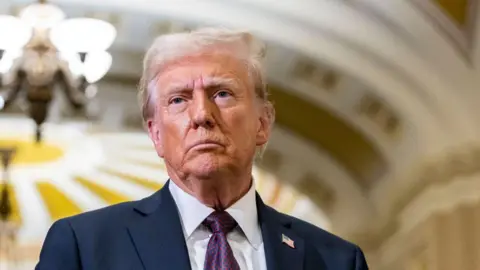
President-elect Donald Trump’s inaugural address on 20 January will take place indoors due to dangerously cold weather being forecast next week in Washington, he has confirmed.

The address, as well as other speeches, will now take place inside the US Capitol’s rotunda, rather than outside the building.

The inaugural parade will also be held indoors at Washington’s Capital One Arena in downtown Washington about one mile (1.6km) away, along with all three inaugural balls.

The last president to be sworn-in indoors was Ronald Reagan in 1985, when cold weather also plagued the US Capitol.

Watch: A look back at Reagan’s 1985 inauguration, which was also held inside the Capitol rotunda

In a statement posted to his Truth Social social media platform, Trump said that he does not “want to see people hurt, or injured, in any way” amid the freezing temperatures.

“It is dangerous conditions for the tens of thousands of law enforcement, first responders, police K9s and even horses” as well as “hundreds of thousands” of supporters.

“In any event, if you decide to come, dress warmly,” he added.

The Capital One Arena will also be open for a live viewing of the inaugural address.

BBC Weather: Inauguration Day may be one of the coldest in US history

Trump – who has a rally planned there on Sunday – said he would visit the arena after being sworn-in at the Capitol.

A planned parade will now take place in a modified form. It is unclear whether it will now take place inside.

Extreme cold has been forecast in Washington DC on inauguration day, with temperatures expected to hit a low of -11C (12F) and a high of -5C (23F). With wind chill factored in, the temperature will feel significantly colder.

The weather forms part of a larger polar vortex that will send temperatures plummeting across the US.

“Everyone will be safe, everyone will be happy, and we will, together, Make America Great Again,” Trump wrote.

Watch moment Kamala Harris signs desk in vice president office

Ahead of the inauguration, organisers had said that about 220,000 tickets would be distributed to watch the event’s on the grounds of the US Capitol.

Those without tickets would also have been able to view the ceremonies on the National Mall.

Alternate plans will now be required for those visitors, as well as the tens of thousands of others expected in the city.

“I think people should be able to make their own decisions,” one man planning to attend the inauguration told the BBC. “They should dress warmly to come out because it’s a historical event and it should be outside.”

Another supporter said of Trump: “I would stand in the [cold] weather in order to support what he’s going to do, what he did in the past, and what he’s going to do in the future.”

Trump said that other inaugural events, including his rally on Sunday and three separate official inaugural balls on Monday evening, would take place as planned.

The move indoors means a much more limited capacity at Monday’s swearing-in for Trump, who is known to closely track attendance figures at his public events.

After his first inauguration, he claimed a “million and half people” had attended on the National Mall.

But crowd-size experts said the numbers were about a third of the estimated 800,000 to one million people who attended Barack Obama’s one in 2009.

Only about 1,000 people attended Joe Biden’s inauguration on the Capitol grounds because of Covid-19 restrictions.

In 1841, then-President William Henry Harrison, 68, gave the longest inauguration speech in US history in cold, wet conditions.

He caught a cold and subsequently pneumonia, and died exactly one month later, making his presidency the shortest in US history.
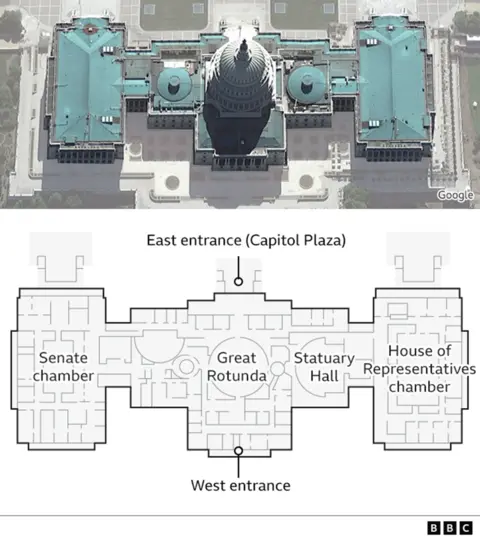
Floor plan of the Capitol


U.S. Spy Chief Took on Role of Negotiator in Gaza War

0
U.S. Spy Chief Took on Role of Negotiator in Gaza War


For his first three years as the head of the C.I.A., William J. Burns was relentlessly focused on tripling the agency’s resources devoted to understanding China, and on countering Russia and its mysterious partnerships with Iran and North Korea.

But in the last 16 months of his tenure, the diplomat-turned-spy was plunged back into his old life.

Over four decades at the State Department, Mr. Burns came to be regarded as the master of creating “the back channel” — the title of his memoir — the invisible, essential outreach to allies and enemies alike.

As the Israel-Hamas war threatened to pull the Middle East into a larger conflagration, President Biden asked Mr. Burns to swim in that back channel once again, blending his intelligence role with his experience as a Middle East negotiator to help find a way to a cease-fire and the release of hostages held in Gaza.

Soon he was, by his own account, “on the phone every day” with David Barnea, the head of Israel’s foreign spy agency, and Prime Minister Mohammed bin Abdulrahman Al Thani of Qatar, the link to Hamas, searching for an opening, for some leverage to bring about a truce and maybe a new Middle East.

The distinction between a diplomatic negotiator and an intelligence operative is vague in the region, and Mr. Burns’s arrivals and departures could be stealthy. “It makes it easier to come and go,” he said in his office on the 7th floor of the C.I.A., with its memorabilia of the agency’s operations and successes, and a framed map of the Russian plan to move in on Ukraine.

Mr. Burns is a singular figure in Washington. He has worked for Republicans and Democrats; in the early 2000s, he was George W. Bush’s ambassador in Moscow, where he got to know Vladimir V. Putin, making him the only member of the Biden inner circle who knows the Russian leader well.

Current and former officials said that had Kamala Harris been elected president last November, Mr. Burns was her selection for secretary of state, something he declined, with some diplomatic aversion, to confirm or deny. It would have been a return to the institution that defined his career — and where he met his wife, Lisa Carty, who is now at the U.S. mission to the United Nations. (They sat next to each other in the Foreign Service training institute. Students were seated alphabetically.)

When he arrived at the C.I.A., several veterans there concede that they were suspicious: Why was a career diplomat leading a spy agency?

By the time he packed up on Friday, the deal between Israel and Hamas barely holding together, and new conflicts on the horizon, several said he had won over the agency.

As Mr. Burns and his deputy, David Cohen, left the building for the last time, thousands of C.I.A. employees lined the corridors for a “clap out,” a sign of the respect they had achieved.

Mr. Burns’s career has included many tense negotiations, from Israeli-Palestinian conflicts to the Iran nuclear agreement, which he and Jake Sullivan, Mr. Biden’s national security adviser, launched secretly in 2013.

But nothing, he says, matched the urgency of the effort to halt the Israel-Hamas conflict before it spread through the region.

“This probably has been the most complicated negotiations I have been involved in, in the sense it was indirect talks twice removed,” Mr. Burns said.

Mr. Burns and Mr. Barnea negotiated with the Qataris and the Egyptians, who spoke to the Hamas leadership based in Doha. Those Hamas leaders negotiated with the Hamas leaders in Gaza, who were hiding underground and held the remaining 95 or so hostages, some alive and some dead.

“Lots of negotiations are passionate, but here you had this human predicament of hostages and their families, innocent civilians in Gaza suffering terrible conditions for the last 15 months,” Mr. Burns said on Wednesday. “This wasn’t just about texts. It was about real human beings whose lives were in danger.”

Mr. Burns made 19 trips to the region after Hamas attacked Israel on Oct. 7, 2023, to work on the issue of the Gaza war and the hostages. Until this week, the talks loomed as the major unfulfilled mission, or even failure, of his time leading the spy agency.

But under pressure from President-elect Donald J. Trump, the opportunity negotiators were looking for appeared. With a last-minute push by Mr. Burns and the rest of Mr. Biden’s team, negotiators announced on Wednesday that they had reached a deal.

Mr. Biden put Mr. Burns in charge of the hostage negotiations after Prime Minister Benjamin Netanyahu put Mr. Barnea, Israel’s spy chief, in charge of Israel’s negotiations.

Over the course of negotiations, both Hamas and Israel prevented an agreement at various points.

In the end it was an approach Mr. Burns and the American team developed that carried the day: a multiphase plan to release some hostages in return for prisoners and aid. Some Israeli troops will be pulled back. The thorny issues of governance of Gaza were left for later negotiations.

Mr. Burns and Mr. Biden had pushed this formulation for months. But what changed, Mr. Burns said, is that Hamas’s military commanders were feeling “beleaguered,” and their forces had been degraded. On the other side, the blows Israel landed against Iran and Hezbollah had created political space for an agreement.

“The Israeli political leadership is beginning to see that perfect is not on the menu here, but they have achieved a lot of what they wanted to achieve,” he said.

The question now for the Israelis, Mr. Burns said, is how to turn their tactical victories against Iran and Hezbollah into a strategic win. And Mr. Burns and his colleagues argue that a cease-fire and hostage release is a vital part of that transformation.

Talking to his fellow intelligence chiefs helped in pressing that case. “I think with intelligence work in general, you’re able to be a little bit more discreet than if you’re a diplomat,” Mr. Burns said.

There was a degree of wariness among the C.I.A.’s rank and file about Mr. Burns when he arrived at the sprawling Langley campus in early 2021.

Not every senior C.I.A. officer stationed abroad gets along with the ambassador overseeing an embassy — and thus American operations. But in his time in Amman, Jordan, and in Moscow, where the C.I.A. station chiefs interact with the ambassador almost daily, his management style won over analysts, case officers and even the military veterans in the paramilitary arm of the agency.

Rob Richer, the agency’s chief of station in Amman when Mr. Burns was the ambassador, recalled that Mr. Burns “never, ever says something was his idea.”

“He is like a vacuum cleaner in terms of what he sucks in,” he said. “And then he bounces ideas off of the people around him.”

Current C.I.A. officials, speaking on the condition of anonymity because they work undercover, said Mr. Burns earned loyalty when he made two key decisions.

The first was during the fall of Kabul in 2021, when Mr. Burns vowed that the 9,000 commandoes who had worked with the agency would be evacuated, along with 25,000 family members.

The second was when he persuaded Mr. Biden to allow a handful of C.I.A. officers to remain in Ukraine after the president had ordered all American government personnel to leave the country. Their presence, Mr. Burns said, was key to the partnership and the C.I.A.’s success.

By the end of his first year, it was the war in Ukraine that tested Mr. Burns, just as he was beginning to restore morale at an agency after near-constant turmoil during Mr. Trump’s first term.

It played to his strength: All those years in Moscow, as Mr. Putin consolidated power (and interacted with the American ambassador) made him the government’s chief expert on the Russian leader.

Starting with a “mother lode” of new intelligence that arrived in the early fall of 2021, Mr. Burns became convinced that his old nemesis intended to try to take Kyiv, a step toward restoring Peter the Great’s empire. .

Over objections inside the intelligence community, Mr. Burns — along with Mr. Sullivan and Avril D. Haines, the director of national intelligence — authorized declassification of the material, in hopes of convincing allies who thought Mr. Putin was bluffing.

The depth of the data demonstrated that the C.I.A. had penetrated deeply into Russia’s military, obtaining its plans and later even considerations about deploying nuclear weapons. Satellite photos, accounts from sources who were clearly close to the Kremlin and communications laid out what the Russians were planning.

“What we collected at this agency, but also elsewhere in the intelligence community, was exquisite, that was quite detailed in terms of not just the military buildup in the late fall of ’21, but also the planning for the day after,” Mr. Burns said. Still, he acknowledged, most NATO allies were skeptical. “It was pretty lonely in the late fall of ’21 because we and the Brits were the only two services who were convinced” of the Russian leaders’ intentions.

Mr. Biden sent Mr. Burns — rather than the secretary of state or the national security adviser — to Moscow on a mission to warn Mr. Putin and try to head off war. But he found a Russian leader who had stewed in his grievances over the years and was only more intent on his goal.

Mr. Burns made his case about the damage Mr. Putin would do to his own country if he invaded Ukraine. “I found Putin utterly unapologetic about what we laid out in front of him,” he said.

The warning did nothing to stop the invasion. But Mr. Burns’s early warnings made it easier to rally the allies, and Congress.

Still, Republicans have said that even if that call was accurate, the C.I.A. failed in understanding other key events: how quickly the Afghan government could collapse, how Bashar al-Assad would flee Syria and how Hamas was preparing to attack Israel.

One of Mr. Burns’s first acts was to create a mission center dedicated to China. It would be a place where analysis of China’s economic future, its technical prowess, its intentions toward Taiwan and the C.I.A.’ s operations would come together. But he also poured more money and people — and Mandarin speakers — at the problem; today China-related work accounts for about 20 percent of the agency’s classified budget, officials say.

Mr. Burns attended a weekly meeting with top officials from the China center. The meeting, said one C.I.A. officer who has worked on the China issue for 30 years, was “a great concrete manifestation of his personal commitment when everything else was going on.”

John Ratcliffe, Mr. Trump’s choice to lead the C.I.A., has promised an agency that takes more risk and more aggressive covert action. But he has praised Mr. Burns’s focus on China and pledged to build on his efforts.

Mr. Burns said the agency has made progress recruiting spies. That would mark a significant comeback, 15 years after many of the C.I.A.’s operatives in China were caught, and some executed.

“China is the biggest long-term geopolitical challenge our country faces,” Mr. Burns said. “And it’s the biggest intelligence priority. It is a concerted effort on the part of the agency that is aimed at collecting intelligence. And it is beginning to pay dividends.”

Keeping focus on priorities like China while giving “the overflowing inbox” of immediate crises the attention they need has been the trick of the past four years, he said.

“It is often the hardest thing in government,” Mr. Burns said. “But I think we have managed the balance pretty well.”


What Border Crisis? Mexican Migrant Shelters Are Quiet Ahead of Trump

0
What Border Crisis? Mexican Migrant Shelters Are Quiet Ahead of Trump


Migrants used to gather by the hundreds in encampments in Ciudad Juárez, on the Mexican side of the Rio Grande, waiting for a chance to cross into the United States. But as President-elect Donald J. Trump prepares to take office on Monday, few people could be found this past week on the once-teeming embankments.

All that remained were extinguished campfires, discarded shoes, shirts and toothbrushes.

One Mexican city after another has reported a similar situation along the border with the United States, where the number of migrants has steadily dropped in recent months. The decline has been attributed largely to hardened restrictions introduced by the Biden administration and by Mexican and Panamanian officials meant to deter migration.

As President Biden came under increasing pressure during his re-election campaign to curb migration flows, he issued in June an executive order effectively blocking undocumented migrants from receiving asylum. That month, U.S. border officials recorded 83,532 illegal crossings, a significant drop from the previous month’s 117,905.

Despite the decline, illegal crossings remain higher than during much of Mr. Trump’s first term, fueling calls by the new Trump administration, and even by some Democrats in Congress, for more severe restrictions on migration to the United States.

Gov. Kristi Noem of South Dakota, Mr. Trump’s pick to run the Homeland Security Department, told senators on Friday that she planned to reinstate a Trump-era policy forcing asylum seekers to stay in Mexico for the duration of their U.S. cases and reduce temporary immigration relief for people from countries experiencing unrest.

“Border security must remain a top priority,” Ms. Noem said.

Some officials in Latin America are pushing back, arguing that the tougher restrictions on both sides of the border have worked to stem the crisis.

“The flow of migration from the south of Mexico toward the border has diminished in the last few months,” said Enrique Serrano Escobar, who leads the Chihuahua State office responsible for receiving migrants. “There is no crisis,” he said of Ciudad Juárez. “There is no problem.”

The quieter border these days contrasts with the recent years of frequent tragedies along the frontier, including family separations and the 2023 fire at a migrant detention facility in Ciudad Juárez that killed dozens.

Thousands of migrants are still trying to make their way north even as the authorities on both sides of the border harden restrictions. But overall, movement through the Darién Gap, the inhospitable land bridge connecting North and South America, and shelter capacity in U.S.-Mexico border cities like Ciudad Juárez and Matamoros have become indicators of how migration flows are easing.

“Normally, we would have around 150,” said Lucio Torres, who has been overseeing a shelter in Nuevo Laredo, across the Rio Grande, for three years. The shelter has capacity for 300 people. This week, the facility housed only seven.

Mr. Serrano Escobar said that migrant shelters run by government and civic organizations in Ciudad Juárez, with capacity for about 3,000 migrants, are currently only about 40 percent full. “The city is calm,” he added.

In November, more than 46,000 people crossed the border illegally, the lowest number during the Biden administration. December saw more than 47,000 illegal crossings. By comparison, in December 2023, illegal crossings surpassed a record of roughly 250,000.

Mexican security forces said that they detained more than 475,000 migrants in the last quarter of 2024. That is nearly 68 percent more detentions compared with the same period a year earlier, according to government data.

Solsiree Petit, 44, a Venezuelan teacher in Ciudad Juárez, said she had tumors in her breasts that require surgery. She said her sons, 10 and 17, had turned themselves in to the U.S. authorities seeking asylum about a week ago. She said she had an appointment with U.S. Customs and Border Protection in El Paso to submit her own asylum application on Jan. 29.

She said she hoped that her appointment would still be honored under the Trump administration. “I prefer not to think otherwise about that,” she said, “because it depresses you more.”

CBP One, the phone app that Ms. Petit used to schedule her appointment, allowed U.S. immigration authorities to process nearly 44,000 migrants in December at ports of entry.

While the Biden administration created the app to incentivize migrants to avoid crossing into the country illegally, Ms. Noem, the Homeland Security nominee, said she would wind down use of the app, reflecting concerns among Republicans that it was used to allow migrants into the country who should be barred from entry.

Similar to the tense calm seen in Ciudad Juárez, the Pumarejo shelter in Matamoros, which can accommodate 1,500 people, currently has only 260, according to shelter officials. In Tijuana, three notable shelters indicated that they were only 50 percent full.

Shelters in Guatemala City have also all but emptied of migrants heading north, said Karina López, a social worker at the city’s Casa del Migrante shelter. Several years ago, the shelter struggled to care for more than 3,000 weary migrants with just over 100 beds. Those numbers are unheard-of today, Ms. López said. That is partly because people are staying only a few hours in their rush to get to the border before the inauguration, she said.

Fear of violent crime and extortion is also thought to be keeping some migrants away from shelters targeted by organized crime in Mexico. Instead of seeking refuge there, some are choosing to stay with acquaintances, in rented rooms or with their smugglers as they try to make their way to the border, legally or illegally.

“I don’t care if the devil himself is in my way, I’m going forward,” said Juan Hernández, a handyman from Honduras. Mr. Hernández, 45, said he had lived in the United States for 23 years and had been deported five times. He arrived six months ago in Monterrey, a major industrial hub in northeast Mexico, after being deported to Honduras following a conviction in North Carolina for drunken driving.

He said he planned to cross the border again soon in a bid to reunite with his two children living in Raleigh, N.C.

For now, migrants like Mr. Hernández appear to be a minority. Not long ago in the historic center of Guatemala City, the sidewalks were filled with people begging for spare change or a meal for their children, many of them draped in the Venezuelan flag. This week, they were mostly absent.

In the Darién Gap, the number of migrants fell sharply after the Panamanian government introduced tougher restrictions to complement the Biden administration’s new asylum policies.

Two years ago, boatloads of people trying to get to the jungle would leave every day from Necoclí, a Colombian beach town at the southern end of the jungle. Migrants would often photograph the boat journeys and share pictures on social media, where they came to symbolize the migrants’ last moments of safety before entering the perilous Darién Gap jungle.

Now, days go by when there are not enough migrants to fill a single boat. Instead, the boats are leaving every two or three days and not always full.

In August 2023, a record 80,000 migrants passed through the Darién in a single month. In December, just under 5,000 people went through, according to Panamanian officials.

Yet, as the Trump inauguration approaches, smugglers have continued to urge migrants to get to the border and avoid a potential crackdown. Fearing it could be their last chance to make their way to the United States, some have resorted to begging friends to loan them money or to turning over the deeds to their homes to smugglers as collateral, shelter operators say.

One option offered by smugglers and referred to by migrants as the “V.I.P. route” shuttles migrants from Guatemala to Cancún, Mexico, by land, and from Cancún to Ciudad Juárez by air using false Mexican passports, according to Ms. López, the social worker. The price of a one-way flight on this route peaked at around $450 this week.

After the inauguration, the price drops to about $100.

Reporting was contributed by Annie Correal from Guatemala City; Julie Turkewitz from Bogotá, Colombia; Chantal Flores from Monterrey, Mexico; Edyra Espriella from Matamoros, Mexico; Aline Corpus from Tijuana, Mexico; and Emiliano Rodríguez Mega and Rocío Gallegos from Mexico City.


Russia Attacks Kyiv With Ballistic Missiles

0
Russia Attacks Kyiv With Ballistic Missiles


Russia targeted the Ukrainian capital and other cities across the country with a barrage of drones and ballistic missiles before dawn on Saturday, killing at least four people and injuring at least a dozen more, Ukrainian officials said.

Air-raid alarms were still sounding as emergency crews raced to search for dead and wounded — a grimly familiar routine in a nation that has been battered by relentless Russian bombardments for nearly three years.

Ukraine’s Air Force said four ballistic missiles and 39 attack drones were used in the assault, adding that two ballistic missiles were shot down in the region of Kyiv, the capital.

In Kyiv, the attack ruptured a water main near the city center, sending water cascading through the streets around the battered facade of the Lukyanivska metro station. Nearby was a charred van, with smoke still rising from it and two burned corpses inside.

As a blaze burned deep inside an industrial building across the street, some firefighters were trying to drag debris away from the front of a heavily damaged McDonald’s. Others were concentrating on the huge chunks of glass, debris and insulation covering the sidewalk near the metro station — typically a place residents seek safety during attacks.

As investigators walked up and down the street, reaching into the flowing water to look for pieces of shrapnel, local shopkeepers tried to get through a police cordon.

“It’s very frightening because this place keeps getting hit again and again. Some things are intercepted, but some always get through. It’s always very scary, especially since my husband has a shop here,” said Yana, 30, who would give only her first name. “It’s just terrifying. There’s never any peace. We came to check if everything was intact, and thank God, everything is fine. We are very happy and relieved.”

The missile attack came after Ukrainian air-defense teams spent hours tracking and trying to shoot down attack drones in the skies above the country.

Russia uses drones to both hit targets and exhaust air-defense teams, and for months, it has sent swarms of them into Ukraine nearly every night. Many are “dummy” drones, with no warheads, meant to overwhelm mobile air-defense teams on watch 24 hours a day.

Kyiv tries to reserve its more sophisticated air-defense systems for contending with cruise and ballistic missiles, which are both deadlier and more costly to produce.

One air-raid alert had just ended in Kyiv shortly before 6 a.m. when booms were heard throughout the city. Seconds later, air-raid sirens began to wail.

Explosions were also reported in other parts of Ukraine.

In Zaporizhzhia, in the south, at least 10 people were injured, including one critically, after a strike on infrastructure. The city has come under heavy attack recently, including a strike this month that killed 13 civilians and injured at least 110 others, according to Ukrainian officials.

The United Nations estimated that there had been a 30 percent increase in civilian casualties in 2024 compared with 2023, as Russia seeks to batter Ukraine into submission.

Saturday’s attack came a day after Russian missiles struck the city of Kryvyi Rih, in central Ukraine, killing four people and damaging buildings.

“Each such terrorist attack is another reminder of who we are dealing with,” President Volodymyr Zelensky said after the strike on Kryvyi Rih, his hometown. “Russia will not stop on its own. It can only be stopped by joint pressure. The pressure of everyone in the world who values life.”

Ukraine has been building its own arsenal of missiles and long-range drones to hit back. In recent weeks, it has stepped up its campaign of targeting oil and gas facilities deep inside Russia.

That campaign continued on Saturday, with fires reported at an oil depot in the Tula region, south of Moscow, and the Kaluga region, about 100 miles southwest of Moscow.

Liubov Sholudko contributed reporting from Kyiv.


Palestine’s President Abbas says ready to govern Gaza after ceasefire deal | Israel-Palestine conflict News

0
Palestine’s President Abbas says ready to govern Gaza after ceasefire deal | Israel-Palestine conflict News


Palestinian president reiterates call for ‘an immediate ceasefire and full Israeli withdrawal’ from besieged territory.

Palestine’s President Mahmoud Abbas has said that the Palestinian Authority (PA) was ready to assume “full responsibility” in post-war Gaza, in his first statement since a ceasefire deal was announced between Israel and Hamas.

“The Palestinian government, under president Abbas’ directives, has completed all preparations to assume full responsibility in Gaza,” a presidency statement said on Friday.

It would include the return of the displaced, providing basic services, crossings management and reconstruction of the war-torn territory.

The statement, published by the Palestinian Wafa news agency, also reiterated the call of Abbas’s government “of the necessity of an immediate ceasefire in and full Israeli withdrawal from the Gaza Strip”.

While Hamas has exercised full control in Gaza since 2007, the PA, dominated by the Fatah movement, runs the West Bank which has been occupied by the Israeli forces.

Currently, Israel has no definitive stance on post-war governance beyond rejecting any role for both Hamas and the PA.

Israeli officials, including Prime Minister Benjamin Netanyahu, have repeatedly opposed Hamas or the PA ruling the Palestinian territory, describing either scenario as “a reward” for the October 7, 2023 attack.

However, outgoing US Secretary of State Antony Blinken said last week that the PA should run the coastal territory.

Palestinian leaders across factions have long said that Gaza’s future is for them to decide, rejecting any outside interference.

On Friday, Palestine’s Prime Minister Mohammad Mustafa said government institutions were ready to step up their work and restore basic services in Gaza, while calling on the European Union (EU) to redeploy a monitoring mission to the Rafah border crossing and help facilitate the entry of aid.

“The Palestinian ministers have clear instructions on what to do from the moment the ceasefire begins. We have a 100-day plan for the day after,” Mustafa was quoted by the Belga News Agency as saying during his trip to Brussels.


Four killed in strike on central Kyiv, Ukraine says

0
Four killed in strike on central Kyiv, Ukraine says


Four people have been killed in a Russian air strike on Kyiv overnight, local officials say.

The city’s mayor, Vitali Klitschko, said air defences were in operation around the Ukrainian capital.

Windows were shattered in Shevchenkivskyi district, including at a metro station, and a fire broke out in a non-residential building, he added. It is not clear what was targeted.

Authorities warned of a ballistic missile threat and urged locals to head for shelter.


The Sheikh, the Mogul and the Diplomat: The Trio Who Sealed the Gaza Truce

0
The Sheikh, the Mogul and the Diplomat: The Trio Who Sealed the Gaza Truce


At his seaside office complex in Doha on Wednesday evening, the Qatari prime minister thought he had a deal. Hamas’s negotiators, led by a burly former lawmaker, had left the prime minister’s office, having given up on an 11th-hour demand that was the last major obstacle to a cease-fire in Gaza after 466 days of war.

Reporters had begun to assemble in an auditorium downstairs, expecting to witness the prime minister, Sheikh Mohammed bin Abdulrahman Al Thani, announce that he and other mediators had finally brokered a deal. Two American envoys joined Sheikh Mohammed as he prepared his statement.

Suddenly, there was a new problem, according to two people familiar with the negotiations.

In a room elsewhere on the sixth floor, the Israeli delegation, led by the heads of Israel’s two main intelligence agencies, had their own last-minute demand. Prime Minister Benjamin Netanyahu wanted to clarify the names of a handful of Palestinian prisoners whom Israel would release during the truce.

As his aides tried to resolve the final hitch, Sheikh Mohammed sat in his office with Brett McGurk, President Biden’s lead negotiator, and Steve Witkoff, the representative of President-elect Donald J. Trump, hoping that their efforts had not been wasted.

This account of the final days of negotiation is based on conversations with nine people involved in or briefed on the talks, some of whom spoke on condition of anonymity to discuss sensitive diplomacy.

The truce that was ultimately announced at the belated news briefing, hours after Israel’s new demand, was little different to versions promoted for most of the past year by mediators from Egypt, Qatar and the Biden administration, whose representatives met frequently with the warring parties in Cairo, Doha and several European capitals throughout 2024.

What pushed the deal over the line this past week was the unlikely partnership between the envoys of America’s current and future presidents, working in tandem with the Qatari prime minister in marathon late-night meetings. While Mr. Biden and Mr. Trump have competed for credit, the reality is that their representatives were both crucial to the final push, each using different approaches to push the Israeli leadership toward a deal while Sheikh Mohammed focused on Hamas.

Starting last Sunday, the Israeli and Palestinian delegations, as well as the two Americans, spent long days at the prime minister’s compound, close to the old market in downtown Doha. The delegations, which do not speak directly to each other, sat in different rooms on different floors, with Qatari and Egyptian officials passing messages between the two sides.

“They aren’t natural partners, but the combination of these three individuals, and the three worlds they represent, was the only thing that was going to get this done,” said Thomas R. Nides, a former U.S. ambassador to Israel. “You needed pressure from all sides — pressure from the Arab world, pressure from Biden, and pressure from Trump.”

An array of officials and interlocutors had helped push negotiations forward for more than a year; on the American side, Mr. McGurk had helped oversee U.S. mediation efforts since the opening weeks of the war alongside other key players, including the head of the C.I.A., William J. Burns.

But in the final days, it came down to the triumvirate. It was Mr. McGurk, a veteran diplomat long focused on the Middle East, who helped craft the deal’s complicated details nearly a year ago. It was Mr. Witkoff, a real estate investor who plays golf with Mr. Trump, who was instrumental in persuading Israel to finally agree to the deal’s contents. And it was Sheikh Mohammed who persuaded Hamas to make key compromises, while providing both sides with the office space in which to wrangle the final details.

The deal they sealed provides for a pause of at least six weeks in the fighting, during which time Hamas has agreed to gradually release 33 of the hostages captured during the group’s raid on Israel at the start of the war on Oct. 7, 2023. In exchange, Israel has committed to gradually releasing roughly 1,000 Palestinian prisoners, some of whom are serving life sentences for murder, and allowing hundreds of thousands of displaced Gazans to return to their homes.

The deal is extremely similar to proposals that the two sides nearly agreed to between May and July 2024. Those talks broke down amid disputes about whether to forge a permanent or temporary truce, whether and how to allow displaced Gazans to return home, how and when Israeli troops might withdraw from Gaza, and the number of hostages Hamas might release in the first weeks of a truce.

As a result, the war dragged on, leading to the killing of tens of thousands more Palestinians, as well as several Israeli hostages.

Critics accused Mr. Netanyahu of sabotaging the talks to avoid a collapse of his governing coalition, which included lawmakers opposed to a deal. Others said that Hamas had intentionally prolonged the negotiations in the hope that Israel might become entrenched in a wider regional conflict with Hamas’s allies in Lebanon, Iran and Yemen. At times, Qatar refused to continue mediating, accusing both sides of halfhearted engagement.

Momentum returned after Mr. Trump’s re-election in November, even before the president-elect warned Hamas that there would be “all hell to pay” if the hostages were not released by his inauguration. He appointed Mr. Witkoff, who had no diplomatic experience but growing business relationships in Qatar, as his emissary in the Middle East. Mr. Witkoff had been playing golf with Mr. Trump in September during what law enforcement officials said was an attempt on the former and future president’s life.

Quietly, members of the Biden administration reached out to Mr. Witkoff to see if they could work together on the cease-fire talks, according to two people familiar with the conversations. Despite vast political chasms between their bosses, Mr. McGurk and Mr. Witkoff began to coordinate, sometimes talking several times a day, according to one of the people.

Still, wide gaps between Hamas and Israel remained. Shortly before Christmas, with just weeks left in the Biden presidency, Mr. McGurk returned despondently from a trip to Doha. He told the Qataris that he would not fly back unless Hamas made a clear signal of its interest in a deal, according to two people familiar with his thinking.

That moment came in the first days of January, according to two people involved in the process. Sheikh Mohammed persuaded Hamas to confirm the names of more than 30 hostages who would be released during the first six weeks of a truce, a long-awaited move that suggested the group was genuinely interested in a deal, the people said. The reason for Hamas’s shift remains unclear, but analysts say that Israel’s increasing dominance over Hamas’s main allies, Hezbollah and Iran, left the group feeling isolated, while its own losses on the battlefield in Gaza left it feeling weakened.

Mr. McGurk was informed of the breakthrough while attending his daughter’s birthday party at an indoor trampoline park on Jan. 4, according to two people familiar with the event. He left the party halfway through, immediately flying to Doha to meet Sheikh Mohammed, his Egyptian counterparts and Israeli negotiators. Mr. Witkoff joined him on Jan. 10, and the pair agreed with Sheikh Mohammed that the Americans would jointly focus on cajoling Israel while the prime minister would press Hamas.

The main remaining differences centered on the depth of a buffer zone that Israel sought to maintain within Gaza’s borders, as well as the number of prisoners to be exchanged for wounded and sick hostages.

It was a visit at short notice by Mr. Witkoff to Jerusalem last Saturday, the Jewish Sabbath, that brought a new breakthrough, according to four officials briefed on the meeting.

Mr. Witkoff sat with Mr. Netanyahu and senior Israeli officials in the prime minister’s Jerusalem office, with Mr. McGurk joining the discussion by telephone.

The two Americans pressed Mr. Netanyahu to soften on the last two big obstacles, according to a person familiar with the discussion. Mr. McGurk warned the Israeli leader that he risked losing his best chance of sealing a deal. Then Mr. Witkoff applied the necessary pressure, stressing to Mr. Netanyahu that Mr. Trump wanted this deal done, the person said.

After the meeting, Mr. Netanyahu seemed to have changed his attitude, four officials said. He immediately ordered his four top negotiators — including David Barnea, the head of Israel’s foreign intelligence agency, and Ronen Bar, Israel’s domestic spy chief — to Doha.

Over the next four days, Sheikh Mohammed hosted a marathon series of meetings, mostly in his personal office, as Hamas officials, Israeli negotiators, Egyptian intelligence officers and the two Americans spoke with him, sometimes until the small hours of the morning.

The Israeli and Hamas teams, based on different floors, never saw each other; they took turns entering the prime minister’s office for updates on their enemy’s latest position.

Progress was sometimes hindered by the nature of Hamas’s command structure, which required its leaders in Qatar to check certain details with their counterparts in Gaza, who are all in hiding and hard to reach.

Mr. McGurk and Mr. Witkoff also often checked in with their respective bosses; at times, Mr. McGurk was speaking with Mr. Biden while Mr. Witkoff, just yards away, was on the phone with Mr. Trump or his team, according to a person familiar with the scene.

“We were negotiating word by word, sentence by sentence and formula by formula,” said Mohammed Al-Khulaifi, a minister of state in the Qatari foreign ministry. “It becomes exhausting mentally and physically.”

The biggest breakthrough came close to midnight on Sunday night, according to three people familiar with the moment.

Sheikh Mohammed told the two Americans that the deal could be closed if Israel could make two more compromises, according to one of the people.

Mr. McGurk and Mr. Witkoff walked together down the corridor to the Israelis’ room, where the negotiators were already speaking by phone with Mr. Netanyahu. Joining the call, the Americans told the Israeli leader that a deal could be reached if he agreed to slightly increase the number of prisoners involved in the swap, as well as slightly decrease the depth of the buffer zone.

After a loud debate in Hebrew between Mr. Netanyahu and his team, they made the compromise.

The Americans returned to update Sheikh Mohammed.

“We will have a deal,” the Qatari leader told the envoys, according to the person familiar with the scene.

After a year of failure, around midnight on Sunday, they thought they had an agreement, subject to wrangling over small final details.

Still, Wednesday brought more hitches. With the news briefing scheduled for the evening, Hamas suddenly tried to reopen a discussion about how much land Israeli troops would continue to control along the border between Egypt and Gaza.

Then, after Egyptian and Qatari leaders had persuaded Hamas to back down, Israel pushed for greater clarity about which Palestinian prisoners would be released.

Thousands of miles away, in the Oval Office, Jake Sullivan, the national security adviser, sat with President Biden and Vice President Kamala Harris, awaiting news from Mr. McGurk.

Even as Sheikh Mohammed finally announced the deal on Wednesday night, the last prisoners’ identities were still being clarified by the two sides, according to a person familiar with the debate.

But Mr. McGurk and Mr. Witkoff felt confident enough to inform their bosses that a cease-fire would be reached, one person familiar with the scene said.

That final wrangling continued into Thursday, with Mr. McGurk and Mr. Witkoff finally leaving Qatar that night.

The deal was cemented — and so was one of the unlikeliest pairings in diplomatic history.

Aaron Boxerman and Ronen Bergman contributed reporting.


Canada Prepares for Trump Tariff Threat With Three-Stage Plan

0
Canada Prepares for Trump Tariff Threat With Three-Stage Plan


Orange juice from Florida. Whiskey from Tennessee. Peanut butter from Kentucky.

Canada is preparing for an all-out trade war with its closest ally and one of its top trading partners, and the list of American goods that could be affected is long.

Canadian officials are preparing a three-stage plan of retaliatory tariffs and other trade restrictions against the United States, which will be put into motion if President-elect Donald J. Trump makes good on his threat to impose a blanket 25 percent tariff on all Canadian goods imported into the United States.

Canadian officials will wait until Mr. Trump has made his move — which he has said will be on his first day in office, Monday — and then start with imposing tariffs. They would mostly affect consumer goods worth 37 billion Canadian dollars ($25.6 billion), according to two senior government officials familiar with the plans.

They spoke on condition of anonymity to discuss details of plans meant to remain private for now.

The Canadian officials said their choice of goods was meant to be precisely targeted and aimed at political impact. They specifically want to focus on goods made in Republican or swing states, where the pain of tariffs, like pressure on jobs and the bottom lines of local businesses, would affect Trump allies.

Canada’s government hopes that those allies, including governors or members of Congress, would then pick up the phone and call Mr. Trump, intervening in favor of de-escalation.

Mélanie Joly, Canada’s foreign minister, who spent Thursday and Friday in Washington, met with a slew of Republicans to make her country’s case, including Senator Lindsey Graham of South Carolina, Senator Jim Risch of Idaho, and the Senate majority leader, John Thune of South Dakota.

Ms. Joly said she hoped her outreach to senior Republicans would persuade them to intervene to avert or limit a trade war and its negative impact on consumers and jobs on both sides of the border.

“My job here is to be able to talk about facts, and that comes before any threat of counter tariffs from our side,” Ms. Joly said in an interview with The Times on Thursday. “Because then the senators might say, ‘Well, why are we doing this? Why are we imposing tariffs? It’s affecting my own constituency.’”

But, she added, Canada was ready to forcefully defend its interests if necessary. “Never underestimate Canadians,’’ she said. “We fight very hard, and we’re very courageous. We are willing to be surgical and appropriate to have an impact on American jobs.”

Bracing for Mr. Trump’s first day in office and what it might bring for Canada, Prime Minister Justin Trudeau and his cabinet will be huddled together on Monday and Tuesday in what some are calling their “U.S. war room,” in order to be able to respond swiftly if U.S. tariffs are announced.

The detailed list of goods is closely held, but it includes dozens of consumer goods from various categories, such as food and beverages, as well as other types of daily products, including dishwashers and porcelain goods like bathtubs and toilets.

Depending on what Canadian goods Mr. Trump chooses to impose tariffs on, and the level of those tariffs, Canada’s second move would be to expand its own tariffs to more American products, impacting 150 billion Canadian dollars’ worth of imports from the United States.

As part of its strategy, the Canadian government is also looking at other measures that would restrict the export of Canadian goods to the United States, such as export quotas or duties to be shouldered by the American side. That type of measure would be reserved for particularly sensitive Canadian exports that the United States relies on, such as hydroelectric power from Quebec used to provide energy across New England.

Tariffs work more like a tax on goods and are usually passed on to consumers. They make imported goods more expensive, and that often means consumers stop buying them, ultimately hurting the foreign companies exporting them.

Trade restrictions like export quotas aim to limit the availability of an exported good, and are particularly effective when an importing nation doesn’t have easily accessible or sufficient alternative sources for that good.

No matter how Canada’s counter tariffs or export restrictions are deployed, the goal will be the same: to pressure the Trump administration to step back from the president-elect’s vow to launch a devastating trade war on the United States’ neighbor.

The trading relationship between the two countries is enormous, with nearly $1 trillion in goods exchanged every year. Canada fluctuates with Mexico as the United States’ biggest trading partner depending on the price of oil.

Some cross-border industries are so integrated that tariffs would suddenly pose a major regulatory headache for many companies. A single vehicle, for example, crosses the U.S.-Canadian border up to eight times before it is fully assembled. Tariffs would immediately disrupt auto assembly lines across the United States and in Ontario, the auto industry’s heart in Canada.

And Canada exports vital commodities to the United States. Some 80 percent of Canada’s oil and 60 percent of its natural gas are exported to the United States. More than half of the oil imported into the United States comes from Canada.

A third and final level of escalation if a trade war between the U.S. and Canada escalates and which the Canadian government is eager to avoid would restrict the export of sensitive commodities worth hundreds of billions of dollars, including oil and gas, potash, uranium and critical minerals. All are exports that are crucial to the United States

Alberta, Canada’s oil-exporting powerhouse, has said it does not support measures that would impact its key industry. The rift between the province’s leadership and the rest of the country could become more consequential if Canada decides oil must be used as leverage against the United States.

Canada’s planning for a potentially prolonged U.S. trade war also includes supporting domestic industries, according to one of the senior officials.

The government is preparing for the possibility of financial bailouts for Canadian businesses that are badly hit by the U.S. tariffs, most likely on a case-by-case basis, the official said.

While mass bailouts or blanket funding for entire industries may not be on the table, the official said it would be unthinkable to allow a tariff war with the United States to wipe out thousands of jobs and businesses without the government stepping in to mitigate the blow.


Israel Prepares for Return of Hostages Held in Gaza for Over a Year

0
Israel Prepares for Return of Hostages Held in Gaza for Over a Year


The Israeli authorities are making preparations to welcome home dozens of hostages held incommunicado by Hamas for over a year in Gaza, without knowing whether they will return starved, traumatized or dead.

Thirty-three hostages are supposed to be freed in the first phase of the Gaza cease-fire agreement between Israel and Hamas, in the first such major release since a weeklong cease-fire seven weeks into the war. Some families have caught glimpses of their loved ones in Hamas-directed hostage videos. But it is far from clear in what condition the captives will return.

At Israeli hospitals, health officials have been preparing isolated areas where the hostages can begin recuperating in privacy. Israel’s Health Ministry has drafted an extensive protocol for their psychological and physical treatment. There are particular concerns that they may be severely malnourished.

“The ones who were freed back then were already poorly nourished,” Hagar Mizrahi, a senior Israeli health ministry official, said of the hostages freed during the 2023 truce. “Imagine their situation now, after an additional 400 days. We are extremely worried about this.”

After Hamas led the Oct. 7, 2023, attack on Israel, killing about 1,200 people and capturing about 250 others, about 105 Israeli and foreign hostages were freed in the weeklong truce in November that year. A few were later released in Israeli military operations, and Israeli soldiers recovered the bodies of dozens of others.

But around 98 hostages remained in Gaza, dozens of whom are presumed dead by the Israeli authorities.

Of the women, older men and other hostages returning under the first phase of this cease-fire deal, many are believed to have been held in the militant group’s warren of tunnels in Gaza, conditions likely to leave physical and psychological scars.

Health officials have been poring over every piece of intelligence — including the hostage videos — in an effort to discern the hostages’ condition, Dr. Mizrahi said. A committee of officials that includes Dr. Mizrahi has determined that some were killed.

Israeli officials say the logistics of the release will be broadly similar to those during the previous cease-fire, when 105 hostages were released in exchange for 240 Palestinians jailed in Israel.

In that exchange, Hamas fighters handed over hostages — mostly women and children — to the International Committee of the Red Cross. The Red Cross’s workers ferried the captives from Gaza in a marked ambulance to Egypt before taking them to Israel.

At the border crossing, Israeli intelligence agents verified their identities. Around the same time, Israeli security officials released a specified group of Palestinian women and teenage prisoners.

This time, the Israeli authorities have established three reception points to receive the hostages along the Gaza border, according to an Israeli military official. Those will be staffed by Israeli soldiers, as well as doctors and psychologists, said the official, who spoke on condition of anonymity in accordance with protocol.

From there, the hostages will be taken to the Israeli hospitals that have been preparing to care for them, the official said.

The 105 hostages released in November 2023 came home after roughly 50 days in captivity in Gaza. They arrived in a country that had fundamentally changed; some learned only then about friends and loved ones who had been killed in the Hamas-led attack.

At first, officials aimed to reintegrate returning hostages as quickly as possible, according to Dr. Mizrahi. Now, the health authorities recommend that the hostages being released remain in the hospital for at least four days, if not longer, she said.

In the meantime, the hostages’ family members — some of whom themselves survived captivity — can only wait.

“Last time, we saw the Red Cross transferring the hostages, and some of them were running to the relatives, hugging them,” said Einat Yehene, a clinical psychologist working with the Hostage Families Forum, an advocacy group. “It’s not going to be easy and similar this time, given the physical and the emotional conditions we expect.”


Man Utd vs Brighton preview: Kickoff time, team news, how to follow, stream | Football News

0
Man Utd vs Brighton preview: Kickoff time, team news, how to follow, stream | Football News


Manchester United manager Ruben Amorim warns of ongoing ‘rollercoaster’ as club attempt at stormy rebuild continues.

Who: Manchester United vs Brighton
What: English Premier League
Where: Old Trafford, Manchester, United Kingdom
When: 2pm (16:00 GMT) on Sunday
Follow Al Jazeera’s live build-up followed by our text and photo stream of the match.

Ruben Amorim has warned that Manchester United’s season will continue to be a “rollercoaster” ride as players learn to adapt to his system following a dramatic 3-1 win against Southampton.

Premier League basement club Southampton were on the brink of a shock win at Old Trafford on Thursday before Amad Diallo scored a stunning 12-minute hat-trick to turn the game on its head.

It followed a hard-fought 2-2 draw with Liverpool and a morale-boosting FA Cup win against Arsenal.

Amorim, who took over from the sacked Erik ten Hag in November, had previously warned that a “storm will come” ahead of a run of six defeats in eight games.

The 39-year-old Portuguese boss forecast more turbulence following the subpar display against the struggling Saints. Despite the win, United, who host Brighton on Sunday, are still languishing in 12th place in the Premier League table.

“I think it’s going to be hard until the end of the season,” Amorim said. “It’s going to be a little bit that rollercoaster. Then it depends on the time you have to train. We are still in the [FA] Cup and we have UEFA games for the Europa League.

“Then it’s important also to focus on next Thursday [when Scottish giants Rangers visit Old Trafford] to win and to try to be in that top eight.”

He added: “We had seven trainings together in 14, 15 games. It’s really hard, but we have to continue and try to win it. Sometimes playing good, sometimes playing bad.”

Amorim accepted his side did not play well against Southampton and indicated several players were tired, including Manuel Ugarte, whose own goal late in the first half gave the visitors the lead.

“You [the media] are focused on what I said about Ugarte,” he said. “Ugarte was tired because he did a great job against Liverpool.

“If you look at the game against Arsenal, maybe Ugarte and Bruno [Fernandes] were the best players against Liverpool.

“They didn’t play against Newcastle. I think that happens with all players in the Premier League.”

Manchester United team news

Diogo Dalot returns from a one-match ban, but Mason Mount and Luke Shaw remain absent through injury.

The midfield may give Amorim pause for thought with Kobbie Mainoo and Manuel Ugarte both substituted against Southampton due to tiredness.

Brighton team news

Former Manchester City midfielder James Milner misses out through injury. Ferdi Kadioglu is also sidelined with a knock, but Georginio Rutter may return to the starting 11 having made a goal-scoring appearance as a sub at Ipswich.

Head-to-head

Brighton will become only the second side to win three consecutive away matches in the Premier League against Manchester United if they claim all three points on Sunday.

The other side to do so are Manchester City, who have achieved the feat twice.

It’s been a positive run overall for the Seagulls, who have won five of their last six matches against the Red Devils.