Thursday, October 1, 2026
Home Blog Page 6935

Why Trump Wanted a Gaza Cease-Fire Deal Before He Took Office

0
Why Trump Wanted a Gaza Cease-Fire Deal Before He Took Office


For President-elect Donald J. Trump, the Israeli-Gaza cease-fire deal was key for two reasons.

It removed one of the most vexing international conflicts that hovered over the start of his second term, and it gave Mr. Trump, who was known during his real-estate developer days in New York City as a “deals guy,” something to claim credit for as an early win — even if it happened before he took office.

In a posting on social media on Wednesday, Mr. Trump declared that the deal “only happened as a result of our Historic Victory in November.”

The contours of the deal were not especially different from what President Biden had sought in May. But multiple people with insight into the process said that Mr. Trump’s win in November, along with the involvement of members of his incoming administration, was a crucial element in moving things forward.

The aftermath of the deadly Oct. 7, 2023, attacks by Hamas had been a backdrop to the U.S. presidential race in 2024. As Mr. Trump emerged not just as the Republican nominee but the survivor of an assassination attempt in July, his relationship with Prime Minister Benjamin Netanyahu of Israel improved. (The ties had frayed after Mr. Netanyahu congratulated Mr. Biden on winning the 2020 election.)

Fear of what the often unpredictable Mr. Trump — who months ago said the world knows that he’s “crazy,” using an expletive for emphasis — might do on the world stage has become a key theme in private discussions among foreign leaders.

So the deal — forged with significant involvement by Mr. Trump’s Mideast envoy, Steve Witkoff — allowed Mr. Trump to begin his term with one less problem.


Trump’s role in Gaza ceasefire fuels Arab American anger with Biden | Israel-Palestine conflict News

0
Trump’s role in Gaza ceasefire fuels Arab American anger with Biden | Israel-Palestine conflict News


Washington, DC – When Samraa Luqman voted for Donald Trump in November, she believed that, even if there were a one-percent chance that the former president would push for a ceasefire in Gaza, he would be a better option than the Democrats who had failed to stop the war.

Trump ultimately won that race and is slated to re-enter the White House on Monday. And in the lead-up to his inauguration, Israel and the Palestinian group Hamas have agreed to pause hostilities in Gaza, where more than 46,700 Palestinians have been killed in the last 15 months.

But Luqman says she doesn’t feel vindicated, even though Trump has claimed credit for pushing the ceasefire deal over the line.

Instead, she’s outraged at outgoing United States President Joe Biden for failing to finalise the agreement months earlier.

“I’m just even more angry because Trump, who is not even in office, did a little arm-twisting, and the ceasefire agreement was done right away,” Luqman told Al Jazeera. “This could have happened sooner. It’s so sad, all those extra lives lost.”

She added that the way the agreement was reached “solidified Biden’s legacy as Genocide Joe”, a nickname that links the Democratic leader to the Israeli abuses in Gaza.

After overwhelmingly backing Democrats in previous elections, many Arab American voters turned against the party and its candidate, Vice President Kamala Harris, in November’s race because of their support for Israel’s war.

While many Arab voters say it is too early to celebrate the fragile ceasefire agreement, they stress that Trump’s intervention shows that they were right to abandon Harris.

The shift in Arab American voting preferences was especially apparent in the swing state of Michigan.

In predominantly Arab neighbourhoods on the east side of the Detroit suburb of Dearborn, Harris received less than 20 percent of the votes. The majority of residents either cast their ballots for Trump or Green Party candidate Jill Stein.

While Harris argued that she and Biden had been working “tirelessly” to achieve a ceasefire in Gaza, the vice president also pledged to continue arming Israel without any conditions.

The Biden administration also vetoed four United Nations Security Council resolutions that would have called for a ceasefire in Gaza.

Trump’s role

Amer Ghalib, the Yemeni American mayor of Hamtramck, Michigan, was among those who endorsed Trump last year, even appearing at his rallies.

He explained that negotiating a ceasefire in Gaza was the top demand of the former president’s Arab and Muslim supporters.

“He knew that it was a fair and humane request,” Ghalib told Al Jazeera in a statement.

“We supported him and asked for ceasefire, peace, fighting Islamophobia, fair representation for Muslims in his administration and promoting and protecting faith and family values and safe education for our kids. He has shown some signs of moving forward to deliver on every one of his promises.”

Both Trump and Biden claimed credit for the ceasefire agreement on Wednesday, with the incoming president asserting that the “epic” deal would not have been reached had he not won the elections in November.

It is difficult, however, to assess the extent of Trump’s role in behind-the-scenes diplomacy.

But several Israeli media reports have indicated that Trump was decisive in getting Prime Minister Benjamin Netanyahu to agree to the pact, which will lead to the release of Israeli captives in Gaza as well as hundreds of Palestinian prisoners held by Israel.

Trump sent his envoy Steve Witkoff to meet with mediators in Qatar and Netanyahu in Israel last week.

On Thursday, the US president-elect appeared to confirm Israeli accounts that Witkoff pushed Netanyahu to accept the agreement.

He shared on social media a Times of Israel article quoting an unidentified Arab official as saying: “Trump envoy swayed Netanyahu more in one meeting than Biden did all year.”

Notably, Qatar’s Prime Minister Sheikh Mohammed bin Abdulrahman bin Jassim Al Thani thanked Witkoff by name when announcing the deal on Wednesday.

‘All hell’ breaking loose

Trump had warned earlier this month that “all hell will break out” if the Israeli captives are not released by the time he takes office on January 20.

Some analysts saw the message as a threat to Hamas. But the Palestinian group had repeatedly said that it would accept the ceasefire deal laid out by Biden in May, which included a prisoner exchange and a permanent end to the war.

It was Netanyahu who publicly stated on several occasions that his government intends to continue the war.

Still, Biden administration officials — including Secretary of State Antony Blinken — have insisted that Hamas has been blocking the agreement.

Hala Rharrit, a former US diplomat who resigned last year over the Biden administration’s handling of the war, said the deal announced on Wednesday is the same proposal that had been on the table since May.

Rharrit told Al Jazeera that the Biden administration’s months-long failure to finalise the agreement was a “matter of political will”.

“If there was not a change in administration, I think we would have kept on hearing the exact same rhetoric of ‘We’re working tirelessly to secure a ceasefire,’” Rharrit said.

She added that there would have been no shift had Harris gotten elected, but Trump’s victory created the incentive to make the ceasefire deal happen.

Concerns about agreement

Although Wednesday’s announcement sparked jubilation in Gaza, Arab American advocates are cautious about celebrating just yet.

It is not clear whether Israel will honour the deal, which does not take effect until Sunday. In neighbouring Lebanon, a US-brokered ceasefire agreement in November has failed to stop daily Israeli attacks.

Israel has also killed dozens of people in Gaza, including at least 21 children, since the deal was announced.

Suehaila Amen, an Arab American community advocate in Michigan, said she hopes the ceasefire will come to fruition, but stressed that it is difficult to take the word of US and Israeli politicians.

Still, she said an agreement reached after Trump’s intervention is further indictment of Biden’s unwillingness to get Israel to end the war.

“For many within the community, pushing back against the Biden administration for their continuous funding of a genocide — as well as turning a blind eye to the verified and documented human rights violations — continues to be something we stand by,” Amen told Al Jazeera.

Amen said voters are “well aware” that Trump helped complete the ceasefire deal.

“As Biden leaves with a bloody legacy of genocide to his name, our work continues to ensure our rights are protected and no further harm or harassment ensues towards the Arab and Muslim American community, from the White House and on down,” she said.

‘We hope it will not be temporary’

The way Walid Fidama sees it, the former president made “concrete promises” to end the war in Gaza when he met with Arab and Muslim advocates before the elections. A lifelong Democrat, the Yemeni American ultimately cast his vote for Trump in November.

“We are happy that he helped with the ceasefire agreement in Gaza, and we hope it will not just be temporary,” Fidama told Al Jazeera.

“We want the agreement to take full effect and allow displaced people to return to their homes.”

But some members of the Arab American community are sceptical that Trump will bring lasting peace to the Middle East, as he promised on the campaign trail. After all, Trump has filled his incoming cabinet with staunchly pro-Israel aides, including Senator Marco Rubio, his nominee for secretary of state.

And during his first term, from 2017 to 2021, Trump made a series of policy shifts that bolstered the Netanyahu government, including by moving the US embassy to Jerusalem.

Luqman said she is under no illusion that the Republican establishment will distance itself from Israel, but ending the atrocities in Gaza “immediately in order to save more lives” was her top concern.

“I’m not going to support Marco Rubio. But at the same time, I’m really conscientious that there aren’t many good options,” Luqman said.



Israel vote on Gaza ceasefire deal delayed

0
Israel vote on Gaza ceasefire deal delayed


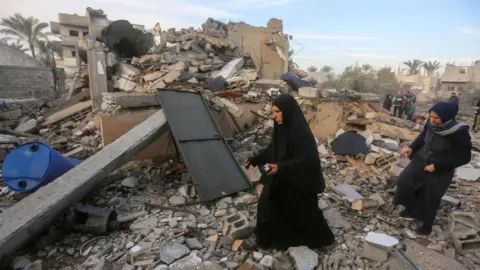
Getty Images Two Palestinian women search and collect usable items among the rubble of a completely destroyed house in Gaza.Getty Images

Strikes continued in Gaza overnight on Wednesday after the ceasefire deal was announced

Israeli Prime Minister Benjamin Netanyahu has delayed a cabinet vote to approve the Gaza ceasefire deal, due on Thursday, accusing Hamas of seeking last-minute changes to the agreement.

US Secretary of State Antony Blinken said a “loose end” was being tied up and that he was confident the ceasefire would still begin on Sunday as planned.

Although Israeli negotiators agreed to the deal after months of talks, it cannot be implemented until it is approved by the security cabinet and government.

Hamas said it was committed to the deal, but the BBC understands it was trying to add some of its members to the list of Palestinian prisoners that would be released under the deal.

The delay came after Israeli strikes in Gaza following Wednesday’s announcement of a deal killed more than 80 people, according to the Hamas-run health ministry.

A few hours before the Thursday morning meeting was due, Netanyahu accused Hamas of trying to “extort last minute concessions”.

The cabinet would not convene until Hamas accepted “all elements of the agreement,” a statement from his office read.

Blinken said such a delay was to be expected in such a “challenging” situation.

“It’s not exactly surprising that in a process and negotiation that has been this challenging and this fraught, you may get a loose end,” he told a press conference in Washington.

“We’re tying up that loose end as we speak.”

He said the US was “confident” the deal would come into force on Sunday as planned, and that the ceasefire would then persist.

Israeli media reported that the cabinet was expected to meet on Friday to approve the deal and that the alleged issue had been resolved, although this was not officially confirmed.

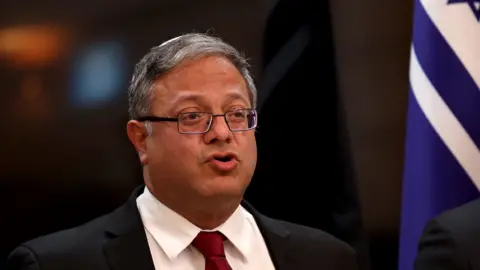
A majority of Israeli ministers are expected to back the deal, but late on Thursday Security Minister Itamar Ben-Gvir said his right-wing party would quit Netanyahu’s government if it was approved.

“The deal that is taking shape is a reckless deal,” Ben-Gvir told a news conference, adding it would “erase the achievements of the war”.

However, he said his Otzma Yehudit (Jewish Power) party would not seek to topple the government should the deal be ratified.

He urged the leader of the other far-right party in government, Finance Minister Bezalel Smotrich of the Religious Zionist party, to join him in resigning.

Ohad Tal, the party’s chair in Israel’s parliament, told BBC Radio 4 that it was “debating” whether to leave Netanyahu’s government over the deal.

EPA Israeli Minister of National Security Itamar Ben-Gvir delivering a statement to the media, at his ministry headquarters in Jerusalem. He wears glasses, a red tie and white shirt, and stands in front of an Israeli flag.EPA

Ben Gvir said the deal would “erase the achievements of the war”

Meanwhile, a senior Hamas official told the BBC that the group was committed to the agreement announced by the mediators.

The head of Hamas’s delegation, Khalil al-Hayya, officially informed Qatar and Egypt of its approval of all the terms of the agreement, the official told the BBC.

But BBC Gaza correspondent Rushdi Abualouf understands that Hamas was attempting to add the names of one or two symbolic members to the list of prisoners that would be released under the deal.

The first six-week phase of the deal would see 33 hostages – including women, children and elderly people – exchanged for Palestinian prisoners in Israeli jails.

Israeli troops would also withdraw to the east, away from densely populated areas of Gaza.

Displaced Palestinians would be able to start returning to their homes and hundreds of aid lorries would be allowed entry to the territory each day.

Negotiations for the second phase – which should see the remaining hostages released, a full Israeli troop withdrawal and a return to “sustainable calm” – would start on the 16th day.

The third and final stage would involve the return of any remaining hostages’ bodies and the reconstruction of Gaza – something which could take years.

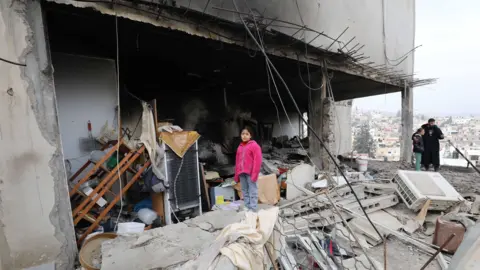
Getty Images Palestinian residents inspect the area among the rubble of damaged buildingsGetty Images

The ceasefire is due to begin on Sunday, should it be approved

Israeli air strikes continued after the deal was announced on Wednesday. At least 12 people were killed in Gaza City, where a doctor told the BBC staff “did not rest for one minute” during the “bloody night”.

Strikes were carried out on 50 targets in Gaza since the deal’s announcement, the Israel Defense Forces and the Israeli Security Agency said in a statement.

The prime minister of Qatar – which mediated negotiations – called for “calm” on both sides before the start of the first six-week phase of the ceasefire deal.

Israel launched a campaign to destroy Hamas – which is proscribed as a terrorist organisation by Israel, the US and others – in response to an unprecedented cross-border attack on Israel on 7 October 2023, in which about 1,200 people were killed and 251 others were taken hostage.

More than 46,788 people have been killed in Gaza since then, according to the territory’s Hamas-run health ministry.

Most of Gaza’s 2.3 million population has also been displaced, there is widespread destruction and there are severe shortages of food, fuel, medicine and shelter, while aid agencies struggle to get help to those in need.

Israel says 94 of the hostages are still being held by Hamas, 34 of whom are presumed dead. There are four Israelis who were abducted before the war, two of whom are dead.


Israeli Vote on Cease-Fire Is Delayed as Diplomats Work on Details

0
Israeli Vote on Cease-Fire Is Delayed as Diplomats Work on Details


Negotiators raced on Thursday to resolve last-minute disputes in a cease-fire agreement between Israel and Hamas that would free hostages and halt the violence that has devastated Gaza over the past 15 months.

The disputes helped delay by at least one day a critical Israeli vote to approve the deal.

Even though negotiators for Israel and Hamas reached a provisional agreement on Wednesday, they continued to discuss outstanding issues through mediators. The Israeli cabinet, whose approval is needed to move the cease-fire ahead, had been expected to vote on it on Thursday, but the vote was postponed.

The deal has reopened deep divides in Israel, where hard-line members of the governing coalition vehemently oppose a cease-fire. Itamar Ben-Gvir, Israel’s far-right minister for national security, announced on Thursday night that his party would resign from Prime Minister Benjamin Netanyahu’s coalition should the cabinet approve the cease-fire deal.

The move threatens to destabilize the government at a critical time but should not, in and of itself, prevent the deal from moving ahead.

The United States, which spent months struggling to broker a deal alongside Qatar and Egypt, downplayed the delay and insisted that the cease-fire would take effect on Sunday as planned.

“I am confident and fully expect implementation will begin,” Secretary of State Antony J. Blinken told reporters on Thursday. “It’s not exactly surprising that in a process, a negotiation, that has been this challenging — this fraught — we may get a loose end. We’re tying up that loose end as we speak.”

He added that he had been on the phone with the U.S. envoy to the region and Qatari officials, seeking to resolve final questions.

In Israel, the office of the prime minister accused Hamas of reneging on parts of the agreement.

“There isn’t any deal at the moment,” Mr. Netanyahu’s spokesman, Omer Dostri, said in a text message on Thursday. “Therefore, there’s no cabinet meeting.”

A Hamas official, Izzat al-Rishq, said that the group remained committed to the deal announced by mediators.

The last-minute disagreements over the deal have included questions of which Palestinians could be released and how Israeli forces would deploy along Gaza’s border with Egypt during the truce, Mr. Dostri said.

After many months of watching negotiations to reach a cease-fire collapse repeatedly, many Gazans, Israelis and others expressed only tempered hope about the fate of the current deal.

“I wish I could say I am happy,” said Fadia Nassar, a 43-year-old who lost her home in northern Gaza, displacing her to the south. The deal, she said, could “collapse for any reason.”

“My heart is broken,” she added. “I will probably stay in a tent. Hundreds of thousands will end up in tents.”

And deadly Israeli airstrikes went on in Gaza on Thursday, with the Israeli military saying it had hit about 50 targets across the territory over the past day.

“The reality in the Strip remains very difficult and catastrophic,” said Mahmoud Basal, a spokesman for Gaza’s Civil Defense, an emergency service under the Hamas-run Interior Ministry.

Recent Israeli attacks in the territory killed at least 81 people and injured nearly 200 others, according to Gaza’s health ministry, which does not distinguish between combatants and civilians. The Civil Defense said that Israeli strikes had killed at least 77 people since the deal had been announced. The claims could not be independently verified.

The Israeli military said its recent targets included militants from Hamas and Islamic Jihad, their compounds, weapons storage areas and other sites, adding that “numerous steps” were taken to prevent civilian harm before the strikes.

Mediators hope the cease-fire deal — which would begin with a 42-day truce and the release of some hostages — will ultimately end the war that began with the Hamas-led attack in October 2023, when about 1,200 people in Israel were killed and 250 taken hostage. The subsequent Israeli military campaign has killed tens of thousands of Gazans and forced nearly the entire population of the enclave to flee their homes.

In Israel, Mr. Ben-Gvir and other hard-line members of Mr. Netanyahu’s government, the most right-wing and religiously conservative in Israel’s history, have opposed the deal and pushed for the war to go on until Hamas is eliminated.

Mr. Ben-Gvir’s party, Jewish Power, holds six seats in the 120-seat Parliament, and the party’s withdrawal from the governing coalition would reduce its majority from 68 to a razor-thin 62. He said his party would offer to rejoin the government should it resume the war against Hamas.

Earlier on Thursday, dozens of demonstrators in Israel blocked a main highway in Jerusalem to protest the deal, eventually being dispersed by the police.

One of the protesters, Eliyahu Shahar, 21, said the agreement posed a threat to Israel’s safety and should be rejected, “even if it means more hostages will die.”

If it comes to a vote, the cease-fire agreement is expected to gain Israel’s approval even without the support of two far-right parties in the governing coalition. Families of hostages have hailed the deal, and opposition parties have broadly committed to propping up Mr. Netanyahu’s coalition, if necessary, to secure the implementation of an agreement that would free the Israelis still held in Gaza.

“This is more important than all the differences of opinion that there have ever been between us,” Yair Lapid, Israel’s opposition leader, said in a statement.

Yona Schnitzer, 36, a marketing writer from Tel Aviv, said he felt “careful optimism” about the deal. “I hope the deal will actually happen this time,” he said. “If it’s confirmed and a done deal, I’ll feel relief, firstly because hostages will come home, and secondly because it will bring us closer to ending this war.”

The cease-fire deal would begin with an initial phase lasting six weeks. It would involve the release of 33 hostages and hundreds of Palestinian prisoners, and allow the entry into Gaza of 600 trucks carrying humanitarian relief daily, according to a copy of the agreement obtained by The New York Times.

The European Commission president, Ursula von der Leyen, described the cease-fire agreement as “the hope the region desperately needed.” But she added that the situation in Gaza remained grim. She announced that Europe would provide $123 million in aid for Gazans this year, along with in-kind aid such as food shipments.

Diplomats hope the first phase of the deal would then lead to more permanent conditions, a point Mr. Blinken stressed on Thursday.

“It’s going to take tremendous effort, political courage, compromise, to realize that possibility, to try to ensure the gains that have been achieved over the past 15 months at enormous, excruciating costs are actually enduring,” he said.

But in Gaza, where ruins dominate the landscape and huge questions remain over what a postwar future will look like, uncertainty and exhaustion reigned.

“It’s undoubtedly a good feeling to hear about the cease-fire,” said Nizar Hammad, a 31-year-old who lost his home in Gaza City. “But when I think about life after the war, I think about the suffering that will continue. The scale of destruction and loss is enormous.”

“Honestly, I feel numb,” said Aseel Mutier, a 22-year-old from Beit Lahia in northern Gaza, whose 16-year-old brother was killed during the war and whose house was destroyed last week.

“We are just waiting for Sunday,” she added. “We don’t know what will happen between now and then.”

Rawan Sheikh Ahmad contributed reporting from Haifa, Israel, and Isabel Kershner and Natan Odenheimer from Jerusalem.


Mark Carney Launches Bid to Be Canada’s Next Prime Minister

0
Mark Carney Launches Bid to Be Canada’s Next Prime Minister


Mark Carney, one of the world’s most prominent central bankers and an evangelist of green investment, announced on Thursday that he was running to be leader of Canada’s Liberal Party and the country’s next prime minister. If he wins, he would lead the party into national elections this year.

“I’m here to ask for your support,” Mr. Carney, 59, said as he announced his candidacy in Edmonton, Alberta. “I’m here to earn your trust.’’

Mr. Carney also said the country faced major challenges that he was prepared to take on. “My generation of Canadians is lucky,” he said. “We had a good time. A time to prosper. The system that our parents built worked well for us. But those good old times, my friends, are over. Our times are anything but ordinary.”

Canadian politics have been in turmoil since Prime Minister Justin Trudeau’s announcement this month that he intended to step down, leaving the job after nearly a decade in power amid the steady fading of his once starry global profile.

Mr. Trudeau leaves a treacherous legacy to any successor: The party is in tatters, with the opposition Conservatives leading the Liberals by more than 25 percentage points in recent opinion polls as voters have grown disenchanted with the country’s direction.

Mr. Carney, who served as an informal economic adviser to Mr. Trudeau during the pandemic, is seeking to portray himself as an outsider and distance himself from Mr. Trudeau’s recent policy struggles, including soaring housing costs, an overstretched health care system and high prices for everyday goods.

Mr. Carney is likely to brandish his command of economics as a heavyweight on the global stage — he led the central banks in Canada and England — at a time when President-elect Donald J. Trump has threatened to impose a 25 percent tariff on all Canadian goods exported to the United States.

Such an across-the-board move would ravage Canada’s economy, though it would also hurt the United States. (Mr. Trump has also threatened tariffs against Mexico).

But it remains to be seen if Mr. Carney can convince voters that he did not play a role in Mr. Trudeau’s stewardship of the country. Even before he officially announced his candidacy, Conservatives had been quick to point out Mr. Carney’s ties to Mr. Trudeau.

Pierre Poilievre, the Conservative Party leader, has called him “the ultimate liberal insider” and “Just like Justin,” sharing a photo on X of Mr. Carney and Mr. Trudeau seated close together and smiling, and adding a comment: “The bond between these two men is almost touching.”

Candidates to lead the Liberal Party will campaign to woo party members before they vote in March. Once a new leader takes charge, Mr. Trudeau will officially step down and the new party leader will also become prime minister. A general election is then expected to take place, probably in spring.

Mr. Carney, who has never run for elected office, will need to overcome a perception among Canadians that he is a stuffy bureaucrat and an out-of-touch member of the global elite. He was born in the Northwest Territories, but raised in Edmonton.

He took a stab at overhauling his image this week by engaging in a coy but humorous interview with Jon Stewart on “The Daily Show,” bantering with the late-night host for about 20 minutes.

At the heart of their chat was a running joke about the relationship between Canada and the United States — Mr. Trump has said that he wants to essentially annex Canada and make it another state, outraging many Canadians.

“We’re not moving in with you” Mr. Carney said. “We can be friends,” he added. “Friends with benefits.”

Mr. Stewart later responded: “I feel like you’re breaking up with me the entire interview.”

Mr. Carney, seeming more relaxed as the interview proceeded, followed up: “We’re resetting the relationship and we’re going to be stronger.”

He also used Mr. Stewart’s show as a platform to try to telegraph that he was never officially part of the embattled government of Mr. Trudeau.

“I am an outsider,” Mr. Carney said.

On Thursday, Mr. Carney formally made his pitch to Liberal voters about how he would steer Canada through what will most likely be turbulent relations with the United States and various domestic challenges, including lagging productivity.

Canada, Mr. Carney added, was not prepared for the global transition away from fossil fuels and the increasing prominence of artificial intelligence.

As for solutions, he said Mr. Poilievre’s penchant for three-word slogans to promote his ideas were not the answer. But he also offered a thinly-veiled criticism of Mr. Trudeau’s progressive agenda, saying “we can’t achieve our full potential with the ideas of the far left.”

Mr. Carney served as the governor of the Bank of Canada between 2008 and 2013, and then led the Bank of England from 2013 to 2020. At the Bank of England, he was known to give speeches that sometimes veered into more political subjects, especially around the dangers climate change posed to global markets.

He has since held positions as a special envoy on climate action and finance with the United Nations; as chair of Bloomberg’s board of directors; and as chair of Brookfield Asset Management, a global investment firm which until recently had headquarters in Toronto.

One potential challenger Mr. Carney may face for Liberal Party leadership is Chrystia Freeland, who abruptly resigned as deputy prime minister last month and criticized Mr. Trudeau’s management of the country.

Mr. Trudeau’s government had pursued Mr. Carney to replace Ms. Freeland in her role but he declined.

Ms. Freeland shares close ties and a similar educational background as Mr. Carney: both are graduates of Harvard University and the University of Oxford. They are also friends — Mr. Carney is the godfather of one of Ms. Freeland’s children.

Of the two, Mr. Carney is far less familiar to Canadians. In a recent opinion poll, 24 percent of Canadians recognized Mr. Carney in a photo while 51 percent recognized Ms. Freeland.

The Liberal Party’s effort to replace its leader will be closely watched. It recently updated its voter eligibility to include only Canadian citizens and permanent residents who are at least 14 years old. Registration was previously open to anyone living in Canada, regardless of citizenship status, raising concerns that the vote could be vulnerable to foreign interference.

A security task force made up of members from Canada’s federal police, global affairs ministry and spy agencies will monitor the leadership race to ensure its legitimacy, Mr. Trudeau’s office has said.

Candidates must raise 350,000 Canadian dollars, or about $245,000, to join the race.


Sudan’s Military Has Used Chemical Weapons Twice, U.S. Officials Say

0
Sudan’s Military Has Used Chemical Weapons Twice, U.S. Officials Say


Sudan’s military has used chemical weapons on at least two occasions against the paramilitary group it is battling for control of the country, four senior United States officials said on Thursday.

The weapons were deployed recently in remote areas of Sudan, and targeted members of the Rapid Support Forces paramilitaries that the army has been fighting since April 2023. But U.S. officials worry the weapons could soon be used in densely populated parts of the capital, Khartoum.

The revelations about chemical weapons use come as the United States is expected to announce sanctions against the Sudanese military chief, Gen. Abdel Fattah al-Burhan, for documented atrocities by his troops, including indiscriminate bombing of civilians and the use of starvation as a weapon of war.

The use of chemical weapons crosses yet another boundary in the war between the Sudanese military and the R.S.F., its former ally. By many measures, the war has created the world’s worst humanitarian crisis, with as many as 150,000 people killed, over 11 million displaced and now the world’s worst famine in decades.

The United Nations, allied nations and aid groups were notified on Wednesday night about the impending sanctions against General al-Burhan. The U.S. decision is considered a significant move against a figure seen by some as Sudan’s head of state who also represents his country at the United Nations.

Aid groups fear that Sudan’s military could retaliate against the sanctions decision by further restricting aid operations in areas that are either in famine or sliding toward it.

It was not immediately clear what type of chemical weapons were used. Knowledge of the chemical weapons program was limited to a small group inside Sudan’s military, two of the U.S. officials said, speaking on the condition of anonymity to discuss sensitive security matters. But it was clear that General al-Burhan had authorized their use, they said.

The sanctions come a week after the United States determined that the Rapid Support forces had committed genocide in the war, and imposed sanctions on its leader, Lt. Gen. Mohamed Hamdan, for his role in atrocities against his own people. The United States also sanctioned seven companies based in the United Arab Emirates that traded in weapons or gold for the R.S.F.


Romania sets May date for new presidential election | Elections News

0
Romania sets May date for new presidential election | Elections News


The first round will take place on May 4, with a second on May 18 if no first-round candidate wins more than 50 percent.

Romania’s coalition government has announced that it will hold a new presidential election in May, after the shock annulment of the December vote amid claims of Russian interference.

A cabinet meeting on Thursday approved the ruling party’s proposal to have a fresh presidential vote.

The first round will take place on May 4, with a second on May 18 if no first-round candidate wins more than 50 percent of the vote.

The European Union and NATO state, which borders Ukraine, was plunged into institutional chaos last year when Calin Georgescu, a little-known far-right pro-Russian politician, won the first presidential round on November 24.

Officials in Romania said Georgescu benefitted from a massive social media campaign spearheaded by TikTok, which gave him preferential treatment, accusations the platform has denied.

Amid suspicions of Russian interference – denied by Moscow – Romania’s top court annulled the ballot and ordered the government to rerun it in its entirety.

The European Commission last month also opened formal proceedings against TikTok over its suspected failure to limit election interference, notably in the Romanian vote.

Georgescu has denounced the vote annulment as a “formalised coup d’etat”.

Tens of thousands of Romanians took to the streets on Sunday in Bucharest in the second protest last week against the cancellation of the original vote. The far-right Alliance for the Union of Romanians (AUR) party had called the protest.

They demanded the resignation of President Klaus Iohannis, a liberal who has remained in office until his successor is elected.

On Thursday, the government, headed by incumbent Prime Minister Marcel Ciolacu, issued a decree saying campaign materials ahead of the next presidential vote will need to be clearly marked as election content and their sponsors identified.

Social media platforms will also be required to take down content that does not follow the rules within five hours of a request from Romanian election officials or risk fines of between 1 percent and 5 percent of their turnover.

Romanian rights groups have, however, criticised the government for failing to consult the public before issuing the decree, warning the new rules did not address real campaign financing issues.


Film director David Lynch dies at 78, family says

0
Film director David Lynch dies at 78, family says


David Lynch, the writer-filmmaker whose works include Mulholland Drive and Twin Peaks, has died aged 78.

Lynch’s death was announced on his Facebook page by his family.

“There’s a big hole in the world now that he’s no longer with us,” the post said.

“But, as he would say, ‘Keep your eye on the donut and not on the hole.’ … It’s a beautiful day with golden sunshine and blue skies all the way.”

Lynch received three best director Oscar nominations throughout his career for his work on Blue Velvet, The Elephant Man and Mulholland Drive.

His last major project was Twin Peaks: The Return, which was broadcast in 2017, and continued the TV series that ran for two seasons in the early 1990s.

Lynch revealed in August last year he was battling emphysema, a chronic lung disease, from “many years of smoking”.

The director said that, despite the diagnosis, he was in “excellent shape” and would “never retire”.


Netanyahu Faces a Political Crisis Over the Gaza Cease-Fire Deal

0
Netanyahu Faces a Political Crisis Over the Gaza Cease-Fire Deal


The Gaza cease-fire deal between Israel and Hamas had yet to be ratified by Israel’s government on Thursday, but the battle over Prime Minister Benjamin Netanyahu’s political future has already begun.

Hours after the deal was announced, Mr. Netanyahu was facing a potential internal rebellion from far-right partners in his governing coalition on whose support he depends to remain in power.

There is a majority in the cabinet in favor of the cease-fire agreement, and if there is a vote it is expected to be approved even without the far-right parties’ votes.

But the far-right parties, led by Israel’s finance minister, Bezalel Smotrich, and the minister for national security, Itamar Ben-Gvir, vehemently oppose the deal.

The far-right ministers have threatened to quit the government if Mr. Netanyahu proceeds from the first phase of the cease-fire agreement, which calls for a temporary, six-week truce, to a permanent one.

Mr. Netanyahu may soon have a fateful choice to make in the politically precarious weeks ahead: keep his coalition together by resuming the fight against Hamas in Gaza, or risk the coalition coming apart halfway through its four-year term and gambling on an early election.

After more than 15 months of devastating war, and with President-elect Donald J. Trump about to assume office, some analysts think ending the conflict in Gaza is his better option.

“Elections are about a story,” said Moshe Klughaft, an Israeli strategic adviser and international political campaign manager who has advised Mr. Netanyahu in the past, adding that in the event of an election, Mr. Netanyahu’s next story will be one of “war and peace.”

The first phase of the deal is expected to start on Sunday and last six weeks, during which Hamas is supposed to release 33 Israeli hostages in exchange for hundreds of Palestinian prisoners, and Israeli troops are supposed to redeploy east, away from populated areas of Gaza.

If implemented, the second phase, over another six weeks, would see the rest of the hostages return home, some alive, some dead, and a full withdrawal of Israeli troops from Gaza.

The hostages’ families have pleaded with Mr. Netanyahu to put politics aside and complete the cease-fire deal. Mr. Trump has made it clear that he wants the war, prompted by the Hamas-led terrorist assault on Israel on Oct. 7, 2023, to end.


As Trump Heads to White House, Bolsonaro May Be Headed to Jail. Why?

0
As Trump Heads to White House, Bolsonaro May Be Headed to Jail. Why?


There is arguably no statesman who cuts such a striking political resemblance to Donald J. Trump than Jair Bolsonaro, Brazil’s former president.

The two men built their brash political brands on insulting rivals, attacking the press, doubting science and vowing to unroot political elites. When they were each running for re-election, they both warned that only fraud could cause them to lose. And when each lost, they both questioned the results and helped spark attempted insurrections in their respective capitols.

Since then, however, their political paths have dramatically diverged.

On Monday, Mr. Trump is set to return to the White House. Mr. Bolsonaro has been invited to attend the inauguration — but he will probably have to watch from home. That is because Brazil’s Supreme Court confiscated his passport as part of sprawling investigations into what it says were his efforts to subvert democracy — probes that could land him in prison this year.

So why have the two political matches faced such different fates for similar acts?

A key reason: Brazilian institutions have responded to Mr. Bolsonaro far differently than their U.S. counterparts responded to Mr. Trump.

Here are three differences that have made an impact.

Perhaps the clearest contrast: Mr. Trump was able to run for president while prosecutors pursued criminal charges against him, while Mr. Bolsonaro has been ruled ineligible for the next election.

Six months after Mr. Bolsonaro left office in 2023, Brazil’s electoral court ruled that he could not run for elected office until 2030. The seven-judge panel — made up of Supreme Court justices, federal judges and lawyers — made the ruling based on Mr. Bolsonaro’s attacks on Brazil’s voting system during the presidential campaign.

In the United States, no such federal electoral court exists. Voting is run by the states, and candidates can appear on a ballot just by passing a few basic thresholds, including collecting a set number of signatures and having been born in the United States. When Colorado’s top court blocked Mr. Trump from that state’s ballot because of his efforts to hold on to power, the U.S. Supreme Court struck down the ruling.

In other words, the Brazilian system empowers a federal court to determine who is fit for office, while the U.S. system largely leaves that decision up to voters.

The court ruling that deemed Mr. Bolsonaro ineligible is an illustration of another divergence in the approaches: The Brazilian judiciary has been faster and far more aggressive in its pursuit of Mr. Bolsonaro.

Just one year after Mr. Bolsonaro left office, Brazil’s federal police filed formal accusations in three separate criminal cases against the former president. The police accused him of overseeing plots to sell jewelry he received as state gifts, falsifying his Covid-19 vaccination records and trying to reverse the results of the election he had lost. Mr. Bolsonaro denies that he committed any crime and says he is being politically persecuted.

It took two years after Mr. Trump’s election loss for the U.S. Attorney General to appoint a special prosecutor to lead criminal investigations into the former president. That appointment came days after Mr. Trump announced he was running again in 2024.

There are wide expectations that Mr. Bolsonaro will be criminally charged and face trial this year. As for the four indictments against Mr. Trump, he was convicted in one case but the sentencing came after his election and he was given no punishment. It appears his other three cases may never go to trial.

The two nations’ Supreme Courts have played very different roles in the processes.

In the United States, appeals to the top court helped to delay the cases against Mr. Trump. The Supreme Court then threw some of the cases into jeopardy when it ruled that presidents were immune from prosecution for their actions carried out as president.

In Brazil, the Supreme Court — and, in fact, a single justice named Alexandre de Moraes — has been leading the investigations into Mr. Bolsonaro.

Justice Moraes’s position alone atop the investigations — in a role that is in some ways akin to both judge and prosecutor — has enabled the inquiries to move much faster as he ordered searches of Mr. Bolsonaro’s home and jailed some of the former president’s allies. But it has also raised grave concerns that, in his pursuit of protecting democracy, Justice Moraes may be doing more harm than good to Brazil’s institutions.

“From a U.S. sensibility, Brazil’s looks like a hyper-activist judiciary that’s willing to do things that most Americans would find very problematic and many Brazilians find very problematic,” said Scott Mainwaring, a Notre Dame political science professor who has studied how each country responded to its former leaders. “But the upside is that it has protected democracy.”

“On the other hand,” he added, “the U.S. judiciary was extremely slow in bringing these four Trump cases to trial.”

Immediately after the Jan. 6 riot on the U.S. Capitol in 2021, Republicans broadly denounced the violence and Mr. Trump for helping to spark it.

But three weeks later, the Republican congressional leader, Kevin McCarthy, flew to Mar-a-Lago and took photos with Mr. Trump. The Republican Party almost universally followed suit, shifting its own politics further to the right to align with Mr. Trump’s.

The Jan. 8, 2023, riot on the Brazilian Capitol has been met with a much clearer rebuke from the Brazilian right. Though some of Mr. Bolsonaro’s allies have criticized the multiyear prison sentences for many of the people who invaded Brazil’s halls of power, many conservative leaders have remained critical of the Bolsonaro movement’s response to losing the election.

That willingness to push back is partly because Brazil has a far more fragmented political landscape: Twenty-five political parties hold seats in Congress.

While the Brazilian right has not abandoned Mr. Bolsonaro, it also appears ready to move on, promoting several conservative governors as a potential candidate to challenge leftist President Luiz Inácio Lula da Silva should he run for re-election next year.

The differing responses from the U.S. and Brazilian right-wing movements is also a consequence of the nations’ divergent judicial approaches, said Malu Gaspar, a political columnist for one of Brazil’s largest newspapers, O Globo. “Trump was eligible,” she said. “Bolsonaro is already ineligible, so you talk to bankers and politicians and they say, ‘Why rehabilitate Bolsonaro?’”

Mr. Bolsonaro’s view of the situation is different: Don’t count me out yet.

In an interview on Tuesday, the former president said he hoped that his ineligibility ruling could be overturned, enabling him to stage a political comeback like Mr. Trump. “I am certain that if I’m eligible, I’ll be re-elected president,” he said.

His hopes are not that far-fetched. Brazil’s current president, Mr. Lula, was in prison just three years before he was elected in 2022; he became eligible to run for president again because a Supreme Court justice tossed out several criminal cases against him.

And two years after Mr. Trump left office — when he had his own series of encircling criminal investigations — expectations in the United States were low that he would rise again politically.

Now, on Monday, Mr. Trump will become the first felon to become U.S. president.