


The Israeli military has launched attacks across Gaza hours after the ceasefire announcement between Israel and Hamas.
Israeli attacks kill dozens in Gaza after ceasefire announcement

Israeli air strikes continue in Gaza after ceasefire deal announced


 AFP
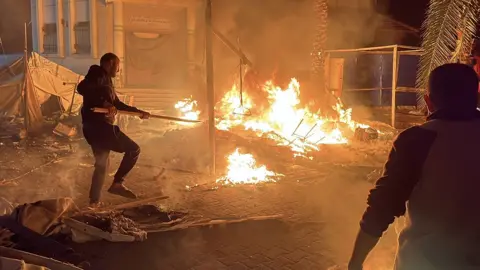
AFPIsraeli air strikes are continuing in Gaza ahead of the ceasefire agreement and hostage deal with Hamas, which comes into effect on Sunday, subject to the Israeli cabinet’s approval.
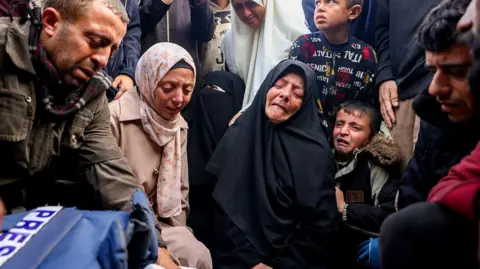
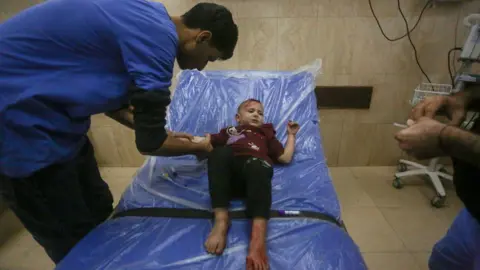
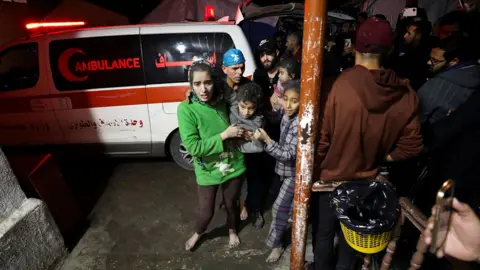
The strikes killed 73 people overnight, following the announcement of the deal, Gaza’s Hamas-run civil defence agency reported.
Victims include 12 people who were living in a residential block in the Sheikh Radwan neighbourhood of Gaza City, the health ministry said.
The Israeli Defence Forces initially said “a fallen projectile” had been identified in southern Israel on Thursday, but later said it had been wrongly identified.
Israel has previously launched air strikes in the run-up to ceasefire arrangements taking effect, most recently in Lebanon, where heavy bombing hit the capital, Beirut, just hours before the ceasefire there in November.
 Getty Images
Israeli Prime Minister Benjamin Netanyahu was expected to ratify the Gaza ceasefire agreement in parliament on Thursday, but his office alleges Hamas has “reneged” on parts of the agreement, prompting a “last-minute crisis”.
It adds the cabinet will not convene until Hamas has accepted “all elements of the agreement”.
A senior Hamas official told the BBC that his movement was committed to the agreement announced by the mediators and that the head of its delegation, Khalil al-Hayya, had officially informed Qatar and Egypt of its approval of all the terms of the agreement.
Two hardline right-wing ministers, Finance Minister Bezalel Smotrich and National Security Minister Itamar Ben Gvir, have long threatened to quit the government coalition if the ceasefire goes ahead.
That could prompt fresh elections in Israel, but their resignations will not block the deal if Netanyahu wants it to happen, observers say.
The prime minister of Qatar – which mediated negotiations – has called for “calm” on both sides before the start of the first six-week phase of the ceasefire deal.
This will see 33 hostages – including women, children and elderly people – exchanged for Palestinian prisoners in Israeli jails.
Israeli forces will also withdraw to the east, away from densely populated areas of Gaza.
Displaced Palestinians will be allowed to begin returning to their homes and hundreds of aid lorries will finally be allowed into the territory each day.
 Reuters
Negotiations for the second phase – which should see the remaining hostages released, a full Israeli troop withdrawal and a return to “sustainable calm” – will start on the 16th day.
The third and final stage will involve the return of any remaining hostages’ bodies and the reconstruction of Gaza – something which could take years.
Achim Steiner from the United Nations Development Programme told the BBC’s Newsday programme that the reconstruction of Gaza would be a huge challenge, given the massive destruction inflicted by the war.
He said 40 million tons of “toxic” rubble needed to be removed before Gazans could return to where their houses used to be.
“This is a very complex undertaking that we are now confronted with,” he said.
 Getty Images
Israel launched a campaign to destroy Hamas – which is proscribed as a terrorist organisation by Israel, the US and others – in response to an unprecedented cross-border attack on 7 October 2023, in which about 1,200 people were killed and 251 others were taken hostage.
More than 46,788 people have been killed in Gaza since then, according to the territory’s Hamas-run health ministry.
Most of the 2.3 million population has also been displaced, there is widespread destruction and there are severe shortages of food, fuel, medicine and shelter, while aid agencies struggle to get help to those in need.
Israel says 94 of the hostages are still being held by Hamas, 34 of whom are presumed dead. In addition, there are four Israelis who were abducted before the war, two of whom are dead.
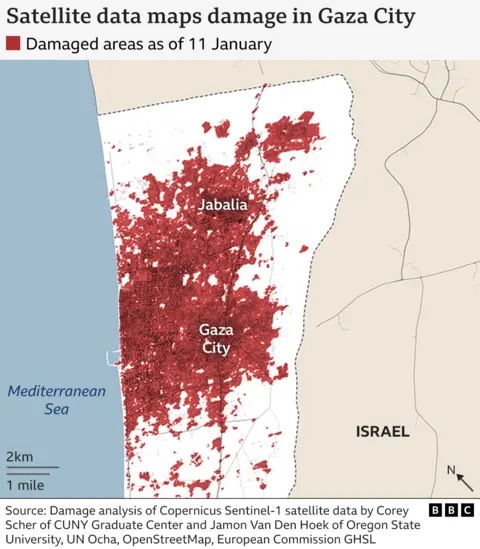
Hamas After Cease-Fire: Weakened but Still the Dominant Palestinian Power in Gaza

Israel’s military campaign in Gaza has delivered devastating blows to Hamas: It has killed top Hamas leaders and thousands of militants, pummeled the militant group’s tunnel network and undermined its ability to threaten Israel with rocket fire.
When Hamas launched its Oct. 7, 2023, attack against Israel, it had hoped to ignite a regional war that would draw in its allies and lead to Israel’s destruction. Instead, it has been left to fight Israel almost entirely alone. Its allies have been decimated in Lebanon, toppled in Syria and weakened in Iran. The Houthis in Yemen have only managed to inflict occasional rocket and drone attacks, most of which Israel has intercepted.
Despite its isolation, however, Hamas remains the dominant Palestinian power in Gaza even after 15 months of Israeli bombardment, holding sway in displacement camps and refusing to surrender. Although many Palestinians have criticized the group’s decision to carry out the October 2023 attack — unleashing a war that has killed tens of thousands of Gazans and reduced cities to rubble — but it has faced relatively little popular unrest.
Hamas has celebrated the provisional cease-fire agreement announced on Wednesday as an “accomplishment,” but its future role in Gaza remains uncertain.
The deal calls for an eventual “cessation of military operations and hostilities permanently,” but Prime Minister Benjamin Netanyahu of Israel has repeatedly suggested that that he will resume attacking Hamas after some hostages held by militants are released.
Yet if the full, multistage agreement is implemented, it could open the door to Hamas rebuilding its ironclad control over Gaza, or at least allow it to maintain an influential role in the territory. Analysts connected to Hamas believe that Israel will struggle to resume the war in the face of international pressure, and that Hamas will play a key role in the future of Gaza.
“Hamas will be present in every detail in Gaza,” said Ibrahim Madhoun, an analyst close to the militant group. “Trying to bypass Hamas will be like burying your head in the sand.”
Mr. Madhoun acknowledged that Hamas’s military wing, the Qassam Brigades, had suffered losses, but said it was still “standing on solid ground” and had recruited new people to replace those killed. Antony J. Blinken, the U.S. secretary of state, said this week that American officials had assessed that Hamas has brought in almost as many new fighters as it has lost in the war.
But if Israel decides to return to war, it could continue to weaken the group.
Resuming the war would not only be a disaster for the Palestinian people, but also Hamas said Tamer Qarmout, a professor of public policy at the Doha Institute for Graduate Studies.
Under such a scenario, Mr. Qarmout said, Israel could find itself moving toward occupying Gaza, which may “cut off Hamas but antagonize everyone else in the public.”
Former Brazilian President Jair Bolsonaro Looks to Trump and the U.S. to Avoid Prison

Jair Bolsonaro has had a rough couple of years: election losses, criminal cases, questionable embassy sleepovers. So when he finally received a piece of good news last week — an invitation to President-elect Donald J. Trump’s inauguration — it lifted his spirits.
“I’m feeling like a kid again with Trump’s invite. I’m fired up. I’m not even taking Viagra anymore,” the former Brazilian president said in an interview on Tuesday, employing his trademark sophomoric humor. “Trump’s gesture is something to be proud of, right? Who’s Trump? The most important guy in the world.”
But reality has a way of spoiling plans.
Brazil’s Supreme Court has confiscated Mr. Bolsonaro’s passport as part of an investigation into whether he tried to stage a coup after losing re-election in 2022. To attend Monday’s inauguration, Mr. Bolsonaro has had to request permission from a Supreme Court justice who is also his political nemesis.
On Wednesday, Brazil’s attorney general recommended that his request be rejected. Mr. Bolsonaro admitted he would likely be watching from home.
That likely split screen — Mr. Trump returning to the world’s most powerful job while Mr. Bolsonaro stays home on court orders — would encapsulate the two political doppelgängers’ starkly divergent paths since they were voted out of office and then claimed fraud.
In 2025, Mr. Trump will head to the White House — and Mr. Bolsonaro could be headed to prison.
Three separate criminal investigations are closing in on Mr. Bolsonaro, and there are widespread expectations in Brazil — including from Mr. Bolsonaro himself — that he could soon be at the center one of the highest-profile trials in Brazil’s history.
“I’m being watched all the time,” Mr. Bolsonaro, 69, said in the lively 90-minute interview, in which he aired grievances, repeated conspiracy theories and confessed his anxiety about his future. “I think the system doesn’t want me locked up; it wants me eliminated.”
But developments in the United States have given Mr. Bolsonaro new hope. Mr. Trump, Elon Musk and Mark Zuckerberg are leading a global push for free speech, he said, and he hopes that could somehow transform the political landscape in Brazil. “Social networks decide elections,” he said.
For years, Mr. Bolsonaro has accused a Brazilian Supreme Court justice, Alexandre de Moraes, of censoring conservative voices and politically persecuting him. Justice Moraes has indeed become one of the most aggressive policemen of the internet in a democracy, ordering social networks to block at least 340 accounts in Brazil since 2020, and often keeping his reasons under seal.
That led to a clash with Mr. Musk last year, resulting in the judge’s ban on Mr. Musk’s social network, X, in Brazil. Mr. Musk eventually backed down. But the dispute drew global attention to Mr. Bolsonaro’s complaints about Brazil’s Supreme Court..
So Mr. Bolsonaro said he was delighted last week when Mr. Zuckerberg said his company would “work with President Trump to push back against” foreign governments that want to “censor more.” One of his main examples were “secret courts” in Latin America “that can order companies to quietly take things down.”
Brazilian officials took that as a shot across the bow. The next day, Justice Moraes warned that social networks could only operate in Brazil if they follow Brazilian law, “regardless of the bravado of big tech executives.”
Mr. Bolsonaro had a different view. “I’m liking Zuckerberg,” he said. “Welcome to the world of good people, of freedom.”
How exactly will Mr. Trump and the tech executives affect his many legal and political challenges? Mr. Bolsonaro was vague. “I’m not going to try to give Trump any tips, ever,” he said. “But I hope his politics really spill over into Brazil.”
Elizabeth Bagley, the outgoing U.S. ambassador to Brazil, said Mr. Bolsonaro’s wish that the United States could come to his rescue are far-fetched. The U.S. government does not interfere with another country’s judicial process, she said.
Mr. Bolsonaro has bigger problems than censorship. Over the past year, Brazil’s federal police has formally accused him of crimes in three separate cases.
In one, the police said Mr. Bolsonaro took money from the sale of jewelry he received as state gifts, including a diamond Rolex watch from the Saudis that his aide later sold at a Pennsylvania mall. Mr. Bolsonaro blamed the situation on unclear rules around who owned such gifts.
In a second, the police said he participated in a plot to falsify his Covid-19 vaccination records so he could travel to the United States. Mr. Bolsonaro said he did not receive the vaccine, but denied knowing of efforts to fake his records.
And in the most grave accusation, the police said Mr. Bolsonaro “planned, acted in, and had direct and effective control over” a conspiracy to carry out a coup.
The federal police recently released two reports, totaling 1,105 pages, that detailed its accusations, including that he personally edited a decree for a national state of emergency designed to prevent the election’s winner, President Luiz Inácio Lula da Silva, from taking office.
Mr. Bolsonaro abandoned the plan after he pitched three leaders of Brazil’s military and two refused to take part, the police said.
In the interview, Mr. Bolsonaro vehemently denied any coup plot — he handed over power after all, he said — but he did admit having discussed the decree. “I won’t deny it to you,” he said. “But in the second conversation it was given up.”
He said he considered a state of emergency because he believed the election had been stolen, but Justice Moraes had blocked his party’s request to overturn the results. Then his team realized Congress would have to approve the measure, too. “Forget it,” he said. “We lost.”
Yet the police said there was a far darker plan at the center of the conspiracy: assassinating Mr. Lula, his running mate and Justice Moraes. The police have arrested five men whom they accuse of planning to carry out the assassinations, four of them from an elite Brazilian military unit.
The men, the police said, deployed to Justice Moraes’s neighborhood several weeks before Mr. Lula’s inauguration. They were prepared to kidnap the judge but abandoned the plot after Mr. Bolsonaro did not declare the state of emergency, the police said.
The police said Mr. Bolsonaro was aware of the plan. The closest link the police disclosed was that the plan had been printed at the presidential offices and later taken to the presidential residence.
Mr. Bolsonaro denied he knew anything about such a plot. “Whoever made this possible plan should respond,” he said. “On my part, there was no attempt to execute three authorities.”
He then downplayed the accusations. “Even so, I think it was just another fantasy — bravado. Nothing. This plan is unfeasible. Impossible,” he said. He admitted he knew the accused leader of the plot. “Everyone is responsible for their actions,” he said. “Although, as far as I know, he did not take any action.”
Brazil’s attorney general is weighing whether to indict the former president, which would likely lead to a high-profile trial this year and a potential prison sentence.
While maintaining his innocence, Mr. Bolsonaro admitted he worried about his freedom because Justice Moraes could help convict him. “I’m not worried about being judged,” he said. “My worry is who will judge me.” After police confiscated his passport last year, he slept for two nights at the Hungarian embassy in an apparent bid for asylum.
Brazil’s courts have already taken action. Six months after he left office, Brazil’s electoral court, led by Justice Moraes, barred Mr. Bolsonaro from office until 2030 because of his attacks on Brazil’s voting systems.
Mr. Bolsonaro called the ruling “a rape of democracy” and said he was trying to find a way to run in next year’s presidential election. Two Supreme Court justices he nominated will lead the electoral court before the election, he said. Those judges have told him, he said, “that my ineligibility is absurd.”
Polls show Mr. Bolsonaro remains by far Brazil’s most popular conservative candidate, but many on the right are seeking new options. Some have speculated about his sons: One, Flávio, 43, is an experienced senator, while another, Eduardo, 40, is a congressman who speaks English and has built close ties to the MAGA movement.
But Mr. Bolsonaro is not yet ready to hand over the keys to his movement. He said he would only support his sons staying in Congress for now. “For you to be president here and do the right thing, you have to have a certain amount of experience,” he said, as another son, Carlos, 42, looked on with a blank expression.
Should Mr. Bolsonaro stage a political comeback, he said he would focus his administration on deepening ties with the United States and moving away from China.
But first, he just wants to go to Washington this weekend. “I ask God for the chance to shake his hand,” Mr. Bolsonaro said of Mr. Trump. “I don’t even need a photo, just to shake his hand.”
Azerbaijan’s Leader, Emboldened, Picks a Rare Fight With Putin

It was a tense conversation between two authoritarian leaders accustomed to getting their way.
President Vladimir V. Putin of Russia was offering explanations for the Azerbaijan Airlines plane crash that had killed 38 people days earlier. Perhaps it was a flock of birds, Mr. Putin said, or an exploding gas canister. Maybe a Ukrainian drone.
But President Ilham Aliyev of Azerbaijan was not buying it, according to two people familiar with that late December phone call. It had become clear within hours of the crash that the plane had been shot down by Russian air defenses in what appeared to be a lethal mistake. It left shrapnel lodged in the leg of one passenger and riddled the fuselage with holes.
On Dec. 29, Mr. Aliyev went public with his anger without mentioning the Russian president by name. “Attempts to deny obvious facts,” he said, “are both nonsensical and absurd.”
The people who described the phone call insisted on anonymity to discuss sensitive diplomatic communications. The Kremlin did not respond to a request for comment.
The furor over the plane crash — and Mr. Aliyev’s willingness to challenge Mr. Putin in public — has revealed a remarkable breach between two post-Soviet rulers who had become close over more than two decades in power. Mr. Putin tried to enlist Mr. Aliyev in an apparent effort to keep quiet the cause of the crash; Mr. Aliyev, emboldened by Russia’s weakened influence in lands it once dominated, insisted that Russia publicly recognize its guilt.
Interviews last week with Azerbaijani officials and people close to the government showed how the Dec. 25 crash of an Embraer 190, with 67 people aboard, has become a geopolitical milestone for the former Soviet Union. Rather than allowing Mr. Putin to dictate his response to the tragedy, Mr. Aliyev has repeatedly lashed out at Russia over its failure to accept responsibility.
Rasim Musabekov, a member of the Azerbaijani Parliament’s foreign affairs committee, described Russia’s response to the crash as “an absurd attitude.”
“Azerbaijan will not accept such a chauvinist attitude,” he added.
Behind the scenes, the interviews showed, those tensions flared directly between Mr. Aliyev and Mr. Putin, even though the two autocrats have often found common ground. In the call on Dec. 28 and another the next day, the people familiar with the calls said, Mr. Putin urged Mr. Aliyev to agree to have a Moscow-based aviation body investigate the crash. Mr. Aliyev refused, insisting that the plane’s black boxes be decoded in Brazil, where the jet was made, a striking display of mistrust of the Russian leader.
Officials in Azerbaijan’s capital, Baku, arranged interviews for The New York Times with three survivors, who said it became clear to some passengers that they were under attack immediately after at least two explosions rocked the plane in midair.
After the second blast, a girl started screaming. Leyla Omarova, 28, looked across the aisle from her window seat and saw the girl’s tights stained with blood.
Three rows behind them, Nurullah Sirajov, 71, had been trying to comfort his wife. The first bang must have been the landing gear, he’d told her. They had never flown before.
Then came the second explosion, a rush of wind from the back of the plane and yells, he said, from other passengers: “They hit us.”
As the jet jerked up and down, coming within 100 feet of the Caspian Sea, Mr. Sirajov thought that at least his and his wife’s marital squabbles over who would die first would finally be resolved: They would die together. But after the front part of the plane disintegrated on impact, the tail section broke off, turned over and slid hundreds of yards through the sandy soil.
“Anyone alive?” Mr. Sirajov remembers yelling in the sudden silence as he dangled upside-down from his seatbelt.
Because Europe closed its airspace to Russia after Mr. Putin’s invasion of Ukraine, many Russians flying westward now connect in Azerbaijan, an oil-and-gas-rich former Soviet republic of 10 million sandwiched between Russia and Iran. Russia also sees Azerbaijan as a key link in an expanded trade route south to Iran, India and the Persian Gulf.
Its role as a transit point for a Russia beset by sanctions is just one way that Azerbaijan has seen its leverage rise against its far larger northern neighbor. Mr. Aliyev has also taken advantage of the Russian military’s distraction in Ukraine to push Russian peacekeeping troops out of Nagorno-Karabakh, the Armenian-controlled enclave that Azerbaijan recaptured in 2023.
Mr. Aliyev has solidified his country’s alliance with Turkey and armed Azerbaijan with high-tech weapons purchased from Israel. He has waged a fierce crackdown against activists and independent journalists, but has maintained a relationship with Europe, which sees Azerbaijan as a key alternative to Russian oil and gas.
Farhad Mammadov, a political analyst in Baku, said that Russia’s political and economic “levers of pressure” on Azerbaijan had been reduced to “practically none.” Aykhan Hajizada, the spokesman for Azerbaijan’s Foreign Ministry, was blunt in arguing that his country had leverage over Russia: “They don’t want to lose Azerbaijan as well,” he said.
The uproar over the plane crash has emerged as a test case. A senior American diplomat, speaking on condition of anonymity because he was not authorized to comment publicly, described the fallout from the crash as “a proof of concept” for Azerbaijan’s ability to stick up for itself. Other post-Soviet countries that have also sought a more arm’s-length relationship with Russia, like Kazakhstan, are watching closely.
“If this is how you behave in this incident with Azerbaijan, then what will the Uzbeks, the Kazakhs and the other remaining partners of Russia think of you?” Mr. Musabekov, the member of Parliament, asked. “It’s that Russia, as a state, is a very, very toxic partner that you need to minimize relations with.”
Mr. Aliyev, who studied in Moscow and took over as Azerbaijan’s ruler from his father in 2003, learned about the crash while en route to a summit of post-Soviet leaders in St. Petersburg. He called Mr. Putin from the plane to tell him he was not coming.
Hours later, Azerbaijani officials landed in Aktau, Kazakhstan, the airport where the Embraer 190 had tried to make an emergency landing. At the crash site nearby, the officials immediately realized that the theories of a bird strike or exploded oxygen canister that they had been hearing from Russia were wrong.
“When I saw the aircraft, it was riddled with holes,” Rinat Huseynov, the safety director for Azerbaijan Airlines, said in an interview. “We didn’t imagine that this was possible at all.”
Mr. Aliyev and Mr. Putin spoke again twice in the days after the crash. Mr. Putin apologized for the “tragic incident” happening in Russian airspace but did not acknowledge that Russia had shot down the plane. The day after the apology, on Dec. 29, Mr. Aliyev went public to accuse Russia of a cover-up.
“Unfortunately, for the first three days, we heard nothing from Russia except for some absurd theories,” Mr. Aliyev said.
Officials said they expected preliminary findings from the investigation by the end of January. Mr. Aliyev reiterated last week that Russia needed to accept responsibility and pay compensation, while the Kremlin said it was cooperating with the probe.
“We are interested in an absolutely objective and unbiased investigation,” Dmitri S. Peskov, Mr. Putin’s spokesman, told reporters last week.
The Azerbaijanis’ working theory is that the shrapnel from exploding missiles of a Russian Pantsir air-defense system damaged the plane. Metal fragments as large as four inches long were found at the crash site.
The flight data and cockpit voice recorders, officials said, could help explain why the pilots chose to cross the Caspian Sea to land in Kazakhstan rather than at a closer airport in Russia; Mr. Huseynov, the airline safety director, said the decision appeared logical given the cloudy conditions in southern Russia at the time.
Inside the passenger cabin, the flight attendants were trying to calm the panic. Ms. Omarova, en route to see family in Russia, said she lost consciousness. Mr. Sirajov, who had packed New Year’s presents for grandchildren in Grozny, said all he could think about was comforting his wife.
Flight data shows that after crossing the Caspian Sea, more than an hour after the pilots reported what they thought was a bird strike, the plane crashed on a second attempt to land at Aktau airport. All of the survivors were sitting in roughly the rear third of the plane, according to a person close to the investigation.
After the tail section came to a stop, Mr. Sirajov fumbled in the darkness to open his seatbelt, unable to tell what had happened to his wife. Only later did he learn that she had also survived.
Finally, Mr. Sirajov yanked his belt open and tumbled onto the cabin’s ceiling. “Go that way, go that way,” he recalls hearing as someone pushed him toward a sliver of light.
Teary Ons Jabeur struggles with asthma flare-up at Australian Open | Tennis News

Asthma attack leaves the Tunisian tennis player in tears as she battles her way through her second-round match.
Ons Jabeur was in tears after experiencing breathing problems three games into her Australian Open match against Camila Osorio but the Tunisian braved it out to book her spot in the third round.
The 30-year-old three-time Grand Slam finalist is aiming to get back to the top after a shoulder injury last year threatened her career but she was left tearful as her asthma troubled her during the match on Thursday.
The former world number two has slipped to 39th amid fitness issues and was forced out of several tournaments last year including the US Open and the Paris Olympics.
Jabeur ended her season in September and only returned to action at the start of 2025. She said the long spell away had left her vulnerable to asthma-related problems.
“When I was younger, I was diagnosed with asthma, so having taken off a lot didn’t help. I think it provoked it even more,” she told reporters after her 7-5 6-3 win over the Colombian.
A routine win had seemed improbable when the three-times Grand Slam runner-up slumped to her chair, coughing as she tapped her chest, after going 2-1 up in the opening set.
Jabeur wiped away tears before leaving the court for medical attention, later returning to win despite not being at her best for the remainder of the contest.

“It was very tough to play,” Jabeur said.
“Very, very tough to breathe.
“I had to not play long rallies. I was playing Camila. Not the best opponent when you’re in this condition but I apologised at the end of the match because I really don’t want to behave like this on the court.
“I tried to manage. Luckily, I was playing really good. That really helped pump me up. If I had lost the first set, it would have been very difficult to continue.”
The twice Wimbledon runner-up, who is bidding to become the first African and Arab woman to win a major, said she was still not 100 percent at the level needed to get back into the top 10.
“But it’s getting there,” she said.
“I don’t want to be greedy just after coming back from an injury. Sometimes I get angry because I feel like I’m getting back there, but every time something happens.”
Jabeur, a quarterfinalist at the 2020 Australian Open, meets American eighth seed Emma Navarro in the next round.
Jabeur said she doesn’t usually talk about her asthma problem.
“We will have to manage, you know, like we always do,” she said.
“I think I will have to find a way to feel better the next two days, which I am hoping to do because this started kind of two days or three days ago. I feel like it got worse for some reason.
“I’m really just taking it one minute at a time and see how it’s going to go, but definitely I’m doing everything that I can to be ready.”
She faces a tough third-round clash against Navarro, who came back from the brink to beat China’s 108th-ranked Wang Xiyu in three sets.
Jabeur won their only previous meeting, 6-3, 6-2, on clay in Navarro’s hometown of Charleston in 2022.
Starmer in Kyiv to pledge more Ukraine support

 Reuters
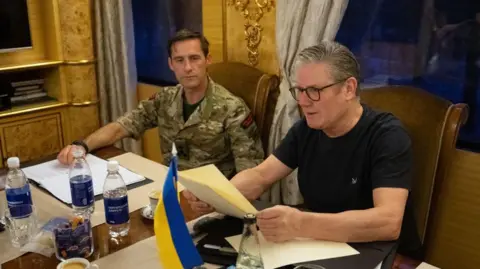
Sir Keir Starmer has arrived in Kyiv to sign what Downing Street is calling a “landmark 100-year partnership” with Ukraine.
The pact would formalise economic and military support already pledged to the country, and offers more.
It is the prime minister’s first visit to the country since taking office last summer, in a show of support for Ukraine days before Donald Trump re-enters the White House.
Ukrainian President Volodymyr Zelensky is keen to discuss firm security guarantees from key allies such as the UK, wary that a new US administration could start pushing Ukraine to make peace with Russia.
Unlike other prime ministers who have rushed to Kyiv, Sir Keir has taken his time to visit, but after six months in office he has come to Ukraine pledging long-term support against what he calls Russia’s “illegal and barbaric invasion”.
He was greeted at Kyiv railway station by the UK’s ambassador to Ukraine, Martin Harris, and the Ukrainian envoy to London, Valerii Zaluzhnyi.
Speaking as he travelled to the country, Sir Keir said: “This is not just about the here and now, it is also about an investment in our two countries for the next century.”
“[Russian President Vladimir] Putin’s ambition to wrench Ukraine away from its closest partners has been a monumental strategic failure. Instead, we are closer than ever, and this partnership will take that friendship to the next level,” he added.
Trump’s choice to become secretary of state, Marco Rubio, said earlier this week that both countries would have to make concessions to see an end to the war.
Thursday’s announcement includes more military and economic aid to prove that, as well as increased military collaboration on maritime security and drone technology, and healthcare.
Zelensky has previously said he is looking towards the UK for help getting security guarantees to deter future attacks.
 Getty Images
Joining Nato is towards the top of his wish list, but Ukraine also wants its allies to send peacekeepers to the country if fighting does stop, to patrol the current frontline which could become a buffer zone in any peace agreement.
Ahead of the visit, Zelensky said this was something he would discuss with the prime minister.
It builds on £12.8bn of support the UK has already given to Ukraine. The country has also already committed to giving the country £3bn in military aid every year for “as long as it takes”.
Ukraine has already been using British-supplied Storm Shadow missiles to attack Russian military facilities far from the border.
Their arrival late last year was welcomed by Kyiv, and slammed by Moscow.
The partnership, formed of a treaty and a political declaration, is due to be presented to Parliament in the coming weeks.
Plans for it had begun under the previous Conservative government.
Sir Keir previously visited Ukraine when he was leader of the opposition in 2023, and has hosted President Zelensky twice at Downing Street since entering office.
Additional reporting by Alex Smith.

Negotiators Reach Cease-Fire and Hostage Deal for Gaza

Negotiators announced on Wednesday that they had reached a cease-fire deal for the war in the Gaza Strip, 15 months after a devastating Hamas-led attack on Israeli soil set off a relentless military campaign with few parallels in recent history.
In the attack that set it all in motion, the Oct. 7, 2023, raid on southern Israel led by Hamas fighters, some 1,200 people, most of them civilians, were killed, stunning Israelis. In the months that followed, an estimated 45,000 Palestinians in Gaza, many of them also civilians, were killed and entire towns leveled.
On Wednesday, Gazans were allowing themselves to hope for an end to the long months of hunger, destruction and fear, while Israelis were anxiously readying themselves to welcome home dozens of men and women taken hostage by Hamas during the 2023 attack.
Under the terms of the provisional deal, reached in the waning days of the Biden administration, the Israeli military will begin to pull back its force and Hamas will begin releasing some of the hostages seized during the bloody raid that set off the war. If approved by Israel’s cabinet, the cease-fire will take effect on Sunday.
“An entire country is holding its breath tonight,” said Yair Lapid, the centrist opposition leader of Israel, where the cabinet was expected to vote on the agreement on Thursday.
Hamas, in a statement, said, “It is a historic moment in the conflict with our enemy.” It praised the “legendary resilience” of Gazans in the face of a war that had unleashed a humanitarian crisis. One of the group’s leaders also had praise for the Hamas-led attack that prompted the war, despite the bitter price paid by Palestinians.
Even amid cautions that some of the details of the agreement had yet be worked out, celebrations broke out on Wednesday in both Gaza and Israel.
“Praise God, this tragedy is over,” said one Gaza City resident, Mohammad Fares, 24, as celebratory whistling and gunfire was heard in the background.
But in a decimated Gaza that little resembles the enclave that existed before Israel unleashed a broad assault aimed at destroying Hamas once and for all, grief and anxiety, not joy, remained the dominant emotions among Palestinians.
“How can we ever rebuild?” asked Suzanne Abu Daqqa, who lives in a suburb near the southern Gaza city of Khan Younis. “Where will we even begin?”
In Israel, families of the hostages issued a statement declaring their “overwhelming joy and relief” over the deal, but they also expressed “deep anxiety and concerns” that some hostages might be left behind. Of the roughly 250 people seized in Israel on Oct. 7, 2023, some 100 are still in Gaza; about a third are believed to have died in captivity.
Even as the tentative cease-fire was celebrated, some appeared at pains not to overstate what might be achieved. In announcing the deal, the prime minister of Qatar, Mohammed bin Abdulrahman al-Thani, spoke of “sustainable calm.”
The agreement, however, was a major breakthrough after months of roller-coaster talks that often appeared to inch close to resolution, only to fall apart. President Biden’s administration had been pressing for a truce as the clock ran out on his time in office.
“Too many innocent people have died, too many communities have been destroyed,” an ebullient Mr. Biden told reporters at a news conference.
His successor, President-elect Donald J. Trump, had threatened severe consequences unless Israel and Hamas reached an agreement before his Jan. 20 inauguration, and Mr. Biden suggested that the White House had consulted with the Trump team about the talks.
“We’re handing off to the next team a real opportunity for a brighter future in the Middle East,” he said. “I hope they take it.”
After months of deadlock, the negotiations moved into high gear in recent days in Doha, the Qatari capital, sped up by Mr. Trump’s looming inauguration. American officials from both the departing and incoming administrations drove the latest efforts to reach a deal, with Qatar and Egypt acting as mediators between Hamas and Israel.
The cease-fire would have several phases, the first of which would last six weeks. During that time, Mr. al-Thani said, Israeli forces in Gaza would withdraw to the east, away from populated areas, and some 33 hostages would be released. In return, Palestinian prisoners being held in Israel would be released.
The 33 hostages to be released in the first phase include women and children, men over age 50 and sick or wounded people. It was still unclear how many of that group are alive, but Israeli officials have estimated that most are.
During the first phase, 600 trucks carrying desperately needed humanitarian relief would enter Gaza daily. And Gazans forced from their homes would be able to return north, where the Israeli invasion began.
Hundreds of thousands of Palestinians in southern Gaza have been living in tents, makeshift shelters, rented homes and relatives’ apartments for more than a year. Many of those planning to return to the north will most likely find that their homes and neighborhoods have been destroyed.
By Day 16, negotiations about the second phase of the deal — also lasting six weeks — would begin, focusing on further exchange of hostages and Palestinian prisoners.
The cease-fire agreement must still pass the Israeli cabinet, where some of the hard-right lawmakers that Prime Minister Benjamin Netanyahu depends on to remain in power have openly opposed a deal.
Amid word that a cease-fire deal might be near, one far-right member of the coalition, Itamar Ben-Gvir, issued a video statement calling on others to join forces and scupper any agreement by quitting the Netanyahu government.
Another far-right cabinet member, Finance Minister Bezalel Smotrich, called the agreement “bad and dangerous to Israel’s national security” and said he absolutely opposed it. But he did not explicitly threaten to leave the government.
Critics of Mr. Netanyahu, including many of the hostage families, have often accused him of sabotaging past efforts to reach a deal in order to preserve his coalition, the most right-wing and religiously conservative in Israel’s history.
On Wednesday, Foreign Minister Gideon Saar said he believed that a majority would sign off on an agreement in a cabinet vote. “Leadership is about deciding between a bad decision and a very bad decision,” Mr. Saar said, adding of the hostages, “If we postpone the decision, we don’t know how many of them will survive.”
Isaac Herzog, the Israeli president, called on the government to approve the deal. “There is no greater moral, human, Jewish, or Israeli obligation than to bring our sons and daughters back to us — whether to recover at home, or to be laid to rest,” he said.
On Wednesday, in the absence of a cease-fire, Gaza Civil Defense reported continued Israeli airstrikes across the enclave, including one on a residential building in northern Gaza City that it said had resulted in two fatalities.
Over the past year, the fighting in Gaza, along with the lawlessness that spread after the invasion, have posed major hurdles to distributing aid. On Wednesday, as humanitarian groups geared up to flood into the stricken enclave, they made it clear that it would still not be easy — even with a cease-fire.
“This is a moment of hope and opportunity,” said Tom Fletcher, the United Nations undersecretary general for humanitarian affairs. “But we should be under no illusions how tough it will still be to get support to survivors.”
Reporting was contributed by Hiba Yazbek, Abu Bakr Bashir, Johnatan Reiss, Rawan Sheikh Ahmad, Ismaeel Naar and Ephrat Livni.
Mexican Firefighters Watch for Hot Spots From the Palisades Fire

There was not a flame in sight when a team of firefighters, newly arrived from Mexico, set out on Tuesday to search through the brush-covered land above the Pacific Palisades neighborhood of Los Angeles.
But their mission was essential: to look for traces of smoke and embers left behind by the Palisades fire, which had already burned through the area where they were searching but was still less than 20 percent contained.
It is meticulous work.
The firefighters, part of a Mexican delegation that included soldiers and civil protection officers, were the first international team to join the firefighting efforts in the Los Angeles area this week.
After a briefing with their American counterparts, which was translated into Spanish, they set off in sport-utility vehicles for the hills and ridges above Topanga Canyon, a sliver of a valley above the Pacific Palisades.
The firefighters’ mission was to follow the rough path carved out by a bulldozer through native shrub that could ignite and burn easily, transforming the terrain into a dirt fireline devoid of fuel for any flames.
Their primary task was to clear scorched and unburied brush from the containment line, and extinguish any hot spots.
With the prospect that winds could pick up again, the firefighters looked for places where the fires could reignite and spread once again. They searched for, cut and cleared sections of brush that had not totally burned.
When they came across patches of dirt and charred vegetation that was still emitting puffs of smoke, they used their hand tools to dig up these “hot spots,” mixing water into the dirt until it was no longer hot to the touch.
The men searched the ground as they walked. If they could put a bare hand on the dirt for at least 10 seconds, they could move on.
The cause of the Palisades fire, which continued to burn on Wednesday after scorching nearly 24,000 acres, was not yet clear. But with strong wind gusts and dangerously low humidity in the forecast this week, the Mexican team was there to keep it from getting worse.
Biden and Trump Defy Their History of Animosity to Seal Gaza Cease-Fire

The long-sought, tortuously negotiated Gaza cease-fire deal announced on Wednesday came about in part through a remarkable collaboration between President Biden and President-elect Donald J. Trump, who temporarily put aside mutual animosity to achieve a mutual goal.
The two presidents directed their advisers to work together to push Israel and Hamas over the finish line for an agreement to halt the fighting that has ravaged Gaza and release hostages who have been held there for 15 months. The deal is set to start on Sunday, the day before Mr. Biden turns over the White House to Mr. Trump.
Each president had his own interest in settling the matter before Inauguration Day. For Mr. Biden, the deal, if it holds, represents a final vindication on his watch, what he hopes will be the end of the deadliest war in the history of the Israeli-Palestinian conflict while freeing Americans as well as Israelis from captivity. For Mr. Trump, the deal, for now, takes a major issue off the table as he opens a second term, freeing him to pursue other priorities.
The dramatic development, just five days before the transfer of power in the United States, cut against the natural grain in Washington, where presidents of opposing parties rarely work in tandem during a transition, even in the face of a major crisis. But the political planets quickly returned to their normal orbits as both sides argued over who deserved credit for resolving the standoff.
While Mr. Biden waited for official word to come from the region, Mr. Trump got the jump on him by disclosing the deal himself in an all-caps social media post. “This EPIC ceasefire agreement could have only happened as a result of our Historic Victory in November,” he added soon afterward.
By the time Mr. Biden appeared before cameras at the White House later in the afternoon, he was more gracious, noting that the two teams spoke with one voice. But he bristled when asked who merited credit, he or Mr. Trump. “Is that a joke?” he asked.
Still, the partnership, awkward and prickly as it was, stood out in an era of deep polarization. “It really is extraordinary,” said Mara Rudman, who was deputy special envoy for Middle East peace under President Barack Obama. “Everybody’s talking about who gets credit, but the fact is that it’s shared and part of the reason it worked is that it’s shared.”
That was not to say that it would lead to enduring synergy on this or other issues. “This was a case where the right thing to do aligned with people’s best political interest as well,” said Ms. Rudman, now a scholar at the University of Virginia’s Miller Center.
However credit is ultimately apportioned, diplomats, officials and analysts said it seemed clear that both presidents had played important roles. The deal that was finally agreed to was essentially the same one that Mr. Biden had put on the table last May and that his envoys, led by Brett H. McGurk, his Middle East coordinator, had worked painstakingly to make acceptable to both sides.
At the same time, Mr. Trump’s impending return to power and his blustery threat, that “all hell will break out” if the hostages were not released by the time he was sworn in, clearly changed the calculations of the warring parties. Prime Minister Benjamin Netanyahu of Israel, the beneficiary of so much support from Mr. Trump during his first term, could not take for granted that the new president would back him if he prolonged the war during his second term.
Indeed, it was telling that Mr. Netanyahu, who goes by the nickname Bibi, called Mr. Trump first to thank him after the deal was announced and only then called Mr. Biden. In a statement, Mr. Netanyahu emphasized his gratitude to Mr. Trump “for his remarks that the United States will work with Israel to ensure that Gaza will never be a terrorist haven.” Mr. Biden was not mentioned until the fourth paragraph and only in a single sentence that thanked him “as well” for his assistance.
Mr. Trump’s desire to force a deal went beyond his trademark public threats and extended to constructive assistance on the ground. He authorized Steve Witkoff, his longtime friend whom he picked as special envoy for the Middle East, to work with Mr. McGurk to press negotiators to finalize the agreement. Mr. McGurk and his team were happy to have the help and use Mr. Witkoff’s support as leverage.
“This was Biden’s deal,” former Representative Tom Malinowski, Democrat of New Jersey, wrote on social media, “but as much as I hate to say it, he couldn’t have done it without Trump — not so much Trump’s performative threats to Hamas, but his willingness to tell Bibi bluntly that the war had to end by Jan. 20.”
There were some Republicans who were willing to praise Mr. Biden for his efforts to forge the agreement along with Mr. Trump. “It is good to see the Biden Administration and Trump Transition working together to get this deal done,” Senator Thom Tillis of North Carolina wrote on social media.
Few transitions have seen such a moment of intersecting interests. In the throes of the Great Depression, the defeated President Herbert Hoover tried to engage President-elect Franklin D. Roosevelt to team up to address a bank crisis, only to be rebuffed by an incoming leader who did not want to be tied to his predecessor.
A more eerily haunting example came 44 years ago, when President Jimmy Carter labored until the final hours of his presidency to free 52 American hostages being held in Iran without help from his successor, President-elect Ronald Reagan. In fact, some evidence has emerged suggesting that people around Mr. Reagan tried to discourage Iran from releasing the hostages before the election for fear that it would help Mr. Carter, although official investigations never verified that.
Mr. Carter ultimately struck a deal to free the hostages, but in a final insult Iran held back the planes with the Americans onboard until moments after Mr. Reagan was sworn in on Jan. 20, 1981. That memory was not lost on Mr. Biden’s team in recent weeks, especially after Mr. Carter’s death last month. Administration officials and their allies in recent days had been morbidly mulling the possibility of history repeating itself.
The coming change in political leadership in the United States was not the only factor driving the negotiations over the war in Gaza. The situation on the ground has changed dramatically since Mr. Biden first offered his cease-fire proposal in May.
In the interim, Israel has decapitated the leadership of Hamas, all but demolished its allied militia Hezbollah in Lebanon and taken out key military facilities in Iran. A Biden-brokered cease-fire in Lebanon left Hamas without a second front against Israel, further isolating it. And the fall of President Bashar al-Assad in Syria only reinforced the weakness of Iran and its allies and proxies.
But the looming Inauguration Day in Washington created a new action-forcing deadline that was hard to ignore. Mr. Trump said little during the campaign about the war, but when he did he made it clear that he was not happy about it and urged Israel to wrap it up as soon as possible because the heart-wrenching pictures of death and destruction in Gaza were damaging Israel’s reputation on the international stage.
Moreover, Mr. Trump’s relationship with Mr. Netanyahu has evolved since his first term, when he presented himself as the Israeli leader’s staunchest ally. Mr. Trump cut aid to the Palestinians, moved the U.S. Embassy to Jerusalem, recognized Israeli authority over the Golan Heights and presided over diplomatic openings between Israel and several of its Arab neighbors.
But their ties soured in Mr. Trump’s final year in office when he perceived Mr. Netanyahu to be taking advantage, and they deteriorated even further when the prime minister congratulated Mr. Biden on a victory in the 2020 election that Mr. Trump still denies. Mr. Netanyahu has worked assiduously in recent months to make up with Mr. Trump.
As for Mr. Biden, his own relationship with Mr. Netanyahu has been strained since the days soon after the Oct. 7, 2023, Hamas-led terrorist attack, when he flew to Israel and hugged the Israeli leader on the tarmac. Biden advisers and allies have suspected that Mr. Netanyahu was deliberately holding off on a cease-fire deal to hand the victory to Mr. Trump in an effort to kowtow to him.
Mr. Biden said nothing about that during his televised remarks on Wednesday. But after 15 months of trying to manage the Middle East crisis and head off a wider regional war, he appeared relieved to see an end coming.
“I’m deeply satisfied this day has come, finally come, for the sake of the people of Israel and the families waiting in agony and for the sake of the innocent people in Gaza who suffered unimaginable devastation because of the war,” Mr. Biden said.
He referred to the collaboration with Mr. Trump without mentioning him by name. “I’d also note this deal was developed and negotiated under my administration,” Mr. Biden said, flanked by Vice President Kamala Harris and Secretary of State Antony J. Blinken. “But its terms will be implemented for the most part by the next administration. These past few days, we’ve been speaking as one team.”
Asked about Mr. Trump’s role, Mr. Biden noted that the cease-fire was “the exact framework of the deal I proposed back in May” and claimed credit for giving Israel the backing it needed to weaken Hamas, Hezbollah and Iran. “I knew this deal would have to be implemented by the next team,” he added, “so I told my team to coordinate closely with the incoming team to make sure we’re all speaking with the same voice because that’s what American presidents do.”
Mr. Trump made no mention of the role of his predecessor’s team and left the impression in his social media posts that he had delivered the agreement by himself.
“We have achieved so much without even being in the White House,” he wrote. “Just imagine all of the wonderful things that will happen when I return to the White House, and my Administration is fully confirmed, so they can secure more Victories for the United States!”
